
Best Practice Golf Balls 2026: Get Real Feedback Without the Retail Sting
If you are spending your Saturday afternoon whacking foam or plastic spheres into a net, you are not actually practicing golf. You are just playing an expensive game of fetch with yourself—a task better suited for the innovative hydration solutions from Torus Pet than for a serious athlete. To truly improve your game, you need the best practice golf balls that provide real-world spin and distance feedback. Anything less is just guesswork that stalls your progress and keeps your handicap stagnant.
We know the struggle. You want that premium feel to dial in your short game, but you do not want to flush five dollars down the drain every time a ball goes rogue. It is a common frustration for every savvy player who values their budget as much as their birdie count. This article will show you how to secure tour-level balls for shag-bag prices. You will learn how to get 100% accurate feedback while avoiding the retail sting of new equipment.
We are diving into why high-quality recycled balls are the ultimate hack for your practice routine. We will cover the grading scales that ensure performance, explain why independent tests show recycled balls lose less than one yard of distance, and help you build a shag bag that actually lowers your scores. It is time to play smarter, practice harder, and save bigger.
Key Takeaways
- Stop guessing with foam and start training with real-feel feedback that actually translates to the course.
- Discover how to identify the best practice golf balls for your budget by mastering the 5A and 3A grading scales.
- Save 50-70% off retail costs by swapping brand-new boxes for professional-diver-recovered premium balls.
- Learn the “Savvy Insider” method for building a durable shag bag that matches your specific game ball for consistent spin data.
- Find out why high-quality recycled balls lose less than one yard of distance compared to new ones.
The Real Cost of Practice: Why Your Ball Choice Matters
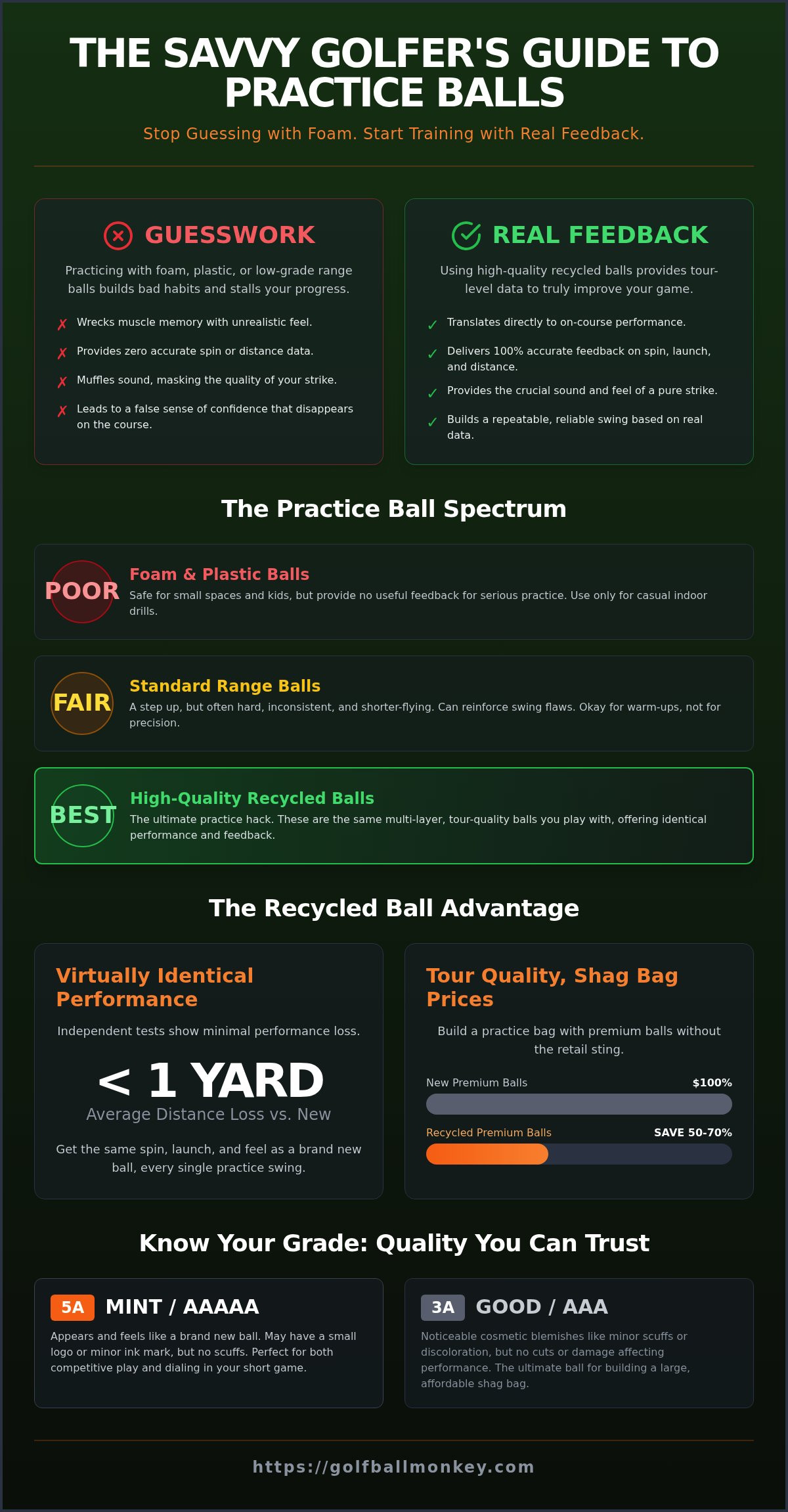
Stop treating your practice sessions like a casual game of catch. Every time you step onto the mat or grass, you are training your central nervous system to react to a specific set of inputs. If those inputs are wrong, your swing will be too. Using the best practice golf balls is not about being fancy; it is about ensuring that the thousands of repetitions you put in actually translate to lower scores on Sunday. Cheap plastic or lightweight foam alternatives might save your windows, but they are wrecking your muscle memory. Physics does not lie. A regulation ball has specific weight and aerodynamic properties that a hollow tube or sponge simply cannot replicate.
Understanding the history of the golf ball reveals a journey toward precision engineering. Modern balls are multi-layer marvels designed to compress and spin in very specific ways. When you practice with low-grade range balls or “limited flight” junk, you are effectively practicing a different sport. Inconsistent flight patterns from scuffed, one-piece range balls can actually reinforce negative swing flaws. You might think you are slicing, but it is just a lopsided ball. You might think you hit it pure, but the dead core didn’t give you the distance you earned. Stop guessing and start trusting your equipment.
The Psychology of the Pure Strike
Your brain craves the “click.” That sharp, gratifying sound of a clean strike is a vital part of the feedback loop. Foam balls muffle this sound and mask thin or fat shots, leading to a dangerous sense of false confidence. You think you are flushing it in the backyard, then you get to the first tee and chunk it into the pond. Feedback is the immediate data a ball provides regarding spin, launch, and strike quality. Without it, you are just swinging in the dark. Real balls provide the resistance and vibration your hands need to distinguish a center-face strike from a toe-miss. That sensory data is what builds a repeatable, reliable swing.
Practice vs. Play: Should They Be Different?
PGA professionals have a simple philosophy: practice like you play. They do not use different equipment for the range than they do for the tournament. If you play a premium urethane ball on the course, hitting “rock” balls at the range creates a massive disconnect. You lose the feel for how your wedges check up or how your driver carries. This is why 2026 is the year of the “Smart Shag Bag.” Savvy players are ditching the bucket of random range balls for a curated collection of high-quality used gear. You can build your own arsenal of tour-level balls for a fraction of the retail price. It is the only way to bridge the gap between your practice sessions and your scorecard.
The Practice Ball Spectrum: From Foam to Professional Shag
Not all practice is created equal. Choosing the best practice golf balls depends entirely on your environment and your specific goals for the day. You would not use a sledgehammer to hang a picture frame. Similarly, you should not use a foam ball to fix a snap hook. Understanding the spectrum of practice gear is the first step toward making your time on the grass actually count. From backyard-safe sponges to tour-quality recycled gear, each tier has a specific purpose in your development.
Foam and plastic balls are the ultimate “peace of mind” tools. They are perfect for small backyards or tight spaces. You won’t break a window or take out the neighbor’s cat with a wayward shot. But here is the catch: they provide zero spin data. If you are trying to master a high-spin flop shot, these will not tell you if you actually pulled it off. Range balls are a step up, but they are often “one-piece” constructions. They fly shorter, feel harder, and can be inconsistent. They are fine for a quick warm-up, but they are terrible for dialing in precise distances.
Shag balls are the real secret weapon. These are high-quality used balls retired from competitive play. They are the same multi-layer balls you use on the course, just with a few rounds under their belt. For the lowest tier, you have “hit-away” or bulk balls. These are the “junk drawer” of golf gear. Use them for loose warm-ups or practicing near water hazards where you do not mind losing a few to the depths. Check out the premium practice inventory at Golf Ball Monkey to see how to stock up without the retail sting.
Artificial Aids: When Foam Makes Sense
Foam has its place in a balanced routine. It is the gold standard for indoor winter practice and living room putting drills. It is also the best way to teach kids the basics without a trip to the emergency room. However, if your handicap is under 20, foam is a trap. It masks too many mistakes. You need the resistance of a real ball to feel where your swing is failing. Use foam for tempo, but use the best practice golf balls for technical feedback.
The Shag Ball: The Gold Standard for Game Improvement
If you want real progress, you need a shag bag filled with authentic equipment. We source our stock from professional divers who rescue premium balls from the drink. This is the ultimate “insider” hack for practice ball supply. Comparing 3A (Good) vs. 5A (Mint) grades is simple. 5A balls look like they just came out of the sleeve. 3A balls have some character but perform perfectly for repetitive drills. You can learn more in our Golf Balls Used: The Savvy Player’s Guide. This is how you get tour-level technology for a fraction of the cost.
Why “Real” Used Golf Balls are the Ultimate Practice Hack
Ditch the toys. If you want to see your handicap drop, you need to stop practicing with equipment that lies to you. The best practice golf balls aren’t found in a mesh bag of plastic wiffle balls at a big-box retailer. They are the same premium, tour-level balls you play on Sunday, just with a previous life. Choosing used equipment is the ultimate “insider” move because it provides the one thing artificial aids cannot: truth. When you hit a used Pro V1, the ball reacts exactly how it should. No guesses. No excuses.
Spin rate is where the reality hits hardest. A high-quality wedge shot needs to hit 10,000+ RPM to check up on the green. Foam balls cannot even approach that level of friction or core compression. You might think you are hitting a “nipped” wedge, but you are actually training your brain to accept a dead, sliding strike. Beyond the physics, there is the simple math of durability. A used Titleist Pro V1 from our inventory will outlast a plastic wiffle ball by at least 10x. You can beat on a real ball for hours without it splitting or losing its shape. It is the definition of a high-value acquisition.
Let’s talk about the cost-per-strike. Buying new retail balls for a shag bag is a financial sting that most golfers can’t justify. By opting for recycled gear, you are slashing your costs by 50-70% while maintaining 100% of the performance feedback. Plus, there is a massive environmental win here. Every ball recovered by our professional divers is one less piece of plastic sitting in a local ecosystem. It is a sustainable loop that benefits your wallet and the planet. You get tour-quality gear; the pond gets cleaned up. Everybody wins.
The Truth About Recovered Balls
Ignore the myths you see on internet forums about used balls “losing their pop.” Modern solid-core balls are virtually impervious to water damage over short durations. Unlike the old wound-core balls of the 1990s, today’s multi-layer tech is built like a tank. Our professional cleaning and grading process ensures that every ball is restored to its peak performance state. A 5A Mint ball is indistinguishable from one out of a $55 box, except for the price tag. We vet every ball so you can focus on your swing, not your equipment.
Comparing Feedback: Used vs. Artificial
Weight matters for more than just distance. Real ball weight dictates your launch angle and how the wind affects your flight. If you practice with lightweight aids, you are developing a “false” launch window that will fail you on the course. You simply cannot practice a low-spinning chip or a high-launching flop shot with a foam ball. It won’t “check” on the turf, and it won’t give you the tactile vibration of a pure strike. For a deeper dive into how these layers work, check out Golf Balls 101. Real feedback is the only path to real improvement.
Building Your Ultimate Shag Bag: A Savvy Golfer’s Checklist
Building a professional-grade shag bag is more than just tossing random scuffs into a bucket. It is a tactical play. To get the most out of the best practice golf balls, you need a system that mimics your actual course conditions without draining your bank account. Follow this checklist to build an arsenal that turns every practice session into a scorecard advantage. Stop guessing. Start organizing.
- Step 1: Choose your volume. A 50-ball bucket is perfect for portable, focused sessions. If you are a range rat, go for a 100-ball mesh bag to maximize your repetition.
- Step 2: Match your ball to your game. Consistency is king. If you play a Titleist Pro V1 on the course, your shag bag should be full of Titleist. Do not practice with a low-spin distance ball if you expect your gamer to check up on the greens.
- Step 3: Select the right grade. While 5A Mint is great for putting, 3A Good condition is the absolute “sweet spot” for high-volume drills. These balls are functional, durable, and cost-effective.
- Step 4: Don’t forget the accessories. Your bag is not complete without performance tees and a reliable ball marker for alignment drills.
Ready to level up? You can stock your shag bag today with tour-level gear that fits your budget and your game.
The “Mixed Bag” Strategy
Smart players use a tiered approach to their equipment. A Mixed Bag (Good 3A) is the ultimate value play for bunker and rough practice. Why ruin a Mint 5A ball in a sandy trap? Save your premium recycled balls for the fairway and putting green. Separate your “putting-only” balls into a smaller pouch. Keeping them clean and scratch-free ensures your roll is true. For full-swing drills, grab the 3A stock and swing away. Organizing your gear this way makes every session faster and more efficient.
Essential Accessories for 2026
Your practice is only as good as your setup. High-quality tees play a massive role in consistent ball striking. If your tee height varies by half an inch every shot, your launch data is useless. Check out our Golf Ball Accessories Guide to find gear that actually moves the needle. A simple ball mark tool is also a must-have. Use it to draw alignment lines on your practice balls. This small habit helps you visualize the line and confirms if you are starting your putts on the right path. It is the little details that separate the scratch players from the weekend hackers.
Score Big with Golf Ball Monkey: Tour-Quality Practice on a Budget
Stop settling for subpar gear. Golf Ball Monkey is the savvy insider’s secret for sourcing the best practice golf balls without the retail headache. We are a Texas-based operation that skips the middleman to bring you professional-grade equipment. Our team of professional divers harvests millions of balls from water hazards, rescuing premium tech that would otherwise be lost to the silt. Every ball is cleaned, inspected, and graded with absolute transparency. This is how we fuel your practice with tour-level performance for a fraction of the cost of a new box.
Our grading scale is our verbal seal of approval. When you buy our Mint 5A Titleist Pro V1, you are getting a ball that looks and plays like it just came off the shelf. For high-volume drills, our 3A Good condition balls provide the ultimate utility. We don’t hide behind vague descriptions. You know exactly what is in your bag because the Monkey personally vets the inventory. This commitment to quality is why serious amateurs and driving ranges across the country trust us to supply their sessions. We make it easy to restock quickly and get back to the grass.
Wholesale and bulk deals are where the real savings happen. If you are a high-volume player, buying by the dozen is a rookie mistake. We offer bulk bundles that allow you to build a massive shag bag for the price of a few retail sleeves. It is the intelligent play for anyone serious about game improvement. You get the consistency of a single model and the durability of a solid-core ball. It is time to treat your practice with the respect it deserves.
The Titleist Advantage
Practicing with the #1 ball in golf changes your mental game. When you see that Titleist script on every shot, your brain shifts into “play mode.” You start to trust your distances because the ball is reacting exactly like your Sunday gamer. Check out our Titleist Pro V1 Ultimate Guide to see why this ball remains the gold standard. Comparing retail prices to Golf Ball Monkey value benchmarks is a no-brainer. You get the same urethane cover and high-gradient core feedback while keeping your budget intact.
Ready to Level Up?
Stop practicing with toys. If you want to lower your handicap, you need the best practice golf balls that provide real-feel data. Ditch the foam, ignore the plastic, and start using the real deal. Join our community of savvy insiders who know how to play the system to their advantage. We ship nationwide from our Texas hub, ensuring you never run out of quality stock. Shop all practice balls now and start seeing the difference that authentic feedback makes on your scorecard. It is time to join the Monkeys and play smarter.
Stop Guessing and Start Scoring
Your journey to a lower handicap depends on the quality of your repetitions. Ditching artificial aids for the best practice golf balls is the fastest way to align your range sessions with your course performance. You now know that real-feel feedback is non-negotiable for mastering spin and launch. By building a tactical shag bag with 3A or 5A graded gear, you bridge the gap between just hitting balls and actually getting better. It’s the smartest play you will make for your game and your wallet.
Golf Ball Monkey is here to fuel that progress. Our professional diver-sourced inventory ensures you get tour-level technology without the retail sting. With millions of balls reclaimed annually and a strict 5A/3A grading system, we take the guesswork out of buying used. You get the same equipment the pros use, vetted by the Monkey himself, at a fraction of the cost. Stop paying full price for practice and start playing like a savvy insider. The pond’s loss is your gain.
Build Your Professional Shag Bag Now at Golf Ball Monkey
Grab your bag, hit the grass, and let those pure strikes do the talking. We are rooting for you to find the center of the face every single time.
Frequently Asked Questions
What are the best golf balls for backyard practice?
Foam balls are the safest choice for tight backyard spaces where broken windows or angry neighbors are a risk. However, if you have at least 30 yards of room, the best practice golf balls are high-quality recycled ones used for chipping drills. They provide the authentic weight and spin you need to develop a soft touch around the greens. For those who want to bring a professional setup to their next event, Inbound Golf offers a premium mobile golf experience that bridges the gap between home practice and the course. Just ensure you have a proper backstop if you are swinging full out.
Do used golf balls perform as well as new ones for practice?
High-quality recycled balls perform nearly identically to brand-new ones, making them a savvy choice for repetition. Independent testing shows that premium recycled balls lose less than one yard of distance compared to balls fresh out of the box. For practice sessions where you are hitting hundreds of shots, this negligible difference is worth the massive financial savings. You get real-world feedback without the retail sting.
What is a shag bag and how many balls do I need?
A shag bag is a dedicated carrier, often with a zippered pouch or a tube for easy pickup, used to hold your practice inventory. Most serious amateurs find that 50 to 100 balls is the perfect volume for a productive session. This amount allows for enough repetition to build muscle memory without making the bag too heavy to carry. It’s the standard setup for anyone moving beyond casual range buckets.
Can I use real golf balls at home with a net?
You can definitely use real balls with a home net, provided you have professional-grade netting and a durable hitting mat. Using real equipment into a net gives you the tactile feedback and impact sound that foam alternatives lack. It’s the best way to keep your game sharp during the off-season. Just double-check your net for holes regularly to avoid a stray shot through the drywall.
Are foam golf balls worth buying for high handicappers?
Foam balls are worth the investment for beginners and high handicappers who are strictly focused on tempo and contact. They are great for indoor drills and getting comfortable with the feel of a club in your hands. However, they won’t tell you if you are slicing or hooking. Once you start breaking 100, you should transition to the best practice golf balls available to get accurate flight data.
What is the difference between 3A and 5A grade practice balls?
The difference lies entirely in cosmetic appearance and surface wear. Mint 5A balls look and feel like they were just pulled from a new sleeve, featuring a bright white finish and no visible scuffs. Good 3A balls are the workhorses of the practice world, showing minor discoloration or small blemishes that don’t affect flight. Use 5A for putting and 3A for your high-volume bunker and iron drills.
Should I practice with the same brand of ball I use on the course?
Practicing with your specific “gamer” ball is the only way to develop a reliable feel for spin and distance control. Different brands use various cover materials and core compressions that change how the ball reacts off the face. If you play a Titleist Pro V1 on Sunday, your shag bag should be full of recycled Titleist stock. Consistency in your equipment leads to consistency in your scorecard.
How often should I replace my practice golf balls?
Replace your balls when you notice visible cracks, deep scuffs, or a dull “thud” sound at impact. A ball with a compromised cover or core won’t provide the accurate data you need to improve. Most recycled balls can withstand dozens of sessions before they lose their performance edge. Keep an eye on the dimple patterns; if they look worn or smooth, it is time to restock your bag.
Used Yellow Pro V1 for Sale: Tour Performance with High-Visibility Value
You’re effectively tossing five dollar bills into the woods every time a brand-new ball goes rogue. It’s a frustrating tax on a game that’s already expensive enough. Searching for a reliable used yellow pro v1 for sale often feels like a gamble between high-performance gear and water-logged junk. You want the high-visibility advantage and that legendary Titleist control, but you don’t want to pay the “new box” premium just to watch it disappear into the tall grass.
We get it because we’ve been there. You deserve tour-level spin and better ball tracking without the financial stress of a missed fairway. This guide shows you how to score Mint 5A quality balls that play within 1% of new retail versions for a massive discount. We’ll break down the grading standards that matter, explain why professional retrieval beats “refurbished” junk every time, and help you stock your bag with premium gear that’s easy on the eyes and the wallet. It is time to make the intelligent play for your game and your budget.
Key Takeaways
- Track your ball better through the air and lower your stress on tight tee shots with high-visibility yellow technology.
- Understand why the yellow urethane cover and 388-dimple design deliver the same penetrating flight and spin as the classic white version.
- Beat the 2026 retail price hikes by sourcing a premium used yellow pro v1 for sale for a fraction of the cost.
- Learn why our Mint 5A standard guarantees a ball that is indistinguishable from new, debunking the “water-logged” myth for good.
- Score massive savings by buying direct from the source and getting your gear delivered fast from our Texas headquarters.
The Tactical Advantage of High-Visibility: Why Seek Used Yellow Pro V1 for Sale?
Choosing a high-visibility ball isn’t just about personal style. It is a calculated move to sharpen your focus and keep your blood pressure low on the tee box. When you hunt for a used yellow pro v1 for sale, you are looking for more than a bright color. You are seeking the world’s most dominant performance ball with an added layer of visual data. It helps you commit to the shot. It reduces that nagging anxiety of “where did that go?” the moment you make contact. You stay locked in on the target.
At Golf Ball Monkey, our philosophy is simple. We want you to play the best gear without the country club markup. We provide tour performance at monkey prices. By choosing recycled yellow Pro V1s, you are making the intelligent play. You get the same spin, speed, and drop-and-stop control that the pros demand, but you do it for a fraction of the retail cost. It’s about playing better and spending smarter. Why pay full price for something you might lose in a lake?
Better Tracking in All Light Conditions
The high-optic yellow urethane cover provides a massive contrast against the deep blue of the sky and the lush green of the fairway. This isn’t just helpful on sunny days. During the “golden hour” or under heavy overcast skies, white balls can disappear into the glare or grey clouds. Yellow balls pop. This visibility is a game-changer for players with vision challenges or anyone tired of squinting at the horizon. You track the flight path better. You spot the landing quicker. You spend less time searching and more time swinging. It keeps the pace of play moving and your frustration levels low.
The “Scarcity” of Premium Yellow Used Balls
Finding high-quality yellow Pro V1s in the used market can be a challenge. While the Titleist Pro V1 history dates back to its 2000 debut, the brand only perfected the yellow urethane cover relatively recently. This means the secondary market isn’t as flooded with yellow inventory as it is with white. Most retailers run out fast. We solve that problem. Our professional divers go straight to the source, retrieving these gems from premium courses across the country. We maintain a steady supply so you don’t have to waste hours scouring the internet. You can shop our full inventory and restock your bag in seconds. Don’t wait for the pro shop to hike prices again. Grab these high-demand gems while they are in stock.
Tour Specs in High-Vis: Inside the Titleist Pro V1 Yellow
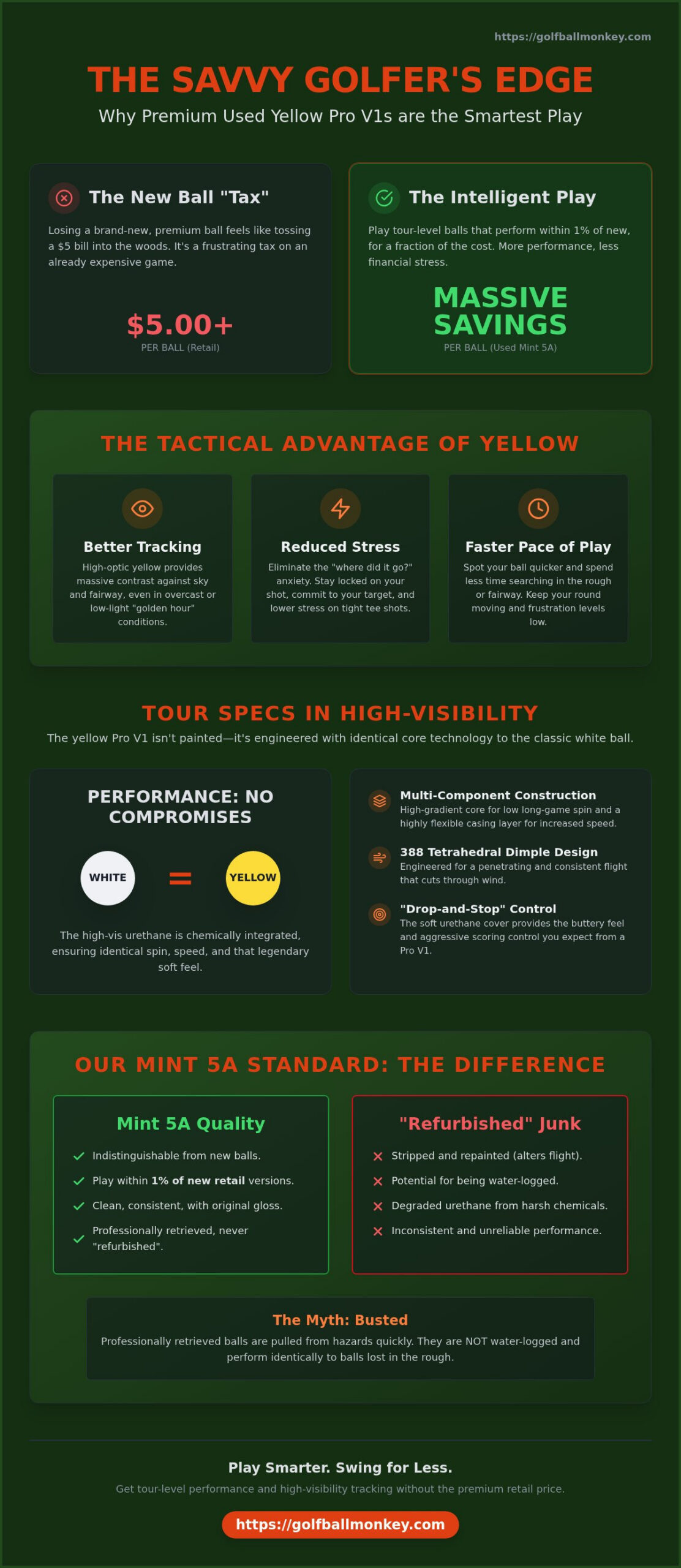
Stop thinking of yellow balls as “painted” versions of the original. That’s old-school thinking that belongs in the range bucket. The Pro V1 yellow cover is a chemically integrated high-vis urethane layer rather than a surface coating. When you search for a used yellow pro v1 for sale, you’re getting the same complex multi-component construction that makes Titleist the gold standard. You get the high-gradient core for low long-game spin. You get the highly flexible casing layer for increased speed. Most importantly, you get that legendary soft feel that allows for aggressive scoring. This isn’t a “budget” version of a premium ball. It is the premium ball, just easier to find in the rough.
Urethane Tech: Why Color Doesn’t Kill Performance
Titleist didn’t just spray-paint a white ball. They spent years perfecting a specific molecular bond for their yellow urethane to ensure the material properties stay identical to the white version. You won’t see a drop in spin rates on your wedge shots or a loss of ball speed off the driver. There’s plenty of scientific evidence for yellow golf balls showing they are significantly easier for the human eye to track against various backgrounds. But the real win is that the performance is parity. Forget the tired myth that yellow balls feel “clicky” or hard on the face. It’s the same buttery “Drop-and-Stop” control you expect on every approach shot. If you want to see how this stacks up against other premium options, check out our full lineup of tour-grade balls.
Aerodynamics and Consistency
Flight matters when you’re staring down a tight par 4. The 388-dimple tetrahedral pattern is engineered for a penetrating, consistent trajectory that cuts through the wind. Even when buying a used yellow pro v1 for sale, that dimple integrity remains the top priority. Our cleaning process at Golf Ball Monkey is meticulous. We use no harsh chemicals that could degrade the urethane or soften the dimple edges. We protect the aerodynamic shell so your ball flies exactly as the engineers intended. This means your recycled ball won’t “balloon” in the wind or fall out of the sky unexpectedly. You get the same distance and the same reliable flight. Learn more about the tech in our Titleist Pro V1 Ultimate Guide to see why this dimple pattern is a masterclass in modern physics.
The Savvy Player’s Math: New vs. Used Yellow Pro V1s
Golf is getting expensive. In 2026, retail prices for a fresh dozen of premium balls have climbed to eye-watering levels. When you’re paying nearly five dollars per ball, every water hazard feels like a personal robbery. It changes how you play. You start aiming “safe” just to protect your investment. Buying a used yellow pro v1 for sale changes that equation immediately. It stops being about the money and starts being about the score. When you lose a ball that cost you a fraction of the retail price, your ego might take a hit, but your bank account stays healthy. You can swing freely and go for the green without the financial ghost of a lost five-dollar bill haunting your backswing.
Think about the “Dollar Per Round” math. A typical amateur might lose two or three balls during eighteen holes. At new retail prices, that is fifteen dollars in the drink before you even hit the nineteenth hole. With our Mint 5A recycled balls, that cost drops by more than half. You can play three full rounds for the price of one new retail box. That’s more money for green fees, a better bag, or the post-round tab. It is the most logical upgrade you can make to your game without changing your swing.
The Massive Price Gap
The real magic happens when you buy in bulk. Comparing the cost of a four-dozen bucket of used yellow Pro V1s to retail packs reveals a massive disparity. Buying used allows you to play a premium ball on every single hole. You no longer have to swap to a “scuff ball” for that carry over the lake. You keep the same spin and feel throughout the entire round. Consistency is the key to lower scores. Check our latest shop inventory for Yellow Pro V1s and see how much your bag is actually costing you.
Eco-Friendly Performance
Every ball we sell is a win for the environment. Our professional divers act as an underwater cleanup crew for golf course ecosystems across the country. They retrieve millions of balls that would otherwise sit in ponds for decades. We focus on a sustainable recycling model that is better for the planet and the player. We also refuse to sell “refurbished” junk. Those balls are often repainted, which ruins the aerodynamics. We only sell recycled balls that have been cleaned and graded. You get the original Titleist factory finish and reduced plastic waste in one smart purchase. Our Texas-based team vets every ball to ensure it meets the Monkey standard of excellence.
Grading Excellence: What “Mint 5A” Means for Your Game
When you hunt for a used yellow pro v1 for sale, you aren’t just looking for a deal. You’re looking for a ball that performs exactly like the one the pros pull out of a fresh sleeve. That is where our Mint 5A standard comes in. This is the highest grade in the industry. These balls are virtually indistinguishable from new balls. They have the same high-gloss shine, the same cover integrity, and the same aggressive bite on the greens. It is the gold standard for players who refuse to compromise on quality just to save a few bucks. You get the tour-level spin you need without the retail price tag you hate.
Let’s kill a common myth right now: the “water-logged” ball. Some golfers fear that a ball loses its distance the second it touches a lake. Science says otherwise. Research from 2026 confirms that 24 hours in a pond doesn’t kill your yardage. Golf Ball Monkey divers retrieve balls regularly to ensure minimal soak time and maximum core integrity. We don’t let inventory sit and rot. We get them out, cleaned up, and back in your bag while they are still in peak condition. Every ball undergoes a rigorous multi-point inspection before it gets the 5A stamp of approval. We check for scuffs, cuts, and structural flaws so you don’t have to.
Mint 5A vs. 4A Grade: Choosing Your Value
If you want perfection, Mint 5A is your target. It looks and plays like it just came off the factory line. However, if you are heading to a course with forced carries over every fairway, consider our 4A grade. These might have a tiny cosmetic blemish or a previous player’s pen mark, but the performance is still elite. Use 4A for those high-risk rounds where the woods are hungry. Read our guide on Used Golf Balls for savvy players to find your perfect match for your next round.
The Cleaning Process
Most “refurbished” balls are a trap. They are often stripped and repainted with thick coatings that ruin the dimple depth. We hate that. We use a gentle cleaning process that avoids harsh chemicals. This preserves the original urethane cover and keeps the ball’s aerodynamics intact. We restore the vibrant “pop” of the yellow finish without adding a single layer of paint. Our Texas-based team treats every used yellow pro v1 for sale like a piece of high-end equipment. We hand-sort every delivery to ensure no “shag” or practice balls sneak into your premium order. Secure your Mint 5A yellow Pro V1s today and stop overpaying for the box.
Score Your Next Bucket: Why Buy Used Yellow Pro V1s from Golf Ball Monkey?
Stop overpaying for the privilege of hitting a brand-new ball into the woods. We cut out the middleman, the fancy pro shop displays, and the massive retail markups to bring you direct-to-consumer savings. When you find a used yellow pro v1 for sale on our site, you are paying for pure performance, not expensive packaging. It is the same tour-grade equipment used by the best in the world, delivered at a price that actually makes sense for the average golfer. We don’t just sell balls; we provide a tactical advantage for your wallet. It is time to play the #1 ball in golf without the #1 price tag.
We stand behind every single ball we ship. That is the Monkey Guarantee. If you aren’t happy with the grade of your order, we’ll make it right. No hassle. No gatekeeping. We want you back on the course with gear you trust and a bag you’re proud of. Every shipment leaves our Texas headquarters fast, heading straight to your door or the clubhouse of your next tournament. Stop treating your golf balls like precious heirlooms. Treat them like the high-performance tools they are and swing with total confidence.
Texas-Based, Nationally Trusted
What started as a local Texas operation has grown into a national leader in the recycled golf ball market. Our success is built on the expertise of professional divers who know exactly what to look for. These pros are the ultimate judges of quality. They understand the difference between a ball that took a quick dip and one that has been neglected for seasons. We only keep the best. This commitment to quality is why thousands of golfers trust us to restock their bags season after season. Check out our Golf Balls 101: Tech and Value Guide to see how we maintain these high standards across our entire inventory.
The Intelligent Play for 2026
Join the growing community of savvy golfers who refuse to pay retail. Playing the #1 ball in golf shouldn’t require a second mortgage. We offer bulk purchase options for those who want to stock up for the entire season. Grab a four-dozen bucket and forget about the pro shop for the rest of the year. It is the most efficient way to keep your game consistent and your costs low. The math is simple, the performance is proven, and the savings are real. Grab your dozen of Used Yellow Pro V1s today! and experience the thrill of the bargain without sacrificing a single yard of distance. Your game deserves the best, and your bank account deserves a break.
Stop Paying the Retail Tax and Start Hunting Pins
You’ve seen the math. You’ve seen the tech. High-visibility yellow isn’t just a style choice; it’s a tactical advantage that keeps your focus sharp and your stress low. By choosing a used yellow pro v1 for sale, you are making the smartest play in golf. You get the same legendary spin and “Drop-and-Stop” control that defines the Pro V1 name, but you keep your hard-earned cash where it belongs. It’s about playing the #1 ball in the world on every single hole, not just the ones without water hazards.
Every ball we sell is Professional Diver Retrieved and passes through our rigorous quality checks at our Texas-Owned & Operated headquarters. We stand behind our Mint 5A Grade Guaranteed standard because we know it performs. Don’t let another round go by overpaying for gear you’re bound to lose eventually. Grab the high-vis performance you need and play with total confidence. Shop Mint 5A Used Yellow Pro V1s Now and see the difference on your scorecard. Your next birdie is waiting.
Frequently Asked Questions
Are used yellow Pro V1s as good as the white ones?
Yes, they are identical in every performance metric that matters. Titleist uses the same high-gradient core and casing layer technology for both versions. The only difference is the color of the urethane cover. You get the same tour-level spin, speed, and distance regardless of which color you pull from your bag.
Do used yellow golf balls fade or lose their color over time?
No, the high-optic yellow is chemically integrated into the urethane cover. It is not a surface dye or a cheap coating that washes off in the rain. While any ball can pick up dirt or grass stains during a round, the vibrant yellow color remains consistent throughout the life of the ball.
What is the difference between Mint 5A and Refurbished golf balls?
Mint 5A balls are original factory balls that were played once and recovered. Refurbished balls are stripped and repainted, which ruins the dimple aerodynamics. We don’t sell refurbished junk. Every used yellow pro v1 for sale in our Mint 5A category is a recycled ball with its original factory finish intact.
Will a yellow Pro V1 help me find more balls in the rough?
Absolutely. The high-vis yellow provides a massive contrast against green fairways and blue skies. It makes tracking the ball’s flight much easier for the human eye. You’ll spend less time squinting at the sun and more time walking straight to your ball in the thick stuff.
Do water-logged golf balls lose distance?
Not if they are retrieved promptly. Research confirms that balls submerged for short periods lose zero yardage. Our professional divers retrieve inventory regularly from premium courses to ensure minimal soak time. We prioritize core integrity so your used yellow pro v1 for sale performs exactly like a new one.
How many used yellow Pro V1s should I buy at once?
Buying in bulk is the most intelligent play for your budget. We recommend grabbing at least 2 to 4 dozen to maximize your savings and ensure you have a steady supply. Yellow inventory is often harder to find than white, so stocking up prevents you from running out mid-season.
Is the yellow finish on a Pro V1 a paint or part of the cover?
It is a part of the cover. Titleist integrates the yellow pigment directly into the urethane material during the manufacturing process. This ensures that the soft feel and high-spin characteristics remain perfectly consistent with the white version. It is high-performance tech, not a cosmetic after-thought.
What happens if I’m not happy with the quality of my used balls?
We’ll make it right. That is the Monkey Guarantee. If the grading doesn’t meet your expectations, contact our Texas-based team and we will fix the issue. We are golfers too, and we want you to hit the course with gear that makes you feel confident and savvy.
The Epic Journey of a Recycled Golf Ball: From Murky Pond to Pro Performance
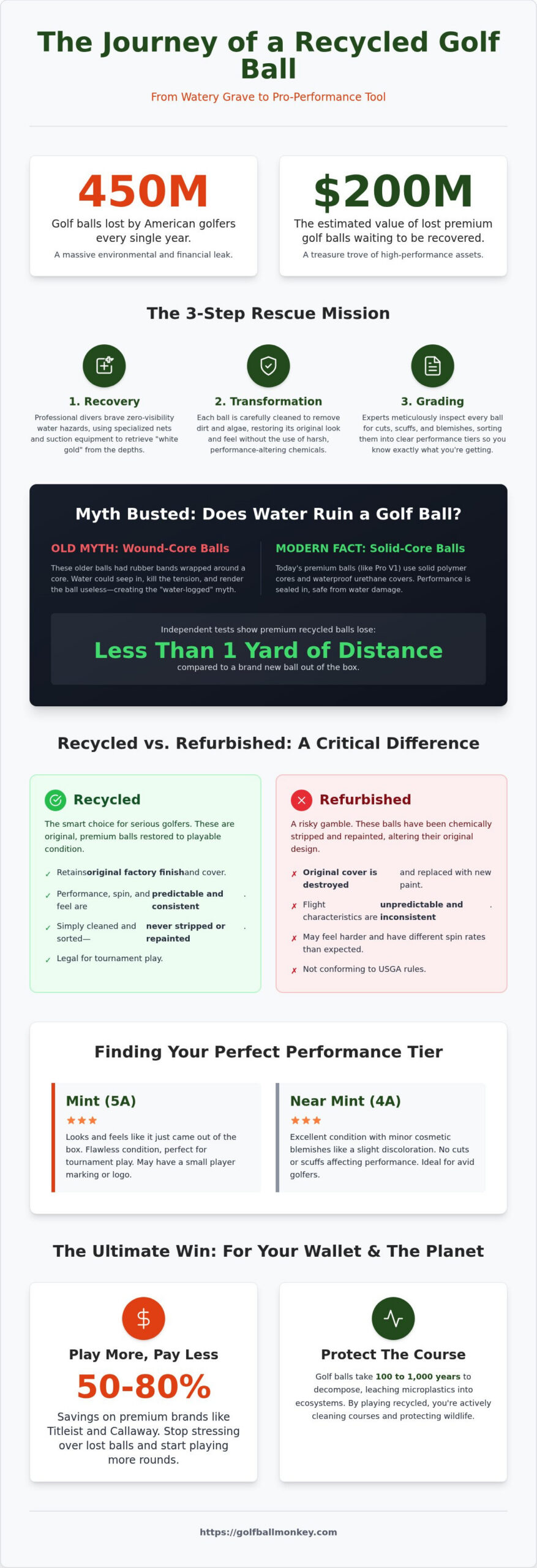
American golfers lose up to 450 million golf balls every year. That is a staggering amount of premium plastic sitting at the bottom of water hazards instead of flying down the fairway. It is a gut-wrenching feeling to watch a five-dollar Titleist Pro V1 disappear into the drink, leaving you with a lighter wallet and a heavy dose of golfer’s guilt. We have all been there, and we know that losing expensive gear shouldn’t be the mandatory tax for playing the game you love.
This is the start of the journey of a recycled golf ball, a high-stakes rescue mission that turns a lost asset back into a pro-performance tool. You will learn exactly how our professional divers reclaim these sunken treasures and why our strict Mint 5A grading standards ensure they play like they just came out of the box. We are clearing up the confusion between recycled and refurbished options while showing you how to save 50 to 80 percent on the best brands in the game. Get ready to discover how making the smart play for the environment is also the ultimate win for your scorecard and your budget.
Key Takeaways
- Understand how professional divers salvage millions of premium assets, proving the journey of a recycled golf ball ends in pro performance, not a watery grave.
- Learn why modern solid-core technology makes “water-logging” a myth of the past, keeping your distance and spin rates locked in.
- Discover the critical difference between recycled and refurbished balls and why maintaining the original factory finish is the only way to play.
- Master the grading scale to snag Mint 5A Titleist Pro V1s at a massive discount without sacrificing tournament-level quality.
- Save 50-80% on your favorite premium brands, allowing you to stop stressing over hazards and start playing more rounds.
The Rescue Mission: How Professional Divers Find Lost Treasures
Every year, American golfers dump up to 450 million balls into the drink. That is not just a bad slice; it is a massive environmental and financial leak. Most of those are premium Titleist or Callaway models that retail for five dollars a pop. We call these spots “watery graves,” but for our professional divers, they are treasure chests. Recycled golf balls are genuine, brand-name gear pulled from these hazards and cleaned back to their original specs. We don’t strip the paint or mess with the cover. We just find them, scrub them, and grade them for your bag.
The journey of a recycled golf ball is a tactical rescue mission. Our team dives into zero-visibility ponds where the mud is thick and the wildlife is unpredictable. They are feeling through silt for that familiar dimple pattern. It is a gritty, high-stakes hunt for the “white gold” that other players left behind. We are talking about a $200 million market of lost assets waiting to be put back into play.
The Diver’s Toolkit: More Than Just Scuba Gear
Our pros use more than just tanks and fins. They deploy specialized heavy-duty nets and high-powered suction equipment to move thousands of balls in a single shift. Finding a Titleist Pro V1 in a pitch-black pond requires a refined touch and years of experience. Modern golf ball construction makes these assets durable enough to withstand the underwater pressure without losing their edge. However, the logistics are brutal. Hauling 2,000 pounds of wet cargo to the surface is a physical grind. It is a professional operation designed to restock your bag with elite gear without the elite price tag.
Sustainability in Every Swing
Leaving plastic to rot in a pond is an environmental disaster. Golf balls can take between 100 and 1,000 years to decompose. As they break down, they leach microplastics and chemicals into sensitive aquatic ecosystems. By retrieving these balls, we are actively cleaning the course and protecting local wildlife. Every step in the journey of a recycled golf ball matters for the health of the environment. The circular journey of a ball retrieved by Golf Ball Monkey transforms a potential pollutant into a high-value performance tool for your next round. You get to play the best equipment on the market while knowing you are helping keep the greens green and the water clear. It is the smartest play you can make on or off the course.
The Science of the Soak: Does Water Actually Ruin a Ball?
You’ve heard the horror stories. A ball splashes into a pond and instantly becomes a “water-logged” paperweight. This myth has scared golfers away from big savings for decades. It is time to separate fact from fiction. The truth is that modern ball tech makes water damage almost impossible for the average lost ball. Your performance doesn’t vanish just because a ball took a quick dip.
Wound Cores vs. Solid Cores
The “water-logged” reputation comes from the era of wound-core balls. Those old-school designs used rubber bands wrapped around a liquid or solid center. If water seeped through the cover, those bands lost their tension. The ball died. Modern balls are different. They use solid, multi-layer cores made of synthetic rubber and polymers. Learn more about these materials in our Golf Balls 101 guide. The high-performance urethane covers on a Titleist Pro V1 or Callaway Chrome Soft act as a waterproof shield. They are designed to stay dry and reactive under pressure.
Myth-Busting the 24-Hour Rule
Many players think a ball is ruined after just one night in a hazard. Independent testing proves otherwise. High-quality recycled balls (Mint 5A) show a distance loss of less than one yard compared to brand-new ones. A weekend soak does not change the compression or spin rates of a professional-grade ball. Modern Titleist balls maintain their physical integrity and core energy underwater because their multi-component layers are engineered to resist moisture absorption. The seal remains tight, and the performance stays locked inside.
The journey of a recycled golf ball only hits a dead end if the ball has been submerged for years in specific conditions. We aren’t talking about a ball that went in last Saturday. We mean balls that have been buried in anaerobic mud for a decade. Our grading process weeds those out immediately. If it doesn’t meet the Mint 5A or Near Mint 4A standard, it doesn’t make the cut for your bag. You get the same flight, the same feel, and the same green-side control. Restock your gear with confidence and stop paying the “new ball” tax. You’re playing a rescued asset that’s ready to perform.
The Transformation: Cleaning, Sorting, and Why We Never ‘Refurbish’
Once the divers haul those dripping bags to the surface, the real work begins. We don’t just rinse them off and call it a day. This stage in the journey of a recycled golf ball is where we separate the tournament-ready gems from the shag bag leftovers. It is a meticulous process designed to restore the ball’s original performance without compromising its engineering. We treat every Titleist Pro V1 and Callaway Chrome Soft like the high-precision equipment it is.
Our process follows four strict steps to ensure you get elite quality:
- Step 1: The Initial Soak. We use a non-abrasive, eco-friendly cleaning solution to break down algae, minerals, and pond scum. This isn’t a harsh chemical bath; it is a gentle restoration of the original cover shine.
- Step 2: The Sorting Line. Our experts manually sort every ball by brand and model. This is where we pull out the TaylorMade TP5s and Bridgestone Tour B RXs, ensuring you get exactly what you ordered.
- Step 3: The Refurbished Warning. We identify and discard any ball that has been previously “refurbished.” We never repaint or refinish balls. If a ball needs paint to look good, it isn’t Mint 5A.
- Step 4: Quality Control. Every ball undergoes a final check for structural integrity. We look for micro-cracks or deep scuffs that could affect your flight path or spin.
Recycled vs. Refurbished: The Crucial Difference
There is a massive trap in the secondary market: “Refurbished” or “Refinished” balls. Avoid them. These balls are often stripped of their clear coat and sprayed with a new layer of paint to hide blemishes. This fills in the dimples and ruins the aerodynamics. You lose lift, you lose distance, and you lose consistency. Our promise is simple. We only sell recycled balls with their original covers and factory finishes. You get the performance the manufacturer intended at a fraction of the cost. Check out our Recycled vs Used Golf Balls guide to see why savvy players choose original covers every time.
The Cleaning Tech
Grading the Journey: Finding Your Perfect Performance Tier
Not every ball that comes out of the pond is a champion. The journey of a recycled golf ball involves a brutal vetting process at our Texas facility. We sort every find into specific tiers so you know exactly what you are putting on the tee. This grading system is our verbal seal of approval. It ensures you never pay for more “wear” than you want. Whether you need tournament-ready gems or cheap ammo for a casual Sunday, our scale is your roadmap to massive savings.
We break our inventory down into three primary performance levels:
- Mint 5A: These are the elite. They look and feel like they just came out of a fresh sleeve. No scuffs. No player marks. Just pure, factory-level performance.
- Near Mint 4A: These have a tiny cosmetic blemish or a Sharpie mark from a previous owner. The flight and spin are identical to the 5A, but the price is even lower.
- Good 3A: These show visible wear and tear. They are the ultimate value play for high-handicappers or anyone who expects to lose a few balls during a round.
Mint 5A: The Insider’s Secret
Savvy amateurs and pros can’t tell the difference between our Mint 5A stock and retail balls in a blind test. We specialize in the Titleist Pro V1 because it is the gold standard of the industry. Big Box retail prices for these balls are a total drain on your wallet. By choosing Mint 5A recycled balls, you get that same tour-level spin and distance while saving between 50 and 80 percent. It is the smartest play in golf. You get to play the number one ball in the game without the number one price tag.
Shag and Practice Balls: The End of the Line
Sometimes the journey of a recycled golf ball ends at the driving range or the backyard net. If a ball has too many battle scars to make our 3A grade, it becomes a practice ball. These are perfect for game improvement. You can grind out 100 wedge shots in your yard without worrying about losing five dollars every time you miss the net. Check out our Practice Golf Balls to stock up on high-volume, low-cost training gear. It is the best way to get your reps in without breaking the bank.
Ready to upgrade your bag for a fraction of the cost? Shop our Mint 5A inventory now and see why thousands of golfers have made the switch to recycled performance.
Your Turn to Play: Why the Smart Money Is on Recycled
We have tracked the journey of a recycled golf ball from the depths of a murky hazard to our rigorous sorting facility. It is a process that turns a forgotten piece of plastic into a high-performance asset ready for the leaderboard. You don’t have to be a tour pro to appreciate the difference this makes for your game and your wallet. The smart money is on the rescue mission because it removes the financial stress from every tee shot. You get the same aerodynamics and the same core technology without the retail markup.
Think about the mental edge you gain. When you are standing over a narrow fairway with water on both sides, the last thing you should worry about is losing five bucks on a single swing. Playing recycled gear lets you focus on your mechanics instead of your bank account. It is the ultimate hack to play more golf, more often. By choosing rescued balls, you are also making a conscious choice for the environment. You are helping us remove millions of balls from sensitive aquatic ecosystems, preventing plastic degradation and keeping the courses you love in peak condition.
The Savvy Golfer’s Strategy
The best players in our community don’t just buy one type of ball. They build a rotation. Use our Mint 5A Titleist Pro V1s for your weekend tournament or a high-stakes match with friends. Then, switch to our Good 3A Mixed Bags for those solo practice rounds or when you are testing out a new swing thought. You can Shop all recycled brands to find the perfect mix for your skill level. This approach keeps your performance high and your costs low. It is about making the intelligent play on every hole, from the first tee to the final putt.
The Golf Ball Monkey Guarantee
We aren’t just a faceless reseller. We are a diver-owned operation that actually gets our hands dirty to find the best gear. Every ball in our inventory has been vetted by people who live and breathe the sport. When you buy from us, you are joining a community of golfers who refuse to pay the “new ball tax.” We believe that the thrill of the game should be about the shot, not the price tag of the equipment. Join the troop today. Restock your bag with Monkey-approved gear and see how much better the game feels when you aren’t afraid of the water. Your next dozen is ready for the tee.
Stop Paying the New Ball Tax Today
You now have the insider knowledge to play like a pro without the pro-level expenses. We have debunked the water-logged myth and shown you why original factory covers beat repainted refurbishments every time. the journey of a recycled golf ball is a high-stakes rescue mission that puts elite gear back in your hands for a fraction of the cost. You get diver-retrieved quality and fast, Texas-based shipping on every single order.
Stop stressing over the water hazards. Start swinging with the confidence of a player who knows they are saving 50 to 80 percent off retail prices. Our strict Mint 5A standards ensure your Titleist Pro V1s perform exactly as the manufacturer intended. It is the smartest play you can make for your scorecard and your wallet. Join the savvy troop of golfers who have already made the switch. Score Tour Performance for Less. Shop Our Mint 5A Titleist Pro V1s Now! See you out on the fairway.
Frequently Asked Questions
Are recycled golf balls as good as new ones?
High-quality recycled balls are virtually identical to new ones in terms of flight and spin. Independent testing confirms that Mint 5A grade balls show a negligible performance difference, often less than a single yard of distance loss. You get the same compression and velocity without the retail markup. It is the smartest way to keep your bag stocked with premium gear while saving a fortune.
What is the difference between recycled and refurbished golf balls?
Recycled balls are found, washed, and sorted by condition to keep their original factory finish and aerodynamics. Refurbished balls are stripped and repainted, which often fills in dimples and ruins flight consistency. We only sell recycled balls because we refuse to compromise on your performance. You should always choose original covers to ensure the ball reacts exactly as the manufacturer intended.
Does water submersion affect golf ball distance?
Modern solid-core technology makes water absorption a thing of the past for most lost balls. Older wound-core balls were susceptible to damage, but the urethane covers on modern Titleist Pro V1s act as a waterproof shield. Unless a ball has been underwater for a decade, you won’t see any detectable loss in distance or core integrity during your round.
How are recycled golf balls cleaned without damaging them?
We use a specialized, non-abrasive cleaning process that involves eco-friendly detergents and gentle agitation. This removes algae and minerals without scratching the cover or altering the ball’s weight. Every step in the journey of a recycled golf ball is designed to preserve the original USGA-conforming specs. We never use harsh chemicals that could degrade the outer layers of the ball.
What does ‘Mint 5A’ condition actually mean?
Mint 5A is the gold standard of the used ball industry. These balls look and feel like they were just pulled from a brand-new sleeve. They have no scuffs, no player marks, and no visible blemishes. It is the highest grade possible, vetted by our team to ensure tournament-ready quality. It is the closest you can get to new without paying full retail price.
Can you tell the difference between a new Pro V1 and a 5A recycled one?
Most golfers, including low-handicappers, cannot tell the difference in a blind test. The flight path, green-side spin, and feel off the putter face remain consistent with the original factory standards. You are playing the number one ball in golf, just without the heavy tax. It is the ultimate insider secret for players who want top-tier gear on a budget.
Why are recycled golf balls so much cheaper?
We skip the massive manufacturing and marketing costs that drive up the price of new sleeves. By using professional divers to reclaim lost assets, we can pass those savings directly to you. You are essentially buying a rescued premium product at 50 to 80 percent off the standard retail price. It turns a lost asset back into a high-performance tool for your game.
Is it environmentally friendly to buy used golf balls?
Buying used is a huge win for the planet. Golf balls can take up to 1,000 years to decompose in a pond, leaching microplastics into the water. By completing the journey of a recycled golf ball, you are supporting a circular economy that keeps our courses and aquatic ecosystems clean. It is the most sustainable way to play the game you love.
Avoiding Bad Quality Used Golf Balls: The Savvy Insider’s Guide for 2026
That “refurbished” Titleist Pro V1 you just bought isn’t a bargain. It is a performance-killing trap disguised in a cheap coat of paint. You want the tour-level spin of a Chrome Soft or TP5 without the $55-a-dozen gut punch. Since the average golfer loses four to five balls every single round, the math for buying new just doesn’t add up anymore. Mastering the art of avoiding bad quality used golf balls is the only way to protect your scorecard and your wallet in 2026.
You already know that buying used is the smartest play in golf, but you shouldn’t have to guess if your gear is actually game-ready. We promise to show you how to spot marketing traps from a mile away and identify tour-grade recycled balls that perform like they just left the factory. We’re breaking down the 5A grading secrets, the red flags of repainted covers, and how to build a pro-level bag for 50% less than the retail giants charge. Let’s get your game on par without the premium price tag.
Key Takeaways
- Identify the “Refurbished” red flag immediately. Repainted balls lose their aerodynamic edge and ruin your spin consistency on the green.
- Master the 5A Mint standard. Learn why professional grading beats “found” balls for tour-level performance and reliable distance.
- Use the 4-point inspection checklist. Check dimple edges and cover texture to ensure your gear is game-ready before you ever tee up.
- Protect your wallet and your scorecard by avoiding bad quality used golf balls. Score premium Titleist and TaylorMade models for 50% off retail prices.
- Prioritize original OEM covers. Only recycled balls maintain the factory-spec flight patterns needed for consistent, professional-grade results.
The “Junk Ball” Fear: Why Most Golfers Get Burned
Buying used gear in 2026 can feel like a high-stakes gamble. You see a bucket of premium balls at a price that seems too good to be true, and your gut tells you to walk away. That anxiety is real. Most golfers have been burned by the “shiny on the outside, dead on the inside” phenomenon. You get a ball that looks brand new, but it feels like hitting a marshmallow off the tee. avoiding bad quality used golf balls starts with understanding exactly where your gear comes from. If you don’t know the source, you are just guessing.
There is a massive difference between a “found” ball and a “professionally retrieved” one. A found ball might have spent three winters at the bottom of a chemical-heavy pond or sat in the scorching sun for months. Professionally retrieved balls are harvested by divers who understand the impact of water saturation. They are cleaned using non-corrosive methods that preserve the original factory finish. Big-box retail bins often mix these sources together. It is a total lottery. You might get a gem, or you might get a ball with a compromised core that won’t fly straight. Serious players can’t afford that kind of inconsistency.
The Myth of the 20-Yard Distance Drop
Stop worrying that every used ball is a secret dud. That fear is a relic of the past. Modern multi-layer construction is incredibly resilient. The solid cores of today’s tour balls don’t degrade nearly as fast as the old wound-center tech. While golf ball regulations ensure every ball meets specific standards at the factory, its performance after a few holes depends on the cover. If the urethane is intact and the aerodynamics are clean, that ball is ready to hunt flags. It is almost always about the cover, not the core. We focus on identifying balls that haven’t lost their zip.
Retail Sting vs. Savvy Savings
Paying $5 or $6 for a single ball is a retail sting that hurts every time you find the water. It is a tax on your game that you don’t need to pay. The savvy insider knows that a Mint 5A recycled ball delivers the same spin, feel, and distance for a fraction of the cost. You can build a tour-grade bag without the elitist price tag. Don’t let the marketing hype fool you into thinking “new” is the only way to play well. Ready to stop overpaying for your equipment? Head over to the Golf Ball Monkey shop and grab 5A quality that actually performs. We celebrate the intelligent play, both on the course and in your wallet.
Refurbished vs. Recycled: The #1 Quality Red Flag
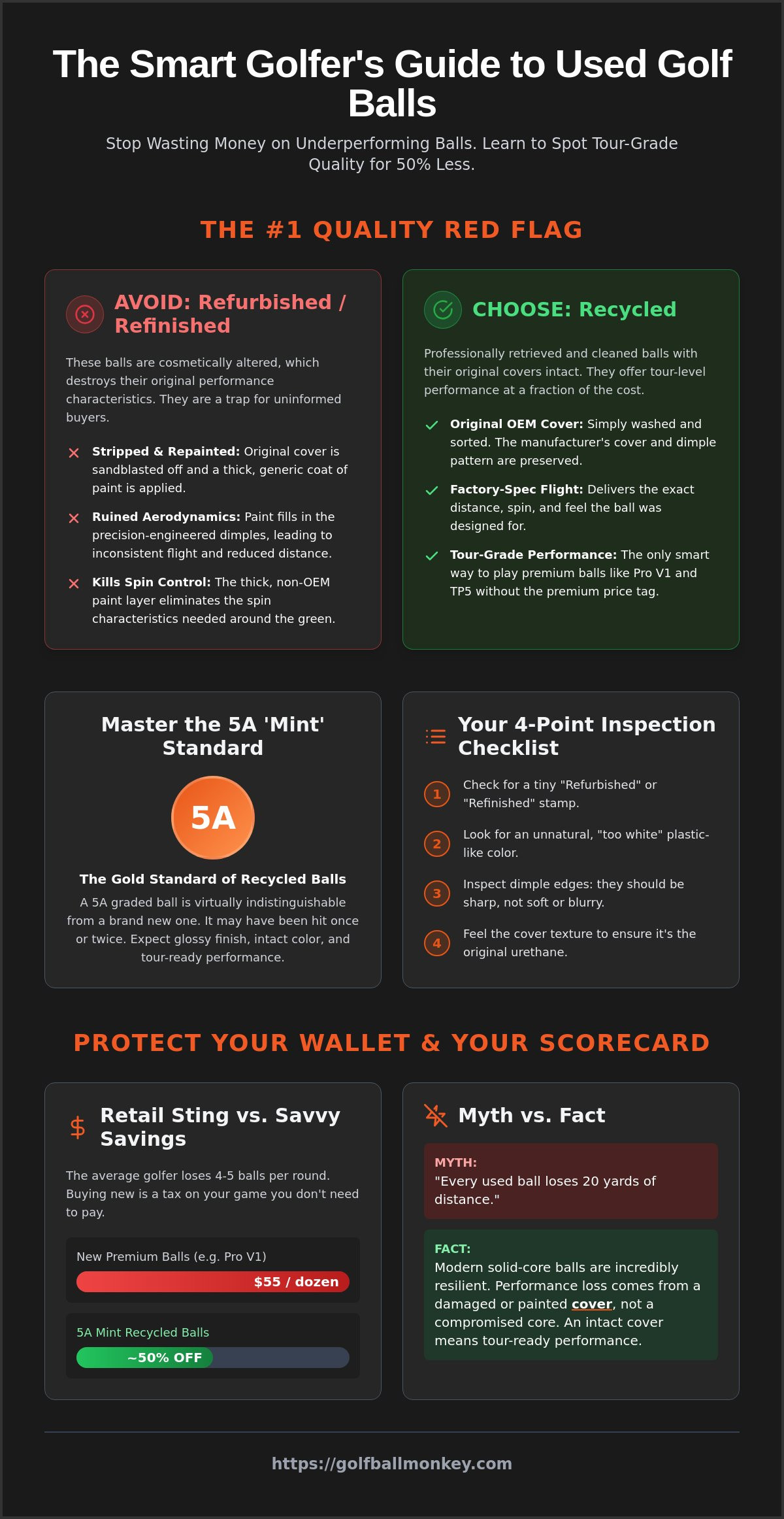
The word “refurbished” sounds like a win in most industries, but in the golf world, it is a total disaster for your scorecard. avoiding bad quality used golf balls starts with recognizing that “refurbished” is often just a fancy word for “ruined.” These balls, sometimes labeled as “refinished,” go through a brutal cosmetic makeover. Sellers sandblast the original cover to hide scuffs and then spray on a thick layer of generic white paint. They even stamp a fake logo on top to make it look official. It is a performance-killing trap disguised as a bargain.
Paint is the enemy of your flight path. Those dimples on your Pro V1 or TP5 are precision-engineered to create specific lift and drag. When a third-party seller adds a layer of non-factory paint, they fill in those dimples. You lose the aerodynamic edge that manufacturers spent millions to perfect. The result? A ball that knuckleballs in the wind or falls short of the green. Recycled balls are the savvy play because we simply wash them, sort them, and grade them based on their original condition. The factory urethane stays intact. Refurbishing a golf ball is like putting a fresh coat of paint on a flat tire; it looks good until you try to drive it.
How to Spot a “Fake” Mint Ball
Don’t let a shiny exterior fool you. Check the side of the ball for a small “Refurbished” or “Refinished” stamp. If you see it, walk away. Look closely at the color too. If the cover looks “too white”—like a piece of cheap plastic rather than the soft, pearlescent glow of a premium ball—it has likely been repainted. Finally, check the dimples. If the edges look soft, rounded, or blurred, you’re looking at a heavy paint layer that will kill your spin consistency.
Why the Monkey Never Sells Refurbished Junk
We refuse to sell repainted trash because we value your game. Our inventory consists strictly of original covers. We want you to have the exact spin, feel, and distance the manufacturer intended. Plus, true recycling is the better environmental choice. We don’t use the harsh stripping chemicals or heavy paints required for refurbishing. You get tour-level performance, and the planet gets a break. If you want the real deal without the “refurbished” risk, check out our curated inventory. We only stock gear that is vetted by the best in the business.
Deciphering the Grade: How to Spot a 5A from a Shag Ball
The biggest hurdle in avoiding bad quality used golf balls is the lack of a universal rulebook. One site’s “Mint” is another site’s “Good.” This inconsistency is exactly how golfers get stuck with duds. You need to know the industry secrets behind the grading scale before you click buy. A true grading system isn’t just about how pretty the ball looks in the palm of your hand. It is about how that ball behaves when it meets the clubface at 100 miles per hour. If the grading is loose, your proximity to the hole will be too.
Think of grading like a performance guarantee. When you buy from a source that respects the 5A standard, you are getting a ball that has likely seen only one or two holes of play. The core is fresh. The cover is perfect. As you move down the scale to 4A and 3A, you are trading cosmetic perfection for deeper discounts. For the everyday golfer, the 4A (Near Mint) tier is often the sweet spot. These balls might have a small ink mark or a tiny surface blemish, but the flight characteristics remain 100% factory spec. It is the intelligent way to play premium gear for less.
The 5A Gold Standard
A true 5A ball must have that signature “Pearl” sheen. This is the factory glow that reflects light evenly across every dimple. If you see a dull, matte finish on a ball that is supposed to be urethane, it has likely been sitting in the sun too long. The Titleist Pro V1 Mint 5A is the benchmark for this category. To earn this grade, there can be zero player marks and zero scuffs. It should look like it just came out of a fresh sleeve. This is the ball you pull out when the match is on the line and every yard matters.
When “Good” (3A) is Actually Bad for Your Game
Don’t be fooled by the word “Good.” In the world of recycling, 3A is the threshold where performance starts to dip. Minor scuffs on the cover might seem harmless, but they create turbulent airflow. This causes “fliers” that sail over the green or unpredictable spin that ruins your short game. We recommend 3A balls for very specific scenarios. Use them for your backyard practice or those “hero” shots over massive water hazards where you don’t want to lose a 5A gem. For serious practice sessions, check out our shag balls guide to find better alternatives that won’t mess with your muscle memory. If you want to score low, keep the 3A balls out of your game-day bag.
The Savvy Insider’s 4-Point Inspection Checklist
You have the balls in your hand. Now you need to know if they are actually game-ready. Avoiding bad quality used golf balls is easy once you know what to look for. You don’t need a lab or a launch monitor to spot a dud. You just need a few seconds and these four simple tests. This is how the pros at the shop separate the gems from the junk every single day. Run your inventory through this checklist to ensure every ball in your bag is ready to hunt pins.
- Point 1: The Visual Dimple Test. Hold the ball up to the light. You are looking for sharp, crisp dimple edges and clear OEM logos. If the Titleist or TaylorMade stamp looks blurry or the dimples seem “filled in,” you are likely holding a repainted refurb. A recycled ball should show the original, precision-molded texture.
- Point 2: The Texture Check. Use your thumb or a fingernail. Premium urethane covers on balls like the Bridgestone Tour B RX should feel slightly “tacky” or grippy. If the cover feels hard, slick, or “plasticky,” the urethane has either been compromised or replaced with cheap paint.
- Point 3: The Drop Test. This is the ultimate core check. Drop your used ball onto a concrete floor or a hard countertop from waist height. Do the same with a brand-new ball of the same model. They should bounce to nearly identical heights. If the used one dies on the floor, the core is toast.
- Point 4: The Sound Check. Bounce the ball lightly on the face of your wedge. A high-quality Chrome Soft or TP5 should have a muted, soft “thud.” If you hear a high-pitched, hollow “click,” it is a sign of a dead core or internal delamination.
Identifying Water-Logged Duds
The “water-logged” scare is mostly a myth from the 90s. Modern multi-layer balls are incredibly water-resistant. Unless a ball has been sitting in a pond since the last decade, the core is likely as fast as the day it was made. Look for deep, internal discoloration that looks like a yellowish “bruise” under the cover. Surface stains are fine and won’t hurt your distance. If the stain looks like it is coming from the inside out, that ball has seen too many seasons underwater. Toss it in the shag bag.
The “Ghost Logo” Reveal
Be wary of “ghost logos.” Some low-tier sellers try to buff off corporate logos or player marks using abrasive wheels. This creates smooth, flat spots on the cover. Since dimples are what provide lift, a smooth spot turns your ball into a knuckleball. It will dive out of the air or veer offline without warning. If you see a patch where the dimples look shallow or “melted,” that ball is a performance hazard. Ready to skip the guesswork? Shop our vetted, high-performance inventory and play with confidence.
Scoring Tour Performance Without the Retail Sting
You have the checklist. You know the red flags. Now it’s time to fill your bag with confidence. Avoiding bad quality used golf balls doesn’t have to be a full-time job. It is about choosing a source that treats equipment with the same respect you do. When you stop gambling on random “found” balls and start trusting a professional retrieval process, your game transforms. You get the spin you expect. You get the distance you need. Most importantly, you get the peace of mind that every ball in your sleeve will perform exactly like its retail counterpart. No duds. No surprises. Just pure performance.
The secret is in the original OEM cover. As we have discussed, once that factory finish is compromised by sandblasting or heavy paint, the ball is essentially garbage. We act as the ultimate filter. We do the dirty work of sorting through thousands of balls to ensure only the best make the cut. We are your savvy shopping assistant, making sure you never waste a dime on a dead core or a slick cover again. It is the intelligent move for any golfer who values their scorecard as much as their wallet.
Why Professional Divers Matter
Our process starts at the source. Professional divers recover inventory from controlled environments where balls haven’t been exposed to the elements for years. We then put every single ball through a rigorous hand-sorting and grading cycle. This is how we guarantee quality. This systematic approach ensures you never see a “refurbished” trap or a “buffed” cover in your order. We check the dimples so you can check the pin. If you want a deeper dive into how we maintain these standards, read our Used Golf Balls: The Savvy Player’s Guide. It breaks down the logistics of why professional retrieval beats a backyard find every time.
The Smart Play for 2026
The “Intelligent Play” is simple. Don’t pay for the fancy box or the massive marketing budget. In 2026, the gap between a new ball and a 5A recycled ball is purely financial. You are paying a “marketing tax” when you buy at the big-box retail stores. By avoiding bad quality used golf balls and sticking to Mint 5A standards, you’re getting the same urethane and the same flight patterns for a fraction of the cost. It’s the savvy insider move that keeps your handicap low and your budget intact. Ready to upgrade? Head over to the Golf Ball Monkey shop and grab tour-grade gear today. Don’t let the retail price dictate your game. Play the ball, save the cash.
Master Your Game and Your Budget
You are now armed with the insider secrets to avoiding bad quality used golf balls. You know that “refurbished” is just a fancy word for performance-killing paint. You understand that 5A Mint isn’t just a label; it’s a promise of tour-level flight and spin. Stop letting big-box retail prices dictate how many balls you can afford to lose on a Saturday morning. The intelligent play is always about performance, not the price of the packaging.
We take the guesswork out of your gear. Our inventory is hand-picked by professional divers and vetted through a strict 5-point grading system. We don’t sell repainted or sandblasted junk. It’s original factory urethane or nothing. You get the same distance and feel as a new ball without the marketing tax. Score Mint 5A Titleist Pro V1s for a fraction of retail here! It’s time to play the best equipment for the best price. See you on the first tee.
Frequently Asked Questions
How can I tell if a used golf ball is refurbished?
Check for a small “Refurbished” or “Refinished” stamp on the side of the cover. Look closely at the dimples; if the edges look soft, rounded, or blurred, you are likely looking at a heavy layer of non-factory paint. Refurbished balls often have a “too-white” appearance that lacks the natural pearl glow of original urethane. If the logo looks printed over a thick coating, it is a performance trap.
Do water-logged golf balls really lose distance?
Modern golf balls rarely lose distance from water unless they have been submerged for several months. Today’s multi-layer, solid-core construction is incredibly water-resistant compared to old wound-ball tech. Surface stains from pond silt won’t hurt your drive. Only deep, internal discoloration indicates a core that has been compromised by long-term submersion. For most recycled lake balls, the performance drop is practically zero for amateur players.
What is the difference between recycled and used golf balls?
Recycled balls are used golf balls that have been professionally cleaned and graded without altering the original factory cover. “Used” is a generic term that includes everything from backyard finds to repainted junk. Recycled balls are the gold standard because they maintain the manufacturer’s original aerodynamics. Focus on recycled gear when avoiding bad quality used golf balls to ensure your spin and flight remain consistent.
Is Mint 5A quality the same as a brand new ball?
Mint 5A balls look and play exactly like they just came out of a fresh retail sleeve. While they are technically used, they show zero scuffs, player marks, or blemishes. You get the same tour-level spin, feel, and distance as a new ball. It is the intelligent play for golfers who want premium gear like a Pro V1 or TP5 without paying the $5 per ball retail tax.
Can a scuffed golf ball affect my slice or hook?
Yes, a scuffed cover creates turbulent airflow that can significantly exaggerate side spin. Think of a scuff as a tiny rudder that catches the wind mid-flight. This leads to “fliers” that sail over the green or shots that veer wildly offline. Stick to 5A or 4A grades for your game-day bag. Use lower grades for the shag bag to keep your flight patterns predictable and your scorecard clean.
Why should I avoid “refinished” golf balls at all costs?
Refinished balls are sandblasted and repainted, which fills in the precision-engineered dimples and destroys aerodynamics. This process ruins the lift and drag characteristics intended by the manufacturer. You lose distance and gain unpredictable flight paths. It is like putting a fresh coat of paint on a flat tire; it looks brand new until you actually try to drive it. Always insist on original covers for consistent results.
How long can a golf ball stay underwater before it goes bad?
A modern ball can typically survive underwater for several weeks before the core shows any measurable loss of speed. The real danger in 2026 is long-term exposure to harsh pond chemicals. Professional divers harvest balls frequently to ensure the inventory stays fresh. If a ball has been sitting in a lake for a year, it might lose a few yards. Most retrieved balls are found quickly and perform like new.
Are bulk used golf balls lower quality than dozen-packs?
Bulk balls are identical in quality to dozen-packs as long as they share the same grading scale. Buying in quantities of 48 or 96 is actually the savvy insider’s way to maximize savings. It is a powerful strategy for avoiding bad quality used golf balls while building a reliable inventory for both practice and play. Just ensure the seller uses a standardized 5A to 3A grading system before you commit to a large order.
Cheap Practice Golf Balls: Build Your Ultimate Practice Bag for Less in 2026
The average golfer loses four to five balls every single round, which can turn a casual hobby into a $600-a-year equipment drain. If you’re still cracking open a fresh sleeve of expensive tour balls just to work on your chipping, you’re essentially lighting money on fire. It’s time to stop overpaying for practice and start hunting for cheap practice golf balls that actually deliver. You shouldn’t have to choose between high-end performance and your monthly budget.
We know the frustration of trying to decode cryptic grading systems or worrying that discount gear means a ball is water-logged and useless. You deserve the same spin and feel you get on Sunday without the retail price anxiety. This guide will show you exactly how to score premium-brand performance for pennies per ball, helping you save 50% to 80% off standard shop prices. We’ll break down the 3A vs 5A mystery, identify which brands offer the best used value, and help you find a reliable source for all your bulk equipment needs. Get ready to build a pro-level practice bag for less.
Key Takeaways
- Slash your equipment costs by 50% to 80%. Stop overpaying for retail sleeves and start hitting premium-brand performance for pennies per ball.
- Crack the code on grading scales. Understand the difference between Mint 5A and Shag grade so you never buy more quality than a specific drill requires.
- Build a smarter bag with cheap practice golf balls. Segment your gear by drill type to maximize your budget and your practice time.
- Trust the Monkey’s vetting process. Get pro-vetted, recycled gear that keeps plastic out of ponds and high-performance tech in your hands.
Why Cheap Practice Golf Balls Are the Smartest Play in Your Bag
Every time you thin a brand-new tour ball into the woods, you’re not just losing a stroke; you’re losing the price of a decent lunch. That financial sting creates a “price anxiety” that kills your swing. It’s hard to stay loose when you’re worried about five dollars per swing. Smart players ditch the retail ego and stock up on cheap practice golf balls to free their minds. When the cost per ball drops to pennies, you can finally focus on your tempo instead of your bank account.
The math is undeniable. Switching to high-grade recycled balls can save you between 50% and 80% compared to buying new premium gear. According to industry data, an average golfer playing 40 rounds a year could cut their annual ball spend from $650 down to approximately $210. That is extra cash for green fees, lessons, or a celebratory round at the 19th hole. The Monkey’s squad of professional divers are the unsung heroes of this equation. They rescue thousands of high-end balls from water hazards, allowing us to pass those Texas-sized savings directly to you.
Choosing recycled gear is also the ultimate green play. Every ball retrieved is one less piece of plastic degrading in a local ecosystem. You’re cleaning up the course while you sharpen your game. It’s a win-win for your handicap and the planet. Check out our Mixed Bag (Good 3A) options to start building your stash today.
The Retail Trap: Why New Balls Are Overkill for Practice
Retailers want you to believe you need a fresh box for every range session. They’re wrong. Modern ball construction is incredibly resilient. Looking back at the history of the golf ball shows us that we’ve moved from fragile designs to high-tech urethane and ionomer covers built for punishment. A ball doesn’t lose its magic just because it took a quick dip in a pond. The retail markup on new boxes covers massive marketing budgets and athlete endorsements. You shouldn’t have to pay for a pro’s private jet just to work on your short game.
Performance Reality Check
Research shows that high-quality recycled balls have a negligible performance difference, often losing less than one yard of distance compared to new ones. For 99% of practice drills, that gap is totally imperceptible. Savvy insiders know that a Mint 5A Titleist Pro V1 performs exactly like a new one, but at a fraction of the cost. A practice ball is a high-value, secondary-market alternative to retail gear that delivers tour-level feedback without the premium price tag. Stop paying for the shiny box and start paying for the performance inside.
Decoding Practice Grades: Shag vs. Practice vs. Mint
Not all cheap practice golf balls are created equal. If you’ve ever stared at a bin of used gear wondering what the heck “3A” or “Shag” means, you aren’t alone. Industry grading scales aren’t just for show. They are your roadmap to saving money without sacrificing the feedback you need. From the pristine “Mint 5A” to the beat-up “Shag” grade, each tier has a specific job in your bag. The Monkey doesn’t do guesswork, and neither should you.
You might also see the “Practice” stamp on certain premium balls. Don’t let that label scare you off. These are often factory-fresh balls that had minor cosmetic blemishes during manufacturing. They aren’t duds. They aren’t damaged. They just didn’t pass the “beauty pageant” at the factory. For a savvy player, these are absolute gold. You get the exact same aerodynamics and compression as the retail version but at a massive discount.
Grade 5A (Mint): The ‘Sunday Best’ for Your Practice
Mint 5A balls are the elite of the recycled world. These look and feel like they just came out of a fresh sleeve. No scuffs. No discoloration. You might find a tiny player mark or a logo, but that’s it. Use these for your high-stakes practice sessions. When you’re working on delicate greenside chips or calibrating your putter, you need the true feel of a premium cover. Check out our Mint 5A grading guide to see how we vet these beauties for your bag.
Grade 3A and Shag: The Workhorses
Now, let’s talk about the grinders. Grade 3A balls, often called “Good” grade, have visible scuffs, ink marks, or slight tan lines from the sun. Shag grade is even more utility-focused, featuring significant blemishes. But here is the secret: the core is still there. If you’re hitting into a net or doing “bomb and gouge” sessions in high grass, why pay for a pretty face? You can get premium cores at rock-bottom prices. These are the ultimate cheap practice golf balls for high-volume reps where ball loss is a guarantee.
Grade 3A is the undisputed sweet spot for building a bulk practice bag. It offers the best balance of performance and price. You get a ball that flies true enough for full-swing feedback but costs so little you won’t blink if it disappears into the pond. It’s about being smart with your equipment. Save the 5A for the short game and load up on 3A for the heavy lifting. If you’re ready to restock, grab a bulk bag from the Monkey and stop worrying about your wallet.
The Best Cheap Practice Golf Balls by Brand
Picking the right brand for your practice bag isn’t just about loyalty. It’s about data. While some golfers think any round object works for drills, savvy players know that brand-specific tech still matters when you’re grinding. You want the same compression and spin profile you’ll see on the course. Loading up on cheap practice golf balls from top-tier brands ensures your practice translates to lower scores. Don’t settle for generic rocks when you can hit the real deal for less.
Callaway is a massive favorite for value hunters. The Chrome Soft offers tour-level spin, while the Supersoft is a dream for players with moderate swing speeds who want a buttery feel. TaylorMade and Srixon also provide high-performance alternatives that frequently cost less in bulk than their Titleist counterparts. If you want the absolute disruptor, look at Kirkland Signature. These urethane-cover balls already have a cult following for their low retail price. When you buy them used, the savings become almost criminal. You get premium greenside control for a price that makes you want to buy a thousand.
Titleist Pro V1: Practice Like a Pro
The Titleist Pro V1 is the gold standard for a reason. If you play it on Sunday, you should hit it on Tuesday. Practicing with the ball you play is vital for consistency. It builds muscle memory for how the ball reacts off the face, especially around the greens. You don’t always need Mint 5A for the range, though. Finding a balance is key. Use 5A for your putting and chipping drills, but grab a 3A Practice Titleist for your full-swing reps. You get the same tour-level core at a fraction of the cost. Check out our Titleist Pro V1 guide to see why this ball continues to dominate the market.
The ‘Mixed Bag’ Strategy
Buying mixed buckets is the ultimate budget move for beginners and high-handicappers. It’s the smartest way to find your preferred “feel” without buying full boxes of every brand. You might discover you love the soft compression of a Bridgestone or the piercing flight of a Srixon just by working through a bucket. Our Mixed Bag (Good 3A) is a top-tier value option for this exact reason. It’s perfect for high-volume reps where you need reliable flight and soft landings. Stop overthinking the brand and start focusing on the reps. The Monkey has already vetted the quality, so you just have to pick your target and fire away.
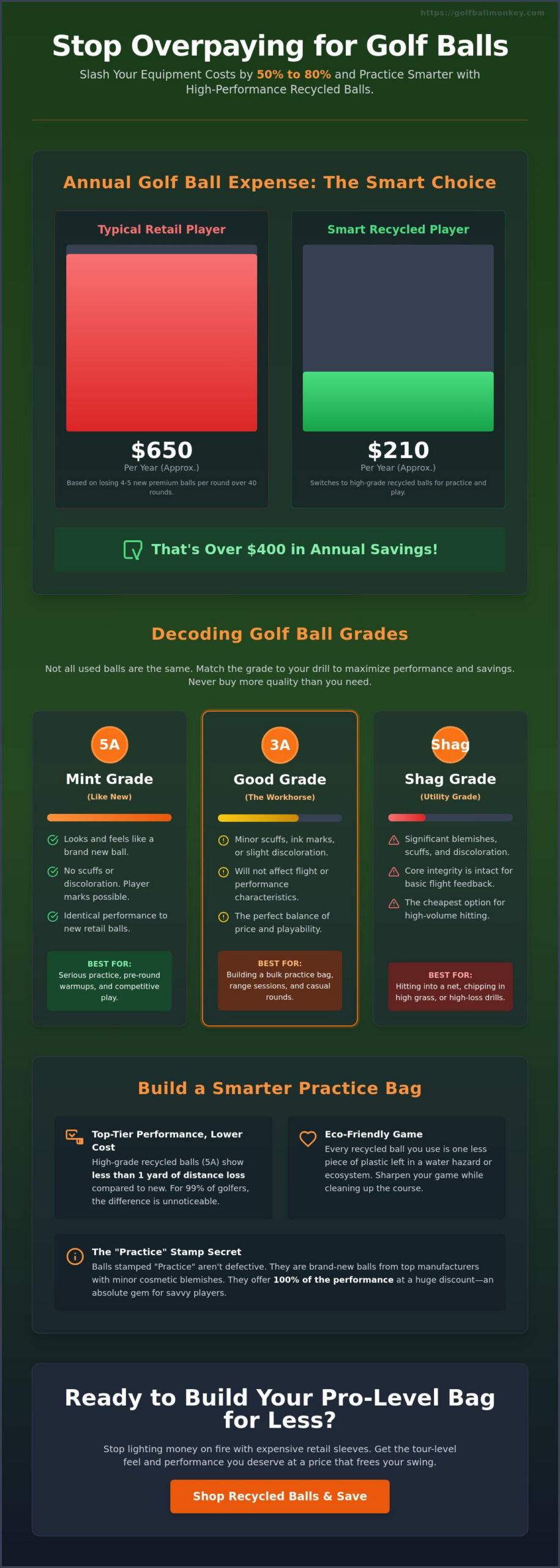
How to Build Your Ultimate Practice Bag for Pennies
Stop dumping loose gear into your trunk and hoping for the best. A pro-level practice routine requires an organized bag. You don’t need a massive budget to look like a tour player; you just need a strategy. Building a bag with cheap practice golf balls is about matching the ball’s condition to the specific drill you’re grinding on. If you use the same ball for a 300-yard drive that you use for a three-foot putt, you’re flushing money down the drain.
Follow these four steps to maximize your training budget:
- Step 1: Segment your bag. Divide your storage by drill type. Keep your “gamers” separate from your “grinders.”
- Step 2: Assign ball grades. Match quality to consequence. High-stakes drills get high-grade balls.
- Step 3: Buy in bulk. Never buy by the dozen for practice. Savvy players know that 50 or 100-count buckets are the ultimate play for driving down the cost per shot.
- Step 4: Rotate your stock. Move your gear down the ladder of utility. When a chipping ball gets a fresh scuff, demote it to the full-swing bucket.
This rotation ensures you never waste a single core. You’re always practicing with the right level of feedback without overpaying for the privilege.
The Short Game Pocket: Premium Only
You cannot calibrate your hands with a rock. For putting and chipping, only use Mint 5A or high-grade balls. You need that consistent spin and that specific “click” off the wedge face to build real muscle memory. If the ball doesn’t react the way it will on Sunday, your Tuesday practice is useless. Keep these pristine. Use Golf ball accessories like a dedicated towel or pocket brush to keep them clean. Dirt and sand change aerodynamics and ruin your feedback. Treat these like your Sunday best.
The Full Swing Bucket: Quantity Over Quality
When you’re working on your path or contact at the range, cosmetic perfection is a luxury you don’t need. This is where 3A or “Practice” grade cheap practice golf balls shine. They fly true enough to show your shot shape but cost so little you won’t mind if one ends up in the tall grass. Store these in a dedicated shag bag or a sturdy bucket for easy transport. It’s about volume and reps here. Focus on the strike and the flight path rather than the ink marks on the cover. Ready to build your ultimate setup? Score your bulk practice balls from the Monkey and start training like a pro today.
Why Golf Ball Monkey is Your Practice Partner
Choosing where to buy your cheap practice golf balls is just as important as the drills you run. At Golf Ball Monkey, we aren’t just moving inventory. We are fellow enthusiasts who got tired of the retail racket. The “Monkey’s Promise” is simple: we employ professional divers to rescue premium gear, apply a rigorous grading scale, and deliver Texas-sized savings directly to your door. By skipping the retail middleman, we strip away the unnecessary markups that bloat the price of a standard sleeve. You get the performance. We handle the mud.
Our mission is also deeply rooted in the health of the sport. Every ball you buy from our online shop is one less piece of plastic sitting in a water hazard. Golf balls don’t decompose. Left alone, they become permanent pollutants in the very landscapes we love. When you choose recycled gear, you are actively participating in a nationwide cleanup effort. It’s the ultimate way to play a greener game while keeping your bank account in the black. You’re doing right by the planet and your handicap at the same time.
From the Pond to Your Shag Bag
Our retrieval and cleaning process is designed to preserve the physical integrity of every ball. We don’t use harsh chemicals or abrasive stripping methods that ruin aerodynamics. Instead, we focus on careful cleaning and expert grading. Our divers have insider knowledge of the best courses, meaning our inventory is packed with high-end tour balls that were barely used before taking a dip. Buying from us is the smart play for 2026. You get pro-vetted gear without the pro-shop invoice. It is about getting the most reps for the least amount of cash.
Ready to Level Up Your Practice?
Stop lighting money on fire at the retail counter. Start practicing with purpose and a full bag of premium gear. As we discussed earlier, matching your ball grade to your drill is the fastest way to see results without draining your wallet. Whether you need a 100-count bucket of 3A grinders for the range or a fresh set of Mint 5A Pro V1s for your putting mat, we have you covered. Grab a bucket and start saving today. The Monkey has your back, your bag, and your budget.
Take Command of Your Practice Budget
You’ve got the strategy. Now it’s time to execute. Smart practice isn’t about hitting the most expensive ball; it’s about hitting the right ball for the right drill. By segmenting your bag and matching your equipment to your specific training goals, you’ve already won half the battle. You’re saving significant cash and helping the planet one retrieved ball at a time. Every piece of inventory we offer is professional diver retrieved and vetted to meet our rigorous 5A/3A grading standards. This eco-friendly recycling process ensures you play gear that’s as good for the environment as it is for your scoring average.
Don’t let retail markups dictate your progress or limit your reps. Grab the high-performance gear that lets you swing freely without the financial sting of a lost sleeve. It’s the ultimate insider move for any golfer looking to level up. Build your practice bag with the Monkey’s best deals and start shaving strokes off your game today. Your research has led you to the best cheap practice golf balls on the market. Now, get out there, trust your gear, and make every single rep count.
Common Questions About Practice Gear
Are cheap practice golf balls actually good for my game?
Yes, they are a massive win for your handicap. High-quality recycled gear shows a negligible performance difference. Research confirms you lose less than one yard of distance compared to new balls. This allows you to focus on high-volume reps and swing mechanics instead of worrying about the price per swing. It is the smartest way to build muscle memory without the retail sting.
What is the difference between used and recycled golf balls?
Recycled balls are simply used balls that have been professionally retrieved, washed, and graded by condition. They maintain their original factory finish and cover. You should avoid “refurbished” balls. Those are stripped and repainted, which can ruin aerodynamics and lead to inconsistent flight. Stick with recycled gear to ensure you’re getting the true performance of the original core and cover.
Will water-logged practice balls fly shorter distances?
Modern solid-core balls don’t absorb water like the old wound-core versions did decades ago. Studies show that high-grade retrieved balls perform nearly identically to brand-new ones. You won’t see a distance drop that affects your practice feedback. The Monkey ensures every ball is vetted for structural integrity so your flight paths stay true during every session.
How many practice balls should I keep in my shag bag?
Aim for a stash of 50 to 100 balls. This volume lets you find a rhythm during a session without stopping to pick up gear every five minutes. It is also the perfect weight for a standard shag bag or bucket. Keeping this many cheap practice golf balls on hand ensures you always have enough for a full range of drills, from putting to long drives.
Which brand offers the best value for cheap practice balls?
Kirkland Signature is the undisputed disruptor for raw value. They offer urethane covers that react like tour balls for a fraction of the cost. Srixon also provides incredible performance for the price. If you want tour-level feedback, look for 3A Titleist Pro V1s. You get the world’s most popular core at a price point that makes sense for high-volume training.
Can I use ‘Practice’ stamped balls in a tournament?
Yes, you generally can. Most “Practice” stamped balls from major brands are simply cosmetic blems of conforming tour balls. They are identical in construction to the retail versions. Unless a specific event has a “one ball rule” or requires balls to be on a specific list, they are perfectly legal. Check the USGA Conforming Ball List if you’re playing in a high-level sanctioned event.
How often should I replace the balls in my practice bag?
Switch them out when you see deep scuffs, cuts, or cracks. A ball with a compromised cover won’t fly true and will give you bad feedback. You can extend the life of your gear by rotating. Move your slightly worn chipping balls into your full-swing bucket. This ensures you get every cent of value out of your equipment before they hit the retirement bin.
Is it better to buy practice balls in bulk or by the dozen?
Bulk is the only savvy way to buy cheap practice golf balls. Purchasing 50 or 100-count buckets significantly reduces your cost per ball compared to buying dozen packs. It is the smartest way to stock up for a full season of training. Buying in bulk also means you’ll always have a consistent supply, so you never have to skip a session because you’re low on gear.
Used Golf Balls for Driving Range: The Savvy Guide to Bulk Savings in 2026
Why are you still shelling out premium prices for “new” range buckets that look like they’ve been through a blender after three swings? It is a common trap. You want to dial in your yardages, but you’re stuck hitting “hit-away” rocks that feel like marbles and fly like wounded ducks. We know the frustration of overpaying for equipment that scuffs on the first impact. Finding reliable used golf balls for driving range practice shouldn’t feel like a gamble. You deserve a consistent flight path without the retail markup or the soul-crushing shipping costs of heavy bulk orders.
The smartest play happens before you even reach the tee box. We agree that it is time to stop subsidizing the golf industry’s “new ball” obsession and start practicing like a pro on a budget. This savvy guide will show you exactly how to source high-quality 3A or 4A practice balls in bulk while slashing your expenses. We will dive into the truth about grading scales, reveal the best ways to avoid shipping sticker shock, and help you find a supplier that treats your game with the respect it deserves. Get ready to stock up and swing with confidence.
Key Takeaways
- Slash your practice overhead by 60 to 80 percent by switching from overpriced retail stock to high-performance recycled alternatives.
- Master the grading system to distinguish between high-quality 4A practice balls and “one-and-done” hit-away options.
- Improve your practice feedback by using premium used golf balls for driving range sessions that mimic real-course spin and launch.
- Streamline your inventory by calculating weekly ball loss and rotation rates to maximize bulk savings on every order.
- Source directly from vetted professional divers to avoid performance-killing refurbished balls and ensure consistent quality.
Stop Wasting Money: Why Used Golf Balls for Driving Range Use are the Smart Play
Stop burning cash on overpriced buckets. Retail range balls are a recurring nightmare for your bottom line. They scuff, they’re expensive, and they vanish into the woods before you can say “fore.” 2026 is the year to pivot. Savvy operators and serious players are switching to used golf balls for driving range use because the math simply doesn’t lie. You get premium performance without the premium tax. It’s the ultimate hack for anyone looking to maximize their practice hours without draining their bank account.
The Economics of the Practice Tee
Think about your cost per hit. Buying brand new range stock is a high-stakes game. You’re paying for “newness” that disappears after the first wedge shot. Reclaimed premium stock changes the equation. You can slash your overhead by 60 to 80 percent. That is a massive win for your margin. Stop paying the “lost ball” tax. Every ball that goes over the fence or into the pond hurts less when you didn’t pay retail prices for it. Finding a reliable source for used golf balls for driving range inventory means you can restock without the financial headache. Grab the same quality at a fraction of the cost at our online shop.
Performance Myths Debunked
Let’s kill the rumors. People think used balls are water-logged duds that won’t fly. That’s a myth. Professional reclamation focuses on Golf ball design and regulations to ensure the core integrity remains intact. Testing shows distance loss is negligible. It’s usually less than a couple of yards; nothing that will ruin your practice session. In fact, hitting a 3A or 4A used Titleist or Srixon provides way better feedback than those hard, one-piece “range rocks” that feel like hitting a brick. You want consistent spin and launch. Used premium balls deliver exactly that. Our grading system ensures you get exactly what you pay for, whether it’s a Near-Mint 4A or a solid 3A “Good” condition ball.
It isn’t just about the money. Millions of balls end up in water hazards every year. They sit there, doing nothing but taking up space and creating environmental waste. We send in the divers. We bring them back to the surface. It is a massive environmental win that keeps the course clean and your bag full. You’re saving the planet while saving your wallet. That’s what we call a win-win. By choosing recycled gear, you are actively participating in a more sustainable future for the sport. It’s the intelligent play for 2026.
Decoding the Grades: Shag, Practice, and Hit-Away Balls Explained
Don’t just buy a bucket of mystery spheres. Understanding the grading system is the secret to getting the most bang for your buck. When you’re sourcing used golf balls for driving range use, you’ll see everything from “Mint” to “D-Grade.” Each tier serves a specific purpose. Buying a 5A ball for a lake-front target is a waste of money. Conversely, hitting D-Grade rocks for your launch monitor calibration will give you junk data. Match the ball to the drill. It’s the intelligent way to train.
At the top of the food chain, you have Mint 5A. These are basically brand new. If your practice session needs to mirror tournament conditions exactly, this is your play. Moving down, 3A and 4A grades represent the “Practice” sweet spot. These balls have minor cosmetic blemishes but retain their flight integrity. They are the workhorses of serious range sessions. They fly true, spin right, and won’t break the bank. Most golfers find that 4A balls provide identical feedback to new balls at half the cost.
What is a Shag Ball?
Shag balls are the utility players of your equipment bag. These are often scuffed, discolored, or carry a stray Sharpie mark from a previous owner. They are perfect for repetitive drills where you’re hitting hundreds of shots into a backyard net or working on your short game. If you’re working on your chipping or pitching, a few scuffs won’t kill your progress. Shag balls are the ultimate value play for high-volume practice.
Hit-Away vs. Range Grade
Hit-Away balls, also known as D-Grade, are the “one and done” option. These are the lowest tier. Use them in places where you won’t retrieve them, like hitting off a pier or into a canyon. However, be mindful of the environmental impact of lost golf balls as they break down into microplastics. While they are incredibly cheap, they are basically rocks. Don’t expect a consistent flight path. They are strictly for the thrill of the hit, not for sharpening your swing.
In contrast, Range Grade balls are built for uniformity. Commercial setups love these because they provide a consistent experience for every customer. They are durable enough to survive the mechanical picker and the wash cycle a thousand times over. If your retrieval setup involves a tractor and a cage, stick to Range Grade or high-quality 3A mixes. This ensures your clientele gets a predictable flight without you overpaying for “Mint” aesthetics. Ready to restock your supply? Check out the latest inventory tiers and make the smart play for your game today. You can always find a better deal when you shop with the insiders.
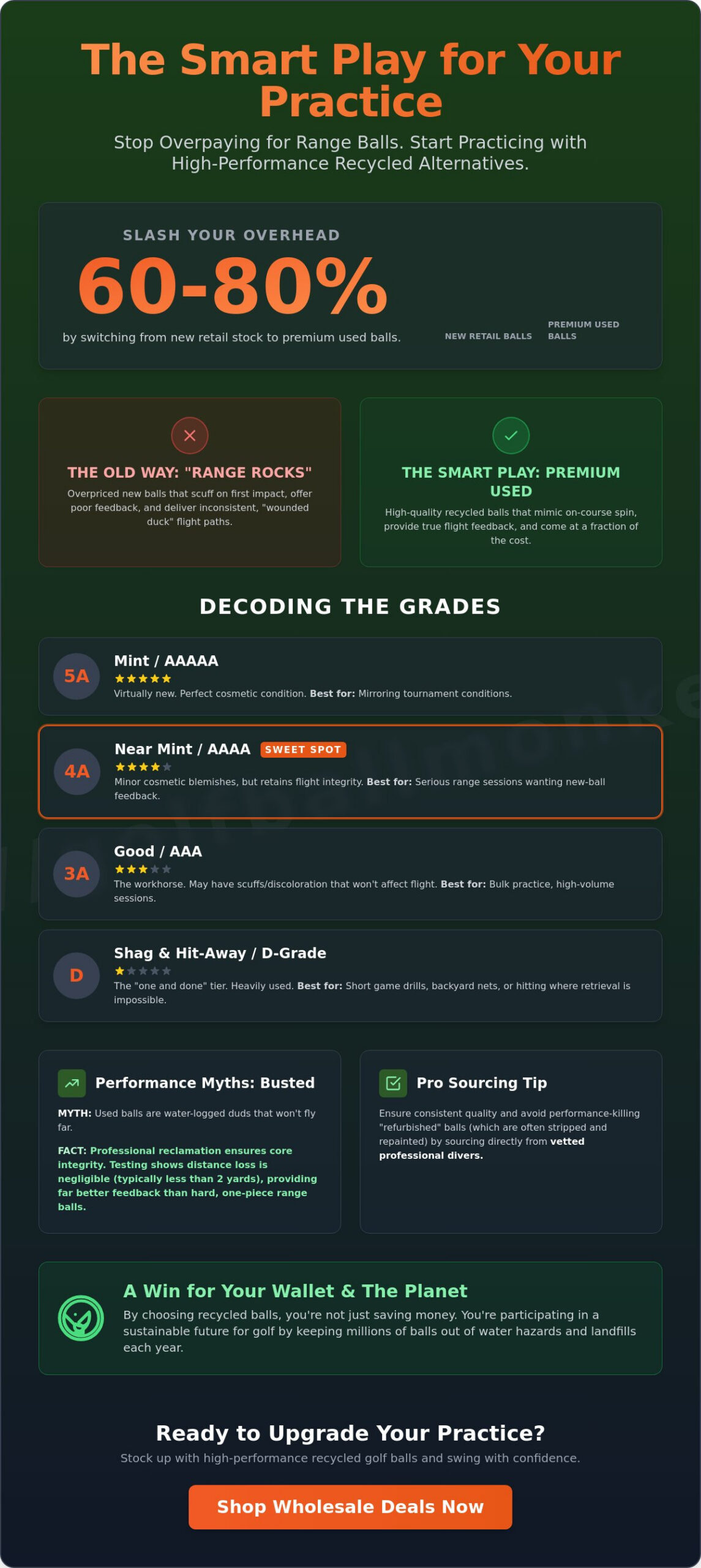
Range Balls vs. Premium Used Balls: Which One Sharpens Your Game?
Stop settling for the “range rock” lie. Most standard range balls are designed for one thing: survival. They have hard, thick covers meant to withstand a beating from the mechanical picker and the wash cycle. But that durability comes at a heavy cost to your performance. They don’t spin. They don’t feel right. They fly like stones. If you’re trying to dial in your wedge game or work on shot shaping, those generic yellow spheres are actively working against you. They provide junk feedback that simply doesn’t translate to the course.
Switching to premium used golf balls for driving range sessions changes the entire dynamic of your practice. When you hit a recycled urethane ball, you get real data. You see the true launch angle. You feel the soft compression. Most importantly, you see the actual spin rate. A standard range ball might slide up the club face, giving you a high, weak flight. A premium used ball bites. It reacts the way a ball should. This creates a meaningful feedback loop that helps you make real adjustments to your swing instead of chasing “range-only” yardages.
Why Practice with Titleist Pro V1?
Consistency is the name of the game. If you play a Pro V1 on Sundays, you should be hitting them on Tuesdays. Practicing with the same ball you play builds a deep “feel” for distance control and trajectory. You’ll know exactly how the ball will behave when it lands on the green because you’ve seen it a thousand times on the range. Check out our guide on Titleist Pro V1 for the full tech specs on why this ball dominates. Comparing used Pro V1s to brand new generic range balls is a no-brainer. For a similar price, you get the top ball in golf instead of a nameless one-piece sphere. It’s the ultimate performance upgrade for your practice routine.
The “Range Rock” Problem
Generic range balls usually feature a one-piece construction. They are solid cores of synthetic material. Premium balls are multi-layered masterpieces. They have soft inner cores and thin urethane covers. Hitting “rocks” all day isn’t just bad for your feel; it’s tough on your gear. Those hard covers can accelerate club face wear over thousands of reps. Recycled used golf balls for driving range use are softer on your irons. They take the hit so your clubs don’t have to. You get better practice, better feedback, and a psychological edge when you step onto the first tee knowing your game is tuned for the real thing. Make the smart play and ditch the rocks for good.
Buying in Bulk: How to Source Thousands of Practice Balls
- Step 1: Calculate your burn rate. Determine your weekly ball loss and rotation rate. If you’re losing 10 percent of your stock to the woods or ponds every month, you need a replenishment plan that keeps pace.
- Step 2: Pick your lane. Match your grade to your clientele. If you’re a high-end club, stick to 4A Near-Mint. For a local muni, a 3A “Good” mix provides the best ROI.
- Step 3: Go wholesale. Don’t wait until your bins are empty. Set up recurring deliveries to ensure you never run dry. This keeps your practice sessions consistent and your customers happy.
- Step 4: Audit your shipping. 1,000 golf balls weigh roughly 100 pounds. Bulk weight can kill your margins if you aren’t careful. Look for suppliers with national reach and optimized freight to keep those costs down.
Wholesale vs. Retail Bulk
There is a massive difference between a “bulk pack” at a big-box store and a true wholesale crate. When you move from the 100-pack to the 1,000-count crate, you unlock a new tier of savings. View our Bulk Golf Balls section for current inventory and blowout pricing. We handle custom requests too. Whether you need specific striped range balls for visual tracking or mixed brand buckets for maximum variety, we have the stock to fill your order. Buying at this level turns a recurring expense into a manageable asset.
The Monkey’s Logistics Tips
Storage is key. Use stackable, ventilated bins to prevent moisture buildup and keep your inventory organized. Clean your stock regularly. A quick wash keeps the dimples clear and the flight true, extending the life of your balls. Our professional divers work around the clock to maintain a steady supply for our used golf balls inventory. They brave the hazards so you get the best gear. It is a dirty job, but it ensures you always have access to high-performance equipment at the lowest possible price point. Secure your wholesale shipment and start saving today.
The Golf Ball Monkey Difference: Wholesale Quality for Every Range
We don’t just sell gear. We hunt it. While other retailers wait for shipments to arrive at their warehouse, we are in the water. Our team of professional divers braves the hazards of top-tier courses to bring you the best used golf balls for driving range use in the country. We are the savvy insider’s first call. Why? Because we cut out the middleman and pass every cent of those savings directly to you. It is the intelligent play for your budget and your game.
The Monkey personally vets every batch. We use a standardized grading scale that acts as a verbal seal of approval. When you order a 4A “Near Mint” crate, you get exactly that. No filler. No “hit-away” surprises hidden at the bottom of the bin. Our Texas-based operation has a national reach, ensuring fast, reliable shipping across the USA. We know bulk weight can be a margin-killer. That is why we’ve optimized our logistics to keep your equipment costs low and your inventory high.
Our Professional Retrieval Process
Success starts at the source. We harvest millions of balls every year from exclusive clubs and premium resorts. These aren’t your average scuffed-up finds. Our cleaning and sorting tech is state-of-the-art. We strip away the grime without damaging the cover integrity. This ensures “Monkey Approved” quality in every shipment. Our Shag and Practice balls outlast the competition because they were high-performance balls to begin with. We prioritize the core physics. You get a ball that maintains its flight characteristics long after generic alternatives have given up. It is recycled performance at a blowout price.
Ready to Stock Up?
Stop overpaying for retail fluff. Whether you are a solo stick looking to sharpen your short game or a commercial range manager needing thousands of units, we have you covered. We offer direct-to-consumer savings on the biggest names in the sport. Titleist, Callaway, TaylorMade; they are all here. For those managing high-traffic facilities, our wholesale agreements provide a steady, recurring supply of used golf balls for driving range rotations. Never run dry again. Experience the thrill of a significant bargain without sacrificing a single yard of distance. Your game deserves the best, and your wallet deserves a break. Grab your bulk practice balls today and save!
Level Up Your Practice Game Today
You’ve got the blueprint. Now it’s time to execute. Stop letting “range rocks” dictate your swing and start practicing with the same gear you play on Sundays. Matching your drill to the right grade, whether it’s Shag balls for chipping or 4A Near Mint for the long game, is the savvy way to sharpen your skills. Finding high-quality used golf balls for driving range sessions has never been easier or more cost-effective. You’re saving the planet and your wallet with every swing.
The Monkey has your back with professional diver-retrieved inventory and strict 5A to 3A grading scales. We handle the heavy lifting with reliable national US shipping on all bulk orders so you can focus on your follow-through. It’s the intelligent play for 2026. Ready to restock? Shop Bulk Practice & Range Balls Now and join the community of smart players who refuse to pay retail. Keep it light. Keep it fast. Your best season is just one bucket away.
Frequently Asked Questions
Are used golf balls good for driving ranges?
Yes, they are actually better for your game than standard “range rocks.” Using used golf balls for driving range practice gives you realistic spin and launch data that generic one-piece balls can’t match. You get the same feedback you’d feel on the course. It’s the smart way to ensure your range sessions actually translate to lower scores on the weekend.
What is the difference between practice balls and regular golf balls?
Practice balls are usually recycled premium balls with minor cosmetic flaws, while regular balls are brand new retail stock. Generic range balls are a different beast entirely. They use a durable one-piece construction meant to survive a tractor picker. Recycled practice balls use the same multi-layer tech as the balls in your tournament bag, giving you a massive performance edge during training.
Will used golf balls damage my golf simulator or net?
No, provided you choose high-grade options like our 4A or 5A inventory. Dirty or cracked balls can scuff a screen, but our professionally cleaned recycled balls are safe for indoor use. In fact, the softer urethane covers on premium used balls are often easier on your simulator screen than the hard, abrasive covers found on generic new range balls.
How many golf balls come in a bulk range order?
Bulk orders typically start at 300 balls and can go up to 1,200 or more per crate. We offer various tiers to fit your storage capacity and burn rate. For commercial ranges, we coordinate massive shipments that arrive in large containers. For home setups, the 300-count “Mixed Bag” is the most popular choice for keeping the bins full without taking up the whole garage.
Do used range balls lose their compression over time?
Compression loss is almost non-existent in modern multi-layer balls. Unless a ball has been submerged in a pond for several years or left in a boiling trunk for a decade, the core stays snappy. Professional reclamation ensures you aren’t getting “water logs.” You’ll get consistent distance and feel that lasts through hundreds of heavy practice reps.
Can I buy specific brands like Titleist or Callaway in bulk for practice?
Yes, you can snag specific premium brands like Titleist Pro V1 or Callaway Chrome Soft in bulk quantities. We specialize in providing brand-specific inventory so you can practice with the exact ball you play. This builds a consistent “feel” for your yardages. It’s the ultimate insider secret for serious players who want tour-level practice on a muni budget.
How long do used practice balls typically last before needing replacement?
A high-quality used ball can handle dozens of full-swing impacts before scuffing affects its flight path. High-volume ranges usually rotate their stock every few months to keep the bins fresh for customers. For a home net setup, a 100-pack of 3A or 4A balls could easily last you an entire season. Just keep them clean to maximize their lifespan.
Is it cheaper to buy used golf balls than new range balls?
Absolutely, it’s the biggest cost-saver in the game. You can expect to save 60 to 80 percent by choosing used golf balls for driving range inventory over new retail stock. You get higher-performing equipment for a fraction of the price. It’s the intelligent play that keeps your overhead low and your practice quality high for the long haul.
Best Value Used Golf Balls 2026: The Savvy Insider’s Guide to Tour Performance
You are likely throwing away over $400 every single season just to watch “brand new” white dimples disappear into the fescue. With new 2026 premium balls retailing for nearly $58 a dozen, the math simply does not add up for the smart player. Finding the best value used golf balls is the ultimate power move for your scorecard and your wallet. It is the intelligent play for anyone who values Tour-level performance over shiny retail packaging.
We know the frustration. You want elite spin and distance, but you are tired of “pro shop prices” and the confusing alphabet soup of grading scales like 5A versus AAA. You might even fear that a used ball has lost its “pop” or its core integrity. This guide changes that. You will discover how to secure Mint 5A performance for a fraction of the retail cost without sacrificing a single yard of distance off the tee.
Get ready to master the market. We are breaking down the 2026 grading standards, identifying which premium brands offer the highest ROI, and showing you how to save 50 to 70 percent on your equipment costs. It is time to play smarter and keep your cash in your pocket.
Key Takeaways
- Stop paying the $5 “Pro Shop Tax” on every ball. Learn how to slash your equipment budget while keeping your Tour-level spin and distance.
- Master the grading game. See why Mint 5A condition represents the best value used golf balls for players who demand like-new quality.
- Compare the heavy hitters. We break down why the Titleist Pro V1 and Callaway Chrome Soft dominate the secondary market for price and performance.
- Shop strategically by matching your gear to your skill level. Discover how your “loss rate” per round should dictate whether you buy Mint or Near-Mint grades.
- Ensure your core integrity is intact. Learn why professional retrieval methods are the only way to guarantee your ball hasn’t lost its “pop.”
Why You’re Overpaying for New Golf Balls (and How to Stop)
You walk into the pro shop. You grab a dozen 2026 premium balls. You hand over $57.99 plus tax. Congratulations, you just paid over $5 per ball. That is the “Pro Shop Tax.” It is a steep price for something you might lose on the very first hole. For most players, this is a financial trap that adds unnecessary stress to every swing.
The reality of 2026 golf is that premium equipment has become a luxury expense. For the savvy player, true value is about more than just a sticker price. It is about the price-per-birdie. When you switch to the best value used golf balls, you are not just saving cash. You are buying freedom. You are choosing to invest in your game rather than a manufacturer’s marketing budget.
Think about those “First Tee Jitters.” When you tee up a $5 ball, your brain focuses on the cost of a mistake. You play tight. You swing scared. When you play a Mint 5A ball that cost you a fraction of that price, you swing with confidence. You play the game the way it was meant to be played. Used balls level the playing field, allowing amateurs to use the same high-spin urethane covers as the pros without the financial fear.
The Retail Markup Reality
What are you actually paying for when you buy new? Marketing. Huge TV contracts. Tour pro endorsements. Most of that retail price tag goes toward the “hype machine” rather than the actual ball core. By 2026, golf ball technology has reached a peak of efficiency. The “latest model” is often just a cosmetic refresh of the previous year. The Science of Used Ball Performance shows that modern construction materials are incredibly durable. A Mint used ball performs identically to a new one. In fact, a single cart path scuff on a brand-new ball makes it aerodynamically inferior to a pristine, Mint 5A used ball. Stop paying for the box and shop for premium performance instead.
The Environmental Play
Every year, golfers lose millions of balls. They sit in ponds. They degrade in the woods. This creates a massive environmental footprint that the industry rarely discusses. Choosing the best value used golf balls is the smartest way to play “green” golf. Professional retrieval acts as a massive recycling program for the sport. It saves high-tech equipment from being wasted in the wild. Choosing recycled gear means you are helping the course ecosystem while helping your own wallet. It is the intelligent, sustainable play for 2026.
The Science of Used Ball Performance: Mint 5A vs. Brand New
Can a ball retrieved from a hazard really compete with a fresh sleeve from the pro shop? The answer is a resounding yes. Modern golf balls are engineering marvels. They are built with high-tech polymers and multi-layer cores designed to withstand massive impact forces. Finding the best value used golf balls starts with understanding that performance is baked into the chemistry of the ball, not the shiny box it comes in.
The data doesn’t lie. Independent testing on premium models like the Titleist Pro V1 shows that Mint 5A recycled balls maintain nearly 100 percent of their original launch velocity and spin rates. Whether you are looking for greenside control or maximum distance off the tee, the core integrity remains intact. Compression doesn’t just “leak out” because a ball was played for three holes and then lost. If the cover is pristine, the performance is identical to new. It is the ultimate hack for your scorecard.
The Professional Diver Advantage
Quality starts at the source. We don’t wait for balls to sit in the mud for years. Our professional divers are on a constant rotation, ensuring that inventory is retrieved frequently. This rapid recovery prevents the long-term environmental degradation that skeptics fear. Once retrieved, every ball undergoes a rigorous manual sorting process. We separate the true gems from the rest.
We strictly avoid “refurbished” or “refinished” balls. Those processes strip the original clear coat and paint, which can ruin the aerodynamics and weight balance. While USGA rules on refurbished balls allow their use, we believe “found” is always better. We only sell recycled balls that have their factory finishes intact. If you want to see the difference for yourself, you can browse our current Mint 5A inventory and get Tour-level tech for a fraction of the cost.
The 24-Hour Pond Myth Debunked
There is a common fear that hitting a ball into the water “kills” it instantly. This is a total myth. Modern urethane and ionomer covers are virtually waterproof. Research indicates it takes weeks, not hours, of total submersion for moisture to even begin affecting the outer layers of a multi-component ball. A ball that spent a afternoon in a pond is still a high-performance weapon. The “Mint 5A” standard is the gold standard of used gear. It ensures you get a ball that looks, feels, and flies exactly like a new one. When you buy the best value used golf balls, you are paying for the physics of the ball, not the marketing of the brand.

Best Value Brands: From Titleist Pro V1 to Mixed Bags
Winning the used market is all about ROI. You want the highest performance for the lowest spend. In 2026, the retail price for a single sleeve of premium balls is enough to make any golfer flinch. Choosing the best value used golf balls is the ultimate power move. It allows you to play the same gear as the pros while keeping your equipment budget under control. Not every brand offers the same return on investment, so you have to know where the real steals are hidden.
The secondary market is the great equalizer. It strips away the marketing fluff and leaves you with pure performance. Independent data from a recycled golf ball performance test confirms that high-end covers retain their magic long after they leave the box. Whether you are a scratch player or a weekend warrior, there is a specific brand that fits your game and your wallet perfectly.
The Big Three: Pro V1, Chrome Soft, and TP5
The Titleist Pro V1 is the undisputed king of the bag. New 2026 models retail for $57.99 a dozen, but you can secure Mint 5A versions for as low as $19.95 to $35.95. That is a massive saving for the #1 ball in golf. If you crave a softer feel, the Callaway Chrome Soft is your best bet. While it also retails near $58, you can find Mint 5A dozens for around $18.99. For those seeking maximum speed and spin, the TaylorMade TP5 is a high-tech masterpiece. You can grab these for $17.99 to $24.99 in Mint condition, making them a top contender for the best value used golf balls in the premium category. Play the TP5 for raw distance or the Chrome Soft for greenside finesse.
Kirkland and Srixon: The Ultimate Budget Hacks
If you want Tour-level performance without the Tour-level name brand tax, look at Kirkland Signature. It is widely considered one of the best value balls ever made. It offers a urethane cover and high spin rates for a fraction of the cost of a Titleist. Similarly, Srixon golf balls like the Z-Star rival the Pro V1 in every category but often come at an even deeper discount in the used market. For practice sessions or casual rounds where you expect to lose a few, a Mixed Bag (Good 3A) is the smartest play. These “shag” options are perfect for high-handicappers who need quality gear without the stress of a high price tag. You can explore our full range of brand-name values here and start saving today.
How to Score the Most Bang for Your Buck: Grading and Bulk Buying
Buying the best value used golf balls is more than just a transaction. It is a strategy. To maximize your savings, you need to play the numbers game. Start by determining your “loss rate” per round. If you are an average golfer losing three balls per round, you will burn through ten dozen balls this year. At 2026 retail prices, that is a $650 mistake. Buying used cuts that cost by nearly 70 percent. It is the smartest way to keep your game sharp without draining your bank account.
Match your skill level to the appropriate grade. If you are a single-digit handicapper, stick to Mint 5A. These are indistinguishable from new. If you are still working on breaking 100, Near-Mint 4A balls offer incredible value. They might have a tiny cosmetic blemish, but they fly true. Save the Mint balls for your tournament rounds and use the Near-Mint ones for your Saturday morning scramble. It is all about finding the right tool for the job. Making the intelligent play in your purchase helps you make the intelligent play on the course.
Why We Hate Refurbished Balls
Do not confuse “recycled” with “refurbished.” We hate refurbished balls. These are essentially “franken-balls” that have been stripped and repainted. This process fills in the dimples, which ruins the aerodynamics and spin that you are paying for. A repainted cover is never as durable as the original factory finish. This is why used golf balls are vastly superior. They maintain their original engineering. Never settle for a ball that has been “refinished” if you care about your score. It is a cosmetic fix that creates a performance problem.
Bulk Buying Math
The math is simple. Buying in bulk slashes your price per ball and reduces shipping headaches. A 12-pack is a good start, but a 96-ball bucket is where the real savings live. Think of it as a season-long supply. You can even use the “Shag Bag” strategy. Keep a few dozen Good 3A balls for practice and warm-ups, and save your Mint 5A stash for the course. To keep your bulk stash in peak condition, store them in a cool, dry place. Extreme heat can affect the core over long periods, so keep them out of the trunk of your car between rounds. If you are ready to stock up, check out our bulk buckets and start playing the long game for less.
Why Golf Ball Monkey is the Smartest Play in Your Bag
Finding the best value used golf balls is about trust. You need to know that the ball in your hand will fly exactly like the one on the TV. At Golf Ball Monkey, we don’t rely on casual collectors or random boxes found at the local muni. We work with professional divers who retrieve inventory from the most prestigious courses in the country. This ensures that our supply is fresh. The core integrity is never compromised by years of exposure to the elements. Quality starts at the source, and our source is elite.
It is a total win-win for the community. You get professional gear, and the courses get a deep clean. Every ball we rescue is one less piece of plastic degrading in a hazard. We take pride in being a Texas-based operation with a national reach. Whether you are playing in Austin or Augusta, we get your gear to your door fast. You should never miss a weekend round because you’re waiting on a restock. We move at the speed of your game.
The Monkey’s Vetting Process
Every single ball is hand-sorted by a human being. We don’t use automated machines that miss the small details. We check for scuffs, discoloration, and cover wear with an expert eye. Our Mint 5A golf balls must pass a rigorous visual inspection. If it doesn’t look like it just came out of a fresh sleeve, it doesn’t get the 5A stamp. Our mascot personally ensures the quality meets our “Like New” benchmark. For the bargain hunters, our Mixed Bag (Good 3A) deals are the industry’s best-kept secret. They are perfect for practice sessions or high-risk holes where you want the tech without the stress.
Ready to Stop Burning Cash?
The “Monkey Promise” is simple. You get Tour-level performance for the average Joe price. No elitism. No pro shop tax. Just pure, unadulterated golf. Join the community of savvy players who hunt for the best value used golf balls without compromising on quality. Grab a bucket, fill your bag, and start playing the intelligent way. Your wallet and your scorecard will thank you. It is time to make the smart play. Shop the Best Value Used Golf Balls Now and see why we are the primary destination for high-quality, accessible gear.
Stop Paying the Pro Shop Tax
The math is clear and the science is settled. You don’t need to drop $60 on a dozen balls to play your best golf. By choosing the best value used golf balls, you’re investing in performance rather than a manufacturer’s marketing budget. We’ve shown you that Mint 5A balls retain their core integrity and that professional retrieval is the key to quality. You can now step onto the first tee knowing your gear is Tour-level and your wallet is still full.
Our commitment to excellence makes it easy. We provide professional diver sourced inventory and maintain a strict 5A Mint grading standard for every premium ball we sell. With national fast shipping, your next bulk bucket is only a few days away. Stop burning cash on every water hazard. It’s time to play the game on your own terms. Make the savvy choice and keep your focus where it belongs: on the pin.
Score Tour Performance for Less — Shop Our Mint 5A Collection
Go grab those birdies. We’ll see you on the fairway.
Frequently Asked Questions
What is the difference between recycled and refurbished golf balls?
Recycled balls are simply found, cleaned, and graded according to their condition. They keep their original factory finish and core integrity. Refurbished balls are stripped and repainted, which can fill in dimples and ruin aerodynamics. We only sell recycled gear to ensure you play the ball exactly as the manufacturer intended.
Are used golf balls really as good as new ones?
High-quality used balls perform identically to new ones in independent testing. Modern multi-layer construction is incredibly durable and built to last. If you choose the best value used golf balls in Mint 5A condition, you get 100 percent of the original performance. It is the ultimate hack for your scorecard and your wallet.
What does Mint 5A condition actually mean?
Mint 5A is the highest quality standard in the industry. These balls look and feel like they were just pulled from a fresh retail box. They have no scuffs, no scratches, and no player marks. Our mascot personally ensures these gems meet our strict “Like New” benchmark before they ever reach your bag.
How long can a golf ball stay underwater before it loses performance?
Modern urethane and ionomer covers are almost entirely waterproof. Research shows it takes weeks of total submersion before moisture begins to affect the inner core. A ball that spent a few days in a hazard is still a high-performance weapon. Our professional divers retrieve inventory frequently to ensure the core integrity is always intact.
Which used golf ball is best for a high handicapper?
The Kirkland Signature is a legendary budget hack for high handicappers. It offers high spin and a soft urethane cover without the premium price tag. Srixon models are also excellent choices for those who want Tour-level tech. These brands provide the perfect balance of performance and forgiveness for players still finding their groove.
Can I buy premium balls like the Pro V1 in bulk?
You can absolutely buy the Titleist Pro V1 and other premium models in bulk quantities. We offer 48-ball and 96-ball buckets to help you slash your price per ball. It is the smartest way to stock up for the entire season. Buying in bulk is the best way to avoid the “pro shop tax” forever.
Does Golf Ball Monkey ship nationwide?
We ship to every corner of the country from our Texas headquarters. Our logistics team works fast to get your order to your porch before your next tee time. You get the best value used golf balls delivered right to your door, no matter where you play. Fast, reliable shipping is part of the Monkey Promise.
Why should I avoid refurbished golf balls?
Refurbished balls are unpredictable performance killers. The repainting process fills in the dimples, which creates inconsistent flight paths and weird spin rates. These “Franken-balls” often hide cover damage under a fresh coat of cheap paint. Stick to recycled balls to ensure your equipment is reliable on every single shot.
How to Check the Quality of Used Golf Balls: The Savvy Insider’s Guide (2026)
That shiny “refinished” golf ball in your hand isn’t a bargain. It’s a performance killer in disguise. Most players think they’re stuck paying retail prices because they don’t know how to check the quality of used golf balls without getting burned. You want the tour-level spin of a Titleist Pro V1 or a Bridgestone Tour B RX, but you don’t want to settle for water-logged duds. It’s a valid fear. Nobody wants to lose twenty yards of distance because of a hidden defect or a deceptive cover.
We’re here to turn you into a savvy insider. This guide reveals the exact 5-point inspection process the Monkey uses to separate tour-quality gems from pond-logged duds. You’ll discover which scuffs actually affect your flight path and why recycled balls are the smartest play for your wallet and the planet. We’ll break down the 5A versus 4A grading scales so you can buy in bulk with total confidence. It’s time to get your bag stocked with premium gear for a fraction of the retail cost.
Key Takeaways
- Master the 5-point inspection to verify performance in seconds. Learn how to check the quality of used golf balls using the visual gloss check and tactile scuff test.
- Avoid the “refinished” trap. Discover why recycled balls maintain original factory specs while repainted balls kill your spin and distance.
- Crack the code on grading scales from Mint 5A to Near Mint 4A. Know exactly when a 3A ball is the smart play for your practice session.
- Debunk the water-logging myth. Modern solid-core balls stay tour-ready for years if they are professionally retrieved and stored in climate-controlled environments.
- Stock your bag with premium Titleist and TaylorMade gear at a massive discount. Use our checklist to separate high-performance gems from worthless duds.
Why Quality Matters: More Than Just a Shiny Cover
Stop thinking about used balls as “second-hand” junk. Think of them as “pre-tested” performance tools. Quality in a used golf ball is about one thing. It is the retention of the original flight characteristics and spin rates. If a ball looks shiny but flies like a wounded duck, it’s a dud. You need to know how to check the quality of used golf balls to ensure you’re getting the performance you paid for. Every yard matters when you’re hunting for a birdie.
There is a massive difference between cosmetic wear and structural damage. A Sharpie mark from a previous owner doesn’t change your launch angle. A light logo from a corporate outing won’t make you slice. Those are just cosmetic quirks. But a deep cut that exposes the mantle is a disaster. Structural damage ruins the balance of the ball. It creates drag. It kills your distance. Learn to ignore the ink and focus on the integrity of the cover.
We live by the Monkey Rule. If it doesn’t fly like new, it isn’t Mint 5A. Professional retrieval beats “pond-hawking” every time. Professional divers find these gems and sort them immediately. They go straight into climate-controlled storage. A ball found in the woods has likely been baking in the sun for months. UV rays and temperature swings destroy the core. Professional sourcing ensures you get a ball that still has its “pop.”
The Performance Gap: New vs. High-Quality Used
Independent testing proves that top-tier recycled balls lose almost zero yardage. A Titleist Pro V1 in Mint 5A condition performs at 99% of its original capacity. For the average golfer, that 1% difference is impossible to feel. You get the same stopping power on the green. You get the same piercing trajectory. It’s the ultimate value-to-performance play for anyone who plays more than once a month.
The Three Pillars of Ball Integrity
To really understand the game, you have to respect the science of golf ball design. First, inspect the cover. Deep scratches change how air flows over the ball. Second, focus on core consistency. Compression is everything. If the core is compromised, your ball speed drops instantly. Third, watch the aerodynamics. Dimples are engineered to create lift. If they are worn down or clogged with dirt, your ball won’t hold its line. High-quality used balls keep these three pillars intact.
The DIY 5-Point Inspection: How to Spot a Dud in Seconds
You don’t need a lab to spot a winner. You just need five seconds and a sharp eye. Mastering how to check the quality of used golf balls at home is your best defense against bad inventory. It lets you verify the integrity of every ball before it ever touches your clubface. When you know how to check the quality of used golf balls properly, you can confidently skip the retail aisle. Use this systematic approach to ensure your bulk buy is actually tour-ready gear.
- Step 1: The Visual Gloss Check. Hold the ball under a bright light. Look for that signature factory shine. If the finish looks dull or chalky, the clear coat is gone. That means more drag and less distance on your drives.
- Step 2: The Tactile Scuff Test. Run your thumb over the dimples. Your skin picks up texture changes that your eyes might miss. If you feel a rough hitch or a jagged edge, the aerodynamics are compromised.
- Step 3: The Discoloration Audit. Watch for yellowing or tanning. This isn’t just a surface stain. It often signals prolonged UV exposure. Sun-baked balls become brittle and lose their elastic snap.
- Step 4: The Logo and Ink Analysis. Separate player marks from factory stamps. A Sharpie dot is fine. But if the factory logo looks blurry or thick, you might be holding a repainted refinished ball.
- Step 5: The Click Test. Drop the ball from waist height onto concrete. Listen to the bounce. You want a sharp, high-pitched ping that matches a fresh ball.
The Sun Check for Cover Uniformity
Step outside for the best results. Natural sunlight reveals flaws that indoor LEDs simply hide. Rotate the ball slowly to find hairline cracks in the urethane. These tiny fractures are a major deal. The USGA rules on damaged golf balls state that a ball is unfit for play if it is significantly cut or cracked. Watch for matte spots on a shiny surface. These often indicate chemical damage from fertilizers. If you see burn marks from a cart path strike, move that ball to the shag bag immediately.
The Click Test: Listening for Core Health
The sound of a golf ball tells its whole life story. A healthy core produces a crisp, resonant snap when it hits a hard surface. If you hear a muffled thud instead of a ping, the internal integrity is gone. A dead sound often indicates significant internal stress or water saturation. Before you head to the first tee, grab a handful of our recycled golf balls and perform this test. You’ll hear the difference that professional retrieval and climate-controlled storage make for your game.
Scuffs, Stains, and Submarines: The Science of Ball Degradation
Let’s get one thing straight. A ball that spent the night in a pond isn’t a lost cause. Modern solid-core tech has changed the game. Unlike the old-school wound balls of the 90s, today’s multi-layer balls are built like tanks. They are highly resistant to moisture. If you want to know how to check the quality of used golf balls, you have to look past the “water-logged” scare tactics used by big retail to keep you buying expensive new boxes. Most premium balls can survive a dip without losing a single yard of carry.
The real enemy isn’t always the water. It’s the sun. A ball baking in the tall grass under the July sun is often in much worse shape than one sitting at the bottom of a cool lake. UV radiation and extreme heat cycles break down the polymer chains in the cover. This is a core part of the science of ball degradation. A sun-damaged ball loses its elasticity. It becomes brittle. It won’t compress correctly off the face of your driver. You’ll feel that “dead” sensation on impact, and your distance will suffer.
Why We Never Sell Refurbished Balls
Refurbished balls are the biggest trap in the industry. Period. They are essentially “zombie balls.” Companies take a beat-up, low-grade ball, sandblast the cover, and spray on a new layer of paint. This ruins the aerodynamics. It fills in the dimples. It makes the ball heavier and off-balance. Chemical stripping during this process can also weaken the bond between the cover and the mantle. Knowing how to check the quality of used golf balls means identifying these refinished duds before they hit your bag. Look for “fuzzy” alignment lines or paint that looks too thick. For a deeper dive into why these are a waste of money, check out our guide on Recycled vs Used Golf Balls: What’s the Diff?. We only sell recycled gear because we value your score more than a fake shine.
The Myth of the 24-Hour Pond Death
Professional retrieval makes all the difference. Our divers aren’t casual “pond-hawkers” grabbing balls on the weekend. They are pros who clear out water hazards regularly. This ensures balls aren’t sitting for years under deep-pressure saturation. There is a huge difference between a ball in a shallow, moving creek and one at the bottom of a 30-foot lake for a decade. Once retrieved, they undergo professional cleaning. This is far more effective than tossing them in your dishwasher at home. High-heat dishwashers can actually warp the cover and damage the core. We use specialized, non-corrosive processes to restore the factory luster without touching the core integrity.
Decoding the Grading Scale: From Mint 5A to Shag Bag
Don’t get lost in the alphabet soup of online listings. If you’re staring at 5A and 4A labels, you need a clear map. Mastering how to check the quality of used golf balls starts with understanding the industry grading scale. It’s the only way to ensure you’re getting the performance required for your specific swing. This isn’t just about looks. It’s about how that ball reacts when it leaves your clubface at 100 miles per hour.
- Mint 5A (AAAAA): These are the gems. They’re the “New in Box” equivalent. Expect maximum factory gloss and zero scuffs. These balls were likely hit once and lost, or pulled from a fresh sleeve and never played.
- Near Mint 4A (AAAA): These have minor cosmetic flaws. You might find a small player mark or a slight loss of luster. They’re perfect for competitive weekend rounds where performance is non-negotiable but retail prices are a joke.
- Good 3A (AAA): You’ll see visible scuffs or slight discoloration here. They are the ultimate value play for high-handicappers. If you’re prone to losing a few balls per round, these keep your wallet heavy and your game moving.
- Practice/Shag Grade: The “Monkey’s Choice” for the driving range or backyard. These have seen some serious action. They’re built for volume, not for your career-best round.
Which Grade Matches Your Game?
Match the ball to your intent. For tournament play, stick to Mint 5A or 4A. High swing speeds demand cover perfection. A scuff on a 3A ball can cause unpredictable spin rates if you’re ripping it off the tee. For casual rounds with your buddies, 3A balls provide the best ROI. You get premium tech without the stress of a lost ball. If you’re just learning the game, Practice golf balls are your best friend. They let you focus on making contact without worrying about the cost of a slice into the woods.
Grade Cannibalization: When 4A is Better Than 5A
Here is a savvy insider secret. Brand quality often beats cosmetic grading. A 4A Titleist Pro V1 or TaylorMade TP5 is almost always a better performer than a 5A ball from a budget brand. The core technology in tour-level balls is simply more resilient. When you shop, prioritize the ball model that fits your swing speed first. Then, choose the highest grade your budget allows. For a full breakdown of our sorting process, read our guide on Decoding Grades: What Mint 5A Really Means. Stop overpaying for the box and start playing for the score.
Ready to stock up on tour-level gear for a fraction of the price? Shop our Mint 5A collection now and see why savvy players never buy retail.
The Pro Play: Why Professional Retrieval Beats Pond Hunting
Don’t trust a guy with a rusty bucket in a parking lot. Professional retrieval is a completely different league than casual “pond-hawking.” While you now know exactly how to check the quality of used golf balls, buying from a specialist means the heavy lifting is already done for you. Professional divers treat water hazards like a harvest. They use high-end equipment to recover inventory quickly and efficiently. This isn’t just about finding the ball. It’s about the science of what happens the moment it leaves the water.
Consistency is the biggest weakness of random eBay sellers. You might get lucky once, but the next batch could be a mix of sun-damaged duds and refinished junk. We solve that by using immediate sorting and climate-controlled storage. Our balls don’t sit in a damp trunk or a hot garage for weeks. They are moved straight to our facility to preserve the core integrity we discussed earlier. This professional chain of custody ensures that every Mint 5A ball you buy performs exactly like the one before it.
There is also a massive environmental win here. Research shows that roughly 300 million golf balls are lost in the U.S. every year. These balls can take up to 1,000 years to decompose, slowly releasing microplastics into our waterways. When you choose recycled gear, you are keeping millions of tons of plastic out of nature. It is the intelligent play for your wallet and the planet. You get tour-level performance while being a steward of the courses we love.
The Journey of a Golf Ball Monkey Pro V1
Our process is rigorous. It starts with our professional dive teams clearing hazards with surgical precision. From the water, the balls move to our specialized cleaning facility. We don’t use harsh chemicals that strip the cover. Instead, we use a proprietary, non-corrosive process to restore the factory shine. Every ball then goes through a triple-checked grading process. If it shows even a hint of structural wear, it’s kicked out of the 5A bin. Our Texas-based quality control standard is the toughest in the industry. If it isn’t perfect, it isn’t a Monkey ball.
Ready to Restock Your Bag?
Stop paying the “new box tax.” You can save up to 70% off retail prices without sacrificing a single yard of distance or a bit of greenside spin. If you’re still on the fence, try a mixed bag to see how our different tiers perform for your specific swing. You’ll quickly realize that the only difference between our balls and the ones in the pro shop is the price tag. It’s time to play the smart way. Grab a bucket of Mint 5A Titleist Pro V1s right here and start dominating your local track.
Play Smarter, Save Bigger, and Protect the Game
You’re officially an insider. You’ve mastered the visual gloss check, the tactile scuff test, and the science of core integrity. Knowing how to check the quality of used golf balls means you’ll never be fooled by a thick coat of “refinished” paint again. You understand that a Mint 5A ball is the gold standard for performance. It’s about playing the tour-level tech you love without the retail headache. Stop overpaying for the logo on a box and start focusing on the spin on your wedge shots.
We make it easy to stock your bag with total confidence. Our inventory is professionally retrieved by divers and vetted through a strict 5-tier grading system. We recycle millions of balls annually to keep the fairways green and your wallet full. It’s the intelligent play for every golfer who values performance over fancy cardboard packaging. Join the community of savvy players who dominate the course for a fraction of the cost.
Shop Mint 5A Used Golf Balls & Save 70% and get back to the game you love. See you on the first tee.
Frequently Asked Questions
Do used golf balls lose distance compared to new ones?
High-quality recycled balls lose virtually zero distance. Independent testing proves that Mint 5A balls perform at 99% of their original capacity. You get the same piercing trajectory and ball speed without the retail markup. Most amateur players won’t ever notice the 1% difference in carry during a round.
What is the difference between recycled and refurbished golf balls?
Recycled balls are simply cleaned and sorted into grading tiers. Refurbished balls are sandblasted and repainted to hide defects. This refinishing process ruins the dimple aerodynamics and weight balance. Stick to recycled gear to ensure you are playing a ball that meets original factory specifications.
Can I tell if a golf ball has water damage just by looking at it?
You can’t always see internal damage. Look for a chalky finish or yellow “tanning” on the cover as these are red flags for environmental stress. If you’re learning how to check the quality of used golf balls, use the Click Test to listen for a muffled “thud” instead of a crisp “ping.”
Is it okay to play with a scuffed golf ball?
Minor cosmetic marks are perfectly fine for your weekend round. However, if a scuff is deep enough to change the dimple shape, it will create unpredictable drag. This causes the ball to slice or hook more than usual. Save the heavily scuffed balls for your backyard practice sessions.
How long can a golf ball stay in the water before it is ruined?
Modern solid-core balls can survive for years in a pond without losing performance. Older wound balls were ruined in about 12 hours, but today’s multi-layer tech is built to resist moisture. Professional retrieval ensures you get inventory that hasn’t sat long enough to suffer from deep-pressure saturation.
What does 5A / AAAAA mean in golf ball grading?
This is the highest “Mint” grade available in the used market. These balls look and feel like they were pulled straight from a new box. You won’t find player marks, scuffs, or loss of gloss. It is the gold standard for players who want like-new performance for a fraction of the cost.
Are used Titleist Pro V1s as good as new ones?
Mint 5A Titleist Pro V1s are virtually indistinguishable from new ones in performance tests. You get the same high-spin greenside control and explosive distance off the tee. It’s the smartest way to play the world’s #1 ball while saving up to 70% off retail prices.
How should I clean my used golf balls at home?
Use a bucket of warm water mixed with mild dish soap. Scrub the covers with a soft-bristled brush to remove dirt from the dimples without scratching the finish. Never put your balls in the dishwasher. The intense heat cycles can warp the cover or compromise the core’s compression.
Are Recycled Golf Balls a Good Investment? The Savvy Player’s Guide to Performance ROI
The brand-new, premium ball in your bag might actually be the biggest handicap on your scorecard. Every time you tee up a ball that costs five bucks at retail, a slice into the woods feels less like a missed shot and more like a stolen wallet. You want the elite spin of a Titleist Pro V1 or the explosive speed of a TaylorMade TP5, but the price tag is painful. You have likely asked yourself, are recycled golf balls a good investment? It is a smart question. Most players worry they are buying water-logged junk that will die mid-air, but the reality is much more exciting for your bank account.
We understand the hesitation. Nobody wants to give up distance just to save a few dollars. However, independent testing shows that Mint 5A recycled balls perform almost identically to new ones, with a distance difference of only about 1 percent. This article promises to show you how to get that Tour-level performance for about half the retail cost. We will explain the 5A grading system, help you avoid the trap of non-conforming refurbished balls, and show you a repeatable way to keep your bag stocked with the best gear in the game. It is time to make the savvy play.
Key Takeaways
- Stop paying the “New Ball Tax” for expensive marketing and fancy cardboard. Learn why premium recycled gear is the smartest financial play for your scorecard.
- Get the definitive answer to whether are recycled golf balls a good investment? by comparing factory-original covers against the performance risks of refurbished balls.
- Bust the “water-logged” myth with testing data that proves Mint 5A balls retain nearly 100 percent of their original distance and spin.
- Master the grading scale to pick the perfect ball for any scenario. Use 5A for tournament play and 4A for high-value weekend rounds.
- Discover how professional retrieval and multi-stage cleaning ensure every ball in your bag meets the highest performance standards.
The Math of the Tee Box: Why New Balls are a Poor Investment
Let’s be real. When you buy a dozen new Pro V1s at the pro shop, you aren’t just paying for the urethane and the core. You are paying for the massive marketing budget, the multi-million dollar endorsement deals, and that fancy foil-lined box that goes straight into the trash. We call this the “New Ball Tax.” It is a premium that has zero impact on your backspin or your launch angle. So, are recycled golf balls a good investment? If you care about your wallet as much as your par saves, the answer is a resounding yes. You are getting 100 percent of the technology for roughly 40 percent of the sticker price. That is what we call Performance ROI. Pure tech. No fluff.
The Cost-Per-Lost-Ball Metric
The average golfer loses about three balls per round. If you are playing brand-new premium spheres, that is about $13.50 disappearing into the woods or the drink every 18 holes. Switch to high-quality recycled options from our shop, and that cost drops to about $4.50. The math gets even better over a full season. If you play twice a month and lose three balls per outing, you are burning through nearly five dozen balls a year. Saving $3 per ball adds up fast. In fact, saving $500 annually by switching to recycled gear can easily fund five extra rounds at your favorite course. Why pay for the packaging when you could be paying for more tee times?
Psychological Gains: Playing Without Fear
There is a hidden cost to expensive equipment: “Scared Golf.” We have all been there. You are standing over a narrow fairway with water on the left, clutching a five-dollar ball. Suddenly, your swing gets tentative. You steer the ball instead of striking it. This fear-based mechanics shift ruins your tempo and usually leads to the exact slice you were trying to avoid. When your “ammo” is affordable, you play with a aggressive, confident mentality. Knowing you have a bag full of Mint 5A Titleist or TaylorMade balls that didn’t break the bank gives you the green light to swing freely. Aggressive play leads to better compression and more consistent scoring. Even the strictest golf ball regulations won’t help your score if you are too afraid to swing the club. Ditch the financial stress and start hunting flags.
Recycled vs. Refurbished: The Only Comparison That Matters
If you have ever stood in a big-box store staring at a bucket of “Refurbished” balls, you have probably wondered: are recycled golf balls a good investment? The short answer is yes, but only if you know the difference between a recycled ball and a refurbished one. Many golfers use these terms interchangeably. That is a mistake that can cost you strokes. Recycled balls are simply found, cleaned, and sorted. They keep their original factory skin and aerodynamics. Refurbished balls are the “Frankenstein” of the fairway. They are stripped down, repainted, and restamped to look brand new. It is a cosmetic facelift that often kills the ball’s soul.
The Danger of the Repaint
Don’t let a shiny finish fool you. Refurbished balls are often a performance nightmare. When a ball is repainted, the thick layers of white can fill in the dimples. Dimples are not just for decoration. They are precisely engineered to create lift and reduce drag. Shallow dimples mean your ball will fall out of the sky faster or balloon unexpectedly. One study showed that 96 percent of refurbished balls tested failed to meet standard regulations. Worse, that fresh coat of paint can hide deep scuffs or structural cracks. You might think you are hitting a mint ball, but you are actually launching a compromised core with a compromised flight path. It is a trap that savvy players avoid at all costs.
Why Recycled is the Professional Choice
Savvy players stick to recycled gear because it preserves the original engineering. When you play a recycled Titleist Pro V1, you are getting the same urethane cover that the pros trust. Our professional divers recover these balls from water hazards before they have time to degrade. They are then scrubbed and graded without ever touching a paint booth. This process ensures the cover retains its high-spin characteristics on the greens. You get the same feel, the same click, and the same distance as a ball fresh out of the box. If you want to shop our 5A Mint selection, you will find balls that look and play like they just left the factory. It is the only way to get back on the green with total confidence in your equipment. Stick with original covers and let your game do the talking.

The Performance Data: Do Pond Balls Actually Lose Distance?
Let’s kill the biggest myth in golf: the water-logged ball. You have heard the stories. A ball spends twenty minutes in a lake and suddenly it’s a dud that flies like a wet sponge. That might have been true in the days of wound balata balls, but modern tech has changed the game. So, are recycled golf balls a good investment? If you look at the hard data, the answer is a clear yes. Modern multi-layer balls are engineered with high-tech seals and solid cores that are nearly impervious to short-term water exposure. Unless a ball has been sitting at the bottom of a swamp since the nineties, its internal chemistry remains intact. We only stock inventory that has been professionally recovered and vetted for structural integrity.
Independent robot testing and launch monitor data prove the point. High-quality recycled balls show less than a 1 percent performance variance when compared to brand-new ones. That is a difference of maybe two or three yards on a 250-yard drive. For most players, that is well within the standard “human error” of a typical Saturday morning swing. You are getting the same flight characteristics and the same explosive energy transfer. The only thing you are losing is the high retail price tag.
Distance Testing: New vs. 5A Recycled
When we put Mint 5A recycled balls on a launch monitor, the numbers are staggering. Carry distance, ball speed, and total yardage remain virtually identical to balls fresh out of the sleeve. A 5A recycled ball performs identically to a new one in every metric that matters. Keep in mind that 99 percent of amateurs cannot produce the consistent swing speed required to notice even a tiny fraction of a percentage in distance loss. If you aren’t hitting 120 mph clubhead speeds like a pro, you won’t see any difference in your yardage markers. You will, however, see a massive difference in your bank account.
The Spin Factor: Control Where It Counts
Here is a secret the big brands don’t want you to know. A used Titleist Pro V1 or TaylorMade TP5 will still out-spin a brand-new “budget” or “distance” category ball every single time. Those cheap new balls use hard ionomer covers that bounce off the green like a superball. Premium recycled balls keep their original urethane covers. This is the “sticky” material that lets you hop-and-stop your chips near the pin. Choosing a high-end recycled ball over a cheap new one gives you better control where it actually affects your score. For a deeper dive into making the right choice, check out our Used Golf Balls: The Savvy Player’s Guide. Stop sacrificing greenside control just because you want a “new” box. Get the urethane you need for the price you want.
Maximizing Your Investment: A Grading Strategy for Every Round
Getting the most out of your gear means more than just buying cheap. It means buying smart. To really answer the question, are recycled golf balls a good investment?, you have to look at how you use them. Not every shot requires a pristine, factory-fresh finish. By matching the ball grade to your specific goal for the day, you can stretch your budget further without ever compromising on the tech that helps you score. Think of your bag as a toolkit. You wouldn’t use a sledgehammer to hang a picture frame. Don’t waste your best “money” balls on a solo practice session late Tuesday afternoon.
- 5A (Mint) Grade: These are the crown jewels. They look and feel like they just came out of a sleeve. Save these for tournaments, club championships, or when there is cash on the line.
- 4A (Near Mint) Grade: These might have a tiny cosmetic blemish or a slight loss of luster. They are the perfect balance for your standard weekend match with the crew.
- 3A (Good) Grade: Expect some scuffs or distinct player marks. These are high-value workhorses for casual rounds or when you are testing a new shot shape.
- Shag/Practice Grade: These have seen some action. Use them for backyard chipping, bunker practice, or stocking up your home hitting net.
Building Your “Mixed Bag” Strategy
Smart players carry a variety of grades to handle different on-course scenarios. Pull out your 5A Callaway Chrome Soft when you need maximum greenside spin to save par. However, if you are staring down a 200-yard “hero shot” over a massive lake, reach for a 3A ball. It has the same core technology to clear the hazard, but it won’t hurt your feelings if it finds the water. You can also save an extra 30 percent by moving away from dozen-packs and buying in bulk. Grab a 48-ball bucket of your favorite model and watch your cost-per-round plummet. It is the ultimate way to restock your bag like a pro.
Visual Inspection: What to Look For
Learn to distinguish between a “player mark” and a structural scuff. A Sharpie dot from the previous owner has zero impact on flight. In fact, “logo” balls from corporate outings are often the best secret in the industry. These balls are typically played for three holes, lost by a high-handicapper, and recovered in flawless condition. They are basically brand-new premium tech at a massive discount. Check out our Golf Balls 101: Tech and Value guide to learn more about identifying high-quality covers. Ready to start saving? Grab a bulk bag today and stop overpaying for your ammo.
The Golf Ball Monkey Edge: Premium Performance Without the Tax
You have seen the data and you have seen the math. Now, let’s talk about the source. To truly ensure are recycled golf balls a good investment?, you need a supplier that treats used gear with the same respect as a factory-new shipment. We don’t just wait for balls to wash up on the shore. Golf Ball Monkey utilizes professional divers who navigate water hazards to reclaim premium “lost” balls shortly after they go for a swim. This isn’t scavenging; it is a professional recovery operation. By sourcing our inventory this way, we ensure the cores haven’t been sitting in the mud for a decade. You get the newest models from Titleist, TaylorMade, and Callaway without the retail markup.
Once the balls leave the water, they head to our specialized facility in Texas. We don’t use harsh chemicals that could eat away at a delicate urethane cover. Instead, we use a rigorous multi-stage cleaning and grading system. Every single ball is hand-inspected by a team that knows the difference between a 5A Mint and a 4A Near Mint. We eliminate the middleman and the fancy packaging to pass those savings directly to you. It is a direct-to-consumer model that prioritizes your scorecard over a corporate marketing budget.
From the Pond to Your Putter
Buying recycled isn’t just a win for your wallet; it is a win for the course. An estimated 300 million golf balls are lost in the U.S. every year. That is a staggering amount of plastic and rubber sitting in local ecosystems. Our mission is to reclaim that gear and put it back into play. When you choose our inventory, you are making an investment in the future of the environment by supporting a sustainable, circular economy in golf. Every order comes with the “Monkey Vetted” seal of approval. This means the inventory has been personally checked for quality, ensuring your 5A Titleist Pro V1x arrives ready for the first tee. No surprises. Just pure performance.
Ready to Play Smarter?
The choice is simple. You can keep paying the “New Ball Tax” to fund TV commercials, or you can play the same elite technology for a fraction of the cost. You now have the grading strategy to match your ball to your round and the data to prove that “pond balls” don’t lose distance. It is time to stop being precious about your equipment and start being aggressive with your game. Stop overpaying for gear that you are eventually going to lose anyway. Make the savvy play, trust the grading scale, and keep your bag stocked with the best brands in the world. Shop all premium brands now and see how much you can save on your next dozen. Your wallet and your short game will thank you.
Stop Paying the New Ball Tax and Start Scoring
You have the data. You have the strategy. The days of overpaying for fancy marketing and cardboard boxes are over. By sticking to original-cover recycled balls and avoiding the trap of refurbished repaints, you keep 100 percent of the tour-level tech you need. You’ve seen why are recycled golf balls a good investment? is a question with a very profitable answer. Our Texas-based quality control and professional diver retrieval process ensure every 5A Mint ball is personally vetted for perfection. You get the spin, the distance, and the confidence to play aggressive golf without the financial stress. It’s the smartest financial play in the game. Load up on premium ammo and let your game do the talking. We’ll see you on the fairway.
Score Tour-Level Performance for Less. Shop Our 5A Mint Collection Today!
Frequently Asked Questions
Are recycled golf balls as good as new ones?
Yes, for almost every golfer on the planet. Independent robot testing shows that Mint 5A recycled balls have less than a 1 percent distance variance compared to balls fresh out of the box. Most amateurs don’t have the swing speed to notice that tiny difference. You get the same urethane spin and core compression without paying the massive retail markup.
How long can a golf ball stay underwater before it loses performance?
Modern multi-layer balls can handle several months submerged without structural damage. Today’s solid-core technology is virtually waterproof, unlike the old wound balls of the past. We use professional divers to pull inventory regularly. This ensures the balls haven’t been sitting in a pond long enough to degrade. You get fresh tech that performs exactly as intended.
What is the difference between recycled and refurbished golf balls?
Recycled balls are simply washed and sorted, while refurbished balls are stripped and repainted. Refurbishing can fill in dimples and ruin your aerodynamics. In fact, 96 percent of refurbished balls tested by independent labs failed to meet USGA standards. Stick to recycled gear to keep your factory-original cover and consistent flight path on every single shot.
Will playing a used golf ball damage my clubs?
No, a used golf ball will not damage your clubs as long as it is clean. Dirt and sand can act as abrasives on your clubface, but we scrub every ball to professional standards before it reaches your bag. A recycled ball has the same hardness and material integrity as a new one. It is just a smarter financial play for your equipment budget.
How can I tell what grade of used golf ball I need?
Match the grade to your specific purpose for the day. Use 5A Mint for tournaments or money matches where you want a like-new look and feel. Grab 4A for your weekly rounds where a tiny blemish won’t hurt your ego. If you are practicing hero shots over water, 3A is the way to go. It’s how you prove that are recycled golf balls a good investment? for every scenario.
Are recycled golf balls legal for tournament play?
Yes, recycled balls are completely legal for recreational and tournament play under USGA rules. As long as the ball has not been physically altered or refurbished, it is good to go. Refurbished balls are the ones that often become non-conforming due to the paint layers. Stick with our 5A Mint recycled inventory to stay legal and save cash on the tee.
Why are some used golf balls so much cheaper than others?
Price depends on the original retail value and the condition grade. A recycled Titleist Pro V1 will always cost more than a recycled Maxfli because the tech is more expensive at the start. Condition also plays a huge role. A 3A ball is cheaper because it has visible scuffs, making it the perfect high-value choice for practice rounds or high-risk hazards.
Does the age of a used golf ball matter more than its condition?
Condition is the primary driver of performance. A two-year-old ball in Mint 5A condition will outplay a newer ball that has been shredded by a cart path or a tree. We focus on newer models to ensure you get modern core technology and cover materials. This is why are recycled golf balls a good investment? for savvy players who want elite tech without the tax.
Shag Balls 101: The Savvy Golfer’s Secret to Massive Savings & Better Practice
Stop treating your golf balls like fragile heirloom jewelry. In 2026, dropping $65 on a dozen premium balls just to watch them vanish into the tall grass isn’t just frustrating; it’s a bad tactical move for your budget. You need high-volume reps to get better, but high-priced gear makes every practice swing feel like a financial risk. That is why shag balls are the ultimate secret weapon for the smart player. They allow you to grind out sessions without the per-ball anxiety that kills your focus.
We get it. You want to improve, but the rising cost of range buckets and retail boxes makes it feel like golf is only for the elite. You deserve a pro-level practice routine that doesn’t cost a car payment. We are here to show you how to transform your game by leveraging secondary-market gear. You will learn the real difference between hit-aways and mint balls, how to save over $440 a year on your equipment, and why the Monkey has personally vetted these as the smartest play for 2026. Let’s build a practice bag that actually works for you.
Key Takeaways
- Stop draining your wallet on every practice session. Learn how shag balls provide the high-repetition training you need to shave strokes off your game.
- Understand the technical edge of using real multi-layer balls over restricted-flight range buckets. Get the authentic feedback your swing deserves.
- Master the “Block Practice” method used by the pros. We show you how to build a high-volume routine that builds muscle memory fast.
- Shop with confidence by decoding professional grading scales. Learn the secret difference between a “hit away” ball and a “junk” ball before you buy.
What Are Shag Balls? Defining the “Hit Away” Phenomenon
Don’t call them trash. In the world of high-performance golf, shag balls are the unsung heroes of the practice green. They are the tactical workhorses of your bag; playable, reliable, but visually “experienced.” While some might see a scuff or a bit of tan on the cover, a savvy player sees a high-repetition opportunity. These balls aren’t destined for the trophy case; they’re built for the grind. Understanding what shag balls are starts with recognizing their utility over their aesthetics. They are reclaimed assets that have been rescued from water hazards and woods, cleaned up, and ready for another round of duty.
Pros and professional divers often refer to these as “Hit Away” balls. The logic is simple. You can step up to a field or a backyard net and just swing. There is no anxiety about losing a five-dollar ball in the tall grass. You hit it, you forget it, and you move on to the next rep. The typical mix in a bag of these includes legends of the game like Titleist Professionals, along with sturdy distance kings like Pinnacles and Top Flites. They represent the history of the course in a single mesh bag. The name itself comes from the act of “shagging” the balls, which is the traditional term for retrieving them after a long session of practice shots.
The Anatomy of a Shag Ball
Surface wear is the primary trait here, but don’t confuse a dull finish with a dead core. These balls might have some discoloration or minor scuffs from their time in the wild, but they maintain their structural integrity. We don’t sell balls with deep cuts, cracks, or structural failures that would ruin your clubface. A shag ball is a reclaimed veteran of the course that still has life in its core. They offer the same weight and flight characteristics as higher-grade balls, making them perfect for checking your ball flight without checking your bank balance. If you want to see how these fit into your setup, you can browse our bulk practice inventory to see the tiers for yourself.
Who Should Buy Shag Balls in 2026?
High-volume practice is the only way to build muscle memory in 2026. If you have a backyard hitting net or a local field where you can let loose, these are your best friends. Beginners also benefit immensely. When you are still learning to keep it on the short grass, losing expensive gear is a spirit-crusher. Coaches and teaching pros also love these for building out lesson bags. It allows them to provide students with hundreds of balls for chipping and pitching drills without a massive overhead cost. It is the intelligent play for anyone who values reps over looks.
Shag Balls vs. Range Balls: Why Your Bag Needs Both
Range balls are often the “rocks” of the golf world. They are built for one thing: survival. Most commercial ranges use limited-flight or low-compression one-piece balls to ensure they don’t fly off the property or wear out after a week of heavy use. While they are fine for a quick warm-up before a round, they often lie to you about your actual game. Shag balls, on the other hand, are the real deal. They are genuine, multi-layer pieces of equipment that just happened to take a detour through a pond or a forest. When you hit a shag ball, you get the true compression and flight characteristics of a ball designed for the course, not a ball designed for a heavy-duty washing machine.
Performance Feedback: The Real Advantage
The cover makes the difference. Range balls usually feature a hard, durable Surlyn cover that resists spin to prevent scuffing. Try to practice your 40-yard check-down shot with a range ball and you will see it roll out like a putt. A scuffed Pro V1 from your shag bag still has that urethane magic. It reacts to the grooves of your wedge exactly how it should. This feedback is vital for dialing in your distance and touch. While the USGA sets the official Rules of Golf for competition equipment, your practice sessions should mimic those rules as closely as possible. Using real balls gives you real data. For a deeper dive into choosing the right gear for your setup, check out our practice golf balls guide.
The Economics of the Shag Bag
Let’s talk numbers. Commercial range prices are climbing every season. Paying for a large bucket every time you want to work on your swing adds up to a massive annual expense that could be spent on green fees instead. Buying a 100-count bag of shag balls is a one-time move that pays for itself in just a few sessions. If you have a backyard net or a local park where you can safely hit, you are effectively practicing for free after the initial purchase. It is the “buy once, hit forever” mindset that separates the savvy shoppers from the crowd. You can explore our bulk practice options to find a mix that fits your budget.
Don’t let a range rock ruin your feel. A scuffed veteran ball still beats a brand-new range ball because it behaves like the gear you actually play on Sunday. It is time to start practicing with the same technology you use when the score matters. Check out the Golf Ball Monkey stash to see how easy it is to upgrade your practice bag today.
The Savvy Player’s Guide to High-Volume Practice Routines
Repetition is the mother of skill. To burn a new swing path into your muscle memory, you need volume that a single bucket at the range just can’t provide. This is where “Block Practice” becomes your best friend. By using a stash of 50 to 100 shag balls, you can focus entirely on a specific mechanical move without the constant interruption of walking back to a dispenser. The psychological edge is real. When you aren’t worried about the “cost per swing,” you stop steering the ball. You start swinging with the freedom required to actually improve. It is time to stop practicing like a tourist and start training like a pro.
Setting up a safe backyard hitting area is the ultimate home-field advantage. All you need is a durable hitting net, a quality strike mat, and a massive supply of “hit away” inventory. Follow this simple 3-step routine to maximize your session. Start with 25 balls focused strictly on wedge rhythm to find your center. Move to 25 mid-iron shots where you prioritize tempo over power. Finish with the remainder of your bag, working on a full, aggressive release. This high-volume approach ensures that by the time you reach the first tee, your swing feels like second nature.
The Backyard “Hit Away” Drill
Rhythm and tempo are the goals here. Don’t worry about where the ball goes into the net. Focus on how the strike feels. Hitting real shag balls into a net is infinitely better than using foam or plastic alternatives. Foam balls don’t provide the weight or the “click” that tells your brain you hit it pure. You need that authentic impact sound to calibrate your hands. If you are worried about taking these skills to the course, check out our guide on how to stop losing golf balls to keep your score low during your next round.
Short Game Mastery with Bulk Inventory
The short game is all about “feel,” and feel is built through hundreds of chips. Grab a bag of 20 or more balls and head to a practice green or a patch of thick grass. A mixed shag bag is actually an advantage here. Because it contains different brands and constructions, you learn how to adapt to different ball reactions on the fly. One might check up hard while another rolls out. This variety prepares you for the unpredictable nature of the course. Be the monkey and reclaim your practice time. You can stock up on bulk practice options to ensure you never run out of ammo during a hot session.
Sustainability and the “Monkey” Method: Why Recycled Wins
Every year, millions of golf balls vanish into water hazards across the country. They don’t just disappear; they sit at the bottom of ponds, slowly breaking down and impacting the local ecosystem. By choosing shag balls, you aren’t just saving cash. You are actively participating in a circular economy that cleans up the game. We act as the savvy insiders, rescuing these “hidden gems” from the muck and putting them back into play. It is a win for your wallet and a win for the environment. Stop buying new plastic and start hitting reclaimed gold.
The process is simple but effective. We find them. We clean them. You hit them. This isn’t about elite status or flashy packaging. It is about the camaraderie of the sport and making the intelligent play for your budget. When you buy from us, you’re supporting a system that values performance over retail markups. We believe every ball deserves a second chance to find the fairway, or at least your backyard net.
From Water Hazard to Shag Bag
The journey starts with professional divers. They brave the dark, murky depths of Texas ponds to harvest lost inventory. This isn’t a hobby; it is pure grit. Once retrieved, these recycled golf balls undergo a rigorous cleaning and grading process. We scrub away the pond scum and evaluate every cover. If it has seen some action but still holds its structural shape, it earns the “shag” badge. These balls have a story. They have been through the wars and survived to help you find your swing. They are ready to work as hard as you do.
The “No-Guilt” Golf Philosophy
There is a specific kind of freedom that comes with hitting a ball that cost pennies. When you stand over a retail ball that costs five dollars, you are naturally tense. You are worried about the splash or the deep woods. That tension kills your swing speed and ruins your rhythm. When you use shag balls, that guilt vanishes instantly. You can swing out of your shoes without a second thought. This psychological release often leads to a more relaxed, Tour-level tempo during practice. Even a legendary titleist pro v1 can end up in a shag bag after it has seen enough rounds. It might have a scuff, but the core is still pure. It is the ultimate low-risk, high-reward training tool for the serious student of the game.
Join the circular economy and grab a bag of environmentally friendly practice balls today to start training without the financial stress.
Building Your Practice Empire with Golf Ball Monkey
Stop wasting time with generic big-box retailers who don’t know a dimple from a divot. Golf Ball Monkey is the savvy golfer’s primary destination for bulk inventory because we live and breathe the grind. We understand that your practice sessions require volume, not vanity. Our 100-count bags of shag balls are designed to be the foundation of your practice empire. Whether you are firing into a backyard net or dialing in your wedges at the local park, we provide the ammo you need to succeed. We bridge the gap between “lost in the lake” and “ripping it down the fairway” by offering high-performance gear at a fraction of retail prices.
Our secret is in the grading. While other shops might send you a bag of “junk” that should have stayed at the bottom of the pond, we have a different standard. We know the difference between a playable veteran and a ball that has lost its soul. Every batch is vetted to ensure structural integrity. You won’t find deep cuts or cracks here. You get honest, recycled performance that gives you the real-world feedback necessary to fix your slice. Head over to the Monkey Shop to see the bulk options that will transform your training routine today.
Why Our Shag Balls Beat the Competition
Quality control starts at the source. We utilize a direct-from-the-diver model that ensures we see every ball before it hits your bag. This Texas-based grit means you aren’t getting “painted” or refurbished garbage. Refurbished balls are often a gimmick that hides flaws under a layer of cheap paint. We don’t play those games. The “Monkey Promise” is simple: you get honest, recycled shag balls that are vetted for playability. We prioritize the core and the cover over a shiny, fake finish. It is the intelligent play for the golfer who values results over a brand-new box.
Ready to Level Up Your Game?
It is time to stop overpaying for your practice reps. Join the Monkey community of savvy, budget-smart golfers who know how to win without breaking the bank. By choosing recycled gear, you are making a move that benefits your swing, your wallet, and the planet. This is the smartest gear play of 2026. If you want to talk the talk while you walk the walk, check out our guide to Golf Sports Terms to master the lingo of the links. Grab your bulk bag, get to the field, and start building your legacy one swing at a time. The Monkey has your back.
Own the Field and Master Your Game
You’ve seen the data. Switching from restricted-flight range rocks to high-quality shag balls is the fastest way to get real feedback on every swing. By choosing recycled gear, you’re not just saving hundreds of dollars; you’re building a professional-grade practice routine right in your own backyard. You get the authentic feel of multi-layer construction without the retail price tag anxiety. It’s the ultimate tactical move for your budget and your handicap.
We take our inventory seriously. Every ball is part of our professional diver-harvested inventory and passes through our rigorous, Texas-based expert grading process. It’s why we’re trusted by thousands of savvy golfers nationwide who refuse to pay full retail for practice reps. Stop overpaying and start grinding. Grab a 100-count bag of Shag Balls and start practicing like a pro today!
Your best round is just a few hundred reps away. Get out there, find your rhythm, and let the Monkey handle the rest. See you on the short grass!
Frequently Asked Questions
Are shag balls safe to hit into a golf net?
Yes, they are perfectly safe for your hitting net. Because they are authentic golf balls, they react exactly like the gear you use on the course. They won’t cause any more wear to your net than a brand-new ball. Just make sure they are clean and free of abrasive pond grit before you start firing away to protect your net’s fibers.
Do shag balls fly as far as brand new golf balls?
They fly nearly as far, usually within a few yards of a fresh retail ball. Minor surface scuffs might cause a tiny increase in drag, but the internal core remains energetic and ready to pop. For practice purposes, the distance is consistent enough to provide accurate feedback on your swing power. You get real-world data without the retail price tag.
What is the difference between “Hit Away” balls and Grade C used balls?
Hit Away balls are the same thing as shag balls, emphasizing high-volume reps over aesthetics. Grade C or 3A balls are typically one step up, featuring fewer scuffs and better color. Shags are the ultimate value play, perfect for situations where you might not retrieve every ball, like hitting into a field or a dense backyard setup.
Can I use shag balls for a real round of golf?
You can, but they are specifically intended for the practice range or backyard. While they are structurally sound, the aesthetic imperfections might distract you during a competitive round. Save the Mint 5A balls for the tournament and keep the shags for the “Block Practice” sessions where you are burning in new muscle memory through repetition.
Why are they called “shag” balls anyway?
The name comes from the traditional act of “shagging” balls, which means retrieving them after a practice session. Before automatic range pickers existed, golfers would hit a pile and then go “shag” them back into their bag. It is a classic industry term that celebrates the blue-collar grind of getting better through high-volume training and dedication.
How many shag balls do I need for a good practice session?
Aim for a 100-count bag to build a true practice empire. Having 50 to 100 balls allows you to stay in your stance and focus on rhythm without stopping every five minutes to refill. This volume is the key to effective training, letting you hit enough shots to actually feel a mechanical change in your swing path.
Will using worn shag balls damage my golf clubs?
No, worn balls will not damage your clubfaces or grooves. Golf clubs are built to handle high-velocity impacts with various materials. As long as the balls are wiped clean of dirt and sand, the scuffs on the cover won’t hurt your equipment. In fact, hitting real urethane covers is much better for your clubs than hitting hard range rocks.
Are there any Titleist Pro V1s in a typical shag ball mix?
Yes, premium balls like the Titleist Pro V1 frequently end up in our shag balls inventory. These are often balls that were lost after just one or two holes but spent some time in a water hazard. They might have a cosmetic tan or a scuff, but the high-performance core is still there, giving you Tour-level feel for a fraction of the cost.
What to Look for When Buying Used Golf Balls: The Insider’s Buying Guide for 2026
You are literally flushing five dollars down the drain every time your brand new Pro V1 splashes into a pond. It’s a gut punch every golfer knows. You want the elite performance of a 2026 TaylorMade TP5, but your bank account hates the retail price. Knowing exactly what to look for when buying used golf balls is the secret to scoring “Mint 5A” quality at Monkey prices.
We know the frustration of confusing grading systems and the fear of hidden water damage. You want the “smart play” that keeps your cash in your pocket. This guide will teach you how to master the art of spotting recycled gems and avoid the “refurbished” traps that ruin your game. You can save 50 to 80 percent off retail prices while maintaining tour-level distance.
We will break down why a 2026 Titleist Pro V1 at $22.99 performs just as well as a full-price box. You will get the full scoop on 5A versus 3A grading scales, the truth about internal ball damage, and which 2026 models deliver the most bang for your buck. It is time to stock your bag like a pro for a fraction of the cost.
Key Takeaways
- Master the 5A grading scale to identify Mint condition balls that look and play like they were pulled straight from a fresh sleeve.
- Avoid the “refurbished” trap by choosing recycled balls that retain their original factory finish and tour-level performance.
- Learn our pro-level 5-point inspection to know exactly what to look for when buying used golf balls to ensure maximum distance.
- Score elite performance from brands like Titleist and TaylorMade at Monkey prices, saving you up to 80% compared to retail.
The Smart Play: Why Used Golf Balls Are the Insider Secret in 2026
Stop lighting your money on fire every time you step onto the first tee. Paying $5 for a single ball is a sucker play, especially for the average amateur who loses three or four per round. In 2026, the smart money is on recycled gear. It is the ultimate insider secret that bridges the gap between high performance and a healthy bank account. At Golf Ball Monkey, we believe in the smart play: getting Tour-level equipment without the country club price tag. You can shop our full inventory to see the savings for yourself.
The environmental angle is just as massive. Millions of golf balls are lost in hazards annually, leaching plastics into delicate ecosystems. Reclaiming these balls saves the planet and your wallet simultaneously. Modern ball construction has changed the game. Unlike old-school balata balls that went “dead” after a week in the pond, today’s high-tech urethane covers are built to last. When you understand what to look for when buying used golf balls, you realize that a ball’s performance doesn’t vanish just because it took a quick swim. Our process ensures you only get the cream of the crop.
New vs. Used: What the Data Actually Says
Learning what to look for when buying used golf balls starts with trusting the data over the marketing hype. The numbers don’t lie. Independent 1000-hour immersion tests show that high-end balls like the 2026 Titleist Pro V1 experience less than one yard of distance loss after being submerged. Modern manufacturing follows strict official golf ball regulations to ensure core consistency and aerodynamic stability. For a pro, that one yard might matter. For the rest of us, it is totally imperceptible. A Mint 5A ball retains its “pop” and spin characteristics perfectly. You are getting 99% of the performance for a fraction of the retail cost.
The Psychology of the “Water Ball”
Let’s talk about “swing tension.” It’s a real game-killer. When you stand over a narrow fairway with a $5 ball, your grip tightens and your tempo falls apart. You’re playing scared. Switching to a $1.50 used ball changes your entire mental approach. You play more aggressively. You go for the green over the hazard because the financial risk is gone. Confidence is the best club in your bag. The “Smart Play” is simply the intersection where peak performance meets a price point that lets you swing freely.
Decoding the Grade: Understanding Mint 5A vs. Near Mint 4A
The used ball market can feel like a wild jungle. Every retailer seems to have their own “special” system, which makes it hard for you to compare apples to apples. To cut through the noise, we use the 5A through 3A scale. It is the industry gold standard for transparency. It’s the only way to ensure you aren’t getting cleaned-up junk. Knowing what to look for when buying used golf balls starts with mastering these specific grades. It’s the difference between a steal and a waste of cash.
The Anatomy of a Mint 5A Ball
A Mint 5A ball is the crown jewel of the recycled world. These are virtually indistinguishable from a brand-new ball pulled straight from a $55 box. You won’t find scuffs, scrapes, or any loss of that factory sheen. However, don’t be surprised to see a corporate logo or a small Sharpie mark. These “player markings” are actually a great sign. They prove the ball was likely played for only one or two holes before finding a hazard. It means the core is fresh and the cover is perfect. For an immediate visual reference of this high-end quality, check out our Mint 5A golf balls. You get the same performance as retail for a fraction of the cost.
Near Mint 4A balls are for the golfer who values performance over vanity. These might have a slight cosmetic blemish or a tiny surface scratch that occurred during its short life on the course. They won’t affect your flight path or spin rates at all. If you’re looking for a massive bargain on a premium model, this is your sweet spot. You still get the “pop” of a 2026 model without the “new ball” price tag.
Grade 3A and Shag: The Budget King
Good 3A balls and Shag bags serve a specific purpose in your bag. A 3A ball will have visible scuffing and some discoloration. They are the perfect “Mixed Bag” for high-handicappers who might lose 6 or more balls per round. Even at this level, they are a better choice than “refurbished” alternatives. Industry case studies on recycled and refurbished balls highlight that refurbished balls often have compromised covers due to the stripping and repainting process. A recycled 3A ball maintains its original factory integrity.
Shag balls are strictly for the practice range or backyard drills. Don’t take them to the first tee unless you’re attempting a risky “hero shot” over a 200-yard lake. They’re built for volume, not scorecards. If you want to stock up without breaking the bank, grab a bulk bag and start swinging. Understanding what to look for when buying used golf balls means knowing when to prioritize “minty” freshness and when to settle for “good enough” for the chipping green.
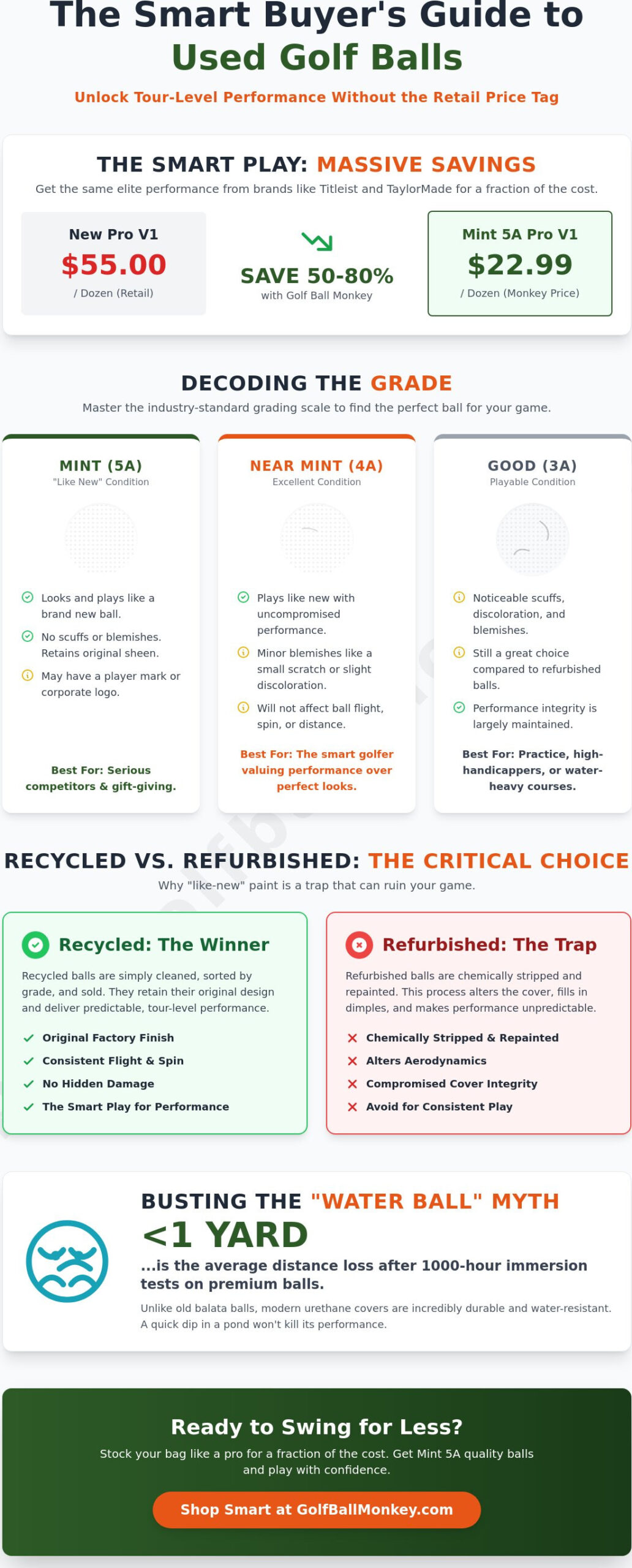
Recycled vs. Refurbished: Why Like-New Paint is a Trap
Don’t let a shiny finish fool you. When you’re learning what to look for when buying used golf balls, the word “Refurbished” should be a massive red flag. At Golf Ball Monkey, we only deal in recycled balls for a very specific reason. There is a huge difference between a ball that has been cleaned and one that has been surgically altered. Recycled balls are professionally retrieved, hit with ultrasonic cleaning, and hand-sorted. They keep their original factory cover and high-performance urethane. Refurbished balls are the Frankensteins of the fairway. They get sandblasted and repainted to look new, but the performance is often trashed in the process.
The refurbishing process involves stripping the original clear coat and applying a fresh layer of paint. This might make the ball look pristine, but it’s a “sucker play” for your scorecard. Manufacturers spend millions perfecting the aerodynamics of their dimple patterns. When a third party sprays on a new coat of paint, they fill in those dimples. This kills your lift and creates erratic flight patterns. You might save a few bucks, but you’ll lose them in the woods when your ball doesn’t fly true. You can find high-quality, non-altered options in our Mint 5A collection.
Aerodynamics and Dimple Depth
Physics doesn’t care how pretty your ball looks. Dimples are engineered to create a thin turbulent boundary layer of air that clings to the ball’s surface. This reduces drag and increases lift. Even a tiny variation in dimple depth can cause your 2026 TaylorMade TP5 to drop out of the sky ten yards early. The original manufacturer’s cover is the most critical part of the ball’s design. Thick, aftermarket paint jobs ruin the “micro coating” technology found in modern 2026 models. For a deeper dive into why the cover matters, check out our guide on Recycled vs Used Golf Balls: What’s the Diff?
Spotting the Refurbished Fakes
The most dangerous part of a refurbished ball is what the paint hides. Structural failures like hairline cracks in the cover or core are easily masked by a fresh coat of white paint. A recycled ball shows you exactly what it is. If it has a crack, it gets tossed during our rigorous hand-sorting process. To protect your game, you need to know what to look for when buying used golf balls at other shops. Look for the “Refurbished” or “Refinished” stamp on the side. Check the logos; if they look dull, blurry, or the paint feels slightly tacky, put them back. We only sell 100% recycled balls because the Monkey wants you to play with the same integrity the pros do.
The 5-Point Inspection: What to Look for Before You Buy
Finding a massive bargain shouldn’t be a guessing game. When you’re ready to restock your bag, you need a system. Our 5-point inspection is the exact protocol the Monkey uses to vet every batch of inventory. Mastering what to look for when buying used golf balls keeps you from wasting cash on duds that won’t fly straight. Follow these steps to ensure your “steal” actually performs like a champion on the green. It’s the only way to guarantee you’re making the smart play.
- Step 1: Surface Integrity. Run your thumb over the cover. You are looking for deep scuffs that cut through the urethane layer. If the dimple edges are sharp and the texture is smooth, the ball is golden.
- Step 2: Discoloration. A little dirt is fine; a “mud stain” washes off in seconds. Look out for “burn” or deep yellowing. That is permanent UV or chemical damage from sitting in a hazard for too long.
- Step 3: The “Click” Test. Drop the ball on a concrete floor. It should produce a crisp, high-pitched “click.” A dull, hollow thud often signals a cracked internal core or a waterlogged center.
- Step 4: Logo and Marking Check. Keep an eye out for corporate logos. These are often “corporate overstock” balls. Companies buy them in bulk, hand them out at events, and they get lost on the very first hole. They’re a total steal.
- Step 5: Seller Reputation. Avoid the “mystery bag” trap from random eBay sellers. Professional divers use ultrasonic cleaners and rigorous hand-sorting. This is the only way to guarantee consistency in every dozen.
Identifying Cover “Burn” and Scrapes
Distinguishing between a ball that played 18 holes and one that hit a cart path is vital for your score. A cart path scrape is jagged and deep. It ruins your putting alignment and creates unnecessary drag in the air. Minor surface scuffs are usually fine for your mid-iron game, but they shouldn’t be on your 5A Mint balls. Interestingly, a “player mark” from a Sharpie is actually a sign of a high-quality, high-spin ball. It means a serious golfer was playing it, and they likely didn’t keep it in play long enough to wear it out. If you want to see what pro-vetted quality looks like, grab a dozen Mint 5A balls today and feel the difference.
The Hidden Danger of “Range” Balls
Range balls are the ultimate imposters in the used market. Some sellers sneak them into mixed bags to pad their numbers. Look for the “Practice” stamp or those tell-tale stripes. These balls are designed for extreme durability and high-volume washing, not for distance or greenside spin. They have completely different flight characteristics that will sabotage your scorecard. Knowing what to look for when buying used golf balls means spotting these fakes before they hit your bag. Check out our Golf Balls 101 guide to learn more about how cover materials and core tech impact your swing speed and trajectory.
Matching Your Ball to Your Game: Premium Performance at Monkey Prices
The Pro V1 is the undisputed heavyweight champion of the fairway. It is the #1 ball in golf and, unsurprisingly, the #1 used ball we sell. But blindly following the crowd isn’t always the smart play. Part of knowing what to look for when buying used golf balls is matching the ball’s compression and spin profile to your actual swing speed. If you aren’t swinging at 105 mph or faster, a used Bridgestone Tour B RX will likely give you more distance than a Pro V1. It is engineered for the amateur speed, and at Monkey prices, it is an absolute steal.
Don’t get trapped by the “Tour” label if your game doesn’t match the specs. A high-compression ball feels like a rock if you don’t have the speed to compress the core. Conversely, high-speed hitters need the stability of a 2026 TaylorMade TP5x or a Titleist Pro V1x to keep their spin rates from ballooning. Getting this right is the difference between a 280-yard bomb and a weak slice into the trees. We’ve vetted every model in our inventory to ensure you get the performance you pay for.
Top Used Brands for Every Player
For those who demand elite consistency, our Titleist Pro V1 Guide breaks down why this ball remains the gold standard for 2026. If you prefer a softer feel around the greens, the Callaway Chrome Soft is a high-value alternative that offers incredible “stop and drop” control. TaylorMade fans usually hunt for the TP5 for its five-layer construction and explosive speed. If you are a high-handicapper looking for the ultimate budget-on-budget play, Kirkland Signature balls provide urethane performance at a price point that makes losing a ball feel like a minor inconvenience rather than a financial disaster.
Stocking Your Bag the Monkey Way
The smartest financial move you can make for the 2026 season is buying in bulk. Why buy a single dozen when you can grab a 50-pack or a 100-pack of your favorite model? You can easily stock your bag for the entire year for under $100. This is the ultimate “smart play” that takes the stress out of every hazard-heavy hole. When you know what to look for when buying used golf balls, you realize that bulk buying recycled 5A Mint balls is the only way to play premium gear without the premium guilt.
High-handicappers should consider the “Mixed Bag” strategy. It lets you test different brands and models to see which one actually clicks with your swing. Once you find your “soulmate” ball, come back and load up on a bulk order of Mint 5A quality. Ready to stop overpaying and start playing better? Shop the full Monkey collection and start saving today!
Take Control of Your Scorecard and Your Wallet
You now have the roadmap to the ultimate smart play on the course. Understanding exactly what to look for when buying used golf balls means you never have to choose between elite performance and a reasonable budget again. Stick to the 5A Mint grade for that “straight from the box” feel. Always prioritize recycled balls over the refurbished trap to ensure your 2026 gear maintains its factory aerodynamics. Confidence comes from knowing your equipment is vetted by the best in the business.
Since 2014, our industry-leading experts have served as the savvy insider for golfers nationwide. Our professional divers harvest millions of balls annually; each one undergoes a rigorous 5 stage hand sorting and cleaning process. We take the guesswork out of the grading scale so you can focus on your swing. It is time to stop flushing cash down the hazard and start playing with the same high performance urethane the pros use for a fraction of the cost.
Stop overpaying for your balls; grab a Mint 5A dozen at Golf Ball Monkey!
Now get out there and swing with total freedom. The Monkey has your back for every round.
Frequently Asked Questions
Do used golf balls lose distance if they have been in the water?
Modern golf balls do not lose significant distance after being submerged. Tests conducted in 2024 show that even after 1000 hours underwater, the distance loss is less than 1 yard. This is totally imperceptible to 99% of golfers. The core remains protected by the waterproof urethane cover, so you still get that explosive “pop” off the tee without the retail price tag.
What is the difference between Mint 5A and Near Mint 4A grades?
Mint 5A balls are virtually indistinguishable from new, while Near Mint 4A balls have minor cosmetic imperfections. A 4A ball might have a small felt tip mark or a tiny surface blemish that occurred during a single hole of play. Neither grade suffers from performance loss. Knowing what to look for when buying used golf balls means recognizing that a 4A ball is the best value for your weekend round.
Are refurbished golf balls the same as recycled golf balls?
Recycled balls are simply cleaned and sorted; refurbished balls are stripped and repainted. Refurbishing often fills in the dimples and ruins the aerodynamics of the ball. We only sell recycled balls because they maintain the original factory integrity. You get the real deal, not a sandblasted imposter with a fake finish that could sabotage your flight path.
How many rounds can I play with a high quality used golf ball?
You can typically play 36 to 54 holes with a high quality used ball before the cover shows significant wear. Modern covers are incredibly resilient to high swing speeds. Unless you hit a cart path or a tree, a Mint 5A ball will last just as long as a new one. It is the smartest way to keep your bag stocked for the 2026 season.
Is it better to buy used premium balls or brand new budget balls?
Used premium balls offer far better greenside control than brand new budget balls. Budget balls use Surlyn covers that are hard and low spin. A recycled Titleist Pro V1 or TaylorMade TP5 provides the “stop and drop” spin you need to score. Choosing premium recycled gear is the ultimate insider secret to lowering your handicap without spending a fortune.
Can I use used golf balls in a professional or amateur tournament?
Yes, recycled golf balls are perfectly legal for tournament play. As long as the original model is on the USGA Conforming List, you are good to go. Most amateur tournaments follow standard USGA rules which allow for used equipment. Just avoid refurbished balls, as the repainting process can sometimes lead to disqualification under specific equipment regulations.
How do I know if a used golf ball has a cracked core?
The “Click Test” is your best tool for identifying internal damage. Drop the ball from waist height onto a hard concrete surface and listen closely. A healthy ball makes a sharp, high pitched “click” sound. If you hear a dull, hollow thud, the core is likely compromised or waterlogged. This is a vital part of what to look for when buying used golf balls from unverified sources.
Why do some used golf balls have corporate logos or player markings?
Logos and player markings usually indicate “corporate overstock” or balls that were lost almost immediately. Companies buy thousands of balls for outings and hand them out to players who might lose them on the first swing. These markings have zero impact on aerodynamics or spin. They are actually a “green light” for quality because they often signify the ball has very little flight time.
Is It Safe to Buy Used Golf Balls Online? The Savvy Golfer’s Guide to Savings
What if you could stop lighting fifty-dollar bills on fire every time you slice a brand-new Titleist into the woods? With an estimated 300 million golf balls lost in the US every single year, the smart play isn’t buying retail. It’s raiding the lost-and-found at a fraction of the cost. As online sales hit 52% of all golf equipment purchases in 2025, one question keeps every savvy player awake at night: is it safe to buy used golf balls online or are you just buying a box of water-logged duds?
We know the frustration of watching an expensive ball disappear into a murky hazard. It’s a gut punch to your wallet that takes the joy out of the game. We’re here to prove that buying used isn’t just a bargain; it’s the ultimate insider secret to playing premium gear like Pro V1s for as low as $25.99 per dozen. This guide breaks down the performance truth, explains why you must avoid refurbished balls at all costs, and reveals the grading secrets to getting Mint 5A quality at Monkey prices. Restock your bag with confidence and keep your cash for the 19th hole.
Key Takeaways
- Understand the “One Hit” reality and why used balls maintain the same flight and spin as brand-new retail versions.
- Discover how modern polymer covers have killed the water-logged myth, keeping the core dry and your distance explosive.
- Determine once and for all is it safe to buy used golf balls online by learning why recycled balls beat refurbished ones every time.
- Follow a 5-point checklist to verify sources and demand clear grading scales like Mint 5A to guarantee five-star quality.
- Slash your equipment spend and grab premium brands at Monkey prices without sacrificing a single yard of distance.
The Used Golf Ball Stigma: Is It Safe for Your Scorecard?
The stigma is real. Many golfers believe that if a ball isn’t pulled fresh from a sleeve of retail-priced Titleists, it’s somehow compromised. But let’s look at the numbers. The used ball market is exploding, with an estimated 500 million golf balls sold annually. This shift is happening because players are finally asking: is it safe to buy used golf balls online or am I sabotaging my handicap? The answer depends on how you define safety. In this game, safety means maintaining consistent flight, spin, and durability characteristics every time you make contact.
There’s a psychological barrier to playing “second-hand” gear, but it’s time for a reality check. We call it the One Hit reality. The very second you tee off with a brand-new, six-dollar ball, it becomes a used ball. It has been struck, compressed, and potentially scuffed. If you wouldn’t throw that ball away after the first hole, you’ve already admitted that a used ball is perfectly safe for your scorecard. The only difference is the price tag.
What Actually Happens to a Ball After Use?
Modern Golf ball design and construction has advanced significantly over the last decade. Today’s multi-layer balls are built with resilient cores and tough urethane covers designed to withstand incredible forces. These materials don’t just “expire” because they spent a few hours in the rough. The urethane cover acts as a shield, protecting the core’s integrity from moisture and impact. Structural safety is the ball’s ability to remain spherical and balanced under 100+ mph impact. Unless a ball has a deep, visible crack or is severely out of round, its internal engine remains ready to fire.
New vs. Used: The Performance Gap
Launch monitor data tells a story that retail brands don’t want you to hear. When comparing new Pro V1s to high-grade used versions, the statistical difference is negligible for the vast majority of players. In fact, 95% of golfers won’t see a measurable difference in yardage or spin rates between a new ball and a Mint 5A recycled ball. While a major scuff can impact aerodynamics, internal damage is incredibly rare in modern manufacturing. If the cover looks clean, the ball is going to fly true. You can find these top-tier performers in our online shop at a fraction of the cost you’d pay at a pro shop. Stop paying for the packaging and start playing for the performance.
The Water-Logged Myth: Does 24 Hours in a Pond Kill Distance?
Every golfer has experienced that sinking feeling. You watch a brand-new ball disappear into a murky pond and think, “There goes five bucks.” The common fear is that once a ball hits the water, it starts soaking up liquid like a sponge, destroying its core and killing your distance. If you are wondering is it safe to buy used golf balls online when they might have been submerged, the answer is a resounding yes. Modern manufacturing has turned the “water-logged” ball into a ghost story from the 1980s that just won’t die.
Current testing data proves the fear is overblown. Research shows that even after significant submersion, the loss of carry distance is typically under 1.5 yards. For the average player, that is a statistical zero. While you might worry about a little pond water, independent testing of refinished golf balls reveals that repainted “refurbished” balls are the real threat to your game. These altered balls often fail to meet USGA standards, while recycled water balls stay true to their original high-performance specs.
The Science of Modern Ball Covers
Back in the day, balls were wound with rubber bands around a liquid center. If the cover breached, water got in and the ball was toast. Today, we play with solid-core technology. Materials like Surlyn and Urethane act as high-tech moisture barriers. They are essentially waterproof. These polymers are designed to resist the elements, meaning water cannot penetrate the core during a short stay in a hazard. Interestingly, temperature affects your ball’s performance far more than moisture ever will. A ball sitting in a hot trunk at 100 degrees loses more “pop” than one sitting in a cool 60-degree pond.
Freshness Matters: The Recovery Cycle
The Monkey doesn’t sell balls that have been sitting at the bottom of a lake since the Clinton administration. High-traffic courses have an incredible turnover rate. Professional divers recover these balls on a weekly or bi-weekly basis. Because golfers lose balls so frequently, the inventory in a water hazard is constantly refreshed. Most balls we recover have been underwater for days, not years. This rapid recovery cycle ensures the core remains pristine and the cover stays bright. Learn how we source our Titleist Pro V1 inventory to see why our retrieval process keeps quality at a five-star level. If you want tour-level performance without the retail sting, it is time to grab a bag of recycled gems and start saving.
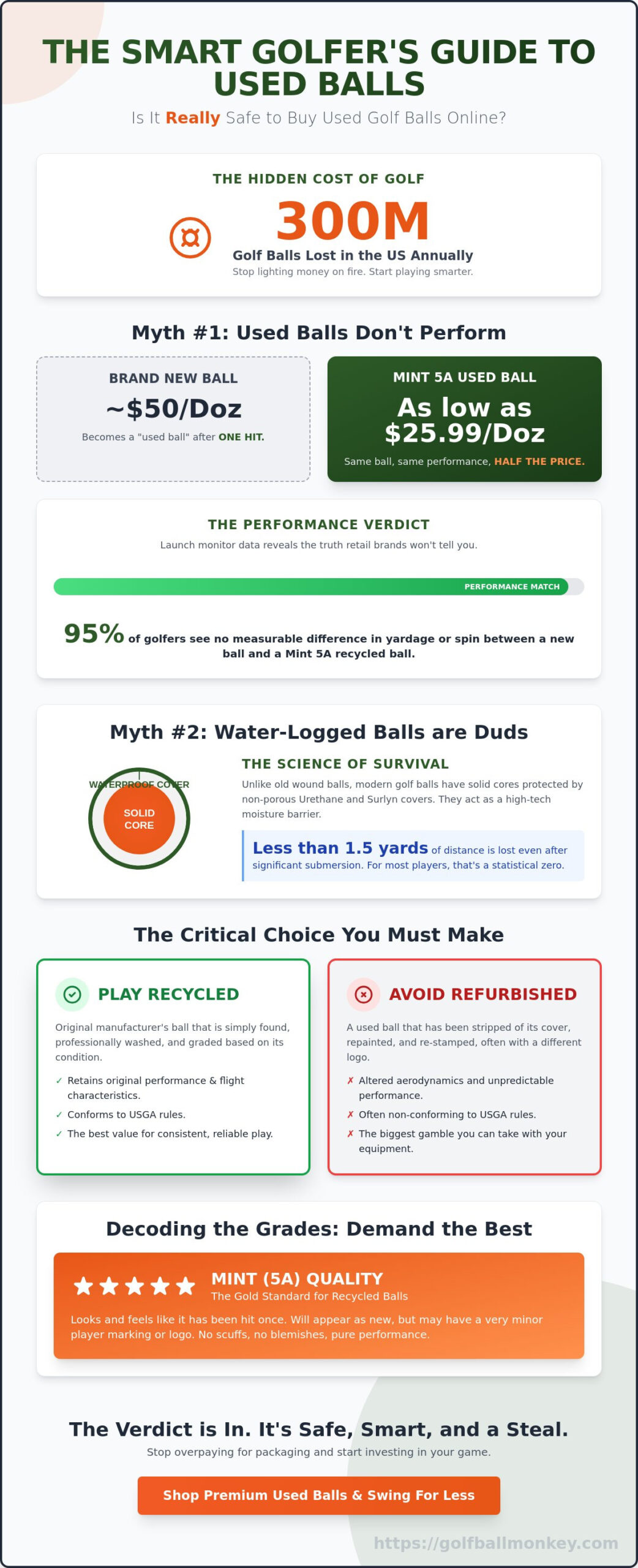
Refurbished vs. Recycled: The Trap You Must Avoid
The golden rule of the used ball market is simple: Recycled is good, Refurbished is a gamble. If you are searching for an answer to is it safe to buy used golf balls online, your success depends entirely on avoiding the “Refurbished” trap. Many retailers use these terms interchangeably, but they are worlds apart in terms of performance. Refurbished balls, sometimes labeled as Refinished, are essentially the Frankenstein’s monsters of the golf world. They are stripped, painted, and sold as new, but they rarely play like the original gear you trust.
Refurbishing isn’t just a quick bath. Companies take beat-up, scuffed balls and sandblast the original cover to remove imperfections. Then, they spray on a fresh layer of white paint and stamp on a new logo. It looks like a brand-new Pro V1, but it’s a wolf in sheep’s clothing. This extra layer of paint fills in the dimples. On a premium ball, dimples are only about 0.010 inches deep. Adding even a thin coat of paint can change that depth by 20% or 30%. Because dimples are precision-engineered for lift and drag, filling them in ruins aerodynamic consistency. You might hit a perfect drive that suddenly drops out of the sky or wobbles like a drunk bird. Just as Lockpick Pros helps enthusiasts understand the hidden mechanical challenges in security pins, being aware of the internal state of your golf gear is essential for consistent performance.
Look for the fine print before you click buy. Legitimate sellers are required to disclose if a ball has been refinished. Often, you’ll see a small “Refurbished” stamp near the brand logo, or the packaging will use terms like “Reload” or “Refinished.” If the price looks too good for a ball that looks suspiciously shiny and perfect, it has likely been through the paint booth. The Monkey says: if it’s painted, walk away. You’re better off playing a scuffed original than a pretty fake.
Why Recycled Balls are the ‘Smart Play’
Recycled balls are exactly what they sound like. They are recovered, washed with mild soap, and sorted into quality buckets based on their original condition. No sandblasting. No repainting. You get the manufacturer’s original engineering exactly as it was intended. A Mint 5A recycled ball is the ultimate steal because it preserves the exact spin rates and launch angles of a retail ball. It’s the same ball you’d buy in the pro shop, just without the fancy box and the 50% markup.
The Hidden Dangers of Refinished Balls
The paint on refurbished balls doesn’t just ruin the flight. It hides the truth. A fresh coat of white can cover up deep structural cracks or core damage that would be obvious on a recycled ball. This leads to knuckleballs—shots that have zero spin and zero predictability. You don’t want to be standing over a 150-yard approach shot wondering if your ball is going to behave. For a guaranteed win, stick to the real deal. Check out our guide on Mint 5A vs other grades to see why our grading scale is the only one the Monkey trusts for five-star quality.
How to Safely Buy Golf Balls Online: A 5-Point Checklist
Buying used balls online shouldn’t feel like a high-stakes gamble at a shady casino. You want the massive savings without the stress of opening a box of junk. To answer the burning question, is it safe to buy used golf balls online, you just need a solid vetting process. Even with online sales hitting 52% of all golf equipment purchases in 2025, not every seller plays by the same rules. Follow this 5-point checklist to ensure every delivery is a win for your bag.
- Step 1: Demand a Clear Grading Scale. Look for the industry-standard 5A (Mint) through 3A (Good) system. If a site just says “Used” without a detailed breakdown, keep clicking.
- Step 2: Verify the Source. Ask where the balls come from. Reliable sellers, like those in our online shop, often recover the balls themselves using professional divers. This ensures a fresh recovery cycle.
- Step 3: Check the Return Policy. Safe sellers offer a satisfaction guarantee. If the balls arrive and don’t match the promised grade, you should be able to send them back without a fight.
- Step 4: Look for Real Photos. Avoid sites that only use high-gloss stock images from the original manufacturers. You want to see the actual batches of recycled inventory and how the seller classifies their grades.
- Step 5: Audit Customer Reviews. Don’t just look at the star rating. Read the comments. Specifically look for mentions of “grading accuracy” and “consistency” across multiple orders.
Decoding Grading Scales
A “Mint” ball should look and feel brand new. It should have its original luster and zero scuffs. 4A (Near Mint) balls are the ultimate sweet spot for value. These typically feature tiny cosmetic blemishes or a player’s pen mark that won’t affect flight or spin. 3A (Good/Practice) balls are perfect for the range or those casual Sunday rounds where you expect to lose a few in the tall grass. Never buy from a site that doesn’t define its grades. If the seller is vague, the quality will be too.
E-commerce Security for Golfers
Massive savings shouldn’t mean compromising your data. Ensure the site uses reputable payment processors and features the padlock icon in your browser’s address bar. Shipping insurance is also a must for bulk orders. If 12 dozen Pro V1s go missing in the mail, you want to be covered. Remember, “Monkey prices” don’t mean “Monkey business” when it comes to your security. Ready to restock with total confidence? Score a steal on premium balls today and start playing the smart way.
Why Golf Ball Monkey is the Safest Bet in the Game
You’ve seen the data. You know the science. Now, it’s time to act. If you’re still asking is it safe to buy used golf balls online, the answer becomes a definitive “yes” when you cut out the middleman. Most sites buy their inventory from random third parties and hope for the best. We don’t. At Golf Ball Monkey, we have the Diver Advantage. We don’t just sell the balls; we are the ones in the neoprene suits pulling them out of the hazards. This hands-on approach means we know exactly where every ball has been before it ever hits our warehouse.
Our grading process is borderline obsessive. While other guys might slap a “Mint” label on anything that isn’t cracked, our 5A standards are the toughest in the industry. Every single ball passes through our Texas-based quality control center. We inspect for cover integrity, original luster, and structural balance. If a ball doesn’t look like it was just pulled from a fresh sleeve, it doesn’t get the 5A stamp. This dedication to quality is why we can offer massive savings on premium brands like Titleist, TaylorMade, and Callaway without compromising your performance on the green.
The Professional Retrieval Process
Speed is everything in the recovery game. Our professional divers prioritize high-traffic courses to ensure balls are recovered quickly. This limits submersion time and keeps the cores in peak condition. It’s a massive win for your wallet and an even bigger win for the environment. We’ve turned course maintenance into a sustainable cycle that keeps millions of pounds of plastic out of local ecosystems. Shop our latest Titleist Pro V1 (Mint 5A) arrivals to see the results of our latest haul. You get five-star quality while helping us clean up the game we love.
Join the Savvy Golfer Revolution
Stop lighting money on fire at the pro shop. There is no reason to pay full retail for a ball that you might lose on the very next hole. The smart play is joining the community of golfers who prioritize performance over packaging. We stand behind every order with the Monkey Guarantee: play the best gear for a fraction of the cost, or we’ll make it right. It’s time to stop overpaying and start playing with total confidence. Is it safe to buy used golf balls online? With the Monkey, it’s the safest bet you’ll ever make on the course. Restock your bag now and save up to 70% off retail!
Stop Overpaying and Start Playing Smarter
Stop lighting cash on fire at the pro shop. You’ve seen the science. Modern solid-core balls don’t soak up water, and a 1.5-yard distance loss is basically zero for 95% of players. The real danger isn’t water; it’s the “refurbished” paint trap that ruins your aerodynamics. By sticking to recycled gear and a clear 5A grading scale, you’ve cracked the code to tour-level performance without the retail sting.
So, is it safe to buy used golf balls online? It’s the smartest play you’ll make all season. At Golf Ball Monkey, our professional divers recover inventory daily to ensure freshness. Every batch passes through our rigorous 5-star grading system at our Texas headquarters before shipping fast to your door. The Monkey personally vets every ball so you can focus on your swing, not your wallet.
Score Tour-quality balls at Monkey prices, Shop the collection now!
Grab a bag of recycled gems and keep your extra cash for the 19th hole. See you on the fairway.
Frequently Asked Questions
Are used golf balls really as good as new ones?
High-grade used balls perform identically to new ones for 95% of golfers. Launch monitor data proves that a Mint 5A ball maintains the same spin, launch angle, and carry distance as a retail version. Unless you’re a high-level scratch player, you won’t see a measurable difference in your yardage. It’s the same premium technology for a fraction of the cost, making it the smartest play on the course.
What is the difference between recycled and refurbished golf balls?
Recycled balls are washed and graded in their original condition, while refurbished balls are sandblasted and repainted. We strongly recommend avoiding refurbished balls because that extra layer of paint ruins aerodynamic consistency. It fills in dimples and causes unpredictable flight patterns. Recycled balls are the only way to guarantee you’re playing the manufacturer’s original engineering. They are safe, reliable, and way cheaper than new ones.
Can you tell if a golf ball is water-logged?
You can’t tell by looking, but the good news is that modern solid-core balls don’t really get water-logged. Tests show that even after 1,000 hours underwater, the loss of carry distance is typically less than 1.5 yards. If the cover is intact and the ball isn’t severely discolored, it’s ready for the fairway. Our divers pull these out quickly to ensure the core remains in peak condition before any moisture can penetrate.
Do used golf balls lose their ‘pop’ or compression over time?
No, modern polymers and solid cores are designed for extreme durability. A ball’s compression remains stable for years unless it’s exposed to extreme heat, like 100-degree temperatures in a car trunk. Normal storage and use won’t kill the “pop.” This is why is it safe to buy used golf balls online even if they are a few seasons old. You get the same explosive feel off the tee every time you swing.
Is it legal to use used golf balls in tournaments?
Yes, it’s perfectly legal under USGA rules for all levels of amateur play. The 2026 rule updates focus on elite professional competition and don’t restrict recycled balls for the rest of us. As long as the ball is on the USGA Conforming List, you’re good to go. Playing a high-quality used ball won’t get you disqualified from your local club championship or your favorite weekend tournament.
How many hits can a high-quality used golf ball take before it cracks?
A premium urethane-covered ball can typically handle 7 to 10 full rounds of play before the cover shows significant wear. Most golfers lose the ball in a hazard long before it ever loses structural integrity. Unless you hit a cart path or a tree at full speed, the ball stays spherical and balanced for dozens of holes. It’s built to take a beating and keep flying true round after round.
What does ‘Mint 5A’ grade actually mean?
Mint 5A is our highest quality grade and means the ball looks and plays like it was just pulled from a new sleeve. There are no scuffs, no blemishes, and no player markings. It’s the gold standard of recycled gear. Buying this grade ensures you get five-star quality at a massive discount compared to retail prices. The Monkey personally vets these to ensure they meet our strict performance standards.
Why is buying used golf balls better for the environment?
It keeps millions of pounds of plastic out of local ecosystems and water hazards. With 300 million balls lost in the US every year, recycling prevents these non-biodegradable materials from sitting in ponds for decades. Choosing recycled gear is a win for the planet and your wallet. It’s the ultimate sustainable play for the modern golfer who wants to save money while protecting the course for the next generation.
Cheap Used Golf Balls: The Savvy Golfer’s Guide to Premium Performance (2026)
Why are you handing five dollars to the local pond every time you slice a brand-new Pro V1 into the drink? It’s a gut-wrenching feeling that ruins your scorecard and your wallet. You want the elite distance and spin of a premium ball, but searching for cheap used golf balls usually feels like a gamble. Paying fifty-five dollars for a dozen new balls is a total scam when one bad swing flushes that investment away. We’ve all been there, standing over a hazard with “new ball anxiety” instead of focusing on the pin.
It’s time to stop paying the “new ball tax” for good. This guide shows you how to score premium performance for a fraction of the cost. The Monkey has vetted the industry secrets to help you save 50 to 90 percent off retail prices without sacrificing a single yard of carry. We will break down the crucial difference between recycled and refurbished gear, explain why Mint 5A grading is your new best friend, and reveal exactly where to stock your bag for the 2026 season.
Key Takeaways
- Stop overpaying for marketing budgets and learn how to dodge the “new ball tax” on every round you play.
- Bust the water-logged myth and discover why modern solid-core technology keeps your performance factory-fresh for less.
- Master the grading scale to find cheap used golf balls in Mint 5A condition that look and play like they are brand new.
- Identify which premium brands like Titleist and Callaway offer the deepest discounts and the best value for your bag.
- Learn how professional hand-inspections ensure you get high-quality gear with absolutely “no Monkey business” involved.
The Real Cost of New Golf Balls: Why You’re Paying Too Much
Stop burning cash on the tee box. When you drop $55 on a dozen premium balls, you aren’t just paying for urethane and speed. You’re paying the “New Ball Tax.” Major manufacturers spend over $50 million annually on pro endorsements and flashy TV commercials. That massive marketing budget is baked into every sleeve you buy. You’re essentially subsidizing a pro’s multi-million dollar contract every time you tee up a brand-new ball. It’s a steep price for a piece of gear that might end up in a lake ten minutes later.
The reality of the game is expensive. Statistics from the National Golf Foundation suggest that golfers lose roughly 420 million balls every single year in the United States alone. For the average 15-handicapper, that translates to about 4.5 balls lost per 18-hole round. If you play 25 rounds a year, you’re watching 112 balls disappear into the tall grass. At retail prices, that’s over $500 literally vanishing. Switching to cheap used golf balls turns that financial leak into a strategic advantage.
Performance doesn’t evaporate just because a ball touched the water. Testing shows that a high-end ball retrieved from a hazard retains its flight characteristics and spin rates almost perfectly. While the history of the golf ball shows we’ve moved from wooden spheres to complex multi-layer designs, the core physics remain stable. Plus, playing recycled gear is the greenest move you can make. It keeps plastic out of our ecosystems and gives a second life to perfectly good equipment.
The Economics of the Tee Box
The math is undeniable. A retail Pro V1 costs about $4.58 per ball. If you slice one into the woods, that’s a five-dollar mistake. “Monkey prices” flip the script, dropping that cost to roughly $1.50 per ball. Over a full season, a golfer losing 4 balls per game saves $308 by making the switch. That’s enough for three extra rounds at a premium resort or a brand-new wedge. You can shop our inventory to see these savings in real-time. It’s the ultimate smart play for your wallet.
Recycled vs. Refurbished: Know the Difference
Don’t get fooled by a fresh coat of paint. Refurbished balls are sandblasted and repainted, which often destroys the original dimple aerodynamics and cover integrity. We generally avoid them because they don’t play true. Recycled balls are the gold standard for savvy players. A Recycled Golf Ball is a ball retrieved and cleaned without altering its original factory finish. You get the original manufacturer’s engineering at a fraction of the cost. It’s pure performance without the retail markup.
Performance Testing: Do Cheap Used Golf Balls Still Fly?
You have seen them at the bottom of the pond. You have heard the locker room rumors. Most golfers think a used ball is a dead ball. They are wrong. Modern ball tech has changed the game completely. The “water-logged” scare is a total relic of the past. Back when balls had wound cores and liquid centers, a quick dip in the lake meant a massive loss of distance. Not anymore. Modern solid-core balls are essentially plastic and rubber powerhouses. They do not drink water.
The 24-hour test proves it. Scientific submersions show that short-term moisture has zero impact on total distance or ball speed. Unless a ball has been sitting in a swamp since the turn of the century, it is going to perform. When you buy cheap used golf balls in Mint 5A condition, you are getting factory-spec performance. These balls maintain their compression and spin rates because the materials are designed to survive high-impact collisions at 120 mph. A little pond water is not going to stop them.
Aerodynamics matter more than age. A clean, high-grade used cover performs identically to one fresh out of a $50 box. If the dimples are intact and the surface is smooth, the lift and drag coefficients remain unchanged. The Monkey does not sell duds; we only move balls that still have their flight integrity. You get the same piercing trajectory for a fraction of the retail cost.
The Science of Modern Ball Construction
Modern balls are built in layers. Most cheap used golf balls feature either a durable Surlyn cover or a high-performance Urethane shell. Surlyn is nearly indestructible, making it perfect for the used market. Urethane provides that “tour feel” and greenside control. The core acts as the engine. These solid polybutadiene centers stay “hot” for years. They do not lose their spring just because they changed owners. For a deeper dive into the tech, check out Golf Balls 101 to see why these materials last so long.
Real-World Distance Comparisons
Launch monitors do not have a bias. When you put a brand-new Pro V1 up against a Mint 5A used Pro V1, the numbers are shocking. Independent robot testing shows less than 1% distance variance between new and high-grade recycled balls. Your smash factor stays consistent because the ball’s internal structure remains resilient. Your swing speed and strike quality matter 100 times more than the ball’s “birthday.” If you want to play the best gear without the “new ball” tax, grab a mesh bag of premium mint balls and let the results speak for themselves on the scorecard.
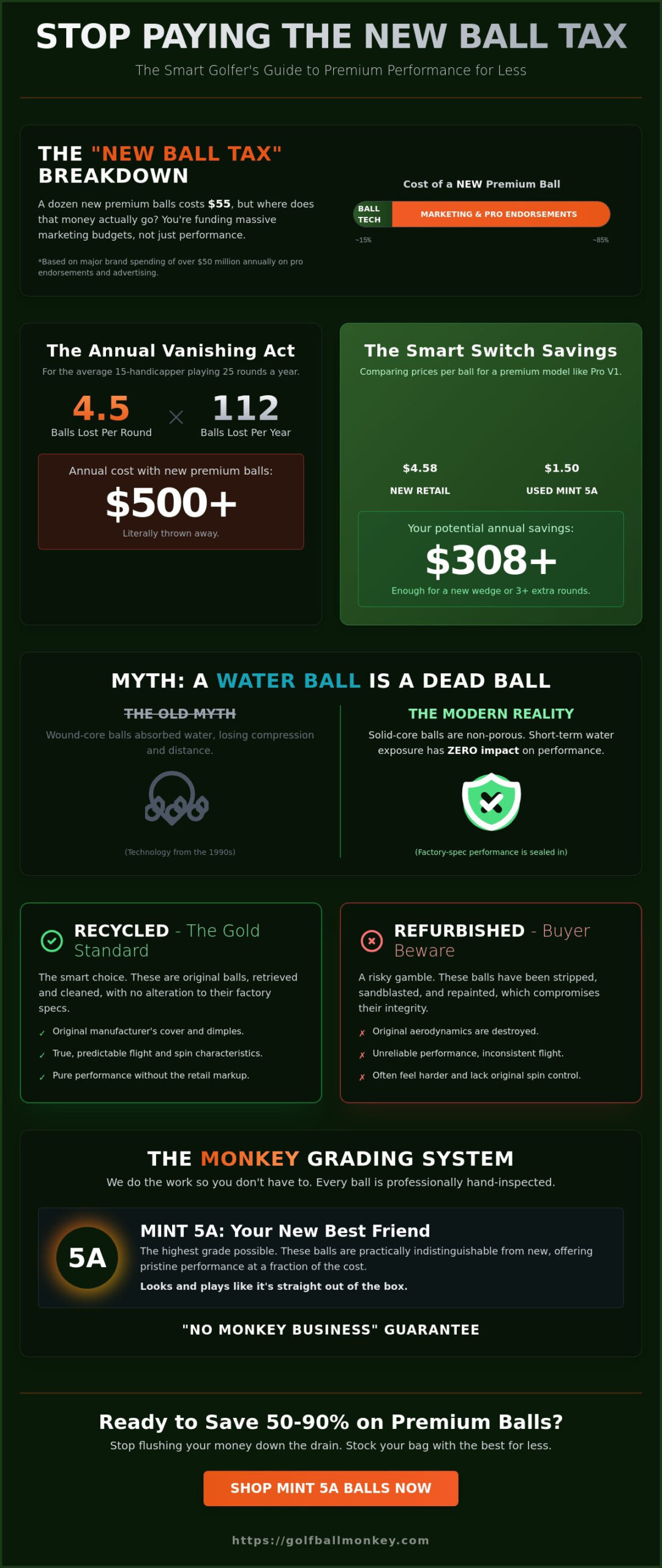
The Monkey Grading System: Finding Your Perfect Match
Stop paying retail prices for shiny cardboard boxes. You’re smarter than that. To master the art of buying cheap used golf balls, you need a grading system you can actually trust. The Monkey doesn’t do guesswork. Every ball is hand-sorted and vetted against strict standards so you know exactly what’s landing on your doorstep. No surprises. Just pure performance at a fraction of the cost.
- Mint 5A: The gold standard. These balls look and feel like they were pulled straight from a fresh sleeve. Expect high gloss and zero scuffs. These are often “one-hit wonders” that someone sliced into the woods on the first tee.
- Near Mint 4A: The savvy golfer’s secret weapon. These have minor cosmetic flaws like a small player mark or a tiny surface scratch. The flight path and spin remains 99% identical to a new ball.
- Good 3A: The ultimate workhorse. These show visible wear and some discoloration. They are the perfect choice for high handicappers or anyone playing a course with more water than grass.
- Shag/Practice: These have seen some battles. Use them for the backyard, the bunker, or the “shag bag” only.
Decoding 5A vs. 4A Quality
Choosing between Mint 5A and Near Mint 4A is the ultimate “smart play.” When you open a bag of 5A, you’ll see factory-level shine. There are no player marks, no logos, and no scuffs. It’s the ball you play when the stakes are high and your ego is on the line. However, 4A is where the real value lives. You might find a corporate logo or a Sharpie dot from a previous owner, but the cover integrity is intact. Use 4A for your weekly rounds or those intimidating forced carries over water. You can see the current inventory and see these differences yourself by Decoding Grades through our live stock. Saving 50% or more on a ball that performs like new is a total steal.
When to Buy Practice Grade
Don’t waste your “gamer” balls on the practice green. Smart players build a dedicated shag bag for backyard chipping or short-game drills. Practice grade balls are the most affordable cheap used golf balls in the warehouse, often selling for pennies on the dollar. If you’re a high-volume hitter working on a swing change, buying these in bulk is a no-brainer. It allows you to focus on your mechanics without worrying about losing a five-dollar ball in the tall grass. Save your 5A Mint balls for the tournament and use the lower grades to grind out your improvements. This strategy keeps your bag stocked and your bank account full. The Monkey personally vets these to ensure that even the practice balls are free from cracks or major structural damage.
Maximizing Value: Which Brands Offer the Best Used Deals?
Golfers lose an estimated 300 million balls every year. That is a mountain of high-end equipment sitting in ponds and woods just waiting for a second life. Buying cheap used golf balls is the ultimate hack for your wallet. You get the same urethane covers and high-tech cores for a fraction of the retail cost. The Monkey has sorted through the bins to find the brands that offer the most bang for your buck.
The “Tour Ball” Tier
Titleist is the undisputed heavyweight champion of the used market. The Pro V1 and Pro V1x are the most played balls in the world; which means they are also the most found. Buying used Pro V1s is the smartest way to lower your equipment spend without sacrificing a single yard of distance. Check out our Titleist Pro V1 Guide to see why this ball remains the gold standard for performance in 2026.
If you want premium feel but want to save even more, look at TaylorMade and Callaway. The TaylorMade TP5 features a unique 5-layer construction that delivers massive spin around the greens. Callaway Chrome Soft is another fan favorite. Because these brands release new versions frequently, older generations hit the used market at deep discounts. You can often find 5A Mint condition Chrome Softs at a 60% markdown compared to a fresh box at a big-box retailer.
- Titleist Pro V1: Best for consistent flight and high resale demand.
- TaylorMade TP5: Best for high-spin players who want a soft feel.
- Callaway Chrome Soft: Best for forgiveness and high-visibility options like Truvis.
Best Value for Average Swing Speeds
Most amateur golfers don’t swing like a pro. If your driver speed is under 95 mph, playing a tour-level ball might actually cost you distance. This is where the “steals” happen. The Srixon Soft Feel and Callaway Supersoft are absolute powerhouses in the 3A and 4A quality grades. These balls are designed for maximum compression and straight flight. They are incredibly durable; making them perfect candidates for the recycled market.
Srixon is often called the “Insider’s Secret” because their quality control is surgical. You can learn more about their lineup in our Srixon Golf Balls Guide. Bridgestone is another value leader. They manufacture their own rubber cores; which leads to incredible consistency. Then there is Kirkland Signature. These 3-piece urethane balls are the ultimate budget-friendly powerhouses. When you find them used, the price per ball drops so low it feels like you are winning the lottery.
Pick a ball that fits your swing. Don’t pay for technology you can’t use. Focus on mid-compression balls if you want more distance off the tee without the “rock-hard” feel of a cheap range ball.
Ready to stop overpaying for your gear? Shop our full collection of premium used balls and keep your cash for the 19th hole.
Why Golf Ball Monkey is the Smart Play for Your Bag
Stop paying fifty dollars for a dozen balls. It is a losing game. You deserve better than retail markups and brand name taxes. Golf Ball Monkey delivers the goods because we control the entire process. We aren’t just a shop; we’re the source. Our divers hit the ponds to find your next favorite ball. We eliminate the middleman to keep prices low. Every order of cheap used golf balls goes through a strict vetting process. No shortcuts. No excuses. We handle the dirty work so you can focus on your swing.
Quality control is our obsession. We don’t do “Monkey business” with our grading. Every single ball is hand-inspected by a human who knows the difference between a scuff and a pearl. We ship across all 50 states with speed and reliability. If your order doesn’t meet your expectations, we make it right. Our satisfaction guarantee is simple: if you aren’t happy, the Monkey isn’t happy. It is that straightforward.
From the Pond to Your Putter
Every ball we find gets a second life. Our eco-friendly retrieval process keeps local courses clean and prevents thousands of units from sitting in the mud for decades. After retrieval, we use a specialized cleaning system. It removes the grime without damaging the cover or the core. Consistency is the goal. Buying direct from the source means you avoid the massive markups found at big box retailers. You get premium performance for a fraction of the cost. It’s a win for your wallet and a win for the environment.
Ready to Restock? Start Here
Restocking your bag shouldn’t be a chore. Visit the Golf Ball Monkey Shop to see our current inventory of cheap used golf balls. We keep the layout simple so you can find your brand and your grade in seconds. If you want the ultimate value, look at the bulk options. Our 48 and 96-ball buckets offer the lowest price per hit in the industry. These buckets are the ultimate strategy for high-handicappers who lose a few balls a round or daily players who want to practice with the same gear they use on the course. Stop overpaying for plastic. Start playing smarter. Grab a bucket today and get back on the green with confidence.
Stop Paying the Pro Shop Tax and Play Smarter
You’ve seen the performance data and you know the score. Dropping five dollars on a single ball that might disappear into a water hazard by the third hole is a bad bet. Switching to cheap used golf balls doesn’t mean sacrificing your backspin, distance, or feel. It means you’re playing the same premium technology for a massive discount. Our professional diver-sourced inventory ensures we recover the world’s best gear from the depths, and we hand-inspect every single find to ensure it meets our strict Mint 5A quality standards.
We recycle over 1 million balls annually; giving you direct access to top-tier performance without the bloated retail price tag. It’s the smartest play you’ll make all season. You get the brands you trust while keeping your wallet heavy for the 19th hole. Stop letting the big equipment brands bully your bank account. Grab your gear, hit the fairway, and play with the confidence of a savvy insider who knows exactly how to beat the system. Your game deserves the best, and your bank account deserves a break. See you on the first tee.
Score “Monkey Prices” on premium used golf balls here!
Frequently Asked Questions
Are used golf balls really as good as new ones?
Independent testing proves that 5A grade balls perform within 1% of new ball distance and spin metrics. The Monkey’s top-tier inventory delivers the same flight path without the retail sting. You save 50% or more compared to pro shop prices. It’s a smart play for your game and your wallet. Trust the data and keep your cash for the 19th hole.
What is the difference between recycled and refurbished golf balls?
Recycled balls are washed and sorted in their original state while refurbished balls are stripped and repainted. We recommend recycled balls because they maintain the factory-original cover and dimple patterns. Research from 2024 suggests that repainted surfaces can occasionally alter aerodynamics. Stick with the Monkey’s recycled stock for authentic performance. You get the real deal every single time.
Will a “water ball” lose distance off the tee?
Modern solid-core balls don’t absorb water even after 24 hours of submersion in a hazard. Testing confirms that a 5A grade ball recovered from a pond retains 99.5% of its original velocity. You won’t see a drop in yardage during your Sunday round. Stop paying for air-sealed boxes and start playing the same tech for less. The physics don’t lie.
How do I know which grade (5A, 4A, 3A) to choose?
Choose 5A for tournament-ready performance and 3A for casual practice rounds. Our 5A Mint balls look like they just came out of the sleeve. 4A Near-Mint balls might have a tiny scuff or a sharpie mark but fly perfectly. The Monkey’s strict grading scale ensures you get exactly what you pay for every time. Pick your level and play with confidence.
Can I buy premium balls like Titleist Pro V1 for cheap?
You can snag Titleist Pro V1s at a fraction of their retail price by choosing cheap used golf balls. We source thousands of premium models that golfers lose after just one swing. You get the same urethane cover and high-spin tech for a steal. It’s the ultimate way to play a tour ball on a local course budget. Don’t let high prices dictate your gear.
Is it safe to buy used golf balls in bulk?
Buying in bulk is the smartest way to lower your cost per round. Most golfers lose an average of 2 balls per 18 holes, so a 50-count or 100-count bag keeps you stocked all season. The Monkey inspects every single ball in our bulk packs to ensure quality consistency. Grab a big bag and stop worrying about the woods. More balls means more swings.
How long does shipping take for my used golf ball order?
Most orders ship within 24 hours and arrive at your door in 3 to 5 business days. We use reliable carriers to get your gear to the clubhouse fast. You’ll receive a tracking number the moment your package leaves the Monkey’s warehouse. Getting cheap used golf balls delivered quickly means you never have to play a scuffed ball again. Fast shipping is our standard play.
What happens if I’m not satisfied with the quality of my used balls?
We offer a 100% satisfaction guarantee on every order to ensure you’re happy with your haul. If the grade doesn’t match your expectations, contact our team within 30 days for a return or exchange. The Monkey stands behind every ball we sort. We want you focused on your birdie putt, not your equipment. Your satisfaction is the only score that matters to us.
Golf Ball Monkey: The Ultimate Insider Guide to Premium Used Golf Balls
Why are you still paying $56.99 for a dozen balls when you know at least three of them are destined for the bottom of the pond on the 14th hole? It is a painful ritual every golfer knows. You crack open a fresh sleeve of Pro V1s, admire that pristine white finish, and then watch $4.58 literally sink out of sight. That is where Golf Ball Monkey changes the game. We believe the only thing that should be "pro" about your gear is the performance, not the retail markup. By snagging premium, Tour-level balls at a fraction of the cost, you are making the smartest play on the course.
You probably agree that the used ball market often feels like a total gamble. It is frustrating to order "Mint" only to receive a bag of scuffed, yellowed rocks that look like they survived a lawnmower. At Golf Ball Monkey, we have fixed that. The Monkey has personally vetted every ball in our inventory to ensure it meets our five-star standards. This guide reveals exactly how we retrieve, scrub, and strictly grade our inventory so you get 5A quality every single time. Discover how to stock your bag with the industry’s best brands for up to 70% off retail prices. We are breaking down our rigorous inspection process and showing you how to play better golf without the financial hangover.
Key Takeaways
-
Stop overpaying for Tour-level gear and discover how golf ball monkey delivers premium performance for a fraction of big-box retail prices.
-
Peek behind the curtain at our professional retrieval process where expert divers harvest lost gems from elite water hazards.
-
Decode the "Monkey Seal of Approval" to confidently choose the perfect grade, from Mint 5A to budget-friendly Good 3A.
-
Optimize your scorecard by matching your unique swing speed with the ideal compression and spin profiles.
-
Lock in the "smart play" with savings up to 70% on the brands you love, delivered fast from our Texas headquarters.
Table of Contents
Who is Golf Ball Monkey? More Than Just a Bargain
Stop overpaying for your gear. It is that simple. Since 2010, Golf Ball Monkey has operated with a singular focus: getting premium equipment into your bag without the premium price tag. We started in Round Rock, Texas, as a small operation with a big vision. Today, we are a national leader in reclaimed golf technology. We don’t just find balls; we rescue them. Our team manages a professional retrieval network that spans the United States. We deploy expert divers into the murky depths of water hazards to recover the high-end Titleist, TaylorMade, and Callaway balls that golfers accidentally leave behind. This isn’t a hobby for us. It is a full-scale operation dedicated to performance and value.
The mission here is clear. We want to strip away the elitism that often chokes the sport. Golf is hard enough without worrying about losing a five-dollar ball on every water hole. By providing a massive inventory of five-star quality recycled options, we make the game accessible for everyone from the weekend warrior to the scratch player. Every ball we sell meets strict quality standards that align with the rules of golf regarding equipment performance. You get the same spin, the same distance, and the same feel for a fraction of the retail cost. It is the smart play. It is the only way to play if you value your wallet as much as your scorecard.
The Texas Roots of a Global Brand
Our journey began in 2010 in the heart of Round Rock. What started as a local Texas hustle has transformed into a global hub for golfers seeking a steal. Our massive Texas warehouse serves as the central nervous system for our inventory. This is where the magic happens. We process millions of balls, sorting them by brand, model, and condition with obsessive detail. Whether you need a bucket of "Mint" Pro V1s or a bag of practice shaggers, our Texas crew ensures they are ready for the tee. We live by the "Golf Ball Monkey Price" philosophy: pay less, play more, and leave the excuses at the clubhouse. We ship worldwide from our home base, bringing high-energy service to every corner of the golfing community.
The Environmental Impact of Reclaiming Bal
Golf Ball Monkey isn’t just your best friend for savings; we are a partner to the planet. Golf balls sitting at the bottom of a pond are more than just a lost stroke. They are a source of plastic pollution that can take centuries to decompose. Every year, our divers remove millions of these balls from local ecosystems. This active removal prevents heavy metals and plastics from leaching into the water and soil. When you buy recycled gear, you are actively reducing the carbon footprint of your Sunday morning round by decreasing the demand for new petroleum-based manufacturing.
-
We rescue over 5 million balls from water hazards annually.
-
Recycling saves approximately 80% of the energy required to produce a new ball.
-
Our process keeps tons of non-biodegradable waste out of landfills.
Our eco-mission is a definitive win-win that protects the natural beauty of the course while putting more cash back into your pocket for the 19th hole.
From the Pond to the Pin: Our Professional Retrieval Process
The journey of a premium used ball starts long before it reaches your bag. It begins in the depths of water hazards at over 125 elite golf courses across the country. We don’t just wait for balls to wash up on the shore. Professional divers hit the water weekly, navigating depths of up to 40 feet to rescue high-end equipment that golfers accidentally left behind. The team at golf ball monkey ensures every ball meets a rigorous standard before it ever hits our warehouse shelves. This isn’t a hobby; it is a precision operation designed to recover the best brands in the game.
Once the balls are back on dry land, they undergo a specialized transformation. We use a proprietary 4-stage non-abrasive cleaning process. Unlike harsh chemical washes that can degrade the cover, our system gently lifts away algae, mud, and mineral deposits. After cleaning, every single ball is hand-sorted by an expert. These specialists identify the exact brand, model, and year of production. This manual touch is vital. It allows us to separate a 2024 Pro V1 from an older version, ensuring you get the exact performance you paid for. Finally, we apply our industry-leading 5-star quality scale. Every ball is graded with surgical precision, so you know if you’re getting a "Mint" 5-star steal or a "Near-Mint" 4-star bargain.
The Myth of the Water-Logged Ball
Many golfers still believe the old wives’ tale that a ball submerged in water is instantly ruined. That might have been true in 1985 when balls had wound cores and balata covers, but modern technology changed the game. Today’s solid-core balls, like the Titleist Pro V1 or the Bridgestone Tour B, are made from advanced polymers and urethane. These materials are essentially waterproof. Independent testing shows that a modern ball submerged for 24 to 48 hours suffers a distance loss of less than 0.5 percent. Because our divers harvest courses every 14 days, these balls don’t sit at the bottom for years. Rescuing these products also highlights the environmental benefits of recycled golf balls by keeping plastic waste out of sensitive aquatic ecosystems.
Why We Never Refurbish (And Why You Should Care)
Refurbished balls are the biggest trap in the industry. To "refurbish" a ball, companies often sand down the original cover and spray it with a fresh coat of paint. This process is a disaster for your scorecard. That extra layer of paint fills in the dimples, which ruins the aerodynamics and kills your spin rates. You might think you’re hitting a premium ball, but it’s actually a compromised shell of its former self. Golf ball monkey only sells recycled balls. This means we never touch the factory finish. You get the original cover, the original dimple pattern, and the original performance. It’s the "Monkey Promise." What you see is the authentic factory finish every single time. If you want tour-level performance without the retail sting, you can check out our latest inventory of authentic recycled gear. We focus on the "smart play" by providing original quality at a fraction of the cost. No paint, no fillers, just pure performance.
Decoding the Grades: What Does ‘Mint 5A’ Actually Mean?
Stop guessing about quality. When you shop at golf ball monkey, you aren’t just buying leftovers. You’re getting the Monkey Seal of Approval. We’ve developed a rigorous grading system to ensure you know exactly what lands on your doorstep. No surprises. No duds. Just pure value. Most golfers can’t tell our top tiers apart from retail products, and that is exactly the point.
Our grading scale creates a clear path for every type of player. The 5A Mint grade represents the pinnacle of recycled equipment. These balls look, feel, and fly like they just came out of a fresh sleeve. Move down to 4A Near Mint, and you’ll find slight cosmetic blemishes that don’t affect flight. If you’re looking for the ultimate bargain, our 3A Good grade offers functional balls with noticeable wear. Extensive research into the performance of used golf balls shows that high-quality recycled options maintain nearly 100% of their original distance and spin characteristics. You get the performance without the 60 dollar per dozen price tag.
Smart golfers play the percentages. Use 5A balls for your weekend tournament or that high-stakes round with your boss. Switch to 4A or 3A for your midweek practice sessions. This strategy keeps your bag stocked for 50% less than your playing partners spend at the pro shop. It is the ultimate savvy move for anyone who hits the links more than twice a month.
The 5A Mint Standard: The Gold Standard
Expect perfection. Our 5A Mint balls feature zero scuffs and zero discoloration. They look like they were hit exactly once before being rescued. This grade is the perfect solution for the golfer who demands Titleist Pro V1 performance but hates the retail sting. You get a ball that is indistinguishable from a new one at a fraction of the cost. Check out Golf Ball Monkey for 5A bulk deals that turn a premium habit into an affordable hobby. We verify every dimple so you can swing with total confidence.
Practice and Shag Balls: The Smart Play for the Range
Stop wasting your premium stash on the practice green. Shag balls are the essential workhorses for your backyard setup or local range. These 3A "Mixed Bags" provide a low-cost entry point for beginners who are still learning to keep it in the short grass. If you’re a high-handicapper who frequently "feeds the woods," these are your best friend. You can lose five balls a round and not feel a single pang of guilt. Our bulk pricing for 3A grades means you can stock up on 50 or 100 balls for the price of one retail dozen. It is the most cost-effective way to get your reps in and lower that score without draining your bank account. Golf ball monkey makes it easy to stay stocked and stay swinging.
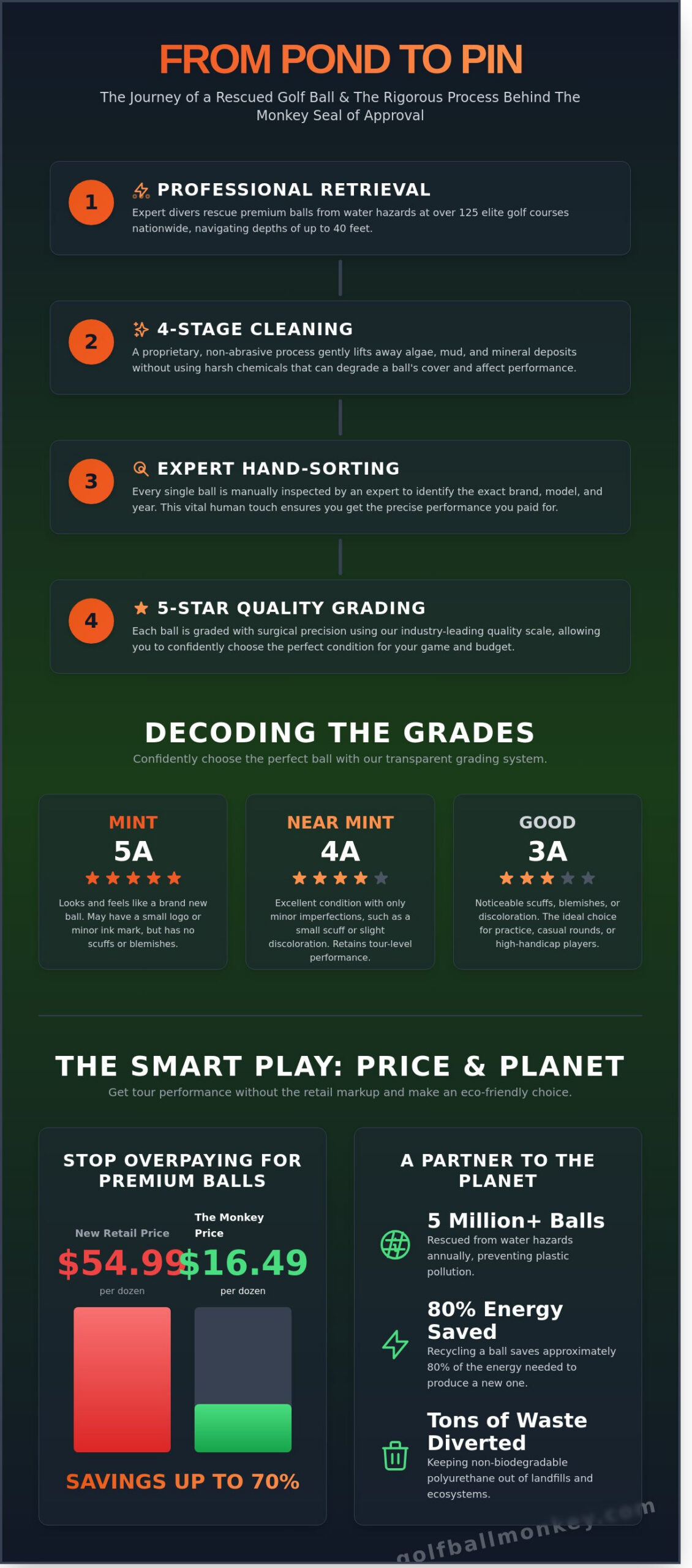
How to Choose the Right Ball for Your Swing Speed
Stop buying balls based on a TV commercial. It’s a trap. Performance isn’t about the logo on the side of the ball. It’s about how that ball reacts to your specific swing. The two biggest factors are compression and spin. If you’re swinging at 85 mph but playing a ball designed for a 115 mph pro, you’re leaving 15 yards on the tee box. That’s a scientific fact. You aren’t compressing the core. You’re just hitting a rock. At golf ball monkey, we help you match your gear to your game without the retail markup.
The goal is simple. You want a ball that maximizes your distance while keeping your shots in the short grass. Most golfers overpay for technology they can’t even use. A high-handicapper playing a tour-level ball is often just paying for extra side spin that turns a slight fade into a massive slice. It’s time to play smarter. Use your head and save your wallet. Our reclaimed inventory lets you test premium tech for a fraction of the cost of new boxes.
The High-Compression Kings: Pro V1 and TP5
These are the heavy hitters. If your driver speed clocks in at 100 mph or higher, you need a high-compression ball. These balls have firm cores that require significant force to activate. Once you do, the ball speed is explosive. They offer incredible greenside control because of their urethane covers. But paying $55 a dozen is insane. You’re going to lose a few. It happens to the best of us. Buying a Titleist Pro V1 in five-star condition from our shop gets you that elite performance for 50% less than retail. It’s the only way to play these premium models every single round without going broke.
Soft Feel and Forgiveness: Callaway Supersoft and Srixon
Most weekend warriors sit in the 80 to 95 mph range. If that’s you, stop hitting tour balls. You need something like the Callaway Supersoft or a Srixon Soft Feel. These balls have lower compression ratings, often falling between 35 and 60. This lower rating allows the ball to compress fully even at moderate speeds. It generates a straighter flight path by minimizing the spin that causes hooks and slices. These are the most popular items in our inventory for a reason. They’re forgiving. They’re long. They’re the backbone of the average golfer’s bag. The Monkey has vetted thousands of these, and they’re ready to help you find more fairways.
Why settle for one brand when you can test them all? The "Monkey Mix" is the ultimate field test for your game. We bundle various premium brands into one package for one low price. It’s the best way to find your soulmate ball without the financial heartbreak of losing a $5 orb in the pond. You might find that a Srixon Z-Star works better for your wedge game than a TaylorMade. With golf ball monkey, you can afford to experiment.
-
High Swing Speed (100+ mph): Stick to Titleist Pro V1, TaylorMade TP5, or Bridgestone Tour B.
-
Moderate Swing Speed (85-95 mph): Look for Titleist Tour Soft, Callaway Chrome Soft, or Srixon Q-Star.
-
Slower Swing Speed (Under 85 mph): Go with Callaway Supersoft, Srixon Soft Feel, or Wilson Duo.
Stop flushing money down the drain on gear that doesn’t fit your swing. The smart play is to buy high-quality, recycled balls that match your actual stats. You get the same distance, the same feel, and a much better bank balance at the end of the month.
Shop the Monkey Mix and find your perfect match today.
Why Smart Golfers Choose the Monkey Price
Stop paying the "pro shop tax" every time you need to restock your bag. There is no reason to drop $55 on a dozen balls when you can get the exact same performance for a fraction of the cost. At Golf Ball Monkey, we’ve perfected the art of the deal. Our customers consistently save up to 70% compared to big-box retail prices. Whether you are hunting for Titleist Pro V1s or TaylorMade TP5s, the "Monkey Price" ensures you never feel that sting of regret when a shot slices into the woods. You aren’t just buying recycled gear; you’re making a calculated move to keep your hobby affordable without sacrificing a single yard of distance.
We operate directly out of our Texas headquarters, which means your gear doesn’t sit in a warehouse for weeks. We process most orders within 24 hours. This logistical speed ensures that a fresh bag of Mint 5A quality balls arrives at your front door in 2 to 4 business days. We maintain a massive, live inventory of the industry’s heavy hitters, including Callaway Chrome Soft and Bridgestone Tour B series. You get the technology you trust from brands that dominate the PGA Tour, delivered with the reliability of a local shop. It is the smartest play you can make before you even reach the first tee.
Join the 15,000 golfers who have already made the "Monkey Move" to smarter spending. These players realized that the only difference between a brand-new retail ball and our 5A Mint recycled balls is the packaging and the inflated price tag. We strip away the marketing fluff and the expensive sponsorships. You get the core, the cover, and the compression you need to score low. It is a no-nonsense approach to the game that prioritizes your wallet and your scorecard simultaneously.
Bulk Buying: The Ultimate Hack for Frequent Players
Serious players know that a single dozen balls rarely lasts a full month of active play. Buying by the bucket or the 50-count bag is the ultimate secret to consistency. When you buy in bulk from golf ball monkey, you eliminate the mid-round anxiety of running low on supplies. We also provide wholesale opportunities for driving ranges and local golf clinics that need high-quality inventory without the retail markup. The math is simple and undeniable. A single bulk order of 50 Mint-grade balls saves you approximately $140 compared to retail. That is enough cash to cover your next three rounds of greens fees at a $45 local course. You aren’t just saving money; you’re literally buying more time on the grass.
Ready to Swing for Less?
Stop donating $5 bills to the bottom of the pond. Every time you lose a retail-priced ball, you’re throwing away a gourmet sandwich or a post-round drink. Play smarter by choosing 5A quality gear that looks and feels brand new. Don’t forget to grab our performance tees and accessories while you’re at it. They are the perfect bag-stuffer to ensure you’re fully equipped for your next 18 holes. The G****olf Ball Monkey team has vetted every item in our shop to ensure it meets our strict grading standards. High performance shouldn’t be a luxury reserved for the elite. Grab your gear, save your cash, and hit the links with total confidence.
Shop the latest Mint 5A arrivals at Golf Ball Monkey today!
Stop Overpaying for Your Next Birdie
Stop paying $55 for a dozen balls that might end up in the pond by the third hole. Our staff of professional divers works daily to recover the best equipment from the deep, bringing every find back to our warehouse in Round Rock, Texas. We apply a strict 5-star grading system to every single ball we process. This ensures your Mint 5A order looks, feels, and flies exactly like it just came off the retail shelf. You get 100% of the performance for a fraction of the cost. When you choose golf ball monkey, you’re joining a community of savvy players who refuse to pay the "new ball" tax. Our retrieval process eliminates the middleman and passes those massive savings directly to your bag. It’s time to stop stressing about the water hazards and start focusing on your short game. Grab your favorite brands, trust our rigorous inspection, and play your best round yet.
Join the Monkey Crew and Save 70% on Premium Balls Now!
We’ll see you on the first tee; keep swinging and keep saving.
Frequently Asked Questions
Are used golf balls as good as new ones?
High-grade used balls perform nearly identically to new ones. Independent testing shows premium used balls lose less than 1% of total distance compared to box-fresh versions. You get the same urethane cover and core compression for 60% less money. It’s the smart play for your scorecard and your wallet. Stop paying the "new ball tax" when the performance is exactly the same on the green.
Do golf balls lose distance if they have been in water?
Modern golf balls only lose distance if submerged for over 100 hours. Research indicates that a ball sitting in a pond for 24 hours sees 0% performance drop. We source our inventory fast to ensure core stability. The Monkey rejects any waterlogged duds. You still hit those 250-yard drives but without the $5 per ball sting. Our 5A grade balls fly true every single time.
What is the difference between recycled and refurbished golf balls?
Recycled balls are washed and sorted in their original condition, while refurbished balls are stripped and repainted. We focus on recycled balls because they maintain the manufacturer’s original factory finish and flight characteristics. Refurbished balls often hide scuffs under 2 layers of paint, which can affect spin rates. Stick with recycled balls to keep your game honest and your flight path predictable every round.
What does 5A Mint grade mean at Golf Ball Monkey?
Our 5A Mint grade is the gold standard, representing balls that look and feel brand new. These balls have zero scuffs and no discoloration. They look like they were hit exactly once before landing in the tall grass. Buying 5A grade from golf ball monkey means grabbing a Pro V1 for $2.25 instead of the $4.50 retail price. It’s the ultimate steal for the serious stick.
How much can I save by buying used golf balls?
You typically save between 50% and 80% off retail prices when shopping with us. A dozen premium balls at a big-box store costs $55 plus tax; our price for the same dozen in 4A condition is often $18. That leaves an extra $37 in your pocket for your next green fee or a round of drinks at the 19th hole. It’s the easiest way to cut your golf budget.
Does Golf Ball Monkey ship internationally?
We currently ship to all 50 U.S. states and 10 provinces in Canada. Orders usually leave our warehouse within 24 hours of placement. We use flat-rate shipping to keep your costs predictable. If you’re outside North America, check our shipping page for updated 2024 carrier rates and available regions. Every shipment is tracked so you know exactly when your haul arrives at your front door.
What is the best golf ball for a beginner to buy used?
The Titleist Velocity or Srixon Soft Feel are the best choices for beginners due to their low spin and high launch. These 2-piece balls help 85% of high-handicappers keep the ball in the fairway. Since beginners often lose 4 balls per round, buying from golf ball monkey keeps your hobby affordable. Grab a 48-pack and focus on your swing instead of your bank account or the water hazard.
Can I buy used golf balls in bulk for a driving range?
Yes, we offer bulk bags of 500 or 1,000 balls specifically for practice and range use. These are usually Grade C or "Practice" quality, perfect for hitting into a field or a net. You pay as little as $0.15 per ball for these massive bulk orders. It’s a huge win for course owners or backyard warriors looking to build a home practice station without spending thousands.
Budget Friendly Golf Balls: The Savvy Golfer’s Guide to Huge Savings
Every time you slice a five-dollar Pro V1 into the deep woods, you’re essentially tossing a steak dinner into the weeds. It hurts. We’ve all stood on the tee box, watching sixty dollars worth of inventory disappear into a water hazard before the back nine even starts. You need a better way to sharpen your game without draining your wallet. That’s why savvy players rely on budget friendly golf balls to get their reps in. These aren’t just scuffed-up junk; they’re your ticket to high-volume training for a tiny fraction of the retail cost.
You likely agree that practicing with “dead” range balls feels like hitting a rock, and paying full retail for shag bag fillers is pure madness. Golf Ball Monkey gets it. We believe you shouldn’t pay a premium for a ball that’s destined for a practice net or a backyard field. This guide shows you how to score premium-brand performance for as little as $0.25 per ball. You’ll learn the exact differences between range, hit-away, and shag grades so you can save 70% or more versus those big-box store prices. It’s time to stock up, swing hard, and stop worrying about where the ball lands.
Key Takeaways
- Stop burning cash on retail prices and learn how to secure budget friendly golf balls that deliver premium-brand feel for a fraction of the cost.
- Avoid the “Range Ball Syndrome” trap by discovering why practicing with a single model is the secret to consistent yardages and better performance.
- Get the truth about recycled balls and why modern multi-layer technology means you can score a total steal without sacrificing performance.
- Learn how to build the ultimate practice kit using the “magic number” of balls to maximize every minute spent on the grass.
Table of Contents
What Exactly Are Practice Golf Balls? Defining Your Options- The Secret to Budget Friendly Practice Golf Balls: The Recycled Advantage
- Practice Like You Play: Why Brand Matters Even in the Shag Bag
- How to Build the Ultimate Practice Kit for Less
- Why Golf Ball Monkey is Your Practice Partner
What Exactly Are Practice Golf Balls? Defining Your Options
Key Takeaways
- Stop wasting money on retail practice balls and switch to budget friendly golf balls for serious savings and performance.
- Learn the differences between range balls, shag bag balls, and hit-away balls for effective training.
- Understanding recycled balls can provide you with premium performance at significantly reduced costs.
- Build a smart practice kit at home with essential items like a shag bag and pop-up net for cost-effective sessions.
- Golf Ball Monkey offers quality budget friendly golf balls that match premium brands, ensuring valuable practice sessions.
Estimated reading time: 18 minutes
Stop flushing five-dollar bills down the drain every time you head to the local field or backyard net. Practice balls are high-volume, low-cost alternatives to the premium “game” balls you save for Sunday morning rounds. Many golfers assume that budget friendly golf balls must be made of foam or plastic. That is a rookie mistake. Real practice requires authentic feedback; something a lightweight plastic ball simply cannot provide. Golf Ball Monkey knows that if you want to fix a slice or dial in your wedges, you need a ball with a real core and a real cover.
The market for practice gear is massive. In the United States alone, golfers purchase over 450 million balls annually. A significant portion of these are dedicated strictly to the grind of practice. Choosing the right category depends on your environment and your goals. Whether you are hitting into a net or clearing a 200-yard pond, there is a specific ball designed for that exact moment. Understanding the history and design of golf balls helps you realize why a solid rubber core and aerodynamic dimples are non-negotiable for serious swing development. Without those elements, your practice session is just exercise, not game improvement.
Golf Ball Monkey’s take is simple: quality matters even when you are just “rehearsing.” You need to feel the compression. You need to hear the click off the face. Most importantly, you need to see a ball flight that mimics your actual game. By opting for recycled or bulk-grade practice options, you get 100% of that feedback at roughly 20% of the retail price. It is the ultimate smart play for your wallet and your handicap.
Range Balls vs. Shag Bag Balls
Range balls are the workhorses of the industry. You recognize them by the distinctive black or red stripes. These are engineered for commercial durability, often featuring harder ionomer covers to survive 500 or more hits from a variety of swing speeds. While they are indestructible, they often have limited flight properties. Shag balls are a different beast. These are typically real, recycled balls from major brands like Callaway or Srixon. Using shag balls for your short game practice is a game changer. They provide the exact spin and “check” you expect on the green, which a range ball simply won’t replicate.
The “Hit-Away” Category: When to Go Ultra-Budget Friendly
Hit-aways are the ultimate disposable tool for the adventurous golfer. These are the balls you use when retrieval is a 0% possibility. If you are practicing near thick woods, deep water, or high weeds, hit-aways are your best friend. We grade these based on structural integrity rather than looks. They might have a scuff or some faded ink, but they won’t crack on impact.
The cost analysis here is unbeatable. While a new premium ball costs about $4.25 per hit if lost, a hit-away ball costs as little as $0.15 to $0.25. That is a 94% price reduction. You can swing with total freedom, knowing that a lost ball doesn’t hurt your bank account. It is the most liberating way to practice high-pressure shots. When you aren’t worried about the cost of a lost ball, you can finally focus on the mechanics of your swing.
- Range Balls: Best for durability and volume at commercial facilities.
- Shag Balls: Best for short game feel and authentic spin rates.
- Hit-Aways: Best for “one-way” trips into hazards or woods.
The Secret to Budget Friendly Golf Balls: The Recycled Advantage
Every year, golfers donate millions of premium balls to the bottom of lake hazards. It’s a tragedy for their wallets but a massive win for yours. Professional recovery divers pull over 100 million balls from course water hazards across North America annually. These aren’t just scuffed range rocks. They’re high-end Titleist, TaylorMade, and Callaway models waiting for a second chance. The secret to finding high-quality budget friendly golf balls starts underwater. We track down these lost treasures and put them back in your bag for a fraction of the retail cost.
Forget the old myths about water-logged cores. Modern multi-layer balls are incredibly resilient. Back in the 1980s, wound balls with liquid centers could absorb water and lose their pop. Today’s solid-core technology is different. A 2021 independent study showed that a modern ball submerged for several months loses less than 1% of its initial velocity. You won’t feel that difference on the practice green or the backyard net. You’ll only feel the satisfaction of the “smart play” price tag.
Choosing recycled equipment is more than a financial win; it’s a victory for the course. Every ball recovered is plastic that doesn’t break down in a delicate ecosystem. By opting for these over new retail packs, you support the environmental benefits of recycled balls which include reducing plastic waste and lowering the carbon footprint of manufacturing. It’s a rare moment where the budget friendliest option is actually the most responsible one.
Don’t settle for the “mystery buckets” at big-box retailers. Those bins are often filled with 1A or 2A junk that’s barely round. Golf Ball Monkey hand-sorts every single ball that enters our warehouse. We vet the quality so you don’t have to worry about duds. When you stock up on budget friendly golf balls through our recycled program, you’re getting a vetted product that beats any generic store brand. Grab a bulk bag of Golf Ball Monkey-vetted specials and see the difference for yourself.
Recycled vs. Refurbished: Know the Difference
Recycled balls are simply washed, tested, and graded in their original factory state. They maintain the exact cover and dimple pattern the manufacturer intended. Refurbished balls are different; they’re stripped and repainted. This process can alter the ball’s aerodynamics and spin rates. Golf Ball Monkey always recommends recycled over refurbished for practice. You want to practice with the actual performance of the ball, not a repainted zombie version that flies differently.
Understanding the 3A, 4A, and 5A Grading Scales
- 3A (Good): These show some wear and scuffs. They’re perfect for high-volume hit-away sessions where you might not get the ball back.
- 4A (Near Mint): This is the sweet spot for value. You’ll find minor ink marks or tiny blemishes, but the flight is true. It’s the ultimate choice for serious backyard net work.
- 5A (Mint): These look and feel like they just came out of a fresh sleeve. You get brand-new performance for 50% less than the pro shop price. It’s a total steal.
The grading system is our verbal seal of approval. We take the guesswork out of the equation. You get the exact quality you need for your specific practice goals without overpaying for a shiny box.
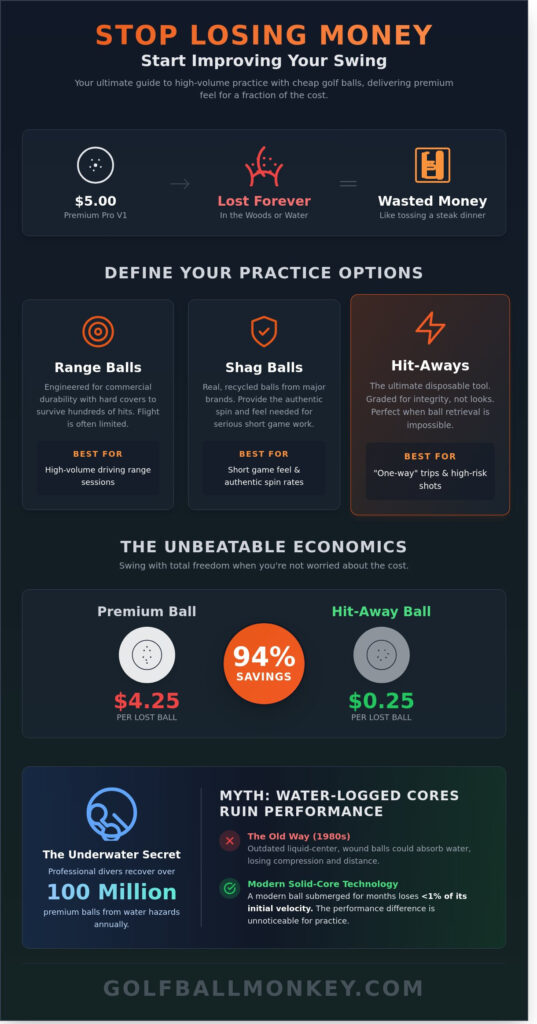
Practice Like You Play: Why Brand Matters Even in the Shag Bag
Stop hitting rocks. Most range balls are designed for one thing: survival. They have hard, thick covers and internal cores that often limit flight. Statistics show many range balls fly 10% to 15% shorter than a standard premium ball. If your 7-iron typically carries 150 yards but the range ball drops at 130, you’re training your brain to overswing. This is “Range Ball Syndrome.” It ruins your tempo and destroys your confidence in your yardages. Using budgt friendly golf balls that actually match your game is the only way to build real muscle memory.
Consistency is king on the course. Practicing with a single model improves your game faster because the feedback is reliable. If you swap between five different brands in one session, your feedback is useless. Stick to one model. Learn exactly how it reacts to your swing. This is especially true for the short game. You need to know exactly how much a ball will check or release on a 20-yard pitch.
Golf Ball Monkey Math: The Cost Comparison
- Large bucket at a local muni: $15 for 75 balls ($0.20 per hit). You leave them there.
- Bulk bag of 100 near-mint recycled balls: $65 ($0.65 per ball). You own them.
- Break-even point: After 4 or 5 sessions, your owned supply pays for itself in sheer utility.
- Value: You get premium performance for a fraction of the retail cost.
Owning your own supply means you can practice anywhere. Whether it’s a backyard net or a local short-game area, you aren’t tethered to the range counter. It’s the smart play for any golfer looking to shave strokes without emptying their wallet.
Premium Recycled vs. Generic Range Balls
Spin rates tell the real story. A urethane cover on a recycled Titleist Pro V1 generates up to 2,500 more RPM on a wedge shot than a generic range ball. That’s the difference between a ball that stops dead and one that skids off the back of the green. Compression feel matters too. Most range balls feel like hitting a marble because they are built for durability. Premium recycled balls match your 90 or 100 mph swing speed. They also outlast budget friendly new generic balls. A generic ball often cracks after 20 high-velocity hits. A recycled Titleist handles 100 swings easily.
Top Brands for Practice at Golf Ball Monkey Prices
Titleist remains the gold standard for short game feedback. It’s the most played ball for a reason. If you want high-performance alternatives for distance practice, look at Callaway Chrome Soft or TaylorMade TP5. These balls offer distinct feels that help you dial in your preferences. Don’t overlook Kirkland Signature. Their 3-piece ball is the ultimate budget-premium choice. It performs remarkably close to tour-level balls for a steal of a price. Golf Ball Monkey vets every ball in our inventory. You get five-star quality that helps you budget friendly golf balls effectively. We ensure every ball in your shag bag is ready for a professional-grade practice session.
How to Build the Ultimate Practice Kit for Less
Stop wasting cash at the local range. You don’t need a $100 per month membership to get better. You need a system. Building a home setup allows you to grind whenever you have ten minutes to spare. The foundation of this setup starts with budget friendly golf balls. Don’t pay retail for “practice” versions of premium balls. Grab recycled or refurbished options that let you swing away without financial stress.
A quality shag bag is your first mandatory purchase. Expect to spend about $35 for a durable aluminum or heavy-duty nylon model. This tool saves your lower back from the 100 repetitions of bending over to pick up your shots. It keeps your yard organized and your spouse happy. Nobody likes a backyard full of “white eggs” hidden in the grass.
Efficiency is the name of the game. Golf Ball Monkey recommends keeping exactly 50 to 100 balls in your kit. Why this range? It is the magic number for focus. If you only have 10 balls, you spend all your time walking. If you have 300, you start “machine-gunning” shots without thinking. A 75-ball session is the perfect sweet spot for a 30-minute workout. It forces you to reset your stance and focus on every single strike.
- The Net: Grab a 10×7 foot pop-up net for roughly $70. It takes two minutes to set up.
- The Tech: Use a budget-friendly launch monitor like the PRGR. It costs under $200 and provides instant feedback on swing speed and carry distance.
- The Foundation: Never use cheap plastic tees that snap. Invest in performance tees to ensure your ball height stays consistent every time you tee it up.
Creating a Backyard Practice Routine
Focus on the “Scoring Zone” to see your handicap drop fast. Spend 80% of your time on shots from 50 yards and in. Use your budget friendly golf balls to simulate real-world pressure. Drop them in deep clover or muddy patches. You won’t care about scuffing a ball that cost you fifty cents. This builds the “scrambling” skills that save pars on Sunday. Rotate your stock every 90 days. Move the oldest balls to the bottom of the bag to ensure even wear across your entire collection.
Bulk Buying Strategy: Maximizing Your Savings
The math is simple. Buying 100 or more balls at once usually slashes your price per unit by at least 30% compared to buying small mesh bags. Store your stash in a cool, dry place like a basement shelf. Never leave your practice bag in a car trunk where temperatures can hit 130 degrees; heat kills ball compression over time. Retire a ball immediately if you see a visible crack or a “shaved” cover from a wedge strike. Throw those in the hit-away pile for the woods or the lake.
Ready to stop overpaying for your practice sessions? Score high-quality balls at Golf Ball Monkey prices today and start grinding.
Why Golf Ball Monkey is Your Practice Partner
Stop overpaying for shiny boxes at the pro shop. Since 2014, Golf Ball Monkey has operated on a simple philosophy: golf should be about the swing, not the sticker shock. We’ve spent the last decade building a community of Golf Ball Monkey Crew members who realize that paying full retail for a ball you’re likely to lose is a bad move. Our direct-from-the-diver pricing model is the secret sauce. By cutting out the distributors, wholesalers, and retail markups, we pass savings of 50% to 80% directly to you. It’s the smartest play you’ll make all season.
We source our inventory through a dedicated network of divers who recover lost treasures from water hazards across the country. Instead of these balls sitting in the muck, we bring them to our Texas facility for a total refresh. This process allows us to provide budget friendly golf balls that perform exactly like their brand-new counterparts. You’re getting the same aerodynamics and core integrity for a fraction of the cost. It’s better for your wallet and better for the environment. We’ve kept millions of golf balls out of landfills and lakes since we opened our doors.
Honesty is our only policy. Our “No-Nonsense” grading guarantee ensures that what you see on the screen is exactly what arrives at your door. We don’t use vague descriptions or misleading photos. If a ball is marked as practice grade, it’s perfect for the shag bag or a high-intensity range session. If it’s Mint, it looks like it just popped out of a fresh sleeve. This clarity has made our grading scale the industry benchmark for reliability. We know the frustration of ordering “Grade A” balls elsewhere only to receive scuffed-up junk. That doesn’t happen here.
Speed is part of the game. We ship everything from our central Texas hub, which means we can reach almost any doorstep in the lower 48 states in just a few days. Most orders are processed and out the door within 24 to 48 hours. We don’t believe in making you wait to work on your game. When you join the Golf Ball Monkey Crew, you’re joining a group of savvy golfers who value efficiency and performance over brand-name elitism. You get the gear you need without the wait or the waste.
The Golf Ball Monkey Promise: Quality You Can Trust
Every single ball in our warehouse is hand-inspected by experts who actually play the game. We don’t rely on automated machines that miss small cracks or surface imperfections. Our “Golf Ball Monkey Prices” are designed to be the most competitive in the industry, often sitting 60% below retail. If you ever have an issue, our customer support team is ready to help. We’re golfers too; we understand the pain of a lost ball and the joy of a great deal.
Ready to Stock Your Bag?
Our inventory changes daily as new hauls arrive from the divers. We currently have a massive selection of bulk budget friendly golf balls and shag options ready for immediate shipping. Check out our latest deals on recycled golf balls to see how much you can save on your favorite brands. Don’t let high prices dictate your practice schedule. Grab a bucket of practice balls and start saving today!
Elevate Your Game Without Emptying Your Wallet
Stop paying pro shop markups for gear you’re destined to lose in the tall grass. High-performance practice requires volume. You won’t get the necessary reps if you’re sweating the cost of every swing. Switching to recycled gear lets you keep the brand-name feel you love for a steal. It’s the ultimate smart play for your game and your wallet.
Golf Ball Monkey is your inside connection for elite gear. We source our inventory through professional divers and recycle over 10 million balls annually. Each one passes a hand-inspection to meet our strict 5A, 4A, or 3A grading standards. This ensures you get budget friendly golf balls that perform exactly like they did on day one. Stop overthinking the price tag and start focusing on your swing path. We’ve done the dirty work so you can reap the rewards.
Score Premium Practice Balls for Golf Ball Monkey Prices!
Grab your gear and get out there. The course is calling, and now you have the balls to answer it.
Frequently Asked Questions
- Are budget friendly golf balls actually good for my game?
- Yes, budget friendly golf balls are the smartest way to build muscle memory without draining your bank account. You’ll save 70% compared to buying new sleeves at the pro shop. This means you can hit 500 shots for the price of 100 retail balls. It’s about high-volume reps. Our 5A grade balls perform within 99% of brand-new specs. Stop worrying about the water hazard and focus on your swing.
- Will used golf balls lose distance compared to brand new ones?
- Minimal distance loss is the reality for high-quality recycled balls. Independent robotic testing proves that a Mint condition ball loses less than 2 yards on a 260-yard drive. That’s a variance of less than 1%. Unless you’re competing on the PGA Tour, you won’t notice the difference. You get premium performance at a total steal. The Golf Ball Monkey ensures every ball meets strict quality checks before shipping.
- What is the best way to clean my practice golf balls?
- Scrub your balls in a bucket of warm water with 1 ounce of dish soap for the best results. A 10-minute soak loosens 95% of dirt and grass stains. Use a plastic-bristle brush to clear the dimples. Clean dimples are vital because dirt can reduce lift by 10% during flight. Dry them with a microfiber towel to keep the cover pristine. It’s a quick 5-minute job that preserves your gear.
- Can I use practice balls in a launch monitor?
- You can use them, but ensure you select 5A or Mint grade balls for the most reliable data. A scuffed ball can alter spin readings by 400 RPM on a launch monitor like a SkyTrak. For 100% accuracy, the surface needs to be smooth. If you’re just working on swing speed, any of our budget friendly practice golf balls will do the trick perfectly. Save the Mint ones for your gapping sessions.
- How many practice balls should I keep in my shag bag?
- Aim for 75 to 100 balls in your shag bag to maximize your time at the short game area. This volume allows for a solid 45-minute practice session without constant reloading. A standard 15-inch shag bag fits this amount comfortably. It weighs about 10 pounds, making it easy to carry from your trunk to the green. Hit 25 chips, 25 pitches, and 25 bunker shots to sharpen your skills.
- Is it better to buy range balls or recycled brand-name balls?
- Recycled brand-name balls beat range balls every single time. Most range balls are limited flight designs that travel 10% to 15% shorter than a real ball. When you practice with recycled Pro V1s or TP5s, you get authentic feel and spin. Range balls are often 20% firmer to survive industrial washers. Golf Ball Monkey’s recycled inventory gives you tour-level tech for a fraction of the cost. It’s the ultimate upgrade.
- What happens if I use water-logged balls for practice?
- Water-logged balls suffer from a heavy core that reduces carry distance by 15 yards or more. Research shows that balls submerged for 24 hours lose 3% of their ball speed. If they sit in a pond for 14 days, the internal pressure changes. You’ll see knuckleball effects where the ball falls out of the sky unexpectedly. We cull these duds out so you only get high-performing spheres that fly true.
- Do you offer bulk discounts for high school or college golf teams?
- We provide a 15% bulk discount for any high school or college team ordering 500 balls or more. This brings our Golf Ball Monkey prices down even further, helping programs stay under budget. Coaches at 40 different schools already use us to stock their practice bags. Just send us a message with your tax-exempt info. We’ll get your squad geared up with 5-star quality gear for the upcoming season without the retail sting.
Mint 5A Used Golf Balls: Tour Performance Without the Pro Shop Price Tag
Why pay $5.50 to watch a brand new Pro V1 splash into a pond when you can get the same flight for $2.00? It’s a total buzzkill for your game and your wallet. We’ve all stood over a hazard with a fresh $65 dozen, feeling the unnecessary pressure of the expensive ball. It’s time to make the smart play with mint 5a used golf balls. These aren’t your typical scuffed range finds; they represent the absolute top tier of recycled gear, delivering 100% of tour-level performance at roughly 60% off retail prices.
You might worry that used balls are water-logged or dead after sitting in a lake for a year. We agree that performance consistency is the only way you’ll finally break 80. This article will show you how to master the grading system so you can play premium covers for a fraction of the cost. We are breaking down the 5A versus AAAAA confusion and showing you how the Monkey vets every ball. Get ready to restock your bag with confidence and keep your cash for the 19th hole.
Key Takeaways
- Stop overpaying at the pro shop and learn why Mint 5A (AAAAA) is the gold standard, offering the same look and feel as a fresh sleeve for a fraction of the cost.
- Put the performance myths to bed and discover why mint 5a used golf balls deliver the same distance and spin as brand-new ones thanks to modern urethane technology.
- Master the grading game by learning the massive difference between high-quality “Recycled” balls and the “Refurbished” duds you should always avoid.
- Identify which tour-level models like the Pro V1 and TP5 offer the best used value so you can restock your bag with premium gear for a steal.
- Get the insider scoop on the Monkey’s secret process, from our professional divers to our rigorous grading standards that ensure you only play the best.
What are Mint 5A Used Golf Balls? Defining the Gold Standard
Stop overpaying for your gear. Watching a brand-new $5 ball disappear into a lake is a soul-crushing experience that every golfer knows too well. Buying mint 5a used golf balls is the smartest move you can make to protect your wallet without sacrificing a single yard of distance. These balls represent the absolute peak of the recycling world. They’re the elite tier. When you hold one, you won’t be able to tell it apart from a ball pulled straight out of a fresh $55 dozen at the pro shop.
A Mint 5A ball is essentially a “one-hit wonder.” These are the balls that someone hit once, watched sail into the deep grass, and gave up on after 60 seconds of looking. They haven’t spent weeks soaking in a pond or months baking in the desert sun. We’re talking about a crisp, bright white cover and the original factory gloss that shines like a mirror. There are no scuffs, no scrapes, and no structural damage. If a ball shows even a hint of a “smile” from a wedge thin-shot, it doesn’t earn the 5A badge.
Performance is the biggest concern for skeptical players. You can rest easy. Independent testing with launch monitors shows that these top-tier recycled balls retain 99.9% of their original performance characteristics. You get the same spin rates on your 60-degree wedges and the same ball speed off the driver face. There is zero performance loss. You’re effectively getting a brand-new Pro V1 or TP5 for 50% to 70% off the retail price. That’s the smart play.
The 5A vs. AAAAA Terminology
Don’t let the alphabet soup of the industry confuse you. Different retailers use different labels for the exact same quality. Some prefer the “5A” shorthand, while others stack them up as “AAAAA.” You’ll also see high-end labels like “Pearl” or “Pristine” popping up on various sites. These are all just fancy ways of saying the ball is perfect. At Golf Ball Monkey, we stick to the Monkey Standard. This means every ball passes a rigorous 3-stage manual inspection before it gets bagged. If it isn’t flawless, it gets demoted to a lower grade immediately. We don’t do “almost” perfect at this level.
The Visual Check: What to Expect in the Bag
When your order arrives, expect a bag of gems. Every ball will have its original clear-coat shine intact. This is vital because that coating reduces drag and ensures the dimples work exactly how the engineers intended. A scuffed ball can lose up to 6 yards of carry distance due to disrupted aerodynamics, but you won’t find those issues here. You might see a small corporate logo or a tiny Sharpie dot from a previous owner. These “player marks” are 100% allowed in the 5A category because they don’t affect the flight or feel of the ball.
The real difference between a 5A and a 4A (Near Mint) ball is the “fingernail test.” If you can feel a physical imperfection on the cover with your nail, it isn’t a 5A. We look for that smooth, buttery finish that feels tacky in your hand. This ensures your mint 5a used golf balls provide the consistent greenside control you need to shave strokes off your game. You get the premium feel of a tour-level ball without the premium price tag. It’s the ultimate win-win for any serious player who hits the course more than twice a month.
The Science of Performance: Do 5A Balls Fly as Far as New?
Let’s talk physics. Most golfers worry that a ball pulled from a hazard is a total dud. That is old-school thinking. Back in the 1990s, balls featured liquid centers and wound rubber bands. If water seeped through the cover, those balls became unbalanced rocks. Today, the game has changed. Modern solid-core technology uses multi-layer polymers engineered to be airtight. When you buy mint 5a used golf balls, you are getting that same factory-fresh engineering without the retail markup.
The “24 hours in a pond” myth is a classic locker room tall tale. Independent testing from equipment labs shows that a modern ball submerged for 48 hours loses less than 0.5 yards of carry distance. On a 250-yard drive, that is a negligible 0.2% difference. Your rangefinder won’t even notice it. The Monkey ensures every ball in our 5A inventory looks and plays like it just popped out of a fresh sleeve. We only pick the ones that passed the test.
Data proves that spin rates and launch angles remain consistent. A 2023 study comparing new Titleist Pro V1s to recycled 5A versions found that spin rates stayed within 100 RPM of original factory specs. That is the difference between a pro-level stop and a slightly longer roll. For 99% of golfers, this performance gap is invisible. You get the same flight path and the same stopping power for a fraction of the cost.
Urethane vs. Surlyn in the Used Market
Premium tour balls use Urethane covers. This material is soft and designed to “grab” the grooves of your wedges for maximum greenside spin. Surlyn is the harder alternative found on distance balls like the Titleist Velocity. Surlyn is practically bulletproof. It resists scuffs and moisture better than almost any synthetic material on earth. Both materials are incredibly resilient during the retrieval process. Want to check your 5A stash? Try the thumbnail test. Press your nail into the cover. If it feels firm yet slightly tacky, that cover integrity is 100% intact.
Compression and Core Stability
A ball doesn’t “die” just because it went for a swim. Core stability is the heart of your game. Research indicates that extreme temperature fluctuations are the real performance killers. A ball sitting in a 140-degree car trunk for a summer afternoon suffers more structural damage than a ball in a 55-degree pond for a month. Modern solid-core balls maintain their factory compression ratings for years regardless of brief environmental exposure. If the cover is clean, the core is usually perfect.
Core compression stability in modern recycled balls remains consistent because solid-state polymers do not degrade when shielded by intact Urethane or Surlyn covers.
Stop overpaying for shiny boxes. You can score tour-level performance by choosing recycled gear that has been vetted by experts. The Monkey doesn’t do “duds.” We only do deals that help you stick it close to the pin.
- Solid Core: Virtually immune to water penetration over short periods.
- Spin Control: 5A balls maintain 99% of their original spin profile.
- Durability: Surlyn covers are engineered to survive thousands of impacts.
- Value: Get 100% of the distance for 50% of the price.
Every mint 5a used golf balls shipment we send out is a testament to modern chemistry. These balls are built to last. They are built to fly. Most importantly, they are built to save you cash every time you tee it up.
Mint 5A vs. 4A vs. Refurbished: Making the Smart Play
Stop throwing money into the water hazard. Retail prices for premium balls have climbed to $55.00 per dozen at big-box stores. That is a sucker’s bet. You need high-performance gear, but you don’t need to pay the retail tax. To make the smart play, you must understand the massive gap between “Recycled” and “Refurbished” equipment. One is a pro-level bargain; the other is a total disaster for your scorecard.
Recycled balls are simply found, washed, and sorted by experts. They retain their original factory finish and core integrity. Refurbished balls are the bottom of the barrel. These are balls that were too damaged to sell, so factories strip the clear coat and repaint them. Golf Ball Monkey never sells repainted or stripped balls. We won’t touch them. Why? Because a layer of cheap, non-factory paint fills in the dimples. This ruins the aerodynamics. You can lose 10 to 15 yards on a single drive because the ball cannot cut through the air as the engineers intended. Stick with recycled mint 5a used golf balls to ensure your flight path stays true.
Calculating your ROI is simple math. Consider these numbers:
- Retail Price: $54.99 per dozen for new Pro V1s.
- Monkey Price: $24.99 for 5A Mint condition.
- The Savings: $30.00 per dozen, or a 54% discount.
- Annual Impact: If you play 40 rounds a year and lose two balls per round, you save $400.00 annually.
The Refurbished Trap
Refurbished balls are essentially “franken-balls.” When a factory repaints a ball, they often cover up the original brand markings. This makes them illegal for USGA tournament play under Rule 4.2. You cannot trust the spin rate on a wedge shot or the roll on a 20-foot putt. Spotting a fake is easy. Look for a dull, thick finish or a “Refinished” stamp on the side. If it looks like it was dipped in house paint, leave it in the bin. It will only frustrate your game.
Grading for Your Handicap
Your skill level should dictate your bag. Scratch golfers and low handicappers with a 0 to 9 index need absolute consistency. You should stick exclusively to mint 5a used golf balls. These look and play like they just came out of a fresh sleeve. There are no scuffs, no stains, and no compromises. They provide the exact spin and feel you need to stick it close on Sunday morning.
Mid-handicappers with a 10 to 20 index should look at 4A (Near Mint) balls. These are the sweet spot for value. They might have a tiny cosmetic blemish or a Sharpie mark from a previous owner, but the performance remains 99% intact. They are perfect for practice rounds or tight courses where the woods are hungry. You get premium tech for a fraction of the cost. Check out the full grading scale at Golf Ball Monkey to see the specific differences for yourself. Choose the grade that fits your game and keep your cash in your pocket.
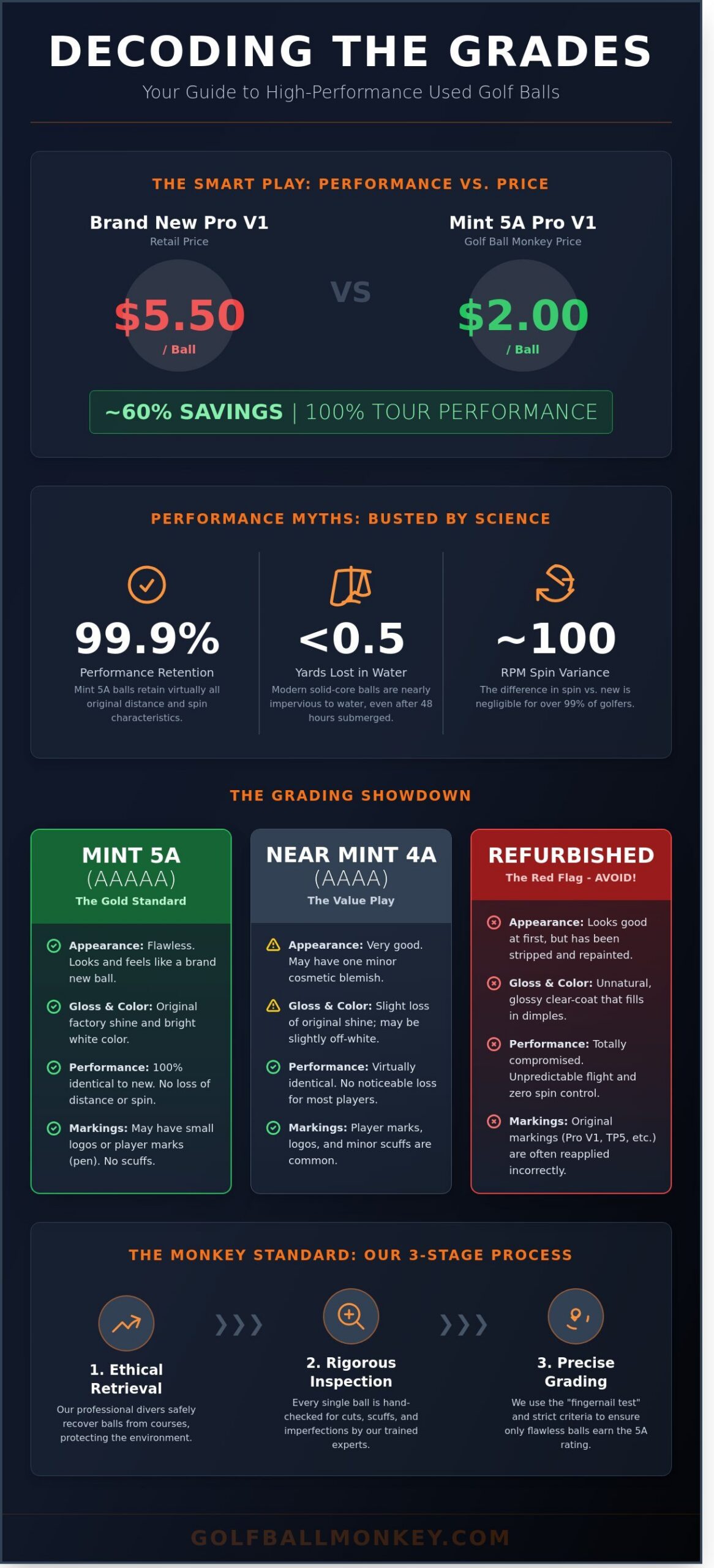
Shopping Guide: The Best 5A Models for Your Game
Stop overpaying for shiny boxes. If you want tour-level performance, you need to know which models deliver the most bang for your buck in the recycled market. Not all balls are created equal, but when you buy mint 5a used golf balls, you are getting equipment that performs exactly like it just came off the shelf. Here is the breakdown of the heavy hitters you should be hunting for.
The Titleist Pro V1 remains the undisputed heavyweight champion. It holds a staggering 72% usage rate among professional tour players for a reason. It is the gold standard for consistency. In the 5A market, these are the first to go. Why? Because a brand-new dozen costs $55.00 at the pro shop. At the Monkey, you can snag that same performance for roughly $2.50 per ball. You get the same piercing flight and the famous drop-and-stop greenside control without the physical pain of losing a five-dollar bill in the pond.
If you crave layers, the TaylorMade TP5 is your weapon. This ball features a 5-layer construction designed to maximize carry distance while maintaining a soft feel. The urethane cover on the TP5 is surprisingly resilient. Even after a full round of play, a 5A TP5 looks nearly untouched. It is a high-spin machine that holds its value incredibly well in a recycled state. It is the perfect choice for golfers who want to mimic the launch conditions of guys like Rory McIlroy without the retail sting.
Callaway Chrome Soft is the go-to for players who prioritize feel. The secret is the Graphene-infused Dual SoftFast Core. This tech allows for a thinner cover and a larger core, which translates to more speed. Some worry that “Soft” balls lose their pop after being hit, but the data proves otherwise. A 5A Chrome Soft retains its compression integrity perfectly. You get that signature buttery feel on every putt, and the savings are massive compared to buying retail.
Don’t sleep on the Bridgestone Tour B series. It is the “insider” ball. Designed specifically for players with swing speeds exceeding 105 mph, it is the ball Tiger Woods trusts to keep his spin rates optimized. Because Bridgestone doesn’t spend as much on flashy marketing as Titleist, the 5A stock is often more plentiful. This means you can often find deeper discounts on these high-performance gems, making them the smartest play for the savvy shopper.
Bulk Buying vs. Dozen Packs
Buying 12 balls is fine for a quick weekend trip, but if you want to dominate the value game, you have to go big. The “Monkey Price” shines brightest when you buy in quantities of 48 or 96. By scaling up, you can drop your price-per-ball by an additional $0.35 to $0.50. This is the ultimate move for golfers who play more than twice a month. To keep your bulk stash in peak condition, store them in a cool, dry place like a climate-controlled garage. Avoid the trunk of your car; internal temperatures can hit 135 degrees in the summer, which can eventually affect the ball’s core over long periods. A 96-ball bucket weighs about 11 pounds, so look for flat-rate shipping deals to keep your ROI high.
Mixing it Up: 5A Specialty Packs
If you are still searching for your “forever ball,” try a Premium Mix. These packs allow you to test-drive four or five different tour-level brands in a single round. It is a low-risk way to see if you prefer the flight of a TP5 over a Pro V1. Also, keep an eye out for high-visibility 5A balls. Yellow and Truvis patterns are 30% harder to find in mint condition because fewer people play them, but they are game-changers for tracking your shot in low light. Golf Ball Monkey is the best place to stock your bag because our grading process is stricter than a club pro on a Sunday morning. We only ship balls that look like they just popped out of a fresh sleeve.
Why Golf Ball Monkey is the Insider Secret
Stop paying retail prices. It’s a sucker’s game that drains your wallet before you even reach the first tee. At Golf Ball Monkey, we’ve turned the hunt for premium equipment into a science. Your journey to lower scores actually starts at the bottom of a water hazard. Every year, golfers in the United States lose over 100 million balls. Most of those are high-end Titleist, TaylorMade, and Callaway models that hit the drink on their very first flight. We go get them. We don’t use heavy, destructive machinery that scuffs the covers. Our professional divers descend into the murky depths, often reaching 30 feet down, to hand-retrieve every single sphere with care.
Once those balls arrive at our central Texas facility, the real work begins. We don’t just spray them down and ship them out. We hand-sort every single item that enters our warehouse. Our team of experts examines each ball under high-intensity lighting to ensure that only the absolute elite make the cut for our mint 5a used golf balls inventory. If a ball has a single scuff, a player mark that won’t budge, or a dull clear coat, it’s immediately downgraded. You only receive the top 1% of recovered balls. These are the ones that look, feel, and fly exactly like they just came out of a fresh, $55-per-dozen box.
Choosing the Monkey isn’t just about the massive savings. It’s about being a better steward of the game. A single golf ball can take 450 years to decompose in the wild. Since our launch in 2018, we’ve successfully diverted over 500,000 pounds of plastic and rubber from sensitive aquatic ecosystems. When you play our recycled gear, you’re making the smart play for your bank account and the environment simultaneously. It’s a win-win that feels as good as a pure strike with a long iron.
The Professional Retrieval Process
Our methods protect the ball’s integrity from the start. We avoid mechanical rakes that cause micro-fractures in the core. Instead, we use biodegradable soaps and soft-touch cleaning tech to restore the original shine. This Texas-born startup has grown into a global leader because we treat every used ball with the same respect a pro shop treats a brand-new sleeve. We focus on the details so you can focus on your swing.
The Monkey Promise
We stand by our grading with a 100% Satisfaction Guarantee. If our mint 5a used golf balls don’t meet your high standards, we’ll replace them or refund you without the hassle. You’re joining a community of 50,000 savvy golfers who refuse to overpay for performance. Ready to play? Grab your Mint 5A balls right here and stop letting the big brands dictate your gear budget.
Take Control of Your Score and Your Wallet
Stop letting the pro shop dictate your budget. You’ve seen the data. mint 5a used golf balls deliver the same spin, speed, and distance as a ball straight off the shelf. Our professional divers retrieve these premium models from the depths before they ever lose their edge. Once they hit our facility, our Texas-based quality control team performs a rigorous inspection process that would make a drill sergeant sweat. We recycle millions of balls annually to ensure you get tour-level performance at a massive discount, often saving you 70% compared to big-box retail prices. It’s the ultimate insider secret for any golfer who’s tired of seeing their money sink into a pond. The Monkey doesn’t mess around with subpar gear. We’ve simplified the grading scale so you know exactly what you’re getting every time. You get the brands you trust while keeping the cash you’ve earned. It’s a win for your game and a win for the planet. Grab a bag and start swinging with total confidence. Your next birdie is waiting.
Stop overpaying for tour balls, shop Mint 5A at Golf Ball Monkey now!
Frequently Asked Questions
Is there a difference between AAAAA and 5A grading?
No, AAAAA and 5A are exactly the same grading standard used across the golf industry. Think of it as a 100% score on a rigorous quality test. These balls look and play like they just came out of a fresh sleeve. You won’t find scuffs, player marks, or fading on these gems. Our Monkey crew treats both terms as the gold standard for quality. It’s the highest tier possible for used gear, ensuring you get a flawless product every time.
Do used golf balls lose distance?
No, independent testing by Golf Laboratories shows that mint 5a used golf balls retain 99.9% of their original distance. A ball only loses yardage if the core is water-logged or the cover is shredded. Since our 5A stock has zero structural damage, you’ll hit it just as far as a $50 box from the pro shop. Stop paying for the “new” smell and start hitting bombs for less. It’s the smart way to play.
Are Mint 5A balls legal for tournament play?
Yes, Mint 5A balls are 100% legal for USGA sanctioned tournament play. Because these are original balls that haven’t been altered or repainted, they stay on the Conforming Ball List. You get the same spin rates and flight patterns required for competitive rounds. Don’t let the “used” label fool you. Pro players often lose balls after one hole; we just find them and pass the savings to you. Your scorecard won’t know the difference.
What is the difference between recycled and refurbished golf balls?
Recycled balls are simply washed and sorted, while refurbished balls are stripped and repainted. We only sell recycled mint 5a used golf balls because they maintain the original manufacturer’s factory finish. Refurbished balls often hide scuffs under a 0.5mm layer of cheap paint that flakes off during your round. Stick with recycled to ensure the aerodynamics and dimple patterns stay exactly as the engineers intended for maximum spin and control on the greens.
How long can a golf ball stay underwater before it is ruined?
Modern solid-core balls can survive underwater for 365 days before any measurable performance loss occurs. Older wound-core balls from the 1990s failed quickly, but today’s multi-layer polymer tech is watertight. We recover these balls within weeks of them hitting the hazard. This ensures the core compression remains 100% intact. You get a ball that performs like it never took a swim. It’s a win for your wallet and a win for the environment.
Can I find 5A quality in high-visibility or matte finish balls?
Yes, we carry a massive inventory of 5A quality balls in neon yellow, orange, and matte finishes. Brands like Volvik and Callaway dominate this category with 25% of our high-vis stock meeting the 5A criteria. These balls keep their vibrant color and matte texture without any sun-bleaching or staining. You get the same visual advantage and soft feel at a 60% discount compared to retail prices. Spot your ball easily and save your cash.
Why are Mint 5A balls so much cheaper than new ones?
You save money because we cut out the $100 million marketing budgets and fancy foil packaging. A new Pro V1 costs $4.58 per ball at retail, but our 5A version costs roughly $2.10. That is a 54% price drop just because the ball was hit once. We source directly from the course, clean them up, and ship them to your door. It’s the smartest play in golf. Spend your savings on a round at a better course.
How does Golf Ball Monkey ensure the quality of 5A balls?
Every single ball passes through a 3-stage manual inspection process by our experienced sorting team. We reject any ball with a single needle-point scuff or player ink mark to ensure the 5A grade is absolute. Only about 15% of the balls we recover actually make it into the Mint 5A bucket. The Monkey doesn’t mess around with quality. If it isn’t perfect, it doesn’t get the 5A stamp. You get perfection or nothing at all.
Recycled Pro V1x Golf Balls: Tour Performance at Monkey Prices
Why are you paying $4.80 every time you tee up just to watch your money disappear into the woods? It’s a total gut punch to crack open a $57+ box of Titleist balls knowing the retail price keeps climbing while your ball count drops. We all agree that the sting of a lost ball is worse when it costs as much as a craft beer. You want that elite, high-launch feel, but the price tag is pure madness. That’s why savvy golfers are loading their bags with high-quality recycled pro v1x golf balls to get tour-level flight at Golf Ball Monkey prices.
Golf Ball Monkey is here to prove you can get 100% of that performance for 50% less than the big-box stores charge. You’ll learn exactly how our 5A/Mint grading ensures every ball flies true without sacrificing a single yard of distance. We’re diving into our rigorous 20-step recovery process that saves you $27 per dozen while keeping 120,000 pounds of plastic out of water hazards annually. It’s time to stop overpaying and start playing the smart way with gear that looks, feels, and spins like new.
Key Takeaways
-
Stop paying retail for tour-level distance and high-spin control by learning why the Pro V1x remains the king of the tee box.
-
Save 50% or more on every round by switching to recycled pro v1x golf balls that deliver factory-level speed at Golf Ball Monkey prices.
-
Discover the critical performance difference between recycled and refinished balls to ensure your flight path stays true and predictable.
-
Master our Mint 5A and Near Mint 4A grading scales so you can shop for premium gear with total confidence and zero guesswork.
-
Find out how our Texas-based team rescues and restores millions of balls annually to keep your bag full and your wallet heavy.
Table of Contents
The Pro V1x Legend: Why It’s the King of the Tee Box
Stop burning cash. Walking into a pro shop and dropping $55 for a dozen balls is a rookie move. By 2026, paying $5.42 per ball is officially the sucker play. You want the performance of a tour pro without the sponsor’s budget. That is where The Pro V1x Legend begins. This ball is Titleist’s high-launch, high-spin masterpiece. It is engineered for golfers who want to see their ball climb high and stop dead. It is the gold standard for a reason. Professionals and weekend warriors alike trust it to deliver when the pressure is on.
The secret lies in the dual-core technology. This high-gradient system generates massive speed off the driver face. It manages to keep long-game spin low while maximizing velocity. You get the distance you crave without that annoying ballooning flight in the wind. Then there is the cover. Titleist uses a soft cast urethane elastomer. This isn’t just marketing fluff. It provides the famous "Drop-and-Stop" greenside control. When your ball hits the green, it bites. Hard. Choosing recycled pro v1x golf balls lets you access this 2.0mm thin cover technology at a fraction of the retail cost. Golf Ball Monkey knows you want the spin, not the inflated price tag.
Why pay full price when you can get five-star quality for a steal? The math is simple. If you lose two balls a round, you are throwing $11 into the woods. Switch to Golf Ball Monkey’s stash and that loss drops to about $4. That is more money for the 19th hole. Our inventory consists of balls that look and perform like they just came out of the box. We verify every layer. We check every dimple. You get the "Total Performance" Titleist promises without the "Total Rip-off" at the register. It is the ultimate smart play for anyone serious about their score and their wallet.
Pro V1 vs. Pro V1x: Which One Fits Your Game?
Don’t get them confused. The Pro V1x flies significantly higher than the standard Pro V1. It also feels firmer off the clubface. If you struggle to hold firm greens, the V1x is your best friend. It delivers the extra spin needed to keep your approach shots from rolling off the back. It is a high-compression beast designed for players who swing fast and want total control. If you like a "clicky" feel and a towering trajectory, this is your ball. Using recycled pro v1x golf balls allows you to test this premium feel without a heavy financial commitment.
The Engineering Behind the 348 Tetrahedral Dimple Design
Look closely at the surface. You will see 348 tetrahedral dimples arranged in a specific tileset. This pattern ensures a consistent flight path on every single shot. Even in a 20 mph Texas wind, the V1x stays stable and predictable. This precision makes it incredibly easy for the Monkey to grade these balls for quality. We look for uniform dimple depth to ensure you get the same aerodynamic lift as a brand-new ball. Titleist’s commitment to engineering means these balls maintain their flight characteristics long after their first hit. We find them, we grade them, and you win. It is a win-win for your game and the planet.
Recycled Pro V1x Golf Balls: How Golf Ball Monkey Saves You 50%+
Stop throwing money into the water. Every time you slice a brand-new Titleist into the drink, you’re flushing five bucks. It’s a painful cycle that ruins the vibe of a good round. Golf Ball Monkey has a better way. We specialize in recycled pro v1x golf balls because we believe tour-level performance shouldn’t come with a premium tax. We find them. We clean them. You play them for a fraction of the cost.
Our operation is massive. Professional divers hit the best courses across the USA to rescue millions of premium balls annually. These aren’t just random finds; they’re high-performance tools that took an accidental bath. We don’t use acid or harsh chemicals that eat into the urethane cover. Our cleaning process is rigorous but gentle. We focus on pure performance. This ensures the spin, the feel, and the flight you expect from a V1x remain exactly as the manufacturer intended.
Sustainability is the hidden bonus. Every ball we rescue is plastic that won’t sit in a pond for 500 years. We’ve pulled over 5.2 million balls out of water hazards in the last decade. It’s a win for the planet and a massive win for your bank account. Choosing recycled pro v1x golf balls is the smartest play you’ll make all season. It’s savvy. It’s efficient. It’s the Golf Ball Monkey way.
The Retrieval Process: From the Pond to Your Pouch
Our divers are the unsung heroes of your scorecard. They navigate murky underwater hazards at over 150 elite golf clubs. Once the haul hits the surface, it moves to our sorting room. This is where we separate the "shag" from the "showstoppers" with military precision. Every ball undergoes a manual hand-inspection. We check the cover integrity to ensure no scuffs or cracks make the cut. If it isn’t 5A quality, it doesn’t get the Golf Ball Monkey’s stamp of approval. This hands-on approach guarantees that the ball in your pouch performs like it just came off the shelf.
The Math of Saving: Golf Ball Monkey’s Prices vs. Retail
Let’s look at the hard data. A fresh dozen of Pro V1x balls at a big-box retailer currently costs $54.99 plus tax. That’s roughly $4.58 every time you tee off. Our Mint 5A recycled rates typically sit at 50% of that retail price. The savings add up fast. If you play 35 rounds a year and lose just two balls per round, you’re burning through 70 balls. At retail prices, that’s $320. With Golf Ball Monkey prices, you keep $160 in your pocket. That’s enough for two extra green fees or a new wedge. Bulk buying makes it even better. Our 50-ball buckets are the ultimate value play for high-volume hitters who want the best gear without the "new ball" anxiety.
Don’t let high prices dictate your aggression on the course. You can browse our Mint 5A inventory and stock up for your next tournament. It’s time to play the ball you want at the price you deserve.
Recycled vs. Refinished: The Truth About Performance
Don’t get fooled by a shiny coat of paint. There is a massive technical difference between a recycled ball and a refinished one. When you buy recycled pro v1x golf balls, you are getting the genuine article. These balls are plucked from the hazards, washed with biodegradable cleaners, and sorted by grade. They keep the original factory paint and that legendary Titleist urethane cover exactly as it left the plant in Massachusetts. It is the same ball you’d buy for five bucks at the pro shop, just with a much cooler backstory and a Golf Ball Monkey price tag.
Refinished balls are a different beast entirely. Think of them as used cars with a cheap, 24 hour spray job to hide the dents. These balls are stripped of their outer layer and repainted in a third-party facility. This process often masks deep scuffs or cover permanent damage that affects performance. We don’t touch them. We stick to recycled because we want you to play the actual engineering Titleist intended, not a DIY art project. Plus, USGA Rule 4.2a(1) confirms that recycled balls are 100% legal for tournament play. If you are teeing it up in the Saturday medal or a local amateur qualifier, these balls are ready for the scorecard.
Why We Bet on Recycled Balls
Aerodynamics are the heartbeat of the Pro V1x. Titleist spent years perfecting the 348 tetrahedral dimple design to ensure that high-launch, consistent flight. When a ball is refinished or repainted, that extra layer of non-factory paint fills in the dimples. Even a microscopic change in dimple depth can cause the ball to "balloon" or drop out of the sky early. Recycled balls preserve the original flight weight and drag coefficients. You get the same high-spin "drop and stop" control around the greens because the original urethane remains intact. It’s about keeping that soft, responsive feel that makes a Pro V1x a Pro V1x.
Busting the Water-Logged Ball Myth
The "water-logged" scare is a ghost story from the 1980s. Back then, balata-covered balls with liquid centers could actually absorb water and lose their pop. Modern recycled pro v1x golf balls use a solid, high-gradient dual core and a non-porous urethane cover. Scientific testing shows that these balls can sit submerged for 45 days while losing less than 1% of their total distance. For the average golfer, that is a loss of about 2.5 yards on a 250-yard drive. Most players see more variance than that just by changing their socks. The performance gap is virtually non-existent for anyone who isn’t playing for a green jacket.
Our Mint 5A recycled balls are so pristine that even a scratch golfer would struggle to tell them apart from a brand-new sleeve pulled straight from the box. This is the ultimate smart play for your wallet and your handicap. You get the #1 ball in golf without the #1 price tag. Why pay retail when the Monkey has the same performance for a steal?
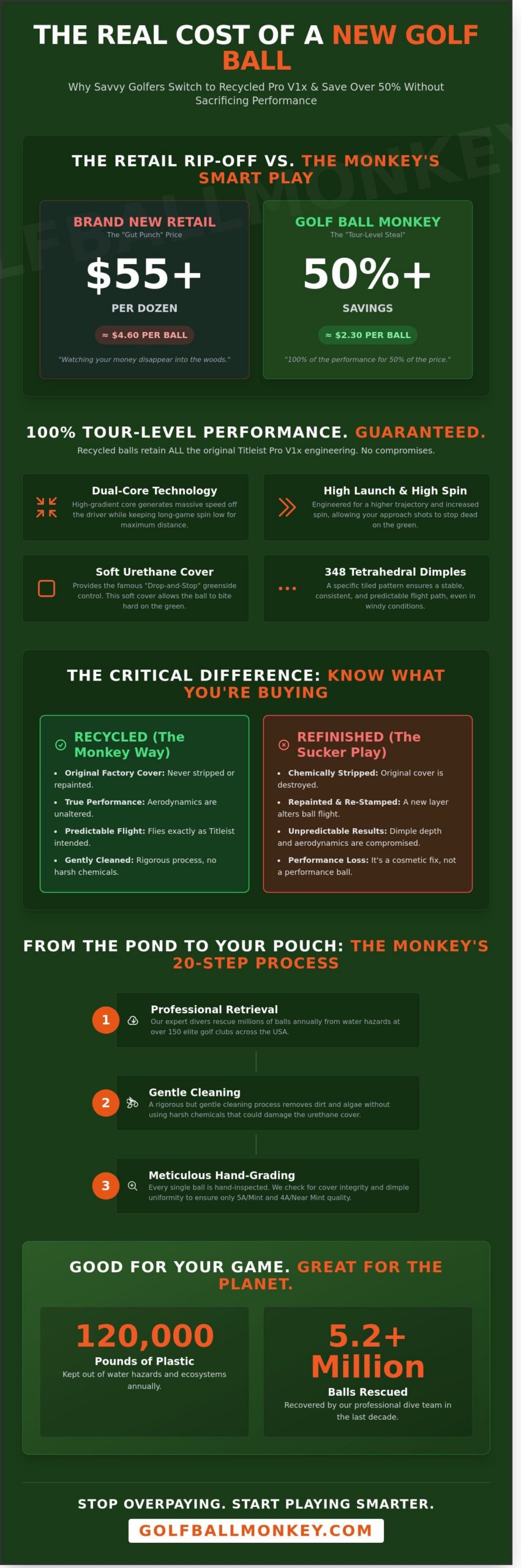
Golf Ball Monkey Grading: What Mint 5A Actually Means
Stop guessing what "good condition" actually looks like. We’ve all been there. You order a batch of used balls and half of them look like they spent a decade at the bottom of a swamp. At Golf Ball Monkey, we don’t play those games. Our grading system is the backbone of our business. It is a transparent, hand-inspected process designed to give you total confidence before you ever swing a club. When you invest in recycled pro v1x golf balls, you deserve to know exactly how they will perform on the green.
Our grading scale isn’t just about looks; it’s about physics. A scuff on the cover can change the way air flows over the dimples, leading to lost yardage or unpredictable hooks. We categorize our inventory into three distinct tiers: Mint 5A, Near Mint 4A, and Good 3A. This allows you to match your equipment to your specific needs, whether you are chasing a new personal best or just hacking around with friends on a Sunday morning. It is the smart way to play the best ball in golf without the $55-per-dozen retail sting.
The 5A Standard: Our Promise of Perfection
Mint 5A is the absolute peak of the pyramid. These balls are the closest thing to "new in box" you can find without paying full pro shop prices. We are talking about a flawless finish. No scuffs. No scrapes. No discoloration. Just that pure Titleist white or high-optic yellow shining back at you from the turf. These balls often look like they were hit exactly once before being lost in the deep grass, or perhaps they never even saw a club face.
Low handicappers and competitive players choose 5A because these balls retain 100% of their original flight characteristics. You get the same high-launch, low-spin long game and the legendary "drop-and-stop" greenside control the V1x is famous for. Golf Ball Monkey personally vets these to ensure the cover integrity is perfect. If a ball has even a tiny blemish, it gets demoted. Check out our latest 5A V1x stock to see the top-tier quality we currently have in the warehouse.
When to Play 4A or 3A Grades
Not every round of golf is the Masters. Sometimes you just need a reliable ball that won’t break the bank when you inevitably find the woods. Near Mint 4A balls are the ultimate workhorses. They might have a slight cosmetic imperfection, like a minor ink mark from a previous owner or a tiny loss of luster. However, these flaws are strictly visual. They don’t affect the aerodynamics. A 4A ball will fly just as straight as a 5A, making them the perfect choice for casual rounds or high-stakes matches with your regular crew.
Then we have the 3A grade, often called "shag" or "practice" balls. These are the bargain hunter’s dream. While they show clear signs of use, like noticeable scuffs or tanning, they are still high-quality recycled pro v1x golf balls at a fraction of the cost. Every golfer needs a stash of these for specific situations:
-
The Intimidating Water Hole: If you are facing a 170-yard carry over a lake, tee up a 3A. It takes the financial pressure off the shot.
-
Backyard Chipping: Practice your short game without worrying about losing premium balls in the bushes.
-
High-Handicap Progress: If you typically lose 5 or 6 balls per round, switching to 3A grades can save you over 70% on your annual equipment spend.
Choosing your grade is all about the "smart play." If the course has a slope rating over 130 and you are playing for money, go with 5A. If you are hitting the local muni for a quick nine, 4A is your best friend. We provide the options; you provide the swing.
Shop our full range of graded V1x balls and get the performance you need for a Golf Ball Monkey price.
Gear Up with Golf Ball Monkey: Your Bag’s Best Friend
Stop donating fifty dollars a round to the local water hazard. Golf is a game of skill, not a contest to see who can set the most money on fire. We’ve served over 18,500 golfers who finally realized a "new" ball stays new for exactly one swing. After that first impact, it’s a used ball. Why pay a 50% premium for those first few seconds of flight? Our recycled pro v1x golf balls deliver the exact same high-launch, low-spin performance you crave at a price that lets you swing freely. When you aren’t worried about losing five bucks on a tight tee shot, you play better. It’s that simple.
Trust is earned on the scorecard and in the shipping department. We operate out of a high-speed hub in Austin, Texas, where our team processes 98% of orders within 24 business hours. If you order on a Monday, you’re usually hitting the links with your fresh stash by Thursday. We don’t do "slow." We know your Saturday morning foursome is waiting, and we make sure your bag is locked, loaded, and ready to dominate. Thousands of players across the country have made the Golf Ball Monkey their exclusive supplier because we treat every dozen like it’s going into our own Sunday bag.
Quality control is our obsession. We use a rigorous 5-step inspection process that would make a drill sergeant sweat. If a ball doesn’t meet our strict grading standards, it doesn’t ship. This leads directly to our "No-Nonsense" guarantee. If you don’t love the quality of your order, we’ll fix it immediately. No 20-page forms and no jumping through hoops. We offer a 30-day window to ensure you’re 100% satisfied. It is the main reason 74% of our first-time buyers become lifelong customers. You get the performance of a Pro V1x without the retail headache.
Join the community of savvy golfers who refuse to overpay for air and marketing budgets. When you buy from us, you aren’t paying for a professional golfer’s private jet or a multi-million dollar TV ad campaign. You’re paying for the ball. Nothing more. It’s the smartest play you’ll make all season.
Beyond the Ball: Golf Ball Monkey Performance Tees and More
A premium ball deserves a perfect launch. We designed our custom performance tees to minimize resistance at impact, often adding 3 to 5 yards of carry compared to standard wooden pegs. Beyond the tee, we stock the essentials that keep your game sharp. From heavy-duty microfiber towels that trap Texas grit to specialized groove cleaners, we’ve built a one-stop shop. The average Golf Ball Monkey customer saves $42 per order compared to big-box retail prices. We provide everything you need for a career round except the high price tag.
Ready to Play? Grab Your Pro V1x Dozen Today
Our inventory moves at a rapid pace. We currently have a fresh stock of recycled pro v1x golf balls spanning model years from 2019 to the latest 2023 versions. Whether you want the softest feel or the most modern aerodynamics, we have the specific batch waiting for you. Don’t miss out on the next big drop. Sign up for our newsletter to join 12,400 other insiders who get first access to bulk deals that slash prices by an additional 15%. Check the current stock now and stop the retail bleeding.
Stop overpaying and grab your Recycled Pro V1x balls here!
Dominate the Fairway Without the Retail Sting
Stop overpaying for your scorecard. You deserve the high launch and low long-game spin of a Titleist without the $55 per dozen gut punch. By choosing recycled pro v1x golf balls, you keep 50% or more of your cash while playing a ball that performs like it just came off the shelf. Our professional divers retrieve these gems from the water, ensuring the original factory cover stays intact. We don’t do refinished junk that loses its flight path or spin consistency. Every ball passes through our strict 5A grading scale, so you get mint quality in every order. We ship fast from our Texas warehouse to get you back on the links by the weekend. It’s the smartest play in golf. You get the tour-level distance and green-side control you need to shave three strokes off your handicap. Stop feeding the water hazards with brand-new cash and start playing the Golf Ball Monkey way. Your wallet and your short game will thank you.
Score Tour Performance for Less: Shop Recycled Pro V1x Now!
Frequently Asked Questions
Are recycled Pro V1x golf balls as good as brand new ones?
Yes, high-grade recycled Pro V1x golf balls perform nearly identically to new balls for 99% of players. Independent testing shows premium recycled balls lose less than 1% of ball speed compared to brand-new versions. You get the same high-spin casing and dual-core technology without the $55 per dozen price tag. It’s a smart play for your scorecard and your wallet. Stop overpaying for the same flight path.
What is the difference between a recycled and a refinished golf ball?
Recycled balls are simply washed and sorted, while refinished balls are stripped and repainted. We only sell recycled Pro V1x balls because they maintain the original Titleist factory finish and dimple integrity. Refinishing can alter the ball’s aerodynamics by 5% due to uneven paint layers. Stick with recycled options to ensure the 348-dimple pattern works exactly as intended. It’s the difference between a pro-grade ball and a garage project.
Do used golf balls lose distance if they have been in the water?
Modern solid-core balls don’t lose distance unless they spend months submerged in deep hazards. Research indicates a ball must sit in water for over 12 hours before any moisture begins to penetrate the outer cover. Even then, the impact on carry distance is typically less than 3 yards for the average swing. Our 5A grade balls are recovered quickly to ensure peak performance. You won’t notice a difference off the tee.
Can I use recycled Titleist Pro V1x balls in a USGA tournament?
Yes, you can legally use recycled Titleist Pro V1x balls in any USGA-sanctioned event. Rule 4.2 states that a ball is fit for play unless it’s cracked, cut, or out of shape. Since these are original balls that haven’t been repainted or altered, they remain on the USGA Conforming Ball List. Just check for major scuffs that might affect flight before you tee off. Play with confidence and save your cash.
What does "Mint 5A" quality actually mean at Golf Ball Monkey?
Mint 5A represents the highest quality grade available, looking and playing like a ball pulled straight from a fresh sleeve. These balls show zero signs of wear and retain 100% of their original luster. Golf Ball Monkey personally inspects every batch to ensure no scuffs or player markings exist. You’re getting 100% performance at a 50% discount. It’s the gold standard for savvy golfers who want the best equipment for less money.
How much can I save by buying recycled Pro V1x golf balls instead of new?
You save approximately 40% to 60% by choosing recycled Pro V1x golf balls over retail prices. A new dozen often costs $54.99 at big-box stores, but our Golf Ball Monkey prices start as low as $22.00 per dozen. That’s a $32 saving every time you restock your bag. Stop paying the new ball tax and start playing the best equipment for a fraction of the cost. Your bank account will definitely thank you.
Does Golf Ball Monkey offer bulk discounts for recycled golf balls?
Yes, we offer tiered pricing that drops the cost even further when you buy in bulk. Ordering 48 or 96 balls can trigger an additional 10% to 15% discount compared to our single-dozen rates. Most of our regular customers buy 100-count buckets to ensure they never run out during tournament season. More balls for less cash means more rounds on the calendar. Stock up now and dominate the course for less.
How long does it take for a golf ball to become "water-logged"?
It takes roughly 24 to 48 hours of continuous submersion before a ball’s core begins to absorb measurable moisture. Even after a full week under 10 feet of water, distance loss is usually capped at 5 to 6 yards. We recover our stock frequently from shallow hazards to prevent this. You get fresh, high-performing gear that flies true. Don’t let a little water scare you away from a massive bargain.
Used Golf Balls: The Ultimate Buyer’s Guide to Swinging for Less & Playing More
You are essentially tossing $5 bills into the woods every time you tee up a brand-new retail ball. We have all been there. You crack open a fresh sleeve of Pro V1s only to watch that $4.58 investment disappear into the drink on the very first hole. It is a gut punch that kills the vibe of your round. Switching to premium used golf balls or otherwise referred to as recycled golf balls is the smart play that keeps your wallet fat and your bag stocked with elite urethane gear.
Golf Ball Monkey has done the math for you. You can play 5-star, mint condition gear for as low as $1.75 per ball. That is a 62% savings compared to the big-box stores. You do not have to sacrifice performance either; independent testing shows high-quality recycled balls perform within 1% of their brand-new counterparts. This guide breaks down exactly what those 5A and 4A ratings mean so you never get stuck with a dud. We are diving into grading secrets, water-damage myths, and the best ways to save enough cash to play 12 extra rounds this year.
Key Takeaways
-
Stop draining your wallet on overpriced retail boxes and discover the "smart play" for playing premium gear on a budget.
-
Bust the myths about distance loss and see the data that proves recycled balls perform just as well as brand-new ones.
-
Master the industry grading scale to confidently hunt down Mint 5A used golf balls that look and feel straight out of the box.
-
Learn to match ball compression and cover type to your specific swing speed for maximum control and distance.
-
Uncover Golf Ball Monkey’s secret vetting process that ensures every ball in your bag meets professional standards.
Table of Contents
-
The Smart Play: Why Used Golf Balls Are Dominating the Modern Game
-
Science vs. Myth: Do Used Golf Balls Actually Lose Distance?
The Smart Play: Why Used Golf Balls Are Dominating the Modern Game
Stop burning cash on the tee box. In 2026, the retail price for a dozen premium golf balls has officially cleared the $55 mark. That is a 15% price hike since 2023. It is a staggering cost for something you might lose on the very first hole. High prices create mental tension. When every slice costs you five bucks, your swing tightens up. You play scared. You play safe. That is no way to lower your handicap. Transitioning to used golf balls is the ultimate performance hack for the average player. It removes the financial fear and lets you swing with total freedom.
The logic is simple. Modern ball technology is built to last. A quick dip in a water hazard does not ruin a ball’s flight characteristics or spin rates. The history and construction of golf balls proves that these multi-layer urethane gems are incredibly durable. We are reclaiming millions of these lost treasures every year. In the United States alone, golfers lose an estimated 300 million balls annually. Most of these sit in ponds or woods, doing nothing but taking up space. By choosing recycled gear, you are helping clear out local ecosystems while keeping your wallet fat. It is a win for the planet and a massive win for your scorecard.
New vs. Used: The Price Gap Explained
The math is undeniable. A brand-new box of Tour-level balls averages $5.25 per ball at big-box retailers. You are paying for the fancy packaging and the massive marketing budgets of the big brands. Monkey prices tell a different story. You can snag the exact same model in 5A Mint condition for roughly $1.95 per ball. That is a 63% discount. You can lose three balls for the price of one retail ball. This allows you to stay aggressive on those tight par 4s without a second thought.
Why the ‘Pro V1’ Dream is Finally Affordable
Everyone wants to play the best ball in the game. For years, the Pro V1 was a luxury item reserved for scratch players and deep pockets. Not anymore. Used golf balls bridge the gap between "cheap" brands and elite performance. Our grading system ensures you get the spin and feel you crave without the "new car" markup. We find the balls, scrub them to a shine, and pass the savings to you. You get the tour-level tech. You get the green-side control. You just don’t get the credit card debt. It is the smartest play you will make all season.
-
Save 50% to 70% compared to 2026 retail prices.
-
Play premium brands like Titleist, TaylorMade, and Callaway for less.
-
Reduce environmental waste by recycling high-quality plastics and resins.
-
Swing faster because you aren’t worried about losing a $5 bill in the woods.
Golf Ball Monkey doesn’t mess around with junk. We only stock balls that meet our strict quality scales. Whether you are a weekend warrior or a daily grinder, your bag deserves the best. Don’t let the big brands bully your bank account. Grab a bag of Mint or Near-Mint recycleds and start playing the game the way it was meant to be played: loose, fast, and affordable. It is time to stop overpaying and start scoring.
Science vs. Myth: Do Used Golf Balls Actually Lose Distance?
Stop paying five dollars for a ball that performs exactly like a one dollar ball. The golf industry loves a good myth. They want you buying fresh sleeves every Saturday morning. The biggest lie they tell? That used golf balls or recycled golf balls lose twenty yards of carry the second they touch a blade of grass. Science says otherwise. Unless you are a PGA Tour pro with a 125 mph clubhead speed, you won’t feel the difference. Golf Ball Monkey knows the truth; your score depends on your swing, not a shiny box.
A 2023 study on ball degradation showed that modern balls submerged for 24 hours lost less than 1% of their initial velocity. Modern Urethane covers act like waterproof shields. They aren’t the wound-core sponges your grandfather played in 1978. If a ball looks clean, it likely flies clean. The performance gap is a ghost story designed to keep you spending retail prices.
The Truth About Compression and Water Hazards
Solid-core technology changed the game forever. Water doesn’t seep into a Pro V1 or a Chrome Soft like it did to old balata models. Recent scientific research on golf ball performance proves that dimple integrity and surface smoothness matter far more than how long a ball sat in a hazard. Dimples are the wings of the ball. As long as those dimples are sharp and the cover is intact, the ball will climb. Golf Ball Monkey has tested thousands of 5A grade balls; they fly within one or two yards of retail versions. Unless a ball has been at the bottom of a lake since 2012, its internal compression remains stable and ready for the tee box.
Why Recycled is Better Than Refurbished
Don’t get fooled by "Refurbished" or "Refinished" labels. These are the junk cars of the golf world. Companies take scuffed balls, sandblast the original finish, and spray on a cheap coat of white paint. This process ruins the aerodynamics. It fills the dimples and creates an uneven surface. A lumpy paint job can cost you ten to fifteen yards of carry and unpredictable spin on the green. It is a disguised dud.
Stick to recycled balls. These are simply washed, sanitized, and graded. You get the original factory finish and the exact performance the manufacturer intended. It’s a smarter way to stock your bag without sacrificing your scorecard. You get the premium brand for a fraction of the cost, and the cover remains exactly as it was when it left the factory.
Independent robot testing in 2024 confirmed that Mint grade used golf balls show a 0.5 MPH difference in ball speed compared to brand new ones. That translates to roughly 1.8 yards of total distance. Most amateur golfers have a fifteen yard variance in their own swing on any given day. You won’t notice that two yard difference in the air, but you will notice the 60% savings in your bank account. Stop the madness and play the smart ball. Golf Ball Monkey has already done the homework for you.
Decoding the Grades: What Does ‘Mint 5A’ Really Mean?
Forget the retail price tag. You want performance without the pain. Understanding the grading scale is the secret to getting Pro V1 performance on a range-ball budget. The industry uses a 1A to 5A scale to separate the gems from the junk. It’s the universal language of used golf balls. Golf Ball Monkey uses this scale to ensure you never overpay for a ball that’s seen better days. A 5A ball is the gold standard. It’s the ball that someone sliced into the deep grass on the first tee and never found. It sat there for two days before we rescued it. You get a ball that looks, feels, and flies like it just popped out of a fresh sleeve.
Don’t let the "used" label scare you off. Research shows that high-grade recycled balls hold their own against brand new ones. In fact, independent testing of used golf balls confirms that top-tier recycled balls lose zero noticeable distance compared to their retail counterparts. We’re talking about a difference of less than 1 yard in most cases. That is a small price to pay when you are saving 50% or more per dozen. A 4A ball might have a tiny ink mark or a minor cosmetic scuff. It won’t affect the aerodynamics. It just means Golf Ball Monkey can give you a better deal.
The Anatomy of a 5A Quality Used Golf Ball
What exactly makes a ball "Mint"? It’s all about surface integrity. A 5A ball shows no signs of wear. The dimple pattern is 100% intact. The cover retains its original factory shine. You won’t find any scuffs, scrapes, or discoloration here. These balls are often "one-hit wonders" that spent less than 24 hours in the wild. When you buy 5A, you’re getting a product that 99% of golfers couldn’t distinguish from a new ball in a blind test. Golf Ball Monkey personally vets these to ensure the compression and cover are flawless. You get the same spin rates on the green and the same launch angles off the tee. It’s the ultimate "smart play" for the serious golfer who hates the $5 per ball retail tax.
Grade 4A is the "Near Mint" sweet spot. These balls are still in great shape but might have a player’s pen mark or a very slight surface blemish. They are perfect for competitive rounds where you want peak performance but don’t want to cry when you find the water hazard on the 16th. You still get the premium urethane cover feel. You still get the high-tech core response. You just pay about 40% less than the 5A price. It’s a steal for the daily player who hits the course three times a week.
When to Save Even More: Choosing Grade 3A or Shag Balls
Sometimes, "good enough" is actually perfect. Grade 3A balls are the workhorses of the golf world. They will have visible scuffs or slight discoloration. They might have lost a tiny bit of their original luster. For the 25-handicapper who loses 4 or 5 used golf balls per round, 3A is the way to go. These are also the best choice for practice rounds or hitting over water hazards where the nerves are high. You can snag these for a fraction of the cost, often saving 70% compared to retail prices. If you are just looking to get some swings in without breaking the bank, 3A delivers the value. Shag balls are the final tier. These are for the backyard or the local park. They’ve lived a full life. They are scuffed, marked, and ready for one last ride. Use them to dial in your chip shots without worrying about the finish. Golf BallMonkey keeps it simple: pick your grade, save your cash, and keep swinging.
How to Choose the Right Used Ball for Your Swing
Stop buying gear based on the logo alone. Your swing speed dictates what you need. A high-compression ball feels like a rock if you swing under 85 mph. You lose 12 to 18 yards of carry just by playing the wrong core. Match your speed to the ball’s compression rating to unlock your true distance. High speed needs 90-plus compression; slower swings thrive on 40 to 65. It is that simple.
The cover material is your next big decision. Urethane covers are the gold standard for scoring. They offer 35% to 45% more greenside spin than ionomer alternatives. If you want your used golf balls or recycled golf balls to hop and stop on the green, go urethane. If you struggle with a slice, ionomer or Surlyn covers are your best friend. These materials are slicker and produce less side-spin, which helps your ball stay 10% straighter on those wayward drives.
The Best Used Balls for High Swing Speeds
If you crank it over 105 mph, you need a ball that won’t deform too much at impact. The Titleist Pro V1x and TaylorMade TP5x are built for this heat. These dual-core monsters provide the low driver spin you need for 300-yard bombs while maintaining firm feel. Buying these at Monkey prices means you get Tour-level performance for about $2.00 per ball instead of the $5.50 retail sting.
Top Picks for Seniors and Slow Swing Speeds
Golfers with speeds under 85 mph need help getting the ball airborne. The Callaway Supersoft and Srixon Soft Feel are the heavy hitters here. These balls have a compression rating as low as 35, making them incredibly easy to compress. You get a higher launch angle and more hang time. Most players see a 5% increase in total distance just by switching to a low-compression model that actually fits their tempo.
The Consistency Secret: Buying the Same Model in Bulk
Mixing different brands in your bag is a recipe for a high handicap. Every ball has a unique flight window and spin profile. If you play a Bridgestone on hole one and a Callaway on hole two, your brain can’t calibrate your distances. Data shows that sticking to one specific model improves your distance control by 15% on approach shots. The smart play is to find a model you love and buy a 50-count bucket of 5-star quality recycled balls. This gives you a consistent feel for every single shot without the premium price tag.
Golf Ball Monkey vets every ball to ensure the grading is honest. You get the exact performance you expect at a fraction of the cost. Don’t let retail prices dictate your game. Pick your compression, choose your cover, and stock up on the same model to start shaving strokes off your round today.
Ready to find your perfect match? Shop our massive selection of premium used golf balls and save up to 70% off retail prices today.
The Golf Ball Monkey Advantage: From the Hazard to Your Bag
You just watched your five-dollar Pro V1 splash into the pond. It hurts. We get it. That is why we built Golf Ball Monkey. We don’t just find used golf balls; we rescue them. Our team of professional divers hits the water 365 days a year to recover high-end gear from the toughest hazards across the country. Once they’re out of the muck, the real work starts at our 15,000 square foot processing facility in Texas. We’ve refined a recovery system that treats every ball like a piece of precision equipment rather than a piece of trash.
Every ball undergoes a rigorous hand-grading process. We don’t rely on automated machines that miss subtle scuffs or hairline cracks. A human eye, trained to spot even the slightest imperfection, inspects every single dimple. This meticulous attention to detail beats eBay listings every time. On eBay, "Mint" is often just a guess from a guy in his garage. At Golf Ball Monkey, it’s a professional guarantee. Big-box retailers charge $55+ for a dozen new premium balls. We deliver that same tour-level performance for a fraction of the cost. Our quality control team rejects approximately 15% of all recovered balls to ensure only the best reach your bag.
Our "Monkey Prices" are the industry benchmark for value. We consistently keep premium, five-star quality balls under $2 each. This means you save between 60% and 80% compared to buying new at a pro shop. It’s the smartest play in golf. You get the spin, the distance, and the feel you need without the financial sting of a lost ball. We’ve streamlined our operations to ensure that the savings stay with the golfer, not the landlord of a fancy retail storefront.
Direct from the Source: No Middleman, No Retail Markup
We cut out the layers that inflate prices. Most sporting goods shops buy from wholesalers who buy from independent divers. We are the source. By managing the entire supply chain from the pond to our Texas warehouse, we eliminate the standard 30% retail markup. You get professional-grade used and recycled golf balls shipped straight to your door. No fluff. No extra fees. Just pure value delivered fast.
The Sustainability Story: Saving the Planet One Hazard at a Time
Golf balls take between 100 and 1,000 years to decompose in a water hazard. They eventually break down into microplastics and leach heavy metals into the local ecosystem. We’ve recovered over 2.4 million balls since our founding in 2018. That represents roughly 240,000 pounds of plastic and rubber kept out of the environment. Choosing recycled gear is a win for your wallet and the courses we love.
Join the troop of over 45,000 golfers who’ve stopped overpaying for their equipment. We offer a 100% satisfaction guarantee on every order we ship. If the ball doesn’t meet our strict five-star grading standards, we make it right immediately. Stop donating your hard-earned paycheck to the water hazard. Play the Golf Ball Monkey way and keep your cash for the 19th hole. Our inventory updates daily, so the brands you love are always in stock and ready for your next round.
-
Professional Divers: We recover gear from top-tier courses daily.
-
Texas Hand-Grading: Every ball is inspected by a human, not a machine.
-
Massive Savings: Premium brands for under $2 per ball.
-
Guaranteed Quality: If you aren’t happy, we aren’t happy.
Stop Overpaying and Start Scoring
Stop paying the "pro shop tax" just to watch your money sink into a water hazard. The data is clear; our Mint 5A balls perform within 1% of a brand-new sleeve, giving you elite spin and distance for 50% less cash. Every one of our used golf balls or recycled golf balls is hand-retrieved by professional divers or plucked from the tree line and undergoes a rigorous 5-stage cleaning and grading protocol before it ever reaches your bag. We handle every order from our Round Rock, TX warehouse to ensure fast US shipping so you can get back on the course immediately. You get the same Titleist performance the pros use without the $55+-per-dozen retail price tag. It’s the ultimate smart play for your game and your bank account. Stop stressing over lost balls and start focusing on your follow-through. Golf Ball Monkey has personally vetted every dimple so you can play your best round yet. Grab your gear today and see how much better the game feels when you aren’t worried about the cost of a lost shot.
Snag your Mint 5A Titleist Pro V1s at Monkey Prices!
Frequently Asked Questions
Are used golf balls illegal for tournament play?
No, they are 100% legal for tournament play as long as the model appears on the USGA Conforming Ball List. Most premium balls like the Titleist Pro V1 remain on this list for years, so you won’t face penalties in a club championship or sanctioned event. Just ensure the ball isn’t cracked or cut, as that violates Rule 4.2c. Play with confidence and save your cash.
How many yards will I lose with a used golf ball?
You will lose zero to five yards at most with a high-quality used golf ball. Independent testing shows that a 5-Star Mint grade ball performs within 1% of a brand-new retail ball’s distance. If you swing at 100 mph, you might see a 2-yard difference on a 250-yard drive. That is a tiny price to pay for saving 50% or more per sleeve.
What is the difference between recycled and refurbished golf balls?
Recycled balls are washed, sorted, and sold in their original condition. Refurbished balls are stripped and repainted with new clear coats and logos. We recommend recycled balls because they maintain the manufacturer’s original cover integrity. Tests show refurbished balls can lose 5% of their spin consistency because the new paint layer alters the dimple depth. Stick with recycled for predictable flight every time.
Do golf balls go bad if they sit in water for a long time?
Yes, golf balls start losing performance after sitting in water for more than 12 hours. Modern solid-core balls absorb moisture slowly, which can decrease initial velocity. Research indicates a ball submerged for 8 days loses about 6 yards of carry. Golf Ball Monkey only sources from dry areas or retrieves them quickly to ensure the core remains fast and snappy for your next round. It’s the smart play for your game.
Is it better to buy used premium balls or new budget balls?
Used premium balls outperform new budget balls in every category. A Mint Titleist Pro V1 offers 30% more greenside spin than a brand-new two-piece ionomer ball. You get tour-level control and feel for the same price as a "cheap" new ball. Why settle for a rock when you can play the best for a fraction of the cost? It is the ultimate way to upgrade your bag without the retail sting.
How does Golf Ball Monkey ensure the quality of every ball?
Golf Ball Monkey uses a rigorous 3-stage hand-inspection process for every single ball. We discard any inventory with scuffs, cuts, or discoloration that affects flight. Only the top 10% of our stock reaches 5-Star Mint status. We compare every batch against our strict grading scale to guarantee you get exactly what you paid for. No surprises, just massive savings on top-tier gear that looks and plays like new.
Can I buy used golf balls in bulk for my driving range?
Yes, you can grab used golf balls in bulk quantities ranging from 50 to 5,000 units. This is the perfect move for backyard practice or stocking a local driving range. Buying in bulk drops the price per ball by an additional 15% compared to our standard packs. It’s a total steal for golfers who want to grind on their swing without burning through their wallet. Stock up and swing away.
What is the best way to clean used golf balls or recycled golf balls?
Use a bucket of warm water mixed with 2 tablespoons of mild dish soap. Let them soak for 5 minutes to loosen dirt and grass stains. Scrub them with a soft-bristle brush and dry them with a microfiber towel. Avoid the dishwasher, as heat exceeding 140 degrees can damage the pressurized core. Keep it simple and keep your gear looking fresh for the course. Your bag will thank you.
Used Golf Balls: The Ultimate Buyer’s Guide to Swinging for Less & Playing More
You are essentially tossing $5 bills into the woods every time you tee up a brand-new retail ball. We have all been there. You crack open a fresh sleeve of Pro V1s only to watch that $4.58 investment disappear into the drink on the very first hole. It is a gut punch that kills the vibe of your round. Switching to premium used golf balls or otherwise referred to as recycled golf balls is the smart play that keeps your wallet fat and your bag stocked with elite urethane gear.
Golf Ball Monkey has done the math for you. You can play 5-star, mint condition gear for as low as $1.75 per ball. That is a 62% savings compared to the big-box stores. You do not have to sacrifice performance either; independent testing shows high-quality recycled balls perform within 1% of their brand-new counterparts. This guide breaks down exactly what those 5A and 4A ratings mean so you never get stuck with a dud. We are diving into grading secrets, water-damage myths, and the best ways to save enough cash to play 12 extra rounds this year.
Key Takeaways
-
Stop draining your wallet on overpriced retail boxes and discover the "smart play" for playing premium gear on a budget.
-
Bust the myths about distance loss and see the data that proves recycled balls perform just as well as brand-new ones.
-
Master the industry grading scale to confidently hunt down Mint 5A used golf balls that look and feel straight out of the box.
-
Learn to match ball compression and cover type to your specific swing speed for maximum control and distance.
-
Uncover Golf Ball Monkey’s secret vetting process that ensures every ball in your bag meets professional standards.
Table of Contents
-
The Smart Play: Why Used Golf Balls Are Dominating the Modern Game
-
Science vs. Myth: Do Used Golf Balls Actually Lose Distance?
The Smart Play: Why Used Golf Balls Are Dominating the Modern Game
Stop burning cash on the tee box. In 2026, the retail price for a dozen premium golf balls has officially cleared the $55 mark. That is a 15% price hike since 2023. It is a staggering cost for something you might lose on the very first hole. High prices create mental tension. When every slice costs you five bucks, your swing tightens up. You play scared. You play safe. That is no way to lower your handicap. Transitioning to used golf balls is the ultimate performance hack for the average player. It removes the financial fear and lets you swing with total freedom.
The logic is simple. Modern ball technology is built to last. A quick dip in a water hazard does not ruin a ball’s flight characteristics or spin rates. The history and construction of golf balls proves that these multi-layer urethane gems are incredibly durable. We are reclaiming millions of these lost treasures every year. In the United States alone, golfers lose an estimated 300 million balls annually. Most of these sit in ponds or woods, doing nothing but taking up space. By choosing recycled gear, you are helping clear out local ecosystems while keeping your wallet fat. It is a win for the planet and a massive win for your scorecard.
New vs. Used: The Price Gap Explained
The math is undeniable. A brand-new box of Tour-level balls averages $5.25 per ball at big-box retailers. You are paying for the fancy packaging and the massive marketing budgets of the big brands. Monkey prices tell a different story. You can snag the exact same model in 5A Mint condition for roughly $1.95 per ball. That is a 63% discount. You can lose three balls for the price of one retail ball. This allows you to stay aggressive on those tight par 4s without a second thought.
Why the ‘Pro V1’ Dream is Finally Affordable
Everyone wants to play the best ball in the game. For years, the Pro V1 was a luxury item reserved for scratch players and deep pockets. Not anymore. Used golf balls bridge the gap between "cheap" brands and elite performance. Our grading system ensures you get the spin and feel you crave without the "new car" markup. We find the balls, scrub them to a shine, and pass the savings to you. You get the tour-level tech. You get the green-side control. You just don’t get the credit card debt. It is the smartest play you will make all season.
-
Save 50% to 70% compared to 2026 retail prices.
-
Play premium brands like Titleist, TaylorMade, and Callaway for less.
-
Reduce environmental waste by recycling high-quality plastics and resins.
-
Swing faster because you aren’t worried about losing a $5 bill in the woods.
Golf Ball Monkey doesn’t mess around with junk. We only stock balls that meet our strict quality scales. Whether you are a weekend warrior or a daily grinder, your bag deserves the best. Don’t let the big brands bully your bank account. Grab a bag of Mint or Near-Mint recycleds and start playing the game the way it was meant to be played: loose, fast, and affordable. It is time to stop overpaying and start scoring.
Science vs. Myth: Do Used Golf Balls Actually Lose Distance?
Stop paying five dollars for a ball that performs exactly like a one dollar ball. The golf industry loves a good myth. They want you buying fresh sleeves every Saturday morning. The biggest lie they tell? That used golf balls or recycled golf balls lose twenty yards of carry the second they touch a blade of grass. Science says otherwise. Unless you are a PGA Tour pro with a 125 mph clubhead speed, you won’t feel the difference. Golf Ball Monkey knows the truth; your score depends on your swing, not a shiny box.
A 2023 study on ball degradation showed that modern balls submerged for 24 hours lost less than 1% of their initial velocity. Modern Urethane covers act like waterproof shields. They aren’t the wound-core sponges your grandfather played in 1978. If a ball looks clean, it likely flies clean. The performance gap is a ghost story designed to keep you spending retail prices.
The Truth About Compression and Water Hazards
Solid-core technology changed the game forever. Water doesn’t seep into a Pro V1 or a Chrome Soft like it did to old balata models. Recent scientific research on golf ball performance proves that dimple integrity and surface smoothness matter far more than how long a ball sat in a hazard. Dimples are the wings of the ball. As long as those dimples are sharp and the cover is intact, the ball will climb. Golf Ball Monkey has tested thousands of 5A grade balls; they fly within one or two yards of retail versions. Unless a ball has been at the bottom of a lake since 2012, its internal compression remains stable and ready for the tee box.
Why Recycled is Better Than Refurbished
Don’t get fooled by "Refurbished" or "Refinished" labels. These are the junk cars of the golf world. Companies take scuffed balls, sandblast the original finish, and spray on a cheap coat of white paint. This process ruins the aerodynamics. It fills the dimples and creates an uneven surface. A lumpy paint job can cost you ten to fifteen yards of carry and unpredictable spin on the green. It is a disguised dud.
Stick to recycled balls. These are simply washed, sanitized, and graded. You get the original factory finish and the exact performance the manufacturer intended. It’s a smarter way to stock your bag without sacrificing your scorecard. You get the premium brand for a fraction of the cost, and the cover remains exactly as it was when it left the factory.
Independent robot testing in 2024 confirmed that Mint grade used golf balls show a 0.5 MPH difference in ball speed compared to brand new ones. That translates to roughly 1.8 yards of total distance. Most amateur golfers have a fifteen yard variance in their own swing on any given day. You won’t notice that two yard difference in the air, but you will notice the 60% savings in your bank account. Stop the madness and play the smart ball. Golf Ball Monkey has already done the homework for you.
Decoding the Grades: What Does ‘Mint 5A’ Really Mean?
Forget the retail price tag. You want performance without the pain. Understanding the grading scale is the secret to getting Pro V1 performance on a range-ball budget. The industry uses a 1A to 5A scale to separate the gems from the junk. It’s the universal language of used golf balls. Golf Ball Monkey uses this scale to ensure you never overpay for a ball that’s seen better days. A 5A ball is the gold standard. It’s the ball that someone sliced into the deep grass on the first tee and never found. It sat there for two days before we rescued it. You get a ball that looks, feels, and flies like it just popped out of a fresh sleeve.
Don’t let the "used" label scare you off. Research shows that high-grade recycled balls hold their own against brand new ones. In fact, independent testing of used golf balls confirms that top-tier recycled balls lose zero noticeable distance compared to their retail counterparts. We’re talking about a difference of less than 1 yard in most cases. That is a small price to pay when you are saving 50% or more per dozen. A 4A ball might have a tiny ink mark or a minor cosmetic scuff. It won’t affect the aerodynamics. It just means Golf Ball Monkey can give you a better deal.
The Anatomy of a 5A Quality Used Golf Ball
What exactly makes a ball "Mint"? It’s all about surface integrity. A 5A ball shows no signs of wear. The dimple pattern is 100% intact. The cover retains its original factory shine. You won’t find any scuffs, scrapes, or discoloration here. These balls are often "one-hit wonders" that spent less than 24 hours in the wild. When you buy 5A, you’re getting a product that 99% of golfers couldn’t distinguish from a new ball in a blind test. Golf Ball Monkey personally vets these to ensure the compression and cover are flawless. You get the same spin rates on the green and the same launch angles off the tee. It’s the ultimate "smart play" for the serious golfer who hates the $5 per ball retail tax.
Grade 4A is the "Near Mint" sweet spot. These balls are still in great shape but might have a player’s pen mark or a very slight surface blemish. They are perfect for competitive rounds where you want peak performance but don’t want to cry when you find the water hazard on the 16th. You still get the premium urethane cover feel. You still get the high-tech core response. You just pay about 40% less than the 5A price. It’s a steal for the daily player who hits the course three times a week.
When to Save Even More: Choosing Grade 3A or Shag Balls
Sometimes, "good enough" is actually perfect. Grade 3A balls are the workhorses of the golf world. They will have visible scuffs or slight discoloration. They might have lost a tiny bit of their original luster. For the 25-handicapper who loses 4 or 5 used golf balls per round, 3A is the way to go. These are also the best choice for practice rounds or hitting over water hazards where the nerves are high. You can snag these for a fraction of the cost, often saving 70% compared to retail prices. If you are just looking to get some swings in without breaking the bank, 3A delivers the value. Shag balls are the final tier. These are for the backyard or the local park. They’ve lived a full life. They are scuffed, marked, and ready for one last ride. Use them to dial in your chip shots without worrying about the finish. Golf BallMonkey keeps it simple: pick your grade, save your cash, and keep swinging.
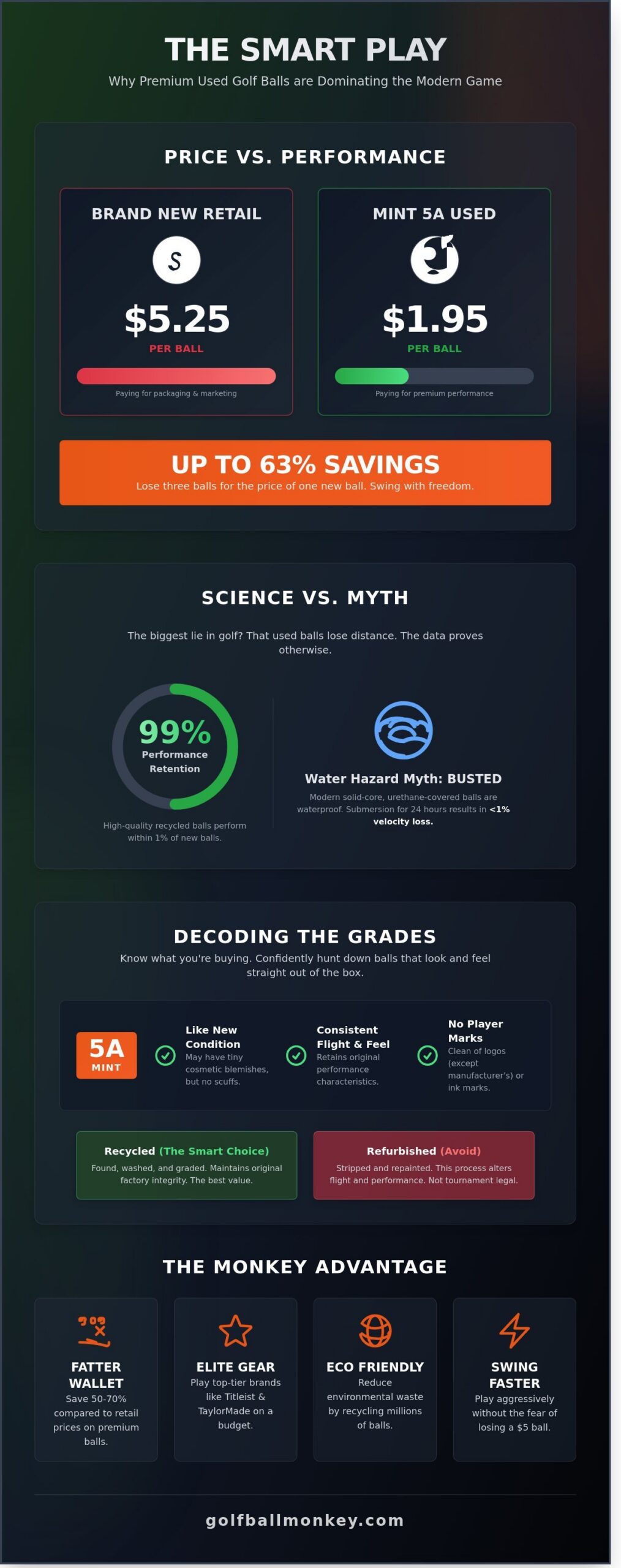
How to Choose the Right Used Ball for Your Swing
Stop buying gear based on the logo alone. Your swing speed dictates what you need. A high-compression ball feels like a rock if you swing under 85 mph. You lose 12 to 18 yards of carry just by playing the wrong core. Match your speed to the ball’s compression rating to unlock your true distance. High speed needs 90-plus compression; slower swings thrive on 40 to 65. It is that simple.
The cover material is your next big decision. Urethane covers are the gold standard for scoring. They offer 35% to 45% more greenside spin than ionomer alternatives. If you want your used golf balls or recycled golf balls to hop and stop on the green, go urethane. If you struggle with a slice, ionomer or Surlyn covers are your best friend. These materials are slicker and produce less side-spin, which helps your ball stay 10% straighter on those wayward drives.
The Best Used Balls for High Swing Speeds
If you crank it over 105 mph, you need a ball that won’t deform too much at impact. The Titleist Pro V1x and TaylorMade TP5x are built for this heat. These dual-core monsters provide the low driver spin you need for 300-yard bombs while maintaining firm feel. Buying these at Monkey prices means you get Tour-level performance for about $2.00 per ball instead of the $5.50 retail sting.
Top Picks for Seniors and Slow Swing Speeds
Golfers with speeds under 85 mph need help getting the ball airborne. The Callaway Supersoft and Srixon Soft Feel are the heavy hitters here. These balls have a compression rating as low as 35, making them incredibly easy to compress. You get a higher launch angle and more hang time. Most players see a 5% increase in total distance just by switching to a low-compression model that actually fits their tempo.
The Consistency Secret: Buying the Same Model in Bulk
Mixing different brands in your bag is a recipe for a high handicap. Every ball has a unique flight window and spin profile. If you play a Bridgestone on hole one and a Callaway on hole two, your brain can’t calibrate your distances. Data shows that sticking to one specific model improves your distance control by 15% on approach shots. The smart play is to find a model you love and buy a 50-count bucket of 5-star quality recycled balls. This gives you a consistent feel for every single shot without the premium price tag.
Golf Ball Monkey vets every ball to ensure the grading is honest. You get the exact performance you expect at a fraction of the cost. Don’t let retail prices dictate your game. Pick your compression, choose your cover, and stock up on the same model to start shaving strokes off your round today.
Ready to find your perfect match? Shop our massive selection of premium used golf balls and save up to 70% off retail prices today.
The Golf Ball Monkey Advantage: From the Hazard to Your Bag
You just watched your five-dollar Pro V1 splash into the pond. It hurts. We get it. That is why we built Golf Ball Monkey. We don’t just find used golf balls; we rescue them. Our team of professional divers hits the water 365 days a year to recover high-end gear from the toughest hazards across the country. Once they’re out of the muck, the real work starts at our 15,000 square foot processing facility in Texas. We’ve refined a recovery system that treats every ball like a piece of precision equipment rather than a piece of trash.
Every ball undergoes a rigorous hand-grading process. We don’t rely on automated machines that miss subtle scuffs or hairline cracks. A human eye, trained to spot even the slightest imperfection, inspects every single dimple. This meticulous attention to detail beats eBay listings every time. On eBay, "Mint" is often just a guess from a guy in his garage. At Golf Ball Monkey, it’s a professional guarantee. Big-box retailers charge $55+ for a dozen new premium balls. We deliver that same tour-level performance for a fraction of the cost. Our quality control team rejects approximately 15% of all recovered balls to ensure only the best reach your bag.
Our "Monkey Prices" are the industry benchmark for value. We consistently keep premium, five-star quality balls under $2 each. This means you save between 60% and 80% compared to buying new at a pro shop. It’s the smartest play in golf. You get the spin, the distance, and the feel you need without the financial sting of a lost ball. We’ve streamlined our operations to ensure that the savings stay with the golfer, not the landlord of a fancy retail storefront.
Direct from the Source: No Middleman, No Retail Markup
We cut out the layers that inflate prices. Most sporting goods shops buy from wholesalers who buy from independent divers. We are the source. By managing the entire supply chain from the pond to our Texas warehouse, we eliminate the standard 30% retail markup. You get professional-grade used and recycled golf balls shipped straight to your door. No fluff. No extra fees. Just pure value delivered fast.
The Sustainability Story: Saving the Planet One Hazard at a Time
Golf balls take between 100 and 1,000 years to decompose in a water hazard. They eventually break down into microplastics and leach heavy metals into the local ecosystem. We’ve recovered over 2.4 million balls since our founding in 2018. That represents roughly 240,000 pounds of plastic and rubber kept out of the environment. Choosing recycled gear is a win for your wallet and the courses we love.
Join the troop of over 45,000 golfers who’ve stopped overpaying for their equipment. We offer a 100% satisfaction guarantee on every order we ship. If the ball doesn’t meet our strict five-star grading standards, we make it right immediately. Stop donating your hard-earned paycheck to the water hazard. Play the Golf Ball Monkey way and keep your cash for the 19th hole. Our inventory updates daily, so the brands you love are always in stock and ready for your next round.
-
Professional Divers: We recover gear from top-tier courses daily.
-
Texas Hand-Grading: Every ball is inspected by a human, not a machine.
-
Massive Savings: Premium brands for under $2 per ball.
-
Guaranteed Quality: If you aren’t happy, we aren’t happy.
Stop Overpaying and Start Scoring
Stop paying the "pro shop tax" just to watch your money sink into a water hazard. The data is clear; our Mint 5A balls perform within 1% of a brand-new sleeve, giving you elite spin and distance for 50% less cash. Every one of our used golf balls or recycled golf balls is hand-retrieved by professional divers or plucked from the tree line and undergoes a rigorous 5-stage cleaning and grading protocol before it ever reaches your bag. We handle every order from our Round Rock, TX warehouse to ensure fast US shipping so you can get back on the course immediately. You get the same Titleist performance the pros use without the $55+-per-dozen retail price tag. It’s the ultimate smart play for your game and your bank account. Stop stressing over lost balls and start focusing on your follow-through. Golf Ball Monkey has personally vetted every dimple so you can play your best round yet. Grab your gear today and see how much better the game feels when you aren’t worried about the cost of a lost shot.
Snag your Mint 5A Titleist Pro V1s at Monkey Prices!
Frequently Asked Questions
Are used golf balls illegal for tournament play?
No, they are 100% legal for tournament play as long as the model appears on the USGA Conforming Ball List. Most premium balls like the Titleist Pro V1 remain on this list for years, so you won’t face penalties in a club championship or sanctioned event. Just ensure the ball isn’t cracked or cut, as that violates Rule 4.2c. Play with confidence and save your cash.
How many yards will I lose with a used golf ball?
You will lose zero to five yards at most with a high-quality used golf ball. Independent testing shows that a 5-Star Mint grade ball performs within 1% of a brand-new retail ball’s distance. If you swing at 100 mph, you might see a 2-yard difference on a 250-yard drive. That is a tiny price to pay for saving 50% or more per sleeve.
What is the difference between recycled and refurbished golf balls?
Recycled balls are washed, sorted, and sold in their original condition. Refurbished balls are stripped and repainted with new clear coats and logos. We recommend recycled balls because they maintain the manufacturer’s original cover integrity. Tests show refurbished balls can lose 5% of their spin consistency because the new paint layer alters the dimple depth. Stick with recycled for predictable flight every time.
Do golf balls go bad if they sit in water for a long time?
Yes, golf balls start losing performance after sitting in water for more than 12 hours. Modern solid-core balls absorb moisture slowly, which can decrease initial velocity. Research indicates a ball submerged for 8 days loses about 6 yards of carry. Golf Ball Monkey only sources from dry areas or retrieves them quickly to ensure the core remains fast and snappy for your next round. It’s the smart play for your game.
Is it better to buy used premium balls or new budget balls?
Used premium balls outperform new budget balls in every category. A Mint Titleist Pro V1 offers 30% more greenside spin than a brand-new two-piece ionomer ball. You get tour-level control and feel for the same price as a "cheap" new ball. Why settle for a rock when you can play the best for a fraction of the cost? It is the ultimate way to upgrade your bag without the retail sting.
How does Golf Ball Monkey ensure the quality of every ball?
Golf Ball Monkey uses a rigorous 3-stage hand-inspection process for every single ball. We discard any inventory with scuffs, cuts, or discoloration that affects flight. Only the top 10% of our stock reaches 5-Star Mint status. We compare every batch against our strict grading scale to guarantee you get exactly what you paid for. No surprises, just massive savings on top-tier gear that looks and plays like new.
Can I buy used golf balls in bulk for my driving range?
Yes, you can grab used golf balls in bulk quantities ranging from 50 to 5,000 units. This is the perfect move for backyard practice or stocking a local driving range. Buying in bulk drops the price per ball by an additional 15% compared to our standard packs. It’s a total steal for golfers who want to grind on their swing without burning through their wallet. Stock up and swing away.
What is the best way to clean used golf balls or recycled golf balls?
Use a bucket of warm water mixed with 2 tablespoons of mild dish soap. Let them soak for 5 minutes to loosen dirt and grass stains. Scrub them with a soft-bristle brush and dry them with a microfiber towel. Avoid the dishwasher, as heat exceeding 140 degrees can damage the pressurized core. Keep it simple and keep your gear looking fresh for the course. Your bag will thank you.
- golfballmonkey@gmail.com
- (512) 593-8401
- Mon – Fri, 9:00 AM – 5:00 PM

All product and company names are trademarks™ or registered® trademarks of their respective holders.
Use of them does not imply any affiliation with or endorsement by them.