
Practice Golf Balls: The Ultimate Buying Guide for Every Budget

Why are you paying $4.50 per swing just to watch a brand-new premium ball disappear into the woods behind your house? It’s a total buzzkill. We know the feeling of watching your hard-earned cash fly away. Most golfers settle for those flimsy plastic shells that offer zero feedback, or they destroy their wallets buying retail. You need practice golf balls that actually mimic real flight without the heart attack price tag.
Let’s be real; you want to sharpen your game, not empty your bank account before you even hit the first tee. You deserve a setup that gives you 100% honest feedback on every strike. This guide shows you how to stop the retail madness and save between 70% and 90% on high-quality gear. The Monkey has personally vetted the best options to help you build a durable shag bag for less than the cost of a single round at the local muni.
We’re diving into the best limited-flight options for small yards, the top-rated recycled balls for short-game drills, and the specific gear that turns a 20-foot space into a pro-level training ground. It’s time to play smarter and keep your cash where it belongs.
Key Takeaways
- Match your practice tools to your specific training goals to ensure every swing translates to lower scores on the course.
- Identify the performance differences between foam and plastic options to get the most feedback out of your backyard sessions.
- Stop paying retail and learn how to source high-quality practice golf balls that deliver tour-level performance at a fraction of the cost.
- Build a custom practice bag in two simple steps by identifying your location and choosing a core ball that mimics your Sunday gamer.
- Master the Monkey’s grading scale to snag 5A mint quality balls and keep your wallet full while your game stays sharp.
Choosing the Right Practice Golf Balls for Your Goals
Stop flushing money down the drain. Many golfers treat practice like an afterthought, grabbing whatever is cheapest. That is a mistake. Practice golf balls range from foam backyard toys to tour-level recycled shag balls. Your goal is feedback. If your ball does not behave like your game ball, you are practicing bad habits. You are training your hands to feel things that will not happen on a real course. You need a ball that matches your intent.
We categorize these tools into three distinct buckets: Simulated (foam or plastic), Limited Flight (hollow), and Real-Feel (Recycled or Shag). To truly master the game, you should understand the history and construction of golf balls and how different layers affect spin and velocity. Our “Monkey prices” change the game. They make it possible to practice with the exact brands you play on Sunday without the $5 per ball retail price tag. You get 100% of the performance for about 30% of the cost of a new box.
Real vs. Simulated: The Great Practice Debate
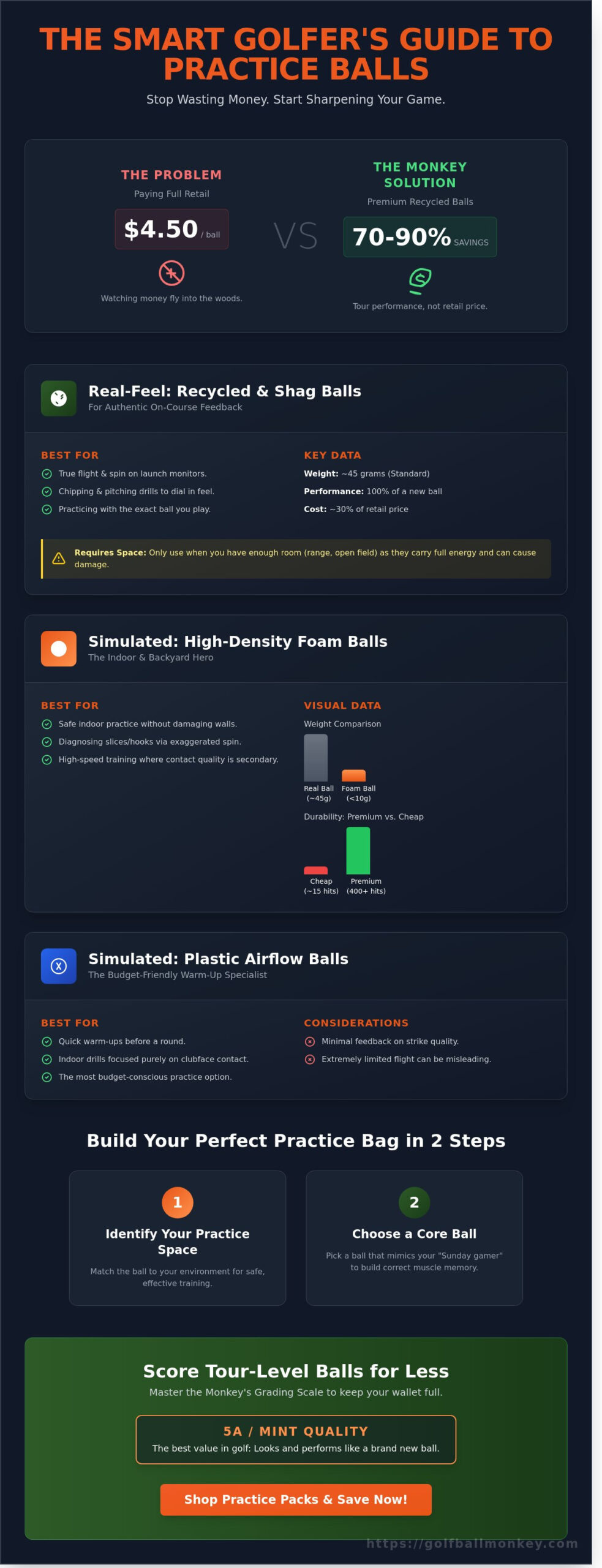
Real balls provide the only true data. If you use a launch monitor, foam balls are useless. They cannot replicate a 160 mph ball speed or a 6,000 RPM spin rate. Use real balls when you need to see how the ball actually reacts to the clubface. Simulated balls are for safety. They are essential for tight spaces like a 10-foot garage or a small backyard. Prioritize feel during short game sessions. Prioritize flight when you have 300 yards of space to see a slice in action.
Why Your Choice of Ball Dictates Your Progress
Your brain is a sponge. If you hit ultra-light foam balls all day, you will likely start over-swinging to compensate for the lack of resistance. This ruins your timing. A standard ball weighs roughly 45 grams, while foam versions often weigh less than 10 grams. This 35-gram difference changes your swing physics. Use different practice golf balls for specific drills:
- Foam balls: Perfect for high-speed “overspeed” training where contact does not matter.
- Plastic wiffle balls: Ideal for indoor contact drills to ensure you are hitting the center of the face.
- Real recycled balls: Essential for chipping and pitching to feel the “click” and check your spin.
There is a massive psychological benefit to hitting a ball that looks and sounds like a Titleist Pro V1 or a TaylorMade TP5. It builds “muscle memory” for the sound of a pure strike. Don’t settle for junk that feels like a rock. Visit the Golf Ball Monkey shop to find premium brands at prices that actually make sense for your wallet. Smart players practice with what they play.
Simulated Practice Balls: Foam, Plastic, and Limited Flight
Hitting a real ball into a net is great, but sometimes you just want to rip a driver in the backyard without paying for a new patio door. That is where simulated balls come in. These are not toys. They are essential tools for getting your reps in when the range is too far or the weather is trash. Safety is the biggest driver here. A standard ball carries enough kinetic energy to shatter double-pane glass from 50 yards away. Simulated practice golf balls drop that risk to near zero. They allow you to focus on your swing path and tempo without the constant fear of a lawsuit from your neighbor.
Foam Practice Balls: The Indoor Hero
High-density foam is the gold standard for home setups. These balls provide a satisfying “pop” off the clubface that mimics a real strike. You get enough weight to feel the impact, but they won’t punch a hole in your drywall. To get the most out of your session, look for balls with accentuated spin dimple patterns. These designs exaggerate your side-spin. They show you exactly why that 7-iron just sliced into the imaginary woods. It is the best way to diagnose a swing flaw in a confined space.
Durability is the main separator between junk and gear the Monkey approves of. Cheap, low-grade foam balls often develop cracks or lose their shape after just 15 high-velocity hits. Premium foam options can withstand 400 or more strikes before they lose their structural integrity. While real balls feature complex different types of golf ball constructions like urethane covers and solid cores, foam balls rely on consistent density to provide feedback. Spending an extra $5 on a quality pack saves you money in the long run.
Plastic Airflow Balls: The Warm-Up Specialist
Plastic airflow balls are the budget king of the practice world. You can usually grab a 24-pack for less than the price of a mid-round hot dog. They are hollow, perforated, and incredibly light. This makes them the safest choice for kids or absolute beginners who are still learning to make contact. The feedback is purely auditory. A sharp clack means you hit it thin. A dull thud means you caught it flush. They are the ultimate “no-excuse” tool for daily practice.
These are contact only tools. Do not expect to learn much about your ball flight here. Because they weigh so little, even a 5 mph breeze will carry them 20 feet off course. They are perfect for a quick 10-minute warm-up in the grass before you head to the first tee. If you want more realistic performance without the retail price tag, you can always score pro-grade gear at a fraction of the cost in our store.
Limited Flight Balls: The Premium Bridge
Options like the BirdieBall bridge the gap between foam and the real thing. These often have a unique cylindrical shape but fly with remarkable accuracy. They provide nearly 100% of the feel of a real ball but only travel about 40 yards. The downside is the price point. You might pay $2.00 per ball. That is a massive jump from the $0.20 you pay for plastic. For the serious golfer with a large lawn, it is a smart play for dialed-in wedge work. It gives you the confidence of a real strike without the need for a 300-yard range.
Shag Balls vs. Premium Recycled: Practicing with the Real Thing
Stop wasting your time with those “limited flight” rocks at the local range. If you want to see how your ball actually reacts on the green, you need to use practice golf balls that were once high-dollar gamers. Shag balls are essentially real golf balls that have seen a few holes of action but still retain 95% or more of their original performance specs. It’s the ultimate hack for the savvy golfer. You get the spin, the feel, and the flight without the soul-crushing price tag of a brand-new box.
Choosing recycled isn’t just about saving your bank account. It’s a massive win for the environment too. Every ball we rescue is one less piece of plastic sitting in a pond or forest for a thousand years. Buying recycled is a smart play for your game and the planet. For a deeper dive into how these layers work, check out our guide on Golf Balls 101 to see the tech behind the cover.
What are Shag Balls? The Unsung Short-Game Heroes
Shag balls are typically 3A or 4A grade gems. They might have a slight scuff or a logo from a corporate retreat; however, they are perfect for the chipping green. Never use a brand-new, $5 ball for “shagging” practice. That is just throwing money away. Use these slightly used beauties to dial in your distance control instead. They provide the authentic click and roll that a plastic range ball can never replicate.
The “Monkey Secret” is simple; mix your brands in your shag bag. You won’t always play on perfect greens with a perfect ball. Mixing a few different models in your practice golf balls stash prepares you for any on-course condition you might face. It keeps your hands soft and your brain sharp. It’s about being ready for anything the course throws at you.
Recycled Premium Balls for Performance Training
If you are a low-handicapper, you cannot afford to practice with junk. You need to train with your specific game ball, like the Titleist Pro V1x or TaylorMade TP5. When you look at the data from the 2025 golf ball test, it’s clear that consistency is king for scoring. Recycled premium balls allow you to maintain that consistency during every single session without going broke.
The math is easy. At the “Monkey Price,” you can hit 100 premium shots for about the same cost as a single retail dozen from a big-box store. High-volume hitters find this a total no-brainer. You get Mint 5A quality that looks and plays like it just came off the shelf. Stop paying the retail tax and start practicing like a pro. Head over to our shop and grab a bulk bag to start saving today.
The Ultimate Practice Bag: How to Gear Up for Less
Stop burning cash on full-priced pellets. Building a killer practice setup doesn’t require a second mortgage. Follow this four-step blueprint to gear up like a pro for a fraction of the retail cost. The Monkey knows that every dollar saved on the range is a dollar you can spend on a tournament entry fee or a post-round round of drinks.
- Step 1: Identify your primary practice location. Your gear needs change depending on whether you’re hitting into a backyard net, heading to the commercial range, or grinding at the short game area.
- Step 2: Choose your “Core Ball.” This is your workhorse. It should mimic your Sunday gamer in feel and spin. If you play a premium urethane ball on the course, don’t practice with rock-hard distance balls.
- Step 3: Add “Utility Balls.” Grab foam balls for high-speed drills in the living room or plastic ones for low-impact warm-ups. These are tools for specific drills, not your entire game.
- Step 4: Buy in bulk. This is the golden rule. Buying 100 balls at once drives your price-per-ball down to the absolute floor. You can buy high-quality used golf balls in bulk to start building your bag right now.
Building Your Backyard Setup
Transform your lawn into a private training ground without the country club fees. You need three essentials: a 10×10 high-quality net, a durable turf mat to save your grass, and a bucket of 50 foam balls for late-night sessions. Don’t just swing blindly. Place an alignment stick on the mat to fix your swing path instantly. For the ultimate “pro” home setup, pair a launch monitor with real recycled practice golf balls. Using real balls provides 100% accurate data on spin and launch angle that foam simply cannot replicate.
Stocking Your Shag Bag for the Local Green
Efficiency is the name of the game at the short game area. Aim for a shag bag count of 50 to 75 balls. This specific volume allows you to find a rhythm and see patterns in your chips without constantly stopping to reload. Focus on “Practice Grade” balls for your bunker work. Sand is incredibly abrasive; it will chew through a mint-condition finish in 12 shots. Save the five-star inventory for the putting green and use the scuffed soldiers for the sand. If you want to maximize every rep with the right shag balls for your short game practice, check out our dedicated guide to building the perfect high-volume practice stash. Check out our guide on Golf Sports Terms to sound like a seasoned vet while you’re grinding out there.
Stop paying the “new ball tax” and start practicing with the same gear the pros use for 70% less. Grab a massive deal on bulk practice golf balls today and start shaving strokes off your score.
Score Massive Savings with Golf Ball Monkey Practice Packs
Golf is expensive. We get it. That’s why the Monkey dives into the murky depths so you can drive down the fairway without breaking the bank. Stop paying $50 or more for a dozen premium balls only to watch them disappear into the woods. Our practice golf balls offer the same flight characteristics and spin rates for a fraction of the retail cost. It is the ultimate smart play for your wallet and your handicap. We find them, we clean them, and we pass the massive savings directly to you. No elitism. No fluff. Just high-quality gear at prices that make sense.
The Monkey Grading Scale: Quality You Can Trust
We do not guess on quality. We obsess over it. Every ball we recover goes through a rigorous manual inspection process to ensure it meets our strict standards. The Monkey personally vets this inventory so you know exactly what is landing on your doorstep.
- Mint 5A: These are the absolute gems of the lot. They look and play like they just came out of a fresh sleeve. You will find zero scuffs and 100% of the original factory shine.
- Near Mint 4A: These balls have minor cosmetic flaws, a slight discoloration, or a previous owner’s pen mark. They are perfect for high-end practice sessions where performance is the priority.
- Practice Grade 3A: Expect some scuffs and visible logos. These are not meant for your club championship, but they are 100% functional for the range or the backyard. They are the toughest workhorses in our inventory.
Why Buying Practice Balls in Bulk is the Smart Play
Retail stores want you to buy small, shiny boxes at high margins. We do things differently. Wholesale pricing is not just for commercial driving ranges anymore. Individual golfers save 40% more on average by purchasing our bulk buckets or mesh “Shag” bags compared to buying standard sleeves. This is where the real value lives.
There is also a psychological edge to having an “unlimited” supply of practice golf balls. When you are not worried about the $4 cost of a single lost shot, you swing free. You focus on the swing mechanic instead of the financial consequence of a slice. If you want to take that mental freedom even further on the course, check out our guide on how to stop losing golf balls and keep more money in your pocket during every round. This mental freedom translates to better muscle memory and faster improvement. You can hit 100 balls for the price of 20 retail balls. The math is simple. The results are real.
Elevate your game by hitting more balls for less money. It is time to restock your bag with the best value in the industry. Shop all used golf balls here and join the community of golfers who play smarter.
Stop Paying Retail and Start Dialing in Your Swing
Practice makes perfect, but paying full retail for balls you’re hitting into a net is a rookie mistake. You’ve learned that simulated foam balls are great for the living room, but nothing beats the feel of real urethane when you’re grooving your wedge play. Our Texas-based team of experts knows that every rep counts. We rely on professional divers who harvest millions of balls annually to keep our inventory stocked with the brands you love. Every single ball undergoes our strict 5A, 4A, or 3A grading process; we don’t do guesswork here. You get premium performance at up to 70% off retail prices, leaving you more cash for your next round. High-quality practice golf balls are the secret to a lower handicap, and we’ve made them more affordable than ever. It’s time to stop the financial bleed and start focused training with gear that actually performs. Grab your pack today and let’s get that swing dialed. Stop Overpaying, Get Your Practice Balls at Monkey Prices Now!
Frequently Asked Questions
Are foam golf balls good for practicing?
Yes, foam balls are excellent for working on your swing in tight spaces. They typically travel only 30 percent of the distance of a standard ball, making them safe for a 40 foot backyard. You get instant feedback on your contact without the risk of shattering a window. It’s a smart play for any golfer looking to squeeze in some reps between rounds using practice golf balls.
Do practice golf balls fly as far as real ones?
No, most practice golf balls are specifically engineered to travel shorter distances for safety. A typical foam or plastic ball will only fly between 25 and 45 yards maximum. Even restricted-flight range balls usually fly 15 to 20 percent shorter than a standard ball. If you need to see your true 150 yard 7-iron carry, you need real balls from the Monkey’s stash.
What is the difference between range balls and practice balls?
Range balls are heavy-duty tools built for commercial use, while practice balls cover everything from foam backyard options to tour-level gear. Range balls feature a rock-hard surlyn cover to survive 1,000 hits from a range picker. The Monkey’s “Practice” stamped balls are actually 100 percent tour-quality balls with tiny cosmetic ink errors. You get pro performance at a massive discount.
Can I use practice golf balls with a launch monitor?
You need real balls for a launch monitor to track spin and velocity accurately. Foam or plastic balls won’t trigger the sensors on a SkyTrak or Trackman correctly. Use our Mint Grade recycled balls to get 99.5 percent accuracy compared to retail versions. Don’t settle for bad data when you can get the real deal for a steal. It’s the only way to get true numbers.
How many practice golf balls do I need for a shag bag?
Most standard shag bags are designed to hold between 75 and 100 balls. Filling your bag with 85 balls is the sweet spot for a productive 45 minute session without getting too tired. Grab a bulk bag of our near-mint recycled balls to fill that bag for a fraction of the cost. It’s the ultimate insider move for serious practice at the local park.
Are plastic golf balls better than foam for backyard use?
Plastic balls are great for seeing ball flight, but foam balls feel much better at impact. A plastic ball weighs about 4 grams and struggles in a 10 mph breeze. Foam balls weigh closer to 12 grams and mimic the compression of a real ball much better. For a true backyard session, the Monkey suggests foam for a more realistic swing feel and better durability.
How long do recycled practice balls last compared to new ones?
Our recycled balls in Mint condition perform identically to brand new balls for the same duration. A standard urethane ball usually lasts for 120 full-swing shots before the cover shows any performance-altering wear. Since the Monkey vets every ball, you get that 5-star quality without the 5-star price tag. You’ll probably lose it in the woods before it ever wears out on you.
Will using scuffed practice balls damage my clubs?
Using dirty or heavily scuffed balls will definitely ruin your clubface over time. A ball covered in sand or deep 3 millimeter scratches acts like a file on your expensive wedge grooves. This can reduce your spin rate by 10 percent after just a few sessions. Protect your investment by using our clean, high-grade balls for all your practice needs. Don’t sacrifice your irons for a cheap ball.
- golfballmonkey@gmail.com
- (512) 593-8401
- Mon – Fri, 9:00 AM – 5:00 PM

All product and company names are trademarks™ or registered® trademarks of their respective holders.
Use of them does not imply any affiliation with or endorsement by them.