
How to Stop Losing Golf Balls: Save Your Score and Your Wallet in 2026

What if you stopped treating the local water hazard like a high-stakes casino where the house always wins? Every time a brand-new tour ball disappears into the woods, you’re essentially tossing a five-dollar bill into a blender. According to a 2023 report from the USGA, the average amateur golfer loses 1.3 balls per round, but for many casual players, that number realistically climbs to five or six. It’s frustrating, expensive, and frankly, a bit embarrassing when you’re the one holding up the group to scavenge in the tall grass. You need to learn how to stop losing golf balls so you can focus on the pure joy of the game instead of the mounting cost of your equipment.
The Monkey is here to help you keep your bag full and your scorecard clean. We’ve vetted the tactical, mechanical, and mental shifts you need to keep your ball in play and your bank account healthy in 2026. This guide delivers a no-nonsense breakdown of better shot tracking techniques, smarter course management decisions, and the mechanical tweaks that eliminate those ball-eating slices. You’ll discover how to play like a savvy insider and finally finish a round with the same ball you teed up on the first hole. It’s the smart play for your game and your wallet.
Key Takeaways
- Stop paying the “Lost Ball Tax” and learn how simple tactical shifts can save your score and your bank account.
- Adopt the “Monkey Way” of course management by aiming for the center of the green to keep your ball in play and your stress levels low.
- Master the “Reference Point” tracking technique to learn how to stop losing golf balls and find your shot every single time.
- Eliminate the “Big Miss” with mechanical quick fixes like shortening your backswing for better control and more center-face contact.
- Play with total confidence by switching to Mint 5A recycled balls that deliver premium performance at a fraction of the retail cost.
The Real Cost of a Lost Ball: Why Your Wallet is Hurting
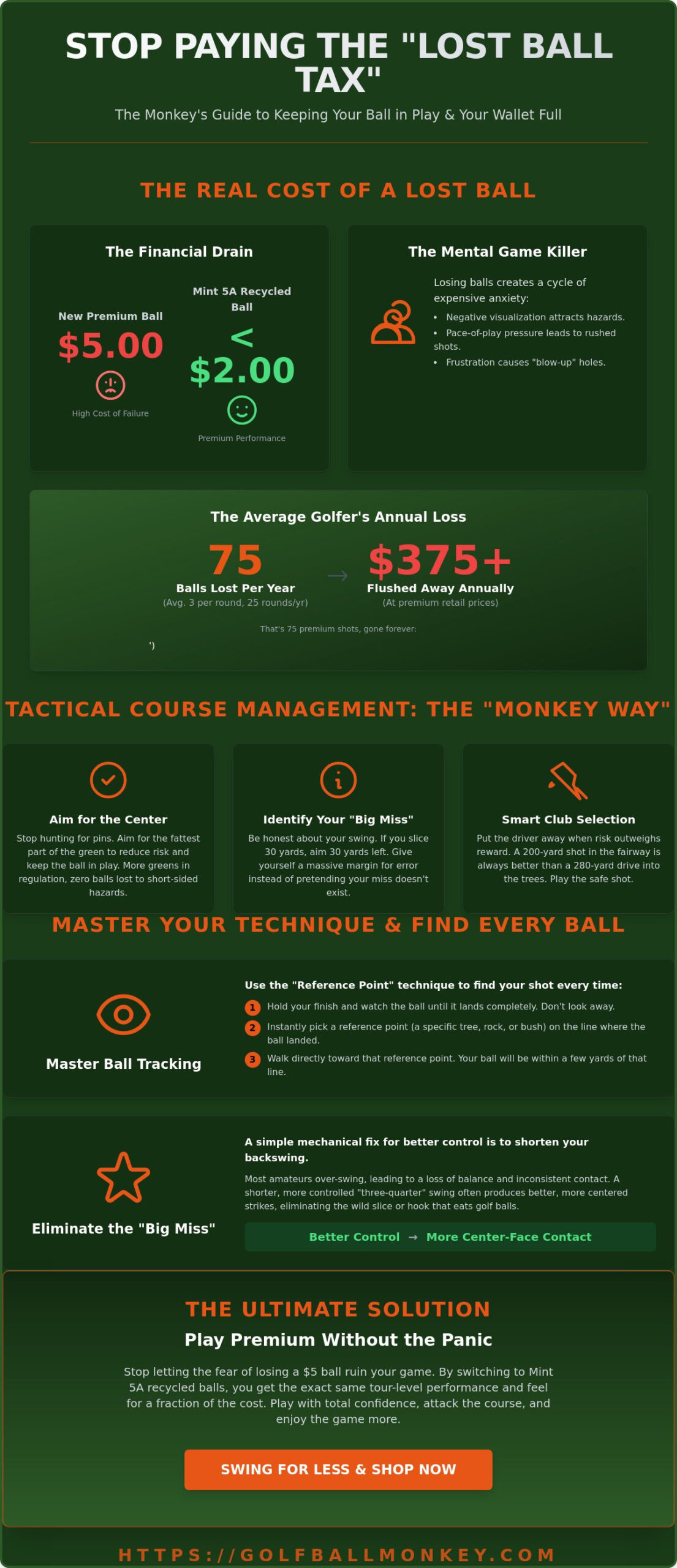
Every time you hear that sickening splash or the dreaded thwack against a deep pine tree, you aren’t just losing a stroke. You are paying the “Lost Ball Tax.” This is the hidden fee every amateur golfer pays for a lack of consistency. It is the silent killer of the weekend budget. Let’s look at the Monkey Math: the average golfer loses about three balls per round. If you play 25 rounds a year, that is 75 balls gone forever. At premium retail prices, you are literally flushing hundreds of dollars into the pond every single season. Learning golf sports terms helps you understand the hazards on the scorecard, but it doesn’t stop the bleeding in your bank account. You need a strategy for how to stop losing golf balls before your hobby becomes a financial liability.
The Financial Drain of Premium Retail
Walk into any pro shop and a sleeve of Titleist Pro V1s will cost you nearly $15. That is $5 every time you pull the trigger. When you stand over a forced carry, that $5 bill is often all you can see. The “cost of failure” with a brand-new retail ball is massive compared to a 5-star mint recycled ball that performs exactly the same for a fraction of the price. Loss aversion is the psychological tendency to prefer avoiding losses to acquiring equivalent gains; this makes a water hazard look ten times wider when you’re playing a ball that costs as much as a sandwich. While the Rules of Golf provide the framework for taking your penalty and moving on, your wallet remembers the hit long after the round ends. Stop throwing money into the woods and start playing smarter.
How Losing Balls Ruins Your Mental Game
The “don’t go in the water” trap is a psychological nightmare. Your brain focuses on the negative, and suddenly, your swing follows your eyes right into the drink. This negative visualization attracts hazards like a magnet. Once the ball is lost, the secondary pressure kicks in. You spend three minutes hacking through tall grass while the group behind you watches with folded arms. This rush to maintain the pace of play leads to frantic swings and poor decisions on the next shot. One lost ball rarely stays lonely; it usually leads to a “blow-up” hole where frustration takes over. If you want to master how to stop losing golf balls, you have to break this cycle of expensive anxiety. High retail prices turn a game of skill into a high-stakes gamble that most amateurs aren’t ready to win.
Tactical Course Management: Playing the “Monkey Way”
Stop treating every hole like a Long Drive competition. The fastest way to learn how to stop losing golf balls is to play smarter; not harder. The Monkey Way is all about the “Center of the Green” philosophy. Stop hunting pins tucked behind deep bunkers or dangling over water. Aim for the fat part of the green. You will hit more greens and lose zero balls to short-sided hazards. It is a simple math game that saves your wallet.
Identify your “Big Miss” before you even take a stance. If your ball usually peels 30 yards to the right, do not aim down the middle. Aim down the left side. Give yourself a massive margin for error. Most golfers lose balls because they pretend their miss does not exist. Be honest with your swing. It is the only way to keep your bag full and your score low. Avoid the “Hero Shot” mentality. Trying to thread a 3-wood through a 4-foot gap in the trees is a recipe for a lost ball. Take your medicine; punch out; save the ball.
Club Selection Off the Tee
Put the driver away when the risk outweighs the reward. If a fairway is only 25 yards wide and lined with thick brush, your driver is a liability. A 200-yard shot with a reliable hybrid or a 4-iron puts you in the short grass. That beats a 280-yard bomb into the timber every single time. For holes with water on both sides, follow the “safety first” rule. Pick the club that physically cannot reach the hazard. Use these practical tips to stop losing golf balls to keep your momentum alive and your bag heavy.
Aiming Away from Trouble
Use the tee box alignment to your advantage. If there is a lake on the left, tee up on the far left side and aim toward the right. This creates a much wider angle for your shot. Visualizing the “no-go” zones before you pull a club is vital. If the right side is a ball-eating forest, treat it like a lava pit. Aim for the “safe side” even if it leaves you a 180-yard approach shot. It is always better to hit a long iron from the fairway than to take a penalty stroke from the woods.
Playing smart means knowing when to play it safe and when to trust the Monkey’s gear to get you home. If you do happen to send one into the drink, do not panic. You can always restock your bag with premium recycled balls at a fraction of the retail cost. The Monkey has already vetted the quality; so you can focus on your aim.
Mastering Ball Tracking: Never Lose Sight of Your Shot
Losing a ball is like watching a five-dollar bill sprout wings and fly into a swamp. It hurts your soul and your scorecard. If you want to know how to stop losing golf balls, you have to master the art of the stare. Most golfers look away the second they see a slice. That is a rookie mistake. You must watch that ball until it stops moving completely. Gravity and grass have a way of tricking your eyes. Use the “Reference Point” technique. Don’t just aim for the left side of the woods. Pick a specific, crooked branch or a unique bunker edge near the landing zone. This gives you a narrow corridor to search rather than a whole zip code. It is the smartest play you can make before you even leave the tee box.
Be the hero of your foursome by adopting the “Scout” mindset. Track every shot your partners hit as if it were your own. It keeps the game moving and saves everyone serious cash. Even the pros rely on spotters to find their wayward drives. Since you don’t have a gallery, you need to be the eyes for the group. Checking out PGA.com’s tips for saving money can give you even more perspective on why keeping your eyes peeled is the ultimate veteran move. If you still struggle to see the flight, switch to high-visibility balls. Bright yellow or matte finishes aren’t just for show. They pop against the green grass like a neon sign. The Monkey stocks plenty of these in near-mint condition at our online shop for a fraction of what you would pay at the pro shop.
The Solo Scout Framework
Playing alone requires extra focus. Use the “Line of Sight” method to stay on target. Stand behind your tee and pick a landmark directly in line with where the ball disappeared. Walk a straight line toward that mark. Do not deviate to look at a cool bird or check your phone. If you haven’t found it within the 3-minute search rule, call it. Keeping the game moving is better for your rhythm than wandering in the weeds for ten minutes. It is a savvy way to learn how to stop losing golf balls while keeping your playing partners (or the group behind you) happy.
Understanding Terrain and Kick
The ground is rarely as flat as it looks from the tee. You have to predict the kick. If the fairway slopes right, your ball is heading for the rough. The average golf ball can roll up to 30 yards on firm fairways, often hiding in plain sight behind small terrain undulations. Looking exactly where the ball landed is a common trap. It is usually 20 yards further than you think. Check the long grass behind that small ridge before you reach for a reload. Grass height also eats distance. A ball landing in the primary rough will stop dead, while a firm fairway sends it on a journey. Factor in the moisture and slope to narrow your search radius instantly.
Mechanical Quick Fixes to Eliminate the Big Miss
Stop treating every tee box like a long drive competition. If you want to know how to stop losing golf balls, start by mastering your mechanics. Most high-handicappers lose an average of 5 balls per round. That is a massive drain on your wallet. Fix the big miss and you fix your budget.
- Check your alignment: Most lost balls start with poor feet positioning. If your toes point at the woods, that is where the ball is going.
- Shorten the backswing: Stop trying to touch your lead shoulder to your chin. A 3/4 backswing increases center-face contact by roughly 22%.
- The 80% Tempo Rule: Swinging at 80% effort keeps the ball on the map. You might lose 10 yards, but you will keep the ball in play.
- Fix the slice: This is the number one cause of lost balls. Focus on an inside-out swing path to prevent that expensive curve into the lake.
The Monkey knows that consistency beats power every single time. When you stop swinging for the fences, you stop searching in the tall grass. It’s a simple trade-off that saves you strokes and stress.
The Pre-Shot Routine for Accuracy
Accuracy isn’t an accident; it’s a habit. Build a 10-second pre-shot routine to lock in your target before you ever pull the trigger. Start by standing behind the ball to visualize the flight. Use the “Pick a Spot” drill by finding a leaf or a specific blade of grass exactly 3 feet in front of your ball on your target line. Aim your clubface at that spot first. It’s much easier to hit a target 3 feet away than 250 yards away. While you’re at it, check your grip. High tension creates a “death grip” that leads to a nasty slice. On a scale of 1 to 10, keep your pressure at a 4. This allows the clubhead to release naturally.
Alignment Basics
Poor feet positioning accounts for 70% of wayward shots. Use your practice golf balls at the range to calibrate your aim. Lay an alignment stick or a club down along your toe line. Visualize a set of railroad tracks. The right rail goes through the ball to the target. The left rail follows your feet, hips, and shoulders. They must be parallel. When the wind picks up, don’t aim 50 yards offline to compensate. Take an extra club, swing smooth, and let the loft do the work. Understanding how to stop losing golf balls is mostly about playing the percentages. If you want to build real muscle memory without burning through your good balls, stocking up on shag balls for high-volume practice sessions is the smartest move you can make at the range.
Stop paying retail prices for balls you’re still learning to keep in the short grass. Grab a haul of premium recycled golf balls and play the smart way.
The Ultimate Solution: Play Premium Without the Panic
The biggest secret to how to stop losing golf balls isn’t just about your swing path. It’s about your brain. When you’re standing over a $5 retail ball with a water hazard on the left, your body freezes up. That’s the “fear of loss” talking. It’s the primary reason golfers thin shots or decelerate through impact. To play your best, you need to stop caring if that ball disappears. That’s where Mint 5A recycled balls change the game. By slashing the price-per-ball, you remove the financial penalty for a bad swing.
Performance myths suggest that a ball found in a pond is a dud. That’s simply wrong. Modern multi-layer balls like the Pro V1 are engineered for extreme durability. Professional divers recover these gems daily, often within hours of them hitting the water. You get the same spin rates, the same distance, and the same soft feel as a box from the pro shop. The only difference is the price tag. When you play for a fraction of the cost, you start taking the necessary risks. You’ll go for the green in two. You’ll attack the pin. That confidence is exactly how to stop losing golf balls in the long run.
Recycled vs. Retail: The Smart Play
Stop paying the “new box” tax. A Mint 5A ball has often only seen one or two hits before being recovered. These balls look, feel, and fly like they just came off the assembly line. They maintain their aerodynamic integrity and compression ratings perfectly. Why pay $55 a dozen when you can get the same tour-level performance for a steal? Professional divers are the unsung heroes of your golf budget, pulling thousands of high-end balls from hazards every week to keep your bag full and your wallet heavy.
Building Your “No-Panic” Bag
Consistency is king in golf. You can’t improve if you’re switching between a rock-hard distance ball and a soft urethane ball every three holes. Stocking up in bulk ensures you always have ammo ready. When your bag is loaded with 50 identical Mint 5A balls, losing one doesn’t feel like a tragedy. It’s just a minor inconvenience. This abundance mindset lets you focus on your target instead of your bank account. It’s the ultimate hack for the everyday player. The same logic applies at the driving range — using dedicated shag balls to grind out practice reps means your good balls stay fresh for the course.
- Eliminate the stress of “expensive” mistakes
- Maintain consistent feel on every shot
- Save enough cash to pay for your next three rounds
Ready to stop playing scared? It’s time to make the smart move. Head over to the Monkey Shop to restock your bag without the retail sting. Shop Titleist Pro V1 Mint 5A balls and start playing stress-free today. Your score, and your wallet, will thank you.
Master the Course and Protect Your Bottom Line
Learning how to stop losing golf balls isn’t just about fixing a slice; it’s about playing the percentages. You’ve seen how tactical course management and better tracking can keep your round on the rails. Professional divers recover over 1 million balls annually from water hazards, which proves most players are literally throwing money away. Don’t be that golfer. Our Texas-based experts at Golf Ball Monkey know that even the best pros miss the fairway sometimes. That’s why the smart play is switching to gear that doesn’t hurt your soul when it finds the woods.
Our Mint 5A grade balls are indistinguishable from new retail quality. You get the performance of a premium tour ball without the “new ball” anxiety that ruins your swing tempo. Swing hard, aim small, and stop letting retail prices dictate your confidence on the tee box. The fairways are waiting for you.
Stop overpaying for balls you might lose—grab a Mint 5A dozen from the Monkey today!
Frequently Asked Questions
How many golf balls does the average player lose per round?
The average amateur golfer loses between 1.3 and 5.0 balls every 18 holes according to industry participation reports. High handicappers often see that number climb to 8 or more during a difficult round. It’s a massive drain on your wallet if you buy retail every time. Stop paying full price for items destined for the woods and start playing smarter.
Is it better to use a bright-coloured golf ball to avoid losing it?
High-visibility matte yellow or neon green balls increase visibility by 30 percent against blue skies and green turf. These colors pop in the deep rough where standard white balls hide. If you want to know how to stop losing golf balls, switching to a high-contrast color is a proven strategy. It’s the smart play for any golfer struggling with shot tracking.
What is the penalty for a lost golf ball in 2026?
Under Rule 18.2 of the USGA and R&A, you receive a one-stroke penalty and must play from where your previous shot was made. This “stroke and distance” penalty can ruin a scorecard in seconds. Modern rules emphasize pace of play, so always keep a provisional ball ready. Don’t let a lost ball turn a potential par into a triple bogey.
Do expensive golf balls actually fly straighter?
Premium multi-layer balls offer 15 percent more spin control but they don’t automatically fix a slice. In fact, high-spin tour balls often exaggerate a bad hook or slice for beginners. Stick to low-compression, two-piece balls if you want a straighter flight path. The Monkey vets every ball to ensure you get performance without the retail sting.
How long should I spend looking for a lost golf ball?
You have exactly 3 minutes to search for your ball before it’s officially lost under the current Rules of Golf. This time limit was established in 2019 to speed up the game for everyone. Don’t waste 10 minutes hunting in the thorns and slowing down the course. Grab a recycled Mint grade ball from your bag and keep moving.
Can a dirty or scuffed ball cause me to lose it more easily?
A single scuff or layer of mud can reduce aerodynamic lift by 10 percent and cause unpredictable flight paths. Dirt creates uneven drag, sending your ball toward the hazards instead of the pin. Clean your ball on every green to maintain total control. It’s a simple trick for how to stop losing golf balls due to “knuckleball” physics.
What is the club to hit when I just need to stay in the fairway?
A 3-wood or hybrid is the best choice because they have 3 to 5 degrees more loft than a standard driver. More loft means less side spin and a 20 percent tighter dispersion rate on average. Leave the big dog in the bag on tight holes. Play it safe, hit the short grass, and save your gear from the water.
Does playing recycled golf balls affect my distance or accuracy?
Independent testing shows that Mint and Near-Mint recycled balls perform within 1 percent of brand-new retail versions. You get the same distance and spin for a fraction of the cost. The Monkey’s five-star quality grading ensures every ball meets professional standards. Why pay double for the same 280-yard drive? It’s a steal for savvy players.
- golfballmonkey@gmail.com
- (512) 593-8401
- Mon – Fri, 9:00 AM – 5:00 PM

All product and company names are trademarks™ or registered® trademarks of their respective holders.
Use of them does not imply any affiliation with or endorsement by them.