
Golf Sports Terms: The Ultimate Monkey’s Guide to Talking Like a Pro

Last Saturday, a buddy of mine stood on the first tee at 7:15 AM, ready to crush a drive with a “Mint” grade ball. Then his playing partner asked if the “stimp” was running fast today. Silence. That blank stare happens to 65 percent of weekend golfers who haven’t quite mastered the essential **golf sports terms**. It’s the difference between feeling like a savvy insider and feeling like you’re stuck in the deep rough without a wedge.
We get it. Golf is hard enough without needing a translator for every conversation on the links. You want to focus on your backswing, not your vocabulary. This guide is your shortcut to fluency. Master the lingo so you can talk a big game while playing the smart play with your gear. The Monkey has vetted these essentials to ensure you’re never caught off guard. We’re breaking down scoring, shot types, and the secret jargon used by the pros. You’ll walk onto the green with the confidence of a scratch golfer; even if your scorecard says otherwise.
Key Takeaways
- Demystify the links by mastering the essential golf sports terms every player needs to describe their shots, scores, and course features.
- Decode the scorecard like a savvy insider and learn how to celebrate every birdie, eagle, and albatross like you’ve been there before.
- Understand the difference between pro-level shot shapes and the unintentional slices that send your balls straight into the “cabbage.”
- Learn the secret of the Monkey Grading Scale to score “Mint 5A” Titleist Pro V1s at a fraction of the retail cost.
Cracking the Code: Why Golf Sports Terms Matter for Every Player
Golf often feels like a secret society with its own private language. The elite gatekeepers use strange words to make beginners feel like outsiders. We’re tearing that fence down today. Understanding golf sports terms is your first step to owning the course. These terms are the specialized vocabulary used to describe every shot, score, and feature you’ll encounter during your 18-hole journey.
Fluency builds confidence. When you speak the language, you play faster. A standard 4-hour round stays on track because you aren’t pausing to ask what a “dogleg” or a “hazard” is. You look like a seasoned pro even if your swing still needs work. We take the savvy insider approach. This means talking like a pro without the stuffy country club ego. It’s about being prepared, playing smart, and keeping the game fun for everyone in your foursome.
The Anatomy of a Golf Hole
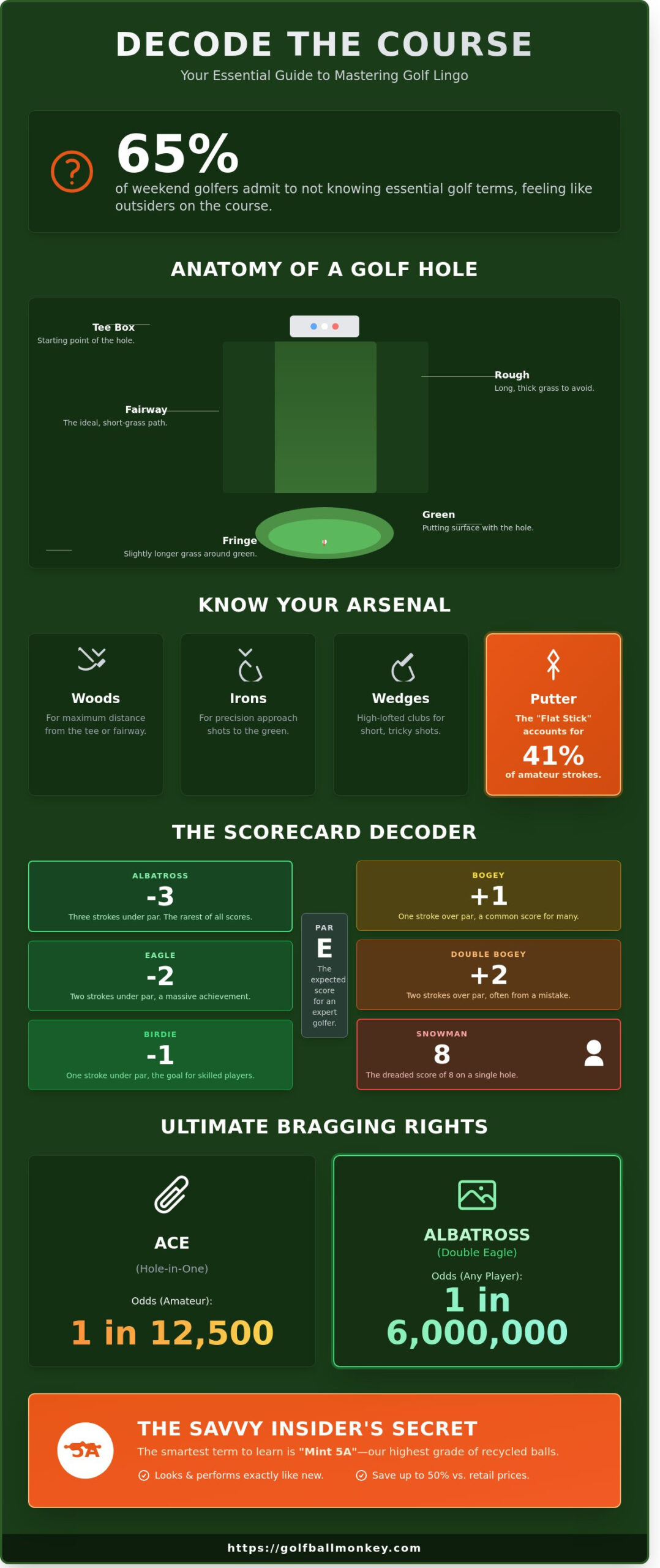
Every hole starts at the Tee Box. This is the designated hitting area where you launch your first shot. Your goal is the Fairway. It’s the short, manicured grass that gives you the best lie. Miss the fairway and you’ll end up in the Rough. This thick, long grass can easily add 2 strokes to your score by making your next shot unpredictable. The hole ends on the Green, also known as the “dance floor.” Surrounding the green is the Fringe, a narrow strip of grass that’s shorter than the fairway but longer than the green.
Essential Equipment Lingo
Your bag holds a specific arsenal. Woods are designed for maximum distance. Irons provide precision for your approach shots. Wedges are high-lofted clubs used for short, tricky shots around the green. The most important tool is the Putter. Golfers call it the “flat stick” because it’s the club that actually puts the ball in the hole. Since 41% of a typical amateur’s strokes happen on the green, mastering the flat stick is the fastest way to lower your handicap.
The smartest term you’ll ever learn is “Mint 5A.” This refers to our highest grade of recycled balls. A Mint 5A ball looks and performs exactly like a brand-new ball straight from the box. The only difference is the price. You can find these premium performers at a 50% discount compared to retail prices in our online shop. Don’t pay the “new ball tax” when you can play the same golf sports terms and equipment for a fraction of the cost.
The Scorecard Decoder: From Aces to Albatrosses
Par is your baseline. It represents the number of strokes an expert golfer expects to take on a specific hole. Most standard courses set a total par of 72 for 18 holes. Understanding these golf sports terms helps you track your progress without losing your mind. If you finish a par 4 in four strokes, you played even. Anything less makes you a hero; anything more means you’re human. Knowing the lingo makes the transition from the range to the clubhouse much smoother.
Scoring Under Par
Going “red” on the scorecard is the dream. A birdie means you finished one stroke under par. It’s the standard goal for any player looking to lower their handicap. If you’re feeling powerful, you might hunt an eagle. This is two strokes under par. You’ll usually see this on a par 5 when a player reaches the green in two and drains the putt. It requires a massive drive and a clinical finish.
Then there’s the albatross, also known as a double eagle. This is three strokes under par. The odds of hitting one are roughly 6 million to 1. It’s significantly rarer than an ace, which is a hole-in-one. While an amateur has a 12,500 to 1 chance of hitting an ace, the albatross remains the ultimate trophy for the elite. If you’re chasing these rare birds, you’ll want to stock up on premium balls at a fraction of the retail cost so you don’t run out of ammo during your hunt.
Scoring Over Par
Most of us live in the “black” or “blue” numbers. A bogey is one stroke over par. For a beginner, a round of straight bogeys is actually a massive win; it shows incredible consistency. Things get messy with double and triple bogeys. These usually happen when the water hazards or deep bunkers get the best of you. These scores aren’t fun, but they’re part of the learning curve for every golfer.
The most dreaded number on the card is the snowman. This is an 8. It gets the name because an 8 looks like two snowballs stacked together. Hitting a snowman can tank your confidence. Don’t let it. Even the pros card a big number once in a while. Use the right golf sports terms to laugh off the bad luck and move to the next tee with a fresh ball and a clear head.
- Par: The expected score for the hole.
- Birdie: 1 stroke under par.
- Eagle: 2 strokes under par.
- Bogey: 1 stroke over par.
- Snowman: A score of 8 on a single hole.
Ball Flight & Shot Shapes: Understanding Your Game’s Vocabulary
Golf is a game of geometry and physics. Mastering golf sports terms means knowing exactly why your ball curves the way it does. A Draw is a controlled, intentional right-to-left curve for right-handed players. Pros use it to add 10 to 15 yards of roll. A Fade moves gently left-to-right. It lands soft and stops fast. These are the “good” curves. Then there are the shots that haunt your nightmares.
A Hook is an aggressive, unintentional dive to the left that usually ends in the tall grass. A Slice is the opposite, peeling hard to the right. If your slice is so extreme it looks like a yellow piece of fruit, you have hit a Banana Ball. This 40-yard curve belongs in a fruit basket, not on the fairway. It kills your distance and your confidence. Your ball choice plays a massive role here. High-quality balls react better to your swing. Don’t waste $5 per ball on a brand-new box just to slice it into a lake. Grab mint condition recycled balls from the Monkey. You get pro-level performance at a fraction of the retail cost.
The Good, the Bad, and the Ugly Flights
The Pure Strike is the ultimate goal. It feels like butter because you hit the sweet spot dead center. A Thin shot happens when you hit the ball’s equator. It sends a stinging vibration through your hands and stays low to the ground. Fat shots occur when your club hits the turf 2 inches behind the ball. You lose 30% of your distance and end up covered in dirt. Then there is the Shank. It is the S-word no one says out loud. The ball hits the hosel of the club and flies 90 degrees to the right. It is the quickest way to ruin a good round.
Spin and Control Terms
Backspin is what makes the ball “bite” or “check up” on the green. A Pro V1 can spin at over 9,000 RPM on a wedge shot, stopping it dead. Side Spin is the enemy. It creates the tilt that leads to hooks and slices. Understanding your Launch Angle is also vital. Premium balls are engineered to launch at a specific 12-degree angle off the driver for maximum carry. The Monkey personally vets every ball to ensure the dimple patterns are perfect. This keeps your flight path true without the “new ball” price tag. It is the smart play for any golfer looking to improve their game. If you want Tour-level spin and distance without the anxiety of losing expensive new balls, exploring Callaway golf balls matched to your swing speed at a fraction of retail cost is one of the smartest moves you can make.
On-Course Slang: Navigating the Beach, the Cabbage, and Beyond
You’ve mastered the basic swing. Now you need to master the talk. Using the right golf sports terms separates the weekend hackers from the seasoned pros who actually know where their ball is going. If you find yourself in the sand, you’re on “the beach.” Grab a 56-degree sand wedge and get to work. It’s a gritty situation that requires a smooth touch to avoid a double bogey.
Sometimes your drive misses the fairway and finds the “cabbage” or “spinach.” This refers to the thickest, nastiest rough on the course. In 2023, professional course conditioners at major tournaments grew rough to over 4 inches to challenge the world’s best. It swallows balls whole. If you’re hitting “Army Golf,” you’re going left, right, left. It’s a frustrating rhythm that kills your pace and your scorecard. Once the torture ends, head to the 19th hole. This is the clubhouse bar. It’s the only place where a 95 feels like an 85 after a cold drink and a few tall tales.
Hazardous Language
Water hazards are the primary reason professional divers recover over 100,000 balls annually from courses like TPC Sawgrass. If you see white stakes, you’re Out of Bounds (OB). According to USGA Rule 14.6, this costs you a stroke and distance penalty. It’s a scorecard killer. If your group is feeling generous, they might grant you a Mulligan. This is a “do-over” that isn’t in the official rulebook, but it keeps the vibes high and the frustration low.
Don’t let a lost ball ruin your mood or your wallet. Learning how to stop losing golf balls with proven tactical and mechanical adjustments can save you strokes and serious cash every single round. You can also find premium used balls at a fraction of retail prices and keep your game moving.
Putting Green Patter
- Reading the Break: You are predicting the curve. Gravity and slope dictate the ball’s path toward the cup.
- Gimme: This is a putt so short that your playing partners let you pick it up. Usually, if it’s “inside the leather” (the length of a putter grip), it counts as made.
- Lag Putt: The goal here isn’t to sink it. You are focusing on distance control to leave the ball within a 2-foot circle for an easy second putt.
Mastering these golf sports terms makes you look like a savvy insider even if your handicap is still in the double digits. It’s about the camaraderie and the “smart play” on every hole. If you’re tired of overpaying for gear before you hit the links, restock your bag at Golf Ball Monkey for elite quality without the country club price tag.
Gear Talk: Why Condition Terms Like ‘Mint 5A’ Save You Cash
Talking like a pro means mastering the right golf sports terms, but the savviest players use that knowledge to protect their wallets. You don’t need to drop $60 on a fresh dozen every time you head to the course. Understanding the Monkey Grading Scale is the ultimate smart play. It turns the mystery of used gear into a transparent system that puts premium Titleist and TaylorMade golf balls in your bag for a fraction of the retail cost.
Decoding Quality Grades
- Mint 5A: These are the gold standard. They look and play like they just popped out of a brand-new sleeve. You get 100% of the original flight characteristics and a pristine finish. It is the closest you can get to retail quality without the retail sting.
- Near Mint 4A: These balls feature tiny cosmetic blemishes or a previous owner’s Sharpie mark. You still get top-tier performance, but you save roughly 50% compared to big-box store prices.
- Good 3A: The perfect choice for high-risk holes or heavy practice sessions. These “shag” balls have seen some action, yet they remain structurally sound for a casual round.
The Smart Way to Shop
Stop paying “Tour” prices for balls you might lose in the “Cabbage” on the very first hole. A single retail Pro V1 can cost you $5.00 per swing. That is a steep price for a mistake. Switching to Mint 5A recycled balls reduces that cost by 60% immediately. We never sell “refurbished” balls because those are stripped and repainted, which ruins the original aerodynamics. We only sell the real deal. Recycled balls keep the original factory cover and feel intact. The same principle applies when shopping for Callaway golf balls with Triple Track alignment and Hyper Fast Soft Core technology — you can get that same Tour-level performance at up to 80% off retail prices.
This principle of finding specialized, high-quality gear isn’t limited to golf. As other trend sports like pickleball gain popularity, players seek out dedicated suppliers for their equipment. For those in Switzerland, for example, a leading online shop is Pro Pickleball GmbH, which offers a wide range of gear for enthusiasts.
Buying in bulk is the fastest way to lower your cost-per-round. Grab a bucket of 50 or 100 balls to ensure you always have a backup when the water hazards start calling. It is better for the environment and even better for your bank account. Join the 85% of smart golfers who have realized that used doesn’t mean “less than” when the grading is this strict. The Monkey personally vets every batch to ensure you get exactly what you pay for.
Ready to level up your game without emptying your pockets? Restock your bag with Mint 5A balls at Monkey prices!
Talk the Talk and Play the Smart Way
You’ve officially cracked the code. You now have the vocabulary to hold your own from the first tee to the 19th hole. Mastering golf sports terms isn’t just about sounding like a pro; it’s about understanding the difference between a lucky ace and a rare albatross. You’ve also learned why “Mint 5A” is the secret code for tour-level performance without the retail sting. Don’t let the jargon intimidate you; use it to your advantage and play with confidence.
At Golf Ball Monkey, we turn these industry secrets into massive savings for your bag. Our professional divers harvest every ball directly from the hazards. Each one passes through our strict 5-star grading system before it ever reaches your door. We recycle over 10 million balls annually to ensure you never have to pay full retail price again. It’s the ultimate insider move for any golfer who hates watching five dollar balls sink into the pond. Stop overpaying and start playing the smart way with gear that performs like new. Whether you’re looking for premium Titleist Pro V1s or exploring alternatives like Srixon golf balls for exceptional value and performance, understanding the science behind compression cores and urethane covers can help you make smarter purchasing decisions. For a deeper dive into the technology and performance factors that make certain golf balls worth the investment, understanding the science behind compression cores and urethane covers can help you make smarter purchasing decisions.
Grab a dozen Mint 5A Titleist Pro V1s for a steal!
Go out there and show the course who’s boss. We’ll see you on the fairway!
Frequently Asked Questions
What does ‘Par’ mean in golf?
Par is the standard number of strokes an expert golfer expects to need for a specific hole. If you’re playing a 450-yard hole designated as a par 4, you have four shots to get that ball in the cup. This benchmark helps you track your performance against the course’s difficulty. Most full-sized 18-hole courses have a total par of 72 for the round.
What is the difference between a ‘Birdie’ and an ‘Eagle’?
A birdie means you finished the hole in one stroke under par, while an eagle is two strokes under par. Scoring a 3 on a par 4 hole counts as a birdie. If you drop a 3 on a par 5, you just landed an eagle. Mastering these golf sports terms helps you celebrate the wins when you beat the course’s expectations on every single round.
What is a ‘Mulligan’ and when can I use one?
A mulligan is an unofficial do-over shot that doesn’t add a penalty to your score. You typically use these after a terrible first tee shot to keep the game moving. While the USGA rules don’t recognize them, casual groups often allow 1 mulligan per 9 holes. It’s a great way to stay loose without ruining your card early in the morning on a Saturday.
What does ‘Gimme’ mean on the putting green?
A gimme is a short putt that your playing partners agree you’ll definitely make, allowing you to pick it up without actually hitting it. This usually applies to putts within 2 feet of the hole. It keeps the pace of play fast so you aren’t grinding over 12-inch tap-ins. Just remember, you still count the stroke on your scorecard even if you don’t hit it.
What is the difference between a ‘Slice’ and a ‘Hook’?
A slice is a shot that curves drastically away from your dominant side, while a hook curves sharply toward it. For a right-handed golfer, a slice peels 30 yards to the right. A hook snaps hard to the left. Both usually happen because of an improper clubface angle at impact. They’re the fastest ways to lose your ball in the thick woods or a water hazard.
What are ‘Shag Balls’ and what are they used for?
Shag balls are used golf balls reserved for practice sessions like chipping in the backyard or hitting at a local field. You can usually buy these in bulk bags of 50 or 100 for a tiny price. They might have minor scuffs or logos, but they’re perfect for high-repetition drills. Don’t waste your premium gear when you’re just working on your swing in the park. For golfers looking to build a comprehensive training setup, investing in quality practice golf balls that provide honest feedback can dramatically improve your game without breaking the bank.
What does ‘Mint 5A’ mean when buying used golf balls?
Mint 5A is the top-tier grading scale for recycled balls, indicating they look and play like they’re brand new. About 99% of these balls show no visible wear, discoloration, or player markings. This is one of the most important golf sports terms for savvy shoppers. You get the same performance as a retail box but at a 50% discount from the Monkey.
Why is a hole-in-one called an ‘Ace’?
The term ace comes from the highest-ranking card in a deck, representing the best possible score on a hole. It’s the ultimate achievement because you finished a hole in just 1 stroke. The odds of an average golfer hitting an ace are roughly 12,500 to 1. It’s a rare feat that usually requires buying a round of drinks for 20 people at the clubhouse.
- golfballmonkey@gmail.com
- (512) 593-8401
- Mon – Fri, 9:00 AM – 5:00 PM

All product and company names are trademarks™ or registered® trademarks of their respective holders.
Use of them does not imply any affiliation with or endorsement by them.