
Best Golf Balls for High Handicappers: Stop Losing Cash in the Woods (2026)
Handing over fifty bucks for a dozen “Tour” balls when you carry a 20-handicap isn’t an investment; it’s a donation to the local water hazard. You’re paying a premium for spin you can’t control and technology that actually makes your slice worse. It is time to stop the bleeding. We know the sting of watching a five-dollar ball vanish into the tall grass after one swing. You want more distance on those off-center hits and a flight path that stays on the map. Most importantly, you want to stop paying the “new ball tax” every single weekend.
The good news is that the best golf balls for high handicappers in 2026 are designed to fix exactly what is broken. This guide breaks down the top low-compression, high-forgiveness options that turn your slow swing speed into serious yardage. We will show you which covers keep it straight and how to grab three or four dozen premium balls for the price of one retail pack. From Mint 5A Titleists to the softest Callaways, here is how you play better golf without going broke. Get ready to find the perfect match for your game and your wallet.
Key Takeaways
- Stop fighting your gear and learn why low-compression tech is the secret to unlocking distance for swing speeds under 90 mph.
- Straighten out that slice by identifying the low-spin covers that help you find more fairways and fewer ponds.
- Get the lowdown on the best golf balls for high handicappers in 2026, featuring the latest from Callaway, Srixon, and Titleist.
- Beat the “new ball tax” with the Mint 5A standard, giving you tour-level performance at a fraction of the retail cost.
- Master the “Mixed Bag” strategy to test top brands and find your perfect ball without the wallet-crushing commitment.
Why High Handicappers Lose More Than Just Their Tempers
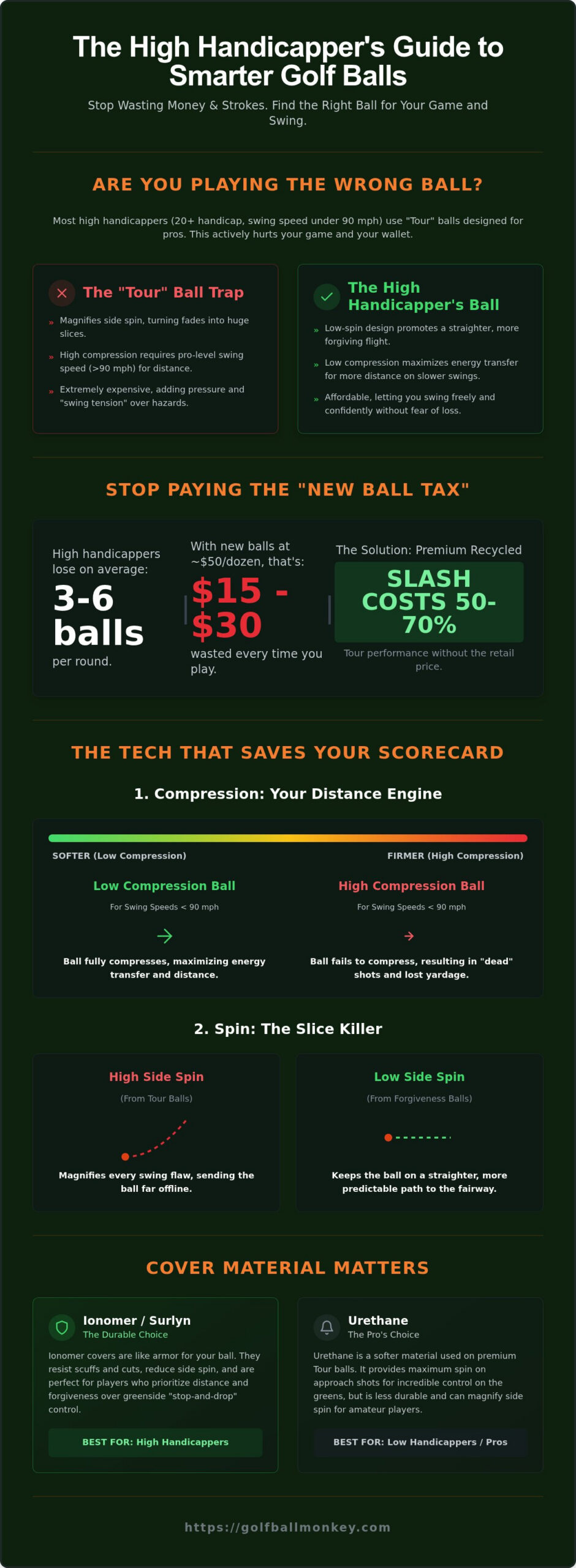
If your handicap is 20 or higher, you’re officially a high handicapper. Welcome to the club. It’s the largest segment in the game, yet most players are using gear that actively fights them. The #1 enemy isn’t necessarily your swing; it’s side spin. While “Tour” balls are designed for pros who want to “work” the ball, they’re a nightmare for the rest of us. That slight fade becomes a massive slice because high-spin balls magnify every mistake. Some experts claim beginners need spin to keep the ball airborne. They’re missing the point. For most, that spin just sends the ball further out of bounds. Understanding the history of the golf ball shows us that modern tech is amazing, but only if you choose the right category. The best golf balls for high handicappers prioritize forgiveness over workability. You don’t need a ball that curves on command. You need one that stays on the short grass. Stop trying to play like a pro and start playing for your scorecard.
The Psychology of the “Water Ball”
Ever stand over a pond and feel your grip tighten? That’s “swing tension.” It happens because you’re mentally calculating the $5 you’re about to lose. This fear ruins your tempo and practically guarantees a splash. Playing a ball you can afford to lose actually improves your score by letting you swing free and easy. A high handicapper ball is a tool for confidence, not just a piece of gear. When you aren’t worried about the “new ball tax,” you play better golf. It is that simple. Confidence comes from knowing you have a backup in the bag that didn’t cost a fortune.
The Cost of Learning the Game
The math is brutal. High handicappers lose between 3 and 6 balls per round on average. If you’re buying retail packs at $50 a dozen, you’re lighting $30 on fire every time you tee off. Stop the financial leak. By switching to premium recycled gear from our online shop, you can slash that cost by 50-70%. Redirect that budget into more lessons or green fees. It’s the smartest play for your wallet and your game. You’ll find that playing with high-quality, recycled equipment feels just as good as a fresh box, without the mental burden of the price tag.
Compression and Spin: The Tech That Saves Your Scorecard
Think of your golf ball as a high-tech spring. To get it to fly, you have to squish it. This is compression. If you swing under 90 mph, hitting a high-compression “Tour” ball is like trying to compress a brick with a fly swatter. You won’t get the energy back, and your distance will suffer. The best golf balls for high handicappers are designed with lower compression ratings. They allow your swing to actually deform the ball, storing energy and snapping it off the face for more yards. Finding the right fit through modern golf ball fitting principles ensures you aren’t leaving distance on the tee box just because your gear is too “hard” for your speed.
Low Compression: The Distance Engine
Low compression balls maximize your “Smash Factor.” This isn’t just a cool term; it’s the ratio of ball speed to clubhead speed. When the ball is soft enough to compress, more energy transfers from the club to the core. Harder balls feel like hitting a rock and often result in “dead” shots for average golfers. If you want that satisfying “thwack” and a ball that jumps off the face, go soft. It’s the easiest way to add 10 yards without changing your swing mechanics.
Spin Rate: Friend or Foe?
Not all spin is equal. Backspin is your friend because it provides the lift needed to keep the ball in the air. Side spin is the enemy that turns a tiny mistake into a trip to the woods. Most 2-piece balls are engineered with a large, soft core and a firm cover to reduce that “wobble” in flight. This construction keeps your shots on a flatter, straighter rope. The “Monkey Tip” is simple: look for labels like “Distance” or “Soft.” These are usually 2-piece designs built for maximum forgiveness and straighter flight paths. If you’re tired of losing gear to the trees, check out the high-forgiveness options in our inventory.
Finally, consider the cover material. You’ll usually choose between Ionomer (often called Surlyn) and Urethane. Urethane is what the pros use for “stop and drop” control on the greens. However, Ionomer is much more durable. It’s like armor for your ball. It resists scuffs from cart paths, trees, and the thick rough where high handicappers often find themselves. Since you aren’t trying to stick a 6-iron from 180 yards, the durability of Ionomer is a massive win for your wallet.
The Heavy Hitters: 5 Best Golf Balls for High Handicappers in 2026
Most “best of” lists are a trap. They recommend sixty-dollar boxes that vanish into the woods before you even finish the front nine. We take a different approach. We focus on the best golf balls for high handicappers that actually balance performance with your bank account, especially when you buy them as Mint 5A recycled gear. You need a ball that stays straight and flies long, even when your swing isn’t perfect. Here are the top five models currently dominating the fairways.
- Callaway Supersoft: This is the king of feel. With an ultra-low compression rating of 38, it’s designed specifically for slower swing speeds. It feels like hitting a marshmallow but launches like a rocket.
- Srixon Soft Feel: Now in its 13th generation, this ball is a legend for a reason. Its FastLayer Core starts soft in the middle and gets firmer toward the edge, providing a great blend of distance and accuracy.
- Titleist Velocity: Forget the Pro V1 for a minute. The Velocity is built for one thing: speed. It uses a high-speed LSX core to deliver soaring flight and maximum yardage on every shot.
- Bridgestone Tour B RX: This is the “thinking man’s” tour ball. It is optimized for swing speeds under 105 mph, giving you premium urethane tech without the massive side spin that ruins your afternoon.
- Kirkland Signature: The ultimate budget disruptor. This 3-piece ball offers urethane performance that rivals the big brands, making it a favorite for those who want tour-level tech without the retail price tag.
Callaway vs. Srixon: The Battle of the “Soft” Balls
These two giants dominate the soft-compression category. Callaway utilizes HEX Aerodynamics to reduce drag and increase lift, which is a lifesaver for players who struggle to get the ball airborne. Srixon fights back with a 338 Speed Dimple pattern designed to cut through the wind. In breezy conditions, the Srixon tends to hold its line better. If you want the absolute softest feel on the face, read our Callaway Golf Balls guide to see why it remains a fan favorite. Both are elite choices for keeping your game in the short grass.
The “Secret” Performance of the Titleist Velocity
High handicappers often score better with a Velocity than a Pro V1 because the Velocity doesn’t punish a slice with excessive spin. It is engineered for high launch and low long-game spin, which translates to longer, straighter drives. The Velocity is the straight-shooting workhorse for the golfer who hates the woods. It helps you clear hazards by boosting your launch angle, turning those “maybe” shots into guaranteed carries. When you stop fighting the spin, you start finding the green.
Stop Paying the “New Ball Tax”: The Case for Recycled Premium Gear
Stop paying the “New Ball Tax.” It is the extra money you fork over at the pro shop just to be the first person to scuff a brand-new ball. For the best golf balls for high handicappers, retail prices are a trap. You are going to lose gear. It is part of the learning curve. But losing a ball that cost you a buck feels a whole lot better than watching five dollars vanish into a lily pad. This is the savvy insider’s secret: play the best brands for 50-70% less by choosing recycled gear.
Let’s clear the air on recycled vs. refurbished. Never buy refurbished balls. Those are balls that have been sandblasted, repainted, and stamped with a fake logo. It ruins the aerodynamics and the feel. Recycled balls are different. They are harvested by professional divers from course hazards, then cleaned and sorted by hand. No paint. No stripping. Just the original ball in its original state. Plus, it is the eco-friendly choice. Every ball recovered is one less piece of plastic sitting in a pond for eternity. Our divers harvest millions of balls annually, saving your wallet and the planet at the same time.
The 24-Hour Myth: Does Water Kill Distance?
Internet forums love to argue about “water-logged” balls. They claim a ball loses 10 yards after a quick dip. That is nonsense. Modern balls use solid cores and multi-layer covers that are incredibly water-resistant. A ball spent 24 hours in a pond is virtually identical to one in a box. Unless a ball has been submerged for years, the performance remains elite. If you’re still skeptical, check out our guide on Are Used Golf Balls Worth It? for the full technical breakdown. You’ll see that the “water damage” fear is mostly just marketing from the big brands.
Decoding the Mint 5A Grade
When you buy recycled, grading is your seal of approval. Our Mint 5A grade is the gold standard. These balls are indistinguishable from new. No scuffs. No player marks. Just pure, factory-level performance. If you want to save even more, look at 4A (Near Mint). These might have a tiny ink mark or a minor blemish, making them the perfect “practice round” sweet spot. Learn more about Decoding Grades: What Mint 5A Really Means to find your perfect value tier. Ready to stop overpaying? Grab a bag of premium recycled balls today and keep your cash in your pocket.
Stock Up Like a Pro: How to Build Your High-Handicap Arsenal
Buying in bulk is the ultimate power move. When you have 96 balls sitting in your garage, losing one on the first tee doesn’t ruin your day. It changes your entire psychology. You stop steering the ball and start swinging the club. For developing players, the best golf balls for high handicappers are the ones you aren’t afraid to lose. Stocking up on 48 or 96 packs of premium recycled gear is the smartest way to build a consistent game. You get the same flight, the same feel, and a massive discount compared to those overpriced 12-packs at the course pro shop.
The “Mixed Bag” Experiment
Maybe you haven’t found “the one” yet. That is perfectly fine. We recommend the Mixed Bag (Good 3A) for pressure-free practice and experimentation. It is the perfect way to test 5-6 different models on the course without a heavy financial commitment. You might find that you prefer the soft landing of a Srixon over the high launch of a Titleist Velocity. The Monkey recommends variety for the developing player. Once you find the brand that clicks with your swing, you can graduate to a bulk order of Mint 5A grades. It is an intelligent way to audition equipment before making a long-term play.
Don’t forget the supporting cast. Your arsenal needs more than just high-quality spheres. Savvy players know that the right accessories make the game easier. Consider these essentials for your next round:
- Golf Ball Monkey Performance Tees: Ensure consistent height on every drive for better contact.
- High-Quality Towel: Keep your dimples and grooves clean to maintain aerodynamic performance.
- Ball Markers: Stay prepared on the green without fumbling through your pockets.
Clean dimples are essential for flight. Dirty grooves lead to unpredictable side spin. It’s these small adjustments that turn a triple-digit score into a personal best. Focus on the details and the distance will follow. A prepared golfer is a confident golfer.
Ready to Restock?
You have the tech. You have the strategy. Now you just need the inventory. If you want the absolute peak of performance, go for the Mint 5A Titleist Pro V1. It gives you tour-level control at a fraction of the retail cost, allowing you to play the world’s #1 ball without the “new ball tax.” If you are still finding your rhythm, stick with the high-forgiveness 2-piece options we covered earlier. Head over to the Golf Ball Monkey Shop to load up your bag. Swing hard, save big, and keep it in the short grass. Play the ball that lets you swing freely. That’s the only way to truly enjoy the thrill of the game.
Level Up Your Game Without the Retail Sting
You’ve got the blueprint to stop the financial bleeding. By choosing low-compression tech and ditching high-spin covers, you’ve identified the best golf balls for high handicappers to keep your shots straight. The “new ball tax” is officially optional. You don’t need a fresh box to play your best; you just need the right gear for your swing speed. Our professional divers recover over 1 million balls annually, ensuring you get top-tier brands without the retail markup. With our Mint 5A grade guarantee, you get performance indistinguishable from new, vetted by insiders who live for the sport. It’s time to swing with total confidence knowing a splash in the pond won’t wreck your wallet. Score Tour Performance for Less-Shop Mint 5A Balls Now! Grab a bulk pack, find your rhythm, and start hunting those flags. We’ll see you in the short grass.
Golf Ball Monkey’s Insider Intel: High-Handicap FAQs
Do high handicappers really need expensive golf balls?
No, you don’t need to drop fifty bucks on a box of Tour balls. High-spin balls actually punish your mistakes by turning a slight fade into a massive slice. Focus on finding the best golf balls for high handicappers that prioritize straight flight and low-compression distance. Save your cash for green fees and buy recycled gear that performs just as well as the shiny retail packs.
What is the best compression for a high handicap golfer?
Aim for a compression rating between 35 and 70. This “soft” range is perfect for swing speeds under 90 mph. It allows you to fully compress the core, which translates to more yardage off the tee. If the ball feels like hitting a rock, the compression is too high for your speed. Low-compression balls are the easiest way to gain distance without changing your swing.
Will a low-spin golf ball actually fix my slice?
A low-spin ball won’t magically cure a bad swing path, but it will definitely minimize the damage. These balls are engineered to reduce side spin, meaning your slice won’t curve as aggressively toward the trees. It keeps your misses manageable and your scorecard cleaner. It’s the intelligent play for anyone tired of hunting through the tall grass for their equipment.
Are used golf balls as good as new ones for high handicappers?
Absolutely. Recycled balls in Mint 5A condition are indistinguishable from new gear. Since high handicappers lose balls frequently, the massive savings on recycled premium brands make them the smartest choice. You get the same aerodynamics and core performance without the “new ball tax.” It’s the savvy way to play top-tier brands like Titleist or Callaway for way less.
What is the most durable golf ball for beginners?
Balls with Ionomer or Surlyn covers are the toughest on the market. These covers act like armor, resisting the scuffs and scrapes that happen when you visit the woods or hit a cart path. They outlast soft Urethane balls by a long shot, making them ideal for the developing player. You’ll get more holes out of every ball before it needs to be retired.
How many golf balls should a high handicapper carry in their bag?
Don’t get caught empty-handed; carry at least 12 to 15 balls. High handicappers lose an average of 3 to 6 balls per round, so having a full dozen provides a necessary safety net. This prevents “swing tension” when you’re facing a forced carry over water. When you have a deep stash, you play with more confidence and fewer nerves.
Is the Titleist Pro V1 good for high handicappers?
The Pro V1 is a masterpiece, but it’s often “too much ball” for a high-handicap swing. Its high spin rate can magnify your slice and send you into the woods. Most high handicappers see better results with the Titleist Velocity or Tour Soft. These models are easier to keep straight while still offering that premium Titleist feel you want on the green.
What does Mint 5A grade mean for used golf balls?
Mint 5A is our gold standard. It means the ball looks and plays like it’s brand new. There are no scuffs, no player markings, and the cover is pristine. It’s the best way to get the best golf balls for high handicappers at a fraction of the retail cost. Our divers personally vet these to ensure they meet factory-level performance standards every time.
Golf Sports Terms: The Ultimate Monkey’s Guide to Talking Like a Pro
Last Saturday, a buddy of mine stood on the first tee at 7:15 AM, ready to crush a drive with a “Mint” grade ball. Then his playing partner asked if the “stimp” was running fast today. Silence. That blank stare happens to 65 percent of weekend golfers who haven’t quite mastered the essential **golf sports terms**. It’s the difference between feeling like a savvy insider and feeling like you’re stuck in the deep rough without a wedge.
We get it. Golf is hard enough without needing a translator for every conversation on the links. You want to focus on your backswing, not your vocabulary. This guide is your shortcut to fluency. Master the lingo so you can talk a big game while playing the smart play with your gear. The Monkey has vetted these essentials to ensure you’re never caught off guard. We’re breaking down scoring, shot types, and the secret jargon used by the pros. You’ll walk onto the green with the confidence of a scratch golfer; even if your scorecard says otherwise.
Key Takeaways
- Demystify the links by mastering the essential golf sports terms every player needs to describe their shots, scores, and course features.
- Decode the scorecard like a savvy insider and learn how to celebrate every birdie, eagle, and albatross like you’ve been there before.
- Understand the difference between pro-level shot shapes and the unintentional slices that send your balls straight into the “cabbage.”
- Learn the secret of the Monkey Grading Scale to score “Mint 5A” Titleist Pro V1s at a fraction of the retail cost.
Cracking the Code: Why Golf Sports Terms Matter for Every Player
Golf often feels like a secret society with its own private language. The elite gatekeepers use strange words to make beginners feel like outsiders. We’re tearing that fence down today. Understanding golf sports terms is your first step to owning the course. These terms are the specialized vocabulary used to describe every shot, score, and feature you’ll encounter during your 18-hole journey.
Fluency builds confidence. When you speak the language, you play faster. A standard 4-hour round stays on track because you aren’t pausing to ask what a “dogleg” or a “hazard” is. You look like a seasoned pro even if your swing still needs work. We take the savvy insider approach. This means talking like a pro without the stuffy country club ego. It’s about being prepared, playing smart, and keeping the game fun for everyone in your foursome.
The Anatomy of a Golf Hole
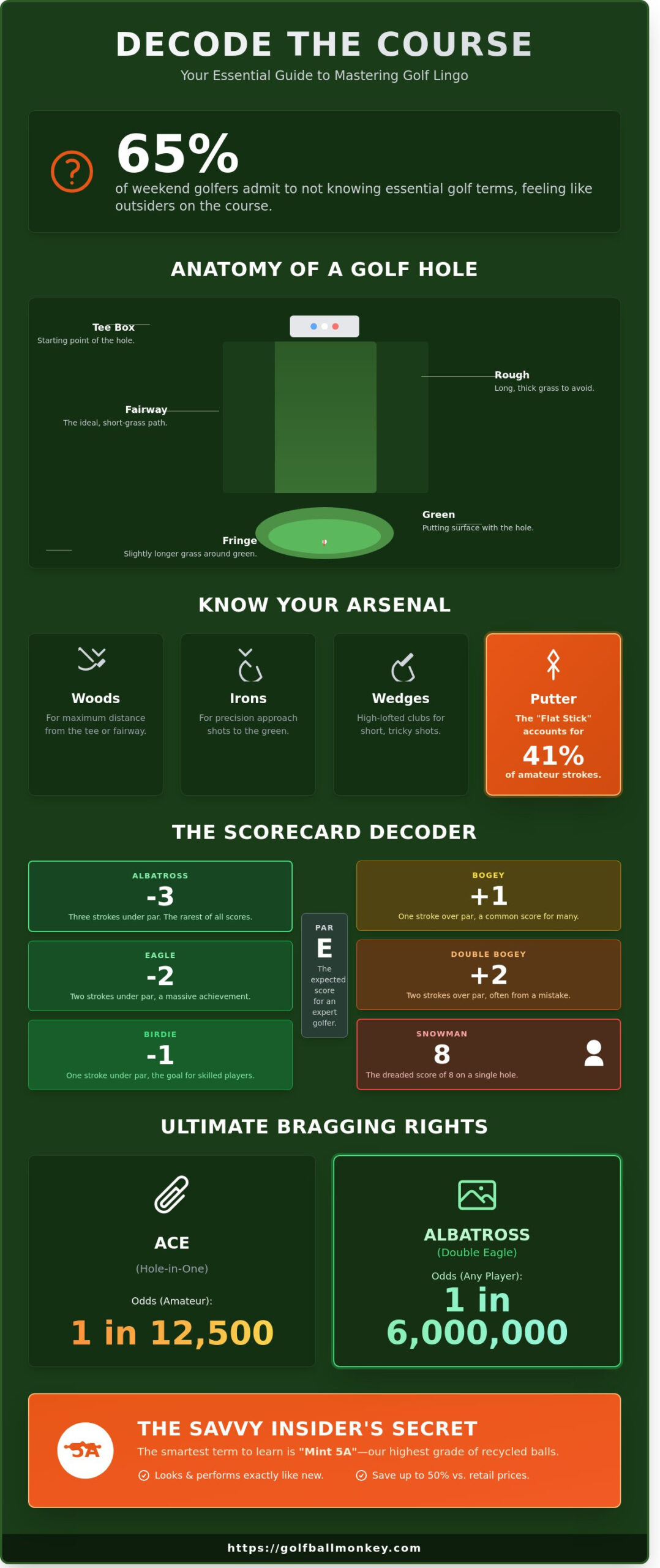
Every hole starts at the Tee Box. This is the designated hitting area where you launch your first shot. Your goal is the Fairway. It’s the short, manicured grass that gives you the best lie. Miss the fairway and you’ll end up in the Rough. This thick, long grass can easily add 2 strokes to your score by making your next shot unpredictable. The hole ends on the Green, also known as the “dance floor.” Surrounding the green is the Fringe, a narrow strip of grass that’s shorter than the fairway but longer than the green.
Essential Equipment Lingo
Your bag holds a specific arsenal. Woods are designed for maximum distance. Irons provide precision for your approach shots. Wedges are high-lofted clubs used for short, tricky shots around the green. The most important tool is the Putter. Golfers call it the “flat stick” because it’s the club that actually puts the ball in the hole. Since 41% of a typical amateur’s strokes happen on the green, mastering the flat stick is the fastest way to lower your handicap.
The smartest term you’ll ever learn is “Mint 5A.” This refers to our highest grade of recycled balls. A Mint 5A ball looks and performs exactly like a brand-new ball straight from the box. The only difference is the price. You can find these premium performers at a 50% discount compared to retail prices in our online shop. Don’t pay the “new ball tax” when you can play the same golf sports terms and equipment for a fraction of the cost.
The Scorecard Decoder: From Aces to Albatrosses
Par is your baseline. It represents the number of strokes an expert golfer expects to take on a specific hole. Most standard courses set a total par of 72 for 18 holes. Understanding these golf sports terms helps you track your progress without losing your mind. If you finish a par 4 in four strokes, you played even. Anything less makes you a hero; anything more means you’re human. Knowing the lingo makes the transition from the range to the clubhouse much smoother.
Scoring Under Par
Going “red” on the scorecard is the dream. A birdie means you finished one stroke under par. It’s the standard goal for any player looking to lower their handicap. If you’re feeling powerful, you might hunt an eagle. This is two strokes under par. You’ll usually see this on a par 5 when a player reaches the green in two and drains the putt. It requires a massive drive and a clinical finish.
Then there’s the albatross, also known as a double eagle. This is three strokes under par. The odds of hitting one are roughly 6 million to 1. It’s significantly rarer than an ace, which is a hole-in-one. While an amateur has a 12,500 to 1 chance of hitting an ace, the albatross remains the ultimate trophy for the elite. If you’re chasing these rare birds, you’ll want to stock up on premium balls at a fraction of the retail cost so you don’t run out of ammo during your hunt.
Scoring Over Par
Most of us live in the “black” or “blue” numbers. A bogey is one stroke over par. For a beginner, a round of straight bogeys is actually a massive win; it shows incredible consistency. Things get messy with double and triple bogeys. These usually happen when the water hazards or deep bunkers get the best of you. These scores aren’t fun, but they’re part of the learning curve for every golfer.
The most dreaded number on the card is the snowman. This is an 8. It gets the name because an 8 looks like two snowballs stacked together. Hitting a snowman can tank your confidence. Don’t let it. Even the pros card a big number once in a while. Use the right golf sports terms to laugh off the bad luck and move to the next tee with a fresh ball and a clear head.
- Par: The expected score for the hole.
- Birdie: 1 stroke under par.
- Eagle: 2 strokes under par.
- Bogey: 1 stroke over par.
- Snowman: A score of 8 on a single hole.
Ball Flight & Shot Shapes: Understanding Your Game’s Vocabulary
Golf is a game of geometry and physics. Mastering golf sports terms means knowing exactly why your ball curves the way it does. A Draw is a controlled, intentional right-to-left curve for right-handed players. Pros use it to add 10 to 15 yards of roll. A Fade moves gently left-to-right. It lands soft and stops fast. These are the “good” curves. Then there are the shots that haunt your nightmares.
A Hook is an aggressive, unintentional dive to the left that usually ends in the tall grass. A Slice is the opposite, peeling hard to the right. If your slice is so extreme it looks like a yellow piece of fruit, you have hit a Banana Ball. This 40-yard curve belongs in a fruit basket, not on the fairway. It kills your distance and your confidence. Your ball choice plays a massive role here. High-quality balls react better to your swing. Don’t waste $5 per ball on a brand-new box just to slice it into a lake. Grab mint condition recycled balls from the Monkey. You get pro-level performance at a fraction of the retail cost.
The Good, the Bad, and the Ugly Flights
The Pure Strike is the ultimate goal. It feels like butter because you hit the sweet spot dead center. A Thin shot happens when you hit the ball’s equator. It sends a stinging vibration through your hands and stays low to the ground. Fat shots occur when your club hits the turf 2 inches behind the ball. You lose 30% of your distance and end up covered in dirt. Then there is the Shank. It is the S-word no one says out loud. The ball hits the hosel of the club and flies 90 degrees to the right. It is the quickest way to ruin a good round.
Spin and Control Terms
Backspin is what makes the ball “bite” or “check up” on the green. A Pro V1 can spin at over 9,000 RPM on a wedge shot, stopping it dead. Side Spin is the enemy. It creates the tilt that leads to hooks and slices. Understanding your Launch Angle is also vital. Premium balls are engineered to launch at a specific 12-degree angle off the driver for maximum carry. The Monkey personally vets every ball to ensure the dimple patterns are perfect. This keeps your flight path true without the “new ball” price tag. It is the smart play for any golfer looking to improve their game. If you want Tour-level spin and distance without the anxiety of losing expensive new balls, exploring Callaway golf balls matched to your swing speed at a fraction of retail cost is one of the smartest moves you can make.
On-Course Slang: Navigating the Beach, the Cabbage, and Beyond
You’ve mastered the basic swing. Now you need to master the talk. Using the right golf sports terms separates the weekend hackers from the seasoned pros who actually know where their ball is going. If you find yourself in the sand, you’re on “the beach.” Grab a 56-degree sand wedge and get to work. It’s a gritty situation that requires a smooth touch to avoid a double bogey.
Sometimes your drive misses the fairway and finds the “cabbage” or “spinach.” This refers to the thickest, nastiest rough on the course. In 2023, professional course conditioners at major tournaments grew rough to over 4 inches to challenge the world’s best. It swallows balls whole. If you’re hitting “Army Golf,” you’re going left, right, left. It’s a frustrating rhythm that kills your pace and your scorecard. Once the torture ends, head to the 19th hole. This is the clubhouse bar. It’s the only place where a 95 feels like an 85 after a cold drink and a few tall tales.
Hazardous Language
Water hazards are the primary reason professional divers recover over 100,000 balls annually from courses like TPC Sawgrass. If you see white stakes, you’re Out of Bounds (OB). According to USGA Rule 14.6, this costs you a stroke and distance penalty. It’s a scorecard killer. If your group is feeling generous, they might grant you a Mulligan. This is a “do-over” that isn’t in the official rulebook, but it keeps the vibes high and the frustration low.
Don’t let a lost ball ruin your mood or your wallet. Learning how to stop losing golf balls with proven tactical and mechanical adjustments can save you strokes and serious cash every single round. You can also find premium used balls at a fraction of retail prices and keep your game moving.
Putting Green Patter
- Reading the Break: You are predicting the curve. Gravity and slope dictate the ball’s path toward the cup.
- Gimme: This is a putt so short that your playing partners let you pick it up. Usually, if it’s “inside the leather” (the length of a putter grip), it counts as made.
- Lag Putt: The goal here isn’t to sink it. You are focusing on distance control to leave the ball within a 2-foot circle for an easy second putt.
Mastering these golf sports terms makes you look like a savvy insider even if your handicap is still in the double digits. It’s about the camaraderie and the “smart play” on every hole. If you’re tired of overpaying for gear before you hit the links, restock your bag at Golf Ball Monkey for elite quality without the country club price tag.
Gear Talk: Why Condition Terms Like ‘Mint 5A’ Save You Cash
Talking like a pro means mastering the right golf sports terms, but the savviest players use that knowledge to protect their wallets. You don’t need to drop $60 on a fresh dozen every time you head to the course. Understanding the Monkey Grading Scale is the ultimate smart play. It turns the mystery of used gear into a transparent system that puts premium Titleist and TaylorMade golf balls in your bag for a fraction of the retail cost.
Decoding Quality Grades
- Mint 5A: These are the gold standard. They look and play like they just popped out of a brand-new sleeve. You get 100% of the original flight characteristics and a pristine finish. It is the closest you can get to retail quality without the retail sting.
- Near Mint 4A: These balls feature tiny cosmetic blemishes or a previous owner’s Sharpie mark. You still get top-tier performance, but you save roughly 50% compared to big-box store prices.
- Good 3A: The perfect choice for high-risk holes or heavy practice sessions. These “shag” balls have seen some action, yet they remain structurally sound for a casual round.
The Smart Way to Shop
Stop paying “Tour” prices for balls you might lose in the “Cabbage” on the very first hole. A single retail Pro V1 can cost you $5.00 per swing. That is a steep price for a mistake. Switching to Mint 5A recycled balls reduces that cost by 60% immediately. We never sell “refurbished” balls because those are stripped and repainted, which ruins the original aerodynamics. We only sell the real deal. Recycled balls keep the original factory cover and feel intact. The same principle applies when shopping for Callaway golf balls with Triple Track alignment and Hyper Fast Soft Core technology — you can get that same Tour-level performance at up to 80% off retail prices.
This principle of finding specialized, high-quality gear isn’t limited to golf. As other trend sports like pickleball gain popularity, players seek out dedicated suppliers for their equipment. For those in Switzerland, for example, a leading online shop is Pro Pickleball GmbH, which offers a wide range of gear for enthusiasts.
Buying in bulk is the fastest way to lower your cost-per-round. Grab a bucket of 50 or 100 balls to ensure you always have a backup when the water hazards start calling. It is better for the environment and even better for your bank account. Join the 85% of smart golfers who have realized that used doesn’t mean “less than” when the grading is this strict. The Monkey personally vets every batch to ensure you get exactly what you pay for.
Ready to level up your game without emptying your pockets? Restock your bag with Mint 5A balls at Monkey prices!
Talk the Talk and Play the Smart Way
You’ve officially cracked the code. You now have the vocabulary to hold your own from the first tee to the 19th hole. Mastering golf sports terms isn’t just about sounding like a pro; it’s about understanding the difference between a lucky ace and a rare albatross. You’ve also learned why “Mint 5A” is the secret code for tour-level performance without the retail sting. Don’t let the jargon intimidate you; use it to your advantage and play with confidence.
At Golf Ball Monkey, we turn these industry secrets into massive savings for your bag. Our professional divers harvest every ball directly from the hazards. Each one passes through our strict 5-star grading system before it ever reaches your door. We recycle over 10 million balls annually to ensure you never have to pay full retail price again. It’s the ultimate insider move for any golfer who hates watching five dollar balls sink into the pond. Stop overpaying and start playing the smart way with gear that performs like new. Whether you’re looking for premium Titleist Pro V1s or exploring alternatives like Srixon golf balls for exceptional value and performance, understanding the science behind compression cores and urethane covers can help you make smarter purchasing decisions. For a deeper dive into the technology and performance factors that make certain golf balls worth the investment, understanding the science behind compression cores and urethane covers can help you make smarter purchasing decisions.
Grab a dozen Mint 5A Titleist Pro V1s for a steal!
Go out there and show the course who’s boss. We’ll see you on the fairway!
Frequently Asked Questions
What does ‘Par’ mean in golf?
Par is the standard number of strokes an expert golfer expects to need for a specific hole. If you’re playing a 450-yard hole designated as a par 4, you have four shots to get that ball in the cup. This benchmark helps you track your performance against the course’s difficulty. Most full-sized 18-hole courses have a total par of 72 for the round.
What is the difference between a ‘Birdie’ and an ‘Eagle’?
A birdie means you finished the hole in one stroke under par, while an eagle is two strokes under par. Scoring a 3 on a par 4 hole counts as a birdie. If you drop a 3 on a par 5, you just landed an eagle. Mastering these golf sports terms helps you celebrate the wins when you beat the course’s expectations on every single round.
What is a ‘Mulligan’ and when can I use one?
A mulligan is an unofficial do-over shot that doesn’t add a penalty to your score. You typically use these after a terrible first tee shot to keep the game moving. While the USGA rules don’t recognize them, casual groups often allow 1 mulligan per 9 holes. It’s a great way to stay loose without ruining your card early in the morning on a Saturday.
What does ‘Gimme’ mean on the putting green?
A gimme is a short putt that your playing partners agree you’ll definitely make, allowing you to pick it up without actually hitting it. This usually applies to putts within 2 feet of the hole. It keeps the pace of play fast so you aren’t grinding over 12-inch tap-ins. Just remember, you still count the stroke on your scorecard even if you don’t hit it.
What is the difference between a ‘Slice’ and a ‘Hook’?
A slice is a shot that curves drastically away from your dominant side, while a hook curves sharply toward it. For a right-handed golfer, a slice peels 30 yards to the right. A hook snaps hard to the left. Both usually happen because of an improper clubface angle at impact. They’re the fastest ways to lose your ball in the thick woods or a water hazard.
What are ‘Shag Balls’ and what are they used for?
Shag balls are used golf balls reserved for practice sessions like chipping in the backyard or hitting at a local field. You can usually buy these in bulk bags of 50 or 100 for a tiny price. They might have minor scuffs or logos, but they’re perfect for high-repetition drills. Don’t waste your premium gear when you’re just working on your swing in the park. For golfers looking to build a comprehensive training setup, investing in quality practice golf balls that provide honest feedback can dramatically improve your game without breaking the bank.
What does ‘Mint 5A’ mean when buying used golf balls?
Mint 5A is the top-tier grading scale for recycled balls, indicating they look and play like they’re brand new. About 99% of these balls show no visible wear, discoloration, or player markings. This is one of the most important golf sports terms for savvy shoppers. You get the same performance as a retail box but at a 50% discount from the Monkey.
Why is a hole-in-one called an ‘Ace’?
The term ace comes from the highest-ranking card in a deck, representing the best possible score on a hole. It’s the ultimate achievement because you finished a hole in just 1 stroke. The odds of an average golfer hitting an ace are roughly 12,500 to 1. It’s a rare feat that usually requires buying a round of drinks for 20 people at the clubhouse.
- golfballmonkey@gmail.com
- (512) 593-8401
- Mon – Fri, 9:00 AM – 5:00 PM

All product and company names are trademarks™ or registered® trademarks of their respective holders.
Use of them does not imply any affiliation with or endorsement by them.