
Used Kirkland 3-Piece Urethane Review: The Savvy Player’s 2026 Performance Guide
Stop lighting money on fire just to look “pro” on the first tee. If you’re still dropping $50 or more on a dozen balls only to lose half of them in the drink, you’re playing the wrong game. This used kirkland 3 piece urethane review reveals why savvy players are ditching the retail markup for the legendary “Costco ball” in its recycled glory. You shouldn’t have to pay a premium tax just to get a ball that actually stops on the green.
We’ve all felt that sting of watching an expensive ball vanish into the woods. You want that buttery urethane feel and greenside zip, but the price tag is a total buzzkill. This guide promises to show you how to grab elite short game control without the financial headache. It’s time to stop worrying about the cost of a lost ball and start focusing on your swing. We’re all about making the intelligent play for your wallet and your scorecard.
We’ll break down the 2026 performance of the v3.0 model and explain why our Mint 5A grading rivals anything you’ll find in a fresh box. You’ll learn the truth about distance trade-offs, the reality of used ball quality, and how to maximize your savings every single round. Let’s get into the data and see if these recycled gems are the right fit for your bag.
Key Takeaways
- Grab elite greenside spin without the “Tour tax” by choosing high-grade recycled 3-piece urethane balls.
- This used kirkland 3 piece urethane review breaks down why the v3.0 model is the 2026 king of value for mid-handicappers.
- Discover why sticking to “Recycled” Mint 5A balls is the only way to ensure the original factory engineering stays intact.
- Compare the driver accuracy and iron stopping power of the Kirkland Signature against the industry’s most expensive alternatives.
- Save your budget and the planet by opting for balls recovered by professional divers from the world’s top courses.
The Kirkland Phenomenon: Why Savvy Golfers Hunt for Used 3-Piece Urethane
Kirkland Signature didn’t just enter the golf market; it kicked the door down. For years, golfers were told that if they wanted Tour-level performance, they had to pay a massive retail tax. Then came Costco’s Kirkland Signature brand. They offered a 3-piece urethane ball that behaved like the top-tier giants but at a fraction of the cost. This used kirkland 3 piece urethane review explores why these balls are the ultimate cheat code for your gear bag.
The “Monkey” loves these balls because they level the playing field. High-handicappers lose balls. It is part of the game. But losing a premium ball hurts your soul; losing a recycled Kirkland feels like a minor speed bump. You get the same high-spin tech that pros use without the financial anxiety. It’s about playing better golf for less money. Buying used doubles down on that savings, making high-spin tech accessible to everyone on the course.
The Urethane Advantage: Why It Matters
Most budget balls use Surlyn covers. Surlyn is durable, but it is hard and slides off the clubface. Urethane is the gold standard. It is a softer material that grabs the grooves of your wedges. This creates that “stop and drop” action on the green instead of the dreaded “scoot and pray.” Even after being recovered by professional divers, these urethane covers maintain their elite spin characteristics. They don’t lose their magic just because they took a quick dip in a hazard. Our expert grading process ensures you get that premium feel every time.
Kirkland Signature V3.0 Specs for 2026
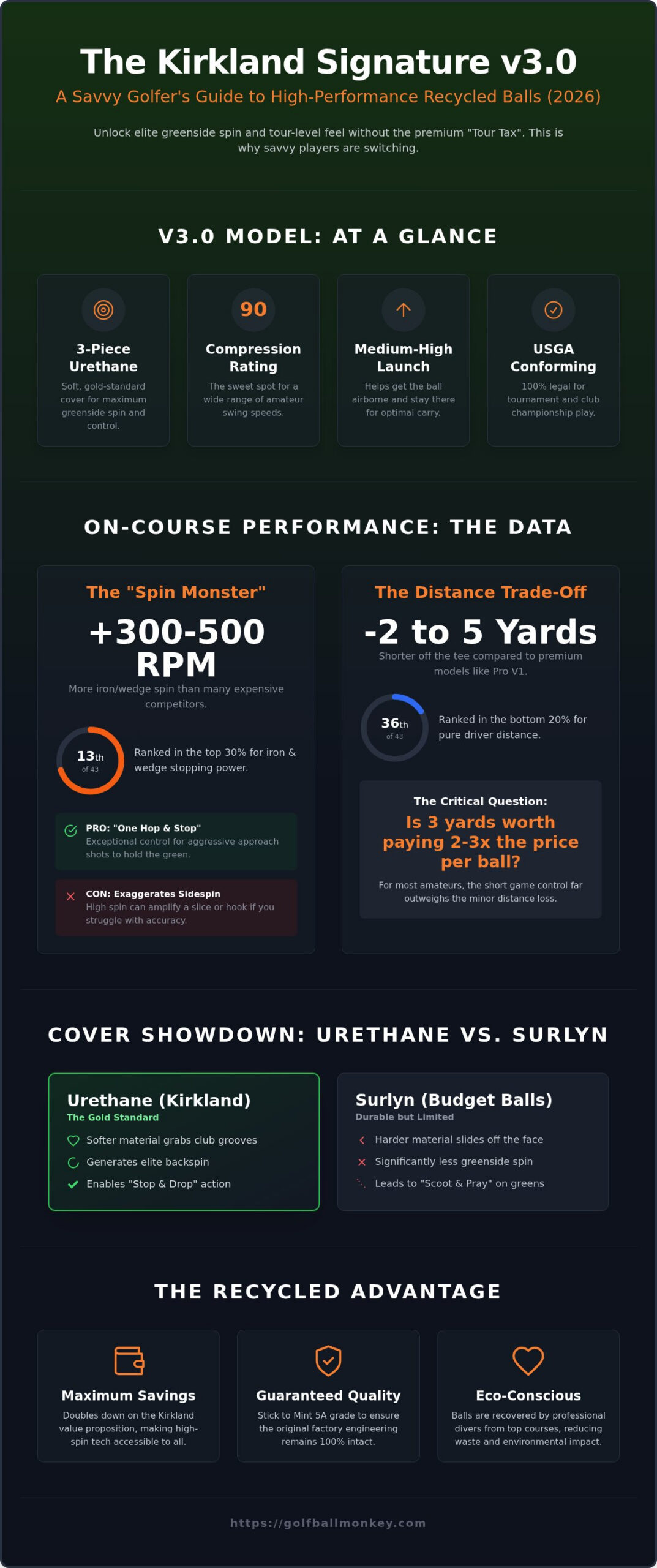
The 2026 season is dominated by the v3.0 model. It features a compression rating of approximately 90, which hits the sweet spot for most amateur swing speeds. You get a medium-high launch profile that helps you get the ball airborne and keeps it there. Best of all, these are 100% USGA conforming. You can roll up to your club championship with a bag of recycled Kirklands and know you’re playing a legal, high-performance ball. It’s the savvy insider’s secret to staying in the short grass without breaking the bank.
Used Kirkland Review: On-Course Performance and Feel
Let’s get real about what happens when the club meets the ball. This used kirkland 3 piece urethane review isn’t just about the price tag; it’s about how this ball behaves under pressure. The v3.0 model is a high-performance machine that punches way above its weight class. If you’re tired of seeing your ball roll off the back of the green, you’re looking at the right solution. It delivers the technical specs of a tour ball without the luxury markup.
The “Spin Monster” Reputation
The data is clear. In iron and wedge testing from July 2026, the Kirkland Signature ranked tied for 13th out of 43 balls for stopping power. It can generate 300 to 500 RPM more spin than many of its more expensive competitors. This is a dream for players who want that “one hop and stop” control on difficult approach shots. However, there’s a trade-off. High spin helps you hold the green, but it can be a double-edged sword off the tee. If you struggle with a slice, that extra side-spin might exaggerate your miss. It’s a ball designed for players who want maximum control over their short game and aren’t afraid of a little extra movement.
When you’re standing over a 10-footer, feel is everything. The Kirkland has a slightly “clickier” sound and feel compared to the muted thud of a Pro V1. It’s not harsh; it’s just distinct. The roll remains consistent, which is what actually matters for your scorecard. The 338-dimple pattern on the 2026 version provides excellent flight stability. It cuts through the wind without ballooning, keeping your trajectory predictable even on breezy afternoons.
Distance: Are You Really Losing Yards?
Every golfer obsesses over distance. Launch monitor tests from February 2026 show that the Kirkland is roughly 2 to 5 yards shorter than a Titleist Pro V1 on long shots. In a broader test of 43 balls, it ranked 36th in driver distance. You might lose a few yards off the tee, but you have to ask yourself a hard question. Is 3 yards worth paying double or triple the price per ball? For most of us, the answer is a hard no. The value proposition here is simply too strong to ignore.
Buying a bulk set of recycled golf balls ensures you play the same ball every hole. Consistency is the secret sauce for lower scores. When you buy a bucket of Mint 5A Kirklands, you’re getting a uniform experience. You’ll know exactly how the ball reacts on every chip and every drive. This predictability is far better than playing a “mixed bag” of random brands you found in the bushes.
Our Mint 5A grading ensures the core energy remains intact. These balls are harvested by professional divers and vetted in Texas to ensure near-new performance. You get the distance, the spin, and the confidence of a premium ball without the retail sting. It is the smart play for any golfer who values their wallet as much as their handicap.
Used Kirkland vs. Used Titleist Pro V1: The Ultimate Value Showdown
It is the heavyweight fight every budget golfer wants to see. In one corner, you have the Titleist Pro V1, the undisputed gold standard of the industry. In the other corner, the Kirkland Signature 3-piece, the warehouse disruptor that changed the game. When you look at a used kirkland 3 piece urethane review, the comparison is inevitable. Both balls target the same player: someone who wants elite spin and a soft feel. However, the price gap between these two in the used market is massive. Choosing the Kirkland is often the difference between playing a premium ball and playing a ball you are actually afraid to lose.
The “Monkey” sees thousands of these balls come through the warehouse. The Pro V1 is a status symbol, but the Kirkland is the savvy insider’s tool. If you are playing a course lined with water hazards and thick woods, throwing Pro V1s into the drink is a quick way to ruin your mood. Switching to a high-grade recycled Kirkland lets you play aggressively without the financial sting. You get about 95% of the performance for a fraction of the cost. That is the definition of a smart play.
Short Game Control Comparison
Both balls are built for the scoring zone. On chips and pitches, the Kirkland Signature often provides more “grab” than the Titleist. It is a high-spin machine that rewards aggressive players who like to see the ball hop and stop. The Pro V1 offers a slightly softer, more muted feel off the clubface. It feels a bit more refined, while the Kirkland feels more energetic. If you struggle to get enough spin to hold firm greens, the Kirkland might actually be the better tool for your specific game.
The Longevity Factor
Durability is where the Titleist usually takes the lead. Kirkland covers are historically softer. This makes them great for spin, but it also makes them prone to “wedge shred” after a few full-out swings with a fresh wedge. The Pro V1 cover is legendary for its resilience; it resists scuffing and maintains its finish through 18 holes of punishment. This is why our grading process is so critical. To understand how we ensure you get the best possible life out of your gear, check out our guide on Decoding Grades: What Mint 5A Really Means.
The “Insider Secret” is simple. If you are playing in a high-stakes tournament on a pristine course, the Pro V1 is a great choice. But for your Saturday morning skins game or a round at a difficult local track, the used Kirkland is unbeatable. It is the ultimate value play for the 2026 season. You get the urethane performance you need to shoot low without the premium tax that kills your buzz.
Buying Used: How to Spot High-Quality Recycled Kirklands
Don’t get fooled by a shiny coat of paint. When you’re digging into any used kirkland 3 piece urethane review, the biggest warning is always about “Refurbished” or “Refinished” balls. These are the zombies of the golf world. Companies take old, beat-up balls, sand them down, and spray on a new plastic finish. This process completely ruins the precise 3-piece engineering Costco designed. You’re basically playing a mystery ball with a Kirkland logo. Stick to “Recycled” balls instead. These are recovered from hazards and cleaned without messing with the original factory urethane. It’s the only way to keep that “stop and drop” magic intact.
The “Monkey” way is all about transparency. We believe you should know exactly what is landing on your doorstep. Buying recycled isn’t just a budget move; it’s an environmental win. Professional divers are the unsung heroes of the sport. They spend their days in the muck of premium courses to rescue these high-performance gems. By choosing recycled, you’re keeping plastic out of the waterways and putting elite gear back in play. It’s the smartest play you can make for the planet and your scorecard.
The Golf Ball Monkey Grading Scale
Our Texas-based team treats grading like an art form. We vet every single ball to ensure it meets our strict standards. Mint 5A is the gold standard. These balls look and play like they just popped out of a fresh sleeve. No scuffs, no fading, just pure performance. Grade 4A/Near Mint balls might have a tiny ink mark or a minor cosmetic flaw. They are perfect for casual rounds or practice sessions where you still want premium feel. If you want to dive deeper into the tech behind these finds, check out Used Golf Balls: The Ultimate Buyer’s Guide.
The Myth of the Water-Logged Ball
Let’s kill the myth about water-logged balls once and for all. Modern multi-layer balls don’t act like sponges. Old-school wound balls with rubber bands inside could soak up water, but today’s solid-core tech is different. Science shows that spending 24 to 48 hours in a pond has zero impact on distance or spin. Unless a ball has been sitting at the bottom of a lake since the 90s, it’s going to perform. Our divers focus on fresh recoveries from top-tier courses, so you get the “snap” you expect off the clubface every time.
Ready to upgrade your bag without the retail sting? Grab a bag of Mint 5A Kirklands today and experience Tour-level spin for a fraction of the cost.
Verdict: Is the Used Kirkland 3-Piece Right for Your Bag?
The numbers don’t lie. After weighing the data in this used kirkland 3 piece urethane review, the conclusion is obvious. If you want Tour-level greenside zip without the soul-crushing price tag of retail giants, this ball is your new best friend. It isn’t just a budget option. It is a high-performance tool for the player who values intelligence over status symbols. It’s the smart play for the 2026 season. You get the technology you need to lower your scores without the financial anxiety that ruins your swing.
Let’s look at the scorecard. The pros are impossible to ignore. You get elite short-game spin, incredible value, and consistent 3-piece engineering. These balls stop on a dime. The cons? They spin more off the driver, which might cost you a few yards or exaggerate a slice if your swing is a bit wild. The cover is also a bit softer than a Titleist, meaning it might scuff easier if you’re hitting out of bunkers all day. But when you’re paying a fraction of the retail price, these are trade-offs most of us will take any day of the week. The Monkey’s bottom line is simple. It is the best performance-per-dollar value in golf right now.
Best For: High-Spin Seekers and Budget Warriors
This ball is a dream for mid-to-high handicappers who need help holding the green. If you’ve been playing hard Surlyn balls to save money, switching to recycled Kirklands will transform your approach game. It is also the perfect choice for those “scary” holes. You know the ones. Tight fairways, water on both sides, and a stiff breeze in your face. Swing with confidence knowing you aren’t flushing five dollars every time you find the drink. It’s also the ultimate practice ball. Use them for your high-volume short game sessions to build a consistent feel that actually transfers to the course. Why practice with a ball that behaves differently than the one you play?
Ready to Stock Up?
Don’t wait for the next warehouse rush. We have a fresh supply of Kirkland Signature (Mint 5A) balls ready for action. Our Texas headquarters is standing by to ship these recycled gems directly to your door with the speed you expect. We offer bulk pricing for the aggressive players who like to go for the green on every par 5. Grab your bag, save your cash, and start playing the game the way it was meant to be played. Every ball we sell is vetted by our team to ensure it meets our strict grading standards. The smart money is on the Monkey. Make the move and see the difference on your next scorecard.
Play Smarter and Save Bigger This Season
The secret is out. You’ve seen the data and the performance benchmarks. This used kirkland 3 piece urethane review makes one thing clear: paying full price for new balls is a choice, not a requirement. By choosing recycled, you get the elite wedge zip and soft feel you crave while keeping your budget intact. It’s the ultimate savvy play for the 2026 season. You don’t have to sacrifice performance just to save a few bucks on the course.
Our team in Texas vets every single ball with expert grading to ensure near-new performance. These gems are harvested by professional divers from the world’s best courses, contributing to over 1 million balls recycled annually. Stop worrying about the water hazards and start swinging with total confidence. You’ve got the tech. You’ve got the savings. Now, go out there and own the green. It’s time to play the best ball for your game and your wallet.
Score Tour Performance for Less—Shop Used Kirkland Signature (Mint 5A) Now!
Frequently Asked Questions
Is there a difference between the Kirkland V2 and V3 balls?
Yes, the v3.0 model is the current 2026 standard and features a 338-dimple pattern with a compression rating of approximately 90. While the older v2.0 was a solid performer, the v3.0 offers a refined flight profile and improved feel. This used kirkland 3 piece urethane review focuses on the latest version because it provides the most consistent performance for the modern game. It is the version savvy players are hunting for right now.
Do used Kirkland golf balls lose distance?
No, high-quality recycled balls perform exactly like new ones off the tee. Science shows that even 48 hours in a water hazard has zero impact on core energy or distance. Our Mint 5A balls are harvested by professional divers and vetted in Texas to ensure they haven’t been submerged long enough to degrade. You get full power and elite launch conditions without the retail price tag.
Are Kirkland golf balls better than Titleist Pro V1?
“Better” depends on your priorities. A Pro V1 is the industry gold standard for consistency and lower driver spin. However, the Kirkland Signature 3-piece delivers nearly identical greenside spin for a fraction of the cost. It is the superior choice for players who want elite performance without the financial anxiety of losing an expensive ball. It is about getting 95% of the performance for a massive discount.
What does Mint 5A condition actually mean for a Kirkland ball?
Mint 5A is the top tier of our grading scale and represents the “gold standard” of recycled gear. These balls look and play like they were just pulled from a fresh sleeve. You won’t find scuffs, fading, or player marks on these gems. Every ball is hand-checked by our team to ensure it meets the highest standards for performance and aesthetics before it ever hits your bag.
Why are Kirkland golf balls so cheap compared to other brands?
Costco avoids the massive marketing budgets and professional athlete endorsements that drive up the price of other premium balls. They focus on high-volume production and direct-to-consumer value. When you buy them used from us, you’re doubling down on those savings. You get the same urethane technology without paying the “brand tax” that funds someone else’s TV commercials.
Can I use Kirkland golf balls in a tournament?
Yes, the Kirkland Signature Performance+ is officially listed on the USGA List of Conforming Golf Balls. This means they are perfectly legal for tournament play and official club championships. You can compete with total confidence knowing your gear meets every professional standard. Many savvy players use them for high-stakes rounds to keep their performance high and their equipment costs low.
How many dimples are on a Kirkland 3-piece ball?
The current v3.0 model features a 338-dimple pattern engineered for a stable, medium-high launch. This design helps players with average swing speeds keep the ball airborne longer for better carry distance. It cuts through the wind effectively and provides a predictable trajectory on every full shot. It is a proven aerodynamic setup that rivals the most expensive tour balls on the market today.
Do used Kirkland balls scuff easily?
Urethane is a soft material, so it is naturally more prone to scuffing than hard Surlyn covers used on cheap balls. A sharp wedge might “shred” the cover slightly on a full-out swing. However, our Mint 5A recycled balls start in pristine condition. They maintain their flight and spin characteristics even with minor cosmetic wear, making them a durable and smart choice for a full 18 holes of play.
How Much Should I Spend on Golf Balls in 2026? The Savvy Player’s Guide
You’re essentially lighting a twenty-dollar bill on fire every time you slice a fresh sleeve of Tour balls into the drink. It’s the “Lost Ball Tax,” and for most players, it’s the most expensive part of the game. If you’ve ever stood in the pro shop staring at a fifty-five dollar box of Titleist Pro V1s and wondered, how much should i spend on golf balls just to survive eighteen holes, you aren’t alone. Between confusing marketing jargon about compression and the fear of being judged for playing a budget brand, finding the right ball often feels like a hazard itself.
We get it. You want the spin and control of a premium cover without the soul-crushing price tag. This guide is your savvy insider shortcut to the perfect balance. You’ll discover a clear spending strategy tailored to your specific skill level and swing speed. We will show you how to identify when urethane actually matters and how to play the world’s best brands for a fraction of the retail cost. From robot testing data to the secret of Mint 5A recycled gear, we’re stripping away the elitism to help you make the intelligent play for your game and your budget.
Key Takeaways
- Stop guessing and start calculating your “Lost Ball Rate” to determine your actual cost per round.
- Discover exactly how much should i spend on golf balls based on your specific handicap and performance needs.
- Learn why cover material is the biggest factor in price and whether your game actually justifies the urethane upgrade.
- Score Tour-level performance for a fraction of the price by choosing Mint 5A recycled options instead of paying the “brand new” tax.
- Use bulk buying and off-season timing to stock your bag like a pro without the pro-shop markup.
The True Cost of Golf: Navigating the “Lost Ball Tax”
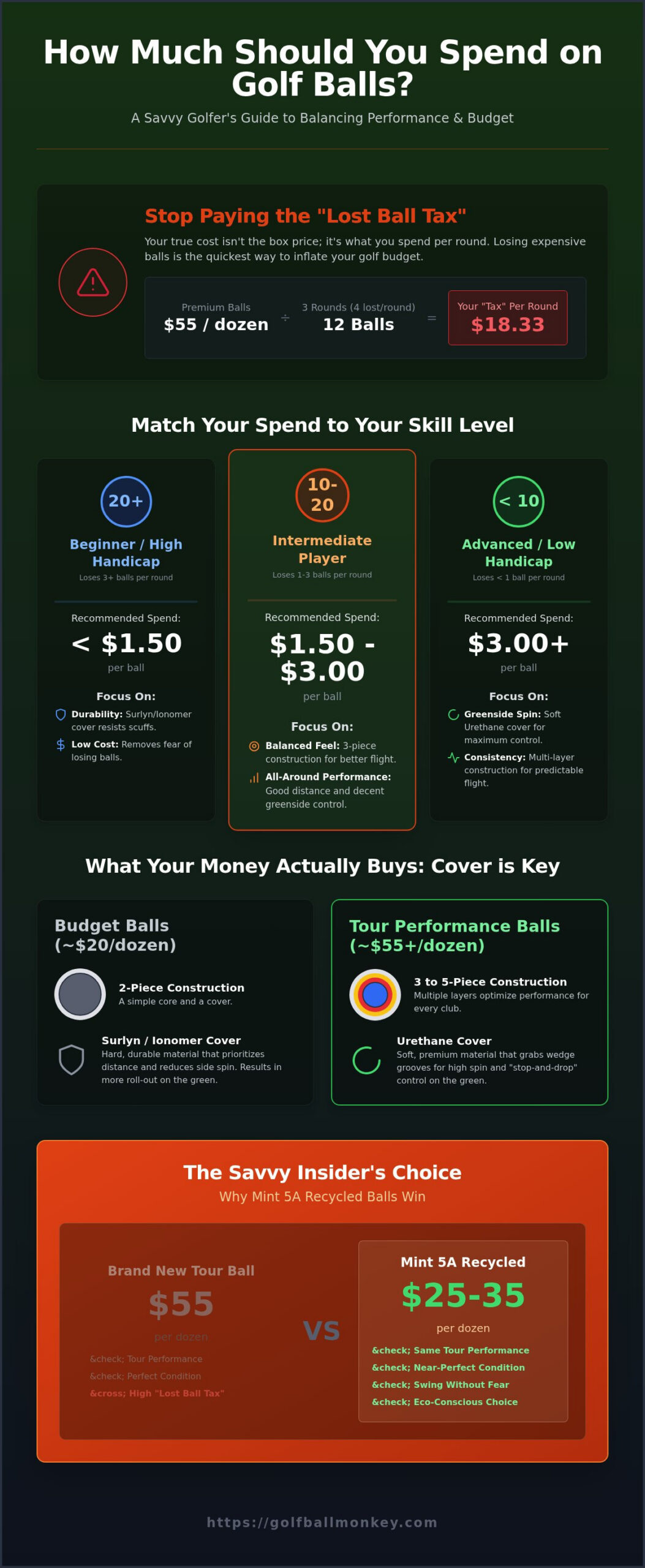
Most golfers look at a price tag and see a number. Savvy players see a tax. The “Lost Ball Tax” is the real metric that dictates your season budget. It’s simple math: take the total amount you spend on balls and divide it by the number of rounds you actually play. If you’re dropping sixty bucks on a dozen premium balls and losing four per round, you’re paying a twenty-dollar tax every time you tee off. That is a steep price to pay for the privilege of hitting the woods. When you ask yourself how much should i spend on golf balls, you have to look past the box price and calculate your cost per hole.
Your spending strategy must be tied to your Lost Ball Rate (LBR). If your LBR is high, your budget should be low. It isn’t just about the money; it’s about your mental game. There is a documented psychological impact when you play expensive equipment. If you’re terrified of losing a five-dollar ball in a water hazard, your swing gets tentative. You steer the ball. You play worse. Switching to high-quality used gear removes that fear. It lets you swing freely and actually improve your score. In 2026, the retail market is pushing new premium balls toward record highs, while the secondary market offers the exact same performance for a fraction of that investment.
Calculating Your Personal Spend-to-Skill Ratio
The “3-ball threshold” is the gold standard for equipment spending. If you consistently lose more than three balls per eighteen holes, you shouldn’t be playing brand-new Tour gear. It’s a waste of cash. Beginners and high-handicappers should aim for a cost of $1.50 per ball or less. This keeps your tax manageable while you learn about golf ball design and regulations and how they impact your flight path. Once you reach the break-even point, where you keep the same ball for an entire round, that’s when the subtle differences in spin finally start to lower your handicap.
The Environmental Cost of New Golf Balls
Every new ball manufactured represents a footprint of plastic and energy. In 2026, being a savvy player means being an eco-conscious one. Reclaimed balls are the ultimate win-win. Professional divers retrieve millions of these “white gold” gems from water hazards every year, preventing plastics from breaking down in our local ecosystems. At Golf Ball Monkey, we see this as a rescue mission. Choosing a recycled 5A Mint ball gives you the same tech as a new one. It keeps the planet green and your wallet full. It’s the intelligent play for your game and the environment.
Tour Performance vs. Budget Value: What Your Money Actually Buys
Walk into any pro shop and you’ll see the price gap immediately. On one end, you have the twenty-dollar budget boxes. On the other, the fifty-five-dollar Tour titans. When you ask how much should i spend on golf balls, you are really asking what that thirty-five-dollar difference actually buys you. It isn’t just a fancy logo. It’s a combination of chemistry, engineering, and a heavy dose of marketing.
The cover material is the biggest line item. Urethane is the expensive, soft plastic used on premium balls. Surlyn or ionomer is the hard, durable stuff found on budget models. There is a literal twenty-dollar difference in manufacturing costs between these covers. Urethane allows the grooves of your wedge to bite the ball. This creates the stop and drop action on the green. Surlyn is slicker. It resists scuffs but slides up the face of your club, resulting in more roll-out and less control.
Construction also adds to the bill. Budget balls are typically two-piece designs. Premium balls use three, four, or even five layers. These layers act like gears in a car. They optimize spin for different clubs. Data from MyGolfSpy’s 2025 Golf Ball Test confirms that while budget balls can keep up in distance, they fall behind in greenside consistency. You are paying for the peace of mind that your ball will react the same way every time it hits the turf.
The Premium Tier: Titleist, TaylorMade, and Callaway
The Titleist Pro V1 remains the benchmark for consistency. It’s the ball most pros trust. TaylorMade TP5 and Callaway Chrome Soft offer similar multi-layer tech. These brands spend millions on R&D and professional endorsements. That cost is baked into every sleeve. You get elite performance, but you also pay a premium for the prestige of the brand name.
The Value Tier: Kirkland and Srixon Soft Feel
Direct-to-consumer brands and soft series balls have changed the game. Kirkland Signature balls offer high spin at a shockingly low price. Srixon Soft Feel provides a great sensation for slower swing speeds. These balls are fantastic for distance. They lack the elite short-game precision of a Pro V1, but for many, good enough is the smarter play. You can find these high-value options in our shop and keep your budget in check while maintaining your performance. How much should i spend on golf balls depends entirely on whether you prioritize a long drive or a checking wedge shot.
The Handicap Calculation: Matching Your Spend to Your Skill Level
Your handicap index is the most honest tool in your bag. It tells you exactly where your game stands. It should also tell you how much should i spend on golf balls before you head to the first tee. Many players make the mistake of buying for the game they want rather than the game they actually have. If you are still fighting a slice or losing several balls per side, playing a brand-new five-dollar ball is a mathematical disaster. You need a strategy that matches your skill level to your spend.
Consistency is the secret weapon of the low handicapper. They play the same ball every single round to ensure predictable distances and spin. Amateurs should adopt a “One Ball Rule” of their own. Even if you aren’t playing for a trophy, switching between different models during a round ruins your feel. If you hit a hard ionomer ball on hole five and a soft urethane ball on hole six, your brain can’t calibrate your short game. Pick a tier that fits your budget and stick with it for at least a month.
Tier 1: The “I Just Want to Finish the Round” Budget
If your handicap is 25 or higher, volume is your priority. You need a deep supply of ammo. Aim for a target spend of $0.50 to $1.00 per ball. This is the perfect time to grab Mixed Bags (Good 3A) or bulk practice balls. These are high-quality, playable options that won’t cause a financial crisis when they disappear into the tall grass. Your goal is to minimize the financial sting of a lost ball so you can focus on your swing mechanics.
Tier 2: The “Breaking 90” Performance Budget
Mid-handicappers (10-24) represent the “Sweet Spot” for performance-to-value. You’ve stopped losing a ball on every water hole, but you still need a ball that helps you stick the green. Target a spend of $1.50 to $2.50 per ball. Look for Mint 5A Srixon models or Callaway Supersoft. These offer a significant jump in feel and distance control without the steep retail markup of Tour-level equipment.
Tier 3: The “Tournament Ready” Elite Budget
For players under a 10 handicap, consistency is non-negotiable. You need maximum spin and a predictable flight path. While new retail balls will cost you over $5.00 each, savvy elite players target a spend of $2.50 to $3.50 by choosing used. The best play here is a Mint 5A Titleist Pro V1 or TaylorMade TP5. You get professional-grade feedback and elite greenside control for a fraction of the price. It’s the intelligent way to play the world’s best tech.
Strategic Savings: How to Lower Your Cost Per Round
Stop paying the “pro shop convenience fee.” It is a massive tax on the unprepared player. When you are calculating how much should i spend on golf balls, your biggest savings don’t come from switching to a cheaper brand. They come from changing how you buy. If you are still buying a single sleeve before your tee time, you are paying the highest possible price per ball. The savvy move is to treat your golf ball inventory like a warehouse operation. You want to buy in bulk and buy with a plan; for those who need to organize their gear and household essentials, Better Home store 2 provides excellent solutions for maintaining an orderly home.
Timing matters. The “Off-Season” play is a classic insider secret. When the weather turns and most players hang up their clubs, demand drops. This is the perfect time to stock up for the coming spring. Retailers and secondary market sellers often run their best promotions when the fairways are empty. By the time the first warm Saturday hits, you should already have a season’s worth of ammo ready to go. This proactive approach ensures you never have to pay retail prices during the peak of the season.
Used vs. Recycled vs. Refurbished
Don’t fall into the “Refurbished” trap. These balls are often stripped of their original clear coat and repainted to hide scuffs or cracks. This heavy-handed process ruins the dimple pattern and kills the aerodynamics. You end up with a ball that looks new but flies like a wounded bird. Always choose “Recycled” balls. These maintain the original factory finish and performance characteristics intended by the manufacturer. Mint 5A represents the highest possible quality of reclaimed ball, appearing and performing virtually indistinguishable from a brand-new one. Stick to this grading scale to ensure you aren’t sacrificing score for savings.
The Bulk Buy Strategy
The math is simple: moving from a dozen-count box to a 50-count or 100-count bucket drastically lowers your cost per round. It turns a premium ball into a budget-friendly asset. To keep your stash in prime condition, store your balls in a cool, dry place. Avoid the trunk of your car during a Texas summer; extreme heat can eventually affect the core’s performance over long periods. For a deeper dive into the numbers, check out our bulk golf balls guide to see how the savings stack up. Ready to restock? Shop our Mint 5A collection and stop overpaying for your gear today.
The Savvy Insider’s Choice: Why Premium Recycled Balls Win in 2026
The secret is out. You don’t need to choose between a high score and a high bank balance. When you ask how much should i spend on golf balls in 2026, the answer is simple: spend exactly what it takes to play the best tech, but don’t pay the retail markup. For players who apply this savvy mindset to their overall financial health, V8Loans offers access to secured vehicle loans for cars, motorcycles, and RVs. Modern multi-layer balls are engineering marvels. Unlike the old wound-core balls of the nineties, today’s solid-core designs are incredibly resilient. The idea that a ball becomes “water-logged” after a short dip is a total myth. Unless a ball sits at the bottom of a lake for years, its performance remains identical to a new one. By harvesting these gems quickly, we bridge the gap between elite performance and budget reality.
Think about the math. You can buy a box of brand-new, entry-level Surlyn balls for twenty-five dollars. Or, you can play a Mint 5A Titleist Pro V1 for roughly the same price. One is a hard, durable ball that slides off the green. The other is the gold standard of the PGA Tour. It is the ultimate value play. You get the spin, the distance, and the soft feel of a sixty-dollar dozen without actually spending sixty dollars. Our final verdict for 2026? Your spend should never exceed the cost of a budget retail ball, because the secondary market gives you Tour-level gear for that exact same price.
The Texas Diver Story: Quality You Can Trust
Our operation isn’t just a warehouse; it’s a rescue mission. Since 2014, our Texas-based team has utilized professional divers to retrieve millions of balls annually. This isn’t some random “lake ball” bin at the local shop. We use a rigorous 5A Mint grading system to ensure every ball meets our professional standard. We clean them, inspect them, and vet them so you can trust every shot. You’re supporting a sustainable, US-based business while keeping high-quality gear in play and out of the landfill. It’s an environmentally conscious choice that actually helps your game.
Your 2026 Spending Action Plan
Ready to stop overpaying? Follow this simple three-step strategy to optimize your bag. First, be honest about your handicap and your Lost Ball Rate. Second, choose your tier based on the frameworks we discussed earlier. Finally, head to the Golf Ball Monkey Shop to secure Mint 5A quality for less. You’ll get the performance you deserve without the “Lost Ball Tax” ruining your weekend. Play smart, save big, and keep it in the short grass.
Dominate the Fairway Without Draining Your Wallet
You’ve got the math. You’ve got the strategy. Now it’s time to execute. Stop letting the “Lost Ball Tax” dictate your approach to the game. Whether you’re a high-handicapper hunting for volume or a scratch player demanding Tour-level spin, the answer to how much should i spend on golf balls is finally clear. You should spend enough to get the performance you need, but never a penny more than necessary.
Our Texas-based professional divers retrieve over 10 million balls annually, ensuring only the best gear makes it back into your bag. Every ball we sell comes with a rigorous 5A Mint grading guarantee. It’s the ultimate insider secret for the 2026 season. You get the world’s best tech without the soul-crushing retail markup. It’s better for the planet and even better for your scorecard.
Shop Mint 5A Titleist Pro V1s and Save 50% or More!
See you on the first tee. Swing hard and play smart.
Frequently Asked Questions
How much should a beginner spend on golf balls?
Beginners should aim for $1.00 or less per ball to manage the “Lost Ball Tax” effectively. Since you will likely lose several balls every round, volume and durability are your best friends. High-quality recycled options like a Mixed Bag (Good 3A) let you focus on your swing mechanics without worrying about the cost of a splash in the pond. It is the smartest way to learn the game while keeping your budget intact.
Is it worth buying expensive golf balls if I lose them often?
It is generally not worth buying expensive balls if you lose them frequently. High-priced Tour balls are designed for specific spin characteristics that most high-handicappers cannot fully utilize yet. If your ball loss rate is high, you are better off spending that money on a few lessons or more rounds of golf. Stick to affordable, high-quality recycled gear until you can keep the same ball for at least nine holes consistently.
Do used golf balls perform as well as new ones?
High-grade used balls perform virtually the same as brand-new ones. Modern solid-core construction is incredibly durable and does not suffer from “water-logging” if retrieved promptly by professional divers. When you look at how much should i spend on golf balls, choosing Mint 5A recycled gear gives you elite performance for a fraction of the retail cost. It is the secret weapon for savvy players who want Tour tech on a budget.
What is the difference between Mint 5A and 4A grade golf balls?
Mint 5A is the highest possible grade, representing balls that look and feel brand new. They have no scuffs and maintain their original factory shine. 4A balls are still in excellent playable condition but might show minor cosmetic blemishes or player ink marks. While 5A is for the perfectionist, 4A is a fantastic way to save even more cash without sacrificing any actual flight performance or distance.
How many golf balls should I bring for a 18-hole round?
Most amateurs should carry at least 6 to 12 balls in their bag to be safe. Running out of ammo on the back nine is a total buzzkill and can ruin your round’s momentum. If you are playing a course with lots of water hazards or thick brush, lean toward the full dozen. It is always better to have a few extra recycled gems in your pocket than to be hunting for scuffed finds in the woods.
Does the type of golf ball really matter for high handicappers?
The type of ball matters, but for different reasons than you might think. High handicappers benefit from low-spin ionomer balls that help minimize slices and hooks off the tee. Playing a high-spin Tour ball can actually make your misses worse by exaggerating side-spin. Focus on finding a consistent, durable ball that flies straight rather than worrying about greenside check until your handicap drops into the mid-teens.
Are recycled golf balls better for the environment?
Recycled balls are the most sustainable choice in the golf industry. Every ball retrieved by a professional diver is one less piece of plastic degrading in a local ecosystem or water hazard. Reusing existing equipment significantly reduces the carbon footprint and energy consumption associated with manufacturing new plastics. It is an easy way to protect the courses we love while keeping your equipment costs manageable.
How much can I save by buying used golf balls in bulk?
You can typically save 50% to 70% by purchasing your gear in bulk buckets. Moving from dozen-count boxes to 50 or 100-count buckets is the fastest way to lower your cost per round. When you calculate how much should i spend on golf balls, bulk buying recycled gear turns premium brands into budget-friendly assets. It ensures you always have a fresh supply ready for your next tee time without the pro-shop markup.
How to Find the Right Golf Ball: Insider’s Guide 2026
You aren’t a bad golfer; you’re just playing the wrong ball and paying a massive “new ball” tax for the privilege. It’s a gut-punch to watch five bucks vanish into the woods because you’re playing a tour ball that doesn’t fit your swing. Most players struggle with how to find the right golf ball because they’re drowning in jargon about compression while their short game suffers. You want a ball that checks up on the green, but you’re tired of $58 retail price tags that make every hazard feel like a financial disaster.
Stop guessing on the tee. We promise to help you find that perfect “gamer” ball that fits your game and your budget. This guide breaks down the 2026 tech, ignores the marketing fluff, and shows you how to score Mint 5A performance without the retail markup. We will look at why urethane is king, how to ignore swing speed myths, and why choosing professional-grade recycled gear is the most intelligent play for your scorecard and the planet.
Key Takeaways
- Drop the swing speed obsession; compression is about personal feel and control rather than just raw power.
- Prioritize urethane covers to gain the critical short-game spin you need to stop three-putting for good.
- Flip the script on fitting by choosing your ball based on green-side performance rather than just driver distance.
- Master how to find the right golf ball by identifying the specific spin and launch characteristics that match your unique game.
- Get tour-level quality for a fraction of the retail cost by learning to spot high-value Mint 5A recycled balls.
The Great Compression Myth: Why Swing Speed Isn’t Your Only Compass
Stop listening to the guy at the pro shop who says you need a 110mph swing to play a “hard” ball. That is old-school thinking that belongs in the 90s. Modern ball tech has completely decoupled compression from total distance. Whether you’re swinging like a tour pro or just trying to clear the pond, how to find the right golf ball starts by ignoring the speed trap. High-compression balls aren’t just for the big hitters anymore. In fact, if you swing too slow for a low-compression ball, you might actually lose ball speed. The core needs to snap back efficiently to generate velocity. It’s about energy transfer, not just the squish. Don’t let a marketing number dictate your gear.
What Compression Actually Is
Think of compression as the “squish” factor. It’s a numerical value representing how much the ball deforms when your club face delivers the blow. Looking back at golf ball design and history, we see how manufacturers moved from wound cores to multi-layer solid constructions. This evolution changed everything. Today, compression is a measure of impact feel rather than a rigid speed requirement. You might prefer the clicky, firm feedback of a Titleist Pro V1x even if your swing speed is average. That is perfectly fine. Your hands are the best judge of feel. Don’t let a launch monitor talk you into a ball that feels like a marshmallow if you hate that sensation.
The ‘Soft is Straight’ Fallacy
We’ve all heard the claim. “Soft balls go straighter.” There is a grain of truth there, but it’s a dangerous trap for your scorecard. Low-compression balls generally produce less side spin. This can keep your slice from visiting the neighboring fairway by a few yards. However, that lack of spin comes with a heavy price. You give up the “zip” and stopping power required for precise short-game control. Most amateurs pick a soft ball because it feels better off the face. They’re trading five strokes around the green for a marginally straighter drive. That isn’t an intelligent play. Learning how to find the right golf ball means weighing that “soft” feel against the need to actually stop the ball on the green. If you want to test different compression levels without the retail sting, browse the premium recycled options to see what actually performs under pressure. You might find that a firmer Mint 5A ball gives you the control you’ve been missing.
Urethane vs. Ionomer: Decoding the Cover Tech That Impacts Your Score
Most golfers look at the box and see “Distance” or “Soft.” They completely ignore the most critical part: the cover. It is the only component of the ball that makes physical contact with your club face. If you are learning how to find the right golf ball, you must understand that the cover material dictates your short game success. You have two main choices: Ionomer (often called Surlyn) and Urethane. One helps you score; the other just helps you survive the rocks.
Savvy players never settle for Surlyn once they feel the difference. It’s like switching from plastic tires to high-performance rubber. You get more grip, more feedback, and significantly more confidence when you’re standing over a delicate chip shot. Don’t let the marketing on the box fool you. The cover tech is the engine of your performance around the green.
The Case for Urethane
Urethane is the secret sauce for every Tour pro. It’s a softer, more flexible material that allows wedge grooves to “bite” into the ball. This creates the friction needed for massive spin. If you want your ball to hop and stop on the green, Urethane is the answer. Modern 2026 formulations, like those in the Titleist Pro V1 and Pro V1x, are now incredibly durable and resistant to scuffing.
When to Play Ionomer/Surlyn
Ionomer is a plastic-like material that is hard and cheap to manufacture. It’s nearly impossible to scuff, making it perfect for beginners or rocky desert courses. However, it’s essentially a “distance” ball tech that won’t spin. Surlyn balls feel harsh off the putter and won’t stop on a dime. Use these for the shag bag or absolute beginners who lose ten balls a round.
The real trick to how to find the right golf ball is getting that Urethane performance without the $58 retail sting. You don’t have to settle for “rocks” just to save a few bucks. You can grab Mint 5A recycled balls and get Tour-level covers for a fraction of the new-ball price. It’s the intelligent play for your scorecard and your wallet. If you want to see what the pros play without the pro price tag, check out our latest inventory and upgrade your game today.
The Savvy Insider’s Fitting Secret: Fit Your Ball from the Green Backwards
Most golfers spend hours chasing five extra yards with their driver. It is a total waste of time. You use that big stick 14 times a round. Your putter and wedges account for over 60% of your score. If you want to know how to find the right golf ball, stop looking at the tee box. Start looking at the hole. This is the “Green Backwards” method. It is the fastest way to shave five strokes off your handicap without changing your swing. You need a ball that behaves predictably when the pressure is on.
Consistency is your biggest weapon. You cannot master your distances if you switch between a hard Surlyn rock and a premium Urethane ball every three holes. Commit to one model for a full 18 holes. Your brain needs to calibrate to the spin and feel of a single “gamer” ball. Whether you are playing a Titleist Pro V1 (Mint 5A) or a Kirkland Signature, stick with it. Predictability leads to lower scores.
Step 1: The Putter & Chip Test
Start on the practice green. Hit a few putts and listen closely. Does the “click” match your ears? Sound is feel. If the ball sounds like a marble hitting a tile floor, you will likely struggle with touch on fast greens. Move to the fringe and hit some chips. Watch the rollout carefully. A premium ball will exhibit a crisp, “one hop and stop” reaction that allows you to attack the pin with confidence. If your ball just skids and runs off the back, it is the wrong fit for your short game.
Step 2: Iron Spin and Peak Height
Move back to the fairway. Are you hitting the green only to watch your ball roll into the back fringe? That is a spin and descent angle problem. The right ball helps you hold more greens by flying higher and landing softer. This “descent angle” secret is how the pros save par from 170 yards out. You want a ball that climbs to a consistent peak height and drops steeply. This prevents the dreaded “roll-out” that turns a great approach shot into a difficult up-and-down. When you finally learn how to find the right golf ball, you will stop fearing tucked pins and start aiming for them.
Stop guessing with a mixed bag of random finds. Grab a dozen of the same model and watch your short game transform. Consistency is the intelligent play. It is the only way to build real trust in your equipment.
Condition Matters: How to Spot Performance Without the Retail Price Tag
Stop paying the “new ball” tax. Most equipment guides assume you have a bottomless bank account. They’re wrong. You don’t need to drop $58 on a fresh dozen every Saturday to play your best. In fact, knowing how to find the right golf ball in 2026 is actually about mastering the secondary market. You can get elite, Tour-level performance for a fraction of the retail cost if you know what to look for in a recycled ball.
Let’s kill the biggest myth in golf: the “water-logged” ball. Old-school balls from the 80s might have soaked up water like a sponge. Modern tech is different. Today’s multi-layer constructions and advanced covers are virtually waterproof. A ball doesn’t lose its distance just because it took a short swim. Our professional divers harvest millions of these gems. Testing shows they are indistinguishable from new for 99% of players. It is the most intelligent play you can make for your wallet and the environment.
Decoding the Mint 5A Standard
Mint 5A is the gold standard of recycled gear. When you open a bag of these, you won’t see scuffs, discolouration, or “refurbished” junk. They look and fly exactly like a ball pulled straight from a brand-new sleeve. If you want to dive deeper into the specifics, you can learn more about our Mint 5A grading process. It is the ultimate sweet spot for the savvy golfer who refuses to compromise on quality.
The Shag Bag Strategy
Don’t waste your premium gamers on the practice range or the backyard. Smart players keep a separate stash for training. Grading scales like 3A or “Good” are perfect for this. They might have a minor blemish, but they’re ideal for working on your swing without worrying about the cost per hit. It is the best way to protect your “scorecard” balls for the rounds that actually count. Go ahead and stock up on practice golf balls to keep your game sharp all season long.
The reality of how to find the right golf ball is that condition is a spectrum. You don’t always need perfection, but when you do, Mint 5A delivers. Stop overpaying for a logo on a cardboard box. Grab a bag of Mint 5A Titleist or Callaway balls today and experience the thrill of a high-value acquisition.
The Monkey’s Top Picks: Finding Your Match by Playing Style
You’ve done the hard work. You understand compression. You know why urethane is the only choice for players who actually want to score. Now it’s time to pick your horse. Figuring out how to find the right golf ball isn’t about trial and error with random finds you plucked out of a lake. It’s about matching these elite performers to your specific tendencies. The Monkey has personally vetted these picks to ensure you get the best bang for your buck.
- The ‘All-Around Legend’: Titleist Pro V1 (Mint 5A). This is the gold standard for a reason. It offers a penetrating flight and precise spin control for the balanced player. It is the most played ball on tour for a reason.
- The ‘High Launcher’: Titleist Pro V1x (Mint 5A). If you need more height and maximum spin to hold firm greens, this is your weapon. It feels slightly firmer than the standard Pro V1.
- The ‘Soft Feel Savant’: Callaway Chrome Soft (Mint 5A). It delivers that buttery impact feel without sacrificing the urethane performance you need around the cup. Ideal for the player who hates a “clicky” sound.
- The ‘Speed Demon’: TaylorMade TP5 (Mint 5A). Built with a five-layer construction to maximize velocity off the club face. It is a distance machine that still bites on the green.
Premium Performance for Less
Titleist remains the #1 ball in golf for a simple reason: consistency. Every ball flies the same. Every chip reacts the same. Read our deep dive into the Titleist Pro V1 to see why it stays at the top of the mountain. If you are torn between other brands, look at your specific needs. The TaylorMade TP5 is a launch monster with high spin. The Callaway Chrome Soft is for the player who wants a quieter, softer feel at impact. Both are incredible. Both are available in our Mint 5A grade for a fraction of the retail cost.
The Smart Play for 2026
Stop overpaying for a logo on a cardboard box. A fresh dozen of Titleist Pro V1x balls can run you nearly $58 at retail. That is a heavy price to pay for something you might lose on the very next hole. The real secret to how to find the right golf ball is realizing that a Mint 5A recycled ball performs identically to a new one. Consistency in your brand is far more important than that “new ball” smell. Pick your model. Buy in bulk. Save your cash for the 19th hole. It is the intelligent play for your game and the planet. Find your perfect gamer in our shop today and start playing like a savvy insider.
Stop Overpaying and Start Scoring
You now have the insider blueprint for 2026. You know that chasing swing speed is a myth and that urethane covers are the only way to truly own the green. Fitting from the hole backwards is the ultimate shortcut to lower scores. You’ve finally learned how to find the right golf ball without falling for the retail hype or overpaying for a fancy cardboard box. It is time to stop guessing and start playing with total confidence in your equipment.
We make the intelligent play easy. Every ball in our inventory is professional diver retrieved and passes our strict 5A Mint grading process. We recycle over 1 million balls annually to keep the game accessible and the planet green. You get tour-level performance and a massive bargain in one shot. Grab a bucket of Mint 5A Titleist Pro V1s and save 50% vs retail!
Get out there and dominate the course. With your scorecard and wallet finally on the same team—and perhaps a premium roast from Bambi Nonno Coffee to fuel your focus—you’re ready to play your best. See you on the first tee!
Frequently Asked Questions
Does the brand of golf ball really matter for high handicappers?
Consistency is the first step in how to find the right golf ball for your handicap. The specific brand matters less than playing the same model every single time. If you switch between a soft ball and a hard rock, your brain cannot calibrate for distance. Stick to one model, like a Kirkland Signature or Srixon, to build a predictable short game and stop the guessing game.
How often should I change my golf ball during a round?
Swap your ball immediately if you see a visible scuff or a deep scratch. Damaged covers ruin aerodynamics and cause the ball to wobble in flight. If you hit a cart path or a tree, check for “skin” damage right away. Most golfers can easily finish 18 holes with a single ball as long as they stay out of the hazards and the woods.
Are recycled golf balls as good as brand new ones?
Yes. Specifically, Mint 5A recycled balls are indistinguishable from brand new ones for 99% of players. Modern manufacturing seals the core against water damage; the old “water-logged” myth is dead. You get elite performance from Titleist or Callaway at a fraction of the retail cost. It is the intelligent play for your wallet and the planet.
What is the difference between a 2-piece and a 3-piece golf ball?
A 2-piece ball focuses on raw distance and durability. It usually features a large core and a hard ionomer cover that resists scuffing. A 3-piece ball adds a mantle layer to bridge the gap between speed and spin. If you want more control and “stop” around the greens, the 3-piece construction is usually the better choice for your scorecard.
How do I know if I need a high-spin or low-spin golf ball?
Watch your ball land on the green to decide. If your approach shots hit and roll off the back, you need a high-spin ball like the Titleist Pro V1x. If your drives balloon too high and die in the wind, a low-spin option will help you penetrate the air. Analyzing these results is the secret to how to find the right golf ball for your specific flight path.
Can a golf ball actually help fix my slice?
A ball won’t fix a bad swing path, but it can limit the side-spin damage. Low-spin balls with hard covers reduce the friction that sends your ball into the trees. It won’t turn a slice into a draw. It might just keep you in the rough instead of the out-of-bounds stakes, saving you a penalty stroke.
What does Mint 5A condition actually mean?
Mint 5A is the gold standard of grading and our verbal seal of approval. It means the ball is in perfect condition with no scuffs, no discolouration, and no player markings. It looks and performs exactly like a ball pulled from a brand-new sleeve. It is the ultimate target for every savvy shopper looking for a bargain.
Is there a ‘best’ golf ball for cold weather play?
Switch to a lower-compression ball when the temperature drops below 50 degrees. Cold air is denser and ball cores get firmer in the chill. A “soft” feel ball like the Callaway Chrome Soft is easier to compress in the winter. This helps you maintain your carry distance when the thermometer starts to dip and the ground gets hard.
Are Used Pro V1s Worth It? Cheap Golf Balls That Feel Like Tour Gear (2026)
Why are you still paying nearly $60 a dozen just to watch your money splash into a water hazard? Retail prices for premium gear have officially hit the roof; this leaves most golfers choosing between draining their bank accounts or hitting balls that feel like literal rocks. It is a mental hazard that kills your swing before you even tee off. You want the spin, the soft urethane cover, and the greenside control, but you do not want the “brand new” tax. This leads to the ultimate question for the savvy player: are used pro v1s worth it or are you just buying someone else’s leftovers?
We get it. You have been told that once a ball hits the water or a fairway, it loses its magic. That is a myth designed to keep you buying shiny new boxes. This guide proves you can snag that legendary tour feel for about half the retail price. We are breaking down the performance data of Mint 5A recycled balls, comparing 2026 retail costs to secondary market steals, and showing you exactly how to maintain a consistent feel without overpaying for a logo. Get ready to play the best ball in golf for under $35 a dozen.
Key Takeaways
- Stop overpaying for a fancy cardboard box and learn why Mint 5A condition balls are the ultimate hack for tour-level performance on a budget.
- Discover the definitive answer to are used pro v1s worth it by comparing real-world greenside control against $60-a-dozen retail alternatives.
- Master the “urethane vs. surlyn” science to ensure your short game has the professional “grab” and spin needed to stop on a dime.
- Learn why you must avoid “refurbished” balls at all costs to protect your flight path and maintain total consistency on every shot.
- Unlock the savvy insider strategy of bulk purchasing to slash your equipment costs while keeping the world’s #1 ball in your bag.
What Defines the Titleist Pro V1 Feel?
Ever since the history of the Titleist Pro V1 began in 2000, it has set the gold standard for sensory feedback. It is not just marketing hype; it is the specific way the ball speaks to you on every shot. When you strike a Pro V1, you hear a crisp, high-frequency “click” rather than the hollow, dull “thud” of a budget ball. That sound tells your brain the energy transfer was perfect. If you are standing over a $5 retail ball, that “thud” often comes with a side of anxiety. You start wondering: are used pro v1s worth it, or do I really need to fork over $60 a box to get that sound back?
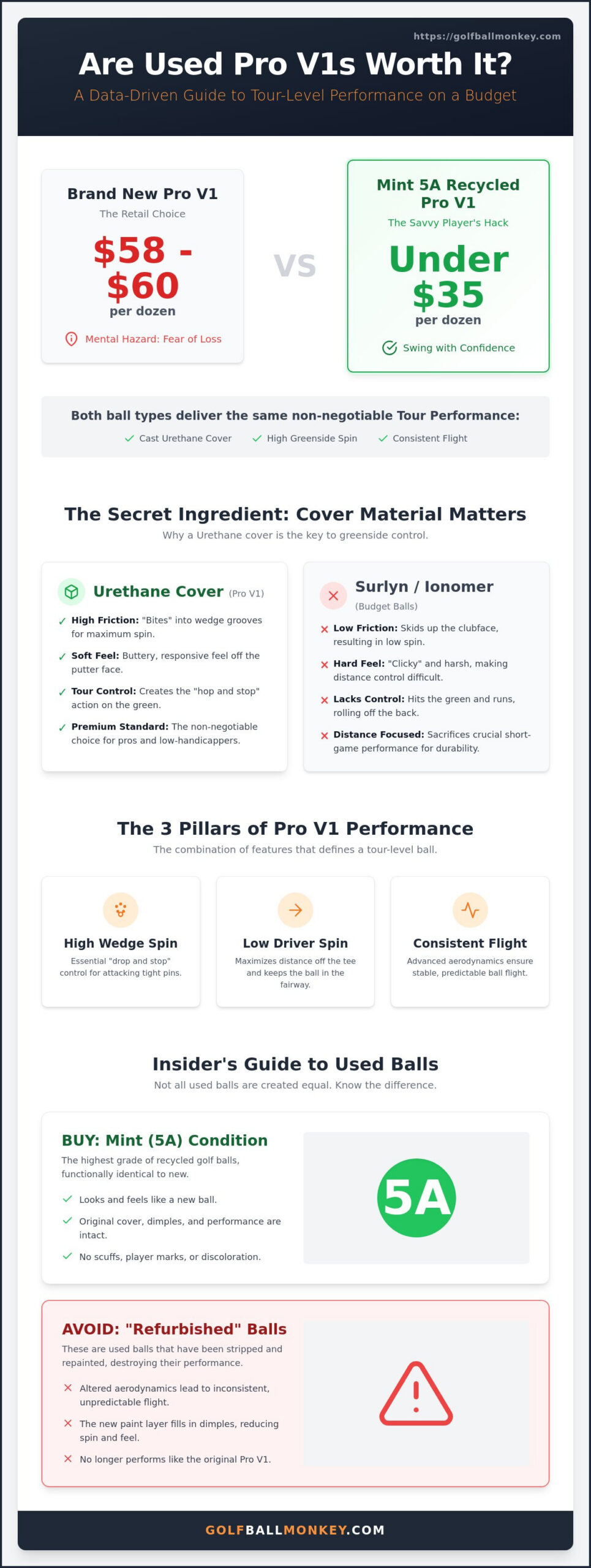
The real magic happens within 30 yards of the pin. A Pro V1 uses a cast urethane cover that practically bites into your wedge grooves. Cheap balls use Surlyn, which is essentially hard plastic. Surlyn balls might feel soft off the putter, but they lack the friction to “grab” the green. They hit and run like they have somewhere else to be. A Pro V1 hits, hops once, and stops. That predictable check-up is why pros and low handicappers refuse to play anything else. It is about confidence in your equipment.
The Three Pillars of Tour Performance
- Low driver spin: This keeps your ball in the short grass and maximizes distance off the tee by reducing side-spin.
- High wedge spin: This provides the essential “drop and stop” control required for attacking tight pin positions.
- Consistent flight: Advanced aerodynamics ensure stable flight patterns even in 2026’s unpredictable wind conditions.
Why ‘Soft’ Doesn’t Always Mean ‘Pro V1’
Do not get fooled by the “Soft” label on a $20 box of balls at a big-box retailer. Most “soft” balls are just low-compression Surlyn cores that feel mushy like a marshmallow. They might feel good on a cold morning, but they won’t give you the spin you need to save par. Urethane is the non-negotiable ingredient here. It provides the cover friction that creates “grab” on the clubface. Tour Feel is the perfect balance of a firm core and a soft urethane cover.
Let’s be real: paying $58.00 for a dozen balls is a mental hazard. Every time you see a pond, you see a five-dollar bill waiting to sink. That stress ruins your swing tempo and your enjoyment of the game. By shifting your strategy to buying Mint 5A used balls, you remove the financial fear. You get the tour-level energy transfer and the iconic “click” for a fraction of the cost. When you stop worrying about the price per sleeve, your game actually improves. So, are used pro v1s worth it? If you value your bank account as much as your backswing, the answer is a resounding yes.
The Secret Ingredient: Why Urethane is Non-Negotiable
Some websites tell you to buy cheap Surlyn balls because they are “just as soft” as premium gear. They are lying to you. Surlyn is a hard, durable ionomer resin. It is great for distance but terrible for control. Urethane is a thermoset material that allows the ball to compress and “melt” into your clubface. This creates the friction needed for high-spin wedge shots. If you are asking are used pro v1s worth it, you have to look at the cover first. Every ball on the PGA Tour uses a urethane cover for a reason.
The aerodynamic properties of a golf ball rely heavily on how the cover interacts with the air and the club. When your wedge strikes a Pro V1, the urethane actually deforms into the grooves. This creates a massive amount of spin. A Surlyn ball just skids up the face. This is the difference between a ball that stops on the third hop and one that rolls off the back of the green. If you’re ready to stop overpaying for retail boxes, grab a batch of premium recycled balls and see the spin for yourself.
The “one-hit wonder” myth needs to die. People think soft covers mean the ball is fragile. That is a 1990s mindset. Modern urethane is incredibly tough. You won’t shred a Pro V1 with one wedge shot anymore. Titleist has engineered these covers to be resilient. You can play 18 holes with one ball and it will still perform. This is exactly why are used pro v1s worth it; the performance doesn’t vanish after a few holes. It stays consistent until you lose it in the woods.
Ever felt a ball “clack” off your putter? That is the “clicky” problem of ionomer covers. It feels harsh and makes distance control a nightmare. Urethane feels like butter. It provides a muted, solid feel that helps you dial in your touch on the greens. Don’t let a cheap cover ruin your feel.
The Cost of Urethane Production
Casting urethane is a slow, expensive process. Manufacturers charge $55+ because it takes more time to bake the cover. Mid-tier balls try to bridge the gap with thinner covers, but they often sacrifice core technology. Don’t settle for plastic when you can get the real deal for less. You can find these premium builds in our Mint 5A inventory right now.
Identifying Urethane Balls at a Glance
- Check the side stamp: If it says “Ionomer” or “Soft Ionomer,” put it back.
- The Thumbnail Test: Press your nail into the cover. If it feels slick and hard, it’s Surlyn. If it feels tacky and leaves a tiny, temporary indent, it’s urethane.
- Look for the ‘Tour’ label: Most brands reserve the word “Tour” for their urethane offerings.
Top Brand Alternatives: Can You Get Pro V1 Spin for Less?
Titleist has a legendary history of Pro V1 innovation, but the 2026 retail price of $58.00 is a tough pill to swallow. If you are looking for that premium “stop on a dime” performance, you have options. Some brands try to mimic the Pro V1’s flight and friction for a slightly lower retail entry point. These alternatives offer urethane covers and multi-layer construction, but they still carry a “brand new” price tag that can be hard to justify for the casual weekend round.
The TaylorMade Tour Response is a standout alternative. It uses a 100% cast urethane cover, just like the flagship models, but it is specifically tuned for the amateur swing speed. It feels soft and provides massive greenside spin that rivals the industry leaders. For a deeper dive into these options, read our breakdown on TaylorMade Golf Balls: Performance and Savings. It is a solid play if you want a new ball with tour-level DNA without the $60 price tag.
Srixon Z-Star is another heavy hitter. It is often the balanced choice for players who want a bit more distance without losing that soft feel. Then there is the Maxfli Tour. It is the data-backed underdog of 2026. Robot testing shows it hangs right with the leaders in ball speed and spin. It is a savvy play for anyone who doesn’t care about the name on the side of the ball. These brands often run sales, but even then, you are usually paying more than you would for a recycled premium ball.
We cannot talk about value without mentioning the Kirkland Signature. It is the Costco legend. It offers incredible spin for a rock-bottom price. However, it is known for high spin off the driver, which can exacerbate a slice or hook. It is a great budget ball, but it doesn’t quite have the refined flight or the wind-fighting stability of a Titleist. You get what you pay for in terms of advanced aerodynamics.
Direct-to-Consumer (DTC) Challengers
Brands like Vice Pro and Snell MTB are the true disruptors. By cutting out the retail middleman, they usually save you about $15 per dozen compared to big-box prices. They offer legitimate tour-level performance. The catch? You have to deal with shipping costs and wait times. You can’t just pop into a pro shop and grab a sleeve when you’re running low. While their consistency has improved, many purists still find Titleist’s quality control to be the gold standard. If you lose several balls a round, the shipping fees can eat into your savings quickly.
The ‘Almost Pro V1’ Comparison Table
When you look at the numbers, the gap between premium and value is shrinking. But the question remains: are used pro v1s worth it compared to these new alternatives? A Mint 5A used Pro V1 often costs less than a brand-new TaylorMade Tour Response or Srixon Z-Star. You get the #1 ball in golf for the price of a mid-tier rival. If you want the best performance for the lowest price per dozen, the secondary market is the clear winner. You stop paying for the marketing budget and start paying for the performance.
- Titleist Pro V1: Max spin, premium feel, ~$58.00 retail price.
- Srixon Z-Star: High spin, firm feel, ~$48.00 retail price.
- TaylorMade Tour Response: High spin, soft feel, ~$43.00 retail price.
- Kirkland Signature: Extreme spin, soft feel, ~$18.00 retail price.
The Insider Play: Are Used Pro V1s Worth It?
Stop paying for the cardboard. Seriously. When you buy a brand-new box of Titleist Pro V1s at the pro shop, you are funding a massive marketing budget and a shiny box you will throw away in five minutes. If you want to know are used pro v1s worth it, look at the math. You can get the world’s #1 ball for under $2 per ball. Meanwhile, your buddies are sweating over every water hazard because they just dropped $58.00 on a dozen. That is the definition of the “Monkey Way.” You get the performance without the retail tax.
Let’s clear up the confusion between “Recycled” and “Refurbished.” This is where most golfers get burned. Refurbished or “Refinished” balls are the enemy. These balls are stripped and repainted to look new. It ruins the dimple patterns and kills the flight. Recycled balls, like our Mint 5A stock, are simply washed and sorted. They keep their original factory finish and aerodynamic integrity. If it is not recycled, it does not belong in your bag. Our grading standards ensure you only play the best.
Then there is the water myth. People on forums claim a ball in a pond is “dead.” That is old-school thinking from the wound-ball era. Modern Pro V1s have solid cores and sealed covers. A week in the water does not seep into the core. Our professional divers harvest these balls quickly, ensuring the performance remains identical to a ball fresh out of the sleeve. You get tour-level distance and spin. When you ask are used pro v1s worth it, the answer is a resounding yes, provided they are harvested correctly. For a deeper dive into how to spot the best deals, check out The Savvy Player’s Guide to Used Balls.
How Golf Ball Monkey Reclaims Performance
We do not just find balls; we rescue them. Our team of professional divers reclaims millions of balls annually from the toughest hazards. We use a proprietary cleaning and sorting process that avoids harsh chemicals. This protects the urethane cover and maintains the ball’s integrity. Our entire operation focuses on quality above everything else. You get the #1 ball in golf for a fraction of the cost. Ready to upgrade? Shop our Mint 5A Pro V1 inventory and stop overpaying for gear.
The Sustainability Bonus
Buying used is the ultimate win-win for the community. Every year, hundreds of millions of balls are lost in the U.S. alone. By choosing recycled gear, you prevent plastic and rubber from polluting local waterways. It is an environmentally conscious move that feels as good as a pure 7-iron. Save the planet, save your cash, and play better golf. It is that simple. You are making the intelligent play for your wallet and the environment simultaneously.
Restock Strategy: How to Buy Like a Savvy Insider
Buying one dozen balls at a time is a rookie move. If you want to maximize your savings, you have to think in bulk. The magic numbers for serious golfers are 48 or 96 balls. When you buy in these quantities, the per-ball price drops significantly. It is the fastest way to ensure you never run out of tour-quality gear mid-round. For anyone still asking are used pro v1s worth it, look at your trunk. A 96-ball stash of Mint 5A Pro V1s costs less than two full-price retail boxes. That is more golf for less money. Plain and simple.
Smart players also know how to mix their inventory. You don’t need a Mint 5A ball for a casual evening practice session or a risky hero shot over a canyon. Keep a stash of Mixed Bag (Good 3A) or shag balls for the practice range. Save your Mint 5A Titleist Pro V1s for tournament rounds and weekend money games. This tiered approach keeps your “game balls” in peak condition while slashing your overall equipment spend. Prioritize ball quality over that shiny new $600 driver; the ball is the only piece of equipment you use on every single shot.
Timing matters too. Stock up during the early spring before the peak 2026 golf season kicks into high gear. This ensures you have the best selection of the latest models before the summer rush drains the inventory. If you are curious about a new model, use the “Sleeve Test.” Buy a smaller quantity to test the flight and feel on your local greens before committing to a full case of 96. It is the ultimate “try before you buy” strategy for the budget-conscious athlete.
Calculating Your Yearly Savings
Let’s do some quick math. A typical golfer playing 30 rounds a year might lose three balls per round. That is 90 balls a season. At the 2026 retail price of ~$58.00 per dozen, you are looking at over $430 just in golf balls. By switching to Mint 5A recycled balls, you can cut that bill in half. That is over $200 back in your pocket. Redirect those savings into more tee times, a mid-round steak sandwich, or professional lessons. The performance remains identical; only the price tag changes. This is why are used pro v1s worth it for the long-term player.
Ready to Restock?
Stop overpaying for a logo and a cardboard box. It is time to play the “Smart Play” way. You can get the legendary feel and greenside control of the world’s #1 ball without the financial headache. Browse our current Titleist Pro V1 (Mint 5A) collection and find your next game-changer. Join the thousands of savvy insiders who have already made the switch. Play better. Spend less. Grab your bulk pack today and dominate the fairways.
Play the Best Ball for Half the Price
You now have the full playbook for smarter gear management. We have debunked the water myths and proven that urethane is the non-negotiable key to greenside spin. When you look at the performance data, the answer to are used pro v1s worth it is obvious. You get tour-level flight and that signature soft feel without the $58 retail tax. It is the ultimate insider move for any golfer who values their score as much as their budget. Stop paying for the marketing budget of giant corporations and start paying for what actually matters on the scorecard.
We are a Texas-owned operation powered by professional divers who reclaim over 1 million balls every year. Our Mint 5A Guarantee is simple: if you can tell it is used, we haven’t done our job. You get the world’s #1 ball delivered to your door with zero compromise on quality. It is better for the planet and better for your wallet. It is time to restock like a pro.
Stop Overpaying-Grab Your Mint 5A Pro V1s at Golf Ball Monkey Now!
Go out there, swing hard, and enjoy the game more knowing you made the intelligent play. We will see you on the first tee.
Frequently Asked Questions
Do used Pro V1s lose distance compared to brand-new ones?
No, high-quality recycled balls do not lose distance. Modern solid-core technology is built to last. Unless a ball has been sitting at the bottom of a lake for years, the energy transfer remains identical to a new one. This is exactly why are used pro v1s worth it for players who want tour-level distance without the retail markup. You get the same launch monitor numbers for a fraction of the cost.
Is the Kirkland Signature ball really the same as a Pro V1?
The Kirkland Signature is a value legend, but it is not a Pro V1 clone. It offers a urethane cover and high spin, but its flight characteristics are different. Kirkland balls often spin more off the driver, which can be a disaster for players with a slice. Titleist provides better aerodynamic stability in the wind. It is a great budget play, but it does not match the refined engineering of the #1 ball in golf.
What is the difference between Mint 5A and Near Mint 4A grades?
Think of Mint 5A as “showroom floor” quality. These balls are indistinguishable from new ones and often have zero player marks or scuffs. Near Mint 4A balls are the savvy insider’s secret. They might have a tiny cosmetic blemish or a Sharpie mark from a previous owner, but the flight and spin are 100% intact. If you can handle a small ink dot, 4A offers even deeper savings for your weekend rounds.
Why are Pro V1s so much more expensive than other urethane balls?
You are paying for a slow, premium manufacturing process. Titleist uses a cast urethane method that takes longer to cure than the injection-molded covers found on cheaper balls. This creates a thinner, more durable cover with better friction. You are also funding the massive R&D and quality control that makes every ball in the box fly exactly the same. It is the price of total consistency on every single shot.
Can a high-handicapper actually feel the difference in a Pro V1 alternative?
Absolutely. You don’t need a 120 mph swing to notice the “grab” of a urethane cover. High-handicappers often struggle with greenside control. A Pro V1 or a high-quality alternative stops faster on the green than a hard Surlyn ball. This helps you keep your chips closer to the pin and saves you strokes on every hole. Feel is about touch and predictable reaction, not just raw power.
What is the best cheap golf ball for a fast swing speed in 2026?
For 2026, the Srixon Z-Star or a recycled Pro V1x are your best bets. High swing speeds need a ball that won’t “mush” at impact. These firmer options maintain their structural integrity under high force, giving you lower spin off the tee and more piercing flight. Buying these as Mint 5A recycled balls is the smartest way to fuel a fast swing without draining your bank account every weekend.
Are refurbished golf balls a good alternative to used Pro V1s?
No, avoid refurbished balls at all costs. Refurbishing involves stripping the original clear coat and repainting the ball. This process often fills in the dimples, which ruins the aerodynamic properties. It makes the ball’s flight path completely unpredictable. When people ask are used pro v1s worth it, they are talking about recycled balls that keep their factory finish and original performance standards.
How many rounds can I realistically play with a single urethane-covered ball?
You can realistically play 36 to 54 holes with a single ball if you avoid the trees and cart paths. Modern urethane covers are surprisingly resilient. They don’t scuff nearly as easily as the soft balls from ten years ago. Most golfers lose the ball long before the performance actually degrades. If you play a clean round, just wash it off and tee it up again for your next tee time.
Srixon Q-Star Tour Used: Get Tour Performance Without the Tour Price Tag
Why are you still paying five bucks a pop just to watch a premium ball vanish into a water hazard? It’s a frustrating cycle that drains your budget before you even reach the turn. If you’ve been hunting for a srixon q-star tour used deal, you’re already making the smart move. Most players think they need the most expensive ball on the shelf to get elite greenside spin, but those high-compression rocks usually feel like hitting a marble for anyone with a moderate swing speed.
We agree that you shouldn’t have to choose between performance and your paycheck. This guide reveals why the Srixon Q-Star Tour is the ultimate value play for golfers who want tour-level urethane control and a buttery soft feel. You’ll discover how to snag Mint 5A quality balls that look brand new while saving 50-80% off the standard retail price. We will break down the tech in the latest 2026 model and show you how our grading scale takes the guesswork out of buying used gear. It’s time to play a better ball for less money.
Key Takeaways
- Discover why a 3-piece urethane ball is the secret weapon for moderate swing speeds looking to achieve elite greenside control.
- Learn how to secure the latest 2026 model technology at a fraction of the retail price by shopping for a srixon q-star tour used stash.
- Understand the impact of SpinSkin+ technology on your short game and why these premium covers maintain their performance after being recycled.
- Identify the best value for your specific game by comparing the “like-new” performance of Mint 5A with the budget-friendly Near Mint 4A grade.
- See how the Monkey Advantage eliminates the middleman by using our own Texas diving team to pass massive savings directly to your golf bag.
The Srixon Q-Star Tour: Tour Tech for the Savvy Amateur
Stop throwing money away on shiny boxes at the pro shop. You want the spin. You want the distance. But you don’t want the $50-a-dozen headache that comes with every lost ball. That’s where a srixon q-star tour used haul changes the game. This isn’t just another mid-tier ball. It’s a 3-piece powerhouse designed specifically for the golfers who actually play the game; the ones who don’t swing like long-drive champions but still want their ball to behave on the green. While a new dozen might retail for $39.99, savvy players know the performance doesn’t disappear just because the ball has been played for a few holes.
The Srixon Q-Star Tour bridges the gap between rock-hard distance balls and expensive tour-level equipment. It offers the same premium urethane cover found on the balls the pros play, but it’s tuned for moderate swing speeds. Buying a srixon q-star tour used set ensures you aren’t paying the “new box” tax for technology you can get for a fraction of the cost. It’s the ultimate savvy play for anyone who values their score and their wallet. Check out our full selection at the Golf Ball Monkey shop to see how much you can save on your next round.
What Makes it a “Tour” Ball?
The “Tour” label isn’t just marketing fluff. It starts with the cover. While budget balls use stiff ionomer, the Q-Star Tour features a thin, soft urethane cover. This is the gold standard of modern golf ball technology. Urethane is essential for greenside control because it allows the wedge grooves to “grab” the ball, generating massive spin. Inside, you’ll find a 3-piece construction with a FastLayer Core. This core is soft in the center and gradually firms up toward the edges. It maximizes distance off the tee without sacrificing that buttery feel on your putter. To top it off, Srixon uses a 338 Speed Dimple Pattern. This design reduces drag and keeps the ball stable even when the wind starts kicking up on the back nine.
Who Should Play the Q-Star Tour?
Be honest about your swing speed. If your driver speed clocks in between 75 and 95 mph, this ball was made for you. Most premium balls require 100+ mph speeds to fully compress the core. If you aren’t swinging that fast, a high-compression ball will actually cost you distance and feel like hitting a stone. The Q-Star Tour has a compression rating of 74. This lower compression allows mid-handicappers to fully “activate” the ball. You’ll see higher launch angles and better carry distances than you would with a ball designed for a PGA pro. It’s the perfect upgrade for anyone tired of “Distance” balls that roll off the back of every green. You get the soft landing of a premium ball without needing a professional’s power.
Why Buying Used Srixon Q-Star Tour Balls is the Smartest Play in 2026
Think about the last time you sliced a brand-new ball into the woods. That’s four bucks gone in four seconds. It’s a gut punch that can ruin your rhythm for the next three holes. Switching to a srixon q-star tour used supply is the ultimate mental hack. You’re playing the exact same 3-piece, urethane-covered tech, but you’re doing it for a fraction of the retail cost. It’s the difference between playing tight because you’re scared of the water and swinging freely because the stakes are lower. When you realize you can get a full bucket of these for the price of a few sleeves at the pro shop, the choice becomes obvious. It’s the intelligent play for your game and your wallet.
The Massive Price-to-Performance Gap
A new dozen of 2026 Q-Star Tours will set you back about $39.99 at most retailers. That’s a steep price for something designed to be hit with a stick. Our Mint 5A used balls deliver roughly 95% of that original performance while only costing you about 40% of the price. You aren’t sacrificing the SpinSkin coating or the FastLayer core. You’re just skipping the marketing markup. If you want to see the full range of what we’ve got, check out our Srixon golf balls collection. It’s the smartest way to stock your bag for a long season. Losing a used ball might hurt your ego, but it won’t empty your bank account.
Sustainability on the Fairway
There is more to this than just your bank account. Every ball we sell is a piece of plastic we’ve rescued from a local pond. Our professional diving team in Texas spends their days clearing hazards to prevent plastic from breaking down and polluting the water. We retrieve them, clean them, and grade them with a level of scrutiny that ensures you get top-tier quality. Choosing recycled gear is the eco-conscious choice for the modern golfer. You’re giving a high-performance ball a second life instead of letting it rot in the muck. It’s a win for the environment and a massive win for your scorecard. Before your next tee time, you might want to grab a fresh batch and see the difference for yourself.
Premium urethane covers are incredibly durable. Unlike cheap surlyn balls that can scuff or crack after one bad bunker shot, urethane is designed to take a beating. These balls are built to last multiple rounds. Even after they’ve spent a little time in a hazard, a thorough professional cleaning restores them to peak condition. You’re getting a ball that still bites on the green and flies true off the tee. It’s the “smart money” move for every practice session and casual Sunday round. Stop paying the tour price when you can get the tour performance for less.
Performance Breakdown: Urethane Covers and Moderate Compression
You’ve heard the technical jargon like SpinSkin and SeRM, but what do they actually do for your Sunday morning round? Investing in a srixon q-star tour used set isn’t just about the money; it’s about playing a ball that matches your physical capabilities. High-tour balls like the Pro V1 are legendary, but they often feel like hitting a marble if you aren’t pushing 105 mph with your driver. The Q-Star Tour features a 74-compression core. This lower number means the ball actually deforms against your clubface at impact, transferring more energy and giving you that “soft” feel that most amateurs crave. You get the distance of a distance ball with the soul of a tour ball.
Let’s kill a common myth right now. You’ll often hear old-timers at the clubhouse claim that used balls are “water-logged” and lose their pop. That was a real concern back when balls were made with wound rubber bands and liquid centers. Modern golf balls are solid-core masterpieces. The urethane and ionomer materials used today are virtually non-porous. Unless a ball has been sitting at the bottom of a lake since the Clinton administration, its performance remains intact. If the cover looks clean and the integrity is solid, it’s going to fly true. We vet every ball to ensure you aren’t getting duds.
SpinSkin with SeRM: The Secret to Stopping Power
The real magic happens on the cover. Srixon uses Slide-Ring Material (SeRM) in their SpinSkin coating. Think of this as a molecular-level shock absorber that makes the urethane cover more flexible. When your wedge grooves bite into the ball, this flexibility creates significantly more friction. More friction equals more spin. Cheaper used balls often feel “clicky” and roll right off the back of the green. The Q-Star Tour bites. It gives you the confidence to fire at pins because you know the ball will actually stop where it lands.
Q-Star Tour vs. Z-Star: Which Used Srixon is Yours?
Choosing the right model is the difference between a birdie and a bogey. The Z-Star is a high-compression beast (usually 90+) designed for high-speed players. Most mid-handicappers actually lose 5 to 10 yards of carry when they try to play a Z-Star because they can’t compress the core. The Q-Star Tour is the “smart money” choice because it’s optimized for the 75-95 mph range. It’s built for the way you actually swing. If you’re still undecided on which brand fits your style, check out our comprehensive used golf balls guide to see how Srixon stacks up against the rest of the field. Stop playing a ball that’s too hard for your game and start playing one that helps you score.
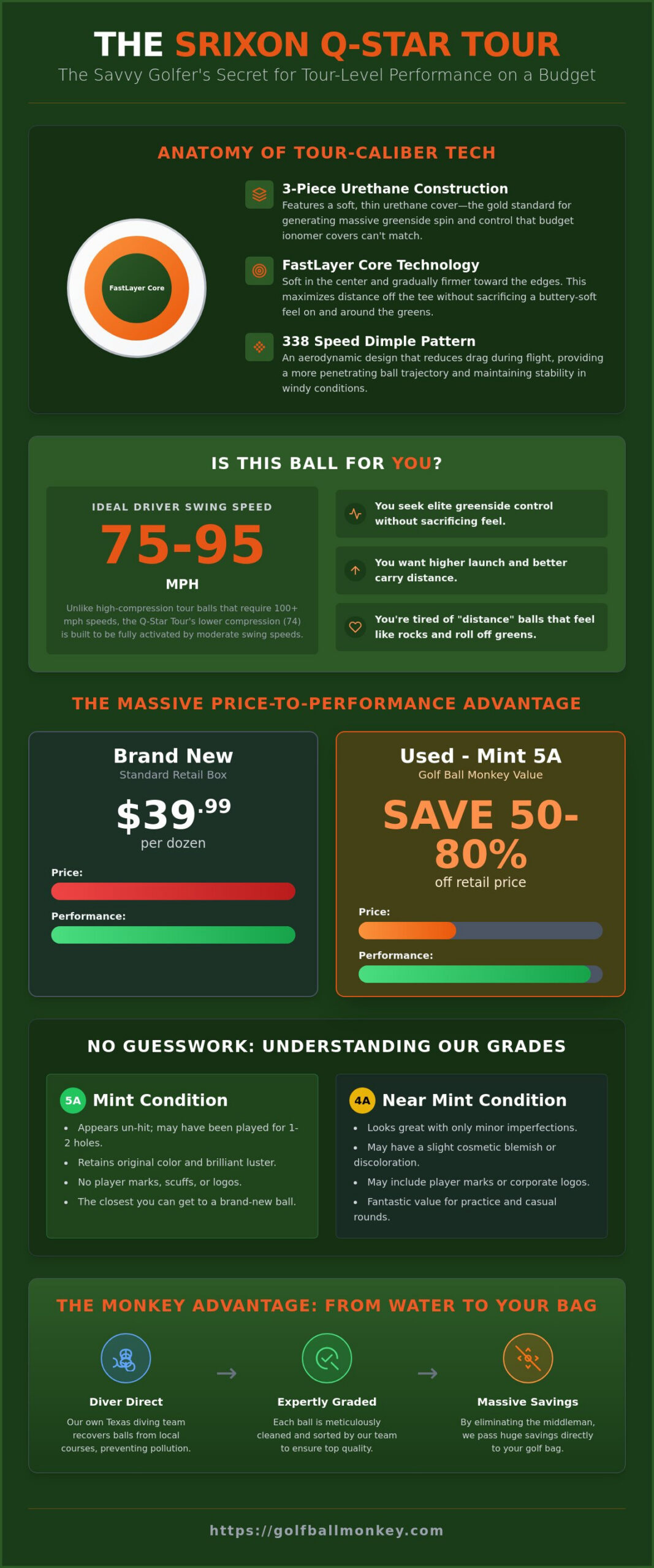
Grading Your Game: Mint 5A vs. Near Mint 4A Conditions
Buying a srixon q-star tour used stash shouldn’t feel like a gamble. You deserve to know exactly what’s arriving on your doorstep before you even open the box. That’s why we use a standardized grading scale that acts as a verbal seal of approval for every order. Our Golf Ball Monkey crew in Texas doesn’t just toss balls in a bin. We have a rigorous, multi-stage sorting process. Each ball is hand-inspected to ensure the grade on the label matches the ball in the bag. We don’t do refurbishing or repainting; we just give you the honest truth about the condition. Whether you’re looking for a pristine ball for your club championship or a bucket of water-hole insurance, we’ve got a grade that fits your mission.
When to Choose Mint 5A
Mint 5A is the gold standard. These balls are virtually indistinguishable from a fresh sleeve you’d buy at the pro shop. Think of these as the “one-hit wonders” of the golf world. Many of these are balls that some poor soul sliced into a hazard on their very first swing of the day. They look new. They feel new. They play new. When you buy srixon q-star tour used balls in Mint condition, you are beating the system. You might find a tiny sharpie mark from a previous owner or a corporate logo, but the flight characteristics and SpinSkin tech are 100% intact. This is the only choice for your competitive rounds or tournament play.
The Value of 4A Near Mint and 3A
Near Mint 4A is the sweet spot for the high-volume golfer who cares more about the scorecard than the shine. These balls have been played for a few holes and might show a minor scuff or a slight loss of luster. They still offer that elite urethane bite on the greens, but they come at an even deeper discount. If you’re heading to a course with more water than grass, you might even consider our 3A “Mixed Bags” or practice balls. They aren’t pretty, and they may have more significant blemishes, but they’re perfect for sharpening your game without the financial stress. You can see our full inventory of all grades on our shop page right now.
Choosing the right grade is about balancing your ego with your budget. If you are practicing your short game or playing a casual round with friends, 4A balls provide incredible performance for pennies on the dollar. Save the 5A “Mint” balls for when there is money on the line. No matter which grade you pick, you’re making the intelligent play by avoiding retail markups. Ready to upgrade your bag without the retail sting? Secure your Mint 5A stash today.
Score Big with Golf Ball Monkey: Direct from the Water to Your Bag
Why pay a middleman to stand between you and a great round? Most used ball sellers buy their inventory from third-party vendors and slap a massive markup on top. We don’t play that game. At Golf Ball Monkey, we are a Texas-based operation with our own boots on the ground and fins in the water. By sourcing our srixon q-star tour used inventory directly from the hazards, we cut out the fluff and pass the savings straight to your bag. It is the ultimate “Monkey Advantage.” You get the high-performance gear you need without the retail baggage or the corporate overhead.
We believe in making the intelligent play both in your strategy on the course and your strategy in the shop. You’ve seen how the 3-piece construction and urethane cover of the Q-Star Tour can transform your short game. Now you see how our direct-to-consumer model transforms your budget. We take the sting out of a lost ball and replace it with the thrill of finding a significant bargain. It’s about pure enjoyment of the sport without the elitist price tag.
Professional Divers, Professional Results
Our professional diving team is the heart of our business. They aren’t just looking for lost treasure; they are recovering premium technology. We handle millions of balls annually. This massive volume gives us the best selection in the industry. Because we control the entire process from retrieval to cleaning and shipping, we can guarantee the quality of every ball. You aren’t getting a mystery box from a faceless warehouse. You are getting gear vetted by fellow enthusiasts who know exactly what a tour ball should look and feel like. It is a human approach to a high-tech game that builds immediate trust.
Bulk Buying: The Ultimate Savvy Move
If you want to maximize your savings, think bigger than a single dozen. Savvy players know that bulk buying is the smartest way to slash shipping costs per ball. Grab a 50-pack or a full bucket to ensure you never run out of your favorite model mid-season. Having a consistent supply of srixon q-star tour used balls allows you to build a reliable practice routine. You should be practicing with the same ball you play on Sunday. When the price is this low, you can afford to use premium urethane on the chipping green and the driving range. It is the savvy move that builds real confidence.
Don’t wait until your bag is empty to think about your next round. High-quality inventory moves fast, especially when the value is this high. We take pride in stripping away the elitism of the sport and making elite equipment accessible to everyone. You’ve seen the tech. You’ve seen the grading. Now it’s time to pull the trigger. Restock your bag with Srixon Q-Star Tour used balls today!
Lock in Your Savings and Level Up Your Game
It’s time to stop overpaying for gear that doesn’t fit your swing. You’ve seen the data. You’ve seen the tech. The Srixon Q-Star Tour is the ultimate secret weapon for golfers who want tour-level spin without the 100 mph requirement. By choosing a srixon q-star tour used supply, you’re making the intelligent play that saves your wallet while sharpening your short game. Our Texas-based quality control ensures every ball meets our strict grading standards, so you never have to worry about performance duds.
You get direct-from-diver pricing because we cut out the middlemen entirely. Whether you choose our Mint 5A guaranteed performance for your next tournament or a bulk bag for the range, you’re winning before you even step onto the first tee. Stop letting high retail prices dictate which ball you play. Grab your gear from the source and start seeing the difference in your scorecard and your bank account.
Restock Your Bag: Shop Srixon Q-Star Tour Used Balls Now
Go out there, have fun, and hit ’em straight!
Frequently Asked Questions
Are used Srixon Q-Star Tour balls as good as new ones?
Yes, they are. When you buy a srixon q-star tour used set in Mint 5A condition, you’re getting performance that is virtually identical to a new ball. These are often “one-hit wonders” lost on the first hole. The core compression and urethane cover don’t degrade just because they’ve been in a hazard for a short time. You get tour-level spin and distance without the retail markup. It’s the smartest way to play a premium ball.
What is the difference between Srixon Q-Star and Q-Star Tour?
It comes down to the cover and construction. The standard Q-Star is a 2-piece ball with an ionomer cover designed for maximum distance and durability. The Q-Star Tour is a 3-piece ball with a premium urethane cover. This extra layer and softer cover provide the greenside spin and control that better players need. If you want the ball to stop on the green, go with the Tour model. It’s a game-changer for your short game.
Do used golf balls lose distance after being in the water?
Modern solid-core balls are almost entirely waterproof. Unlike the old liquid-center balls from decades ago, today’s urethane and ionomer materials don’t absorb water. Unless a ball has been submerged for years, its flight and distance remain unchanged. We vet our inventory to ensure every ball we ship performs exactly like it should. You won’t see any “dead” balls in your order. It is performance you can trust on every shot.
What does Mint 5A grade mean for Srixon golf balls?
Mint 5A is our top-tier rating. It means the ball looks and plays like it just came out of a fresh sleeve. You might find a tiny player mark or a logo, but there are no scuffs, scrapes, or loss of shine. It’s the “smart money” choice for golfers who want peak performance without paying the pro shop’s inflated prices. It is the closest you can get to new gear while keeping your budget intact.
Can I buy Srixon Q-Star Tour balls in bulk?
Absolutely. We encourage buying in 50-packs or full buckets to maximize your savings. Buying a srixon q-star tour used bulk order is the best way to lower your cost per ball and ensure your bag is always stocked. It also lets you practice with the same high-performance ball you use during your rounds. Consistency is the fastest way to lower your scores. It is the savvy move for any serious player.
Why is the Srixon Q-Star Tour better for moderate swing speeds?
It is all about compression. High-tour balls like the Z-Star require massive swing speeds to compress the core. If you swing between 75 and 95 mph, those balls will feel like rocks. The Q-Star Tour has a compression rating of 74, allowing you to fully compress the ball. This leads to higher launch angles and more carry distance for the average amateur golfer. You finally get the distance you deserve without the struggle.
Do used balls come with logos or player marks?
Yes, they often do. Since these are genuine recycled balls, you might see a corporate logo or a previous owner’s sharpie mark. These markings are purely cosmetic and have zero impact on the ball’s flight, spin, or durability. In fact, some players find the logos helpful for identification on the fairway. If you want a perfectly blank ball, used gear might not be for you. We focus on pure performance and value.
How much can I save by buying used Srixon balls?
You can typically save between 50% and 80% compared to buying new at a big-box retailer. A new dozen of these balls often retails for $39.99, but our used prices allow you to get significantly more balls for the same investment. It is the ultimate value play for anyone who plays frequently. You get more rounds, more practice, and more fun for a fraction of the cost. Stop paying the “new box” tax today.
Which Golf Balls Should a Handicapped Golfer Play With? The 2026 Strategy Guide
A 25-handicap golfer loses an average of 5.6 balls every single round. If you’re buying brand-new Titleist Pro V1s at $55 a dozen, you’re essentially handing $25 to the water hazards every weekend. It’s a painful cycle that leaves most players asking: which golf balls should a handicapped golfer play with? You want the performance of a tour ball, but you’re tired of feeling like your equipment is too expensive for your current game.
This 2026 strategy guide will show you how to find your perfect match. We’ll dive into the best options for high, mid, and low handicappers. You’ll learn how to save money without sacrificing greenside spin and discover why 5A Mint recycled balls are the ultimate secret weapon for the savvy golfer.
Key Takeaways
- Stop burning cash on tour-level balls your swing doesn’t need. Learn how to match ball construction to your actual skill level to save money and strokes immediately.
- High handicappers should prioritize forgiveness and low side-spin. Discover which golf balls should a handicapped golfer play with to keep more shots in the fairway and fewer in the drink.
- Mid-handicappers need the perfect balance of distance and greenside check. We break down why transitioning to 3-piece urethane balls is the secret to breaking into the single digits.
- Low handicappers don’t have to pay retail prices for elite performance. Get the predictable flight of a Titleist Pro V1 or TP5 for a fraction of the cost by choosing Mint 5A recycled options.
- Master the “Monkey Math” of equipment. See how playing high-quality used balls lets you maintain a consistent game without the financial sting of a lost ball.
Handicap vs. Performance: Does the Number on Your Card Dictate the Ball in Your Bag?
Your handicap is a strategy guide for your wallet. It’s not just a skill marker. Playing the wrong ball is a fast track to wasted strokes and a lighter bank account. The “one size fits all” approach is dead. You need a ball that matches your typical miss, not just your best drive of the year. Deciding which golf balls should a handicapped golfer play with? isn’t about ego. It’s about physics and smart spending.
Three core factors dominate this decision: swing speed, spin requirements, and your actual budget. If you’re losing five balls a round, playing retail-priced premiums is financial suicide. We advocate for the “Monkey Strategy.” This means making the intelligent play. Stop buying for the pro you see on TV. Start buying for the player standing on the first tee today. Understanding the history and technology of golf balls reveals that modern gear is specialized. You can’t just grab any box and expect results.
The Myth of the “Beginner Ball”
Don’t let the price tag fool you. “Cheap” doesn’t have to mean low quality. It usually just means a different construction. High-handicap players often benefit from ionomer covers. These materials are durable and spin less off the driver. That means your slice stays a little closer to the fairway. Urethane is the gold standard for greenside “check,” but it’s less forgiving on mishits. In 2026, your handicap dictates the ball’s layer count and cover material to minimize your specific “miss” while maximizing your distance.
Why Compression Matters for Amateurs
Compression isn’t just technical jargon. It’s about energy transfer. If you have a moderate swing speed but play a high-compression “Tour” ball, it feels like hitting a brick. You won’t activate the core. You’ll lose distance. Matching ball “softness” to your actual impact force is the easiest way to find an extra 10 yards off the tee. When the ball compresses fully, it springs off the face with maximum velocity. If you’re still confused about core tech, check out our Golf Balls 101 guide for a deep dive into the specs that actually matter for your game.
High Handicap Strategy: Prioritizing Forgiveness and Value
If you’re a 25-handicap, statistics show you’re likely losing an average of 5.6 balls per round. That is a brutal reality for your wallet if you’re buying brand-new retail boxes at $55 a dozen. When asking which golf balls should a handicapped golfer play with?, the answer isn’t about the highest price tag. It’s about minimizing the damage of your miss. For players in the 20+ range, side-spin is the enemy. High-performance Tour balls are designed to spin. For you, that spin often translates into a slice that ends up two fairways over. You need a ball that stays straight and doesn’t break the bank when it disappears into the woods.
Losing a ball shouldn’t be a financial tragedy. Think of it as “Monkey Math.” If you buy Mint 5A recycled balls, you’re getting like-new performance without the retail sting. This reduces tee box anxiety. When you aren’t worried about losing a five-dollar ball, you swing more freely. That confidence alone can shave strokes off your score. Stop playing the random “found” balls you scavenged from the tall grass. Every ball reacts differently. Playing the same model every hole builds the muscle memory you need to improve. You can score a deal on a fresh dozen and finally get some consistency in your bag.
Low Spin for Straighter Drives
For high handicappers, 2-piece balls are the secret to staying in play. Models like the Callaway Supersoft or Srixon Soft Feel use a low-compression core and a durable ionomer cover. This construction is specifically designed to reduce side-spin off the driver. It turns a massive slice into a manageable fade. These balls are built for maximum distance at slower swing speeds. They provide a soft feel without the “clicky” sound of old-school distance balls. Even the Kirkland Signature offers incredible value here, providing a balanced performance that won’t punish your scorecard or your budget.
Building Confidence with Mint 5A Recycled Balls
Buying in bulk is the ultimate power move for the high-handicap player. It removes the stress of the water hazard. There is a massive quality difference between a “found” ball that has been sitting in a pond for months and our professional 5A grading. A Mint 5A ball is indistinguishable from a new ball in performance and appearance. It’s the savvy way to play premium brands like Srixon or Maxfli without the premium price. For a deeper look at how to pick the best second-market gear, check out our Used Golf Balls Guide. It’s time to stop overpaying for gear you’re destined to lose and start playing the smart way.
The Mid-Handicap Sweet Spot: Balancing Distance and Greenside Control
You’ve broken 90. Now you’re hunting for 80. This is the “sweet spot” where your equipment choice starts to seriously impact your scorecard. For the 10-20 handicap bracket, the game changes. You aren’t just trying to survive the tee box anymore. You want to attack the pin. Research shows a 15-handicap golfer loses about 2.8 balls per round. At retail prices, that is still a $15 tax on every game. When deciding which golf balls should a handicapped golfer play with?, you need to stop settling for “distance” balls and start looking for greenside check.
The transition to 3-piece urethane balls is the hallmark of a mid-handicapper’s upgrade. These balls offer a softer cover that grabs the grooves of your wedges. This creates the “drop and stop” action you see on TV. But don’t get trapped by the $55-per-dozen retail price tag. Our Mint 5A grading allows you to play elite, multi-layer technology for roughly half the cost of a new box. It’s the ultimate insider move. You get the tour-level performance required to lower your handicap without the financial stress of a water hazard. Before you buy, evaluate your swing speed. Are you “Mid” (under 105 mph) or “Fast”? Matching your compression to your speed is the difference between a birdied hole and a frustrated par.
Top 5A Mint Picks for Mid-Handicappers
We’ve vetted the inventory to find the best performers for this skill level. These three models consistently top the charts for mid-handicap players:
- Bridgestone Tour B RX: This is the secret weapon for moderate swing speeds. It’s designed to maximize distance for players who don’t swing like pros but still want tour-quality spin.
- TaylorMade TP5: Featuring a unique 5-layer construction, this ball excels in the “all-around” game. It provides a massive boost in wind stability and soft feel.
- Srixon Z-Star: A high-value powerhouse. It offers incredible greenside control and durability. If you want a deep dive into why this brand dominates the mid-tier, check out our Srixon Golf Balls Guide.
The Urethane Advantage
Mid-handicappers often struggle to lower their scores because their approach shots roll off the back of the green. Ionomer covers are great for distance, but they lack the friction needed for control. Upgrading to a Mint 5A Titleist Pro V1 gives you the urethane advantage. You get predictable flight windows and the ability to stop the ball on a dime. Compare that to a brand-new, mid-tier ionomer ball from a big-box store. The price is similar, but the performance isn’t even close. Play the better ball. Keep the extra cash. That’s the smart play.
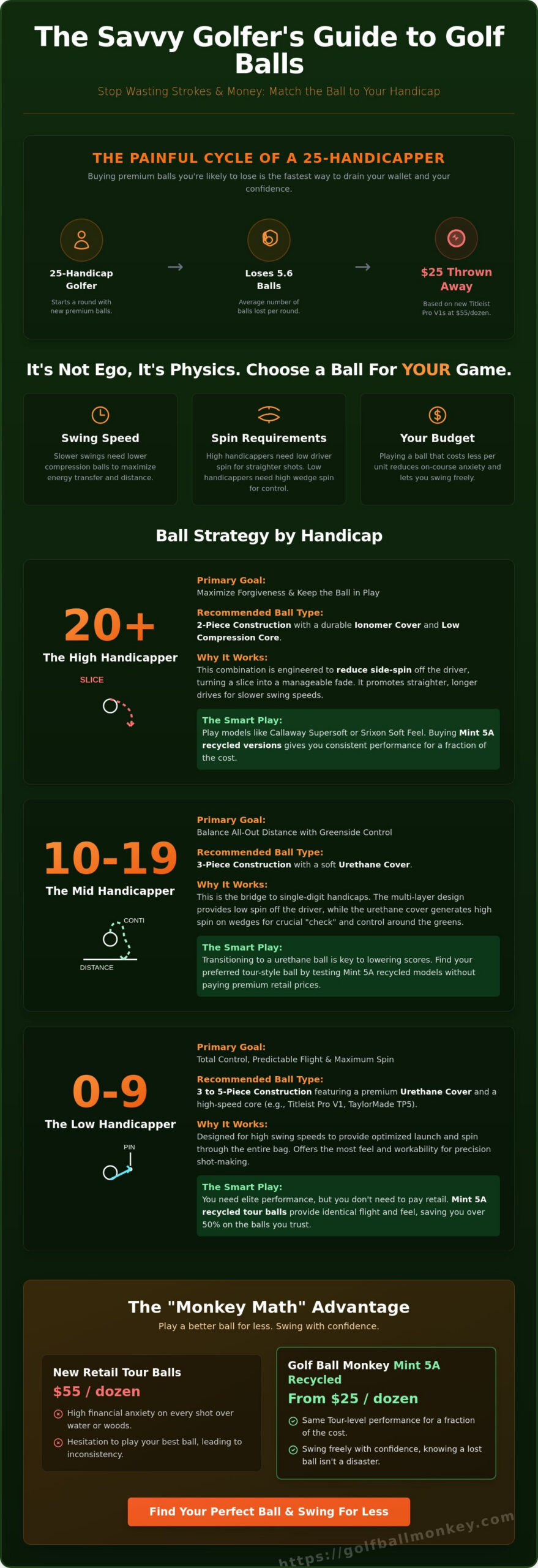
Low Handicap Logic: Why Tour Performance Doesn’t Have to Cost Retail Prices
Precision is everything once you hit a single-digit handicap. You aren’t just trying to hit the green; you’re trying to hit a specific quadrant. A 5-handicap golfer loses approximately 0.9 balls per round. While that is significantly better than the average player, it doesn’t mean you should ignore the price tag. When experts discuss which golf balls should a handicapped golfer play with?, the conversation for low handicappers always centers on consistency. You need predictable flight windows. You need total control over spin. Titleist Pro V1 and Pro V1x remain the gold standard for a reason. They offer the most reliable performance in the game. But elite players are waking up to a secret: you don’t have to pay $55 a dozen to get that reliability.
The “water-logged” myth is a relic of the past. Independent testing proves that high-quality recycled balls lose less than one yard of distance compared to new ones. Professional retrieval services act fast. They get the balls out of the environment before any structural damage occurs. This allows savvy low-handicappers to maintain a “practice like you play” mentality. Why switch to a cheaper, lower-performing ball for your casual rounds when you can play Mint 5A tour balls every day? It keeps your feel sharp without draining your wallet. Being a low-handicapper means making the intelligent play on every hole. That logic should extend to your gear, too.
Pro V1 vs. Pro V1x: Choosing Your Trajectory
Matching your ball to your desired launch is the final step in optimization. The Pro V1 is the choice for players seeking a penetrating flight and a softer feel. If you need more height and a firmer strike, the Pro V1x is the savvy choice. It provides the extra spin required to stop long irons on firm greens. Don’t guess which one fits your game. Check out our Titleist Pro V1 Guide to see the technical breakdown of the world’s most popular ball.
The Performance of Mint 5A Recycled Balls
Professional recovery operations use rapid retrieval protocols to ensure balls aren’t submerged long enough to absorb moisture, while our 5A grading scale acts as a verbal seal of approval that guarantees the same aerodynamic integrity as a ball fresh out of the sleeve. The math is simple. A season’s worth of retail Titleist balls can easily top $500. Choosing Mint 5A brings that cost down to roughly $300 for the same performance. Low-handicap “savviness” means knowing when to pay for the tech, not the fancy cardboard box. It’s time to restock your bag with Mint 5A Titleist balls and keep your game—and your budget—at an elite level.
The Smart Play: Building a High-Performance Bag for Less with Golf Ball Monkey
The ultimate answer to which golf balls should a handicapped golfer play with? is simple. Play the ball you can afford to lose. If you’re standing over a forced carry with a $5 retail ball, you’re already tense. Tension kills golf swings. By choosing Mint 5A recycled balls, you remove the financial fear. You get to play Titleist, Srixon, or TaylorMade tech without the retail markup. This isn’t just about saving money; it’s about playing with a clear head. Consistency comes from playing the same model every single round. We make that consistency affordable.
Our grading system acts as a verbal seal of approval. A Mint 5A ball is the gold standard. It looks, feels, and flies like it just came out of a fresh sleeve. We don’t do “refurbished” junk that hides scuffs under paint. We provide genuine, reclaimed performance. Beyond your wallet, this is a win for the environment. Every recycled ball you play is one less piece of plastic sitting in a pond or a landfill. It’s a sustainable way to fuel your obsession. It’s the intelligent play for the planet and your pocketbook. Stop overpaying. Start playing smarter.
Why Every Golfer Needs a “Practice Bag”
Don’t waste your Mint 5A stash on the range or in your backyard. Every savvy player keeps a separate stash of Shag/Practice balls for wood-work and chipping drills. It’s about tiered strategy. Use your 5A balls for tournament rounds or matches with friends. Switch to 3A or 4A “Good” condition balls for those “risky” holes where the water is calling your name. This keeps your best gear fresh for when the score really matters. To round out your setup, check out our guide on Golf Ball Accessories to find the gear that actually improves your routine.
Join the Monkey Community
The smartest players in the game don’t wait for retail sales. They stay updated on our bulk deals and fresh inventory drops. Whether you’re hunting for a 48-ball bucket of Kirkland Signature or a dozen Mint Srixon Z-Stars, we’ve got you covered. This is the savvy insider approach to equipment in 2026. Join the community of golfers who value performance over fancy packaging. You can shop the full range of Mint 5A golf balls here and finally build the high-performance bag you deserve. Grab a deal. Hit the links. Repeat.
Master the Course Without the Retail Sting
You have the strategy. Now you just need the equipment. Whether you are battling a slice with a low-spin 2-piece ball or hunting for birdies with a high-performance urethane cover, the intelligent play is clear. Millions of balls are reclaimed annually by our professional divers. Our Texas-based, family-operated team vets every single one to ensure it meets our professional 5A Mint grading standards. This gives you the savvy insider edge on every tee box without the elitist price tag.
Deciding which golf balls should a handicapped golfer play with? is no longer a guessing game. It is about matching your equipment to your actual swing speed and typical miss. You deserve tour-level performance that fits your budget. Don’t let the fear of a water hazard hold your game back. Play the same model every hole and watch your consistency soar while your costs drop. We have done the dirty work so you can enjoy the pure thrill of a bargain. It is time to stop overpaying for the box and start playing for the score.
Grab a bucket of Mint 5A Titleist Pro V1s and save 50% today!
Go get ’em. The fairway is waiting, and your next personal best is just a dozen balls away.
Frequently Asked Questions
Do used golf balls lose distance compared to new ones?
High quality recycled balls lose less than one yard of distance compared to brand new ones. Independent testing confirms that modern core technology remains stable even after being submerged for short periods. Professional retrieval services act fast to pull these balls before any structural damage occurs. You get the same aerodynamics and velocity as a retail ball but without the steep price tag.
What is the best golf ball for a 20 handicap player?
The best choice for a 20 handicap player is a low compression, 2-piece ball like the Srixon Soft Feel or Callaway Supersoft. These models are engineered to minimize side-spin, which helps keep your slices and hooks closer to the fairway. When asking which golf balls should a handicapped golfer play with?, the priority at this level is staying in play while keeping your cost per round manageable.
Should I use a soft or hard golf ball if I have a slow swing speed?
You should play a soft, low compression ball if you have a slow swing speed. Soft balls allow you to fully compress the core at impact, which maximizes your distance off the tee. Harder “Tour” balls require high impact force to activate the technology. If you don’t swing fast, a hard ball will feel like a rock and likely cost you 10 or more yards in total distance.
How many golf balls does the average handicapped golfer lose per round?
A 25-handicap golfer loses an average of 5.6 balls per round, while a 15-handicap loses about 2.8. These statistics from the 2026 season highlight why buying expensive retail boxes is a losing game for most amateurs. Switching to Mint 5A recycled balls lets you maintain your equipment quality without the financial sting that comes with every water hazard and out-of-bounds stake.
What is the difference between Mint 5A and 4A grade balls?
Mint 5A balls are the gold standard and look virtually indistinguishable from a new ball fresh out of the sleeve. They have no scuffs, no discolorations, and no player markings. 4A Near Mint balls are still high performance but might have a slight cosmetic blemish or a previous owner’s Sharpie mark. Both grades offer massive savings, but 5A is for the player who demands perfection.
Is the Titleist Pro V1 too much ball for a high handicapper?
The Titleist Pro V1 is designed for high spin, which can actually make a high handicapper’s slice significantly worse. While it is a legendary ball, its multi-layer technology is optimized for greenside control rather than maximum forgiveness. If you are still losing several balls a round, a low-spin 2-piece ball is usually the smarter play for both your scorecard and your equipment budget.
Can playing the same ball model every round really lower my handicap?
Playing the same ball model every round builds essential consistency for your short game and putting. Every ball reacts differently off the wedge face and the putter. When you switch models every few holes, you can’t develop a reliable feel for distance and check. Sticking to one model is a proven way to shave strokes by making your results more predictable on the green.
Are recycled golf balls better for the environment?
Recycled golf balls are a massive win for the planet because they keep plastic and rubber out of sensitive water ecosystems. Millions of balls are lost in ponds every year where they can slowly degrade over decades. By playing reclaimed gear, you are participating in a sustainable cycle that reduces manufacturing waste and cleans up our local courses. It is the savvy, eco-conscious move for every player.
Golf Balls 101: The Ultimate Guide to Performance, Tech, and Value in 2026
You are literally flushing five dollars down the drain every time you slice a brand-new Pro V1 into the pond. It is a painful ritual that 80 percent of golfers know all too well. We have all stood on the tee box feeling that spike of anxiety, wondering if we should risk the “good” ball or settle for a scuffed-up range rock. Between the complex jargon like 100-compression cores and the $65 retail price tags, buying golf balls in 2026 has become a total headache. It’s time to stop overpaying for marketing fluff and start playing like a savvy insider.
You deserve Tour-level performance without the country club tax. This guide will teach you the science behind urethane covers and show you how to snag Mint condition, five-star quality equipment for 70 percent less than the big-box stores charge. The Monkey has personally vetted the tech so you can focus on your swing. We are diving into the 2026 construction trends, decoding the grading scales, and proving that recycled speed is just as fast as the expensive, shrink-wrapped alternative.
Key Takeaways
- Stop treating your ball like a plastic toy and master the aerodynamic engineering that turns the core into a high-velocity engine.
- Shift gears on the course by understanding how multi-layer construction provides the precision you need for every club in your bag.
- Forget the myths about water damage; learn why premium recycled golf balls deliver tour-level performance at a fraction of the retail cost.
- Maximize your yardage by finding your perfect compression match, ensuring your swing speed isn’t being wasted on a ball that’s too hard.
- Make the “smart play” for your wallet and the planet by discovering the massive savings found in vetted, five-star quality recycled gear.
The Anatomy of a Golf Ball: More Than Just Dimples
Stop treating your gear like a plastic toy. That ball in your hand is a complex piece of aerodynamic engineering designed to survive a 150 mph collision. Every layer serves a specific purpose. If you want to stop losing money in the woods, you need to understand what’s happening under the hood. High-performance golf balls are built to balance speed, spin, and flight path. It’s a game of physics. The Monkey has vetted thousands of these, and the tech inside is what separates a five-star quality ball from a total dud.
The Core: Where Distance Begins
Think of the core as the engine. This high-energy center determines your initial velocity the moment you make contact. When the club hits, the core compresses and then snaps back to its original shape. This rebound effect launches the ball forward. Larger cores generally equate to higher ball speeds for players with faster swings. Compression is the measure of how much a ball deforms under load. If you match your swing speed to the right compression, you’ll see a 10 to 15 yard jump in distance. Don’t waste your power on a core that doesn’t react to your swing. Finding that perfect match at Monkey prices is the smartest play you can make.
The cover acts as the interface. It’s the only part of the ball that touches your club. This outer layer dictates your greenside control and overall feel. Urethane covers offer maximum spin for those “stop on a dime” shots. Surlyn covers provide extreme durability for the golfer who wants their ball to last multiple rounds. You choose the feel; the Monkey provides the savings.
Dimples and Aerodynamics
Smooth balls are a disaster for your scorecard. If a ball was perfectly smooth, it wouldn’t fly 100 yards because the air resistance would kill the momentum instantly. Dimples are the solution. They create a thin layer of turbulent air that clings to the surface, reducing drag and creating the lift needed for hang time. Most modern golf balls feature between 300 and 400 dimples. This pattern is precisely engineered to keep your shot airborne and stable in the wind. Without these tiny craters, your 300-yard drive would drop out of the sky before it reached the fairway markers. It’s pure science packaged in a dimpled shell.
Choosing Between 2-Piece and Multi-Layer Construction
Think of golf ball construction like the gears in a car. A 2-piece ball is your reliable cruiser, built for straight lines and simple trips. A 5-piece tour ball is a high-performance sports car with a complex transmission. Most golf balls fall into one of these two camps. Your choice depends on your swing speed and whether you value raw distance over greenside control. More layers generally mean more “gears” for different clubs. While a driver compresses the whole ball for maximum velocity, a wedge only interacts with the outer layers to generate spin.
The Monkey knows that complexity isn’t always better. If you’re still fighting a slice, those extra layers might work against you. High-spin tour balls don’t just spin back on the green; they spin sideways into the trees if your face angle is off. Starting with a simpler construction is often the smart play to keep your scorecard and your wallet happy.
2-Piece Balls: The Distance Kings
These are built for survival and speed. A 2-piece ball features a large, high-energy rubber core wrapped in a Surlyn cover. Surlyn is a specialized ionomer resin that’s virtually indestructible. It resists scuffs from cart paths, trees, and thin shots. These are the “smart play” for high handicappers because they produce low spin off the driver. This lack of spin helps 85% of amateur golfers keep the ball in the fairway by minimizing the effects of a hook or slice.
- Durability: These balls last until you actually lose them in a hazard.
- Low Spin: Maximum distance with a straighter flight path.
- Top Picks: Look for the Callaway golf balls like the Warbird or Srixon Soft Feel for reliable performance.
You can find these workhorses at Monkey prices, allowing you to stock up for a fraction of the cost of premium alternatives.
Multi-Layer Tour Balls: Total Control
When you start hitting greens in regulation, you need “stop-and-drop” power. This is where multi-layer golf balls shine. They use mantle layers between the core and cover to fine-tune performance for every club in the bag. The outer layer is almost always Urethane. This material is softer than Surlyn, allowing wedge grooves to “bite” into the cover for maximum spin.
The Titleist Pro V1 remains the industry benchmark for this category. It uses a 3-piece design to balance high speed off the tee with a soft feel around the cup. If you want to dive into the technical specs of mantle compression and dimple patterns, check out our Titleist Pro V1 vs Pro V1x comparison guide. Just remember that this level of control requires a consistent swing to see the 10% to 15% increase in spin rates that pros rely on.
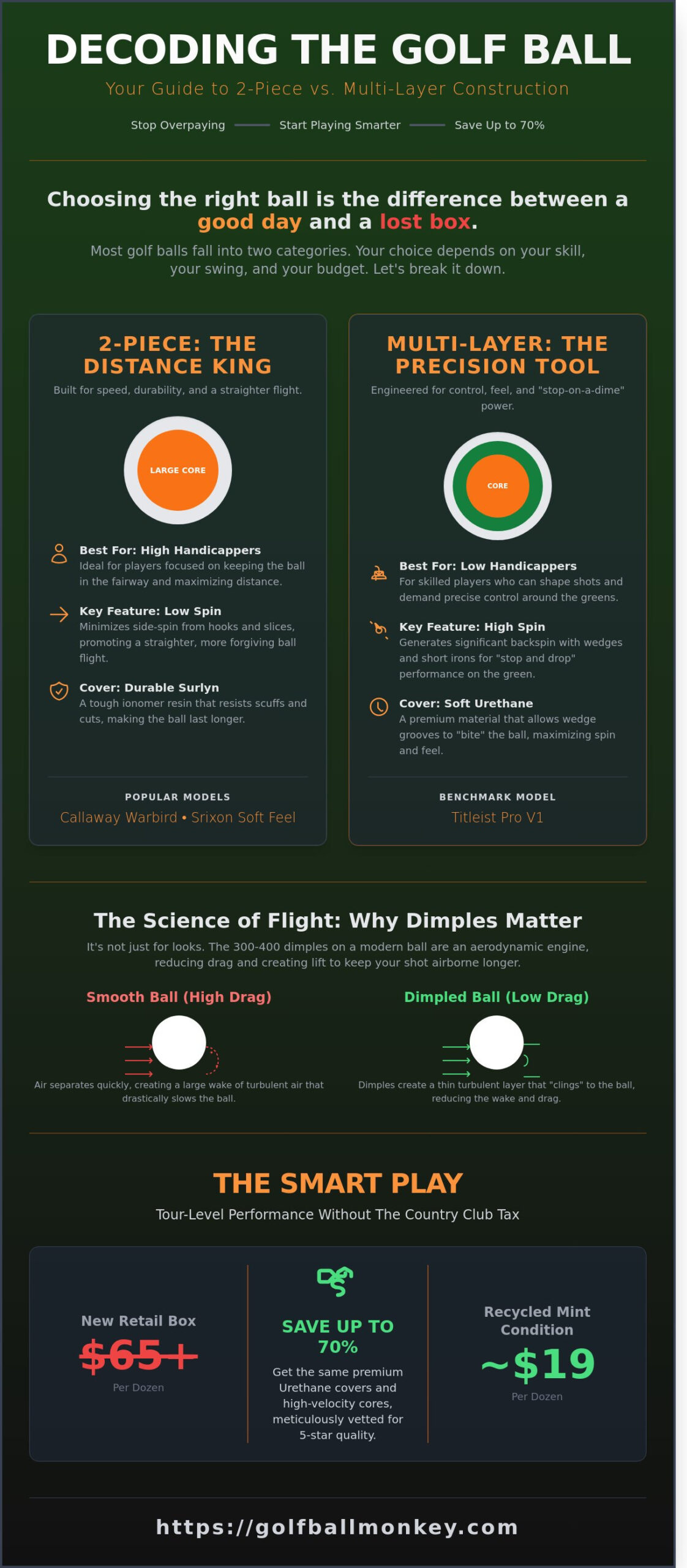
The Truth About Used vs. New Golf Balls
Stop paying retail prices. It is a total trap. You are standing on the tee box with a $5 ball in your hand, worrying more about your wallet than your swing. That is not how you shoot low scores. Recycled golf balls are the ultimate smart play for any golfer who values performance over shiny packaging.
Understand the distinction before you buy. Refurbished balls are the enemy. These are often stripped, repainted, and stamped with a fake logo. They lose their aerodynamic integrity and spin consistency. Recycled balls are different. These are recovered, cleaned, and graded. You get the original factory finish and the exact performance the manufacturer intended. It’s the same ball, just at Monkey prices.
Debunking the Water-Logged Myth
The idea that water ruins a ball comes from the 1980s. Old wound-balata balls were essentially sponges. Modern solid-core polymers are a different breed. They are nearly impervious to short-term moisture. Follow the 24-hour rule: a ball needs a full day of submersion before any measurable change occurs. Our professional divers harvest these treasures frequently, often within 48 to 72 hours of them hitting the drink. Independent testing confirms that 5A Mint balls perform within 1% of new balls. You won’t feel the difference, but your bank account will.
The Mint 5A Grading Standard
We don’t guess at quality. We obsess over it. The Monkey grading system is the industry benchmark. It ensures you know exactly what is landing on your doorstep. Check out the full inventory to see these grades in action:
- Mint 5A: These are the unicorns. They look and play like they just came out of a fresh sleeve. No scuffs. No stains. Just pure performance.
- Near Mint 4A: The best value on the market. These might have a tiny cosmetic flaw or a player pen mark, but the structural integrity is 100% intact.
- Shag/Practice: Perfect for the backyard or the local park. These have seen some battle, but they are great for grooving your swing on a budget.
Grab a bag of high-quality golf balls and stop stressing over the hazards. It’s time to play with confidence. Choose the grade that fits your game and save your cash for the 19th hole.
How to Match a Golf Ball to Your Swing Speed
Stop playing your buddy’s ball just because he’s a scratch golfer. If your swing is slow and your ball is rock-hard, you’re likely losing 10 to 15 yards of carry. It’s simple physics. You have to “squish” the ball to launch it properly. A ball that’s too firm for your speed won’t compress. It just bounces off the clubface like a pebble, leaving your distance short and your hands vibrating.
High swing speeds need high compression. Low speeds need low compression. It’s a direct relationship for peak performance. If you aren’t sure where you land on the spectrum, this swing speed guide provides a personalized recommendation to get your game on track. For a deeper dive into how compression affects your game, our comprehensive guide on soft vs hard golf balls breaks down exactly which compression rating will maximize your distance and accuracy. Matching your golf balls to your actual speed is the fastest way to lower your score without changing your swing.
Low to Mid Swing Speeds (Under 95 MPH)
About 75% of weekend golfers fall into this category. If your driver carries between 200 and 240 yards, you’re likely swinging under 95 MPH. You need “Soft” golf balls. These have lower compression ratings, typically between 35 and 60, which allow the core to deform and rebound even at moderate speeds.
- Callaway Supersoft: Ultra-low compression for maximum feel and distance.
- Srixon Soft Feel: Designed to launch high and reduce drag.
These balls help straighten out a “big miss” off the tee. Because they’re easier to compress, they generate less side-spin. Less side-spin means your slice stays in the light rough instead of the woods. You could see a 7% increase in total distance just by switching to a ball that matches your tempo.
High Swing Speeds (100+ MPH)
If you’re cranking drives past 270 yards, you’re in the triple digits. You have the opposite problem. You might “over-compress” a soft ball, which makes the flight erratic and kills your energy transfer. You need a firm, high-compression ball to keep your ball flight stable and your spin numbers optimized.
The Titleist Pro V1x and TaylorMade TP5x are the gold standard for this group. These balls offer maximum stability at high velocities. You’ll benefit most from the multi-layer construction and urethane covers. High-speed players can generate 1,200 RPM more spin on greenside chips with these premium models compared to two-piece surlyn balls. It’s about total control when the stakes are high.
The Smart Play: Why Savvy Golfers Choose Recycled Performance
Stop overpaying for your gear. It’s that simple. Every time you slice a brand-new, $5 tour ball into the woods, you’re literally throwing money away. Savvy golfers know better. They play the same high-performance golf balls for a fraction of the sticker price. It’s the ultimate insider secret that keeps your bag full and your wallet heavy. Why fund a corporate marketing budget when you can fund your next tee time instead?
The Economics of the Game
Let’s look at the hard data. Most average players lose about two balls per round. If you play 30 rounds a year, that is 60 balls gone. At a retail price of $5 per ball, you’re spending $300 a season just on replacements. Switch to the Monkey Price of $1.50 per ball, and your annual cost drops to a mere $90. That’s a total savings of $210. Think about what that cash can do for your game:
- Pay for 3 to 4 extra rounds of golf at your favorite local course.
- Buy a brand-new, high-end wedge to fix your short game.
- Cover your gas and beers for the entire summer season.
The performance gap between a “mint” recycled ball and one in a shiny box is non-existent. You get the same spin, the same distance, and the same feel without the “new ball” anxiety that ruins your swing over water hazards.
Sustainability on the Course
The mission is bigger than just your scorecard. Every year, millions of golf balls end up sitting in water hazards, slowly leaching plastics into the ecosystem. We reclaim these lost treasures annually, keeping lakes clean and courses pristine. It’s a massive cleanup operation that turns a potential environmental hazard into a high-performance bargain. You get tour-level equipment at a steal, and the planet gets a break. It’s a rare win-win in a sport that usually demands sacrifice.
If you want to talk like a pro while you save like a pro, check out our Golf Sports Terms guide. It helps you master the lingo while you walk the walk with better gear for less cash.
Join the smart-player revolution today. Stop overthinking the price tag and start focusing on your target. Shop the full collection now and see why the Monkey is the golfer’s best friend. Grab a bag of five-star quality gear and play the game the way it was meant to be played, guilt-free and fully stocked.
Take Control of Your Game and Your Wallet
Mastering the physics of golf balls doesn’t require a degree in aerospace engineering; it just takes a smarter approach to your gear. You’ve seen how matching a multi-layer construction to your specific swing speed can shave 3 strokes off your scorecard by optimizing spin and launch. You also know that paying full retail price is a choice, not a necessity. By choosing recycled performance, you get the same tech that the pros use without the heart-wrenching feeling of losing a five-dollar ball in the woods.
The Monkey makes it easy to stay stocked. Our team of professional divers harvests every ball, reclaiming over 1 million premium units annually. Each one goes through a strict 5-star grading system to ensure you get exactly what you pay for. Whether you need a 2-piece distance ball or a tour-level urethane cover, we have the inventory to keep you on the fairway. For a complete breakdown of which models deliver the most bang for your buck, check out our best rated golf balls 2026 roundup to see exactly which balls are dominating the course this season. If you’re specifically interested in TaylorMade golf balls and their performance characteristics, we’ve got you covered with detailed analysis and massive savings opportunities. Stop letting high prices dictate your strategy on the course.
Grab a bucket of Mint 5A Titleist Pro V1s and save 50% today!
It’s time to play your best game yet. Grab your clubs, trust your swing, and enjoy the massive savings waiting for you at the clubhouse. See you on the first tee!
Frequently Asked Questions
Are used golf balls as good as new ones?
High-grade used golf balls perform nearly identical to brand new ones straight out of the box. Independent testing shows that 5A grade recycled balls lose less than 0.5% of their total distance compared to a fresh sleeve. You get the same spin rates and launch angles without the steep retail markup. It’s the smartest way to play premium gear while keeping your wallet heavy.
What is the difference between recycled and refurbished golf balls?
Recycled balls are simply recovered, washed, and sorted by quality to maintain their original factory finish. Refurbished balls are sandblasted and repainted, which often strips away the original aerodynamics and covers up damage. Tests show refurbished models can lose 5 yards of carry distance due to uneven paint layers. The Monkey only stocks recycled balls to ensure you get the factory-spec performance you expect.
Do golf balls lose distance over time?
Modern golf balls don’t lose distance for 5 to 7 years if you store them in a cool, dry place. Performance only drops significantly if a ball stays submerged in a lake for over 100 hours or sits in a 120 degree car trunk. Keep your stash in the garage or a closet and they’ll stay fast and long for hundreds of rounds without any degradation.
What does 5A Mint condition mean?
5A Mint condition is our highest rating, representing a ball that looks and plays like it was just pulled from a new box. These balls show 0 scuffs, 0 stains, and 0 signs of wear. You can expect 100% of the original manufacturer performance. It’s the ultimate bargain, offering a pristine product at 50% of the price you’d pay at a big-box pro shop.
How many golf balls are in a dozen?
There are 12 balls in a standard dozen, typically packaged in 4 individual sleeves of 3 balls each. If you want to maximize your savings, grab a Monkey bulk pack of 48 or 96. Buying in bulk typically slashes your cost per ball by an additional 20% compared to buying single dozens, making it the best play for frequent golfers.
Can I use a 3-piece ball if I have a slow swing speed?
You can definitely play a 3-piece ball if you choose a low-compression model designed for your speed. Golfers with swing speeds under 90 mph should look for a compression rating between 60 and 75. This setup provides the greenside spin of a 3-piece construction while adding 8 yards of distance off the tee. It’s a win for your short game and your drives.
Why are Titleist Pro V1s so expensive?
You’re paying for massive marketing budgets and professional tour contracts when you buy at retail. Retailers charge $55 for a dozen Pro V1s to fund multi-million dollar TV ads and player sponsorships. The balls themselves feature a high-tech urethane cover and a 388-dimple design for consistency. If you want to see how the Pro V1 stacks up against other premium models in our comprehensive testing, our best rated golf balls guide breaks down the performance data and shows you where to get them for $29 instead.
What is the best golf ball for a beginner?
Beginners should start with a 2-piece, soft-compression ball like the Callaway Supersoft. This ball has a low 38 compression rating that helps reduce side spin by 12% on off-center hits. This means your slices won’t curve as far into the trees. It’s a forgiving, durable choice that keeps you on the fairway while you’re still refining your swing mechanics. For a full breakdown of the entire lineup, our guide to Callaway golf balls and their performance advantages shows you exactly which model fits your game and how to get them at a fraction of retail cost.
- golfballmonkey@gmail.com
- (512) 593-8401
- Mon – Fri, 9:00 AM – 5:00 PM

All product and company names are trademarks™ or registered® trademarks of their respective holders.
Use of them does not imply any affiliation with or endorsement by them.