
Soft vs. Hard Golf Balls: The Ultimate Guide to Compression and Performance (2026)
Your $5 premium ball just vanished into the pond, and let’s be honest, it probably cost you 15 yards of distance before it even hit the water. Most golfers play a ball that’s far too firm for their actual swing speed, which means they’re paying for performance they can’t even trigger. Choosing between soft vs hard golf balls shouldn’t feel like a high-stakes guessing game or a complex math exam. You want that satisfying feel off the clubface and a flight path that stays true through the air without emptying your wallet.
We’ve all felt the frustration of watching a brand-new ball disappear on the very first hole. It’s time to stop the gear-induced headaches. This guide unlocks the mystery of compression ratings so you can find your perfect match with total confidence. We’ll show you how to pick the right ball for your swing, helping you gain consistency on the green while saving a massive 50% compared to retail prices. The Monkey has vetted the specs for 2026 to ensure you’re making the smart play. We’re breaking down the performance tech, comparing the heavy hitters, and showing you how to snag five-star quality at a steal.
Key Takeaways
- Stop guessing on the tee and master the measurable physics of soft vs hard golf balls to finally match your unique swing.
- Learn how to trigger the “Spring Effect” by turning the ball’s core into a high-octane engine for explosive energy transfer.
- Identify your swing speed category to ensure you aren’t over-compressing your ball and sacrificing massive distance.
- Balance the raw speed of hard balls with the “braking” control of soft covers to stick more greens and lower your score.
- Score a “steal” on premium performance by testing different compression levels at Monkey prices using high-quality recycled balls.
Soft vs. Hard Golf Balls: More Than Just a Feeling
Stop overpaying for tour-level balls just because a pro plays them on TV. Your swing is unique. Your golf ball should be too. The debate over soft vs hard golf balls isn’t just about how the ball feels when you putt. It’s a measurable physics equation that dictates your distance, accuracy, and total score. There is no universal “best” ball. There is only the best ball for your specific swing speed and impact style.
Many golfers fall for the old myths. They think hard balls are strictly for distance and soft balls are only for greenside spin. That’s 1990s logic. Modern manufacturing has flipped the script. Today, a low-compression “soft” ball might actually help a slower swinger gain 10 yards, while a high-compression “hard” ball could provide the stability a high-speed player needs to keep the ball in the fairway. The Monkey wants you to play smarter. That starts with understanding the numbers behind the core.
Before you drop $50 on a new dozen, check out the massive savings at our shop. You can test different compression levels for a fraction of the retail cost. Finding your match shouldn’t break the bank.
What is Compression Rating?
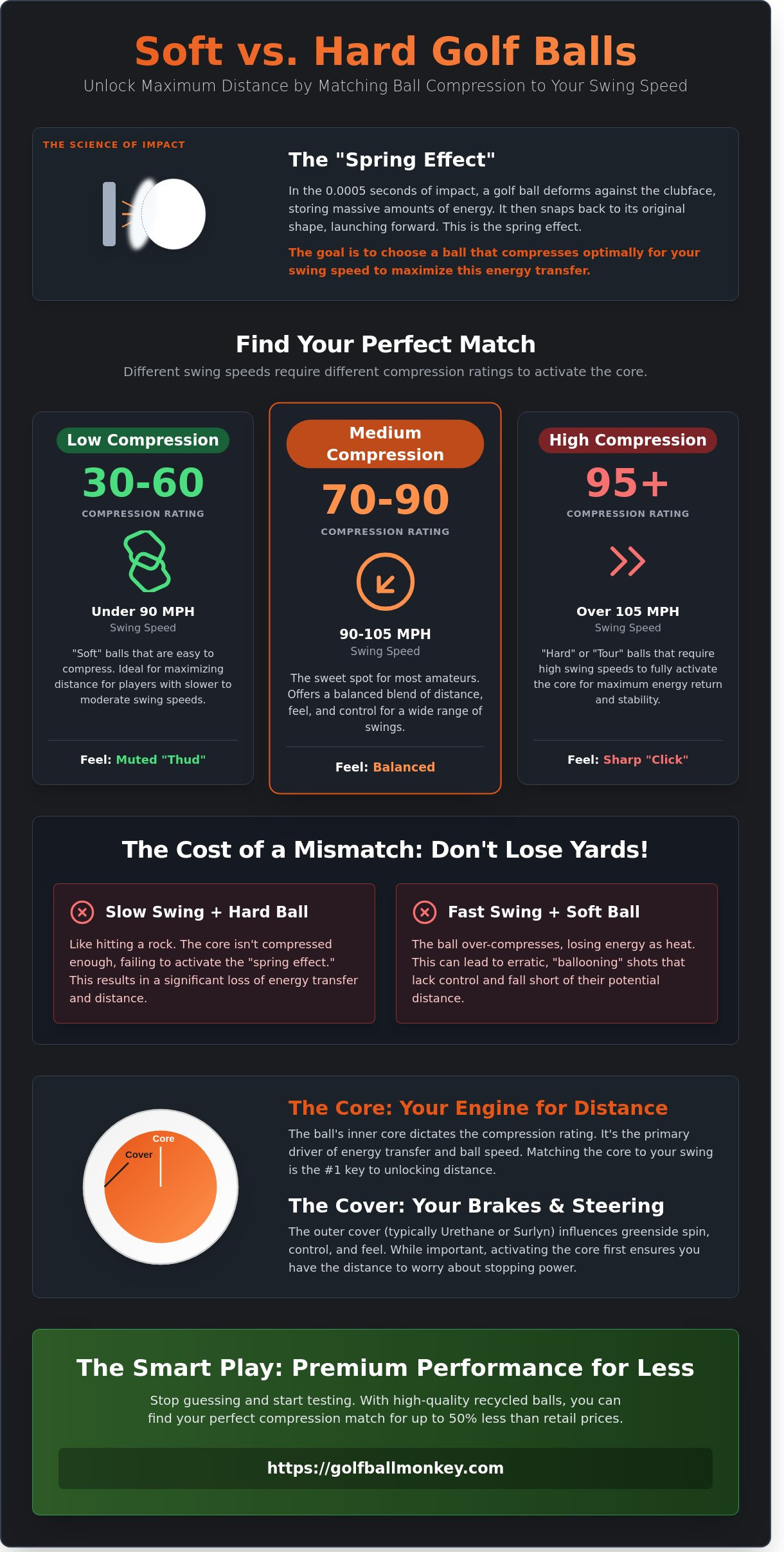
Manufacturers like Titleist and Bridgestone use a scale ranging from 30 to over 100 to rank ball hardness. This number tells you how much the ball resists the force of your club. When you make contact, the ball deforms, squashing against the face to store energy. It then snaps back to its original shape, launching into the air. Compression is the measure of a ball’s resistance to being squashed by the clubface.
- Low Compression (30-60): These are “soft” balls. They deform easily, making them perfect for swing speeds under 90 mph.
- Medium Compression (70-90): The middle ground for the average amateur swinging between 90 and 100 mph.
- High Compression (95+): These are “hard” balls. They require massive force, typically a 105 mph+ swing, to fully activate the core’s energy.
The “Click” vs. The “Thud”
Sound heavily influences your perception of quality. A hard ball produces a sharp “click” at impact. A soft ball delivers a muted “thud.” This feedback is psychological gold. If you love a soft feel, you’ll likely swing with more confidence and rhythm. However, don’t let your ears deceive you. If your swing speed is 110 mph and you play a 40-compression ball, you might love the feel but lose 5 mph in ball speed. That’s a heavy price for a nice sound. Matching the compression to your mechanics is the only way to ensure you aren’t leaving yards on the tee box.
The Science of Compression: What Happens at Impact
Impact lasts about 0.0005 seconds. In that tiny window, your clubface transfers massive kinetic energy into the ball’s core. This is the spring effect. When the club hits the ball, the ball actually deforms, flattening against the face before snapping back to its original shape. This snap provides the velocity. Think of the core as the engine and the cover as the brakes or the steering wheel. To maximize distance, you need a ball that matches your specific swing speed.
The debate over soft vs hard golf balls usually comes down to “activation.” If you swing at 85 mph but play a 100-compression ball, you won’t compress the core enough. It’s like hitting a rock. The ball stays round, energy stays trapped in the club, and your drive dies early. Conversely, if you have a 115 mph gorilla swing and use a 60-compression ball, you’ll over-compress it. The ball squashes too much, losing energy as heat. This results in erratic flight and “ballooning” shots that fall short of the target.
Core Density and Energy Transfer
Manufacturers manipulate polybutadiene rubber density to set a ball’s compression rating. A low-compression core, typically sub-70, feels like a marshmallow. It’s designed for slower swings to help them get “pop” off the face without needing tour-level speed. High-compression cores, rated 90 or above, require serious force to trigger that energy return. Engineers focus on the Coefficient of Restitution (COR). This is a measurement of energy efficiency. The USGA limits COR to 0.830; most premium balls sit right near that edge. You can find these high-performance options at Monkey prices, ensuring you get the best energy transfer for a fraction of the retail cost.
- Low Compression (Sub-70): Easier to deform; ideal for swing speeds under 90 mph.
- High Compression (90+): Maximizes energy return for swing speeds over 105 mph.
- Energy Efficiency: A ball with high COR returns more speed, regardless of how “hard” it feels.
Urethane vs. Surlyn Covers
Don’t confuse compression with cover material. “Soft” often describes how the ball feels on a putter face, not its actual compression rating. Surlyn is a durable ionomer found on most distance and budget balls. It’s tough, resists scuffs, and minimizes spin. It’s the “hard” cover that helps your slice stay in play. Urethane is the premium, “soft” alternative. It’s a thinner material that allows club grooves to bite into the ball. This creates the 10,000+ RPM of spin needed for tour-level greenside control. While Surlyn is great for the wallet, Urethane is the choice for players who want “drop and stop” performance on the green.
Speed Matters: Matching the Ball to Your Swing
Your swing speed is the boss of your ball choice. It dictates how the core reacts at the moment of impact. If you’re swinging a club at 110 mph but playing a low-compression “soft” ball, you’re actually losing distance. This happens because of over-compression. The ball deforms too much, loses its shape, and wastes energy that should be pushing it down the fairway. Think of it like hitting a marshmallow with a sledgehammer; the energy just gets absorbed instead of transferred.
On the flip side, low-speed players need that “spring” effect. To get the most out of soft vs hard golf balls, you have to match the compression to your force. We generally break golfers into three speed buckets:
- Slow Swings (Under 85 mph): You need a soft ball (compression 35 to 60) to help the core “activate” and pop off the face.
- Average Swings (85 to 100 mph): This is the sweet spot for mid-compression balls. You have enough juice to compress a firmer core without losing control.
- Fast Swings (100+ mph): You need a hard ball (compression 90 to 100+). These stiff cores resist deforming, keeping your spin rates stable and your ball flight piercing.
The hard truth? Most “Average Joes” are playing balls that are way too stiff for their actual game. Roughly 70% of amateur golfers choose a ball based on what they see on TV. If you aren’t regularly carrying your driver 250 yards, a Tour-level “hard” ball is likely costing you 10 to 15 yards of total distance. It’s time to make the smart play and stop punishing your scorecard for the sake of a brand name.
Finding Your Swing Speed
You don’t need a $20,000 launch monitor to get a ballpark figure. A simple rule of thumb is to take your average driver carry distance (not total roll) and divide it by 2.3. If you carry the ball 210 yards, your speed is roughly 91 mph. This puts you firmly in the average category. Once you know your number, you can head over to our shop to find the perfect match at Monkey prices. For a deeper dive into the data, check out our guide on How to Choose the Best Golf Ball for Your Swing Speed in 2026.
The Temperature Factor
Weather changes everything. When the mercury drops, the materials in a golf ball tighten up. A 10-degree drop in temperature can make a soft ball feel like a rock and a hard ball feel like a granite pebble. Cold air is denser, which creates more drag, but the ball itself also loses 1.5% of its resilience for every 10-degree decrease. Many savvy pros switch to a softer ball during winter months to compensate for this loss of compression. Pro tip: keep your balls in the house overnight before a cold round. Starting with a “warm” core can save you 5 yards on the first few tees.
Performance Trade-offs: Spin, Distance, and Control
Choosing between soft vs hard golf balls isn’t just about how the ball feels when you thwack it off the tee. It is a calculated trade-off between raw power and surgical precision. Hard balls are the heavy hitters of the golf world. These high-compression options, often rated 90 or above, are engineered for swing speeds exceeding 105 mph. They offer maximum energy transfer and exceptional durability. If you have the clubhead speed to activate the core, you’ll see massive distance. The downside? They feel like hitting a pebble on the putting green and offer very little “grab” on short approach shots.
Soft balls occupy the other end of the spectrum. These low-compression gems, typically rated between 35 and 70, are designed for the 80% of golfers who swing at more moderate speeds. They provide a plush feel and much-needed forgiveness. Many amateurs claim they aren’t “good enough” for ball choice to matter, but that is a costly mistake. If you’re playing a high-compression “Tour” ball with an 85 mph swing, you won’t compress the core. You’ll lose 10 to 15 yards of distance and struggle to keep the ball on the planet. The Monkey knows that playing the wrong ball is like trying to drive a nail with a screwdriver; it’s the wrong tool for the job.
- Hard Balls: Best for high swing speeds, maximum roll-out, and scuff resistance.
- Soft Balls: Best for moderate swing speeds, straighter flight, and better feedback on chips.
The Slice Killer: Low Compression
If your typical drive ends up two fairways over, a hard distance ball is likely your worst enemy. Harder balls are designed to spin, and for a high handicapper, that spin is rarely the “good” kind. When you hit a glancing blow, a high-compression ball generates massive side spin, turning a small fade into a soul-crushing slice. Low-compression balls are more compliant. “A ball that compresses more easily stays on the face longer, reducing the glancing blow that creates excessive side spin.” This extra millisecond of contact dampens the horizontal axis spin by up to 15%, helping you find the short grass more often. It is the smartest play for anyone fighting a persistent hook or slice.
Greenside Manners and the Short Game
The real magic of the soft vs hard golf balls debate happens within 30 yards of the pin. A hard ball tends to “jump” off the face of a wedge, resulting in a long roll-out that is difficult to predict. Soft balls, especially those with urethane covers, provide that “click” and “stop” sensation every golfer craves. You get more control over your distances because the ball isn’t skidding uncontrollably. If you want to see which models are leading the pack this year, check out the Best Rated Golf Balls 2026: The Savvy Insider’s Roundup for a deep dive into performance metrics.
Don’t overpay for performance you can’t use. Grab a bag of mint-condition recycled balls at a fraction of the retail price and start playing the ball that actually fits your swing. Shop the Monkey’s five-star quality selection now.
The Smart Play: Premium Performance for Monkey Prices
Stop paying $5.00 every time you slice a ball into the woods. It’s a total buzzkill. Finding the winner in the soft vs hard golf balls debate shouldn’t cost you a car payment. Most golfers stick to one ball because they’re afraid to waste $55 on a dozen that might not fit their swing. That ends today. You can’t truly understand compression by reading a box in a fluorescent-lit pro shop. You need to feel the click off the putter and see the climb on a long iron. The smart play is to audition every major brand without the retail sting.
Using recycled golf balls is the ultimate shortcut to better scores. It allows you to test premium urethane covers against ionomer shells at a fraction of the cost. You get to be the scientist. You get to find the ball that stops on a dime or adds 10 yards to your drive. Golf Ball Monkey is your savvy insider’s connection to the gear the pros use, minus the elitist price tag. We make it easy to restock your bag with the best tech in the game while keeping your budget intact.
The Variety Pack Strategy
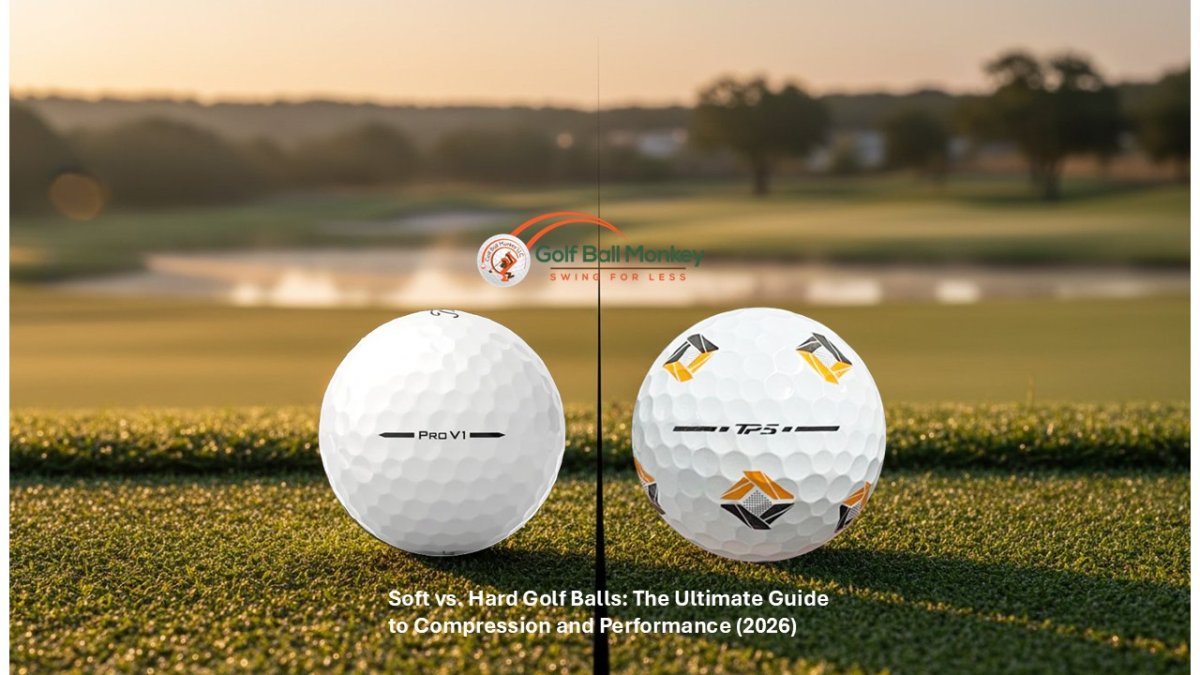
Don’t just guess which compression works for you. Conduct a real-world test at your local short game area. Grab a variety pack and head to the chipping green. Compare the feel of a Titleist Pro V1 against the firmer Pro V1x. This is the industry gold standard for compression testing. One will feel like butter; the other will provide a sharp, responsive pop. For a detailed breakdown of these two tour favorites, check out our Titleist Pro V1 vs. Pro V1x comparison guide to understand exactly how they differ in spin, launch, and feel.
The Monkey advantage lets you try these tour-level balls for the same price as those rock-hard budget buckets. You can’t master your game with “rocks” that don’t spin. Use our variety packs to find your perfect match. Test them on 40-yard pitches and full 7-irons. When you find the one that lands soft and stays put, you’ll know you’ve found your new gamer.
Why Mint 5A Quality Matters
There is a massive myth that “used” means “worse.” That’s 100% false. Our professional divers recover balls that were lost on the very first hole. These aren’t balls that sat in a pond for a decade. They are fresh, high-performance pieces of equipment that often have zero performance degradation. Research shows that modern solid-core balls maintain their speed and spin even after being submerged for short periods.
Playing our Mint 5A gear is an environmental win too. You are keeping plastic out of the ecosystem while keeping your wallet fat. It’s the most efficient way to play the best brands in the world. For a deeper dive into the science, check out our Golf Balls 101: The Ultimate Guide to Performance, Tech, and Value in 2026. We take our grading seriously so you can swing with total confidence.
Stop guessing and start swinging. Grab a Mint 5A variety pack today and find your perfect compression level. Your game, and your bank account, will thank you.
Stop Guessing and Start Scoring
Stop guessing on the tee box and start playing the numbers. Choosing between soft vs hard golf balls isn’t just about feel; it’s about matching your unique swing speed to the right compression level for maximum distance. High-speed players need that firm core for explosive velocity. Moderate swingers benefit from the extra launch and spin control of a softer ball. You’ve learned the science, so now it’s time to stock your bag like a savvy insider.
Don’t pay $55 a dozen just to watch a brand new ball splash into a water hazard. Our professional divers harvest millions of premium balls every year from the best courses in the country. Every single ball passes through our Texas-based facility for rigorous expert grading. We specialize in Mint 5A quality. This means you get Titleist, Callaway, and TaylorMade performance that looks and plays like it just came out of the box. You’ll save up to 70% off retail prices every time you choose Monkey prices over the pro shop. It’s the smartest play you’ll make all season.
Score Tour-Level Performance for Monkey Prices. Shop Our Mint 5A Collection Now!
Grab your gear and get out there. The course is calling.
Frequently Asked Questions
Do soft golf balls go further for seniors?
Yes, soft golf balls typically add 5 to 8 yards of distance for golfers with swing speeds under 85 mph. These low-compression cores flatten out more easily at impact, which helps slower swingers generate a maximum spring-like effect. You don’t need a 110 mph tour swing to get these balls airborne and moving down the fairway. Grab a box of near-mint softies at Monkey prices and watch your drives carry further without changing your swing.
Why do pro golfers use hard golf balls?
Professional golfers use hard balls because their swing speeds often exceed 115 mph. A soft ball would over-compress at that velocity, leading to a loss of energy and inconsistent flight paths. High-compression cores provide the stability needed for 175 mph ball speeds. When comparing soft vs hard golf balls, the pros choose hardness to gain precise spin control on approach shots. They need that firm feedback to stick the ball within 10 feet of the pin.
Can a hard golf ball damage my driver?
No, a hard golf ball won’t damage a modern driver. Manufacturers design titanium driver faces to withstand impact speeds over 150 mph for thousands of hits. Even a high-compression, 100-rated tour ball won’t crack or dent a standard driver face. You’re more likely to break a wooden tee than your clubhead. Focus on making center-face contact rather than worrying about the ball’s density. Your gear is tougher than you think.
What is the best compression golf ball for a 90 mph swing?
A compression rating between 70 and 85 is the sweet spot for a 90 mph swing. This range allows the average golfer to fully compress the core without the mushy feel of an ultra-soft ball. Brands like Srixon and Bridgestone dominate this mid-range category. It’s the smart play for players who want a balance of distance and feel. You get 95 percent of the performance of a tour ball at a fraction of the cost.
Do soft golf balls spin more than hard ones?
No, hard tour-level balls actually produce more greenside spin due to their thin urethane covers. While soft balls feel grabby, they often have surlyn covers that slide up the clubface rather than biting into the grooves. A premium hard ball can generate 2,000 more RPM on a wedge shot than a budget soft ball. If you want to stop the ball on a dime, the cover material matters more than the core’s compression rating.
Are “soft” balls better for putting?
Soft balls aren’t technically better for putting, but they offer a quieter sound that 80 percent of golfers prefer. Putting is about confidence and personal preference. A softer ball produces a muted thud while a hard ball makes a high-pitched click off the putter face. If your local greens are running at a 12 on the Stimpmeter, a soft feel might help you control your pace. The Monkey suggests testing both to see which one helps you drain more 10-footers.
Does temperature affect how hard or soft a golf ball plays?
Yes, cold weather makes every golf ball play significantly harder. When the temperature drops below 50 degrees, the rubber materials in the core lose elasticity. You’ll typically lose 2 yards of carry for every 10-degree drop in temperature. In the winter, switching to a soft ball helps compensate for this loss of feel. Keep your balls in the house overnight instead of the trunk to maintain their intended compression levels on the first tee.
Should beginners use soft or hard golf balls?
Beginners should almost always choose soft balls to help reduce side spin on slices and hooks. When debating soft vs hard golf balls for high handicappers, the soft option is the winner because it’s more forgiving on off-center hits. You’ll keep more balls in play and save your wallet from total exhaustion. Don’t waste 5 dollars per ball on tour equipment while you’re still learning. Buy a bucket of recycled soft balls and enjoy the game without the stress.
- golfballmonkey@gmail.com
- (512) 593-8401
- Mon – Fri, 9:00 AM – 5:00 PM

All product and company names are trademarks™ or registered® trademarks of their respective holders.
Use of them does not imply any affiliation with or endorsement by them.