
The Epic Journey of a Recycled Golf Ball: From Murky Pond to Pro Performance
American golfers lose up to 450 million golf balls every year. That is a staggering amount of premium plastic sitting at the bottom of water hazards instead of flying down the fairway. It is a gut-wrenching feeling to watch a five-dollar Titleist Pro V1 disappear into the drink, leaving you with a lighter wallet and a heavy dose of golfer’s guilt. We have all been there, and we know that losing expensive gear shouldn’t be the mandatory tax for playing the game you love.
This is the start of the journey of a recycled golf ball, a high-stakes rescue mission that turns a lost asset back into a pro-performance tool. You will learn exactly how our professional divers reclaim these sunken treasures and why our strict Mint 5A grading standards ensure they play like they just came out of the box. We are clearing up the confusion between recycled and refurbished options while showing you how to save 50 to 80 percent on the best brands in the game. Get ready to discover how making the smart play for the environment is also the ultimate win for your scorecard and your budget.
Key Takeaways
- Understand how professional divers salvage millions of premium assets, proving the journey of a recycled golf ball ends in pro performance, not a watery grave.
- Learn why modern solid-core technology makes “water-logging” a myth of the past, keeping your distance and spin rates locked in.
- Discover the critical difference between recycled and refurbished balls and why maintaining the original factory finish is the only way to play.
- Master the grading scale to snag Mint 5A Titleist Pro V1s at a massive discount without sacrificing tournament-level quality.
- Save 50-80% on your favorite premium brands, allowing you to stop stressing over hazards and start playing more rounds.
The Rescue Mission: How Professional Divers Find Lost Treasures
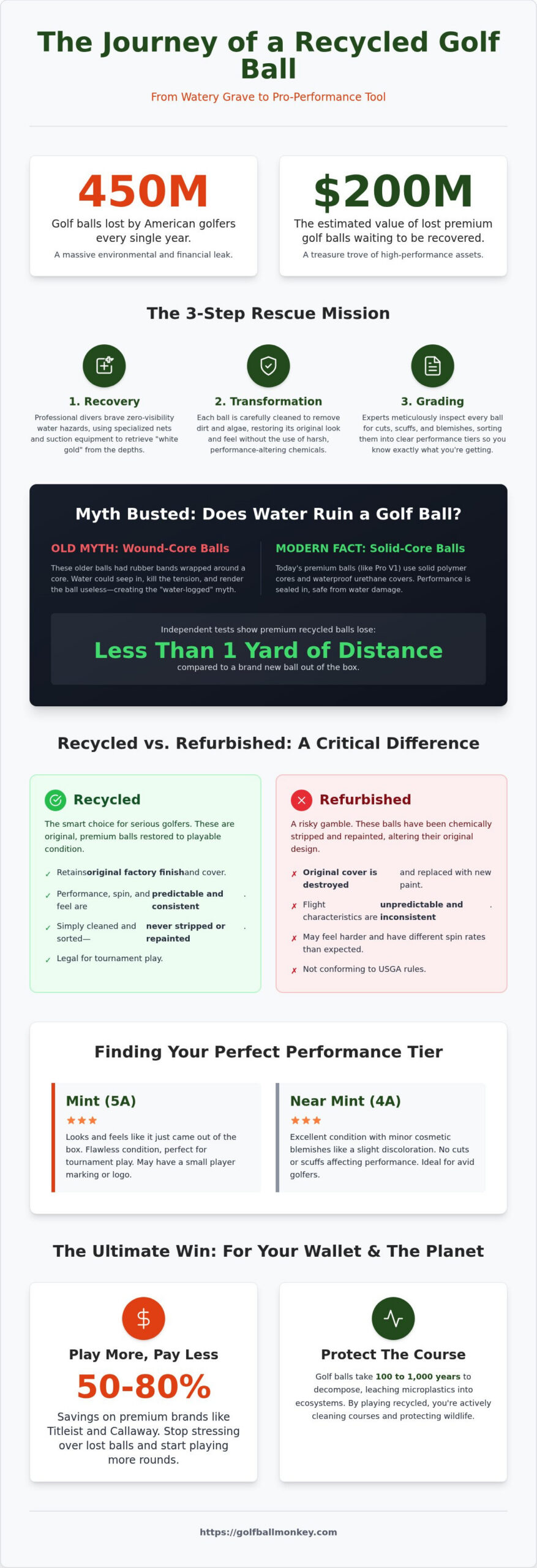
Every year, American golfers dump up to 450 million balls into the drink. That is not just a bad slice; it is a massive environmental and financial leak. Most of those are premium Titleist or Callaway models that retail for five dollars a pop. We call these spots “watery graves,” but for our professional divers, they are treasure chests. Recycled golf balls are genuine, brand-name gear pulled from these hazards and cleaned back to their original specs. We don’t strip the paint or mess with the cover. We just find them, scrub them, and grade them for your bag.
The journey of a recycled golf ball is a tactical rescue mission. Our team dives into zero-visibility ponds where the mud is thick and the wildlife is unpredictable. They are feeling through silt for that familiar dimple pattern. It is a gritty, high-stakes hunt for the “white gold” that other players left behind. We are talking about a $200 million market of lost assets waiting to be put back into play.
The Diver’s Toolkit: More Than Just Scuba Gear
Our pros use more than just tanks and fins. They deploy specialized heavy-duty nets and high-powered suction equipment to move thousands of balls in a single shift. Finding a Titleist Pro V1 in a pitch-black pond requires a refined touch and years of experience. Modern golf ball construction makes these assets durable enough to withstand the underwater pressure without losing their edge. However, the logistics are brutal. Hauling 2,000 pounds of wet cargo to the surface is a physical grind. It is a professional operation designed to restock your bag with elite gear without the elite price tag.
Sustainability in Every Swing
Leaving plastic to rot in a pond is an environmental disaster. Golf balls can take between 100 and 1,000 years to decompose. As they break down, they leach microplastics and chemicals into sensitive aquatic ecosystems. By retrieving these balls, we are actively cleaning the course and protecting local wildlife. Every step in the journey of a recycled golf ball matters for the health of the environment. The circular journey of a ball retrieved by Golf Ball Monkey transforms a potential pollutant into a high-value performance tool for your next round. You get to play the best equipment on the market while knowing you are helping keep the greens green and the water clear. It is the smartest play you can make on or off the course.
The Science of the Soak: Does Water Actually Ruin a Ball?
You’ve heard the horror stories. A ball splashes into a pond and instantly becomes a “water-logged” paperweight. This myth has scared golfers away from big savings for decades. It is time to separate fact from fiction. The truth is that modern ball tech makes water damage almost impossible for the average lost ball. Your performance doesn’t vanish just because a ball took a quick dip.
Wound Cores vs. Solid Cores
The “water-logged” reputation comes from the era of wound-core balls. Those old-school designs used rubber bands wrapped around a liquid or solid center. If water seeped through the cover, those bands lost their tension. The ball died. Modern balls are different. They use solid, multi-layer cores made of synthetic rubber and polymers. Learn more about these materials in our Golf Balls 101 guide. The high-performance urethane covers on a Titleist Pro V1 or Callaway Chrome Soft act as a waterproof shield. They are designed to stay dry and reactive under pressure.
Myth-Busting the 24-Hour Rule
Many players think a ball is ruined after just one night in a hazard. Independent testing proves otherwise. High-quality recycled balls (Mint 5A) show a distance loss of less than one yard compared to brand-new ones. A weekend soak does not change the compression or spin rates of a professional-grade ball. Modern Titleist balls maintain their physical integrity and core energy underwater because their multi-component layers are engineered to resist moisture absorption. The seal remains tight, and the performance stays locked inside.
The journey of a recycled golf ball only hits a dead end if the ball has been submerged for years in specific conditions. We aren’t talking about a ball that went in last Saturday. We mean balls that have been buried in anaerobic mud for a decade. Our grading process weeds those out immediately. If it doesn’t meet the Mint 5A or Near Mint 4A standard, it doesn’t make the cut for your bag. You get the same flight, the same feel, and the same green-side control. Restock your gear with confidence and stop paying the “new ball” tax. You’re playing a rescued asset that’s ready to perform.
The Transformation: Cleaning, Sorting, and Why We Never ‘Refurbish’
Once the divers haul those dripping bags to the surface, the real work begins. We don’t just rinse them off and call it a day. This stage in the journey of a recycled golf ball is where we separate the tournament-ready gems from the shag bag leftovers. It is a meticulous process designed to restore the ball’s original performance without compromising its engineering. We treat every Titleist Pro V1 and Callaway Chrome Soft like the high-precision equipment it is.
Our process follows four strict steps to ensure you get elite quality:
- Step 1: The Initial Soak. We use a non-abrasive, eco-friendly cleaning solution to break down algae, minerals, and pond scum. This isn’t a harsh chemical bath; it is a gentle restoration of the original cover shine.
- Step 2: The Sorting Line. Our experts manually sort every ball by brand and model. This is where we pull out the TaylorMade TP5s and Bridgestone Tour B RXs, ensuring you get exactly what you ordered.
- Step 3: The Refurbished Warning. We identify and discard any ball that has been previously “refurbished.” We never repaint or refinish balls. If a ball needs paint to look good, it isn’t Mint 5A.
- Step 4: Quality Control. Every ball undergoes a final check for structural integrity. We look for micro-cracks or deep scuffs that could affect your flight path or spin.
Recycled vs. Refurbished: The Crucial Difference
There is a massive trap in the secondary market: “Refurbished” or “Refinished” balls. Avoid them. These balls are often stripped of their clear coat and sprayed with a new layer of paint to hide blemishes. This fills in the dimples and ruins the aerodynamics. You lose lift, you lose distance, and you lose consistency. Our promise is simple. We only sell recycled balls with their original covers and factory finishes. You get the performance the manufacturer intended at a fraction of the cost. Check out our Recycled vs Used Golf Balls guide to see why savvy players choose original covers every time.
The Cleaning Tech
Grading the Journey: Finding Your Perfect Performance Tier
Not every ball that comes out of the pond is a champion. The journey of a recycled golf ball involves a brutal vetting process at our Texas facility. We sort every find into specific tiers so you know exactly what you are putting on the tee. This grading system is our verbal seal of approval. It ensures you never pay for more “wear” than you want. Whether you need tournament-ready gems or cheap ammo for a casual Sunday, our scale is your roadmap to massive savings.
We break our inventory down into three primary performance levels:
- Mint 5A: These are the elite. They look and feel like they just came out of a fresh sleeve. No scuffs. No player marks. Just pure, factory-level performance.
- Near Mint 4A: These have a tiny cosmetic blemish or a Sharpie mark from a previous owner. The flight and spin are identical to the 5A, but the price is even lower.
- Good 3A: These show visible wear and tear. They are the ultimate value play for high-handicappers or anyone who expects to lose a few balls during a round.
Mint 5A: The Insider’s Secret
Savvy amateurs and pros can’t tell the difference between our Mint 5A stock and retail balls in a blind test. We specialize in the Titleist Pro V1 because it is the gold standard of the industry. Big Box retail prices for these balls are a total drain on your wallet. By choosing Mint 5A recycled balls, you get that same tour-level spin and distance while saving between 50 and 80 percent. It is the smartest play in golf. You get to play the number one ball in the game without the number one price tag.
Shag and Practice Balls: The End of the Line
Sometimes the journey of a recycled golf ball ends at the driving range or the backyard net. If a ball has too many battle scars to make our 3A grade, it becomes a practice ball. These are perfect for game improvement. You can grind out 100 wedge shots in your yard without worrying about losing five dollars every time you miss the net. Check out our Practice Golf Balls to stock up on high-volume, low-cost training gear. It is the best way to get your reps in without breaking the bank.
Ready to upgrade your bag for a fraction of the cost? Shop our Mint 5A inventory now and see why thousands of golfers have made the switch to recycled performance.
Your Turn to Play: Why the Smart Money Is on Recycled
We have tracked the journey of a recycled golf ball from the depths of a murky hazard to our rigorous sorting facility. It is a process that turns a forgotten piece of plastic into a high-performance asset ready for the leaderboard. You don’t have to be a tour pro to appreciate the difference this makes for your game and your wallet. The smart money is on the rescue mission because it removes the financial stress from every tee shot. You get the same aerodynamics and the same core technology without the retail markup.
Think about the mental edge you gain. When you are standing over a narrow fairway with water on both sides, the last thing you should worry about is losing five bucks on a single swing. Playing recycled gear lets you focus on your mechanics instead of your bank account. It is the ultimate hack to play more golf, more often. By choosing rescued balls, you are also making a conscious choice for the environment. You are helping us remove millions of balls from sensitive aquatic ecosystems, preventing plastic degradation and keeping the courses you love in peak condition.
The Savvy Golfer’s Strategy
The best players in our community don’t just buy one type of ball. They build a rotation. Use our Mint 5A Titleist Pro V1s for your weekend tournament or a high-stakes match with friends. Then, switch to our Good 3A Mixed Bags for those solo practice rounds or when you are testing out a new swing thought. You can Shop all recycled brands to find the perfect mix for your skill level. This approach keeps your performance high and your costs low. It is about making the intelligent play on every hole, from the first tee to the final putt.
The Golf Ball Monkey Guarantee
We aren’t just a faceless reseller. We are a diver-owned operation that actually gets our hands dirty to find the best gear. Every ball in our inventory has been vetted by people who live and breathe the sport. When you buy from us, you are joining a community of golfers who refuse to pay the “new ball tax.” We believe that the thrill of the game should be about the shot, not the price tag of the equipment. Join the troop today. Restock your bag with Monkey-approved gear and see how much better the game feels when you aren’t afraid of the water. Your next dozen is ready for the tee.
Stop Paying the New Ball Tax Today
You now have the insider knowledge to play like a pro without the pro-level expenses. We have debunked the water-logged myth and shown you why original factory covers beat repainted refurbishments every time. the journey of a recycled golf ball is a high-stakes rescue mission that puts elite gear back in your hands for a fraction of the cost. You get diver-retrieved quality and fast, Texas-based shipping on every single order.
Stop stressing over the water hazards. Start swinging with the confidence of a player who knows they are saving 50 to 80 percent off retail prices. Our strict Mint 5A standards ensure your Titleist Pro V1s perform exactly as the manufacturer intended. It is the smartest play you can make for your scorecard and your wallet. Join the savvy troop of golfers who have already made the switch. Score Tour Performance for Less. Shop Our Mint 5A Titleist Pro V1s Now! See you out on the fairway.
Frequently Asked Questions
Are recycled golf balls as good as new ones?
High-quality recycled balls are virtually identical to new ones in terms of flight and spin. Independent testing confirms that Mint 5A grade balls show a negligible performance difference, often less than a single yard of distance loss. You get the same compression and velocity without the retail markup. It is the smartest way to keep your bag stocked with premium gear while saving a fortune.
What is the difference between recycled and refurbished golf balls?
Recycled balls are found, washed, and sorted by condition to keep their original factory finish and aerodynamics. Refurbished balls are stripped and repainted, which often fills in dimples and ruins flight consistency. We only sell recycled balls because we refuse to compromise on your performance. You should always choose original covers to ensure the ball reacts exactly as the manufacturer intended.
Does water submersion affect golf ball distance?
Modern solid-core technology makes water absorption a thing of the past for most lost balls. Older wound-core balls were susceptible to damage, but the urethane covers on modern Titleist Pro V1s act as a waterproof shield. Unless a ball has been underwater for a decade, you won’t see any detectable loss in distance or core integrity during your round.
How are recycled golf balls cleaned without damaging them?
We use a specialized, non-abrasive cleaning process that involves eco-friendly detergents and gentle agitation. This removes algae and minerals without scratching the cover or altering the ball’s weight. Every step in the journey of a recycled golf ball is designed to preserve the original USGA-conforming specs. We never use harsh chemicals that could degrade the outer layers of the ball.
What does ‘Mint 5A’ condition actually mean?
Mint 5A is the gold standard of the used ball industry. These balls look and feel like they were just pulled from a brand-new sleeve. They have no scuffs, no player marks, and no visible blemishes. It is the highest grade possible, vetted by our team to ensure tournament-ready quality. It is the closest you can get to new without paying full retail price.
Can you tell the difference between a new Pro V1 and a 5A recycled one?
Most golfers, including low-handicappers, cannot tell the difference in a blind test. The flight path, green-side spin, and feel off the putter face remain consistent with the original factory standards. You are playing the number one ball in golf, just without the heavy tax. It is the ultimate insider secret for players who want top-tier gear on a budget.
Why are recycled golf balls so much cheaper?
We skip the massive manufacturing and marketing costs that drive up the price of new sleeves. By using professional divers to reclaim lost assets, we can pass those savings directly to you. You are essentially buying a rescued premium product at 50 to 80 percent off the standard retail price. It turns a lost asset back into a high-performance tool for your game.
Is it environmentally friendly to buy used golf balls?
Buying used is a huge win for the planet. Golf balls can take up to 1,000 years to decompose in a pond, leaching microplastics into the water. By completing the journey of a recycled golf ball, you are supporting a circular economy that keeps our courses and aquatic ecosystems clean. It is the most sustainable way to play the game you love.
Avoiding Bad Quality Used Golf Balls: The Savvy Insider’s Guide for 2026
That “refurbished” Titleist Pro V1 you just bought isn’t a bargain. It is a performance-killing trap disguised in a cheap coat of paint. You want the tour-level spin of a Chrome Soft or TP5 without the $55-a-dozen gut punch. Since the average golfer loses four to five balls every single round, the math for buying new just doesn’t add up anymore. Mastering the art of avoiding bad quality used golf balls is the only way to protect your scorecard and your wallet in 2026.
You already know that buying used is the smartest play in golf, but you shouldn’t have to guess if your gear is actually game-ready. We promise to show you how to spot marketing traps from a mile away and identify tour-grade recycled balls that perform like they just left the factory. We’re breaking down the 5A grading secrets, the red flags of repainted covers, and how to build a pro-level bag for 50% less than the retail giants charge. Let’s get your game on par without the premium price tag.
Key Takeaways
- Identify the “Refurbished” red flag immediately. Repainted balls lose their aerodynamic edge and ruin your spin consistency on the green.
- Master the 5A Mint standard. Learn why professional grading beats “found” balls for tour-level performance and reliable distance.
- Use the 4-point inspection checklist. Check dimple edges and cover texture to ensure your gear is game-ready before you ever tee up.
- Protect your wallet and your scorecard by avoiding bad quality used golf balls. Score premium Titleist and TaylorMade models for 50% off retail prices.
- Prioritize original OEM covers. Only recycled balls maintain the factory-spec flight patterns needed for consistent, professional-grade results.
The “Junk Ball” Fear: Why Most Golfers Get Burned
Buying used gear in 2026 can feel like a high-stakes gamble. You see a bucket of premium balls at a price that seems too good to be true, and your gut tells you to walk away. That anxiety is real. Most golfers have been burned by the “shiny on the outside, dead on the inside” phenomenon. You get a ball that looks brand new, but it feels like hitting a marshmallow off the tee. avoiding bad quality used golf balls starts with understanding exactly where your gear comes from. If you don’t know the source, you are just guessing.
There is a massive difference between a “found” ball and a “professionally retrieved” one. A found ball might have spent three winters at the bottom of a chemical-heavy pond or sat in the scorching sun for months. Professionally retrieved balls are harvested by divers who understand the impact of water saturation. They are cleaned using non-corrosive methods that preserve the original factory finish. Big-box retail bins often mix these sources together. It is a total lottery. You might get a gem, or you might get a ball with a compromised core that won’t fly straight. Serious players can’t afford that kind of inconsistency.
The Myth of the 20-Yard Distance Drop
Stop worrying that every used ball is a secret dud. That fear is a relic of the past. Modern multi-layer construction is incredibly resilient. The solid cores of today’s tour balls don’t degrade nearly as fast as the old wound-center tech. While golf ball regulations ensure every ball meets specific standards at the factory, its performance after a few holes depends on the cover. If the urethane is intact and the aerodynamics are clean, that ball is ready to hunt flags. It is almost always about the cover, not the core. We focus on identifying balls that haven’t lost their zip.
Retail Sting vs. Savvy Savings
Paying $5 or $6 for a single ball is a retail sting that hurts every time you find the water. It is a tax on your game that you don’t need to pay. The savvy insider knows that a Mint 5A recycled ball delivers the same spin, feel, and distance for a fraction of the cost. You can build a tour-grade bag without the elitist price tag. Don’t let the marketing hype fool you into thinking “new” is the only way to play well. Ready to stop overpaying for your equipment? Head over to the Golf Ball Monkey shop and grab 5A quality that actually performs. We celebrate the intelligent play, both on the course and in your wallet.
Refurbished vs. Recycled: The #1 Quality Red Flag
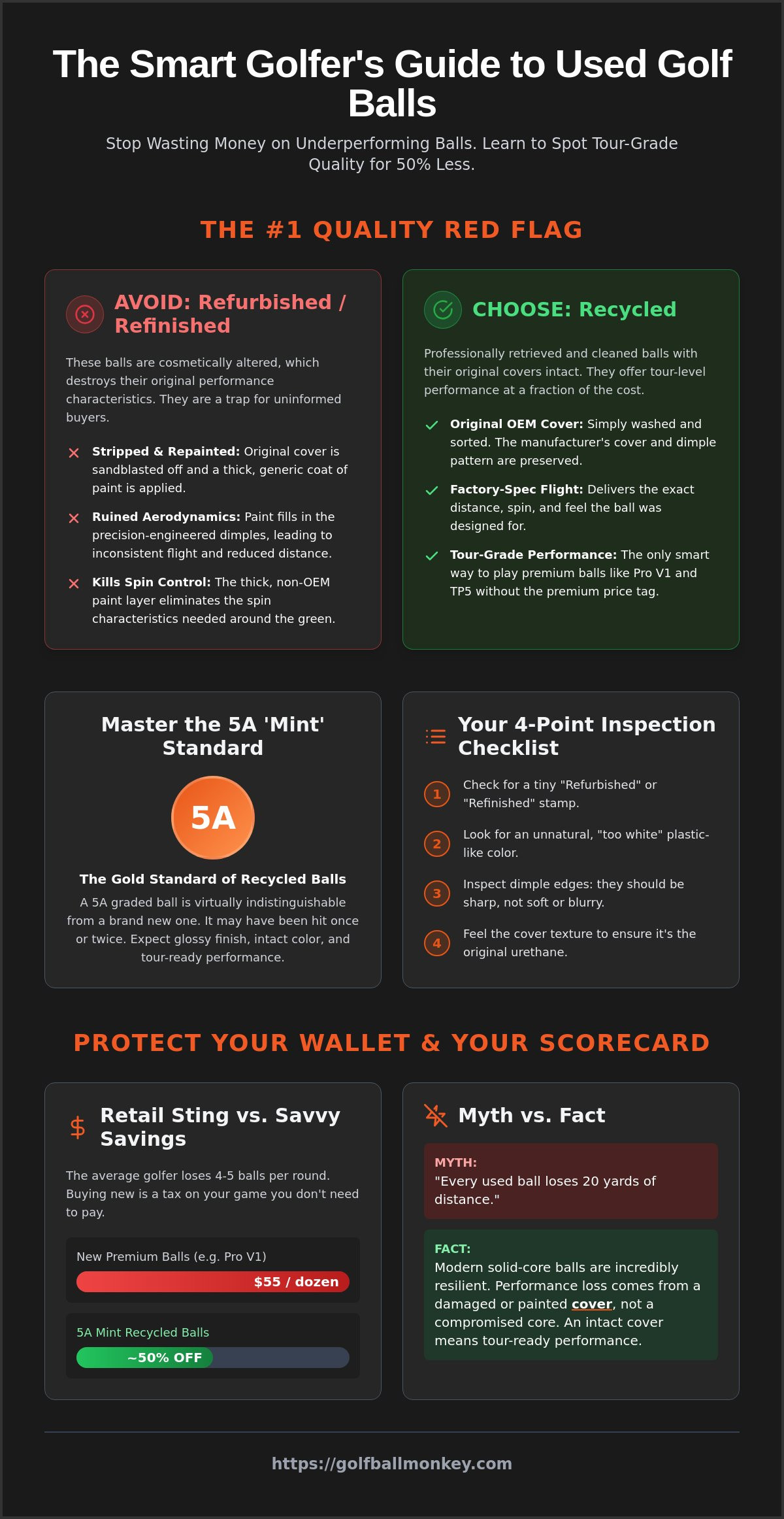
The word “refurbished” sounds like a win in most industries, but in the golf world, it is a total disaster for your scorecard. avoiding bad quality used golf balls starts with recognizing that “refurbished” is often just a fancy word for “ruined.” These balls, sometimes labeled as “refinished,” go through a brutal cosmetic makeover. Sellers sandblast the original cover to hide scuffs and then spray on a thick layer of generic white paint. They even stamp a fake logo on top to make it look official. It is a performance-killing trap disguised as a bargain.
Paint is the enemy of your flight path. Those dimples on your Pro V1 or TP5 are precision-engineered to create specific lift and drag. When a third-party seller adds a layer of non-factory paint, they fill in those dimples. You lose the aerodynamic edge that manufacturers spent millions to perfect. The result? A ball that knuckleballs in the wind or falls short of the green. Recycled balls are the savvy play because we simply wash them, sort them, and grade them based on their original condition. The factory urethane stays intact. Refurbishing a golf ball is like putting a fresh coat of paint on a flat tire; it looks good until you try to drive it.
How to Spot a “Fake” Mint Ball
Don’t let a shiny exterior fool you. Check the side of the ball for a small “Refurbished” or “Refinished” stamp. If you see it, walk away. Look closely at the color too. If the cover looks “too white”—like a piece of cheap plastic rather than the soft, pearlescent glow of a premium ball—it has likely been repainted. Finally, check the dimples. If the edges look soft, rounded, or blurred, you’re looking at a heavy paint layer that will kill your spin consistency.
Why the Monkey Never Sells Refurbished Junk
We refuse to sell repainted trash because we value your game. Our inventory consists strictly of original covers. We want you to have the exact spin, feel, and distance the manufacturer intended. Plus, true recycling is the better environmental choice. We don’t use the harsh stripping chemicals or heavy paints required for refurbishing. You get tour-level performance, and the planet gets a break. If you want the real deal without the “refurbished” risk, check out our curated inventory. We only stock gear that is vetted by the best in the business.
Deciphering the Grade: How to Spot a 5A from a Shag Ball
The biggest hurdle in avoiding bad quality used golf balls is the lack of a universal rulebook. One site’s “Mint” is another site’s “Good.” This inconsistency is exactly how golfers get stuck with duds. You need to know the industry secrets behind the grading scale before you click buy. A true grading system isn’t just about how pretty the ball looks in the palm of your hand. It is about how that ball behaves when it meets the clubface at 100 miles per hour. If the grading is loose, your proximity to the hole will be too.
Think of grading like a performance guarantee. When you buy from a source that respects the 5A standard, you are getting a ball that has likely seen only one or two holes of play. The core is fresh. The cover is perfect. As you move down the scale to 4A and 3A, you are trading cosmetic perfection for deeper discounts. For the everyday golfer, the 4A (Near Mint) tier is often the sweet spot. These balls might have a small ink mark or a tiny surface blemish, but the flight characteristics remain 100% factory spec. It is the intelligent way to play premium gear for less.
The 5A Gold Standard
A true 5A ball must have that signature “Pearl” sheen. This is the factory glow that reflects light evenly across every dimple. If you see a dull, matte finish on a ball that is supposed to be urethane, it has likely been sitting in the sun too long. The Titleist Pro V1 Mint 5A is the benchmark for this category. To earn this grade, there can be zero player marks and zero scuffs. It should look like it just came out of a fresh sleeve. This is the ball you pull out when the match is on the line and every yard matters.
When “Good” (3A) is Actually Bad for Your Game
Don’t be fooled by the word “Good.” In the world of recycling, 3A is the threshold where performance starts to dip. Minor scuffs on the cover might seem harmless, but they create turbulent airflow. This causes “fliers” that sail over the green or unpredictable spin that ruins your short game. We recommend 3A balls for very specific scenarios. Use them for your backyard practice or those “hero” shots over massive water hazards where you don’t want to lose a 5A gem. For serious practice sessions, check out our shag balls guide to find better alternatives that won’t mess with your muscle memory. If you want to score low, keep the 3A balls out of your game-day bag.
The Savvy Insider’s 4-Point Inspection Checklist
You have the balls in your hand. Now you need to know if they are actually game-ready. Avoiding bad quality used golf balls is easy once you know what to look for. You don’t need a lab or a launch monitor to spot a dud. You just need a few seconds and these four simple tests. This is how the pros at the shop separate the gems from the junk every single day. Run your inventory through this checklist to ensure every ball in your bag is ready to hunt pins.
- Point 1: The Visual Dimple Test. Hold the ball up to the light. You are looking for sharp, crisp dimple edges and clear OEM logos. If the Titleist or TaylorMade stamp looks blurry or the dimples seem “filled in,” you are likely holding a repainted refurb. A recycled ball should show the original, precision-molded texture.
- Point 2: The Texture Check. Use your thumb or a fingernail. Premium urethane covers on balls like the Bridgestone Tour B RX should feel slightly “tacky” or grippy. If the cover feels hard, slick, or “plasticky,” the urethane has either been compromised or replaced with cheap paint.
- Point 3: The Drop Test. This is the ultimate core check. Drop your used ball onto a concrete floor or a hard countertop from waist height. Do the same with a brand-new ball of the same model. They should bounce to nearly identical heights. If the used one dies on the floor, the core is toast.
- Point 4: The Sound Check. Bounce the ball lightly on the face of your wedge. A high-quality Chrome Soft or TP5 should have a muted, soft “thud.” If you hear a high-pitched, hollow “click,” it is a sign of a dead core or internal delamination.
Identifying Water-Logged Duds
The “water-logged” scare is mostly a myth from the 90s. Modern multi-layer balls are incredibly water-resistant. Unless a ball has been sitting in a pond since the last decade, the core is likely as fast as the day it was made. Look for deep, internal discoloration that looks like a yellowish “bruise” under the cover. Surface stains are fine and won’t hurt your distance. If the stain looks like it is coming from the inside out, that ball has seen too many seasons underwater. Toss it in the shag bag.
The “Ghost Logo” Reveal
Be wary of “ghost logos.” Some low-tier sellers try to buff off corporate logos or player marks using abrasive wheels. This creates smooth, flat spots on the cover. Since dimples are what provide lift, a smooth spot turns your ball into a knuckleball. It will dive out of the air or veer offline without warning. If you see a patch where the dimples look shallow or “melted,” that ball is a performance hazard. Ready to skip the guesswork? Shop our vetted, high-performance inventory and play with confidence.
Scoring Tour Performance Without the Retail Sting
You have the checklist. You know the red flags. Now it’s time to fill your bag with confidence. Avoiding bad quality used golf balls doesn’t have to be a full-time job. It is about choosing a source that treats equipment with the same respect you do. When you stop gambling on random “found” balls and start trusting a professional retrieval process, your game transforms. You get the spin you expect. You get the distance you need. Most importantly, you get the peace of mind that every ball in your sleeve will perform exactly like its retail counterpart. No duds. No surprises. Just pure performance.
The secret is in the original OEM cover. As we have discussed, once that factory finish is compromised by sandblasting or heavy paint, the ball is essentially garbage. We act as the ultimate filter. We do the dirty work of sorting through thousands of balls to ensure only the best make the cut. We are your savvy shopping assistant, making sure you never waste a dime on a dead core or a slick cover again. It is the intelligent move for any golfer who values their scorecard as much as their wallet.
Why Professional Divers Matter
Our process starts at the source. Professional divers recover inventory from controlled environments where balls haven’t been exposed to the elements for years. We then put every single ball through a rigorous hand-sorting and grading cycle. This is how we guarantee quality. This systematic approach ensures you never see a “refurbished” trap or a “buffed” cover in your order. We check the dimples so you can check the pin. If you want a deeper dive into how we maintain these standards, read our Used Golf Balls: The Savvy Player’s Guide. It breaks down the logistics of why professional retrieval beats a backyard find every time.
The Smart Play for 2026
The “Intelligent Play” is simple. Don’t pay for the fancy box or the massive marketing budget. In 2026, the gap between a new ball and a 5A recycled ball is purely financial. You are paying a “marketing tax” when you buy at the big-box retail stores. By avoiding bad quality used golf balls and sticking to Mint 5A standards, you’re getting the same urethane and the same flight patterns for a fraction of the cost. It’s the savvy insider move that keeps your handicap low and your budget intact. Ready to upgrade? Head over to the Golf Ball Monkey shop and grab tour-grade gear today. Don’t let the retail price dictate your game. Play the ball, save the cash.
Master Your Game and Your Budget
You are now armed with the insider secrets to avoiding bad quality used golf balls. You know that “refurbished” is just a fancy word for performance-killing paint. You understand that 5A Mint isn’t just a label; it’s a promise of tour-level flight and spin. Stop letting big-box retail prices dictate how many balls you can afford to lose on a Saturday morning. The intelligent play is always about performance, not the price of the packaging.
We take the guesswork out of your gear. Our inventory is hand-picked by professional divers and vetted through a strict 5-point grading system. We don’t sell repainted or sandblasted junk. It’s original factory urethane or nothing. You get the same distance and feel as a new ball without the marketing tax. Score Mint 5A Titleist Pro V1s for a fraction of retail here! It’s time to play the best equipment for the best price. See you on the first tee.
Frequently Asked Questions
How can I tell if a used golf ball is refurbished?
Check for a small “Refurbished” or “Refinished” stamp on the side of the cover. Look closely at the dimples; if the edges look soft, rounded, or blurred, you are likely looking at a heavy layer of non-factory paint. Refurbished balls often have a “too-white” appearance that lacks the natural pearl glow of original urethane. If the logo looks printed over a thick coating, it is a performance trap.
Do water-logged golf balls really lose distance?
Modern golf balls rarely lose distance from water unless they have been submerged for several months. Today’s multi-layer, solid-core construction is incredibly water-resistant compared to old wound-ball tech. Surface stains from pond silt won’t hurt your drive. Only deep, internal discoloration indicates a core that has been compromised by long-term submersion. For most recycled lake balls, the performance drop is practically zero for amateur players.
What is the difference between recycled and used golf balls?
Recycled balls are used golf balls that have been professionally cleaned and graded without altering the original factory cover. “Used” is a generic term that includes everything from backyard finds to repainted junk. Recycled balls are the gold standard because they maintain the manufacturer’s original aerodynamics. Focus on recycled gear when avoiding bad quality used golf balls to ensure your spin and flight remain consistent.
Is Mint 5A quality the same as a brand new ball?
Mint 5A balls look and play exactly like they just came out of a fresh retail sleeve. While they are technically used, they show zero scuffs, player marks, or blemishes. You get the same tour-level spin, feel, and distance as a new ball. It is the intelligent play for golfers who want premium gear like a Pro V1 or TP5 without paying the $5 per ball retail tax.
Can a scuffed golf ball affect my slice or hook?
Yes, a scuffed cover creates turbulent airflow that can significantly exaggerate side spin. Think of a scuff as a tiny rudder that catches the wind mid-flight. This leads to “fliers” that sail over the green or shots that veer wildly offline. Stick to 5A or 4A grades for your game-day bag. Use lower grades for the shag bag to keep your flight patterns predictable and your scorecard clean.
Why should I avoid “refinished” golf balls at all costs?
Refinished balls are sandblasted and repainted, which fills in the precision-engineered dimples and destroys aerodynamics. This process ruins the lift and drag characteristics intended by the manufacturer. You lose distance and gain unpredictable flight paths. It is like putting a fresh coat of paint on a flat tire; it looks brand new until you actually try to drive it. Always insist on original covers for consistent results.
How long can a golf ball stay underwater before it goes bad?
A modern ball can typically survive underwater for several weeks before the core shows any measurable loss of speed. The real danger in 2026 is long-term exposure to harsh pond chemicals. Professional divers harvest balls frequently to ensure the inventory stays fresh. If a ball has been sitting in a lake for a year, it might lose a few yards. Most retrieved balls are found quickly and perform like new.
Are bulk used golf balls lower quality than dozen-packs?
Bulk balls are identical in quality to dozen-packs as long as they share the same grading scale. Buying in quantities of 48 or 96 is actually the savvy insider’s way to maximize savings. It is a powerful strategy for avoiding bad quality used golf balls while building a reliable inventory for both practice and play. Just ensure the seller uses a standardized 5A to 3A grading system before you commit to a large order.
Are Lake Balls Bad for Your Clubs? The Truth About Scuffs, Water, and Your Bag
You just dropped a paycheck on a set of precision-milled irons. The last thing you want is to chew up those faces with “pond scum” specials. But are lake balls bad for your clubs, or is that just a myth cooked up by retailers to keep you paying nearly $60 for a fresh dozen? We get it. You want the massive savings, but you refuse to sacrifice your equipment’s longevity or your scorecard.
It is natural to worry about scuffs and performance loss when you are fishing for value. However, your clubs aren’t actually afraid of the water. They are afraid of grit, hidden surface damage, and the nasty chemicals used on “refurbished” balls. Discover why pro-grade recycled balls won’t wreck your bag provided you know what to look for. We are breaking down the science of cover integrity, the reality of moisture absorption, and how to spot the difference between a raw find and a Mint 5A Titleist. Get ready to save a fortune while keeping your grooves sharp and your peace of mind intact. It is time to make the intelligent play for your bag and your budget.
Key Takeaways
- Stop worrying about “water-logged” balls denting your expensive irons; modern clubfaces are far tougher than any submerged golf ball.
- Learn why water absorption actually makes a ball lose speed and feel “dead” rather than becoming a club-killing rock.
- Discover why “refurbished” balls are the real risk to your gear because they hide defects under fresh paint and clear coats.
- If you’re asking are lake balls bad for your clubs, the real culprit is surface grit and sand found on unwashed “woods” balls, not the water itself.
- Save 50-70% on premium Titleist Pro V1s by choosing professional Mint 5A recycled balls that are vetted for safety and performance.
The Million-Dollar Question: Can a Lake Ball Actually Damage Your Clubs?
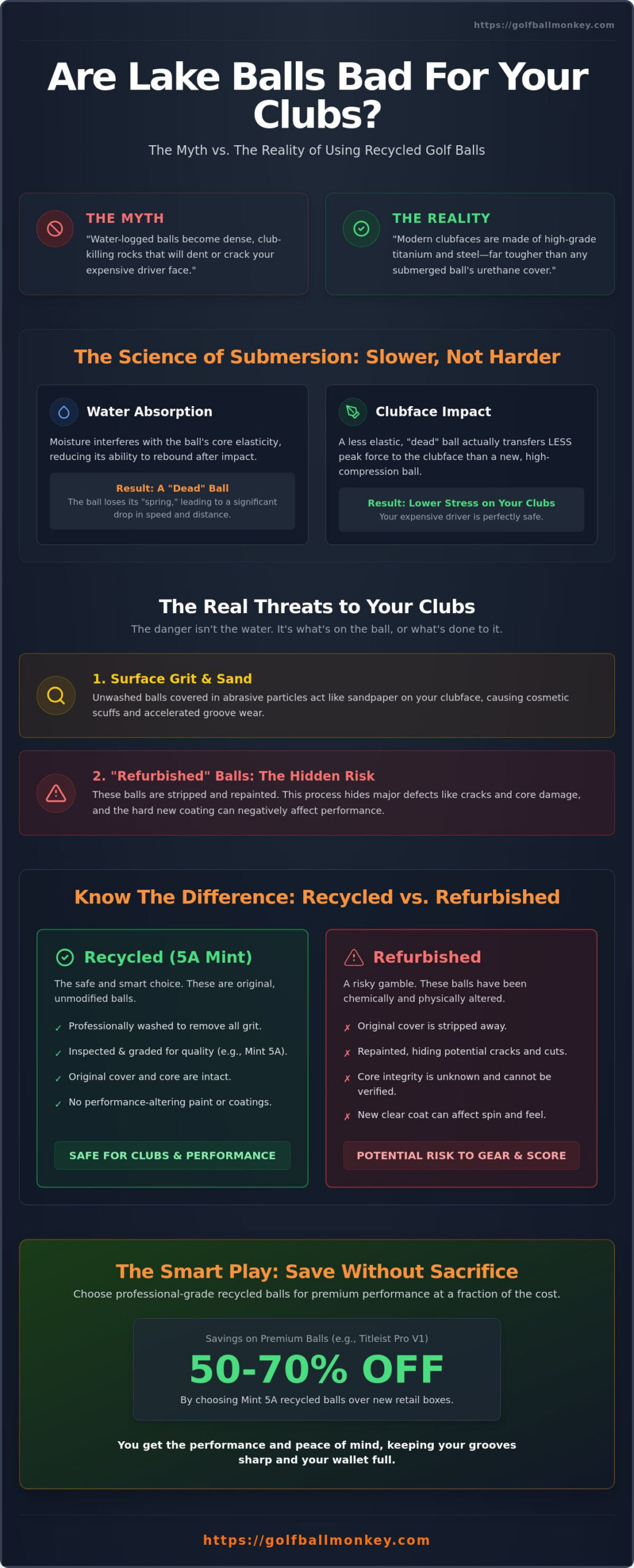
You just spent a small fortune on a new driver with a face thinner than a wafer. It is designed for maximum “trampoline effect” and blistering ball speeds. Naturally, you might hesitate before teeing up a ball that spent six months at the bottom of a pond. If you are constantly asking are lake balls bad for your clubs, let’s clear the air immediately. The short answer is a resounding no. A standard golf ball, even one that has been submerged, will not dent, crack, or break a modern clubface during normal play.
The fear usually stems from the “heavy ball” myth. Some golfers believe that water-logged balls turn into literal rocks that can cave in a titanium driver face. This is simply not how physics works on the course. Modern driver faces are engineered to withstand impacts at speeds exceeding 150 mph. Adding a microscopic amount of water weight to a ball does not change the structural reality of the impact. Your clubs are built for battle. A used ball is not going to win that fight.
Understanding Clubface Durability
Think about the materials involved. On one side, you have high-grade titanium or hardened stainless steel. On the other, you have Modern golf ball construction utilizing Surlyn or Urethane covers. In every collision, the softer material deforms. The yield strength of a modern titanium driver face is significantly higher than the maximum compression force any golf ball can exert, ensuring the ball gives way long before the metal does. Whether the ball is brand new or a seasoned lake veteran, it remains the “soft” object in the equation. While you might see cosmetic scratches from dirt or sand, the structural integrity of your expensive gear is safe.
The ‘Heavy Ball’ Myth Debunked
Does water absorption make a ball heavy enough to matter? Not really. While modern balls can absorb a tiny amount of moisture if the cover is compromised, it does not turn them into lead weights. Instead of becoming “harder,” water-logged balls actually become “dead.” The core loses its elasticity, which leads to a softer feel and a massive drop in ball speed. If you hit a ball and it feels like a brick, your ears might be tricking you. The change in internal density alters the vibration and sound of the shot. This “thud” sounds dangerous, but it is just a sign of a degraded core, not an over-pressure impact. If you want to avoid that dead feel without paying retail, check out our recycled inventory where we sort out the duds for you. You get the performance of a premium ball without the “pond rock” anxiety.
The Science of Water Absorption: Weight, Hardness, and Impact
Let’s get into the nitty-gritty of why your clubs aren’t in danger. Many golfers worry that a ball sitting in a hazard becomes a “heavy” rock. It’s a common fear when asking are lake balls bad for your clubs. The reality is that moisture absorption doesn’t make a ball harder; it makes it slower. Modern multi-layer balls use hydrophilic materials in their mantle layers. These layers can draw in tiny amounts of water over long periods. This moisture interferes with the core’s ability to snap back after impact. In technical terms, the Coefficient of Restitution (COR) drops.
A ball with lower COR is a “dead” ball. It doesn’t spring off the face with the same energy. Because it’s less elastic, it actually transfers less peak force to your club than a brand-new Titleist. Your driver face is under less stress hitting a lake ball than hitting a fresh one out of the sleeve. Research into The Science of Water Absorption suggests that modern balls are incredibly resilient, even after 12 months underwater. They don’t explode. They don’t turn into grenades. They just lose a few yards of carry. The myth of the “exploding” lake ball is a relic of the past. Modern solid-core manufacturing has ended that era. Today’s balls are high-tech rubber and plastic sandwiches that stay together even if they’ve been submerged for a season.
Water and the Multi-Layer Core
After 24 hours in a hazard, the mantle layer acts as a shield. Even if moisture eventually gets through, it affects the “spring” of the ball. A loss of spring protects your club. It’s like the difference between hitting a trampoline and hitting a mattress. The mattress (the lake ball) absorbs more energy, putting less strain on the club’s “yield strength.” You’re not hitting a rock; you’re hitting a ball that has lost its mojo. This energy loss is why you might see a 3 mph drop in ball speed, but that’s a performance issue, not a club-safety issue.
Hardness vs. Density
A “heavy” ball is just a ball that has lost its zip. A lake-soaked Pro V1 will still have a lower compression rating than a brand-new, entry-level distance ball. Your swing speed generates the force, not the age of the ball. Unless you are swinging like a long-drive pro, the impact of a used ball is well within the safety limits of your gear. If you want to skip the “pond-aged” duds and get the good stuff, take a look at our curated inventory where we grade everything for you. We filter out the duds so you can play with confidence and save cash.
Recycled vs. Refurbished: Which Is Safest for Your Gear?
Not all second-hand balls are created equal. If you are still asking are lake balls bad for your clubs, the answer depends entirely on whether you are hitting a recycled ball or a refurbished one. Savvy golfers know that “refurbished” is a major red flag. These balls are the real villains in the used market. They aren’t just cleaned; they are structurally altered in ways that can actively harm your high-end equipment. Recycled balls, on the other hand, are simply found, washed, and graded. Nothing is added, and nothing is taken away. It is the difference between a professional car wash and a cheap, thick Maaco paint job that hides a rusted frame.
The Hidden Dangers of Refurbished Balls
Refurbished balls go through a brutal process. To hide scuffs and player markings, they are often sandblasted. This strip-mining of the cover alters the dimple pattern, which ruins the aerodynamics. Worse, it creates a micro-abrasive surface. When you strike a refurbished ball, you are essentially hitting your clubface with high-speed sandpaper. This “sandpaper effect” can wear down the finish of your irons and wedges over time.
There is also the risk of paint transfer. Refurbished balls use generic clear-coats and paints that aren’t bonded the same way a factory Titleist or Callaway finish is. During a high-compression strike, these cheap chemicals can smear onto your clubface. This leaves behind a stubborn residue that is a nightmare to clean and can interfere with the spin consistency of your grooves. If you value your gear, stay far away from anything labeled “refinished” or “refurbished.”
Why Recycled is the Intelligent Play
Recycled balls are the gold standard for safety and savings. At Golf Ball Monkey, our process focuses on preservation. We use ultrasonic baths and mild soaps to remove pond scum and dirt without touching the original factory finish. A study on golf ball performance after water submersion confirms that the physical integrity of the ball remains intact even after being underwater. By choosing a Mint 5A golf ball, you are getting a product that is physically indistinguishable from a new one.
Our grading system ensures you never have to worry about abrasive surfaces or hidden defects. We vet every ball to ensure the cover is smooth and the core is active. It is the ultimate way to play premium gear without the premium price tag. For a deeper look at how we protect your game and your bag, check out our Decoding Grades: What Mint 5A Really Means article for the full breakdown. Save your money, save the planet, and most importantly, save your clubs from the “sandpaper” traps of the refurbished market.
The Real Danger to Your Clubs (It’s Not the Water)
Forget the “heavy ball” scare stories. If you want to know are lake balls bad for your clubs, you need to look at what is stuck to the cover, not what is inside the core. The real enemy of your expensive irons and wedges is grit. Many golfers fall into the “Found Ball” trap. They find a ball in the woods, wipe it on their towel, and tee it up. This is far riskier than playing a professionally cleaned lake ball. A ball that has been sitting in the dirt or sand for months develops a layer of microscopic debris that acts like liquid sandpaper on your clubface.
Sand and grit are much harder than the steel or titanium on your club. When you strike a dirty ball, those tiny particles are crushed between the ball and the clubface. This creates micro-scratches that dull your finish and round off your grooves. While a lake ball has been “rinsed” by the water, a woods ball is often caked in abrasive minerals. It is the surface integrity that matters most for the health of your bag. Professional cleaning removes these hazards, but a quick wipe with a towel doesn’t.
Grit: The Groove Killer
Your wedges rely on sharp, clean grooves to generate spin. If you hit balls covered in “pond crust” or dried mud, you are essentially filing down those grooves with every swing. This grit doesn’t just scratch the surface; it builds up inside the grooves. This reduces friction and leads to inconsistent spin rates and unpredictable ball flight. Never hit a ball that hasn’t been deep-cleaned. If you want to keep your gear in top shape, check out our Golf Ball Accessories guide for the right tools to maintain a clean strike every time.
Scuffs and Surface Integrity
Scuffs and cuts are another major hazard. A deep gash from a cart path or a tree strike isn’t just an eyesore. Those jagged edges on the Urethane cover can leave microscopic scratches on your driver’s crown or the face of your shiny new irons. This is why we are so picky about our grading. While our Mixed Bag (Good 3A) balls are perfect for the shag bag or a casual practice round, they might have minor surface imperfections. For your premium gamers, stick to Mint 5A. These balls have a smooth, factory-fresh surface that glides across your clubface without leaving a mark.
Protect your investment by playing balls that have been vetted for surface quality. Grab a bag of Mint 5A Pro V1s today and stop worrying about your grooves. You get the tour-level performance without the risk of chewing up your equipment.
Smart Savings: How to Play Premium Balls Without Risking Your Bag
You have seen the science and debunked the myths. The verdict is clear. If you are still wondering are lake balls bad for your clubs, the answer is a hard “no,” provided you skip the “found” balls and the refurbished traps. The real secret to playing like a pro on a budget is knowing where your gear comes from. Professional retrieval is the game-changer. Our divers hit the hazards regularly to ensure balls don’t sit in the “soak” for years. This keeps the core snappy and the cover factory-fresh. It is the savvy insider’s way to stock a bag without draining a bank account.
Choosing high-grade recycled balls is the ultimate win-win. You get to play the world’s best equipment, like the Titleist Pro V1, while saving 50-70% off the standard retail price of approximately $58 per dozen. That is more cash for green fees and less stress when you inevitably find the water again. Beyond the savings, you are making an environmentally conscious choice. Every recycled ball played is one less piece of plastic left to degrade in a local ecosystem. You are saving your bag, your budget, and the planet in one swing.
The Golf Ball Monkey Quality Standard
We don’t just “find” balls; we curate them. Our professional divers are on a strict schedule to ensure inventory is retrieved before any significant degradation can occur. Every ball is put through a multi-stage cleaning and inspection process that removes every trace of abrasive grit. The 5A Mint promise is our verbal seal of approval. It means no scuffs, no hidden sand, and absolutely no club damage. Shop the Titleist Pro V1 (Mint 5A) collection to experience tour performance that looks and feels brand new.
Building Your Perfect Practice Bag
The smartest players segment their equipment. Don’t waste your Mint 5A gamers on the practice range or a backyard net. Instead, load up on Shag/Practice balls for your training sessions. These are the perfect cost-effective solution for grooving your swing without burning through your premium stash. Before any used ball touches your clubface, give it a quick “thumb-test.” If the cover feels chalky or you see a jagged “smile” from a previous thin shot, toss it in the shag bag. If the surface is smooth and clean, you are good to go. Your clubs are safe, the data is on your side, and the savings are massive. Now go hunt some birdies.
Play Smarter and Protect Your Bag
You’ve got the facts. Your high-end titanium and steel are built to handle the impact. The real danger isn’t the water; it’s the grit and chemicals found on low-grade “found” or refurbished balls. By choosing professionally retrieved recycled gear, you protect your grooves and your wallet at the same time. It’s about playing the smartest game possible without the retail price tag.
Thousands of savvy golfers nationwide already trust the Golf Ball Monkey process. Our professional divers retrieve inventory before it degrades. Our strict 5A/Mint grading standards ensure every ball is safe for your shiny new irons. Stop asking are lake balls bad for your clubs and start making the intelligent play for your next round. You get tour-level performance while keeping your equipment in showroom condition.
Stop overpaying and start saving. Shop Mint 5A Recycled Balls now!
Grab a bag, hit the course, and enjoy the thrill of a bargain that performs like new. Your game, your bag, and your budget will thank you. See you on the fairway.
Frequently Asked Questions
Do lake balls really lose distance?
Yes, they can, but it depends on the “soak” time. Scientific tests on Titleist Pro V1s show that balls submerged for extended periods can lose up to 3 mph in driver ball speed. This results in a distance loss of approximately 11 meters. While this affects your scorecard, it doesn’t hurt your clubs. Professional retrieval ensures you get balls that haven’t been soaking for years, keeping your carry distances consistent and your budget happy.
Can a water-logged ball dent my driver face?
No, your driver is safe. Modern clubfaces are made of high-grade titanium or steel designed to withstand extreme forces. A water-logged ball actually becomes less elastic, meaning it transfers less peak pressure to the face. It might feel like a “rock” because of the dead sound, but the ball will always deform before the metal does. You don’t have to worry about structural damage from used gear.
Is there a difference between recycled and refurbished golf balls?
There is a massive difference. Recycled balls are simply found, ultrasonic-cleaned, and graded by condition. Refurbished balls are sandblasted and repainted to hide defects. This process ruins the dimple pattern and can leave nasty paint residue on your wedge faces. If you are worried are lake balls bad for your clubs, avoid refurbished ones at all costs. Stick to Mint 5A recycled balls for total safety.
How long does a golf ball have to be in water before it’s ‘bad’?
It takes more than a quick splash. Modern golf balls are built with water-resistant covers, but moisture can seep in after 12 to 24 hours. Performance degradation usually becomes measurable after a ball has been submerged for several weeks or months. Our professional divers retrieve balls on a regular schedule to minimize “soak time.” This ensures the core stays active and the ball performs like it just came out of the box.
Will hitting dirty golf balls ruin my wedge grooves?
Yes, grit is the real club killer. Sand and microscopic debris trapped on the surface of a found ball act like sandpaper. Every strike grinds down the sharp edges of your grooves, which kills your spin rate. Professional cleaning removes this abrasive layer. Never hit a ball you just pulled out of the mud without a deep scrub. It is the best way to keep your wedges biting and your finish looking sharp.
Are Mint 5A used balls safe for tournament play?
They are 100% legal. The USGA and R&A care about whether a ball model is on the Conforming Golf Ball List, not whether it has been in a lake. Mint 5A balls are the highest grade available and are physically indistinguishable from new. Thousands of savvy golfers use them in tournaments to get tour-level performance for 50-70% less than retail prices. You get the same spin and control without the “new ball” tax.
How can I tell if a lake ball is water-logged?
It’s nearly impossible to tell with a visual check. A water-logged ball won’t look “swollen” or different on the outside. You only notice it at impact. It will have a dull “thud” sound and a “dead” feel, often resulting in a noticeable drop in distance. This is why we vet every ball in our inventory. Our grading process filters out the duds so you never have to guess on the tee box.
Why do some used balls feel harder than new ones?
It is usually a trick of the ears. When the core absorbs moisture, it changes how the ball vibrates against the clubface. This creates a different sound profile that many golfers interpret as “hardness.” In reality, the ball has likely become softer and less responsive. When people ask are lake balls bad for your clubs, they are often reacting to this sound. Rest assured, your equipment isn’t under any extra stress from these “dead” balls.
Recycled Golf Balls: The Savvy Player’s Secret to Tour Performance for Less (2026)
What if you could fire a Titleist Pro V1 into the middle of a lake and actually laugh it off? You love the feel of a premium ball. We get it. But paying top dollar for a dozen just to watch them vanish into the thick stuff is a total gut punch. With 300 million golf balls lost every year in the U.S. alone, you are definitely not the only one hitting the hazards. Recycled golf balls? They are the smartest play in the game. You can save 50 to 80 percent off retail prices without sacrificing a single yard of distance or a drop of spin.
The confusion over 5A or Mint grading is real. The fear of buying water-logged junk is even worse. This guide clears the air. You will discover exactly why recycled balls are the savvy insider’s secret to playing the world’s best equipment for less. Our team at Golf Ball Monkey has vetted the quality so you don’t have to. We are diving into the truth about grading scales, the massive difference between recycled and refurbished tech, and how you can stock up on TaylorMade TP5s or Callaway Chrome Softs while keeping your wallet heavy.
Key Takeaways
- Discover why recycled balls crush refurbished options by keeping the original cover and flight physics intact.
- Debunk the water-logged myth and see how modern solid-core construction protects your distance and spin.
- Are you curious about Recycled golf balls? Learn to decode the Mint 5A and Near Mint 4A grades to buy with total confidence.
- Stop overpaying for the #1 ball in golf and start playing Titleist Pro V1s at a fraction of the retail cost.
- Clean up the course and your scorecard by choosing high-performance gear that’s vetted by our team of professional divers.
What Are Recycled Golf Balls? (And Why They Beat Refurbished)
Let’s get one thing straight. A recycled ball is a ball that has already lived a little. It’s the same high-performance Titleist Pro V1 or TaylorMade TP5 you’d buy at the pro shop, but it took an accidental detour into a pond or some tall grass. What Are Recycled Golf Balls? Simply put, they are balls that have been found, thoroughly cleaned, and sorted by condition. We never repaint them. We never sand them. We never mess with the physics that the manufacturers spent millions to perfect. This is equipment that keeps its integrity.
Why ask about Recycled golf balls? Because they represent the ultimate win for your game and your budget. When you buy from us, you get the original urethane cover and the exact dimple pattern designed by the engineers. You aren’t buying a mystery product. You are buying a proven performer at a fraction of the cost. Wearing the “used” label is a badge of honor. It means you’re too smart to pay full retail when you can get the same performance for significantly less. It also means you’re doing your part for the planet. Instead of letting plastic sit in a pond for 100 to 1,000 years, you’re putting it back in play.
Recycled vs. Refurbished: The Crucial Difference
Don’t fall for the refurbished trap. Refurbished balls are the Frankenstein’s monsters of the golf world. These balls are stripped of their original paint and clear coat, then repainted and restamped. It sounds fine until you realize that even a microscopic change in paint thickness ruins the ball’s aerodynamics. It kills your spin rates and robs you of distance. Our “Monkey’s Rule” is simple: if the cover is compromised, it isn’t a game ball. We only sell 100% authentic, original covers that maintain their factory-spec flight paths.
The Journey from Water Hazard to Your Tee
Every ball in our inventory starts with a splash. Our team of expert divers travels across the country to reclaim these lost treasures from course hazards. We use a specialized, eco-friendly washing process to remove dirt and algae without using harsh chemicals that could degrade the finish. Finally, every single ball undergoes a rigorous hand-sorting process. We check for scuffs, cuts, and discoloration to ensure that only the best models make it to our online shop. It’s a labor-intensive process, but it’s the only way to guarantee you get a ball that performs like new. We do the dirty work so you can reap the rewards on the scorecard.
Performance Check: Do Recycled Golf Balls Lose Distance?
Think back to the old days of liquid-center, wound balls. If one of those spent a night in a pond, it was basically a sponge. That’s where the “water-logged” myth started. But it’s 2026. The tech has changed, and the performance of Recycled golf balls? It’s virtually identical to what you find in a fresh sleeve. You aren’t playing with your grandfather’s equipment. You are playing with high-tech, solid-core machines designed to withstand the elements.
Independent testing consistently shows that Mint (5A) condition recycled balls perform within 1% of brand-new retail balls. We’re talking about a yard or two at most. For the average player, that’s less than the difference between a good swing and a great one. The real performance killer isn’t a quick dip in a hazard. It’s surface damage. Scuffs and deep cuts ruin aerodynamics. That’s why we grade those out. If a ball has a “smile” on it, it doesn’t make our top-tier cut. We prioritize the integrity of the cover to ensure every shot flies true.
The Science of Modern Solid-Core Balls
Modern premium balls use solid-core construction and high-tech covers made of Urethane or Surlyn. These materials are non-porous and moisture-resistant by design. A few days or even weeks in a hazard won’t penetrate the core of a Titleist Pro V1 or a TaylorMade TP5. The cover acts as a sealed vault for the energy-packed core inside. Research shows that modern balls require months of continuous submersion before any measurable yardage loss occurs. Our divers are constantly clearing hazards, so the inventory stays fresh. If you want to see the latest arrivals, check out our full inventory of premium models.
Spin, Launch, and Feel: The Triple Threat
Distance is only half the story. You need that “drop-and-stop” control on the green. Because we don’t refurbish or repaint, the original dimple patterns and cover textures remain perfect. Are you still questioning the value of Recycled golf balls? The data proves they hold their own. Your recycled Srixon Z-Star will spin exactly like a new one. Launch angles stay consistent because the ball’s balance isn’t messed with by aftermarket coatings. The dimple depth remains exactly as the manufacturer intended, ensuring the ball climbs and carves through the air with zero unexpected wobbles.
Try a blind test next time you’re on the practice green. Put a Mint 5A recycled ball next to a new one. Feel the cover. Hit a few chips. You won’t tell the difference. But your bank account certainly will. It’s time to stop paying the “new ball tax” and start playing smarter. You can find your favorite tour-level balls without the tour-level price tag right here.

Decoding the Grades: What Mint 5A vs. 3A Really Means
Stop guessing. Start saving. The biggest hurdle for players looking at Recycled golf balls? It’s the grading. You see 5A, 4A, or “Mint” and wonder if it’s just marketing fluff. It isn’t. At Golf Ball Monkey, we use a standardized system to ensure you know exactly what’s landing on your doorstep. No surprises. No duds. Just pure performance at a price that makes sense. We’ve spent years refining our sorting process so you can buy with total confidence.
The grading scale is your roadmap to value. It allows you to match the ball’s condition to your specific needs on the course. Whether you’re hunting for a career-low round or just looking to survive a tight fairway, there’s a grade that fits. Our team hand-inspects every single ball that comes through our doors. If it doesn’t meet the criteria, it gets bumped down. We don’t take shortcuts because we know your scorecard depends on it. Vetted by the Monkey himself, these ratings are our verbal seal of approval.
Breaking Down the 5A Grading Scale
- 5A (Mint): These are the gold standard. They look and play like they just came out of a fresh retail sleeve. You might find a tiny player pen mark or a corporate logo, but the cover is pristine. No scuffs. No fading. Pure performance.
- 4A (Near Mint): This is the “workhorse” grade. These balls have slight surface wear or minor cosmetic blemishes. Think of a ball you’ve played for three holes. The flight and spin remain 100% factory spec, but the price is even lower.
- 3A (Good): These balls show visible wear, scuffs, or some discoloration. They aren’t going to win a beauty pageant, but they’re perfect for practice or high-handicap players who tend to lose a few balls per round.
Which Grade Should You Buy?
Pick your grade based on your mission. If you’re playing in the club championship or a high-stakes weekend match, stick with Mint 5A. You want maximum confidence when you’re standing over a crucial putt. For your typical Saturday morning round with the crew, 4A Near Mint is the sweet spot. It offers the best balance of price and performance. It’s the savvy insider’s choice for everyday play.
If you’re just starting out or working on a swing change, grab one of our Mixed Bags in 3A condition. You can lose a dozen without breaking a sweat or your budget. Finally, our Shag and Practice balls are the ultimate value for the backyard or the driving range. They’ve seen some action, but they’re still great for grooving that tempo. Whatever you choose, you’re getting tour-level tech for a fraction of the retail cost.
Sustainability: The Greener Side of the Tee
Golf is a beautiful game, but it has a messy secret. Those lost balls don’t just disappear. They sit. They stay. A single golf ball can take anywhere from 100 to 1,000 years to decompose naturally. During that time, they release microplastics and other chemicals into the environment. Why consider Recycled golf balls? Because every ball we pull out of a hazard is one less piece of plastic polluting the local ecosystem. We’re talking about roughly 300 million balls lost or discarded every year in the United States alone. That is a massive amount of waste that doesn’t need to exist.
Manufacturing new gear is a heavy lift for the planet. For instance, in 2019, Callaway Golf’s manufacturing process resulted in an estimated 18,000 metric tons of carbon dioxide emissions. By opting for recycled gear, you are directly slashing that demand. You’re keeping premium materials like urethane and surlyn in play longer. This is the “circular economy” of golf in action. It’s a system that celebrates the intelligent play in both practice and purchasing. You get the performance you crave while the planet gets a much-needed break.
Why Recycling Matters for the Course
Our divers are the unsung heroes of the fairway. They act as “underwater janitors,” cleaning up ponds and lakes across the country. Left alone, aging balls can leach harmful substances into the water. By reclaiming these hazards, we prevent that damage before it starts. We also reduce the demand for new petroleum-based plastics and rubbers. It’s a win for the course, the wildlife, and your scorecard. Supporting this process means you’re helping maintain the pristine conditions we all enjoy on Sunday mornings.
Guilt-Free Golfing
Losing a ball is part of the game. We’ve all been there. But losing a recycled ball feels a whole lot better than watching a brand-new, five-dollar retail ball vanish into the drink. You aren’t just saving 50 to 80 percent on your equipment. You’re reusing a high-quality product that would otherwise be trash. The “Monkey’s Mission” is simple. We want to make golf accessible and fun while protecting the fairways we love. You can read more about our Golf Balls Used philosophy to see how we balance high-energy performance with planet-friendly practices.
Ready to do your part for the environment and your wallet? Shop our eco-friendly collection of tour-level balls and start playing the smarter way today. Every shot counts, and every reused ball makes a difference.
Score More for Less: Why Savvy Golfers Choose Golf Ball Monkey
Choosing where to buy your gear is the most important decision you’ll make off the course. Why ask about Recycled golf balls? Because you want tour-level performance without the tour-level price tag. At Golf Ball Monkey, we aren’t just another faceless retailer. We are the ones in the neoprene suits. Our team of expert divers personally reclaims every ball from the hazards. This hands-on approach is our secret weapon. It ensures that every ball in our inventory has been vetted by someone who actually knows the game and the equipment. We don’t just move boxes. We curate quality.
Buying in bulk is the ultimate power move for the 2026 season. Savvy players know that a single dozen is never enough. When you buy by the bucket or the mesh bag, you’re locking in the lowest possible cost per hit. It’s the smartest way to stock your trunk for a summer of heavy play. We also stand behind every grade we assign. Our reputation is built on the “Monkey’s Choice” 5A standard. If the balls you receive don’t match the condition you expected, we make it right. That is our verbal seal of approval and our promise to the community.
Shop the Biggest Brands
We keep the heavy hitters in stock year-round. You can play the same equipment the pros use without the retail markup. From the legendary Titleist Pro V1 to the high-launch tech of Callaway Chrome Soft, we have it all. If you are a fan of the “number one ball in golf,” you can now play it every single round. We also carry a deep inventory of TaylorMade Golf Balls, including the TP5 and TP5x models. Whether you need maximum spin around the greens or extra yards off the tee with Bridgestone or Srixon, your specialized swing has a home here.
Stop Overpaying for Your Hobby
The math is simple. New premium balls often retail for over $50 per dozen. Our Mint 5A models offer the exact same flight physics and feel for a fraction of that cost. You’re saving 50 to 80 percent every time you restock. Think about what you can do with those savings. It’s an extra round at your favorite resort. It’s the new driver you’ve been eyeing. It’s more time on the grass and less time worrying about your wallet. Don’t let the “new ball tax” hold your game back. It’s time to join the thousands of golfers who have already made the switch to a smarter way of playing. Restock your bag at the Shop today!
Master the Course with the Smartest Play in Golf
Stop paying the “new ball tax” and start playing the brands you love. You’ve seen the data. Modern solid-core tech doesn’t lose its magic just because it took a quick dip. By choosing our professional diver vetted inventory, you’re getting tour-level performance for a fraction of the cost. Still wondering about Recycled golf balls? They are the ultimate secret to keeping your spin rates high and your equipment budget low. It’s the intelligent play for every part of your game.
You can now stock your bag with Titleist Pro V1s or TaylorMade TP5s with total confidence. Our strict 5A Mint grading standard ensures every ball looks and performs like it just came out of a fresh sleeve. You’re locking in 50 to 80 percent savings compared to standard retail prices. That means more money for extra rounds and zero guilt when you fire one into a hazard. The Monkey has your back on every swing.
Ready to save? Shop our Mint 5A Recycled Golf Balls now!
See you on the first tee. Play smart. Save big. Let’s get after it.
Frequently Asked Questions
Are recycled golf balls as good as new ones?
High-quality recycled balls perform nearly identically to new ones. Independent testing shows that Mint 5A balls stay within 1 percent of new retail ball performance. Most amateur players won’t notice any difference in yardage or spin. You get the same Titleist or TaylorMade tech without the expensive “new box” markup. It is the smartest way to play premium gear without overspending.
Is there a difference between recycled and refurbished golf balls?
Yes, and it is a massive difference for your game. Recycled balls are simply found, washed, and graded by hand. Refurbished balls are stripped and repainted, which ruins their aerodynamics and spin consistency. We only sell recycled balls because we want you to have the original factory cover. Never settle for a repainted ball if you care about your scorecard and flight physics.
What does 5A or Mint grade actually mean?
Mint 5A is the gold standard of the industry. These balls look and feel like they were just pulled from a fresh sleeve. You might see a tiny player pen mark or a corporate logo, but the cover is flawless. It is our “Monkey’s Choice” for players who want top-tier appearance. Recycled golf balls? This specific grade proves they are elite equipment.
Do golf balls lose their ‘pop’ if they sit in water?
Modern solid-core balls are moisture-resistant and don’t lose compression from a stay in a hazard. Older wound balls were sponges, but today’s urethane and surlyn covers act as a seal. Research confirms it takes months of continuous submersion to see any measurable drop in distance. Our divers rotate inventory quickly to ensure everything you buy is fresh, fast, and ready for the tee.
Can I use recycled golf balls in tournament play?
Absolutely. Recycled balls are perfectly legal for tournament use under the Rules of Golf. Since they haven’t been structurally altered like refurbished balls, they maintain their original USGA conforming status. Just make sure you choose a Mint 5A grade for maximum confidence when every stroke counts. Many savvy competitive players use them to keep their season expenses under control while playing tour-level tech.
Why are recycled balls so much cheaper than new ones?
You are skipping the massive marketing and retail overhead of the big brands. New balls are expensive because you’re paying for pro endorsements and fancy packaging. We skip the fluff and go straight to the hazards to get the goods ourselves. This allows us to pass 50 to 80 percent savings directly to you. It’s the same performance for a fraction of the cost.
What happens if I’m not happy with the quality of my order?
We make it right. If the grade of the balls you receive doesn’t match our strict 5A, 4A, or 3A standards, we’ll fix the situation immediately. We value our community of golfers and want you to be stoked every time you open a shipment. Our reputation is built on trust and the quality vetted by our divers. You can buy with total peace of mind.
Do you sell recycled golf balls in bulk quantities?
Yes, we offer several bulk options for players who want the best value. Buying by the bucket or in larger mesh bags is the most cost-effective way to restock your trunk. Are you looking for Recycled golf balls? Check our shop for bulk deals on Titleist, Callaway, and TaylorMade models. It’s the perfect move for high-volume players or anyone prepping for a long season.
Is It Safe to Buy Used Golf Balls Online? The Savvy Golfer’s Guide to Savings
What if you could stop lighting fifty-dollar bills on fire every time you slice a brand-new Titleist into the woods? With an estimated 300 million golf balls lost in the US every single year, the smart play isn’t buying retail. It’s raiding the lost-and-found at a fraction of the cost. As online sales hit 52% of all golf equipment purchases in 2025, one question keeps every savvy player awake at night: is it safe to buy used golf balls online or are you just buying a box of water-logged duds?
We know the frustration of watching an expensive ball disappear into a murky hazard. It’s a gut punch to your wallet that takes the joy out of the game. We’re here to prove that buying used isn’t just a bargain; it’s the ultimate insider secret to playing premium gear like Pro V1s for as low as $25.99 per dozen. This guide breaks down the performance truth, explains why you must avoid refurbished balls at all costs, and reveals the grading secrets to getting Mint 5A quality at Monkey prices. Restock your bag with confidence and keep your cash for the 19th hole.
Key Takeaways
- Understand the “One Hit” reality and why used balls maintain the same flight and spin as brand-new retail versions.
- Discover how modern polymer covers have killed the water-logged myth, keeping the core dry and your distance explosive.
- Determine once and for all is it safe to buy used golf balls online by learning why recycled balls beat refurbished ones every time.
- Follow a 5-point checklist to verify sources and demand clear grading scales like Mint 5A to guarantee five-star quality.
- Slash your equipment spend and grab premium brands at Monkey prices without sacrificing a single yard of distance.
The Used Golf Ball Stigma: Is It Safe for Your Scorecard?
The stigma is real. Many golfers believe that if a ball isn’t pulled fresh from a sleeve of retail-priced Titleists, it’s somehow compromised. But let’s look at the numbers. The used ball market is exploding, with an estimated 500 million golf balls sold annually. This shift is happening because players are finally asking: is it safe to buy used golf balls online or am I sabotaging my handicap? The answer depends on how you define safety. In this game, safety means maintaining consistent flight, spin, and durability characteristics every time you make contact.
There’s a psychological barrier to playing “second-hand” gear, but it’s time for a reality check. We call it the One Hit reality. The very second you tee off with a brand-new, six-dollar ball, it becomes a used ball. It has been struck, compressed, and potentially scuffed. If you wouldn’t throw that ball away after the first hole, you’ve already admitted that a used ball is perfectly safe for your scorecard. The only difference is the price tag.
What Actually Happens to a Ball After Use?
Modern Golf ball design and construction has advanced significantly over the last decade. Today’s multi-layer balls are built with resilient cores and tough urethane covers designed to withstand incredible forces. These materials don’t just “expire” because they spent a few hours in the rough. The urethane cover acts as a shield, protecting the core’s integrity from moisture and impact. Structural safety is the ball’s ability to remain spherical and balanced under 100+ mph impact. Unless a ball has a deep, visible crack or is severely out of round, its internal engine remains ready to fire.
New vs. Used: The Performance Gap
Launch monitor data tells a story that retail brands don’t want you to hear. When comparing new Pro V1s to high-grade used versions, the statistical difference is negligible for the vast majority of players. In fact, 95% of golfers won’t see a measurable difference in yardage or spin rates between a new ball and a Mint 5A recycled ball. While a major scuff can impact aerodynamics, internal damage is incredibly rare in modern manufacturing. If the cover looks clean, the ball is going to fly true. You can find these top-tier performers in our online shop at a fraction of the cost you’d pay at a pro shop. Stop paying for the packaging and start playing for the performance.
The Water-Logged Myth: Does 24 Hours in a Pond Kill Distance?
Every golfer has experienced that sinking feeling. You watch a brand-new ball disappear into a murky pond and think, “There goes five bucks.” The common fear is that once a ball hits the water, it starts soaking up liquid like a sponge, destroying its core and killing your distance. If you are wondering is it safe to buy used golf balls online when they might have been submerged, the answer is a resounding yes. Modern manufacturing has turned the “water-logged” ball into a ghost story from the 1980s that just won’t die.
Current testing data proves the fear is overblown. Research shows that even after significant submersion, the loss of carry distance is typically under 1.5 yards. For the average player, that is a statistical zero. While you might worry about a little pond water, independent testing of refinished golf balls reveals that repainted “refurbished” balls are the real threat to your game. These altered balls often fail to meet USGA standards, while recycled water balls stay true to their original high-performance specs.
The Science of Modern Ball Covers
Back in the day, balls were wound with rubber bands around a liquid center. If the cover breached, water got in and the ball was toast. Today, we play with solid-core technology. Materials like Surlyn and Urethane act as high-tech moisture barriers. They are essentially waterproof. These polymers are designed to resist the elements, meaning water cannot penetrate the core during a short stay in a hazard. Interestingly, temperature affects your ball’s performance far more than moisture ever will. A ball sitting in a hot trunk at 100 degrees loses more “pop” than one sitting in a cool 60-degree pond.
Freshness Matters: The Recovery Cycle
The Monkey doesn’t sell balls that have been sitting at the bottom of a lake since the Clinton administration. High-traffic courses have an incredible turnover rate. Professional divers recover these balls on a weekly or bi-weekly basis. Because golfers lose balls so frequently, the inventory in a water hazard is constantly refreshed. Most balls we recover have been underwater for days, not years. This rapid recovery cycle ensures the core remains pristine and the cover stays bright. Learn how we source our Titleist Pro V1 inventory to see why our retrieval process keeps quality at a five-star level. If you want tour-level performance without the retail sting, it is time to grab a bag of recycled gems and start saving.
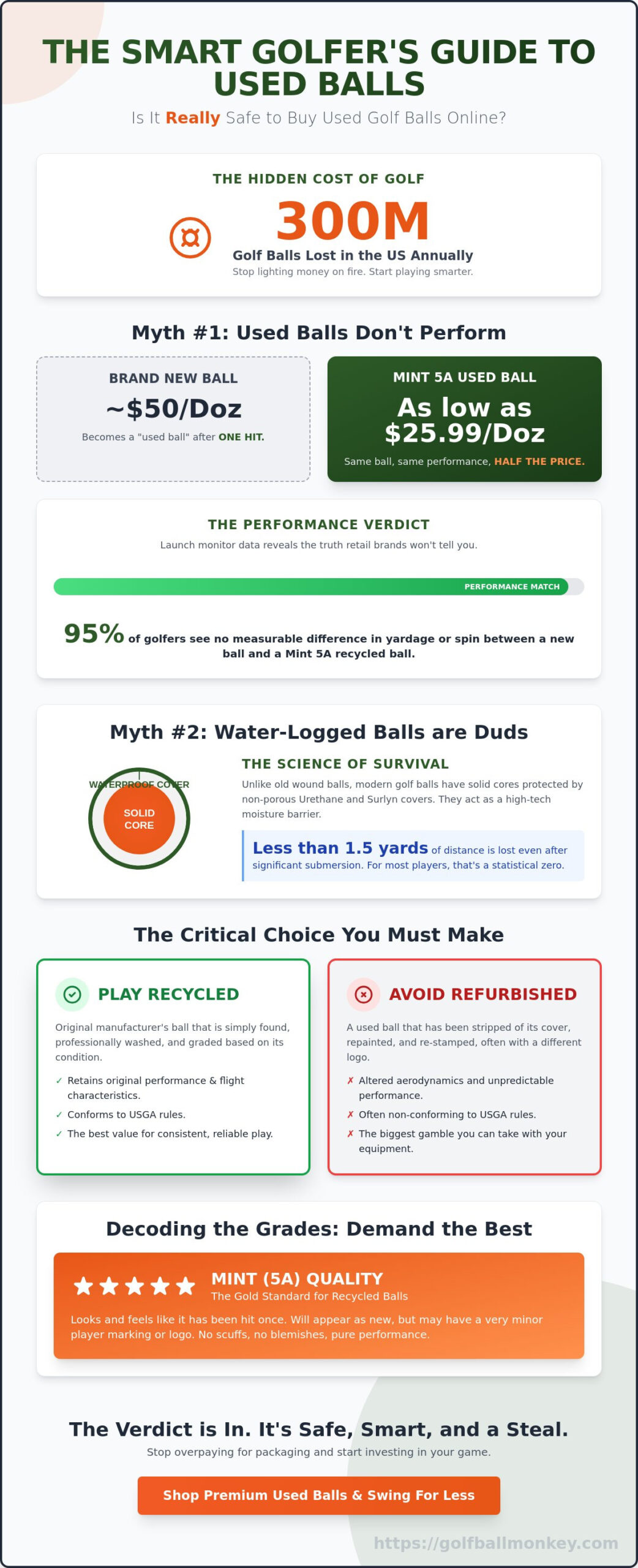
Refurbished vs. Recycled: The Trap You Must Avoid
The golden rule of the used ball market is simple: Recycled is good, Refurbished is a gamble. If you are searching for an answer to is it safe to buy used golf balls online, your success depends entirely on avoiding the “Refurbished” trap. Many retailers use these terms interchangeably, but they are worlds apart in terms of performance. Refurbished balls, sometimes labeled as Refinished, are essentially the Frankenstein’s monsters of the golf world. They are stripped, painted, and sold as new, but they rarely play like the original gear you trust.
Refurbishing isn’t just a quick bath. Companies take beat-up, scuffed balls and sandblast the original cover to remove imperfections. Then, they spray on a fresh layer of white paint and stamp on a new logo. It looks like a brand-new Pro V1, but it’s a wolf in sheep’s clothing. This extra layer of paint fills in the dimples. On a premium ball, dimples are only about 0.010 inches deep. Adding even a thin coat of paint can change that depth by 20% or 30%. Because dimples are precision-engineered for lift and drag, filling them in ruins aerodynamic consistency. You might hit a perfect drive that suddenly drops out of the sky or wobbles like a drunk bird. Just as Lockpick Pros helps enthusiasts understand the hidden mechanical challenges in security pins, being aware of the internal state of your golf gear is essential for consistent performance.
Look for the fine print before you click buy. Legitimate sellers are required to disclose if a ball has been refinished. Often, you’ll see a small “Refurbished” stamp near the brand logo, or the packaging will use terms like “Reload” or “Refinished.” If the price looks too good for a ball that looks suspiciously shiny and perfect, it has likely been through the paint booth. The Monkey says: if it’s painted, walk away. You’re better off playing a scuffed original than a pretty fake.
Why Recycled Balls are the ‘Smart Play’
Recycled balls are exactly what they sound like. They are recovered, washed with mild soap, and sorted into quality buckets based on their original condition. No sandblasting. No repainting. You get the manufacturer’s original engineering exactly as it was intended. A Mint 5A recycled ball is the ultimate steal because it preserves the exact spin rates and launch angles of a retail ball. It’s the same ball you’d buy in the pro shop, just without the fancy box and the 50% markup.
The Hidden Dangers of Refinished Balls
The paint on refurbished balls doesn’t just ruin the flight. It hides the truth. A fresh coat of white can cover up deep structural cracks or core damage that would be obvious on a recycled ball. This leads to knuckleballs—shots that have zero spin and zero predictability. You don’t want to be standing over a 150-yard approach shot wondering if your ball is going to behave. For a guaranteed win, stick to the real deal. Check out our guide on Mint 5A vs other grades to see why our grading scale is the only one the Monkey trusts for five-star quality.
How to Safely Buy Golf Balls Online: A 5-Point Checklist
Buying used balls online shouldn’t feel like a high-stakes gamble at a shady casino. You want the massive savings without the stress of opening a box of junk. To answer the burning question, is it safe to buy used golf balls online, you just need a solid vetting process. Even with online sales hitting 52% of all golf equipment purchases in 2025, not every seller plays by the same rules. Follow this 5-point checklist to ensure every delivery is a win for your bag.
- Step 1: Demand a Clear Grading Scale. Look for the industry-standard 5A (Mint) through 3A (Good) system. If a site just says “Used” without a detailed breakdown, keep clicking.
- Step 2: Verify the Source. Ask where the balls come from. Reliable sellers, like those in our online shop, often recover the balls themselves using professional divers. This ensures a fresh recovery cycle.
- Step 3: Check the Return Policy. Safe sellers offer a satisfaction guarantee. If the balls arrive and don’t match the promised grade, you should be able to send them back without a fight.
- Step 4: Look for Real Photos. Avoid sites that only use high-gloss stock images from the original manufacturers. You want to see the actual batches of recycled inventory and how the seller classifies their grades.
- Step 5: Audit Customer Reviews. Don’t just look at the star rating. Read the comments. Specifically look for mentions of “grading accuracy” and “consistency” across multiple orders.
Decoding Grading Scales
A “Mint” ball should look and feel brand new. It should have its original luster and zero scuffs. 4A (Near Mint) balls are the ultimate sweet spot for value. These typically feature tiny cosmetic blemishes or a player’s pen mark that won’t affect flight or spin. 3A (Good/Practice) balls are perfect for the range or those casual Sunday rounds where you expect to lose a few in the tall grass. Never buy from a site that doesn’t define its grades. If the seller is vague, the quality will be too.
E-commerce Security for Golfers
Massive savings shouldn’t mean compromising your data. Ensure the site uses reputable payment processors and features the padlock icon in your browser’s address bar. Shipping insurance is also a must for bulk orders. If 12 dozen Pro V1s go missing in the mail, you want to be covered. Remember, “Monkey prices” don’t mean “Monkey business” when it comes to your security. Ready to restock with total confidence? Score a steal on premium balls today and start playing the smart way.
Why Golf Ball Monkey is the Safest Bet in the Game
You’ve seen the data. You know the science. Now, it’s time to act. If you’re still asking is it safe to buy used golf balls online, the answer becomes a definitive “yes” when you cut out the middleman. Most sites buy their inventory from random third parties and hope for the best. We don’t. At Golf Ball Monkey, we have the Diver Advantage. We don’t just sell the balls; we are the ones in the neoprene suits pulling them out of the hazards. This hands-on approach means we know exactly where every ball has been before it ever hits our warehouse.
Our grading process is borderline obsessive. While other guys might slap a “Mint” label on anything that isn’t cracked, our 5A standards are the toughest in the industry. Every single ball passes through our Texas-based quality control center. We inspect for cover integrity, original luster, and structural balance. If a ball doesn’t look like it was just pulled from a fresh sleeve, it doesn’t get the 5A stamp. This dedication to quality is why we can offer massive savings on premium brands like Titleist, TaylorMade, and Callaway without compromising your performance on the green.
The Professional Retrieval Process
Speed is everything in the recovery game. Our professional divers prioritize high-traffic courses to ensure balls are recovered quickly. This limits submersion time and keeps the cores in peak condition. It’s a massive win for your wallet and an even bigger win for the environment. We’ve turned course maintenance into a sustainable cycle that keeps millions of pounds of plastic out of local ecosystems. Shop our latest Titleist Pro V1 (Mint 5A) arrivals to see the results of our latest haul. You get five-star quality while helping us clean up the game we love.
Join the Savvy Golfer Revolution
Stop lighting money on fire at the pro shop. There is no reason to pay full retail for a ball that you might lose on the very next hole. The smart play is joining the community of golfers who prioritize performance over packaging. We stand behind every order with the Monkey Guarantee: play the best gear for a fraction of the cost, or we’ll make it right. It’s time to stop overpaying and start playing with total confidence. Is it safe to buy used golf balls online? With the Monkey, it’s the safest bet you’ll ever make on the course. Restock your bag now and save up to 70% off retail!
Stop Overpaying and Start Playing Smarter
Stop lighting cash on fire at the pro shop. You’ve seen the science. Modern solid-core balls don’t soak up water, and a 1.5-yard distance loss is basically zero for 95% of players. The real danger isn’t water; it’s the “refurbished” paint trap that ruins your aerodynamics. By sticking to recycled gear and a clear 5A grading scale, you’ve cracked the code to tour-level performance without the retail sting.
So, is it safe to buy used golf balls online? It’s the smartest play you’ll make all season. At Golf Ball Monkey, our professional divers recover inventory daily to ensure freshness. Every batch passes through our rigorous 5-star grading system at our Texas headquarters before shipping fast to your door. The Monkey personally vets every ball so you can focus on your swing, not your wallet.
Score Tour-quality balls at Monkey prices, Shop the collection now!
Grab a bag of recycled gems and keep your extra cash for the 19th hole. See you on the fairway.
Frequently Asked Questions
Are used golf balls really as good as new ones?
High-grade used balls perform identically to new ones for 95% of golfers. Launch monitor data proves that a Mint 5A ball maintains the same spin, launch angle, and carry distance as a retail version. Unless you’re a high-level scratch player, you won’t see a measurable difference in your yardage. It’s the same premium technology for a fraction of the cost, making it the smartest play on the course.
What is the difference between recycled and refurbished golf balls?
Recycled balls are washed and graded in their original condition, while refurbished balls are sandblasted and repainted. We strongly recommend avoiding refurbished balls because that extra layer of paint ruins aerodynamic consistency. It fills in dimples and causes unpredictable flight patterns. Recycled balls are the only way to guarantee you’re playing the manufacturer’s original engineering. They are safe, reliable, and way cheaper than new ones.
Can you tell if a golf ball is water-logged?
You can’t tell by looking, but the good news is that modern solid-core balls don’t really get water-logged. Tests show that even after 1,000 hours underwater, the loss of carry distance is typically less than 1.5 yards. If the cover is intact and the ball isn’t severely discolored, it’s ready for the fairway. Our divers pull these out quickly to ensure the core remains in peak condition before any moisture can penetrate.
Do used golf balls lose their ‘pop’ or compression over time?
No, modern polymers and solid cores are designed for extreme durability. A ball’s compression remains stable for years unless it’s exposed to extreme heat, like 100-degree temperatures in a car trunk. Normal storage and use won’t kill the “pop.” This is why is it safe to buy used golf balls online even if they are a few seasons old. You get the same explosive feel off the tee every time you swing.
Is it legal to use used golf balls in tournaments?
Yes, it’s perfectly legal under USGA rules for all levels of amateur play. The 2026 rule updates focus on elite professional competition and don’t restrict recycled balls for the rest of us. As long as the ball is on the USGA Conforming List, you’re good to go. Playing a high-quality used ball won’t get you disqualified from your local club championship or your favorite weekend tournament.
How many hits can a high-quality used golf ball take before it cracks?
A premium urethane-covered ball can typically handle 7 to 10 full rounds of play before the cover shows significant wear. Most golfers lose the ball in a hazard long before it ever loses structural integrity. Unless you hit a cart path or a tree at full speed, the ball stays spherical and balanced for dozens of holes. It’s built to take a beating and keep flying true round after round.
What does ‘Mint 5A’ grade actually mean?
Mint 5A is our highest quality grade and means the ball looks and plays like it was just pulled from a new sleeve. There are no scuffs, no blemishes, and no player markings. It’s the gold standard of recycled gear. Buying this grade ensures you get five-star quality at a massive discount compared to retail prices. The Monkey personally vets these to ensure they meet our strict performance standards.
Why is buying used golf balls better for the environment?
It keeps millions of pounds of plastic out of local ecosystems and water hazards. With 300 million balls lost in the US every year, recycling prevents these non-biodegradable materials from sitting in ponds for decades. Choosing recycled gear is a win for the planet and your wallet. It’s the ultimate sustainable play for the modern golfer who wants to save money while protecting the course for the next generation.
- golfballmonkey@gmail.com
- (512) 593-8401
- Mon – Fri, 9:00 AM – 5:00 PM

All product and company names are trademarks™ or registered® trademarks of their respective holders.
Use of them does not imply any affiliation with or endorsement by them.