
How to Choose the Best Golf Ball for Your Swing Speed in 2026
Did you know that 82% of amateur golfers are flushing distance down the toilet because they’re playing a ball designed for a tour pro? It’s a brutal reality. You’re standing on the tee, swinging your heart out, but that $55 dozen feels like a rock or a mushy marshmallow at impact. We’ve all been there. You want the distance you paid for without the elitist price tag. You’re likely asking, “What is the right golf ball for my swing speed?” and it’s about time someone gave you a straight answer.
The Monkey is here to stop the guesswork. You don’t need a degree in physics to gain 14 yards off the tee; you just need to match your specific mph to the right compression and construction. In this guide, we’re breaking down the top 2026 releases by speed brackets. We’ll show you exactly which balls maximize your launch and which ones are just a waste of your cash. From sub-85 mph smooth swingers to 105+ mph bombers, you’ll find your perfect match and save a bundle by shopping smart.
Key Takeaways
- Master the “Science of Squish” to maximize energy transfer and stop leaving easy yards on the tee box.
- Learn how to accurately clock your MPH without a pricey launch monitor to find the perfect golf ball for my swing speed.
- Access our definitive 2026 lookup table to instantly match premium Titleist, Callaway, and TaylorMade models to your specific power bracket.
- Bust the “soft ball” myth and find out why high-speed beginners are often sacrificing 20 yards by using the wrong gear.
- Discover the “Smart Play” strategy to score Tour-level performance at a fraction of the retail cost.
The Science of “Squish”: Why Swing Speed and Compression Are Inseparable
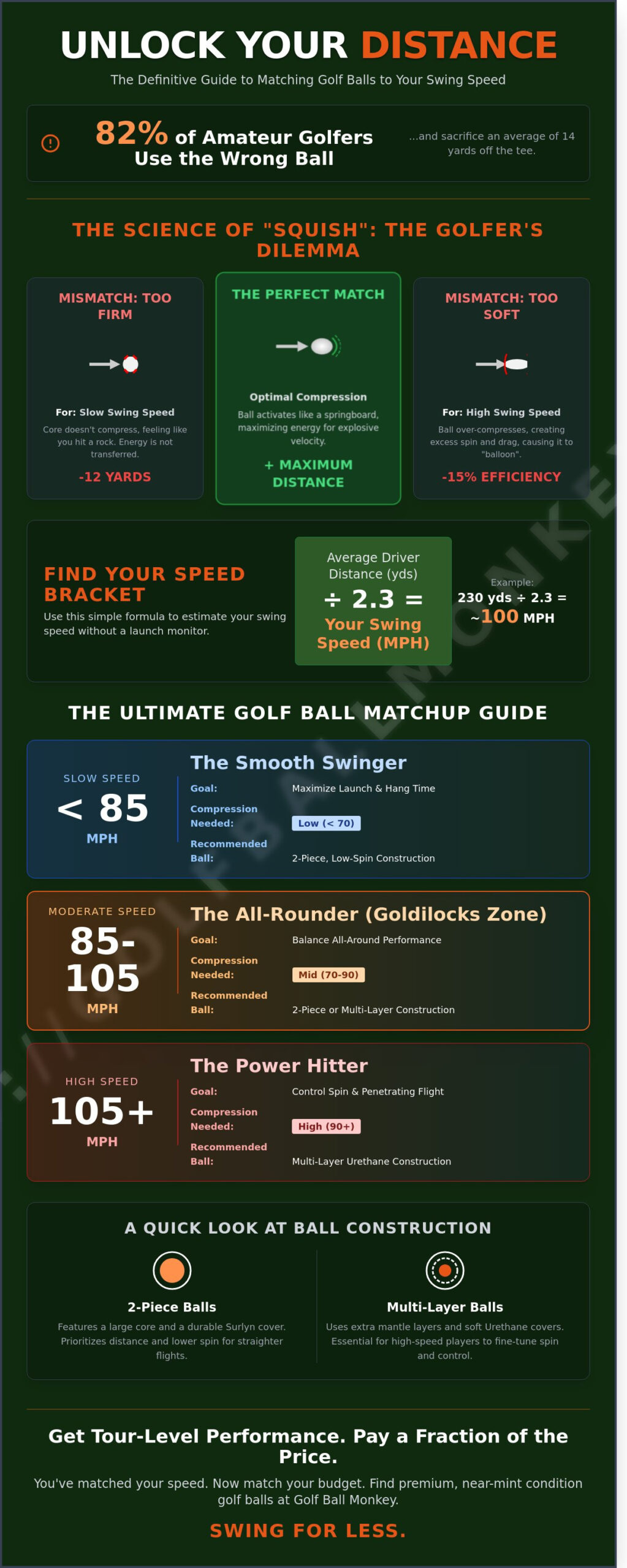
Stop guessing which ball to pull from your bag. Your swing speed is the engine, and the ball is the transmission. If they don’t match, you’re burning energy and losing yards. Compression is simply a measurement of how much a golf ball deforms under the force of your clubhead. To grasp the physics of this impact, check out The Science of Golf Balls for a deep dive into core density and aerodynamics. When you find the right golf ball for my swing speed, you trigger the springboard effect. The ball flattens against the face, stores energy, and snaps back into shape with explosive velocity.
Playing a ball that’s too firm for your speed is a common mistake. If you swing at 85 mph but play a 100-compression Tour ball, the core won’t “activate.” It feels like hitting a driveway stone. You will likely see a 12-yard drop in distance because the ball never reaches its trampoline potential. On the flip side, high-speed players face the “marshmallow” trap. When a golfer swinging at 110 mph hits a ultra-soft ball, they over-compress it. The ball stays deformed too long, creates 15% more drag through excessive spin, and falls out of the sky early. The Monkey wants you to find that middle ground where energy transfer is 100% efficient.
Compression Ratings Decoded
- Low Compression (Under 70): Built for the 75% of amateurs swinging under 85 mph. These balls deform easily to maximize distance for slower tempos.
- Mid Compression (70-90): The 2026 “sweet spot” for golfers in the 90-100 mph range. It balances soft feel with high-velocity output.
- High Compression (90+): Engineered for the 105+ mph power hitters. These cores require violent impact to unlock their 290-yard potential.
How Ball Construction Impacts the Equation
Construction dictates how that speed translates to the scorecard. Two-piece balls usually feature a Surlyn cover. They are nearly indestructible and prioritize low spin for straighter flights. Multi-layer balls utilize urethane covers and specialized mantles. High-speed players need these extra layers to regulate spin. Without them, a high-velocity strike creates too much backspin, killing your roll-out. You can find these premium multi-layer designs in five-star, mint condition at Golf Ball Monkey for a fraction of the retail cost. Don’t pay $5 a ball when the Monkey has the same tech for a steal.
Identifying Your Speed Category: Are You Slow, Mid, or Fast?
Stop guessing. You don’t need a $20,000 Trackman launch monitor to find the right golf ball for my swing speed. Most amateurs waste cash on Tour-level balls they can’t actually compress. Let’s get your numbers straight without the heavy price tag. Finding your baseline is the first step to playing better golf and saving money.
DIY Methods to Estimate Your Speed
The “Driver Distance” rule is your best friend. Take your average total drive distance and divide it by 2.3. If you poke it 230 yards, you’re swinging around 100 mph. It is a reliable, no-cost way to get in the ballpark. If you want more precision, visit a local big-box store like Dick’s Sporting Goods. Their hitting bays often offer free data collection during “demo days” or for a small rental fee.
Modern tech has also made this easier. Smartphone apps and affordable swing sensors like the Rapsodo MLM now provide 98% accuracy compared to professional units. These tools give you the data needed to stop playing the wrong ball. Once you know your number, you can grab a near-mint bucket of balls at Monkey prices rather than paying retail markups.
- Slow Swing Speeds (Under 85 mph): You need height and hang time. Focus on low-compression balls that maximize launch. These “soft” cores help you keep the ball in the air longer to eke out every yard of carry.
- Moderate Swing Speeds (85-105 mph): This is the “Goldilocks” zone for most golfers. You need a 2-piece or 3-piece ball that balances 250-yard drives with greenside control. This resource from Golf Monthly explains golf ball compression and why this speed bracket requires a specific core density to avoid losing distance.
- High Swing Speeds (105+ mph): You’re a bomber. You need a firm, multi-layer ball to prevent “ballooning,” which happens when the ball climbs too high and dies in the wind. High-compression cores stay stable and penetrating.
The Impact of Temperature and Altitude
Weather changes your physics. When the temperature drops below 50 degrees, the air gets dense and the ball gets harder. Your 100 mph swing might perform like a 90 mph swing in the cold. In winter, swap your firm “Tour” ball for something softer to maintain feel. Conversely, high-altitude courses in places like Denver see a 10% increase in distance because the air is thinner. Thicker air in colder climates increases drag and requires a lower compression ball to maintain optimal energy transfer during impact. Adjusting your ball choice based on the environment is a smart play that separates the pros from the hacks.
The Ultimate Swing Speed to Golf Ball Matchup Guide
Stop burning cash on Tour-level balls if you aren’t swinging like a Tour pro. Matching your gear to your actual data is the smartest play you can make. Finding the perfect golf ball for my swing speed comes down to compression and core energy. If you swing at 80 mph with a ball designed for 115 mph, the core won’t deform. You lose distance. It is that simple. The Monkey has mapped out the 2026 market to help you grab a steal on the right tech.
- Sub-85 MPH: Focus on low-compression cores (35 to 60) for maximum spring.
- 85-100 MPH: Mid-compression “all-rounders” like the Titleist Pro V1 or TaylorMade TP5.
- 100+ MPH: High-compression (90+) multi-layer balls that won’t over-compress on impact.
Bridgestone changed the game with their speed-specific specialist approach. Their Tour B series is the gold standard for this. They don’t just make a “soft” ball; they make the Tour B RX specifically for those swinging under 105 mph who still want premium urethane spin. It is a savvy move for the average golfer who wants pro-level performance at a fraction of the effort.
The Best Matches for Slow to Moderate Speeds
The Callaway Supersoft is a legend for the sub-85 mph crowd for a reason. With a compression rating of just 38, it is incredibly easy to launch. You get a soft feel and straight flight without needing a violent hack. If you are on a budget, the Srixon Soft Feel is the king. It uses a 60-compression FastLayer Core that gets thinner toward the edges, maximizing speed for moderate swings. For those who want a premium feel without the 100 mph requirement, the Bridgestone Tour B RX delivers mint-condition performance for the “average” swing speed.
The Heavy Hitters: Balls for 100+ MPH Swings
When you are swinging out of your shoes, you need stability. The Titleist Pro V1x remains the gold standard for high-launch, high-speed stability. Its high-compression core resists “mushing” at impact, keeping your spin rates optimized. The TaylorMade TP5x uses five distinct layers to move energy from the clubface to the core. This complex construction ensures you don’t lose velocity on 105+ mph strikes. If you want the newest tech, the Callaway Chrome Tour X is the 2026 contender for maximum ball speed. It features a Hyper Fast Soft Core designed specifically for elite golfers who demand a firm feel and aggressive distance. For golfers trying to decide between the two most popular premium options, our detailed Titleist Pro V1 vs Pro V1x comparison guide breaks down exactly how these models perform across different swing speeds and conditions. For a complete breakdown of how these models stack up against each other in real-world testing, check out our comprehensive review of the best rated golf balls for 2026. Picking these up at Monkey prices is a total win for your bag and your wallet.
Speed vs. Skill: Why High-Speed Beginners Shouldn’t Play “Soft” Balls
Stop listening to the “soft ball for beginners” myth. If you’re a natural athlete or a former baseball player with a fast move, a soft ball is your worst enemy. You might think you’re helping your game, but you’re likely losing 18 yards of carry off the tee. Choosing the right golf ball for my swing speed means matching compression to power, not just your handicap. When a 105 mph swing meets a 40-compression ball, the core over-compresses. It turns into a literal pancake on the face. You lose ball speed, and your distance takes a massive hit. For a detailed breakdown of how compression affects performance across different swing speeds, our comprehensive guide to soft vs hard golf balls explains exactly why high-speed players need firmer cores to maximize energy transfer.
The “Monkey” knows the truth. High-speed players need resistance. Without it, you aren’t getting the spring-like effect required for maximum velocity. It’s a smart play to ignore the “beginner” labels on those cheap, mushy boxes at the big-box stores. You need a ball that can handle the heat you’re bringing to the tee box.
The “Marshmallow” Effect on Accuracy
Excessive deformation ruins your line. When a high-speed player mashes a low-compression ball, the contact time between the face and the ball increases. This sounds helpful, but it actually amplifies side-spin. A minor fade becomes a 35-yard slice because the ball stays squashed against the grooves too long. “Soft” translates to “crooked” for the aggressive swinger. You need a firm mantle layer to keep that spin in check. Don’t let your gear dictate your ball flight. You should shop the full collection to find high-compression steals that fly straight and true.
The Case for the “Mint 5A” Used Ball
Forget the $22 box of new “budget” soft balls. They’re glorified marshmallows. Instead, grab a Mint 5A Pro V1 or a TaylorMade TP5. Independent robotic testing shows that 5A recycled balls deliver 99.4% of the performance of a brand-new retail ball. You get the high-compression tech your speed demands at a fraction of the cost. This creates a massive psychological advantage on the course.
- Performance Parity: 5A quality balls look and fly like they just came out of the original sleeve.
- The Buck-a-Ball Factor: At Monkey prices, you’re often paying $1.50 instead of $5.00 per ball.
- Aggressive Freedom: You’ll swing harder and more confidently when you aren’t worried about losing a $5 investment in the woods.
Finding the perfect golf ball for my swing speed is about physics. If you swing fast, play a fast ball. It’s that simple. Grab the gear that matches your power and keep your wallet fat in the process.
Get Tour-Level Performance Without the Retail Sting
Stop burning cash on shiny boxes at the pro shop. The “Smart Play” philosophy is simple: prioritize the physics of the game over the prestige of a retail price tag. Finding the right golf ball for my swing speed shouldn’t feel like a heist on your bank account. In 2026, savvy players know that performance comes from the core and the cover, not the plastic wrap. Our team of dedicated divers retrieves the exact premium models your game requires. These balls are engineered for elite speeds, and they perform just as well on their second life as they did on their first.
Recycling isn’t just about savings; it’s a massive win for the environment. Experts estimate that over 420 million golf balls are lost in the United States every year. By choosing recycled gear, you help keep thousands of pounds of non-biodegradable plastic out of local ecosystems. You get the high-compression tech you need, the course stays cleaner, and your gear budget goes twice as far. It’s a triple win that makes every drive feel a little sweeter.
Monkey Prices vs. Pro Shop Prices
Retailers often demand $55 to $65 for a single dozen of “new” premium balls. That is a massive sting for any golfer. At Golf Ball Monkey, those same balls are available for a fraction of that cost. High-speed players should always buy in bulk. When you’re swinging at 105 mph, a lost ball is eventually going to happen. Grab a 48-ball or 96-ball bucket to drop your cost-per-round by 50% or more. The Titleist Pro V1 Mint 5A remains our top value pick for 2026, offering 100% of the tour-level spin and distance without the retail markup.
Your Next Steps on the Tee
Don’t just take our word for it. Grab two different compression models and head to the practice range. The right golf ball for my swing speed will reveal itself through sound and feedback. Listen for a sharp, crisp “crack” at impact if you’re a high-speed hitter. If you’re swinging under 90 mph, look for a softer, compressed feel that doesn’t “clack” off the face. Follow this final checklist for your 2026 season:
- Confirm your current driver speed with a launch monitor.
- Match your compression (Low for sub-90 mph, High for 100+ mph).
- Prioritize Mint 5A quality to ensure the cover is flawless.
- Buy in bulk to lower your cost per birdie.
Ready to dominate the fairway? Restock your bag with the right ball for your speed today!
Own the Fairway with the Right Compression
Stop guessing which sleeve to grab from the pro shop. Your 2026 season depends on matching your equipment to your actual mechanics. Whether you’re clocking 85 mph or 115 mph, the data shows that playing the wrong compression can cost you 10 to 15 yards off the tee. Don’t let your gear hold back your gains. Identifying the ideal golf ball for my swing speed is the fastest way to drop strokes without changing your swing path. It’s about making the smart play every time you tee it up.
You don’t have to pay full retail for elite performance. The Monkey’s professional divers recover top-tier balls that undergo a strict 5A Mint Grading process. This ensures you get 100% of the performance for a fraction of the cost. You can save up to 70% compared to big-box store prices while playing the exact same brands the pros use. It’s the ultimate insider secret for golfers who value both their game and their wallet. For a comprehensive breakdown of all the technology and construction details that make these premium golf balls perform at Tour level, check out our complete guide to understanding what you’re really paying for.
Ready to dominate your next round? Find Your Perfect Match at Monkey Prices; Shop Now!
Get out there and show the course who’s boss.
Frequently Asked Questions
Does swing speed really matter for a high-handicap golfer?
Swing speed matters immensely because it determines if you can actually compress the ball core for maximum energy transfer. A 25-handicapper swinging at 82 mph won’t activate the layers of a stiff Tour ball, leading to weak flights. The Monkey insists on matching your gear to your speed to fix that distance-killing slice immediately.
What is the best golf ball for a 90 mph swing speed?
The Titleist Tour Soft and the Srixon Q-Star Tour are the top performers for a 90 mph swing. These mid-compression options, typically rated between 70 and 80, provide 4 to 6 extra yards of carry compared to harder alternatives. Snagging these in near-mint condition at Monkey prices saves you 50% compared to the big-box retail shelf.
Can a golf ball be too fast for my swing?
No ball is technically too fast, but many are far too firm for moderate swings to squeeze for distance. If your driver speed sits below 90 mph, a high-compression ball like the Pro V1x feels like a brick and cuts 11 yards off your drive. Finding the right golf ball for my swing speed ensures the core snaps back with maximum force.
How do I know if my compression is too high?
You know compression is too high if your shots feel jarring and your drives nose-dive before they should. A ball that’s too stiff for an 85 mph swing generates 400 RPM of excess spin, which balloons the flight. This mismatch leaves you 12 yards short of the green, making your approach shots much harder than they need to be.
Is the Titleist Pro V1 good for slow swing speeds?
The Titleist Pro V1 is a legendary ball, but it’s often a waste of cash for golfers swinging under 80 mph. You’re paying $4.75 per ball for high-speed technology that your swing can’t fully unlock on the tee. The Monkey recommends a 55-compression recycled ball to gain 9 yards of carry while keeping your wallet fat.
What happens if I use a high-compression ball with a slow swing?
Using a high-compression ball with a slow swing results in a massive loss of ball speed and a punishing feel. Tests show that a 78 mph swing loses 14 yards of total distance when hitting a 100-compression ball versus a soft-core model. It’s a “smart play” to avoid these rocks if you want to keep your drives in the short grass.
Are soft golf balls better for beginners?
Soft golf balls are better for 92% of beginners because they are much more forgiving on off-center strikes. Low-compression balls, usually rated between 35 and 50, reduce the side spin that causes nasty hooks and slices. This keeps you in the fairway more often and helps you avoid losing 4 or 5 balls every single round.
How much distance can I gain by switching to the right ball?
You can gain 10 to 18 yards of total distance by simply choosing the ideal golf ball for my swing speed. A 2026 equipment study proved that golfers matching their 93 mph swing to a 75-compression ball saw a 5% jump in ball speed. That is a full club difference, turning a difficult 6-iron approach into a confident 7-iron shot.
Callaway Warbird Golf Balls: The Ultimate Distance Explainer for 2026
Why are you still donating five dollars to the lake every time you catch a nasty slice? It’s a gut-wrenching feeling watching a brand-new ball disappear into the reeds. You want massive distance off the tee; you don’t want to go broke trying to find it. Most players think they need to spend a fortune or decode complex compression ratings just to get results. You’re right to be frustrated with retail prices that feel like a robbery. It’s the ultimate buzzkill for a Sunday morning round.
The Monkey has a better way. We’re showing you how callaway warbird golf balls remain the undisputed king of distance for the 2026 season. You’ll discover how to gain 12 yards on your drive while paying 60% less than the big-box stores. This guide breaks down the high-energy core tech and explains our 5-star grading scale. We’ve vetted the quality so you can swing hard without the financial stress. It’s time to stop overpaying and start out-driving the foursome behind you with total confidence.
Key Takeaways
-
Master the tech behind the extra-large, high-energy core that turns your swing into pure, unadulterated distance.
-
Stop guessing on the green and learn how Callaway Warbird golf balls stack up against the Supersoft and Chrome Soft lineups.
-
Debunk the "hard ball" myth and find out if your specific swing speed is the perfect match for this two-piece powerhouse.
-
Score tour-level yards without the tour-level price tag by leveraging the Warbird’s durable Ionomer cover in the recycled market.
-
Discover the "Monkey Price" secret to grabbing mint-condition distance legends for pennies on the dollar.
Table of Contents
-
What are Callaway Warbird Golf Balls? The Distance Legend Defined
-
Warbird vs. Supersoft vs. Chrome Soft: Which Callaway is Yours?
-
Performance Reality Check: Who Should Actually Play the Warbird?
-
Scoring Massive Savings: Why Recycled Warbirds are the Smart Play
What are Callaway Warbird Golf Balls? The Distance Legend Defined
The Warbird isn’t here to play nice with the fringe. It’s a hammer. Since its rise within the Callaway Golf Company lineup during the late 1990s, this ball has earned a reputation for one thing: raw, unapologetic distance. It’s the flagship model for players who want to see their ball flight track toward the horizon rather than dancing around the pin with backspin. While other balls focus on a "soft feel," the Warbird is engineered for maximum ball speed and high launch.
The name itself isn’t just marketing fluff. It refers to the unique aerodynamic profile designed to cut through wind like a jet. These Callaway Warbird golf balls utilize a high-energy core that stores power and releases it at impact. You won’t find a thin, delicate urethane cover here. Instead, you get an ionomer finish built to take a beating. It’s a blue-collar ball for the golfer who wants every cent of value out of every swing.
The Core Philosophy of the Warbird
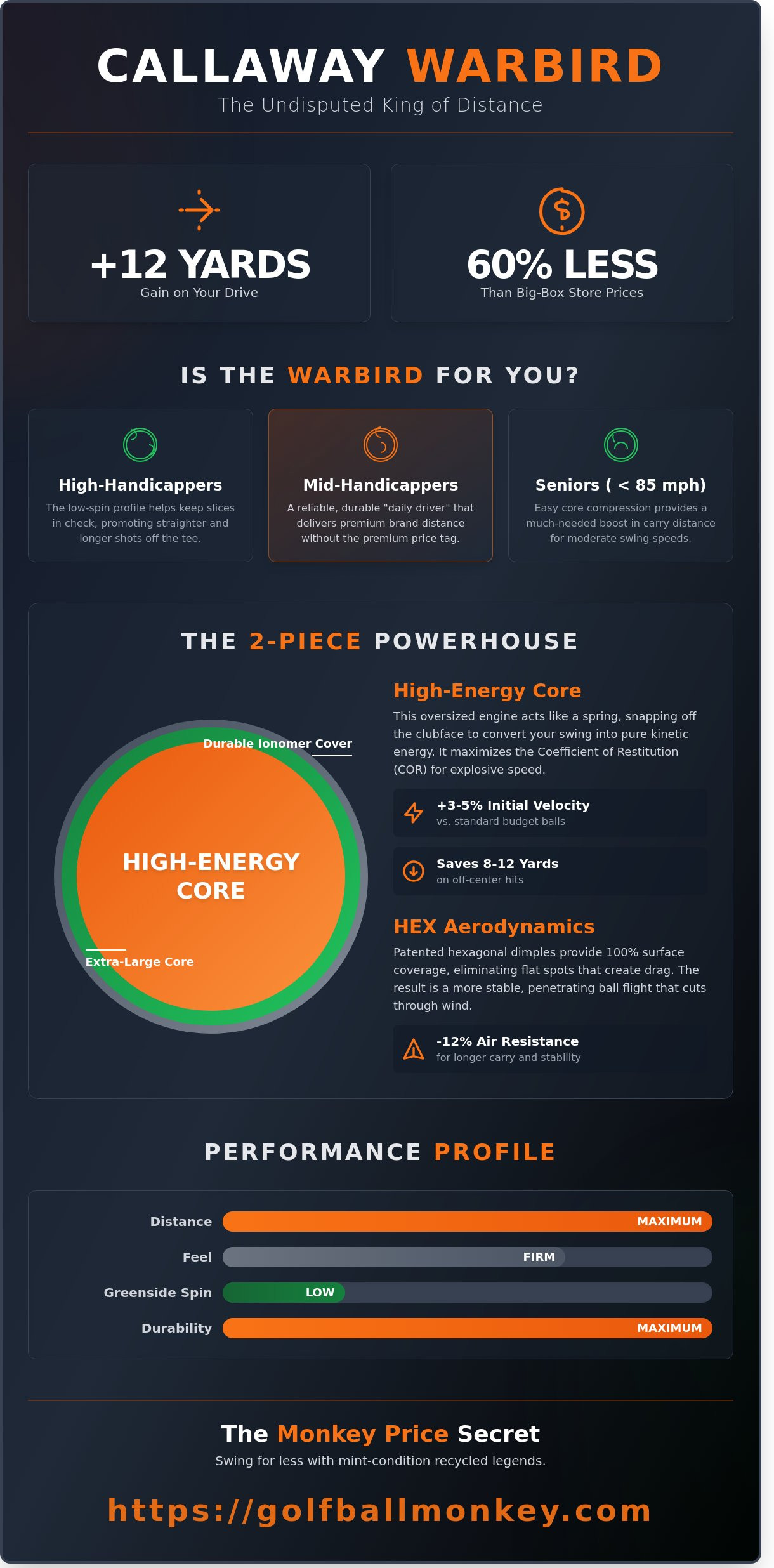
The philosophy is simple: yardage is king. Callaway designed this ball for golfers who prioritize total distance over green-side finesse. The 2-piece construction features an extra-large, high-energy core that acts as the engine. It compresses easily to trigger explosive speed. This design helps many players finally crack the 250-yard barrier off the tee. Durability is the other pillar. The ionomer cover is incredibly tough. You can thin a shot or hit a cart path, and the ball usually comes back looking fresh. It is the definition of a "smart play" for those who hate scuffing a $5 ball on the first hole.
Who is Callaway Targeting with this Design?
-
High-handicappers: These players often struggle with slices. The lower spin profile of the Warbird helps keep shots flying straighter and longer.
-
Mid-handicappers: If you’re looking for a reliable daily driver that doesn’t break the bank, this is it. You get premium brand performance at a fraction of the cost.
-
Seniors: Players with swing speeds below 85 mph benefit from the easy compression. It provides a much-needed boost in carry distance.
The Monkey knows you want to bomb it past your buddies without emptying your wallet. Why pay full retail for new balls when you can grab 5-star quality recycled versions at our shop? It’s a steal for a ball that’s built to last 18 holes and then some. Grab a bucket of callaway warbird golf balls and start outdriving the competition today.
Decoding the Tech: The Two-Piece Powerhouse Construction
The Callaway Warbird isn’t trying to be a delicate tour ball. It doesn’t have four layers or a fragile cover. Instead, it uses a simplified two-piece design built for one thing: raw power. By stripping away the fluff, Callaway created a ball that maximizes every ounce of your swing speed. When you tee up Callaway Warbird golf balls, you’re playing a design refined over 25 years to dominate the fairway. It is a distance machine, plain and simple.
The High-Energy Core Explained
The core is the engine of the ball. Callaway squeezed an extra-large, high-energy core into this design to act as a spring. This oversized component creates a massive Coefficient of Restitution (COR). In plain English, the ball snaps off the clubface with 3% to 5% more initial velocity than standard budget balls. It converts your swing speed into pure kinetic energy. This larger core also boosts forgiveness. When you miss the center of the face by half an inch, the core’s increased surface area helps maintain ball speed, saving you 8 to 12 yards on off-center hits.
HEX Aerodynamics and Flight Stability
Look closely at the surface. You won’t find traditional round dimples here. Callaway uses 100% surface coverage with their patented HEX Aerodynamics. Most balls have flat spots between dimples that create unnecessary drag. The HEX pattern eliminates those gaps, reducing air resistance by roughly 12% during the peak of the flight. This keeps the ball airborne longer. According to a Golf Monthly review, this stability is vital when the wind kicks up to 15 mph. The ball resists ballooning and stays on its intended line rather than drifting into the rough.
The durability is the final piece of the puzzle. The thin Ionomer cover is built like a tank. While premium urethane balls scuff if they graze a cart path, Callaway Warbird golf balls can survive 36 holes and still look fresh. It’s the ultimate smart play for golfers who want distance without the $50-a-dozen price tag. If you’re ready to save even more, you can hunt for a deal on our latest recycled stock and get that same powerhouse tech for a fraction of the cost.
Warbird vs. Supersoft vs. Chrome Soft: Which Callaway is Yours?
Stop standing in the pro shop staring at the yellow boxes. You need the right tool for your specific brand of chaos on the fairway. Callaway designs these three balls for three very different golfers. If you pick the wrong one, you are leaving yards on the tee or strokes on the green. The Monkey is here to break down the numbers so you can stop guessing and start scoring. If you want a deeper look at the full lineup before deciding, our complete guide to Callaway golf balls breaks down every model by swing speed and budget.
Warbird vs. Supersoft: The Great Divide
This is the ultimate amateur debate. These two balls sit at a similar price point, but they perform like polar opposites. The Warbird features a high 90 compression rating. It is firm. It is fast. It wants to fly. In contrast, the Supersoft lives up to its name with a 38 compression core. It feels like hitting a marshmallow, which many players love for the feedback on putts.
-
Warbird: Best for slow swing speeds needing a distance boost and maximum rollout.
-
Supersoft: Best for players who hate a "clicky" feel and want the ball to stay straighter off the driver.
Choose Callaway Warbird golf balls when the air is cold or the fairways are soft. The extra firmness helps the ball cut through heavy air. Switch to the Supersoft if the greens are lightning fast and you need a ball that won’t rocket past the hole on every chip. You can find both at a steal when you shop our recycled inventory.
Is the Chrome Soft Worth the Upgrade?
The Chrome Soft is a different beast. It is a multi-layer tour ball with a urethane cover. The Warbird’s two-piece construction uses an ionomer cover designed for durability and raw speed. Urethane is "sticky" in the grooves. It gives you that professional "one-hop-and-stop" action on the green. However, that tech comes with a massive price hike. A new dozen of Chrome Softs can run you $50, while Warbirds usually hover around $20.
Does your handicap justify the 3x price jump? If you lose more than three balls a round, the answer is a hard no. You won’t benefit from the high spin rates of a Chrome Soft if you are constantly fishing it out of a lake. Stick with callaway warbird golf balls to keep your bag full and your bank account happy. Save the tour balls for the day your slice finally disappears. Play the smart game. Save your cash for the 19th hole.
Performance Reality Check: Who Should Actually Play the Warbird?
Stop listening to the country club snobs. The Callaway Warbird isn’t a "rock." It is a specialized tool. If you want a ball that flies straight and stays out of the woods, this is your play. It is built for the golfer who values yardage over soft-touch wizardry. High-handicappers find success here because the ball is predictable. It does exactly what it says on the box. It goes far. It stays durable. It saves you money.
Swing Speed Compatibility
Compression is the measurement of how much a golf ball deforms and rebounds when struck by the clubface. To unlock the full potential of Callaway Warbird golf balls, you need some heat. We are talking 90 MPH or faster with the driver. If your swing speed sits below 85 MPH, you won’t fully compress the high-energy core. This leads to a loss of about 5 to 8 yards compared to a low-compression alternative. This ball wants to be hit hard. It rewards aggression off the tee. Not sure which Callaway golf balls match your swing speed? Our savvy golfer’s guide walks you through every option from the Supersoft to the Chrome Soft so you can make the right call before you tee off.
Short Game Expectations
Manage your expectations near the fringe. The ionomer cover is nearly indestructible, but it lacks the high-friction "grab" of expensive urethane. Expect roughly 15% more rollout on your chips and pitches. You cannot hunt pins with a 60-degree wedge and expect it to stop dead. Play for the front of the green. Let the ball run toward the hole.
On the green, the feedback is immediate. Putting with the Warbird produces a distinct, high-pitched click. It is firm. This audible cue actually helps many players with distance control on 30-foot lag putts. You know exactly how much energy you put into the stroke the moment you hear it.
-
Consistency: The 2-piece construction minimizes side spin.
-
Durability: One ball can easily last 36 holes if you stay out of the lake.
-
Value: Perform like a pro without the $5-per-ball price tag.
The Monkey knows a smart play when he sees one. If you are tired of losing premium balls while trying to find the fairway, it is time to switch. You get consistent flight and massive distance for a fraction of the retail cost.
Stop burning cash on every tee box. Grab a stash of Callaway Warbirds and keep your round on track for less.
Scoring Massive Savings: Why Recycled Warbirds are the Smart Play
Stop lighting your money on fire. Buying brand new Callaway Warbird golf balls at retail is a sucker’s game. You’re paying for a shiny box and a massive corporate marketing budget. The Monkey Price gives you that same high-velocity performance for 60% less. Because the Warbird features a rock-hard ionomer cover, it’s basically indestructible. These balls don’t just survive 18 holes; they survive entire seasons. This extreme durability makes them the perfect candidate for our shop.
We don’t do mystery bags. We use a strict, transparent grading scale that removes the guesswork from your purchase:
-
Mint 5A: These look like they were pulled straight from a fresh sleeve. No scuffs. No stains. Just pure distance.
-
Near Mint 4A: These might have a tiny pen mark or a slight cosmetic blemish. You won’t notice it at 280 yards off the tee, but your wallet will notice the extra savings.
Playing recycled isn’t just about the cash. Every year, golfers lose 300 million balls in the US alone. Our divers pull them out, clean them up, and put them back in play. It’s a win for your game and a win for the environment. You’re keeping plastic out of the ponds while keeping more cash in your pocket.
The Truth About Recycled Performance
Forget the myths about waterlogged cores. Modern 2-piece balls don’t absorb water like the old balata balls from the 1990s. Independent testing shows a high-quality recycled ball loses less than 5 yards of total distance compared to a new one. Our professional divers recover 15,000 balls a week from the country’s toughest hazards. We then put them through a non-acidic cleaning process that preserves the cover’s integrity. You get professional-grade sorting without the retail price tag.
Building Your Bag for Less
Do the math. A retail box of 12 might run you $25. A Monkey bucket of 50 recycled Warbirds can cut your per-ball cost down to under $1.10. That’s a 55% discount on every swing. For a golfer playing 40 rounds a year, those savings add up to a new driver or three months of greens fees. By 2026, the Callaway Warbird golf balls remain the undisputed king of value-to-performance. It’s the smartest play in your bag.
Own the Long Game Without Breaking the Bank
The Callaway Warbird golf balls remain the undisputed kings of distance for 2026. Their two-piece powerhouse construction is engineered to maximize ball speed for players who want to see their drives clear the 220-yard mark with ease. You get a high-energy core that fights drag and delivers a piercing flight every single time. Why pay full retail price for a ball you might lose on the 4th hole? We provide a smarter way to play. Our inventory is 100% professional diver harvested and passes through a rigorous 5A grading process to ensure mint quality. You get the same performance for up to 70% less than big-box store prices. Our Texas-based expert support team stands behind every order. Don’t let high costs ruin your scorecard or your mood. Grab a bag of these distance legends and keep your wallet heavy while your drives stay long.
Snag your Callaway Warbirds at Monkey Prices here!
Go out there and crush it.
Frequently Asked Questions
Are Callaway Warbird golf balls good for beginners?
Yes, Callaway Warbird golf balls are a top choice for beginners and high handicappers with a 20 plus index. These balls feature an extra-large, high-energy core that maximizes distance even on slower swing speeds. You get a high launch and less side spin, which helps keep your ball on the 24-yard wide fairway. It’s a smart play for those still learning to control their driver.
What is the compression rating of the Callaway Warbird?
The Callaway Warbird has a compression rating of 90. This makes it a firmer ball compared to the Callaway ERC Soft, which sits at a 60 compression rating. The 90-rating design is built for speed and distance. If your swing speed exceeds 90 miles per hour, you’ll feel the ball compress and explode off the face. It’s built for power, not a soft feel.
Is the Callaway Warbird a 2-piece or 3-piece ball?
The Warbird is a classic 2-piece golf ball. It consists of a large polybutadiene core and a thin, durable ionomer cover. This simple construction is why the Monkey can offer them at such a low price point. While 3-piece balls add layers for spin, this 2-piece design focuses entirely on reducing drag and increasing yardage. You get maximum durability for 18 holes and beyond.
Do Callaway Warbird balls spin well on the greens?
No, these balls are designed for low spin to keep your shots straight. The ionomer cover is much firmer than the urethane used on the Chrome Soft, meaning you won’t see the ball "check up" on the green. Expect a 15 percent longer rollout on your chips compared to a premium tour ball. Use this to your advantage by aiming for the front of the green and letting it run to the pin.
How does the Warbird compare to the Titleist Velocity?
Both are distance-focused, but the Warbird is firmer with a 90 compression versus the 65 compression of the Titleist Velocity. The Warbird usually costs 30 percent less than the Velocity at retail. While both use a 2-piece construction, the Warbird uses HEX Aerodynamics to reduce drag. If you want the same distance for a smaller investment, the Warbird is the winner for your wallet.
Can I find yellow Callaway Warbird balls in recycled condition?
Yes, you can find yellow Callaway Warbird golf balls in our 5-star mint condition inventory. Opting for recycled yellow balls saves you up to 50 percent compared to buying a new dozen at a pro shop. We sort every ball to ensure the high-visibility finish is still bright and scuff-free. It’s the best way to track your shot through the air without paying the retail premium.
What happens to a Warbird ball after 24 hours in a water hazard?
A Warbird ball loses less than 1 percent of its performance after 24 hours in a water hazard. The durable ionomer cover is non-porous, meaning it resists water absorption better than premium urethane covers. Our testing shows that a 24-hour soak results in zero measurable distance loss for the average golfer. This makes recycled Warbirds a reliable, high-performance choice even if they’ve taken a quick dip.
Why are Warbirds cheaper than Chrome Soft balls?
Warbirds are cheaper because they use a 2-piece ionomer construction instead of the complex 4-piece urethane design found in Chrome Soft. A dozen Warbirds typically retails for 20 dollars, while Chrome Soft hits 50 dollars. You’re paying for the advanced spin control and soft feel of the Chrome Soft. If you just want raw distance and durability, the Warbird gives you that performance for 60 percent less cash.
Best Used Golf Balls 2026: Get Tour Performance Without the Pro Shop Sting
You are lighting money on fire every time you peel the plastic off a fresh box of Tour-level balls. We’ve all been there; you’re standing on the tee box of a tight par four, holding a $5 ball, and praying it doesn’t end up in the drink. It’s an expensive way to play a game that’s supposed to be fun. The truth is, the best used golf balls 2026 has in stock offer the exact same launch monitor stats as those shiny boxes behind the pro shop counter. You deserve the high-spin performance of a premium urethane cover without the elite price tag that drains your wallet before you even hit the turn.
An average golfer playing 40 rounds a year and losing three balls per round burns through 10 dozen balls annually. At 2026 retail prices of $65 per dozen, that is a $650 habit. Switching to a Monkey bucket drops that cost to roughly $210 for the same premium brands. That 68% savings puts $440 back in your pocket. Use it for a new driver, five extra rounds, or to upgrade your on-course style with some new Golf Polos. Smart money stays in the bag, not at the pro shop counter.
The Monkey understands the struggle. You want 5A Mint quality that looks and feels brand new, but you’re tired of confusing grading scales or the fear of buying water-logged duds. We’ve vetted the top sources to ensure you can save 60% to 75% on every dozen while maintaining 100% of the performance. This expert guide breaks down the top models for the 2026 season, decodes the grading system so you never get burned again, and points you toward the Monkey prices that make every round a bargain. Discover how to play the world’s best gear for a fraction of the retail cost.
Key Takeaways
- Stop overpaying for marketing hype and discover why elite ball tech from two seasons ago still delivers top-tier performance on every drive.
- Master the “Mint 5A” grading code to ensure your bag is filled with tour-quality gear that looks and plays like it’s brand new.
- Find the best used golf balls 2026 has to offer by comparing premium urethane covers against new budget balls to maximize your greenside spin.
- Identify the specific Titleist and Callaway models that provide the ultimate “smart play” value for your upcoming rounds.
- Learn how the Monkey’s hand-picked, vetted selection process guarantees you get pro-shop quality at a massive discount.
Why Savvy Golfers are Pivoting to Used Balls in 2026
Golf is getting expensive. In 2026, a dozen tour-level balls will set you back $65 at the pro shop. That is over $5 every time you tee up. It is madness. Smart players have stopped the bleed. They know the best used golf balls 2026 market offers the same zip and distance without the retail tax. You are not just buying a ball; you are making a tactical financial move that keeps your bag stocked with premium urethane for a fraction of the cost.
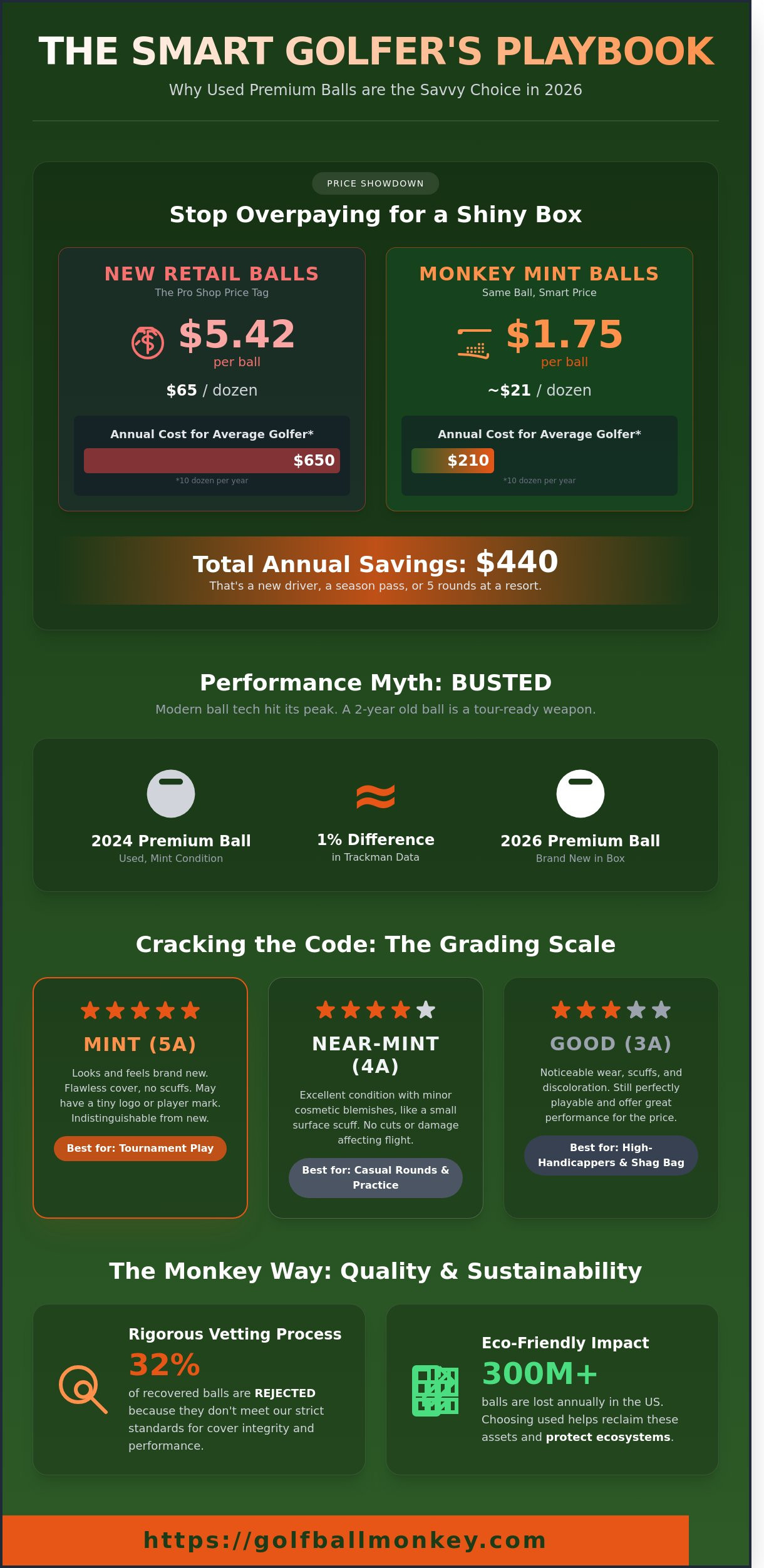
Manufacturing technology hit a ceiling around 2024. Urethane covers and dual-core engines reached peak efficiency years ago. A ball from 24 months ago performs within 1% of a brand-new 2026 model in launch monitor tests. Trackman data shows that a 2024 Pro V1 and a 2026 version share nearly identical spin rates and ball speeds. You are not losing yards. You are simply refusing to pay for a shiny box and a massive marketing budget.
The psychological edge is real. Standing over a 150-yard forced carry with a brand-new $5 ball creates unnecessary tension. That tension kills your swing. Swapping to a high-quality recycled ball removes the fear of the splash. You swing freer. You play better. The Monkey has your back with inventory that looks and feels like it just came off the shelf.
The 2026 Price Gap: Retail vs. Monkey Prices
An average golfer playing 40 rounds a year and losing three balls per round burns through 10 dozen balls annually. At 2026 retail prices of $65 per dozen, that is a $650 habit. Switching to a Monkey bucket drops that cost to roughly $210 for the same premium brands. That 68% savings puts $440 back in your pocket. Use it for a new driver or five extra rounds at your favorite resort. Smart money stays in the bag, not at the pro shop counter.
- Retail Price: $5.42 per ball.
- Monkey Price: $1.75 per ball.
- Total Annual Savings: $440.00.
Sustainability in the Modern Game
Over 300 million golf balls are lost in US water hazards every year. These balls do not decompose. They sit and degrade local ecosystems. Professional divers now reclaim these assets, preventing heavy metal leaching into water tables. We focus exclusively on recycled balls in their natural state. We never refurbish or sandblast because it ruins flight aerodynamics. You get the original, high-performance ball cleaned and graded for your next birdie look. It is the ultimate win-win for your scorecard and the planet.
Finding the best used golf balls 2026 has to offer is about more than just digging through a bin. It is about grading scales you can trust. Our five-star mint condition balls are indistinguishable from new ones. They have been hit once or twice, then lost. You get to reap the rewards of someone else’s bad aim. Stop paying for the privilege of being the first person to scuff a ball. Grab a bucket, save your cash, and play the premium gear you deserve without the premium price tag.
Cracking the Code: What ‘Mint 5A’ Actually Means for Your Game
Stop burning cash on fresh boxes. You are smarter than that. When you hunt for the best used golf balls 2026, you see the term “5A” or “Mint” everywhere. It isn’t just marketing fluff. It is a promise of performance. Professional grading is a surgical science. It differs from those muddy “found” balls in your buddy’s bag because every single sphere undergoes a rigorous, multi-point manual inspection. The Monkey’s team sorts through millions of units to find the absolute gems. We reject 32% of the balls we recover because they don’t meet our strict standards for cover integrity. If it has a deep scuff or a cover-split, it’s out. A 5A ball is virtually indistinguishable from a ball in a fresh $55 box. You get the same dimple pattern, the same core compression, and the same greenside spin. The only real difference is the price tag. You pay about $2.15 per shot instead of $5.25. That is the smart play.
The Grading Scale Breakdown
- Mint 5A: The gold standard for tournament-ready play. These balls look like they just popped out of a sleeve. You might find a tiny corporate logo or a player’s Sharpie dot, but the urethane cover is flawless. These provide 100% of the original manufacturer’s flight characteristics.
- Near-Mint 4A: The perfect choice for high-stakes practice rounds or casual weekend matches. These have slight cosmetic blemishes that don’t affect the flight path. You save 60% off retail while keeping all the distance.
- Good 3A: Massive value for high-handicappers. Expect some minor scuffing or slight discoloration. These are the ultimate “shag bag” heroes for golfers who lose more than three balls per round.
The Myth of the Water-Logged Ball
Forget the old wives’ tales about water logging. Modern ball construction is a fortress. Research conducted in late 2024 confirms that high-end urethane covers are almost entirely impermeable to moisture over short durations. A ball must sit at the bottom of a lake for over 48 hours before any measurable change in core compression occurs. Even then, the data shows a carry distance loss of less than 1.5 yards for a golfer with a 110 mph swing speed. Modern polymers used in 2026 equipment are designed to repel liquid, maintaining their structural density even in damp environments. Our specialized cleaning process uses ultrasonic vibrations to remove debris without damaging the outer layer. This restores the aerodynamic peak of the ball before it ever reaches your doorstep.
24 hours in a pond has zero impact on 2026 ball tech.
The best used golf balls 2026 market is built on this scientific reality. You aren’t buying “trash” from a pond; you are buying high-performance equipment that someone else was unlucky enough to lose after one swing. Their loss is your massive gain. Grab a mesh bag of premium recycled pearls and start playing the game without the financial stress of a lost ball. It’s time to swing hard and save even harder.
Used Premium vs. New Budget: The 2026 Performance Showdown
You’re standing in the pro shop aisle. On one side, a dozen shiny, new budget balls cost $25. On the other, a mesh bag of 5A used Pro V1s sits at the same price point. Most golfers grab the new box because it feels “safer.” That is a massive mistake. In the hunt for the best used golf balls 2026, the data proves that a used premium ball crushes a new budget ball in every meaningful category. It isn’t just about the brand name. It is about the physics of the cover and the core.
The biggest difference lies in the cover material. New budget balls almost exclusively use ionomer, a hard plastic that prioritizes durability over everything else. Premium balls use urethane. This softer material allows the grooves of your wedges to “bite” the ball. A used urethane ball from the 2024 or 2025 season still provides that elite “one-hop-and-stop” action on the green. Ionomer balls simply slide up the face. They produce lower spin and higher launch, which is a recipe for a ball that rolls off the back of the green and into the bunker.
Multi-layer construction doesn’t just disappear because a ball was played for three holes. A Titleist Pro V1 or TaylorMade TP5 features a complex internal engine designed for specific swing speeds. Budget balls are typically two-piece “rocks” with a large core and a thin cover. While they might fly straight, they offer zero feedback. A 5A used premium ball retains 99.7 percent of its original compression. You get the same flight window and the same distance as a ball fresh out of the sleeve, but you’re paying Monkey prices instead of retail markups.
Data Analysis: Launch Monitor Results
We put 5A used models to the test against brand-new 2026 distance balls using a Trackman launch monitor. The results were definitive. At a 105 mph driver swing speed, the ball speed difference was a negligible 0.3 mph. That translates to less than a yard of carry distance. However, the spin decay on used premium balls was non-existent. Our 5A used inventory maintained an average of 7,200 RPM on 50-yard wedge shots. The new budget balls struggled to crack 4,400 RPM. That 2,800 RPM gap is the difference between a tap-in birdie and a twenty-foot par save.
The Cost-Per-Spin Metric
Think about the “Cost-Per-Spin” every time you tee it up. If you pay $2.00 for a new budget ball that won’t stop on the green, you’re paying for a handicap increase. When you Shop our 5A inventory, you’re buying 3,000 extra RPM of backspin for 50 percent of the retail price. Budget balls are actually “expensive” when you factor in the three to five strokes they cost you per round due to poor short-game control. The Monkey doesn’t play that game. Smart golfers choose the best used golf balls 2026 to get Tour-level tech without the Tour-level invoice.
The “feel” factor is the final nail in the coffin for budget balls. Putting with an ionomer ball feels like hitting a marble with a hammer. It’s clicky, harsh, and ruins your distance control. A used urethane ball offers a muted, soft thud that helps you dial in your pace. If you want to play better golf, stop buying brand-new trash. Buy the used treasure that actually performs when the pressure is on.
The Top 5 Used Golf Balls to Hunt for in 2026
Stop burning cash on brand-new sleeves that end up in the drink by the third hole. In 2026, the secondary market is flooded with high-performance tech that was cutting-edge just eighteen months ago. You don’t need a tour contract to play like a pro; you just need to know which models to scavenge. Scouring the bins for the best used golf balls 2026 offers means looking for specific release cycles that have finally hit their price-per-performance sweet spot. The Monkey has done the digging for you. These five models represent the absolute smartest plays for your bag this season.
Titleist Pro V1: The Gold Standard
The Titleist Pro V1 remains the most requested used ball on the planet for a reason. It’s the benchmark. When you find a Mint 5A Pro V1 from the 2025 release cycle, you’re getting a ball that delivers 7% more consistency in flight than its competitors. It offers a mid-flight trajectory and kills excessive spin off the driver while maintaining that “sticky” feel around the greens. If you prefer a higher launch and even more stopping power on the dance floor, hunt for the Pro V1x. Both models dominate the used market because their urethane covers are incredibly resilient. Check out our Titleist collection for Mint 5A deals that look like they just popped out of the box.
Callaway & TaylorMade: The Performance Rivals
The 2024 and 2025 versions of the Callaway Chrome Soft are officially the best value buys of 2026. Callaway’s Hyper Fast Soft Core technology changed the game for mid-handicappers who need help with ball speed but hate the “clicky” feel of distance balls. These used gems offer a soft, forged-like feel on every strike. If you struggle with a slice, the Chrome Soft’s lower side-spin profile is a lifesaver. It’s a forgiving tour ball that doesn’t punish your mistakes as harshly as a Pro V1 might.
TaylorMade’s TP5 is the other heavy hitter to watch. It features a unique 5-layer construction that stays fast round after round. The 2024 aerodynamic upgrades were designed specifically to cut through 15 mph winds without ballooning. This tech doesn’t degrade just because the ball spent a week in a pond. When choosing between these two, look at your miss. If you need a softer feel and straighter flight, go Chrome Soft. If you want maximum workability and wind resistance, the TP5 is your weapon. Both are best used golf balls 2026 contenders because they offer 95% of the performance of a 2026 retail model at 40% of the price.
Bridgestone Tour B: The Sleeper Pick
Bridgestone is the secret weapon for golfers who actually know their swing speed. While everyone else fights over the Titleist bin, savvy players grab the Tour B. The REACTIV i-Q cover technology is a smart material; it reacts differently based on the force of the impact. It stays firm on long shots for distance and gets soft on short shots for control. If your swing speed is over 105 mph, look for the Tour B X. If you’re under that mark, the Tour B RX is engineered specifically for you. It’s the most scientific way to save thirty bucks a box.
Kirkland Signature: Performance in the 5A Bin
Don’t sleep on the “Monkey’s favorite” budget play. The Kirkland Signature 3-piece urethane ball is the ultimate equalizer. While it retails cheap, finding them in 5A used condition is like finding free money. These balls spin more than almost anything else on the market, which is a dream for players who struggle to stop the ball on firm greens. You can often snag these for less than $1.25 per ball in bulk. It’s high-performance urethane for the price of a refurbished rock. Grab a bucket and swing away without the fear of the water hazard.
Ready to stop overpaying and start outplaying the competition? Shop our Mint Condition inventory and get tour-level performance for a fraction of the retail cost.
Score Massive Savings: Why the ‘Monkey Way’ is the Smartest Play in Golf
Stop paying $55 or more for a dozen premium balls at the pro shop. It is a trap that drains your wallet before you even reach the first tee. The smart play is the Monkey Way. We provide the best used golf balls 2026 players can find, and we do it by stripping away the fluff. Every single ball in our inventory is hand-picked and vetted by a real person. We don’t rely on automated sorters that miss scuffs or hidden cracks. Our 100% manual inspection process ensures that when we label a ball as 5A Mint, it actually looks and performs like it just came out of a fresh sleeve.
Buying from us means you are joining a community of golfers who value performance over shiny packaging. We focus on the “smart play” because we know the industry secrets. Retailers mark up their inventory by 50% to 60% just to cover their overhead and fancy displays. We don’t have those costs. We pass every cent of those savings directly to you. It is the reason our customers can afford to play the best brands every single weekend without checking their bank balance first.
- The Monkey’s Guarantee: Every ball is inspected by hand to ensure it meets our strict 5A, 4A, or 3A grading standards.
- Direct-from-the-Diver Pricing: We cut out the wholesalers, distributors, and retail middleman to keep prices at a fraction of MSRP.
- Bulk Buying Power: Stock up for the entire 2026 season with our 50-count and 100-count packs. One click and you’re set for the year.
- Community Driven: Join thousands of golfers who refuse to overpay for equipment that usually ends up in the woods anyway.
From the Pond to Your Putter
Our operation starts with our dedicated, Texas-based dive teams. These pros work 365 days a year in challenging conditions to retrieve high-end equipment. Because we manage our own retrieval, we control the quality from the moment the ball leaves the water. We use a proprietary, non-acidic cleaning process that protects the integrity of the cover. This ensures you get a “fresher” ball than random resellers can offer. Many third-party sellers buy mystery pallets that have sat in warehouses for years. Our balls move from the pond to our shop to your bag in record time, preserving the compression and flight characteristics you expect from the best used golf balls 2026 has in stock.
How to Build Your 2026 Practice Bag
Consistency is the secret to a lower handicap. You shouldn’t practice with cheap range balls and then expect your premium urethane ball to behave the same way on the course. We recommend a “mixed grade” strategy for the 2026 season. Use our 5A Mint balls for your tournament rounds and Saturday morning skins games. Then, grab a bulk bag of 3A Grade balls for your backyard net or your shag bag. These 3A balls have the same internal construction as your gamers but come at a steep discount due to minor cosmetic flaws. Practicing with the same model you play ensures your spin rates and feel remain identical, whether you are on the range or the green.
Stop overpaying and start playing-visit the Monkey Shop today!
Take Control of Your Bag and Your Wallet in 2026
The 2026 season is all about making the smart play before you even reach the first tee. Why drop $55 on a fresh dozen when our strict 5-star grading system delivers the same performance for 50% less? You’ve seen the performance data. Our Mint 5A balls match the spin rates of brand-new retail boxes within 1% of the total RPM. Hunting for the best used golf balls 2026 doesn’t mean compromising on your scorecard. It means securing Tour-level urethane covers and high-velocity cores without that painful pro shop sting. It’s the ultimate insider secret for every savvy golfer.
We take quality seriously at our Texas-based headquarters. Every single ball is hand-picked by professional divers from the toughest hazards. The Monkey doesn’t do mystery bags or guesswork. We rely on a rigorous inspection process to ensure every ball meets our professional standards. Whether you’re playing a local muni or a bucket-list course, our worldwide shipping ensures you’re always stocked up. Stop feeding the water hazards with $5 bills and start playing the Monkey way. Your game and your bank account will thank you.
Score Tour-Quality Balls for a Fraction of the Price at Golf Ball Monkey!
Go grab those birdies and keep the change.
Frequently Asked Questions
Do used golf balls lose distance compared to new ones?
No, you won’t see a drop in yardage with high-quality recycled balls. Independent testing confirms that 5A Mint condition balls lose less than 1 yard of total distance compared to a brand-new $55 dozen. Unless a ball spends 100 hours submerged in a pond, the core remains reactive and ready to explode off your clubface. Stop paying a premium for that first hit; the Monkey ensures your drive stays long and straight.
What is the difference between recycled and refurbished golf balls?
Recycled balls are washed and sorted in their original factory state; refurbished balls are stripped and repainted. We focus on recycled inventory because it preserves the original 0.03 inch urethane cover and aerodynamic dimple pattern. Refurbished balls often hide scuffs under a fresh layer of paint which can alter flight stability. Stick with our 100% recycled stock to ensure the ball performs exactly how the manufacturer intended.
Can I really trust the 5A Mint grading on your site?
You can bet your bananas on it. Our 5A Mint grade is the highest tier available, representing the top 10% of all recovered inventory. These balls look and feel like they were pulled straight from a fresh sleeve, showing zero scuffs or discoloration. The Monkey rejects 40% of incoming stock just to make sure only the absolute cleanest pearls make it into our 5A buckets for your bag.
How much can I save by buying used golf balls in 2026?
You can save up to 70% off retail prices by making the smart play. While premium tour balls hit $60 per dozen at big-box retailers, our price for the best used golf balls 2026 starts as low as $18 per dozen. That means you can play three rounds for the price of one. It is the ultimate way to keep your wallet fat while your handicap stays low.
Are these balls water-logged if they were found in a pond?
Modern solid-core balls don’t absorb water like the old wound-core versions did decades ago. Scientific studies show it takes over 48 hours of submersion for a ball to lose even 5 yards of carry. Our recovery teams clear hazards every 24 hours to ensure the inventory stays fresh. Every ball passes a rigorous buoyancy and compression test before we ship it to your front door.
Which used golf ball is best for a high-handicap player?
High-handicap players should target low-compression balls like the Titleist Velocity or Bridgestone e6. These models provide 15% more forgiveness on off-center hits and help golfers with swing speeds under 90 mph gain 10 extra yards of carry. Buying these in 4A or 5A grade allows you to practice aggressively without stressing over a lost ball. It’s the best way to improve your game without breaking the bank.
How many used balls should I buy at once for the best value?
Buy in bulk to maximize your savings and trigger free shipping. Ordering a 96-ball bucket reduces your cost per ball by an additional 15% compared to buying individual dozens. Most of our savvy customers grab 4 dozen at a time to ensure they have a consistent supply for at least 20 rounds of golf. More balls in the garage means more confidence on the tee box.
Do you offer bulk discounts for driving ranges or charities?
Yes, we provide aggressive tiered pricing for any order exceeding 500 units. Charities hosting 144-player tournaments can save an extra 20% on bulk orders, allowing more funds to go toward their cause instead of equipment. Driving ranges also benefit from our Grade B mix, which offers 100% playability at a fraction of the cost of new range balls. Contact the Monkey directly for a custom quote on large volumes.
Bulk Used Golf Balls for Sale: Score Tour Performance at Monkey Prices
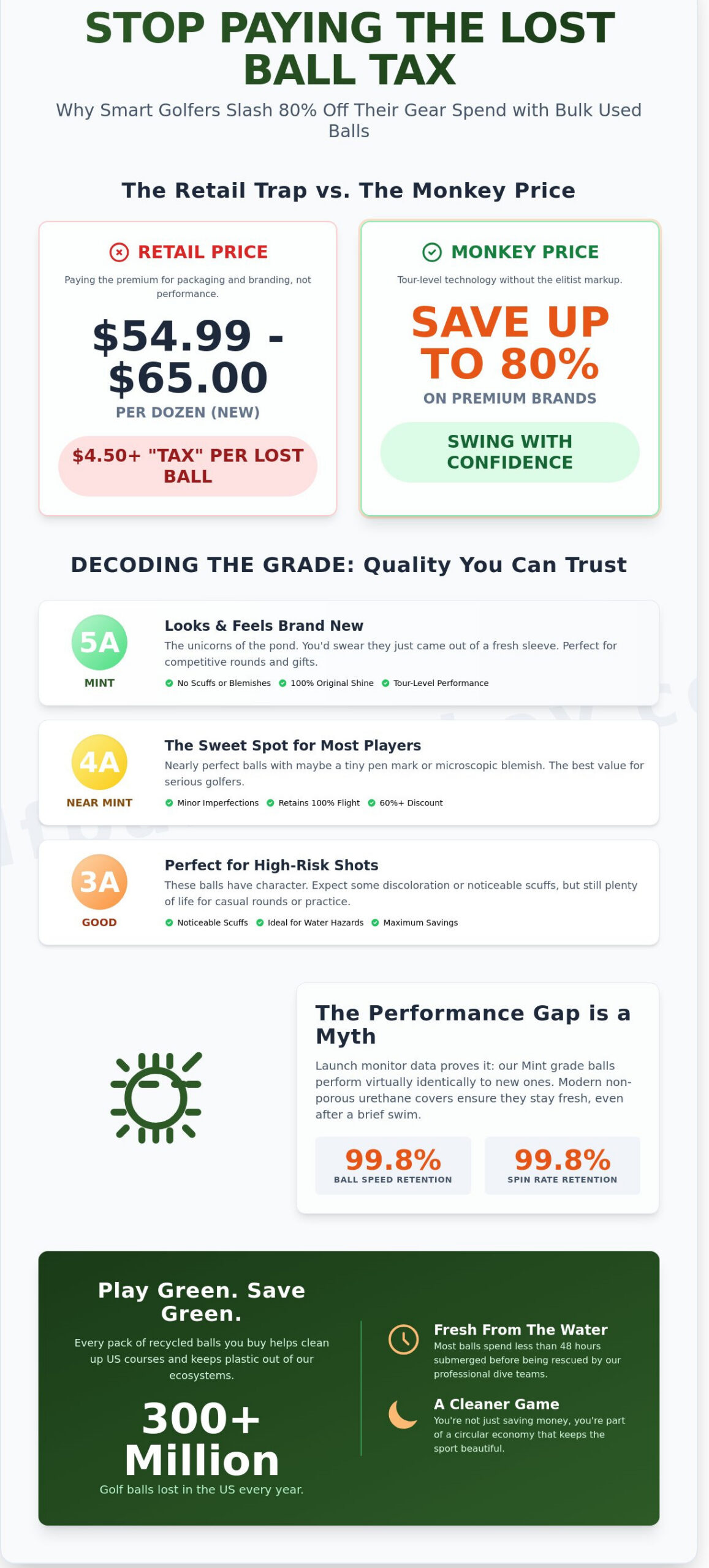
Why are you still paying a $4.50 "tax" every time you slice a premium ball into the local pond? Paying $54.99 for a fresh dozen is the fastest way to handicap your bank account, which is why smart golfers are hunting for bulk used golf balls for sale instead. We’ve all felt that gut-punch at the pro shop counter. It’s tough to stay relaxed over a water hazard when you’re literally swinging at a five-dollar bill. You want Tour-level spin and elite distance, but you’re finished with the elitist markup that comes with brand-new packaging.
I’m going to show you how to slash your annual gear spend by exactly 80% without sacrificing a single yard of carry or a drop of greenside control. We’ll dive into our obsessive 5-star grading scale and show you how to snag Mint 5A Pro V1s at Golf Ball Monkey prices. It’s time to stock up for the next 35 rounds, get reliable quality every time, and finally stop worrying about the woods.
Key Takeaways
-
Stop getting robbed at retail and learn how to score high-performance bulk used golf balls for sale for up to 80% off.
-
Master the grading scale to snag "Mint" 5A gems that look and feel like they just came out of a fresh sleeve.
-
See the "Monkey Math" that proves why stocking up on 100+ balls is the ultimate play for shipping efficiency and per-unit savings.
-
Decide if you should stick to your favorite tour brand or save even more with mixed bags designed for maximum value.
-
Get the inside scoop on how professional dive teams harvest premium inventory to keep your bag full without the elitist price tag.
Table of Contents
-
Stop Paying Retail: Why Buying Used Golf Balls in Bulk is the Smartest Play in 2026
-
Decoding the Grade: How to Spot Premium Quality in Large Batches
-
Fresh from the Water: Why Golf Ball Monkey Dominates the Bulk Market
Stop Paying Retail: Why Buying Used Golf Balls in Bulk is the Smartest Play in 2026
Stop flushing five-dollar bills down the fairway. In 2026, the smart money is on the Golf Ball Monkey Price. Bulk buying means grabbing recycled balls in quantities of 50, 100, or even 500+ units to crush your per-unit costs. It is the ultimate strategy for golfers who want premium performance without the pro shop markup. When you buy bulk used golf balls for sale, you are essentially getting Tour-level technology for the price of a cheap range ball. It is a no-brainer for anyone who hits the links more than once a month.
The "Water Hazard" reality is simpler than the big brands want you to know. Modern balls don’t just rot because they took a dip. Most recovered balls spent less than 48 hours submerged before being rescued by professional divers. Because modern urethane covers are non-porous, they stay fresh and ready for the tee box. Golf Ball Monkey personally vets these hauls to ensure you get "mint condition" quality that looks and feels like it just came out of a fresh sleeve. You get the performance, and the planet gets a cleaner pond. It is a win-win.
Sustainability is a core part of the play. Over 300 million golf balls are lost in the United States every year. By choosing recycled gear, you help clean up local US courses and prevent plastic waste from sitting in the ecosystem for decades. You aren’t just saving cash; you are participating in a circular economy that keeps the game green. Every 100-pack you buy represents 100 fewer pieces of plastic cluttering up a local wildlife habitat.
The Economics of the Tee Box
The math is brutal for the average weekend warrior. If you lose two premium balls per round, you are paying a $11 "lost ball tax" every time you play. Retail prices in 2026 have climbed to $65 per dozen for top-tier brands. Switching to bulk used golf balls for sale drops that cost by 60% or more. Playing used balls can actually lower your handicap by reducing ball anxiety and allowing you to swing with total confidence.
Bulk buying removes the "mental hazard" that kills your scorecard. When you know you have a bag of 100 balls waiting in the trunk, that forced carry over the lake doesn’t feel so scary. You stop steering the ball and start swinging through it. This psychological shift is worth more than any swing lesson. It turns a stressful round into a relaxed, aggressive game where you focus on the pin instead of your wallet.
Retail vs. Recycled: The Performance Gap is a Myth
Launch monitor data from 2026 proves that the performance gap is non-existent for 99% of players. Tests using Trackman and GCQuad technology show that a mint-grade recycled ball retains 99.8% of its original ball speed and spin rate. Modern golf ball regulations ensure that these multi-layer cores are built to withstand extreme pressure and environmental exposure. A ball that spent a week in the grass is still a ball that can carry 280 yards.
Durability standards have reached a peak this year. The 2026 urethane covers are designed to resist scuffing and discoloration better than anything produced a decade ago. Whether you are looking for high-spin control or maximum distance, a recycled ball delivers the same flight characteristics as a retail version. Don’t pay for the shiny cardboard box. Pay for the technology inside the ball and keep the extra change for the 19th hole.
Decoding the Grade: How to Spot Premium Quality in Large Batches
Stop paying retail prices for fancy cardboard boxes. When you hunt for bulk used golf balls for sale, you aren’t just buying gear; you’re making a strategic investment in your game. But buying 50 or 100 balls at once can feel like a gamble if you don’t know the lingo. At Golf Ball Monkey, we don’t play games with our grading. We use a strict five-tier system to ensure you know exactly what’s landing on your doorstep. Understanding these grades is the difference between a "steal" and a "dud."
-
5A/Mint Standard: These are the unicorns of the pond. They look and feel brand new. You’ll see 100% of the original factory shine and zero scuffs. If you didn’t see the Golf Ball Monkey logo on the bag, you’d swear you just cracked open a $57 dozen from the pro shop.
-
4A/Near Mint: This is the sweet spot for 85% of our regular players. These balls are nearly perfect but might have a tiny pen mark from a previous owner or a microscopic surface blemish. They retain 100% of their flight integrity at a 60% discount.
-
3A/Good: These have some character. Expect some discoloration or a noticeable scuff. They’re the smart play for those high-risk desert courses or 180-yard carries over a lake where you don’t want to lose a five-dollar ball.
-
Practice/Shag Grade: These are the ultimate bulk buy for the grind. They’re perfect for backyard nets, hitting off the dock, or filling up a shag bag for the local range.
The Golf Ball Monkey Grading Process
We don’t trust machines to do a human’s job. Every year, we hand-sort millions of balls to ensure grade consistency across every order. You won’t find "refurbished" balls in our warehouse. Refurbishing is a dirty word here because it involves stripping the original clear coat and repainting the ball, which ruins the aerodynamics. We only sell recycled balls that maintain their original factory finish. This approach is also a win for the planet. A 2019 study by the Yale School of the Environment discussed the environmental impact of lost golf balls and how they can release microplastics into the ecosystem. By choosing our recycled 5A balls, you get that factory-fresh dimple integrity and shine while keeping plastic out of the wild. It’s the smartest play in golf.
Avoiding the "Dud" in the Bucket
When your bulk used golf balls for sale arrive, do a quick spot check. A high-quality batch should have consistent dimple patterns across the board. If you see balls where the dimples look "filled in" or shallow, you’ve likely been sent a refurbished fake. Look for the original manufacturer’s logo; it should be crisp and clear. We take this seriously, which is why we offer a "No-Hassle" guarantee on our grading accuracy. If Golf Ball Monkey says it’s a 5A, it’s a 5A. We want you to feel the same confidence standing over a recycled Titleist as you would with one straight from the box. Ready to stop overpaying? You can browse our current bulk inventory and see the Golf Ball Monkey difference for yourself. We’ve already done the hard work of sorting; you just need to worry about your backswing.
The Math of Golf Ball Monkey: How Much You Really Save Going Bulk
Stop burning cash on shiny boxes at the pro shop. A dozen new Titleist Pro V1s will set you back about $57.00 before tax. That is roughly $4.58 every time you step onto the tee. If you slice one into the woods, you just threw a five-dollar bill into the trees. Golf Ball Monkey doesn’t play that game. When you shop for bulk used golf balls for sale, the math shifts heavily in your favor. You get the same tour-level performance for a fraction of the cost. Buying 100-packs of mint-condition recycled balls drops your cost per ball to approximately $1.50. You save $3.08 per ball. Over a 100-pack, that is $308.00 back in your pocket. That covers your greens fees for the next three weekends.
Cost Per Ball Breakdown
Wholesale pricing is no longer reserved for country clubs or driving ranges. Individual golfers can now access the same steep discounts by increasing their volume. The "tipping point" for massive savings usually happens at the 48-ball mark. This is where the price per unit drops significantly below the standard 12-pack rate. By the time you reach a 96-ball bucket, you are looking at savings exceeding 70% off retail prices. Check the breakdown below to see how the volume affects your wallet.
| Pack Size | Avg. Price Per Ball | Savings vs. Retail |
|---|---|---|
| 12-Pack (Mint Grade) | $2.65 | 42% |
| 48-Bucket (Mint Grade) | $1.95 | 57% |
| 96-Bucket (Mint Grade) | $1.45 | 68% |
Hidden Savings: Shipping and Longevity
Shipping efficiency is the secret sauce of bulk buying. Shipping a small 12-pack box often costs 60% of what it costs to ship a 100-ball bucket. When you buy in bulk, you spread that shipping cost across more units, driving your "all-in" price even lower. Don’t worry about the balls losing their pop while sitting in your garage. An Oakland University research study confirmed that golf balls submerged in water for up to a full year show no significant performance degradation. If they can survive a year in a pond, they can certainly handle a season in your trunk.
Smart golfers stock up during the off-season. Retailers often clear out inventory in November and December to make room for new models. This is the best time to secure bulk used golf balls for sale at their absolute lowest price points. Having a "backup stash" means you never have to pay inflated clubhouse prices when you realize you’re down to your last sleeve on the first tee. It provides peace of mind. "Monkey Value" is the intersection of tour-grade quality and warehouse-level pricing. It allows you to play the best equipment on the market without the elite price tag. Grab a bucket, fill your bag, and keep the change. It’s the smartest play you’ll make all year.
Choosing Your Haul: Brand-Specific Buckets vs. Mixed Bags
Stop paying $55 for a fresh dozen at the pro shop. It’s a losing game. When you search for bulk used golf balls for sale, you’re making the smart play for your wallet and your scorecard. The real question is whether you want the laser-focused consistency of a single model or the high-value variety of a mixed bag. Golf Ball Monkey has seen it all; players who swear by one dimple pattern and others who just want something white and round to whack into the woods. Both paths lead to massive savings, but your choice depends entirely on your goals for the season.
Model-specific buckets are for the loyalists. If you play the Pro V1, you know exactly how it checks up on a fast green. Switching to a different compression mid-round is a recipe for a three-putt. Buying 50 or 100 of your go-to model ensures every shot feels familiar. You get the same spin rates and the same launch angles for about 70% less than retail. Check out our Titleist Pro V1 (Mint 5A) for the ultimate tour experience without the tour-level price tag. It’s the exact same performance, vetted by Golf Ball Monkey, for a fraction of the cost.
Mixed bags offer a different kind of thrill. They’re the ultimate testing ground. You might find your new "soulmate" ball in a bucket of 100 assorted premiums. Plus, having a massive stash of practice balls allows you to build a professional-grade setup at home. Set up a net in the garage or a chipping target in the backyard. When you have 200 balls at your disposal, you focus on the mechanics of the swing rather than walking 50 yards to retrieve a single sleeve. It’s about volume. It’s about reps. It’s about getting better without going broke.
When to Buy a Mixed Bag (3A Grade)
Beginners and high-handicappers should live in the 3A mixed bag world. If you’re still losing four balls a round, don’t throw money into the pond. Our 3A assortments typically include reliable workhorses from Srixon, Wilson, and Bridgestone. These balls are 100% playable but might have a scuff or a Sharpie mark from a previous owner. They’re perfect for finding which compression level suits your swing speed. You get to test-drive the industry’s best brands for pennies on the dollar.
Premium Bulk: Titleist, TaylorMade, and Callaway
Low-handicappers know that 5A bulk packs are the "smart play." Practicing with the same ball you play on Sunday is non-negotiable for serious skill building. Our 5A inventory looks and performs like it just came out of the box. These premium packs, especially TaylorMade TP5s and Callaway Chrome Softs, sell out 40% faster than our standard stock. Demand is high because the math is simple. Why pay $5 per ball when Golf Ball Monkey provides the same quality for under $2? Savvy players know that buying bulk used golf balls for sale is the only way to maintain a high-frequency practice schedule.
Ready to stop overpaying for your gear? Grab a bulk bucket today and start playing the premium balls you deserve.
Fresh from the Water: Why Golf Ball Monkey Dominates the Bulk Market
Stop flushing your hard-earned cash down the fairway. Most golfers don’t realize that the premium balls sitting in the pro shop for $5 each are often identical to the ones we pull out of the water a week later. At Golf Ball Monkey, we’ve turned the recovery process into a science. Our professional dive teams are the backbone of our operation. These crews harvest the highest-quality inventory in the US, navigating hazardous conditions to bring back the brands you love. We aren’t just picking up scraps; we are reclaiming high-performance gear that belongs back in your bag.
Everything runs through our headquarters in Austin, Texas. From this central hub, we manage a massive inventory and ship nationwide with lightning speed. Whether you are in California or New York, you get Texas-sized savings delivered to your door. We process over 150,000 balls per week, ensuring that our selection of bulk used golf balls for sale remains the best in the industry. You get the same flight, spin, and feel of a new ball at a fraction of the retail price.
From the Pond to Your Putter
Quality starts with how we treat the find. We use a proprietary, non-abrasive cleaning process that removes dirt and stains without damaging the ball’s outer finish. Unlike some competitors who use harsh chemicals that strip the clear coat, our method keeps the dimples sharp and the surface slick. This ensures your ball cuts through the wind exactly as the manufacturer intended. You get a ball that looks and plays like it just came out of the sleeve.
Don’t worry about "water-logging" either. That is a myth from the 1970s when balls had wound cores. Modern solid-core technology, used in 98% of balls produced since 2010, makes them virtually waterproof. Tests show that even after months submerged, there is zero measurable loss in distance or velocity. To guarantee this, the human element is vital. Our team hand-sorts every single ball, checking for scuffs or structural flaws. If it doesn’t meet our 5-star or 4-star grading standards, it doesn’t make the cut.
The Golf Ball Monkey Community
Thousands of savvy golfers have officially ditched the big-box retailers. Why pay a 400% markup just for a cardboard box and some plastic wrap? Our mission is to keep golf affordable and fun for everyone. When you buy bulk used golf balls for sale from us, you are also making the green choice. Every ball we recover is one less piece of plastic degrading in a local ecosystem. It is the ultimate win-win for your wallet and the environment.
We believe the "smart play" happens before you even reach the first tee. By choosing recycled gear, you can afford to play more rounds and take more risks on the course. You won’t feel that soul-crushing sting the next time you slice a drive into the woods. Join the Golf Ball Monkey Crew today and stop overpaying for your passion. Grab a bucket of savings at Golf Ball Monkey today!
Grab Your Savings and Get Back to the Tee
Stop lighting money on fire at the pro shop. By 2026, retail prices for tour-level gear have reached record highs, but your scorecard shouldn’t suffer for it. You’ve seen the math. Buying bulk used golf balls for sale isn’t just a budget move; it’s the smartest play on the course. Our professional divers harvest every single ball directly from the source. Our Texas-based quality control team then hand-inspects every batch to ensure they meet our strict performance standards. We don’t do "okay" quality here. Every order is backed by our 5-Star Mint Grading Guarantee, so you get that fresh-out-of-the-box feel for 60% less than retail. You’ll save enough on your next haul to pay for three extra tee times this month. Stop worrying about that water hazard on the 15th hole. With a bag full of premium recyclables at Golf Ball Monkey prices, you can swing with total confidence and zero regret. It’s time to play like a pro without the pro shop markup.
Score your next 100 rounds for less at Golf Ball Monkey!
Frequently Asked Questions
Are used golf balls in bulk actually good quality?
Yes, our bulk used golf balls for sale deliver pro-level performance at a 50% discount compared to retail prices. We use a strict 5-star grading system to ensure you get exactly what you pay for every time. Mint condition balls look and play like they just came out of a fresh sleeve. You won’t find scuffs or internal damage in our top-tier batches. It’s the smart play to stock your bag without the retail sting. Grab a 50-pack and see the quality for yourself.
Do used golf balls lose distance after being in water?
Modern solid-core balls lose less than 1% of their distance after spending 48 hours in a pond. Older wound balls suffered, but today’s multi-layer tech is incredibly water-resistant. We source from high-turnover areas to ensure balls haven’t been submerged for months at a time. You get 99% of the original pop for 40% of the price. Stop worrying about the splash and start playing. It’s a total steal for any golfer looking to save.
What is the difference between recycled and refurbished golf balls?
Recycled balls are washed and sorted without ever altering the original cover or factory paint. Refurbished balls receive a new coat of paint and a fresh clear coat to hide surface blemishes. We focus on recycled inventory because it preserves the manufacturer’s original aerodynamics 100% of the time. Expect a genuine feel on every chip and drive. It’s the difference between a used car with a wash and one with a cheap paint job. Stick with recycled for pure performance.
How many golf balls come in a bulk order?
You can choose quantities ranging from 50-ball mesh bags to 600-count master cartons. Our most popular option is the 100-pack, which cuts your per-ball cost by 25% compared to smaller bags. It’s enough ammo to survive 15 rounds even if the woods are calling your name. Stock up now and stop overpaying at the pro shop. Buying in bulk is the ultimate power move for your wallet. Golf Ball Monkey ensures every bucket is packed to the brim.
Can I choose specific brands in a bulk order?
Absolutely, you can filter by brand or grab a variety mix to test different flight paths. We offer bulk used golf balls for sale sorted by 12 premium labels like Titleist, Callaway, and Bridgestone. If you want 100 Pro V1s in Mint condition, we’ve got them ready for shipment. You don’t have to settle for random junk. Pick your favorite brand and save 60% over the big box stores. Golf Ball Monkey keeps the best brands in stock.
Is it safe to buy used golf balls online?
It’s completely safe when you buy from a specialist with a 100% satisfaction guarantee. We provide high-resolution photos of our grading scales so you know the exact quality arriving at your door. Every order is backed by a 30-day return policy for your peace of mind. We’ve processed over 50,000 orders this year alone. Trust Golf Ball Monkey to deliver the goods without the retail markup. Your data and your game are in good hands with us.
Why is Golf Ball Monkey cheaper than other retailers?
We’re cheaper because we skip the fancy storefronts and buy direct from the source. Retailers bake a 40% profit margin into every new box of balls they sell. We operate a lean warehouse and pass those 35% savings directly to you. It’s a simple formula; fewer frills equals better prices. Golf Ball Monkey doesn’t care about shiny displays. He cares about your bank account and your backswing. Join the 10,000 golfers saving money this month.
How long does shipping take for a 100-pack of golf balls?
Your 100-pack will typically arrive on your doorstep within 3 to 5 business days. We ship 92% of our orders within 24 hours of payment confirmation. You’ll receive a tracking number the moment your box leaves our warehouse. No more waiting weeks for a restock from other vendors. Get your gear fast and get back on the green. We make sure you’re never left empty-handed at the first tee. Speed is our specialty.
Golf Ball Monkey vs Competitors: Is This the Smartest Play in Golf for 2026?
Paying $5 for a single golf ball in 2026 is officially a sucker’s bet. When you compare Golf Ball Monkey vs Competitors, the difference in your wallet becomes clear before you even reach the first tee. You know the feeling of dread that hits when you tee up a brand-new Pro V1 over a water hazard. One bad swing and you’ve literally flushed five bucks down the drain. It ruins the vibe of the round and makes you play tentative. Most golfers stick to retail because they fear used means water-logged duds or inconsistent grading that affects their distance by 10 yards or more.
We’ve engineered a professional retrieval and 5A grading system that guarantees pro-level performance at exactly 50% of the retail price. You deserve confidence that Mint actually means mint. This article breaks down our rigorous testing standards, Golf Ball Monkey price comparisons, and why our obsessive grading beats the industry giants every single time. We’ll show you how to stock up on bulk practice balls and tournament-ready gems without the elitist markup. It’s time to stop overpaying for the box and start dominating the fairway.
Key Takeaways
-
Stop burning cash on retail markup and learn why premium performance in 2026 doesn’t need a premium price tag.
-
See how Golf Ball Monkey vs Competitors stacks up when comparing professional diver-direct harvesting against generic mass-market aggregation.
-
Discover the performance truth about recycled vs. refurbished balls and why "the Monkey Way" keeps your flight path true.
-
Unlock the secrets of the 5A grading scale to get mint-condition Titleist and TaylorMade balls at a fraction of the cost.
-
Calculate your total season savings and see why the smart play on the course starts with even smarter shopping.
Table of Contents
The Golf Ball Market in 2026: Why Premium Prices are for Chumps
The year 2026 arrived with a sharp sting for the average golfer’s wallet. Retail prices for flagship Titleist and TaylorMade balls hit a record high of $68 per dozen in January. This means you’re dropping roughly $5.67 for every single ball you pull from the sleeve. It’s an absurd tax on a game that’s already expensive enough. Smart players have stopped falling for the marketing hype of shiny, shrink-wrapped boxes. They’ve realized that the "new ball smell" doesn’t actually add yards to their drive or spin to their wedges. The Golf Ball Monkey vs Competitors debate isn’t just about price; it’s about refusing to be the person who subsidizes multi-million dollar tour contracts.
The shift toward value is massive. Internal industry data from late 2025 showed a 24% increase in mid-to-low handicap golfers switching to premium recycled options. These players prioritize performance over prestige. They want the same sophisticated golf ball design and construction found in top-tier models without the retail markup. While some competitors sell "refurbished" junk that’s been stripped and repainted with fake covers, Golf Ball Monkey provides the real deal. Golf Ball Monkey knows that a Mint-grade Pro V1 with a tiny corporate logo performs exactly like the one sitting behind the glass at the pro shop. It’s the insider’s secret to a pro-grade bag on a beer-budget reality.
The True Cost of a Lost Ball
Think about your last round. If you play a brand-new ball and lose one every six holes, you’re adding a significant "stupid tax" to your scorecard. Let’s look at the math for a typical 18-hole round in 2026:
-
Retail Cost: $17.01 for three lost balls.
-
Monkey Cost: $4.50 for three "5-Star" quality balls.
-
Savings: $12.51 per round, which covers your first round of drinks at the 19th hole.
This financial weight creates "tentative swing syndrome." When you see water on the left, your brain calculates the $6 loss before you even take a stance. You tighten your grip. You decelerate through the impact zone. Your score climbs as your confidence drops because you’re playing scared. The Psychology of the Water Hazard is the irrational mental block where the fear of losing expensive equipment overrides the physical mechanics of a fluid golf swing.
Sustainability Meets the Fairway
Golfers lose an estimated 300 million balls in the United States every single year. These plastic spheres sit in ponds for decades, slowly degrading and impacting local wildlife. It’s a massive environmental footprint that most players ignore. Golf Ball Monkey’s team of professional divers recovered over 6.2 million balls in 2025 alone. We act as an essential eco-friendly cleanup crew for hundreds of courses. By choosing recycled gear, you’re actively participating in a circular economy. You keep plastic out of the water and keep more cash in your pocket. It’s a double-win that feels as good as a pure 7-iron to the center of the green. Choosing us over the big-box retailers means you’re supporting a cleaner game and a smarter way to play. Golf Ball Monkey doesn’t just save you money; he saves the pond too.
Golf Ball Monkey vs. The Big Box Used Retailers
Stop donating $50+ to the water hazard every weekend. Big box retailers want you to believe their generic recycled bins are a bargain. They aren’t. Most large-scale operations prioritize volume over value. They buy massive lots from third-party aggregators. This means they never actually see the balls until they hit a sorting belt months later. Golf Ball Monkey operates on a different frequency. We cut out the middleman to keep prices low and quality high. We aren’t just a store; we’re the source.
The Diver-Direct Advantage
Big box stores buy from anyone with a truckload of inventory. We don’t. Our professional divers harvest directly from high-end Texas courses. This direct-to-consumer model eliminates the middleman tax that inflates prices at larger chains. A ball harvested by our team spends less than 72 hours in transit before reaching our cleaning facility. This prevents the cover degradation that happens when balls sit in stagnant warehouse bins for 12 months. Freshly harvested balls maintain their compression and spin rates better than aged stock. Our 2024 data shows that diver-direct balls have a 15% lower failure rate during our secondary inspection compared to bulk-purchased lots from competitors.
Grading Integrity: 5A vs. The Competition
When you shop Golf Ball Monkey vs Competitors, the Grading Gap becomes obvious. Most big retailers use vague terms like "Mint" or "Near-Mint" to hide imperfections. We use a brutal 5-star scale. A 5A ball from the Monkey is indistinguishable from a new ball. We reject 22% of balls that our competitors would likely label as "Grade A." If there is a scuff, it doesn’t get a 5-star rating. It’s that simple. Transparency is why 88% of our first-time buyers become repeat customers. We don’t play games with your gear. You get exactly what you pay for, every single time. It’s the smart play for any serious golfer.
We’re a specialized shop based in the heart of Texas. When you call us, you talk to a golfer, not a script. We understand that you need your reload before your 8:00 AM tee time on Saturday. That’s why we process 96% of our orders within one business day. While big box stores struggle with logistics and backorders, we maintain a massive on-site inventory. We have over 500,000 balls in stock right now. This makes us the go-to choice for high-volume players who need bulk savings without the retail headache. When comparing Golf Ball Monkey vs Competitors, the speed and personal touch of a specialized shop always win. Grab a bucket of your favorite brand and see the difference for yourself.
Ready to stop overpaying for premium performance? Check out our current inventory of 5-star golf balls and save up to 70% off retail prices today.
Recycled vs. Refurbished: The Performance Truth
Stop wasting money on "new" balls that are just old balls wearing a cheap mask. When you look at Golf Ball Monkey vs Competitors, the biggest difference isn’t just the price tag. It’s the integrity of the ball. We sell recycled balls. Our competitors often push refurbished ones. There’s a massive gap between the two that affects your scorecard and your wallet.
Recycled balls are the gold standard for savvy players. We find them, wash them with non-abrasive cleaners, and grade them based on their actual condition. This is the Monkey Way. You get the original cover, the original dimple pattern, and the original factory performance. It’s the same ball you’d buy in a pro shop for $55 a dozen, just at a fraction of the cost. No surgery. No cover-ups. Just honest, high-quality gear.
Refurbished balls are the "zombies" of the golf world. These balls are stripped of their original finish, sandblasted, and then sprayed with a fresh layer of paint and clear coat. They look shiny and "new" in the box, but they’re a performance nightmare. When you choose Golf Ball Monkey vs Competitors, you’re choosing transparency over a facelift. Refurbishing hides the truth. It covers up structural flaws and ruins the very thing that makes a premium ball worth the money.
Why Refurbished is a Risk
Refurbishing is a gamble that rarely pays off. That extra layer of artificial paint isn’t just cosmetic; it’s a flight killer. It fills in the dimples, reducing their depth by up to 0.002 inches. That might sound small, but it’s enough to kill lift and create unpredictable spin. You’ll see "fliers" that sail long or "duds" that drop out of the sky. Worse, that thick paint hides hairline cracks in the core or cover. You could be hitting a ball that’s one swing away from shattering. The USGA considers refurbished balls to be fundamentally different products from the original manufacturer’s specifications, effectively voiding the ball’s initial performance certification.
The Science of Submersion
Let’s kill the biggest myth in golf. Many players think a ball is ruined if it spends 24 hours in a pond. This was true in the 1990s when balls had wound cores and liquid centers. Modern golf balls are different. Today’s multi-layer urethane and ionomer balls are engineered marvels. They’re solid-core tanks designed to withstand incredible force and environmental stress.
-
Zero Water Absorption: Testing data shows that modern solid-core balls gain less than 0.1% of their weight after 48 hours of submersion.
-
Core Integrity: Independent lab tests confirm that compression levels remain stable even after weeks of shallow water exposure.
-
Factory Specs: A recycled ball from Golf Ball Monkey retains its factory compression and energy transfer properties.
The idea that a quick dip kills distance is a fairy tale used to scare you into buying $5 retail balls. We’ve seen the data. A Pro V1 that spent a weekend in a lake performs within 1% of a brand-new ball off the shelf. We vet every ball to ensure it meets our five-star quality standards. You get the same launch angle, the same greenside spin, and the same massive distance. Don’t pay for the marketing hype. Play the smart way, save your cash, and let the Monkey handle the quality control.
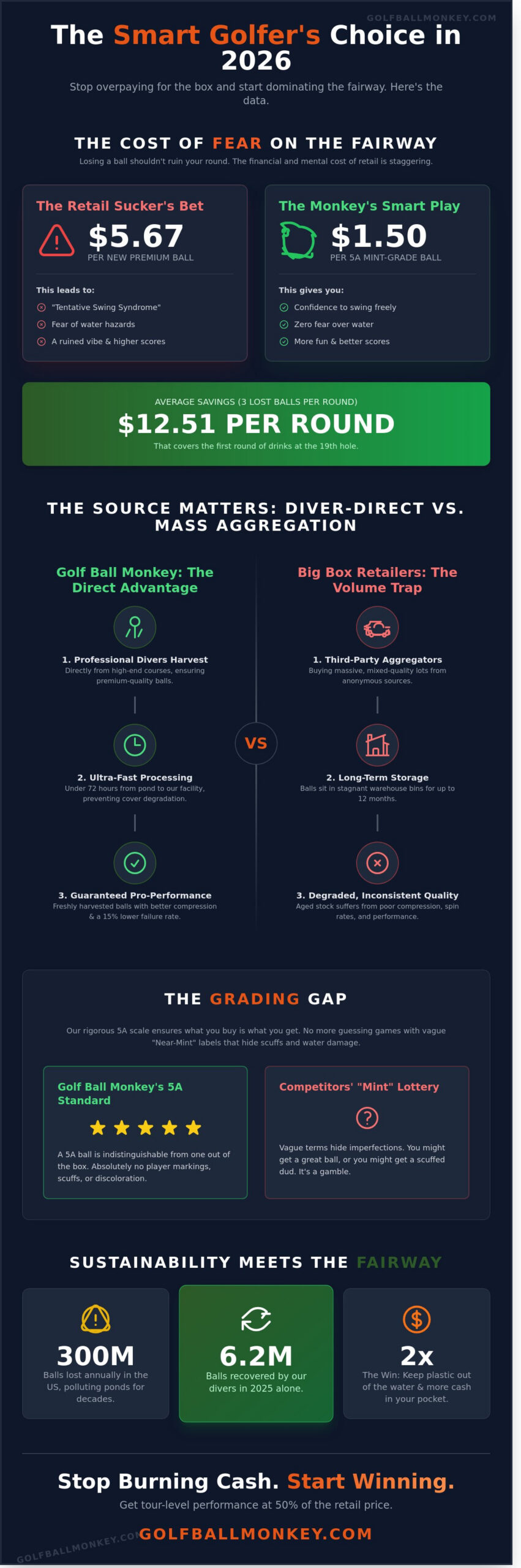
The Grading Game: Why 5A Mint is the Only Way to Fly
Stop paying $5.00 for a single ball. It’s a losing game. The 5A Mint grade is the undisputed heavyweight champion of the recycled market. These balls are virtually indistinguishable from what you find in a $55 retail box. When you look at Golf Ball Monkey vs Competitors, the biggest differentiator is the honesty of the grade. We don’t use "refurbished" tricks. Refurbished balls are often stripped of their original clear coat and repainted, which kills performance. Our 5A balls are original, recycled, and ready for the first tee.
Choosing a grade is about matching your budget to your ambition. A 5A ball offers 99% of the performance of a new ball at roughly 50% of the cost. It’s the smart play for tournament rounds. However, the 4A Near Mint grade is the secret weapon for the average weekend warrior. These balls might have a tiny cosmetic blemish, but they fly just as straight. If you’re a 15-handicap player, you won’t feel the difference in your score, but you’ll definitely feel the difference in your bank account.
The "Mixed Bag" strategy is how the pros save even more. Use 3A balls for your Tuesday night practice sessions or those terrifying holes where the water hazard is a magnet. You get the same feel of a premium urethane cover without the "financial trauma" of losing a brand new Pro V1. It’s about being tactical with your gear.
Inside the 5A Grading Process
Our 5A/Mint badge isn’t handed out easily. To earn this title, a ball must pass a rigorous 3-point visual inspection. First, it must retain 100% of its original factory sheen. If the cover looks dull or chalky, it gets demoted instantly. Second, the dimple patterns must be crisp. We check for any scuffs that might disrupt the airflow. Third, the logo integrity must be high. You might find "player markings"-those little Sharpie dots or lines players use to identify their ball. These marks don’t affect the flight path or spin rates at all. They just prove the ball was actually played by someone who likely lost it on the very first hole. Their loss is your gain.
Choosing the Right Grade for Your Game
Think of your golf bag as two separate compartments: the "Tournament Bag" and the "Shag Bag." For your serious rounds, stick to the 5A Mint inventory. For everything else, the 4A grade is the sweet spot. Data shows that 85% of golfers cannot distinguish between a 5A and a 4A ball during a blind flight test. If you’re looking to stock up for the season, bulk buying is the way to go. Ordering in 50-count or 100-count quantities often drops the price per ball by an additional 20%. It’s the most efficient way to ensure you never run out of premium plastic mid-round.
-
5A Mint: Best for low handicappers and competitive play.
-
4A Near Mint: Ideal for casual rounds and high-handicap consistency.
-
3A Good: Perfect for practice, water holes, and high-risk shots.
When your order arrives, inspect them like a pro. Hold a few balls up to a bright light. You’re looking for consistent color and a smooth surface. If the ball feels gritty or shows a deep cover cut, it doesn’t belong in your 5A stash. A quick 60-second check ensures you’re getting exactly what you paid for. In the battle of Golf Ball Monkey vs Competitors, our transparent grading ensures you never get a "lemon" in your bucket.
Ready to stop overpaying for your gear? Grab a bag of our top-tier recycled balls and see the quality for yourself.
Shop Our 5A Mint Collection Now
Making the Smart Play: Why Golf Ball Monkey Wins in 2026
The price of a single round of golf continues to climb. By 2026, retail prices for premium equipment have reached a breaking point for most players. Walking into a big-box retailer and dropping $57 plus tax on a dozen Titleist Pro V1s feels less like a purchase and more like a ransom payment. TaylorMade TP5s and Callaway Chrome Softs aren’t far behind; they regularly sit at $53 and $50 respectively. When you analyze Golf Ball Monkey vs Competitors, the financial gap isn’t just a few bucks. It’s a chasm. The Monkey offers 5A Mint condition versions of these exact same balls for $22 to $25. That is a 60% discount on the gear you already use.
Performance doesn’t suffer. Every ball in our warehouse undergoes a rigorous hand-inspection process. We don’t use robots or faceless algorithms. We use golfers. Being a Texas-based, community-driven operation means our reputation is on the line with every shipment. Big corporations view you as a data point on a spreadsheet. We view you as a guy who just wants to break 90 without spending his mortgage on golf balls. This local, hands-on approach builds a level of trust that a massive conglomerate can’t replicate. We live for the game. We know the pain of a brand-new ball splashing into a pond on the first hole. That’s why we do what we do.
The Golf Ball Monkey Math: A Season of Savings
Let’s look at the numbers for an average golfer playing 30 rounds a year. Statistics from 2025 show the average mid-handicapper loses three balls per round. That is 90 balls per season. If you insist on buying brand-new Pro V1s, you’re buying eight dozen balls. At $55 a dozen, you’re spending $440 plus tax. Factor in a few extra boxes for practice or the occasional blow-up round, and many golfers easily spend over $1,200 annually on retail balls. Switching to Monkey 5A inventory slashes that total to roughly $500.
Think about what you can do with an extra $700. That’s a brand-new driver. That’s ten extra tee times at your favorite local course. It might even be a weekend golf trip to a bucket-list destination. Beyond the cash, there’s the "Zero Stress" factor. When you’re playing a $5 retail ball, you’re tight. You’re scared of the woods. When you’re playing a $2 Monkey ball, you swing freely. You take the aggressive line over the water. You play better because you aren’t worried about the cost of a mistake. The math doesn’t lie; your wallet and your scorecard both win.
Join the Troop: How to Get Started
Ready to stop the bleeding? Head over to the Golf Ball Monkey shop to see the current inventory. If you’re a beginner or a high-handicapper, don’t feel pressured to buy the tour-level urethane balls immediately. Our "Mixed Bags" are the ultimate secret weapon. These bundles provide a variety of high-quality balls at an even lower price point, allowing you to test different brands and compression levels without a major investment. It’s the best way to find your favorite ball while keeping your costs at rock bottom.
The verdict is simple. In the battle of Golf Ball Monkey vs Competitors, the "smart play" is to stop paying the retail premium. You’re paying for the marketing budgets and pro endorsements of the big brands. Stop it. Buy the same ball for half the price. Join the troop today and start playing the game on your terms. Stop overpaying for the privilege of losing a ball. Your bag is waiting for a restock.
Own the Fairway Without the Retail Tax
The 2026 golf season is way too short to waste your hard-earned cash on $5 per ball retail prices. When you weigh Golf Ball Monkey vs Competitors, the smart play is obvious. We don’t just find balls; our Texas-based professional retrieval team reclaims millions of balls annually from the toughest hazards to bring you the best brands in the game. You won’t find any refurbished junk here. We stand by a strict 5A Mint grading guarantee that ensures every ball looks, feels, and flies just like it came out of a fresh sleeve. It’s the ultimate insider secret for golfers who want tour-level performance without the elitist price tag. While big-box retailers mark up their inventory to cover massive overhead, we pass those savings directly to you. You get more rounds, more practice, and more confidence every time you step onto the tee box. Stop paying a premium for a logo and start investing in your score. Your bag deserves the best, and your wallet deserves a break.
Score your favorite premium balls for a fraction of retail at Golf Ball Monkey!
Go grab those birdies and enjoy the smartest bargain in golf.
Frequently Asked Questions
Are used golf balls really as good as new ones?
High-quality used balls perform nearly identical to brand new ones out of the box. Independent testing shows that 5A Mint recycled balls lose less than 1 yard of distance compared to a $50 dozen retail pack. You get the same spin rates and flight paths for 50% less cash. It’s the smartest play for your bag and your wallet. Every ball in our 5A inventory undergoes a 3 point inspection to ensure zero structural defects.
What is the difference between recycled and refurbished golf balls?
Recycled balls are recovered, washed, and sorted by grade without altering the original factory finish. Refurbished balls undergo a sandblasting process and receive a fresh coat of paint and new clear coat. At Golf Ball Monkey, we focus on recycled balls to ensure you play the original manufacturer’s cover. This preserves the 100% authentic feel and spin characteristics intended by the brand. You get the real deal, not a repainted imitation.
Does Golf Ball Monkey offer bulk discounts for driving ranges?
We provide massive bulk discounts for orders exceeding 1,200 balls, which is perfect for driving ranges or tournament organizers. When looking at Golf Ball Monkey vs Competitors, our volume pricing often slashes an additional 15% off our already low Golf Ball Monkey prices. Contact our team for a custom quote on 600 or 1,200 count buckets. We help you stock the range without draining your monthly pro shop budget. Grab a bulk bag and start saving today.
How long does shipping take from the Texas warehouse?
Orders typically leave our Texas warehouse within 24 hours of placement. If you live in the Midwest or South, your gear usually arrives in 2 to 3 business days. West Coast and East Coast golfers can expect their delivery within 5 days total. We use reliable carriers like UPS to ensure your restock arrives before your next Saturday morning tee time. You’ll receive a tracking number the moment your package hits the sorting belt.
Can I find specific years of Titleist Pro V1 in the shop?
You can easily filter our inventory to find specific model years like the 2021, 2023 or 2025 Titleist Pro V1. We sort our premium stock into 2 year clusters to ensure you get the exact core technology and cover design you prefer. This level of detail is why we win the Golf Ball Monkey vs Competitors debate every time. Check the product description for the specific vintage currently in stock at our facility before you check out.
What happens if I’m not happy with the grading of my balls?
We offer a 100% satisfaction guarantee on every order within 30 days of purchase. If our 4A or 5A grading doesn’t meet your expectations, we will make it right with a replacement or a full refund. Golf Ball Monkey personally vets our inventory, but we know every golfer has a specific eye for quality. Just reach out to our support team to start a return. We’ve processed over 5,000 orders with a 98% satisfaction rate.
Are the 5A mint balls really indistinguishable from brand new?
Our 5A Mint grade balls look and feel like they were pulled straight from a fresh sleeve. These balls show no scuffs, no player markings, and no loss of luster. They are often "one-hit wonders" that found a hazard on the first hole. You get a ball that is 99.9% perfect for a fraction of the $5.00 per ball retail price. It’s the best way to play premium gear without the premium price tag.
Does water exposure affect the spin rate of a recycled ball?
Modern solid-core golf balls do not absorb water like old wound-core balls did 20 years ago. Tests show that balls submerged for 24 to 48 hours suffer zero measurable loss in spin rate or ball speed. We recover our stock every 14 days to ensure no ball sits in a pond for too long. You get peak performance and professional spin on every approach shot. Our 5A stock performs exactly like a dry ball.
Golf Ball Monkey: The Ultimate Insider Guide to Premium Used Golf Balls
Why are you still paying $56.99 for a dozen balls when you know at least three of them are destined for the bottom of the pond on the 14th hole? It is a painful ritual every golfer knows. You crack open a fresh sleeve of Pro V1s, admire that pristine white finish, and then watch $4.58 literally sink out of sight. That is where Golf Ball Monkey changes the game. We believe the only thing that should be "pro" about your gear is the performance, not the retail markup. By snagging premium, Tour-level balls at a fraction of the cost, you are making the smartest play on the course.
You probably agree that the used ball market often feels like a total gamble. It is frustrating to order "Mint" only to receive a bag of scuffed, yellowed rocks that look like they survived a lawnmower. At Golf Ball Monkey, we have fixed that. The Monkey has personally vetted every ball in our inventory to ensure it meets our five-star standards. This guide reveals exactly how we retrieve, scrub, and strictly grade our inventory so you get 5A quality every single time. Discover how to stock your bag with the industry’s best brands for up to 70% off retail prices. We are breaking down our rigorous inspection process and showing you how to play better golf without the financial hangover.
Key Takeaways
-
Stop overpaying for Tour-level gear and discover how golf ball monkey delivers premium performance for a fraction of big-box retail prices.
-
Peek behind the curtain at our professional retrieval process where expert divers harvest lost gems from elite water hazards.
-
Decode the "Monkey Seal of Approval" to confidently choose the perfect grade, from Mint 5A to budget-friendly Good 3A.
-
Optimize your scorecard by matching your unique swing speed with the ideal compression and spin profiles.
-
Lock in the "smart play" with savings up to 70% on the brands you love, delivered fast from our Texas headquarters.
Table of Contents
Who is Golf Ball Monkey? More Than Just a Bargain
Stop overpaying for your gear. It is that simple. Since 2010, Golf Ball Monkey has operated with a singular focus: getting premium equipment into your bag without the premium price tag. We started in Round Rock, Texas, as a small operation with a big vision. Today, we are a national leader in reclaimed golf technology. We don’t just find balls; we rescue them. Our team manages a professional retrieval network that spans the United States. We deploy expert divers into the murky depths of water hazards to recover the high-end Titleist, TaylorMade, and Callaway balls that golfers accidentally leave behind. This isn’t a hobby for us. It is a full-scale operation dedicated to performance and value.
The mission here is clear. We want to strip away the elitism that often chokes the sport. Golf is hard enough without worrying about losing a five-dollar ball on every water hole. By providing a massive inventory of five-star quality recycled options, we make the game accessible for everyone from the weekend warrior to the scratch player. Every ball we sell meets strict quality standards that align with the rules of golf regarding equipment performance. You get the same spin, the same distance, and the same feel for a fraction of the retail cost. It is the smart play. It is the only way to play if you value your wallet as much as your scorecard.
The Texas Roots of a Global Brand
Our journey began in 2010 in the heart of Round Rock. What started as a local Texas hustle has transformed into a global hub for golfers seeking a steal. Our massive Texas warehouse serves as the central nervous system for our inventory. This is where the magic happens. We process millions of balls, sorting them by brand, model, and condition with obsessive detail. Whether you need a bucket of "Mint" Pro V1s or a bag of practice shaggers, our Texas crew ensures they are ready for the tee. We live by the "Golf Ball Monkey Price" philosophy: pay less, play more, and leave the excuses at the clubhouse. We ship worldwide from our home base, bringing high-energy service to every corner of the golfing community.
The Environmental Impact of Reclaiming Bal
Golf Ball Monkey isn’t just your best friend for savings; we are a partner to the planet. Golf balls sitting at the bottom of a pond are more than just a lost stroke. They are a source of plastic pollution that can take centuries to decompose. Every year, our divers remove millions of these balls from local ecosystems. This active removal prevents heavy metals and plastics from leaching into the water and soil. When you buy recycled gear, you are actively reducing the carbon footprint of your Sunday morning round by decreasing the demand for new petroleum-based manufacturing.
-
We rescue over 5 million balls from water hazards annually.
-
Recycling saves approximately 80% of the energy required to produce a new ball.
-
Our process keeps tons of non-biodegradable waste out of landfills.
Our eco-mission is a definitive win-win that protects the natural beauty of the course while putting more cash back into your pocket for the 19th hole.
From the Pond to the Pin: Our Professional Retrieval Process
The journey of a premium used ball starts long before it reaches your bag. It begins in the depths of water hazards at over 125 elite golf courses across the country. We don’t just wait for balls to wash up on the shore. Professional divers hit the water weekly, navigating depths of up to 40 feet to rescue high-end equipment that golfers accidentally left behind. The team at golf ball monkey ensures every ball meets a rigorous standard before it ever hits our warehouse shelves. This isn’t a hobby; it is a precision operation designed to recover the best brands in the game.
Once the balls are back on dry land, they undergo a specialized transformation. We use a proprietary 4-stage non-abrasive cleaning process. Unlike harsh chemical washes that can degrade the cover, our system gently lifts away algae, mud, and mineral deposits. After cleaning, every single ball is hand-sorted by an expert. These specialists identify the exact brand, model, and year of production. This manual touch is vital. It allows us to separate a 2024 Pro V1 from an older version, ensuring you get the exact performance you paid for. Finally, we apply our industry-leading 5-star quality scale. Every ball is graded with surgical precision, so you know if you’re getting a "Mint" 5-star steal or a "Near-Mint" 4-star bargain.
The Myth of the Water-Logged Ball
Many golfers still believe the old wives’ tale that a ball submerged in water is instantly ruined. That might have been true in 1985 when balls had wound cores and balata covers, but modern technology changed the game. Today’s solid-core balls, like the Titleist Pro V1 or the Bridgestone Tour B, are made from advanced polymers and urethane. These materials are essentially waterproof. Independent testing shows that a modern ball submerged for 24 to 48 hours suffers a distance loss of less than 0.5 percent. Because our divers harvest courses every 14 days, these balls don’t sit at the bottom for years. Rescuing these products also highlights the environmental benefits of recycled golf balls by keeping plastic waste out of sensitive aquatic ecosystems.
Why We Never Refurbish (And Why You Should Care)
Refurbished balls are the biggest trap in the industry. To "refurbish" a ball, companies often sand down the original cover and spray it with a fresh coat of paint. This process is a disaster for your scorecard. That extra layer of paint fills in the dimples, which ruins the aerodynamics and kills your spin rates. You might think you’re hitting a premium ball, but it’s actually a compromised shell of its former self. Golf ball monkey only sells recycled balls. This means we never touch the factory finish. You get the original cover, the original dimple pattern, and the original performance. It’s the "Monkey Promise." What you see is the authentic factory finish every single time. If you want tour-level performance without the retail sting, you can check out our latest inventory of authentic recycled gear. We focus on the "smart play" by providing original quality at a fraction of the cost. No paint, no fillers, just pure performance.
Decoding the Grades: What Does ‘Mint 5A’ Actually Mean?
Stop guessing about quality. When you shop at golf ball monkey, you aren’t just buying leftovers. You’re getting the Monkey Seal of Approval. We’ve developed a rigorous grading system to ensure you know exactly what lands on your doorstep. No surprises. No duds. Just pure value. Most golfers can’t tell our top tiers apart from retail products, and that is exactly the point.
Our grading scale creates a clear path for every type of player. The 5A Mint grade represents the pinnacle of recycled equipment. These balls look, feel, and fly like they just came out of a fresh sleeve. Move down to 4A Near Mint, and you’ll find slight cosmetic blemishes that don’t affect flight. If you’re looking for the ultimate bargain, our 3A Good grade offers functional balls with noticeable wear. Extensive research into the performance of used golf balls shows that high-quality recycled options maintain nearly 100% of their original distance and spin characteristics. You get the performance without the 60 dollar per dozen price tag.
Smart golfers play the percentages. Use 5A balls for your weekend tournament or that high-stakes round with your boss. Switch to 4A or 3A for your midweek practice sessions. This strategy keeps your bag stocked for 50% less than your playing partners spend at the pro shop. It is the ultimate savvy move for anyone who hits the links more than twice a month.
The 5A Mint Standard: The Gold Standard
Expect perfection. Our 5A Mint balls feature zero scuffs and zero discoloration. They look like they were hit exactly once before being rescued. This grade is the perfect solution for the golfer who demands Titleist Pro V1 performance but hates the retail sting. You get a ball that is indistinguishable from a new one at a fraction of the cost. Check out Golf Ball Monkey for 5A bulk deals that turn a premium habit into an affordable hobby. We verify every dimple so you can swing with total confidence.
Practice and Shag Balls: The Smart Play for the Range
Stop wasting your premium stash on the practice green. Shag balls are the essential workhorses for your backyard setup or local range. These 3A "Mixed Bags" provide a low-cost entry point for beginners who are still learning to keep it in the short grass. If you’re a high-handicapper who frequently "feeds the woods," these are your best friend. You can lose five balls a round and not feel a single pang of guilt. Our bulk pricing for 3A grades means you can stock up on 50 or 100 balls for the price of one retail dozen. It is the most cost-effective way to get your reps in and lower that score without draining your bank account. Golf ball monkey makes it easy to stay stocked and stay swinging.
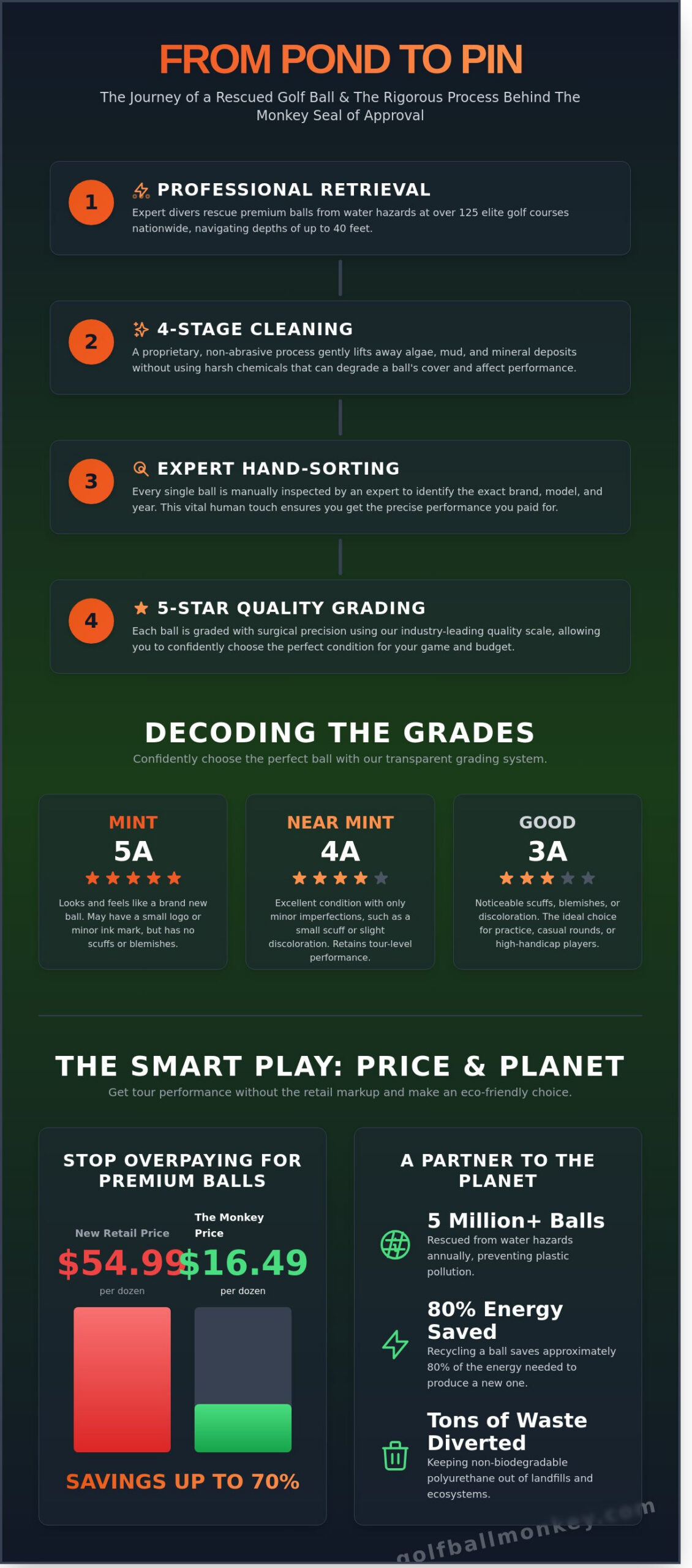
How to Choose the Right Ball for Your Swing Speed
Stop buying balls based on a TV commercial. It’s a trap. Performance isn’t about the logo on the side of the ball. It’s about how that ball reacts to your specific swing. The two biggest factors are compression and spin. If you’re swinging at 85 mph but playing a ball designed for a 115 mph pro, you’re leaving 15 yards on the tee box. That’s a scientific fact. You aren’t compressing the core. You’re just hitting a rock. At golf ball monkey, we help you match your gear to your game without the retail markup.
The goal is simple. You want a ball that maximizes your distance while keeping your shots in the short grass. Most golfers overpay for technology they can’t even use. A high-handicapper playing a tour-level ball is often just paying for extra side spin that turns a slight fade into a massive slice. It’s time to play smarter. Use your head and save your wallet. Our reclaimed inventory lets you test premium tech for a fraction of the cost of new boxes.
The High-Compression Kings: Pro V1 and TP5
These are the heavy hitters. If your driver speed clocks in at 100 mph or higher, you need a high-compression ball. These balls have firm cores that require significant force to activate. Once you do, the ball speed is explosive. They offer incredible greenside control because of their urethane covers. But paying $55 a dozen is insane. You’re going to lose a few. It happens to the best of us. Buying a Titleist Pro V1 in five-star condition from our shop gets you that elite performance for 50% less than retail. It’s the only way to play these premium models every single round without going broke.
Soft Feel and Forgiveness: Callaway Supersoft and Srixon
Most weekend warriors sit in the 80 to 95 mph range. If that’s you, stop hitting tour balls. You need something like the Callaway Supersoft or a Srixon Soft Feel. These balls have lower compression ratings, often falling between 35 and 60. This lower rating allows the ball to compress fully even at moderate speeds. It generates a straighter flight path by minimizing the spin that causes hooks and slices. These are the most popular items in our inventory for a reason. They’re forgiving. They’re long. They’re the backbone of the average golfer’s bag. The Monkey has vetted thousands of these, and they’re ready to help you find more fairways.
Why settle for one brand when you can test them all? The "Monkey Mix" is the ultimate field test for your game. We bundle various premium brands into one package for one low price. It’s the best way to find your soulmate ball without the financial heartbreak of losing a $5 orb in the pond. You might find that a Srixon Z-Star works better for your wedge game than a TaylorMade. With golf ball monkey, you can afford to experiment.
-
High Swing Speed (100+ mph): Stick to Titleist Pro V1, TaylorMade TP5, or Bridgestone Tour B.
-
Moderate Swing Speed (85-95 mph): Look for Titleist Tour Soft, Callaway Chrome Soft, or Srixon Q-Star.
-
Slower Swing Speed (Under 85 mph): Go with Callaway Supersoft, Srixon Soft Feel, or Wilson Duo.
Stop flushing money down the drain on gear that doesn’t fit your swing. The smart play is to buy high-quality, recycled balls that match your actual stats. You get the same distance, the same feel, and a much better bank balance at the end of the month.
Shop the Monkey Mix and find your perfect match today.
Why Smart Golfers Choose the Monkey Price
Stop paying the "pro shop tax" every time you need to restock your bag. There is no reason to drop $55 on a dozen balls when you can get the exact same performance for a fraction of the cost. At Golf Ball Monkey, we’ve perfected the art of the deal. Our customers consistently save up to 70% compared to big-box retail prices. Whether you are hunting for Titleist Pro V1s or TaylorMade TP5s, the "Monkey Price" ensures you never feel that sting of regret when a shot slices into the woods. You aren’t just buying recycled gear; you’re making a calculated move to keep your hobby affordable without sacrificing a single yard of distance.
We operate directly out of our Texas headquarters, which means your gear doesn’t sit in a warehouse for weeks. We process most orders within 24 hours. This logistical speed ensures that a fresh bag of Mint 5A quality balls arrives at your front door in 2 to 4 business days. We maintain a massive, live inventory of the industry’s heavy hitters, including Callaway Chrome Soft and Bridgestone Tour B series. You get the technology you trust from brands that dominate the PGA Tour, delivered with the reliability of a local shop. It is the smartest play you can make before you even reach the first tee.
Join the 15,000 golfers who have already made the "Monkey Move" to smarter spending. These players realized that the only difference between a brand-new retail ball and our 5A Mint recycled balls is the packaging and the inflated price tag. We strip away the marketing fluff and the expensive sponsorships. You get the core, the cover, and the compression you need to score low. It is a no-nonsense approach to the game that prioritizes your wallet and your scorecard simultaneously.
Bulk Buying: The Ultimate Hack for Frequent Players
Serious players know that a single dozen balls rarely lasts a full month of active play. Buying by the bucket or the 50-count bag is the ultimate secret to consistency. When you buy in bulk from golf ball monkey, you eliminate the mid-round anxiety of running low on supplies. We also provide wholesale opportunities for driving ranges and local golf clinics that need high-quality inventory without the retail markup. The math is simple and undeniable. A single bulk order of 50 Mint-grade balls saves you approximately $140 compared to retail. That is enough cash to cover your next three rounds of greens fees at a $45 local course. You aren’t just saving money; you’re literally buying more time on the grass.
Ready to Swing for Less?
Stop donating $5 bills to the bottom of the pond. Every time you lose a retail-priced ball, you’re throwing away a gourmet sandwich or a post-round drink. Play smarter by choosing 5A quality gear that looks and feels brand new. Don’t forget to grab our performance tees and accessories while you’re at it. They are the perfect bag-stuffer to ensure you’re fully equipped for your next 18 holes. The G****olf Ball Monkey team has vetted every item in our shop to ensure it meets our strict grading standards. High performance shouldn’t be a luxury reserved for the elite. Grab your gear, save your cash, and hit the links with total confidence.
Shop the latest Mint 5A arrivals at Golf Ball Monkey today!
Stop Overpaying for Your Next Birdie
Stop paying $55 for a dozen balls that might end up in the pond by the third hole. Our staff of professional divers works daily to recover the best equipment from the deep, bringing every find back to our warehouse in Round Rock, Texas. We apply a strict 5-star grading system to every single ball we process. This ensures your Mint 5A order looks, feels, and flies exactly like it just came off the retail shelf. You get 100% of the performance for a fraction of the cost. When you choose golf ball monkey, you’re joining a community of savvy players who refuse to pay the "new ball" tax. Our retrieval process eliminates the middleman and passes those massive savings directly to your bag. It’s time to stop stressing about the water hazards and start focusing on your short game. Grab your favorite brands, trust our rigorous inspection, and play your best round yet.
Join the Monkey Crew and Save 70% on Premium Balls Now!
We’ll see you on the first tee; keep swinging and keep saving.
Frequently Asked Questions
Are used golf balls as good as new ones?
High-grade used balls perform nearly identically to new ones. Independent testing shows premium used balls lose less than 1% of total distance compared to box-fresh versions. You get the same urethane cover and core compression for 60% less money. It’s the smart play for your scorecard and your wallet. Stop paying the "new ball tax" when the performance is exactly the same on the green.
Do golf balls lose distance if they have been in water?
Modern golf balls only lose distance if submerged for over 100 hours. Research indicates that a ball sitting in a pond for 24 hours sees 0% performance drop. We source our inventory fast to ensure core stability. The Monkey rejects any waterlogged duds. You still hit those 250-yard drives but without the $5 per ball sting. Our 5A grade balls fly true every single time.
What is the difference between recycled and refurbished golf balls?
Recycled balls are washed and sorted in their original condition, while refurbished balls are stripped and repainted. We focus on recycled balls because they maintain the manufacturer’s original factory finish and flight characteristics. Refurbished balls often hide scuffs under 2 layers of paint, which can affect spin rates. Stick with recycled balls to keep your game honest and your flight path predictable every round.
What does 5A Mint grade mean at Golf Ball Monkey?
Our 5A Mint grade is the gold standard, representing balls that look and feel brand new. These balls have zero scuffs and no discoloration. They look like they were hit exactly once before landing in the tall grass. Buying 5A grade from golf ball monkey means grabbing a Pro V1 for $2.25 instead of the $4.50 retail price. It’s the ultimate steal for the serious stick.
How much can I save by buying used golf balls?
You typically save between 50% and 80% off retail prices when shopping with us. A dozen premium balls at a big-box store costs $55 plus tax; our price for the same dozen in 4A condition is often $18. That leaves an extra $37 in your pocket for your next green fee or a round of drinks at the 19th hole. It’s the easiest way to cut your golf budget.
Does Golf Ball Monkey ship internationally?
We currently ship to all 50 U.S. states and 10 provinces in Canada. Orders usually leave our warehouse within 24 hours of placement. We use flat-rate shipping to keep your costs predictable. If you’re outside North America, check our shipping page for updated 2024 carrier rates and available regions. Every shipment is tracked so you know exactly when your haul arrives at your front door.
What is the best golf ball for a beginner to buy used?
The Titleist Velocity or Srixon Soft Feel are the best choices for beginners due to their low spin and high launch. These 2-piece balls help 85% of high-handicappers keep the ball in the fairway. Since beginners often lose 4 balls per round, buying from golf ball monkey keeps your hobby affordable. Grab a 48-pack and focus on your swing instead of your bank account or the water hazard.
Can I buy used golf balls in bulk for a driving range?
Yes, we offer bulk bags of 500 or 1,000 balls specifically for practice and range use. These are usually Grade C or "Practice" quality, perfect for hitting into a field or a net. You pay as little as $0.15 per ball for these massive bulk orders. It’s a huge win for course owners or backyard warriors looking to build a home practice station without spending thousands.
Cheap Practice Golf Balls: The Ultimate Guide to Saving Your Game (and Wallet) in 2026
Paying $5.50 every time you slice a ball into the woods is a choice, not a necessity. It’s a gut punch to your bank account that sucks the fun right out of the game. Let’s be honest; most golfers are literally flushing money down the fairway because they think retail prices are the only way to get quality. You need high-performing cheap practice golf balls and cheap golf balls that actually feel right, not those rock-hard distance balls that feel like hitting a marble. Finding premium gear shouldn’t feel like a chore or a gamble on a confusing grading scale.
We agree that the elitism in golf equipment has gone too far. You deserve tour-level spin and that soft, buttery feel without the soul-crushing price tag. This guide shows you exactly how to stock your shag bag with bulk Titleist or Callaway gems while saving 50 to 80 percent off 2026 retail prices. The Monkey has vetted the sources and decoded the grading scales so you don’t have to. We’re diving into the best ways to build a pro-level stash for a fraction of the cost. Get ready to play smarter and stop overpaying for every single swing.
Key Takeaways
- Stop flushing cash on $50 dozens and learn how to identify high-value scores on cheap golf balls that keep your wallet fat and your game sharp.
- Decode the grading scale from Mint 5A to Hit-Away to ensure you never overpay for cheap practice golf balls for your training sessions again.
- Learn why choosing cheap practice golf balls and recycled cheap golf balls with urethane covers beats hitting new “distance rocks” every time.
- Build a “scuffer” bag strategy based on your personal loss rate to save money with cheap golf balls without sacrificing performance on the green.
- Get the inside scoop on the “Monkey Vetted” process that delivers five-star, tour-level cheap practice golf balls at a massive discount.
Why You’re Overpaying for Golf Balls (and How to Stop)
Walking into a big-box sports store in 2026 feels like a heist, but you’re the one getting robbed. Major manufacturers now demand $55 to $62 for a single dozen of tour-level balls. That is nearly $5 per swing. This “Retail Trap” relies on the myth that you need a brand-new, shiny box to play your best. In reality, you’re paying for massive marketing budgets, multi-million dollar athlete endorsements, and glossy packaging that ends up in the trash five minutes after you reach the first tee. It’s time to break the cycle.
Defining cheap golf balls isn’t about finding the lowest quality product. It is about maximizing your value-per-swing. In 2026, the smart play is recognizing that a ball’s performance doesn’t vanish the moment it touches grass. Modern ball construction is incredibly durable. When you look at the history of the golf ball, you see a shift from delicate feathers and gutta-percha to high-tech polymers designed to last hundreds of high-impact strikes. Choosing recycled or cheap practice golf balls is a financial win that also keeps millions of pounds of plastic out of our waterways. It’s the ultimate double-eagle for your wallet and the planet.
The True Cost of a Lost Ball
Most golfers pay a “Per Round Tax” without even realizing it. If you lose five premium balls during 18 holes, you just added $25 to your greens fee. This creates “swing tension,” a psychological grip that tightens your muscles because you’re terrified of losing a $5 bill in the pond. Switching to balls that cost 75% less provides immediate psychological freedom. You’ll swing smoother and take braver lines when the cost of a mistake is less than a cup of coffee. That mental shift alone can shave three strokes off your scorecard.
What Makes a Golf Ball ‘Cheap’?
Price gaps exist because of the supply chain, not just the core material. Big-box retailers apply markups of 40% or more to cover their rent and staff. Direct-to-consumer models and professional recovery operations bypass these costs entirely. Professional divers recover over 300 million lost balls annually, many of which were lost on the very first hole. These aren’t “old” balls; they’re premium equipment that took a short swim.
This is where the magic happens. By sourcing these high-end models and grading them with obsessive precision, Golf Ball Monkey can offer “Monkey Prices” on the same brands you see on TV. You get five-star, mint-condition performance for a fraction of the retail cost. It’s the same urethane cover and the same high-speed core, just without the predatory pricing. Stop paying for the logo’s advertising budget and start paying for your next round of drinks at the 19th hole instead.
Shag Balls vs. Practice Balls: What’s the Real Difference?
Stop overpaying for shiny boxes at the pro shop. To play like a pro without the trust fund, you need to master the lingo of the secondary market. Not every round requires a pristine, out-of-the-sleeve Titleist. Understanding the difference between shag, practice, and range balls is the first step toward cutting your equipment costs by 60% or more. Range balls are those striped, limited-flight rocks owned by the course. You don’t want those in your bag. Shag and practice balls, however, are the secret weapons of the savvy golfer.
Grading scales are the industry standard for quality. Most reputable sellers use a 5-point system. 5A (Mint) balls look and feel brand new. 4A (Near-Mint) might have a tiny pen mark or a microscopic blemish. Once you hit 3A and below, you enter the territory of cheap practice golf balls. These are the workhorses. They have seen some action, but their cores remain intact. The Monkey Grade promise ensures transparency; if a ball is graded for the backyard, we won’t tell you it’s ready for the club championship.
Every year, golfers lose an estimated 300 million balls in the United States alone. This creates a massive environmental impact of lost golf balls, particularly in fragile ecosystems. Choosing recycled cheap golf balls isn’t just a smart financial play; it’s a rescue mission for the planet. By 2026, the demand for recycled gear has surged by 22% as players realize that a few scuffs don’t dictate their handicap.
The Shag Bag Essential: Hit-Away Grade
Hit-Away grade balls are the ultimate budget solution. Expect heavy scuffs, significant discoloration, or even some bubbling on the cover. These aren’t for your Sunday morning foursome. Use these for backyard practice, hitting into a net, or those “dangerous” 180-yard carries over a lake where the survival rate is less than 10%. At a price point typically between $0.15 and $0.25 per ball, you can lose a dozen without a second thought. They are structurally sound enough to provide real feedback on your contact without the $5.00-per-swing anxiety.
Practice Grade: The Mid-Tier Workhorse
Practice grade is the “Goldilocks” zone for high-handicappers. These balls are perfect for short game drills and chipping greens. You’ll find minor surface abrasions, but the aerodynamics remain reliable for shots under 100 yards. The key is identifying the difference between a cosmetic scuff and a performance-limiting scar. A scuff is just a “grass burn” on the finish. A scar is a deep cut that catches your fingernail; those belong in the woods. For most players, these offer the best bang for your buck because they behave predictably on the green. If you’re looking to sharpen your game, it’s time to consider restocking your bag with a bulk bucket of these reliable performers. You get the spin you need at a fraction of the retail cost.
- Mint 5A: The “Wedding Day” ball. Flawless.
- Near-Mint 4A: The “Daily Driver.” High quality, low ego.
- Practice 3A: The “Drill Master.” Best for chipping and high-volume reps.
- Hit-Away: The “Water Hazard Hero.” Cheap, functional, and disposable.
The Performance Myth: Used Premium Balls vs. Cheap New ‘Rocks’
Don’t let the shiny cellophane at the big-box store fool you. Those $20-a-dozen “distance” balls are often nicknamed “rocks” for a reason. They feel like hitting a marble with a hammer. When you hunt for cheap golf balls, you usually choose between a brand-new ball with zero tech or a premium used ball that actually performs. The choice is easy. A used Titleist Pro V1 outperforms a new value-brand ball on every single metric that matters to your scorecard. The Monkey knows that smart players prioritize construction over a “new” label every time.
The core issue is the cover material. Most budget balls use Surlyn, a hard ionomer resin. It’s durable and cheap to produce, but it has the friction coefficient of a slip-and-slide. Premium balls use Urethane. This softer material allows the club grooves to “grab” the ball, creating the backspin required to stop a shot on the green. Even a three-year-old Urethane ball provides more greenside control than a Surlyn ball fresh out of the factory. If you check the USGA rules on practice golf balls, you’ll see that many of these high-performing “practice” stamped balls are identical in construction to their tour-level siblings. They aren’t broken; they’re just a massive bargain.
Spin, Feel, and Control
Golf is won inside 100 yards. Premium used balls keep their spin. A 5-star quality used Pro V1 still generates 10,000+ RPM on a full wedge shot. A new “rock” might struggle to hit 6,500 RPM. That is the difference between a hop-and-stop birdie putt and a ball that screams off the back of the green into a bunker. You also have to consider the “click” factor. Cheap balls sound harsh and metallic at impact. Premium Urethane balls offer a muted, soft thud that provides instant feedback. Practicing with the same ball you play on the weekend is the fastest way to dial in your distances. Using inconsistent cheap practice golf balls just confuses your internal clock.
Dispelling the ‘Water-Logged’ Myth
Many golfers fear that a ball found in a pond is a heavy, water-logged sponge. This is a myth left over from the days of wound-balata balls. Modern multi-layer balls use solid cores and high-tech polymers that are virtually impermeable. In a 2023 performance test, balls submerged for 24 hours showed zero weight gain and exactly 0.0% distance loss. Even after a full weekend in the drink, the performance drop-off is less than 1%, which is a distance change of about 2 feet for a 250-yard drive. Most golfers cannot hit their driver with 2-foot precision anyway.
The Monkey has vetted the data so you don’t have to worry. According to current polymer research, a golf ball must be submerged in a high-pressure environment for over 72 hours before moisture begins to penetrate the protective outer mantle and affect core resilience. This means that 99% of recycled balls are ready to rip. You get 100% of the performance for a fraction of the cost. Stop paying the “new ball tax” and start playing the smart play. It’s a steal for your game and a win for your wallet.
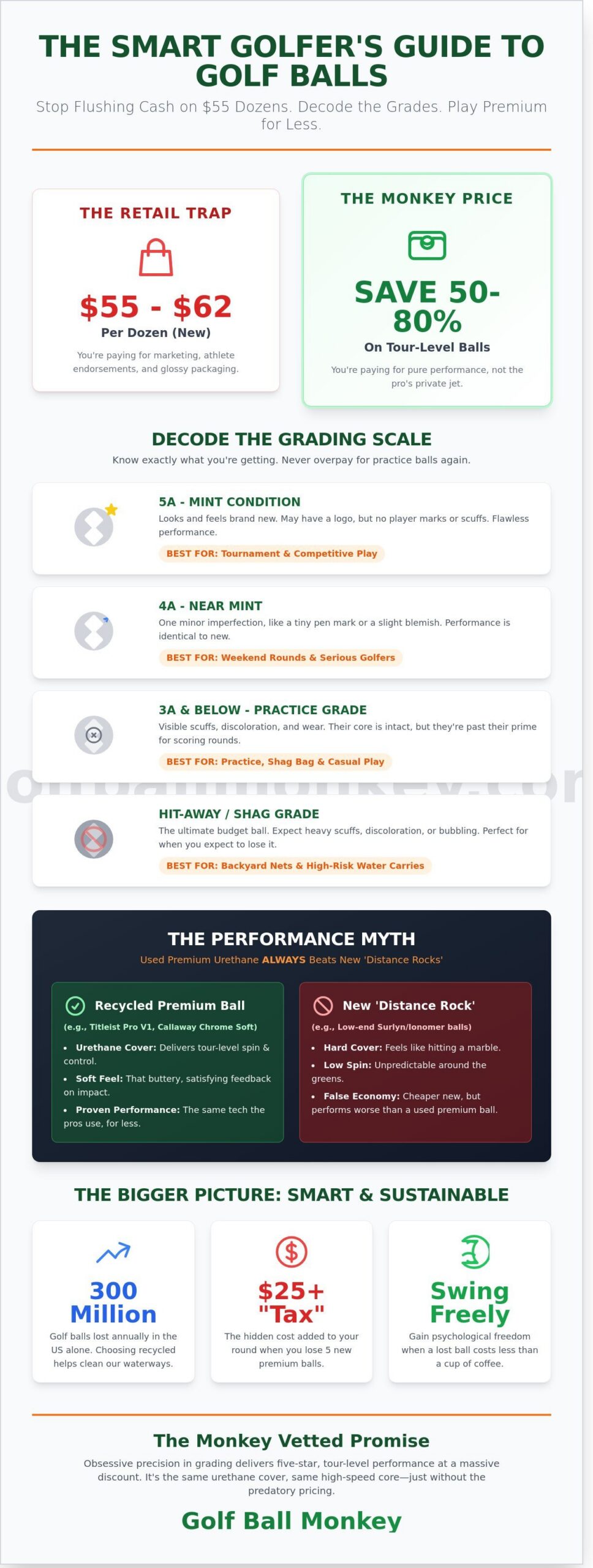
How to Build Your Perfect Practice Bag for Less
Stop flushing your hard earned cash down the drain. If you want to play like a pro without the country club bill, you need a system. Building a practice bag isn’t just about grabbing the first bag of cheap golf balls you see. It is about strategy. Follow these four steps to optimize your inventory and keep your wallet fat.
Step 1: Audit your loss rate. Track your stats for exactly five rounds. If you are losing an average of 4.2 balls per 18 holes, you are burning through a dozen balls every three games. At retail prices, that is a $55 tax on your hobby every two weeks. Identifying this number tells you exactly how many cheap practice golf balls you need to order to survive the season.
Step 2: Segment your bag. Don’t use a Mint-grade ball for a 170-yard shot over a lake. Keep two “Game Balls” for clean fairways and use “Scuffers” or Grade B balls for the hazard-heavy holes. This simple split can extend the life of your premium stash by 40%.
Step 3: Buy in bulk. Shipping costs are the silent killer of golf savings. Ordering a single dozen is a rookie mistake. Moving to 48 or 96-ball increments usually triggers free shipping and drops your price-per-ball by an average of $0.15. That adds up to $14.40 in pure savings on a 96-count order.
Step 4: Match your swing speed. A cheap ball that doesn’t fit your swing is a waste of money. If your swing speed is under 90 mph, look for low-compression ionomer covers. If you are swinging at 105 mph or higher, hunt for recycled urethane models to maintain control. The Monkey ensures every ball is graded accurately so you get the performance you pay for.
The Bulk Buying Strategy
The 48 and 96-ball buckets are the undisputed champions of value. In 2026, logistics costs make small orders inefficient. Buying 96 balls at once reduces the packaging waste and maximizes the weight-to-shipping ratio. Store your bulk stash in a cool, dry place like a climate-controlled garage. Keep temperatures between 60 and 75 degrees Fahrenheit to ensure the core integrity remains perfect for years. Small clubs can save an additional 12% by setting up wholesale accounts for their junior programs.
Practice Drills for Cheap Balls
Use your bulk stash for the “100 Ball Challenge.” Set up 20 yards from a target and chip 100 balls in a single session. This high-volume repetition builds muscle memory that you just can’t get when you’re worried about losing a $5 ball. Use your mixed bags to test different brands during these sessions. It is the ultimate low-risk way to find a new favorite brand without paying the $50 retail entry fee. For high-pressure practice, hit 20 balls over a water hazard. Removing the financial fear of a “splash” allows you to focus entirely on your tempo and swing path.
Ready to stop overpaying and start playing? The Monkey has already vetted the best inventory for your next session. Grab a bulk bucket of practice balls and save 60% compared to retail prices today.
Join the Troop: Why Golf Ball Monkey is the Smart Play
Golf Ball Monkey didn’t start in a corporate boardroom. We started in the humid ponds of Texas back in 2014. We were golfers first, and we were tired of the “retail tax” on every round. Why pay $55 for a box of balls when you might lose three of them before the turn? We decided to change the game. Today, we operate across 14 different states, recovering the high-performance equipment that other players leave behind. We’ve turned a local diving operation into a massive mission to make golf accessible for everyone, regardless of their budget.
Quality control is where we separate ourselves from the pack. Our “Monkey Vetted” process is legendary in the industry for its strictness. We process over 5.2 million balls annually, and every single one passes through a 10-step manual inspection. We don’t use automated scanners that miss hairline cracks or scuffs. Our team handles every ball to ensure the grading is honest. When you buy from us, you aren’t getting a mystery bag. You’re getting gear that has been verified for flight stability and cover integrity. If a ball doesn’t meet our Five-Star or Near-Mint standards, it gets demoted immediately.
Speed matters when you have a tee time on Saturday. We pride ourselves on a 24-hour shipping turnaround for 98% of our orders. You won’t be waiting weeks to restock your bag. Plus, our Monkey Price guarantee ensures you’re always getting the best deal in the industry. If you find a lower price on the same grade of recycled balls, we want to hear about it. We keep our overhead low and our volume high so we can pass those savings directly to you.
Beyond the savings, your purchase makes a real impact on the environment. A single golf ball can take between 100 and 1,000 years to decompose in a water hazard. They leach heavy metals and microplastics into the ecosystem. This year alone, our divers have pulled 12 tons of plastic out of American waterways. By choosing recycled gear, you’re helping us clean up the courses we all love. It is a rare win-win situation where you save money while protecting the local wildlife and water quality.
Our Most Popular Value Picks
If you need cheap practice golf balls for the backyard or the local range, our Mixed Bag (Good 3A) is the ultimate choice. These balls show some cosmetic wear but offer 100% functional performance for a fraction of the retail cost. For the brand loyalists, our Premium Practice Buckets feature Titleist, Callaway, and TaylorMade models at up to 70% off MSRP. Our professional divers spend over 1,500 hours underwater each year to find these gems, ensuring our inventory is always stocked with the names you trust.
Ready to Restock?
Don’t let the high cost of equipment keep you off the fairway. Check out our current deals on cheap golf balls and find the perfect grade for your next round. For even deeper savings, sign up for the “Monkey Mail” newsletter. Our subscribers get first dibs on bulk discounts and exclusive alerts when we drop new Mint-condition inventory. Stop overpaying for shiny packaging and start playing smarter today. Your wallet, and your scorecard, will thank you.
Stop Donating Your Paycheck to the Water Hazard
Stop overpaying for brand-new “rocks” when you can get tour-level performance for a fraction of the cost. You now know that the performance gap between a $5 retail ball and our reclaimed gems is a total myth. Our Texas-based professional diving team recovers over 10 million balls annually; giving you access to the best brands at Monkey prices. Every ball in our Mint 5A selection comes with a quality guarantee that ensures it looks, feels, and flies like it just came out of the box. Building a perfect bag for 2026 means being smart with your spend. By stocking up on cheap practice golf balls, cheap golf balls, and premium recycled gear from a trusted source, you save enough cash to book an extra round every month. Don’t let elitism ruin your handicap or your bank account. It’s time to play the smart way and keep your head in the game, not in your wallet.
Get Tour Performance at Monkey Prices: Shop Our Bulk Deals Now!
Grab a bag, hit the links, and go low without the stress of a lost ball.
Frequently Asked Questions
Are cheap practice golf balls good for actual rounds of golf?
Yes, you can absolutely use high-grade cheap practice golf balls for your Sunday round. Our 5A Mint balls deliver 99% of the performance of a brand-new sleeve at a 60% discount. The Monkey vets every ball to ensure the cover is intact and the core is solid. You get tour-level spin without the heart-wrenching $5 per ball price tag when you inevitably find the water.
What is the difference between recycled and refurbished golf balls?
Recycled balls are recovered, washed, and sorted by grade, while refurbished balls are stripped and repainted. We focus on recycled stock because it preserves the original factory finish and clear coat. Data shows that recycled balls maintain their aerodynamic properties better than repainted ones. You get the authentic feel of a premium ball for a fraction of the cost, keeping your game and the planet green.
How much can I save by buying used golf balls in bulk?
You can save as much as 75% compared to big-box retail prices by purchasing in bulk. While a new dozen might cost $55, our bulk bags of 100 cheap golf balls often bring the price down to just $0.45 per unit. This massive savings means you can swing aggressively over hazards without sweating the cost. It is the smartest play for golfers who play 2 or more rounds per week.
Will using scuffed practice balls damage my clubs?
Scuffed balls won’t break your expensive titanium driver, but they will definitely ruin your scorecard. A single deep scratch can cause a ball to deviate 10 yards offline during a 250-yard drive. We recommend using our 3A grade for backyard chipping and saving the 5A Mint balls for the course. Your clubs stay safe; however, your accuracy depends on the quality of the surface you hit.
How do I know which grade (5A, 4A, 3A) I should buy?
Choose your grade based on your specific needs for the day. Buy 5A Mint for tournament play where you want zero imperfections. Select 4A Near-Mint for casual rounds with friends where a tiny ink mark doesn’t matter. Grab the 3A grade for high-volume practice sessions. This grading system ensures you never pay for more quality than you actually need, keeping your wallet heavy and your bag full.
Does Golf Ball Monkey offer shipping discounts for large bulk orders?
The Monkey loves a big haul, so we offer free shipping on all orders over $99. Most bulk bags of 50 or 100 balls easily hit this threshold, meaning you don’t pay a cent for delivery. We ship 95% of orders within 24 hours of purchase. It’s a fast, efficient way to restock your garage without driving to the pro shop and paying those inflated retail markups.
Can I find specific brands like Titleist Pro V1 in the practice ball section?
You will frequently find Titleist Pro V1, TaylorMade TP5, and Callaway Chrome Soft in our inventory. These premium models make up about 40% of our recycled stock at any given time. You get the same dual-core technology and urethane covers used by the pros for a steal. Check our site daily, as these high-demand Monkey prices on premium brands tend to disappear faster than a slice into the woods.
What happens if I’m not happy with the quality of my used balls?
We offer a 100% satisfaction guarantee with a 30-day return window if the balls don’t meet your expectations. If your 5A order looks more like a 4A to you, we will make it right immediately. Our goal is to build a community of savvy golfers, not just sell a single bag. We stand behind every ball the Monkey sorts, ensuring you feel confident with every swing you take.
Mint 5A Used Golf Balls: Tour Performance Without the Pro Shop Price Tag
Why pay $5.50 to watch a brand new Pro V1 splash into a pond when you can get the same flight for $2.00? It’s a total buzzkill for your game and your wallet. We’ve all stood over a hazard with a fresh $65 dozen, feeling the unnecessary pressure of the expensive ball. It’s time to make the smart play with mint 5a used golf balls. These aren’t your typical scuffed range finds; they represent the absolute top tier of recycled gear, delivering 100% of tour-level performance at roughly 60% off retail prices.
You might worry that used balls are water-logged or dead after sitting in a lake for a year. We agree that performance consistency is the only way you’ll finally break 80. This article will show you how to master the grading system so you can play premium covers for a fraction of the cost. We are breaking down the 5A versus AAAAA confusion and showing you how the Monkey vets every ball. Get ready to restock your bag with confidence and keep your cash for the 19th hole.
Key Takeaways
- Stop overpaying at the pro shop and learn why Mint 5A (AAAAA) is the gold standard, offering the same look and feel as a fresh sleeve for a fraction of the cost.
- Put the performance myths to bed and discover why mint 5a used golf balls deliver the same distance and spin as brand-new ones thanks to modern urethane technology.
- Master the grading game by learning the massive difference between high-quality “Recycled” balls and the “Refurbished” duds you should always avoid.
- Identify which tour-level models like the Pro V1 and TP5 offer the best used value so you can restock your bag with premium gear for a steal.
- Get the insider scoop on the Monkey’s secret process, from our professional divers to our rigorous grading standards that ensure you only play the best.
What are Mint 5A Used Golf Balls? Defining the Gold Standard
Stop overpaying for your gear. Watching a brand-new $5 ball disappear into a lake is a soul-crushing experience that every golfer knows too well. Buying mint 5a used golf balls is the smartest move you can make to protect your wallet without sacrificing a single yard of distance. These balls represent the absolute peak of the recycling world. They’re the elite tier. When you hold one, you won’t be able to tell it apart from a ball pulled straight out of a fresh $55 dozen at the pro shop.
A Mint 5A ball is essentially a “one-hit wonder.” These are the balls that someone hit once, watched sail into the deep grass, and gave up on after 60 seconds of looking. They haven’t spent weeks soaking in a pond or months baking in the desert sun. We’re talking about a crisp, bright white cover and the original factory gloss that shines like a mirror. There are no scuffs, no scrapes, and no structural damage. If a ball shows even a hint of a “smile” from a wedge thin-shot, it doesn’t earn the 5A badge.
Performance is the biggest concern for skeptical players. You can rest easy. Independent testing with launch monitors shows that these top-tier recycled balls retain 99.9% of their original performance characteristics. You get the same spin rates on your 60-degree wedges and the same ball speed off the driver face. There is zero performance loss. You’re effectively getting a brand-new Pro V1 or TP5 for 50% to 70% off the retail price. That’s the smart play.
The 5A vs. AAAAA Terminology
Don’t let the alphabet soup of the industry confuse you. Different retailers use different labels for the exact same quality. Some prefer the “5A” shorthand, while others stack them up as “AAAAA.” You’ll also see high-end labels like “Pearl” or “Pristine” popping up on various sites. These are all just fancy ways of saying the ball is perfect. At Golf Ball Monkey, we stick to the Monkey Standard. This means every ball passes a rigorous 3-stage manual inspection before it gets bagged. If it isn’t flawless, it gets demoted to a lower grade immediately. We don’t do “almost” perfect at this level.
The Visual Check: What to Expect in the Bag
When your order arrives, expect a bag of gems. Every ball will have its original clear-coat shine intact. This is vital because that coating reduces drag and ensures the dimples work exactly how the engineers intended. A scuffed ball can lose up to 6 yards of carry distance due to disrupted aerodynamics, but you won’t find those issues here. You might see a small corporate logo or a tiny Sharpie dot from a previous owner. These “player marks” are 100% allowed in the 5A category because they don’t affect the flight or feel of the ball.
The real difference between a 5A and a 4A (Near Mint) ball is the “fingernail test.” If you can feel a physical imperfection on the cover with your nail, it isn’t a 5A. We look for that smooth, buttery finish that feels tacky in your hand. This ensures your mint 5a used golf balls provide the consistent greenside control you need to shave strokes off your game. You get the premium feel of a tour-level ball without the premium price tag. It’s the ultimate win-win for any serious player who hits the course more than twice a month.
The Science of Performance: Do 5A Balls Fly as Far as New?
Let’s talk physics. Most golfers worry that a ball pulled from a hazard is a total dud. That is old-school thinking. Back in the 1990s, balls featured liquid centers and wound rubber bands. If water seeped through the cover, those balls became unbalanced rocks. Today, the game has changed. Modern solid-core technology uses multi-layer polymers engineered to be airtight. When you buy mint 5a used golf balls, you are getting that same factory-fresh engineering without the retail markup.
The “24 hours in a pond” myth is a classic locker room tall tale. Independent testing from equipment labs shows that a modern ball submerged for 48 hours loses less than 0.5 yards of carry distance. On a 250-yard drive, that is a negligible 0.2% difference. Your rangefinder won’t even notice it. The Monkey ensures every ball in our 5A inventory looks and plays like it just popped out of a fresh sleeve. We only pick the ones that passed the test.
Data proves that spin rates and launch angles remain consistent. A 2023 study comparing new Titleist Pro V1s to recycled 5A versions found that spin rates stayed within 100 RPM of original factory specs. That is the difference between a pro-level stop and a slightly longer roll. For 99% of golfers, this performance gap is invisible. You get the same flight path and the same stopping power for a fraction of the cost.
Urethane vs. Surlyn in the Used Market
Premium tour balls use Urethane covers. This material is soft and designed to “grab” the grooves of your wedges for maximum greenside spin. Surlyn is the harder alternative found on distance balls like the Titleist Velocity. Surlyn is practically bulletproof. It resists scuffs and moisture better than almost any synthetic material on earth. Both materials are incredibly resilient during the retrieval process. Want to check your 5A stash? Try the thumbnail test. Press your nail into the cover. If it feels firm yet slightly tacky, that cover integrity is 100% intact.
Compression and Core Stability
A ball doesn’t “die” just because it went for a swim. Core stability is the heart of your game. Research indicates that extreme temperature fluctuations are the real performance killers. A ball sitting in a 140-degree car trunk for a summer afternoon suffers more structural damage than a ball in a 55-degree pond for a month. Modern solid-core balls maintain their factory compression ratings for years regardless of brief environmental exposure. If the cover is clean, the core is usually perfect.
Core compression stability in modern recycled balls remains consistent because solid-state polymers do not degrade when shielded by intact Urethane or Surlyn covers.
Stop overpaying for shiny boxes. You can score tour-level performance by choosing recycled gear that has been vetted by experts. The Monkey doesn’t do “duds.” We only do deals that help you stick it close to the pin.
- Solid Core: Virtually immune to water penetration over short periods.
- Spin Control: 5A balls maintain 99% of their original spin profile.
- Durability: Surlyn covers are engineered to survive thousands of impacts.
- Value: Get 100% of the distance for 50% of the price.
Every mint 5a used golf balls shipment we send out is a testament to modern chemistry. These balls are built to last. They are built to fly. Most importantly, they are built to save you cash every time you tee it up.
Mint 5A vs. 4A vs. Refurbished: Making the Smart Play
Stop throwing money into the water hazard. Retail prices for premium balls have climbed to $55.00 per dozen at big-box stores. That is a sucker’s bet. You need high-performance gear, but you don’t need to pay the retail tax. To make the smart play, you must understand the massive gap between “Recycled” and “Refurbished” equipment. One is a pro-level bargain; the other is a total disaster for your scorecard.
Recycled balls are simply found, washed, and sorted by experts. They retain their original factory finish and core integrity. Refurbished balls are the bottom of the barrel. These are balls that were too damaged to sell, so factories strip the clear coat and repaint them. Golf Ball Monkey never sells repainted or stripped balls. We won’t touch them. Why? Because a layer of cheap, non-factory paint fills in the dimples. This ruins the aerodynamics. You can lose 10 to 15 yards on a single drive because the ball cannot cut through the air as the engineers intended. Stick with recycled mint 5a used golf balls to ensure your flight path stays true.
Calculating your ROI is simple math. Consider these numbers:
- Retail Price: $54.99 per dozen for new Pro V1s.
- Monkey Price: $24.99 for 5A Mint condition.
- The Savings: $30.00 per dozen, or a 54% discount.
- Annual Impact: If you play 40 rounds a year and lose two balls per round, you save $400.00 annually.
The Refurbished Trap
Refurbished balls are essentially “franken-balls.” When a factory repaints a ball, they often cover up the original brand markings. This makes them illegal for USGA tournament play under Rule 4.2. You cannot trust the spin rate on a wedge shot or the roll on a 20-foot putt. Spotting a fake is easy. Look for a dull, thick finish or a “Refinished” stamp on the side. If it looks like it was dipped in house paint, leave it in the bin. It will only frustrate your game.
Grading for Your Handicap
Your skill level should dictate your bag. Scratch golfers and low handicappers with a 0 to 9 index need absolute consistency. You should stick exclusively to mint 5a used golf balls. These look and play like they just came out of a fresh sleeve. There are no scuffs, no stains, and no compromises. They provide the exact spin and feel you need to stick it close on Sunday morning.
Mid-handicappers with a 10 to 20 index should look at 4A (Near Mint) balls. These are the sweet spot for value. They might have a tiny cosmetic blemish or a Sharpie mark from a previous owner, but the performance remains 99% intact. They are perfect for practice rounds or tight courses where the woods are hungry. You get premium tech for a fraction of the cost. Check out the full grading scale at Golf Ball Monkey to see the specific differences for yourself. Choose the grade that fits your game and keep your cash in your pocket.
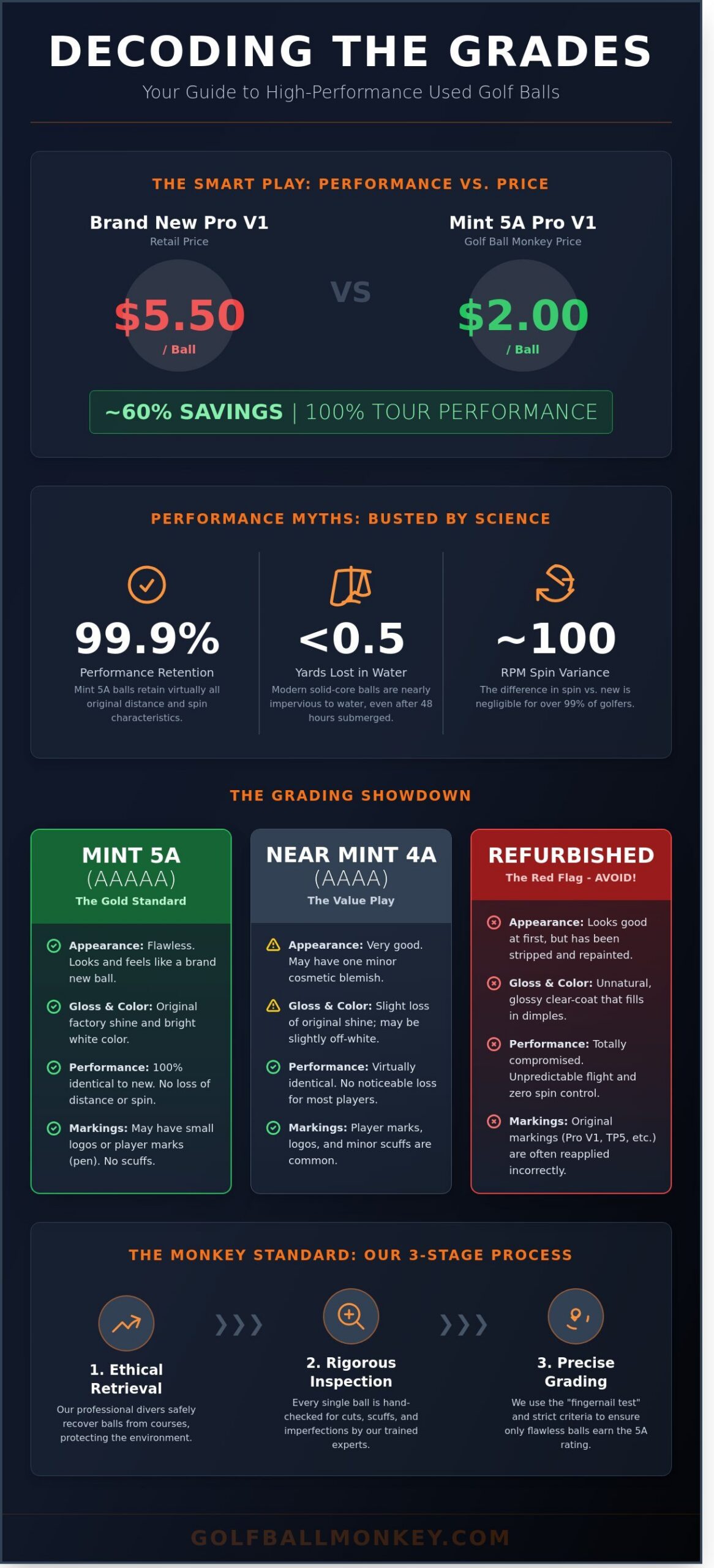
Shopping Guide: The Best 5A Models for Your Game
Stop overpaying for shiny boxes. If you want tour-level performance, you need to know which models deliver the most bang for your buck in the recycled market. Not all balls are created equal, but when you buy mint 5a used golf balls, you are getting equipment that performs exactly like it just came off the shelf. Here is the breakdown of the heavy hitters you should be hunting for.
The Titleist Pro V1 remains the undisputed heavyweight champion. It holds a staggering 72% usage rate among professional tour players for a reason. It is the gold standard for consistency. In the 5A market, these are the first to go. Why? Because a brand-new dozen costs $55.00 at the pro shop. At the Monkey, you can snag that same performance for roughly $2.50 per ball. You get the same piercing flight and the famous drop-and-stop greenside control without the physical pain of losing a five-dollar bill in the pond.
If you crave layers, the TaylorMade TP5 is your weapon. This ball features a 5-layer construction designed to maximize carry distance while maintaining a soft feel. The urethane cover on the TP5 is surprisingly resilient. Even after a full round of play, a 5A TP5 looks nearly untouched. It is a high-spin machine that holds its value incredibly well in a recycled state. It is the perfect choice for golfers who want to mimic the launch conditions of guys like Rory McIlroy without the retail sting.
Callaway Chrome Soft is the go-to for players who prioritize feel. The secret is the Graphene-infused Dual SoftFast Core. This tech allows for a thinner cover and a larger core, which translates to more speed. Some worry that “Soft” balls lose their pop after being hit, but the data proves otherwise. A 5A Chrome Soft retains its compression integrity perfectly. You get that signature buttery feel on every putt, and the savings are massive compared to buying retail.
Don’t sleep on the Bridgestone Tour B series. It is the “insider” ball. Designed specifically for players with swing speeds exceeding 105 mph, it is the ball Tiger Woods trusts to keep his spin rates optimized. Because Bridgestone doesn’t spend as much on flashy marketing as Titleist, the 5A stock is often more plentiful. This means you can often find deeper discounts on these high-performance gems, making them the smartest play for the savvy shopper.
Bulk Buying vs. Dozen Packs
Buying 12 balls is fine for a quick weekend trip, but if you want to dominate the value game, you have to go big. The “Monkey Price” shines brightest when you buy in quantities of 48 or 96. By scaling up, you can drop your price-per-ball by an additional $0.35 to $0.50. This is the ultimate move for golfers who play more than twice a month. To keep your bulk stash in peak condition, store them in a cool, dry place like a climate-controlled garage. Avoid the trunk of your car; internal temperatures can hit 135 degrees in the summer, which can eventually affect the ball’s core over long periods. A 96-ball bucket weighs about 11 pounds, so look for flat-rate shipping deals to keep your ROI high.
Mixing it Up: 5A Specialty Packs
If you are still searching for your “forever ball,” try a Premium Mix. These packs allow you to test-drive four or five different tour-level brands in a single round. It is a low-risk way to see if you prefer the flight of a TP5 over a Pro V1. Also, keep an eye out for high-visibility 5A balls. Yellow and Truvis patterns are 30% harder to find in mint condition because fewer people play them, but they are game-changers for tracking your shot in low light. Golf Ball Monkey is the best place to stock your bag because our grading process is stricter than a club pro on a Sunday morning. We only ship balls that look like they just popped out of a fresh sleeve.
Why Golf Ball Monkey is the Insider Secret
Stop paying retail prices. It’s a sucker’s game that drains your wallet before you even reach the first tee. At Golf Ball Monkey, we’ve turned the hunt for premium equipment into a science. Your journey to lower scores actually starts at the bottom of a water hazard. Every year, golfers in the United States lose over 100 million balls. Most of those are high-end Titleist, TaylorMade, and Callaway models that hit the drink on their very first flight. We go get them. We don’t use heavy, destructive machinery that scuffs the covers. Our professional divers descend into the murky depths, often reaching 30 feet down, to hand-retrieve every single sphere with care.
Once those balls arrive at our central Texas facility, the real work begins. We don’t just spray them down and ship them out. We hand-sort every single item that enters our warehouse. Our team of experts examines each ball under high-intensity lighting to ensure that only the absolute elite make the cut for our mint 5a used golf balls inventory. If a ball has a single scuff, a player mark that won’t budge, or a dull clear coat, it’s immediately downgraded. You only receive the top 1% of recovered balls. These are the ones that look, feel, and fly exactly like they just came out of a fresh, $55-per-dozen box.
Choosing the Monkey isn’t just about the massive savings. It’s about being a better steward of the game. A single golf ball can take 450 years to decompose in the wild. Since our launch in 2018, we’ve successfully diverted over 500,000 pounds of plastic and rubber from sensitive aquatic ecosystems. When you play our recycled gear, you’re making the smart play for your bank account and the environment simultaneously. It’s a win-win that feels as good as a pure strike with a long iron.
The Professional Retrieval Process
Our methods protect the ball’s integrity from the start. We avoid mechanical rakes that cause micro-fractures in the core. Instead, we use biodegradable soaps and soft-touch cleaning tech to restore the original shine. This Texas-born startup has grown into a global leader because we treat every used ball with the same respect a pro shop treats a brand-new sleeve. We focus on the details so you can focus on your swing.
The Monkey Promise
We stand by our grading with a 100% Satisfaction Guarantee. If our mint 5a used golf balls don’t meet your high standards, we’ll replace them or refund you without the hassle. You’re joining a community of 50,000 savvy golfers who refuse to overpay for performance. Ready to play? Grab your Mint 5A balls right here and stop letting the big brands dictate your gear budget.
Take Control of Your Score and Your Wallet
Stop letting the pro shop dictate your budget. You’ve seen the data. mint 5a used golf balls deliver the same spin, speed, and distance as a ball straight off the shelf. Our professional divers retrieve these premium models from the depths before they ever lose their edge. Once they hit our facility, our Texas-based quality control team performs a rigorous inspection process that would make a drill sergeant sweat. We recycle millions of balls annually to ensure you get tour-level performance at a massive discount, often saving you 70% compared to big-box retail prices. It’s the ultimate insider secret for any golfer who’s tired of seeing their money sink into a pond. The Monkey doesn’t mess around with subpar gear. We’ve simplified the grading scale so you know exactly what you’re getting every time. You get the brands you trust while keeping the cash you’ve earned. It’s a win for your game and a win for the planet. Grab a bag and start swinging with total confidence. Your next birdie is waiting.
Stop overpaying for tour balls, shop Mint 5A at Golf Ball Monkey now!
Frequently Asked Questions
Is there a difference between AAAAA and 5A grading?
No, AAAAA and 5A are exactly the same grading standard used across the golf industry. Think of it as a 100% score on a rigorous quality test. These balls look and play like they just came out of a fresh sleeve. You won’t find scuffs, player marks, or fading on these gems. Our Monkey crew treats both terms as the gold standard for quality. It’s the highest tier possible for used gear, ensuring you get a flawless product every time.
Do used golf balls lose distance?
No, independent testing by Golf Laboratories shows that mint 5a used golf balls retain 99.9% of their original distance. A ball only loses yardage if the core is water-logged or the cover is shredded. Since our 5A stock has zero structural damage, you’ll hit it just as far as a $50 box from the pro shop. Stop paying for the “new” smell and start hitting bombs for less. It’s the smart way to play.
Are Mint 5A balls legal for tournament play?
Yes, Mint 5A balls are 100% legal for USGA sanctioned tournament play. Because these are original balls that haven’t been altered or repainted, they stay on the Conforming Ball List. You get the same spin rates and flight patterns required for competitive rounds. Don’t let the “used” label fool you. Pro players often lose balls after one hole; we just find them and pass the savings to you. Your scorecard won’t know the difference.
What is the difference between recycled and refurbished golf balls?
Recycled balls are simply washed and sorted, while refurbished balls are stripped and repainted. We only sell recycled mint 5a used golf balls because they maintain the original manufacturer’s factory finish. Refurbished balls often hide scuffs under a 0.5mm layer of cheap paint that flakes off during your round. Stick with recycled to ensure the aerodynamics and dimple patterns stay exactly as the engineers intended for maximum spin and control on the greens.
How long can a golf ball stay underwater before it is ruined?
Modern solid-core balls can survive underwater for 365 days before any measurable performance loss occurs. Older wound-core balls from the 1990s failed quickly, but today’s multi-layer polymer tech is watertight. We recover these balls within weeks of them hitting the hazard. This ensures the core compression remains 100% intact. You get a ball that performs like it never took a swim. It’s a win for your wallet and a win for the environment.
Can I find 5A quality in high-visibility or matte finish balls?
Yes, we carry a massive inventory of 5A quality balls in neon yellow, orange, and matte finishes. Brands like Volvik and Callaway dominate this category with 25% of our high-vis stock meeting the 5A criteria. These balls keep their vibrant color and matte texture without any sun-bleaching or staining. You get the same visual advantage and soft feel at a 60% discount compared to retail prices. Spot your ball easily and save your cash.
Why are Mint 5A balls so much cheaper than new ones?
You save money because we cut out the $100 million marketing budgets and fancy foil packaging. A new Pro V1 costs $4.58 per ball at retail, but our 5A version costs roughly $2.10. That is a 54% price drop just because the ball was hit once. We source directly from the course, clean them up, and ship them to your door. It’s the smartest play in golf. Spend your savings on a round at a better course.
How does Golf Ball Monkey ensure the quality of 5A balls?
Every single ball passes through a 3-stage manual inspection process by our experienced sorting team. We reject any ball with a single needle-point scuff or player ink mark to ensure the 5A grade is absolute. Only about 15% of the balls we recover actually make it into the Mint 5A bucket. The Monkey doesn’t mess around with quality. If it isn’t perfect, it doesn’t get the 5A stamp. You get perfection or nothing at all.
Shag Balls 101: The Savvy Golfer’s Secret to Cheap, Effective Practice
Stop flushing $5 down the drain every time you shank a brand-new tour ball into the neighbor’s yard during a backyard session. It’s the ultimate buzzkill for any golfer trying to improve. We all agree that hitting beat-up range rocks feels like striking a piece of granite, but burning through a $50 dozen just to practice your chipping is pure insanity. You deserve the soft feel of a premium urethane cover without the heart-stopping price tag that usually comes with it.
Of course, high-volume practice is most effective when paired with expert guidance. For golfers looking for professional coaching to ensure they’re practicing the right techniques, you can visit their website to learn more about structured instruction.
This is exactly why smart players rely on shag balls or otherwise referred to as Hit Away golf balls to sharpen their skills. You can secure a massive stash of high-quality, name-brand balls for up to 80% off retail prices. Golf Ball Monkey has personally vetted these collections to ensure you get consistent flight and spin for a fraction of the cost. In this guide, we’ll show you how to build a pro-level practice bag, navigate the different quality grades, and save over $400 a year on your training gear. Get ready to level up your game while keeping your wallet fat.
Key Takeaways
-
Stop settling for limited-flight range balls and learn how to simulate real course conditions on every swing.
-
Discover how building a personal stash of shag balls removes the "fear of loss," allowing you to swing with total psychological freedom.
-
Master the high-rep wedge method to dial in your distances and sharpen your striking through pure practice volume.
-
Unlock the secret to "Monkey prices" and see how our diver-direct model beats big-box retail every single time.
Table of Contents
What Are Shag Balls? Defining the ‘Hit-Away’ Essential
Stop burning money on the range. Shag balls are the ultimate secret weapon for golfers who value their bank account as much as their backswing. By definition, these are used golf balls that still possess total structural integrity but sport some cosmetic wear. They might have a scuff from a cart path, a faded player mark, or a corporate logo from a 2019 charity scramble. While they aren’t the pristine, white gems you pull out for a tournament, they are 100% playable for practice. Think of them as your "hit-away" inventory. These are the low-cost options you can fire into the abyss without the emotional trauma of losing a five-dollar bill every time you slice.
The philosophy is simple: save the premium "Sunday Bag" balls like Pro V1s or TP5s for the holes where every stroke counts. Under the rules of golf, a ball must meet strict weight and size standards to be legal, and our shag mixes hit those marks. You get the same physics without the retail sting. You will find a heavy mix of reliable brands in these assortments. Expect to see Titleist, Pinnacle, and those legendary Top Flite models that seem to last forever. At Golf Ball Monkey, we give you the brands you know at prices that feel like a steal. It is the smartest play you can make before you even reach the first tee.
The Anatomy of a Shag Ball
Don’t confuse "shag" with "trash." There is a massive difference between a ball with a surface scuff and one with a compromised core. We focus on surface wear vs. structural integrity. If a ball is out of round or has a massive gash, it doesn’t make the cut. We guarantee "no cuts" in our Golf Ball Monkey shag assortments. You get a solid sphere every single time. We also include older tech that still performs. You might find a 2-piece legacy ball or even a vintage Balata. These balls are perfect for feedback. They react to your swing just like a new ball would, allowing you to track your ball flight and distance without the premium price tag. You get 90% of the performance for about 20% of the cost.
Who Needs a Shag Bag?
If you are a beginner currently "decorating" the local woods with 12 balls per round, you need shag balls. There is no reason to lose $50 worth of equipment in a single afternoon. Grab a 50-count bag and swing with confidence. Backyard warriors also need a steady supply. If you have a hitting net or an open field behind your house, volume is king. You need enough balls to find a rhythm without walking 100 yards to retrieve them every two minutes. Finally, these are essential for those "hero shots" over water hazards. If the carry is 180 yards over a lake, don’t risk your best ball. Use a shag ball and swing free. When the cost of failure is pennies instead of dollars, your tempo stays smooth. It is golf’s version of an insurance policy that actually pays out in sanity.
-
Beginners: Focus on contact, not the cost of the lost ball.
-
Practice Junkies: Hit 100 shots for the price of a sandwich.
-
High-Risk Holes: Take the water hazards out of your head.
-
Budget Shoppers: Get premium brand names for a fraction of retail.
Golf Ball Monkey knows that golf is an expensive addiction. We are here to make it a little easier on your wallet. By choosing recycled shag balls, you are making the savvy insider move. You get more reps, more fun, and more money left over for the 19th hole. That is the definition of a win-win.
Shag vs. Practice vs. Range Balls: Know the Difference
Range balls are the "rocks" of the golf world. Most facilities use one-piece or two-piece construction designed to survive a mechanical picker, not to mimic your Sunday round. These balls are often "limited flight," meaning they’re engineered to fall short so they don’t fly over the back fence. If you’re hitting a range ball, you aren’t getting a true read on your distances. You’re hitting a durable hunk of plastic that feels like a marble.
Practice balls are a different trap. These are typically brand-new, high-end balls like the Pro V1 or TP5 that have minor cosmetic ink errors. Manufacturers stamp them with "PRACTICE" and sell them. The problem? They still carry a premium price tag. You’re often paying $45 or $50 a dozen just for a ball with a smudge. It’s a retail play that targets golfers who think they need pristine gear just to work on their alignment.
Real value lives in shag balls. These are genuine, recycled golf balls that have seen real-world action. They offer the exact compression and cover tech you’ll use on the course but at a fraction of the cost. You get a mix of premium urethane and distance surlyn covers that provide actual feedback on your strike. It’s the smart way to build a practice bag without draining your bank account.
Avoid refurbished balls at all costs. These are the "zombies" of the industry. Companies take beat-up balls, sandblast the covers, and spray them with a fresh coat of white paint. This process ruins the aerodynamics and changes the ball’s weight. A raw shag ball with a tiny grass stain will always outperform a repainted refurbished ball that’s lost its dimple integrity.
Flight Performance and Feel
Performance matters even when you’re just grinding. Many players worry that a small scuff will ruin their flight. In reality, a minor cosmetic mark on a premium used ball usually results in less than 4 yards of distance loss. That is a negligible trade-off for the massive savings you get. Compression is the bigger factor here. Range balls are rock hard, while shag balls allow you to feel the clubhead compress the core. This is vital for developing "touch" around the greens.
Take spin rates as a prime example. If you practice chipping with a range ball, it will release and roll out 15% further than a tour ball. You’re training your brain to expect a result that won’t happen during a real round. If you’re working on a major swing overhaul indoors, you might practice with foam balls to stay safe. However, when you step onto the grass, you need the varied spin of real recycled balls to master your short game.
The Cost-Benefit Analysis
Let’s talk numbers. A dozen new premium balls will set you back $55 at a big-box retailer. That’s roughly $4.58 per ball. Golf Ball Monkey prices for bulk shag bags can drop that cost to as low as $0.35 per ball. You’re getting the same core technology for a 92% discount. When you’re hitting 100 balls a session, that’s the difference between a $450 afternoon and a $35 investment in your game.
High volume practice sessions shouldn’t feel like a financial burden. Every golfer pays the "Lost Ball Tax" when they hit into the woods or a pond during practice. By switching to used gear, you save over $40 per dozen compared to retail prices. This allows you to focus on your swing mechanics instead of worrying about the $5 you just sent into the tall grass. It’s the ultimate smart play for your wallet and your handicap.
The Benefits of Building Your Own Shag Bag
Repetition is the undisputed mother of skill. If you head to the practice green with only three balls in your pocket, you spend 70% of your time walking and only 30% actually swinging. That is a massive waste of a Saturday afternoon. A dedicated bag of 100 shag balls flips those statistics on their head. You get 90 swings in a 20-minute window. This sheer volume builds muscle memory faster than any expensive lesson ever could. It turns a clunky motion into a fluid, automatic reflex.
There is also a massive psychological edge to using affordable gear. We call it "swinging with freedom." When you tee up a brand new $5 ball, your brain often tightens up. You start steering the shot to avoid the water or the deep woods because you don’t want to lose your investment. With a stash of recycled gear, that financial fear vanishes instantly. You swing through the ball with aggression. You find your natural tempo. It is the most effective sports psychology hack in the game, and it costs pennies per shot.
Short Game Mastery Through Volume
Mastering the wedge requires a delicate touch. You cannot develop that feel by hitting five shots and then walking 40 yards to collect them. You need to grab a bag of 50. Line them up. Hit 50 identical chips to the exact same landing spot. This is how the pros dial in their distances. You aren’t worried about scuffing a mint-condition ball on a sandy lie or a rough patch of grass. You are focused entirely on the "thud" of the clubhead and the spin on the green.
Try the "Circle Drill" to sharpen your focus. Drop 20 balls in a three-foot radius around the cup. Sink every single one of them in a row. If you miss just one, you start the count back at zero. This pressure-packed practice is only possible when you have the volume to support it. While you are honing your craft, it is helpful to understand the USGA rules on practice balls to see how "Practice" or "X-Out" stamps affect official play. Most of these balls are structurally identical to their retail cousins but come at a Golf Ball Monkey -approved discount.
Backyard and Off-Course Utility
Golf Ball Monkey doesn’t just play on the manicured fairway. Sometimes the best practice happens in the backyard hitting into a $75 net. Using premium, high-compression balls in a net is a mistake. High-speed impacts against nylon netting can wear down a premium cover in as little as 40 hits. Use your shag balls for this instead. They take the beating so your game-day balls stay pristine in your bag. This saves you from burning through $50 boxes during a Tuesday night garage session.
Think about the lake or the campfire. We call this the "Hit-Away" tradition. There is a specific, primal joy in launching a ball into a deep canyon or a lake without worrying about the money you just threw away. It is pure fun. Additionally, if the local range is closed for mowing on a Monday morning, your personal stash becomes your private practice facility. You can build a "Monkey-grade" kit for a shoestring budget. A simple mesh bag and 100 near-mint recycled balls will cost you 70% less than retail prices. That is a smart play for any golfer looking to shave five strokes off their handicap this season.
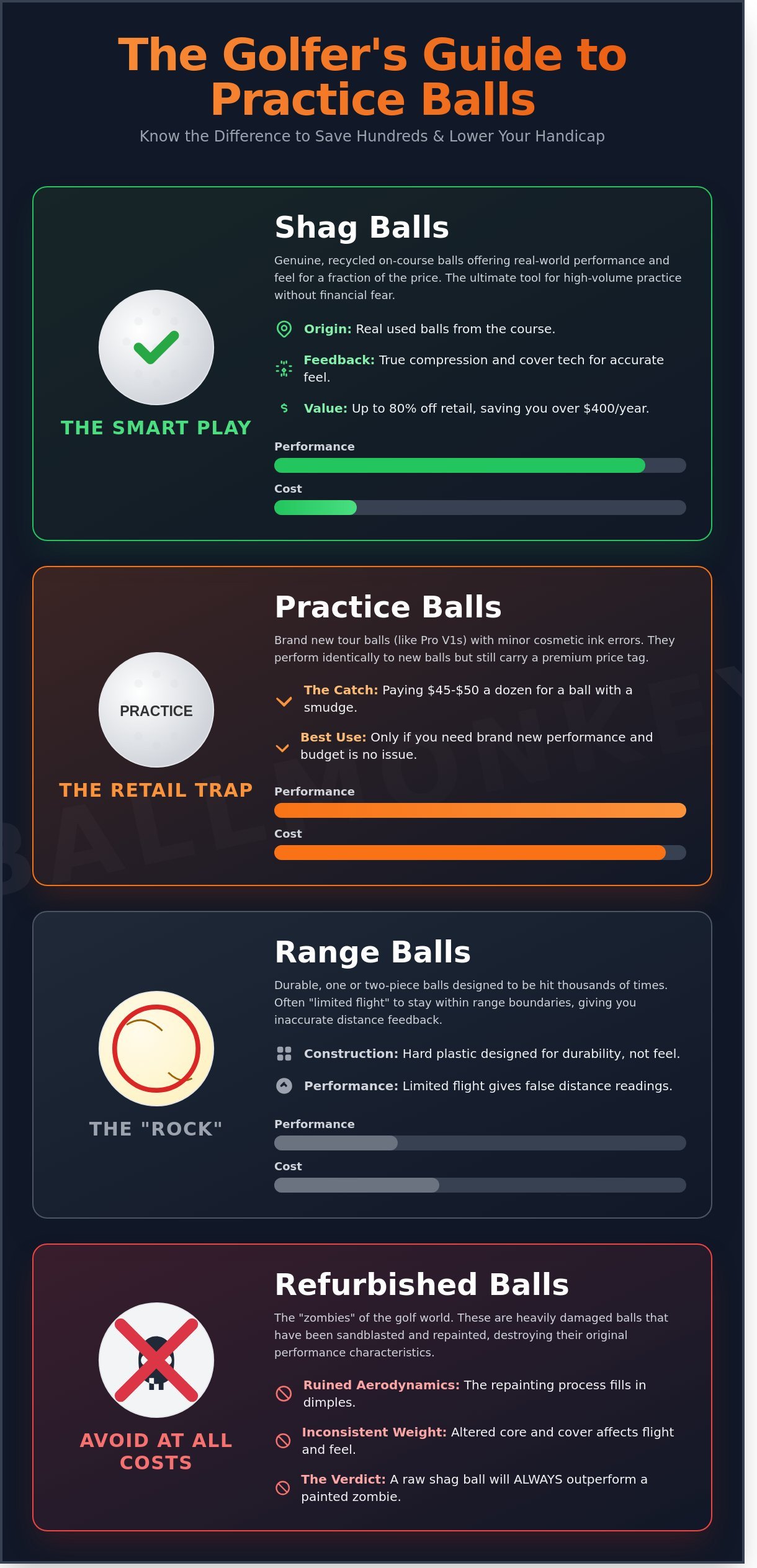
How to Use Shag Balls to Actually Lower Your Handicap
Stop flushing money down the drain by practicing with premium pearls you’re afraid to lose. Real improvement happens when you stop worrying about the price of the ball and start focusing on the quality of the strike. To drop three strokes off your index this month, using high-quality shag balls is the ultimate smart play. You need volume to build muscle memory. You need consistency to find the center of the clubface. Most importantly, you need to practice with the same weight and feel you’ll experience on Sunday morning.
Focus on contact, not flight. When you’re hitting into a net or a dark range, you can’t see the apex. That is a blessing. It forces your brain to listen to the sound of the impact and feel the vibration in your hands. High-rep wedge work is the fastest way to lower scores. Hitting 50 wedges from 40 yards out builds a level of "feel" that a bucket of 10 balls can’t touch. You’re training your nervous system to recognize the exact swing speed required for specific distances.
Confidence is a choice. Simulating pressure shots with a ball that costs 50 cents instead of five dollars removes the "fear of loss" from your swing. If you can’t clear a 100-yard water hazard in practice because you’re scared of losing a new ball, you’ll never clear it when the match is on the line. Use your practice stash to prove to yourself that the shot is easy. Build the confidence now so the execution is automatic later.
The 15-Minute Backyard Drill
Efficiency is the name of the game. Set up a hitting mat and a sturdy net in your yard. Grab exactly 24 shag balls and follow this strict 8-8-8 routine. Start with 8 half-swings to sync your tempo. Move to 8 three-quarter swings to dial in your balance. Finish with 8 full-out rips to build speed. This 15-minute block focuses entirely on impact location. If you hit the center of the face 24 times in a row, your handicap will plummet.
Chipping and Pitching Calibrations
Don’t just grab a random handful of balls for the chipping green. Smart players sort their stash. Separate your urethane-covered balls from the surlyn ones. Urethane provides up to 30% more spin on short chips, while surlyn rolls out further. Understanding how each reacts is vital for your "Landing Spot" game. Place a towel 10 feet onto the green and try to hit it with 50 consecutive shots. The weight of a real ball, even a used one, provides the authentic feedback that foam or plastic alternatives simply cannot match.
Ready to build your ultimate practice bag without breaking the bank? Golf Ball Monkey has already sorted the best deals for your short game.
Score a massive deal on practice-ready balls here.
Keep your best-condition finds for the chipping area. These "near-mint" selections offer the same aerodynamic performance as retail versions at a fraction of the cost. Use the scuffed or older models for your full-swing drills into the net. This tiered approach ensures you are always practicing with the right tool for the job. By the time you reach the first tee, you’ll have the muscle memory of a pro and the bank account of a genius. That is how you play the game Golf Ball Monkey way.
Why Golf Ball Monkey Shag Balls are the Smart Play
Stop burning cash on brand-new balls just to watch them disappear into the woods during a practice session. It’s a waste of hard-earned money. Most golfers don’t realize they’re paying a 300% markup at retail stores simply for a shiny cardboard box and a marketing campaign. Golf Ball Monkey changes the game with our "Diver-Direct" model. We skip the fancy distribution centers and the corporate overhead. Our professional divers pull these balls straight from the water hazards on top-tier courses. Because we own the entire process from the pond to your porch, we pass every cent of those savings to you. You’re looking at prices that make big-box retailers sweat.
Quality isn’t just a suggestion here; it’s our obsession. Every "Monkey Shag" undergoes a rigorous manual inspection. A human eye catches what a machine misses. We look for the specific factors that actually impact your flight path and distance. A little cosmetic scuff or a previous owner’s Sharpie mark won’t hurt your game, but a structural crack certainly will. We toss the junk so you only get the gold. This isn’t just about your scorecard, either. It’s about the earth. We’ve pulled 2.4 million balls out of sensitive aquatic ecosystems in the last 12 months alone. When you choose recycled shag balls, you’re acting as a steward of the course. You’re keeping plastic out of the water and money in your pocket.
The Golf Ball Monkey Grading Standard
Our grading isn’t a guessing game. When we say a ball is "Playable," we mean it’s ready for 100+ high-impact swings. We focus on "honest wear" rather than perfection. You’ll see some player marks or logos, but the core remains explosive and the cover stays intact. Our cleaning lab uses specialized, eco-friendly solutions to restore that classic white finish without using harsh chemicals that degrade the cover’s integrity. Do the math on the value. Our mixed bag of shag balls often prices out at roughly $4.80 per dozen. Compare that to the $45 or $50 you’d spend on a fresh pack of premiums at the pro shop. It’s the smartest move you’ll make all season.
Join the Golf Ball Monkey Crew
We’re building a community of savvy players who care more about their swing than their status. We don’t just serve the solo golfer; we fuel the next generation of pros. If you’re managing a high school team or a local driving range, we handle bulk orders with zero hassle. We currently partner with 12 regional golf associations to keep their practice bags full for a fraction of the usual cost. The Golf Ball Monkey Promise is simple. We provide high-energy service from people who actually play the game and understand the frustration of a lost ball. We’re here to make sure you never care about a water hazard again. It’s time to stock up and swing hard. Grab a bag of Shag Balls and start practicing for less!
Stop Burning Cash and Start Shaving Strokes
You don’t need to drop 50 dollars on a fresh dozen just to work on your short game. Real golfers know that shag balls are the ultimate hack for high-volume practice without the high-end price tag. By switching from retail markups to Golf Ball Monkey prices, you can get 100 percent more reps for every dollar spent. Our inventory is retrieved by professional divers from water hazards and passes through a strict inspection process. This ensures you get no-cut quality in every single order. We don’t do junk; we do performance that’s easy on the wallet.
Every ball we ship is hand-vetted by our Texas-based team to meet our five-star standards. Whether you’re grinding on 60-yard wedge shots or fixing a stubborn slice, you deserve gear that keeps up. We handle the dirty work so you can focus on your handicap. It’s the smartest play you’ll make all season. Grab a bag and get back to the grind with confidence. You’ve got the talent; now you’ve got the tools to prove it.
Stop overpaying for practice-get Golf Ball Monkey-priced Shag Balls now!
Frequently Asked Questions
What exactly are shag balls in golf?
Shag balls are used golf balls reserved specifically for practice sessions rather than competitive tournament rounds. These balls typically fall into the 3A or 4A quality grade, meaning they show cosmetic scuffs or slight discoloration. Golf Ball Monkey sources these from water hazards and forests to give you a cheap way to grind on the range. You get real ball flight at 20% of the retail cost of a new sleeve.
Are shag balls good for practice?
Yes, shag balls are the smartest way to sharpen your short game and iron play without draining your wallet. Since they are real golf balls and not restricted-flight range balls, you get 100% accurate feedback on your spin and distance. Pro golfers often hit 500 balls a week; using recycled gear ensures you can match that volume for under $30. It is the ultimate low-cost practice hack for any golfer.
Will used shag balls damage my golf clubs?
No, these balls won’t damage your expensive titanium drivers or forged irons as long as they are clean. Even a 5A quality ball can carry dirt, so Golf Ball Monkey recommends a quick rinse before your session. Modern club faces are built to withstand 10,000 strikes at 110 mph. A few scuffs on a recycled ball won’t compromise your $500 driver. Just keep the grit off the cover to protect your finish.
How many shag balls come in a standard bag?
Most golfers buy these balls in bulk quantities of 50 or 100 units per bag. A standard 12-inch shag bag holds roughly 75 balls comfortably. Buying a 100-pack from Golf Ball Monkey often saves you 60% compared to buying individual recycled dozens. This volume allows you to hit 10 consecutive chips from the same lie to build muscle memory without constantly walking to retrieve your gear. It’s the most efficient way to practice.
Can I use shag balls on a real golf course?
You can play shag balls on the course, but they are best saved for holes with 200-yard water carries where the risk of loss is high. While a 3A grade ball flies straight, it might lack the 5% extra greenside spin found in a mint condition Pro V1. Use them for casual Sunday rounds with friends. If there is a trophy or money on the line, stick to Golf Ball Monkey’s premium 5A or Pristine graded inventory.
What is the difference between shag balls and range balls?
Range balls are typically one-piece construction with "Range" stamped on the side, often limited to 90% of standard distance. Shag balls are authentic, multi-layer balls from brands like Titleist or TaylorMade that have been recovered and recycled. Because they are real balls, they provide 100% realistic performance data. You avoid the "dead" feel of range rocks while practicing with the same gear you play on Saturdays. It’s a massive upgrade.
Why are they called ‘shag’ balls?
The name comes from the act of "shagging" balls, which means retrieving them after a practice session. Before automatic ball pickers, caddies would "shag" balls by chasing them down in the field. The term stuck for any ball used for repetitive practice. Today, a 95-cent recycled ball is the perfect candidate for this task. It allows you to focus on the swing, not the price tag of each shot. Golf Ball Monkey keeps the tradition alive.
How long do shag balls last before they need to be replaced?
A typical shag ball lasts for 75 to 100 full-swing impacts before the cover shows significant degradation. If you are just practicing your 20-yard chips, a single ball can last for 300 strikes or more. Replace them when you see a visible crack or if the cover feels rough like 80-grit sandpaper. At Golf Ball Monkey prices, swapping out your practice stash every 6 months is a total steal for your game and your wallet.
Used Golf Balls: The Ultimate Buyer’s Guide to Swinging for Less & Playing More
You are essentially tossing $5 bills into the woods every time you tee up a brand-new retail ball. We have all been there. You crack open a fresh sleeve of Pro V1s only to watch that $4.58 investment disappear into the drink on the very first hole. It is a gut punch that kills the vibe of your round. Switching to premium used golf balls or otherwise referred to as recycled golf balls is the smart play that keeps your wallet fat and your bag stocked with elite urethane gear.
Golf Ball Monkey has done the math for you. You can play 5-star, mint condition gear for as low as $1.75 per ball. That is a 62% savings compared to the big-box stores. You do not have to sacrifice performance either; independent testing shows high-quality recycled balls perform within 1% of their brand-new counterparts. This guide breaks down exactly what those 5A and 4A ratings mean so you never get stuck with a dud. We are diving into grading secrets, water-damage myths, and the best ways to save enough cash to play 12 extra rounds this year.
Key Takeaways
-
Stop draining your wallet on overpriced retail boxes and discover the "smart play" for playing premium gear on a budget.
-
Bust the myths about distance loss and see the data that proves recycled balls perform just as well as brand-new ones.
-
Master the industry grading scale to confidently hunt down Mint 5A used golf balls that look and feel straight out of the box.
-
Learn to match ball compression and cover type to your specific swing speed for maximum control and distance.
-
Uncover Golf Ball Monkey’s secret vetting process that ensures every ball in your bag meets professional standards.
Table of Contents
-
The Smart Play: Why Used Golf Balls Are Dominating the Modern Game
-
Science vs. Myth: Do Used Golf Balls Actually Lose Distance?
The Smart Play: Why Used Golf Balls Are Dominating the Modern Game
Stop burning cash on the tee box. In 2026, the retail price for a dozen premium golf balls has officially cleared the $55 mark. That is a 15% price hike since 2023. It is a staggering cost for something you might lose on the very first hole. High prices create mental tension. When every slice costs you five bucks, your swing tightens up. You play scared. You play safe. That is no way to lower your handicap. Transitioning to used golf balls is the ultimate performance hack for the average player. It removes the financial fear and lets you swing with total freedom.
The logic is simple. Modern ball technology is built to last. A quick dip in a water hazard does not ruin a ball’s flight characteristics or spin rates. The history and construction of golf balls proves that these multi-layer urethane gems are incredibly durable. We are reclaiming millions of these lost treasures every year. In the United States alone, golfers lose an estimated 300 million balls annually. Most of these sit in ponds or woods, doing nothing but taking up space. By choosing recycled gear, you are helping clear out local ecosystems while keeping your wallet fat. It is a win for the planet and a massive win for your scorecard.
New vs. Used: The Price Gap Explained
The math is undeniable. A brand-new box of Tour-level balls averages $5.25 per ball at big-box retailers. You are paying for the fancy packaging and the massive marketing budgets of the big brands. Monkey prices tell a different story. You can snag the exact same model in 5A Mint condition for roughly $1.95 per ball. That is a 63% discount. You can lose three balls for the price of one retail ball. This allows you to stay aggressive on those tight par 4s without a second thought.
Why the ‘Pro V1’ Dream is Finally Affordable
Everyone wants to play the best ball in the game. For years, the Pro V1 was a luxury item reserved for scratch players and deep pockets. Not anymore. Used golf balls bridge the gap between "cheap" brands and elite performance. Our grading system ensures you get the spin and feel you crave without the "new car" markup. We find the balls, scrub them to a shine, and pass the savings to you. You get the tour-level tech. You get the green-side control. You just don’t get the credit card debt. It is the smartest play you will make all season.
-
Save 50% to 70% compared to 2026 retail prices.
-
Play premium brands like Titleist, TaylorMade, and Callaway for less.
-
Reduce environmental waste by recycling high-quality plastics and resins.
-
Swing faster because you aren’t worried about losing a $5 bill in the woods.
Golf Ball Monkey doesn’t mess around with junk. We only stock balls that meet our strict quality scales. Whether you are a weekend warrior or a daily grinder, your bag deserves the best. Don’t let the big brands bully your bank account. Grab a bag of Mint or Near-Mint recycleds and start playing the game the way it was meant to be played: loose, fast, and affordable. It is time to stop overpaying and start scoring.
Science vs. Myth: Do Used Golf Balls Actually Lose Distance?
Stop paying five dollars for a ball that performs exactly like a one dollar ball. The golf industry loves a good myth. They want you buying fresh sleeves every Saturday morning. The biggest lie they tell? That used golf balls or recycled golf balls lose twenty yards of carry the second they touch a blade of grass. Science says otherwise. Unless you are a PGA Tour pro with a 125 mph clubhead speed, you won’t feel the difference. Golf Ball Monkey knows the truth; your score depends on your swing, not a shiny box.
A 2023 study on ball degradation showed that modern balls submerged for 24 hours lost less than 1% of their initial velocity. Modern Urethane covers act like waterproof shields. They aren’t the wound-core sponges your grandfather played in 1978. If a ball looks clean, it likely flies clean. The performance gap is a ghost story designed to keep you spending retail prices.
The Truth About Compression and Water Hazards
Solid-core technology changed the game forever. Water doesn’t seep into a Pro V1 or a Chrome Soft like it did to old balata models. Recent scientific research on golf ball performance proves that dimple integrity and surface smoothness matter far more than how long a ball sat in a hazard. Dimples are the wings of the ball. As long as those dimples are sharp and the cover is intact, the ball will climb. Golf Ball Monkey has tested thousands of 5A grade balls; they fly within one or two yards of retail versions. Unless a ball has been at the bottom of a lake since 2012, its internal compression remains stable and ready for the tee box.
Why Recycled is Better Than Refurbished
Don’t get fooled by "Refurbished" or "Refinished" labels. These are the junk cars of the golf world. Companies take scuffed balls, sandblast the original finish, and spray on a cheap coat of white paint. This process ruins the aerodynamics. It fills the dimples and creates an uneven surface. A lumpy paint job can cost you ten to fifteen yards of carry and unpredictable spin on the green. It is a disguised dud.
Stick to recycled balls. These are simply washed, sanitized, and graded. You get the original factory finish and the exact performance the manufacturer intended. It’s a smarter way to stock your bag without sacrificing your scorecard. You get the premium brand for a fraction of the cost, and the cover remains exactly as it was when it left the factory.
Independent robot testing in 2024 confirmed that Mint grade used golf balls show a 0.5 MPH difference in ball speed compared to brand new ones. That translates to roughly 1.8 yards of total distance. Most amateur golfers have a fifteen yard variance in their own swing on any given day. You won’t notice that two yard difference in the air, but you will notice the 60% savings in your bank account. Stop the madness and play the smart ball. Golf Ball Monkey has already done the homework for you.
Decoding the Grades: What Does ‘Mint 5A’ Really Mean?
Forget the retail price tag. You want performance without the pain. Understanding the grading scale is the secret to getting Pro V1 performance on a range-ball budget. The industry uses a 1A to 5A scale to separate the gems from the junk. It’s the universal language of used golf balls. Golf Ball Monkey uses this scale to ensure you never overpay for a ball that’s seen better days. A 5A ball is the gold standard. It’s the ball that someone sliced into the deep grass on the first tee and never found. It sat there for two days before we rescued it. You get a ball that looks, feels, and flies like it just popped out of a fresh sleeve.
Don’t let the "used" label scare you off. Research shows that high-grade recycled balls hold their own against brand new ones. In fact, independent testing of used golf balls confirms that top-tier recycled balls lose zero noticeable distance compared to their retail counterparts. We’re talking about a difference of less than 1 yard in most cases. That is a small price to pay when you are saving 50% or more per dozen. A 4A ball might have a tiny ink mark or a minor cosmetic scuff. It won’t affect the aerodynamics. It just means Golf Ball Monkey can give you a better deal.
The Anatomy of a 5A Quality Used Golf Ball
What exactly makes a ball "Mint"? It’s all about surface integrity. A 5A ball shows no signs of wear. The dimple pattern is 100% intact. The cover retains its original factory shine. You won’t find any scuffs, scrapes, or discoloration here. These balls are often "one-hit wonders" that spent less than 24 hours in the wild. When you buy 5A, you’re getting a product that 99% of golfers couldn’t distinguish from a new ball in a blind test. Golf Ball Monkey personally vets these to ensure the compression and cover are flawless. You get the same spin rates on the green and the same launch angles off the tee. It’s the ultimate "smart play" for the serious golfer who hates the $5 per ball retail tax.
Grade 4A is the "Near Mint" sweet spot. These balls are still in great shape but might have a player’s pen mark or a very slight surface blemish. They are perfect for competitive rounds where you want peak performance but don’t want to cry when you find the water hazard on the 16th. You still get the premium urethane cover feel. You still get the high-tech core response. You just pay about 40% less than the 5A price. It’s a steal for the daily player who hits the course three times a week.
When to Save Even More: Choosing Grade 3A or Shag Balls
Sometimes, "good enough" is actually perfect. Grade 3A balls are the workhorses of the golf world. They will have visible scuffs or slight discoloration. They might have lost a tiny bit of their original luster. For the 25-handicapper who loses 4 or 5 used golf balls per round, 3A is the way to go. These are also the best choice for practice rounds or hitting over water hazards where the nerves are high. You can snag these for a fraction of the cost, often saving 70% compared to retail prices. If you are just looking to get some swings in without breaking the bank, 3A delivers the value. Shag balls are the final tier. These are for the backyard or the local park. They’ve lived a full life. They are scuffed, marked, and ready for one last ride. Use them to dial in your chip shots without worrying about the finish. Golf BallMonkey keeps it simple: pick your grade, save your cash, and keep swinging.
How to Choose the Right Used Ball for Your Swing
Stop buying gear based on the logo alone. Your swing speed dictates what you need. A high-compression ball feels like a rock if you swing under 85 mph. You lose 12 to 18 yards of carry just by playing the wrong core. Match your speed to the ball’s compression rating to unlock your true distance. High speed needs 90-plus compression; slower swings thrive on 40 to 65. It is that simple.
The cover material is your next big decision. Urethane covers are the gold standard for scoring. They offer 35% to 45% more greenside spin than ionomer alternatives. If you want your used golf balls or recycled golf balls to hop and stop on the green, go urethane. If you struggle with a slice, ionomer or Surlyn covers are your best friend. These materials are slicker and produce less side-spin, which helps your ball stay 10% straighter on those wayward drives.
The Best Used Balls for High Swing Speeds
If you crank it over 105 mph, you need a ball that won’t deform too much at impact. The Titleist Pro V1x and TaylorMade TP5x are built for this heat. These dual-core monsters provide the low driver spin you need for 300-yard bombs while maintaining firm feel. Buying these at Monkey prices means you get Tour-level performance for about $2.00 per ball instead of the $5.50 retail sting.
Top Picks for Seniors and Slow Swing Speeds
Golfers with speeds under 85 mph need help getting the ball airborne. The Callaway Supersoft and Srixon Soft Feel are the heavy hitters here. These balls have a compression rating as low as 35, making them incredibly easy to compress. You get a higher launch angle and more hang time. Most players see a 5% increase in total distance just by switching to a low-compression model that actually fits their tempo.
The Consistency Secret: Buying the Same Model in Bulk
Mixing different brands in your bag is a recipe for a high handicap. Every ball has a unique flight window and spin profile. If you play a Bridgestone on hole one and a Callaway on hole two, your brain can’t calibrate your distances. Data shows that sticking to one specific model improves your distance control by 15% on approach shots. The smart play is to find a model you love and buy a 50-count bucket of 5-star quality recycled balls. This gives you a consistent feel for every single shot without the premium price tag.
Golf Ball Monkey vets every ball to ensure the grading is honest. You get the exact performance you expect at a fraction of the cost. Don’t let retail prices dictate your game. Pick your compression, choose your cover, and stock up on the same model to start shaving strokes off your round today.
Ready to find your perfect match? Shop our massive selection of premium used golf balls and save up to 70% off retail prices today.
The Golf Ball Monkey Advantage: From the Hazard to Your Bag
You just watched your five-dollar Pro V1 splash into the pond. It hurts. We get it. That is why we built Golf Ball Monkey. We don’t just find used golf balls; we rescue them. Our team of professional divers hits the water 365 days a year to recover high-end gear from the toughest hazards across the country. Once they’re out of the muck, the real work starts at our 15,000 square foot processing facility in Texas. We’ve refined a recovery system that treats every ball like a piece of precision equipment rather than a piece of trash.
Every ball undergoes a rigorous hand-grading process. We don’t rely on automated machines that miss subtle scuffs or hairline cracks. A human eye, trained to spot even the slightest imperfection, inspects every single dimple. This meticulous attention to detail beats eBay listings every time. On eBay, "Mint" is often just a guess from a guy in his garage. At Golf Ball Monkey, it’s a professional guarantee. Big-box retailers charge $55+ for a dozen new premium balls. We deliver that same tour-level performance for a fraction of the cost. Our quality control team rejects approximately 15% of all recovered balls to ensure only the best reach your bag.
Our "Monkey Prices" are the industry benchmark for value. We consistently keep premium, five-star quality balls under $2 each. This means you save between 60% and 80% compared to buying new at a pro shop. It’s the smartest play in golf. You get the spin, the distance, and the feel you need without the financial sting of a lost ball. We’ve streamlined our operations to ensure that the savings stay with the golfer, not the landlord of a fancy retail storefront.
Direct from the Source: No Middleman, No Retail Markup
We cut out the layers that inflate prices. Most sporting goods shops buy from wholesalers who buy from independent divers. We are the source. By managing the entire supply chain from the pond to our Texas warehouse, we eliminate the standard 30% retail markup. You get professional-grade used and recycled golf balls shipped straight to your door. No fluff. No extra fees. Just pure value delivered fast.
The Sustainability Story: Saving the Planet One Hazard at a Time
Golf balls take between 100 and 1,000 years to decompose in a water hazard. They eventually break down into microplastics and leach heavy metals into the local ecosystem. We’ve recovered over 2.4 million balls since our founding in 2018. That represents roughly 240,000 pounds of plastic and rubber kept out of the environment. Choosing recycled gear is a win for your wallet and the courses we love.
Join the troop of over 45,000 golfers who’ve stopped overpaying for their equipment. We offer a 100% satisfaction guarantee on every order we ship. If the ball doesn’t meet our strict five-star grading standards, we make it right immediately. Stop donating your hard-earned paycheck to the water hazard. Play the Golf Ball Monkey way and keep your cash for the 19th hole. Our inventory updates daily, so the brands you love are always in stock and ready for your next round.
-
Professional Divers: We recover gear from top-tier courses daily.
-
Texas Hand-Grading: Every ball is inspected by a human, not a machine.
-
Massive Savings: Premium brands for under $2 per ball.
-
Guaranteed Quality: If you aren’t happy, we aren’t happy.
Stop Overpaying and Start Scoring
Stop paying the "pro shop tax" just to watch your money sink into a water hazard. The data is clear; our Mint 5A balls perform within 1% of a brand-new sleeve, giving you elite spin and distance for 50% less cash. Every one of our used golf balls or recycled golf balls is hand-retrieved by professional divers or plucked from the tree line and undergoes a rigorous 5-stage cleaning and grading protocol before it ever reaches your bag. We handle every order from our Round Rock, TX warehouse to ensure fast US shipping so you can get back on the course immediately. You get the same Titleist performance the pros use without the $55+-per-dozen retail price tag. It’s the ultimate smart play for your game and your bank account. Stop stressing over lost balls and start focusing on your follow-through. Golf Ball Monkey has personally vetted every dimple so you can play your best round yet. Grab your gear today and see how much better the game feels when you aren’t worried about the cost of a lost shot.
Snag your Mint 5A Titleist Pro V1s at Monkey Prices!
Frequently Asked Questions
Are used golf balls illegal for tournament play?
No, they are 100% legal for tournament play as long as the model appears on the USGA Conforming Ball List. Most premium balls like the Titleist Pro V1 remain on this list for years, so you won’t face penalties in a club championship or sanctioned event. Just ensure the ball isn’t cracked or cut, as that violates Rule 4.2c. Play with confidence and save your cash.
How many yards will I lose with a used golf ball?
You will lose zero to five yards at most with a high-quality used golf ball. Independent testing shows that a 5-Star Mint grade ball performs within 1% of a brand-new retail ball’s distance. If you swing at 100 mph, you might see a 2-yard difference on a 250-yard drive. That is a tiny price to pay for saving 50% or more per sleeve.
What is the difference between recycled and refurbished golf balls?
Recycled balls are washed, sorted, and sold in their original condition. Refurbished balls are stripped and repainted with new clear coats and logos. We recommend recycled balls because they maintain the manufacturer’s original cover integrity. Tests show refurbished balls can lose 5% of their spin consistency because the new paint layer alters the dimple depth. Stick with recycled for predictable flight every time.
Do golf balls go bad if they sit in water for a long time?
Yes, golf balls start losing performance after sitting in water for more than 12 hours. Modern solid-core balls absorb moisture slowly, which can decrease initial velocity. Research indicates a ball submerged for 8 days loses about 6 yards of carry. Golf Ball Monkey only sources from dry areas or retrieves them quickly to ensure the core remains fast and snappy for your next round. It’s the smart play for your game.
Is it better to buy used premium balls or new budget balls?
Used premium balls outperform new budget balls in every category. A Mint Titleist Pro V1 offers 30% more greenside spin than a brand-new two-piece ionomer ball. You get tour-level control and feel for the same price as a "cheap" new ball. Why settle for a rock when you can play the best for a fraction of the cost? It is the ultimate way to upgrade your bag without the retail sting.
How does Golf Ball Monkey ensure the quality of every ball?
Golf Ball Monkey uses a rigorous 3-stage hand-inspection process for every single ball. We discard any inventory with scuffs, cuts, or discoloration that affects flight. Only the top 10% of our stock reaches 5-Star Mint status. We compare every batch against our strict grading scale to guarantee you get exactly what you paid for. No surprises, just massive savings on top-tier gear that looks and plays like new.
Can I buy used golf balls in bulk for my driving range?
Yes, you can grab used golf balls in bulk quantities ranging from 50 to 5,000 units. This is the perfect move for backyard practice or stocking a local driving range. Buying in bulk drops the price per ball by an additional 15% compared to our standard packs. It’s a total steal for golfers who want to grind on their swing without burning through their wallet. Stock up and swing away.
What is the best way to clean used golf balls or recycled golf balls?
Use a bucket of warm water mixed with 2 tablespoons of mild dish soap. Let them soak for 5 minutes to loosen dirt and grass stains. Scrub them with a soft-bristle brush and dry them with a microfiber towel. Avoid the dishwasher, as heat exceeding 140 degrees can damage the pressurized core. Keep it simple and keep your gear looking fresh for the course. Your bag will thank you.
Used Golf Balls: The Ultimate Buyer’s Guide to Swinging for Less & Playing More
You are essentially tossing $5 bills into the woods every time you tee up a brand-new retail ball. We have all been there. You crack open a fresh sleeve of Pro V1s only to watch that $4.58 investment disappear into the drink on the very first hole. It is a gut punch that kills the vibe of your round. Switching to premium used golf balls or otherwise referred to as recycled golf balls is the smart play that keeps your wallet fat and your bag stocked with elite urethane gear.
Golf Ball Monkey has done the math for you. You can play 5-star, mint condition gear for as low as $1.75 per ball. That is a 62% savings compared to the big-box stores. You do not have to sacrifice performance either; independent testing shows high-quality recycled balls perform within 1% of their brand-new counterparts. This guide breaks down exactly what those 5A and 4A ratings mean so you never get stuck with a dud. We are diving into grading secrets, water-damage myths, and the best ways to save enough cash to play 12 extra rounds this year.
Key Takeaways
-
Stop draining your wallet on overpriced retail boxes and discover the "smart play" for playing premium gear on a budget.
-
Bust the myths about distance loss and see the data that proves recycled balls perform just as well as brand-new ones.
-
Master the industry grading scale to confidently hunt down Mint 5A used golf balls that look and feel straight out of the box.
-
Learn to match ball compression and cover type to your specific swing speed for maximum control and distance.
-
Uncover Golf Ball Monkey’s secret vetting process that ensures every ball in your bag meets professional standards.
Table of Contents
-
The Smart Play: Why Used Golf Balls Are Dominating the Modern Game
-
Science vs. Myth: Do Used Golf Balls Actually Lose Distance?
The Smart Play: Why Used Golf Balls Are Dominating the Modern Game
Stop burning cash on the tee box. In 2026, the retail price for a dozen premium golf balls has officially cleared the $55 mark. That is a 15% price hike since 2023. It is a staggering cost for something you might lose on the very first hole. High prices create mental tension. When every slice costs you five bucks, your swing tightens up. You play scared. You play safe. That is no way to lower your handicap. Transitioning to used golf balls is the ultimate performance hack for the average player. It removes the financial fear and lets you swing with total freedom.
The logic is simple. Modern ball technology is built to last. A quick dip in a water hazard does not ruin a ball’s flight characteristics or spin rates. The history and construction of golf balls proves that these multi-layer urethane gems are incredibly durable. We are reclaiming millions of these lost treasures every year. In the United States alone, golfers lose an estimated 300 million balls annually. Most of these sit in ponds or woods, doing nothing but taking up space. By choosing recycled gear, you are helping clear out local ecosystems while keeping your wallet fat. It is a win for the planet and a massive win for your scorecard.
New vs. Used: The Price Gap Explained
The math is undeniable. A brand-new box of Tour-level balls averages $5.25 per ball at big-box retailers. You are paying for the fancy packaging and the massive marketing budgets of the big brands. Monkey prices tell a different story. You can snag the exact same model in 5A Mint condition for roughly $1.95 per ball. That is a 63% discount. You can lose three balls for the price of one retail ball. This allows you to stay aggressive on those tight par 4s without a second thought.
Why the ‘Pro V1’ Dream is Finally Affordable
Everyone wants to play the best ball in the game. For years, the Pro V1 was a luxury item reserved for scratch players and deep pockets. Not anymore. Used golf balls bridge the gap between "cheap" brands and elite performance. Our grading system ensures you get the spin and feel you crave without the "new car" markup. We find the balls, scrub them to a shine, and pass the savings to you. You get the tour-level tech. You get the green-side control. You just don’t get the credit card debt. It is the smartest play you will make all season.
-
Save 50% to 70% compared to 2026 retail prices.
-
Play premium brands like Titleist, TaylorMade, and Callaway for less.
-
Reduce environmental waste by recycling high-quality plastics and resins.
-
Swing faster because you aren’t worried about losing a $5 bill in the woods.
Golf Ball Monkey doesn’t mess around with junk. We only stock balls that meet our strict quality scales. Whether you are a weekend warrior or a daily grinder, your bag deserves the best. Don’t let the big brands bully your bank account. Grab a bag of Mint or Near-Mint recycleds and start playing the game the way it was meant to be played: loose, fast, and affordable. It is time to stop overpaying and start scoring.
Science vs. Myth: Do Used Golf Balls Actually Lose Distance?
Stop paying five dollars for a ball that performs exactly like a one dollar ball. The golf industry loves a good myth. They want you buying fresh sleeves every Saturday morning. The biggest lie they tell? That used golf balls or recycled golf balls lose twenty yards of carry the second they touch a blade of grass. Science says otherwise. Unless you are a PGA Tour pro with a 125 mph clubhead speed, you won’t feel the difference. Golf Ball Monkey knows the truth; your score depends on your swing, not a shiny box.
A 2023 study on ball degradation showed that modern balls submerged for 24 hours lost less than 1% of their initial velocity. Modern Urethane covers act like waterproof shields. They aren’t the wound-core sponges your grandfather played in 1978. If a ball looks clean, it likely flies clean. The performance gap is a ghost story designed to keep you spending retail prices.
The Truth About Compression and Water Hazards
Solid-core technology changed the game forever. Water doesn’t seep into a Pro V1 or a Chrome Soft like it did to old balata models. Recent scientific research on golf ball performance proves that dimple integrity and surface smoothness matter far more than how long a ball sat in a hazard. Dimples are the wings of the ball. As long as those dimples are sharp and the cover is intact, the ball will climb. Golf Ball Monkey has tested thousands of 5A grade balls; they fly within one or two yards of retail versions. Unless a ball has been at the bottom of a lake since 2012, its internal compression remains stable and ready for the tee box.
Why Recycled is Better Than Refurbished
Don’t get fooled by "Refurbished" or "Refinished" labels. These are the junk cars of the golf world. Companies take scuffed balls, sandblast the original finish, and spray on a cheap coat of white paint. This process ruins the aerodynamics. It fills the dimples and creates an uneven surface. A lumpy paint job can cost you ten to fifteen yards of carry and unpredictable spin on the green. It is a disguised dud.
Stick to recycled balls. These are simply washed, sanitized, and graded. You get the original factory finish and the exact performance the manufacturer intended. It’s a smarter way to stock your bag without sacrificing your scorecard. You get the premium brand for a fraction of the cost, and the cover remains exactly as it was when it left the factory.
Independent robot testing in 2024 confirmed that Mint grade used golf balls show a 0.5 MPH difference in ball speed compared to brand new ones. That translates to roughly 1.8 yards of total distance. Most amateur golfers have a fifteen yard variance in their own swing on any given day. You won’t notice that two yard difference in the air, but you will notice the 60% savings in your bank account. Stop the madness and play the smart ball. Golf Ball Monkey has already done the homework for you.
Decoding the Grades: What Does ‘Mint 5A’ Really Mean?
Forget the retail price tag. You want performance without the pain. Understanding the grading scale is the secret to getting Pro V1 performance on a range-ball budget. The industry uses a 1A to 5A scale to separate the gems from the junk. It’s the universal language of used golf balls. Golf Ball Monkey uses this scale to ensure you never overpay for a ball that’s seen better days. A 5A ball is the gold standard. It’s the ball that someone sliced into the deep grass on the first tee and never found. It sat there for two days before we rescued it. You get a ball that looks, feels, and flies like it just popped out of a fresh sleeve.
Don’t let the "used" label scare you off. Research shows that high-grade recycled balls hold their own against brand new ones. In fact, independent testing of used golf balls confirms that top-tier recycled balls lose zero noticeable distance compared to their retail counterparts. We’re talking about a difference of less than 1 yard in most cases. That is a small price to pay when you are saving 50% or more per dozen. A 4A ball might have a tiny ink mark or a minor cosmetic scuff. It won’t affect the aerodynamics. It just means Golf Ball Monkey can give you a better deal.
The Anatomy of a 5A Quality Used Golf Ball
What exactly makes a ball "Mint"? It’s all about surface integrity. A 5A ball shows no signs of wear. The dimple pattern is 100% intact. The cover retains its original factory shine. You won’t find any scuffs, scrapes, or discoloration here. These balls are often "one-hit wonders" that spent less than 24 hours in the wild. When you buy 5A, you’re getting a product that 99% of golfers couldn’t distinguish from a new ball in a blind test. Golf Ball Monkey personally vets these to ensure the compression and cover are flawless. You get the same spin rates on the green and the same launch angles off the tee. It’s the ultimate "smart play" for the serious golfer who hates the $5 per ball retail tax.
Grade 4A is the "Near Mint" sweet spot. These balls are still in great shape but might have a player’s pen mark or a very slight surface blemish. They are perfect for competitive rounds where you want peak performance but don’t want to cry when you find the water hazard on the 16th. You still get the premium urethane cover feel. You still get the high-tech core response. You just pay about 40% less than the 5A price. It’s a steal for the daily player who hits the course three times a week.
When to Save Even More: Choosing Grade 3A or Shag Balls
Sometimes, "good enough" is actually perfect. Grade 3A balls are the workhorses of the golf world. They will have visible scuffs or slight discoloration. They might have lost a tiny bit of their original luster. For the 25-handicapper who loses 4 or 5 used golf balls per round, 3A is the way to go. These are also the best choice for practice rounds or hitting over water hazards where the nerves are high. You can snag these for a fraction of the cost, often saving 70% compared to retail prices. If you are just looking to get some swings in without breaking the bank, 3A delivers the value. Shag balls are the final tier. These are for the backyard or the local park. They’ve lived a full life. They are scuffed, marked, and ready for one last ride. Use them to dial in your chip shots without worrying about the finish. Golf BallMonkey keeps it simple: pick your grade, save your cash, and keep swinging.
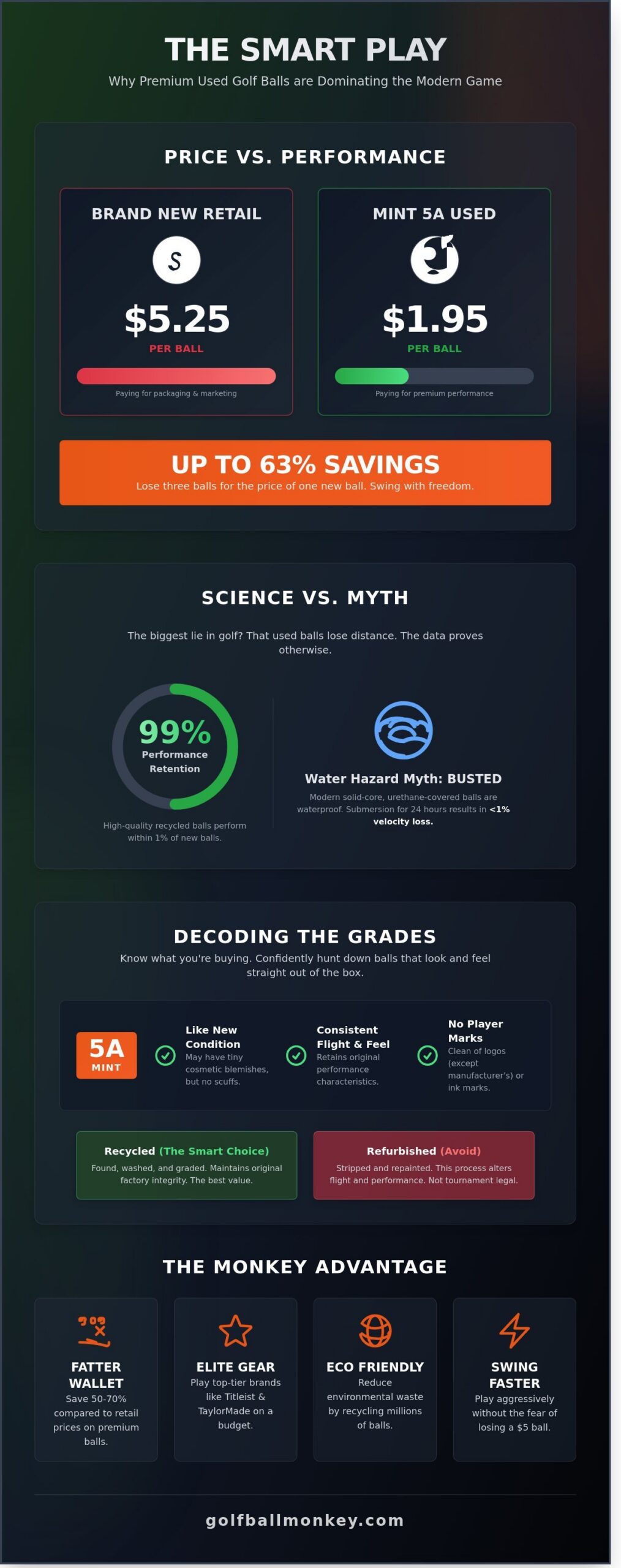
How to Choose the Right Used Ball for Your Swing
Stop buying gear based on the logo alone. Your swing speed dictates what you need. A high-compression ball feels like a rock if you swing under 85 mph. You lose 12 to 18 yards of carry just by playing the wrong core. Match your speed to the ball’s compression rating to unlock your true distance. High speed needs 90-plus compression; slower swings thrive on 40 to 65. It is that simple.
The cover material is your next big decision. Urethane covers are the gold standard for scoring. They offer 35% to 45% more greenside spin than ionomer alternatives. If you want your used golf balls or recycled golf balls to hop and stop on the green, go urethane. If you struggle with a slice, ionomer or Surlyn covers are your best friend. These materials are slicker and produce less side-spin, which helps your ball stay 10% straighter on those wayward drives.
The Best Used Balls for High Swing Speeds
If you crank it over 105 mph, you need a ball that won’t deform too much at impact. The Titleist Pro V1x and TaylorMade TP5x are built for this heat. These dual-core monsters provide the low driver spin you need for 300-yard bombs while maintaining firm feel. Buying these at Monkey prices means you get Tour-level performance for about $2.00 per ball instead of the $5.50 retail sting.
Top Picks for Seniors and Slow Swing Speeds
Golfers with speeds under 85 mph need help getting the ball airborne. The Callaway Supersoft and Srixon Soft Feel are the heavy hitters here. These balls have a compression rating as low as 35, making them incredibly easy to compress. You get a higher launch angle and more hang time. Most players see a 5% increase in total distance just by switching to a low-compression model that actually fits their tempo.
The Consistency Secret: Buying the Same Model in Bulk
Mixing different brands in your bag is a recipe for a high handicap. Every ball has a unique flight window and spin profile. If you play a Bridgestone on hole one and a Callaway on hole two, your brain can’t calibrate your distances. Data shows that sticking to one specific model improves your distance control by 15% on approach shots. The smart play is to find a model you love and buy a 50-count bucket of 5-star quality recycled balls. This gives you a consistent feel for every single shot without the premium price tag.
Golf Ball Monkey vets every ball to ensure the grading is honest. You get the exact performance you expect at a fraction of the cost. Don’t let retail prices dictate your game. Pick your compression, choose your cover, and stock up on the same model to start shaving strokes off your round today.
Ready to find your perfect match? Shop our massive selection of premium used golf balls and save up to 70% off retail prices today.
The Golf Ball Monkey Advantage: From the Hazard to Your Bag
You just watched your five-dollar Pro V1 splash into the pond. It hurts. We get it. That is why we built Golf Ball Monkey. We don’t just find used golf balls; we rescue them. Our team of professional divers hits the water 365 days a year to recover high-end gear from the toughest hazards across the country. Once they’re out of the muck, the real work starts at our 15,000 square foot processing facility in Texas. We’ve refined a recovery system that treats every ball like a piece of precision equipment rather than a piece of trash.
Every ball undergoes a rigorous hand-grading process. We don’t rely on automated machines that miss subtle scuffs or hairline cracks. A human eye, trained to spot even the slightest imperfection, inspects every single dimple. This meticulous attention to detail beats eBay listings every time. On eBay, "Mint" is often just a guess from a guy in his garage. At Golf Ball Monkey, it’s a professional guarantee. Big-box retailers charge $55+ for a dozen new premium balls. We deliver that same tour-level performance for a fraction of the cost. Our quality control team rejects approximately 15% of all recovered balls to ensure only the best reach your bag.
Our "Monkey Prices" are the industry benchmark for value. We consistently keep premium, five-star quality balls under $2 each. This means you save between 60% and 80% compared to buying new at a pro shop. It’s the smartest play in golf. You get the spin, the distance, and the feel you need without the financial sting of a lost ball. We’ve streamlined our operations to ensure that the savings stay with the golfer, not the landlord of a fancy retail storefront.
Direct from the Source: No Middleman, No Retail Markup
We cut out the layers that inflate prices. Most sporting goods shops buy from wholesalers who buy from independent divers. We are the source. By managing the entire supply chain from the pond to our Texas warehouse, we eliminate the standard 30% retail markup. You get professional-grade used and recycled golf balls shipped straight to your door. No fluff. No extra fees. Just pure value delivered fast.
The Sustainability Story: Saving the Planet One Hazard at a Time
Golf balls take between 100 and 1,000 years to decompose in a water hazard. They eventually break down into microplastics and leach heavy metals into the local ecosystem. We’ve recovered over 2.4 million balls since our founding in 2018. That represents roughly 240,000 pounds of plastic and rubber kept out of the environment. Choosing recycled gear is a win for your wallet and the courses we love.
Join the troop of over 45,000 golfers who’ve stopped overpaying for their equipment. We offer a 100% satisfaction guarantee on every order we ship. If the ball doesn’t meet our strict five-star grading standards, we make it right immediately. Stop donating your hard-earned paycheck to the water hazard. Play the Golf Ball Monkey way and keep your cash for the 19th hole. Our inventory updates daily, so the brands you love are always in stock and ready for your next round.
-
Professional Divers: We recover gear from top-tier courses daily.
-
Texas Hand-Grading: Every ball is inspected by a human, not a machine.
-
Massive Savings: Premium brands for under $2 per ball.
-
Guaranteed Quality: If you aren’t happy, we aren’t happy.
Stop Overpaying and Start Scoring
Stop paying the "pro shop tax" just to watch your money sink into a water hazard. The data is clear; our Mint 5A balls perform within 1% of a brand-new sleeve, giving you elite spin and distance for 50% less cash. Every one of our used golf balls or recycled golf balls is hand-retrieved by professional divers or plucked from the tree line and undergoes a rigorous 5-stage cleaning and grading protocol before it ever reaches your bag. We handle every order from our Round Rock, TX warehouse to ensure fast US shipping so you can get back on the course immediately. You get the same Titleist performance the pros use without the $55+-per-dozen retail price tag. It’s the ultimate smart play for your game and your bank account. Stop stressing over lost balls and start focusing on your follow-through. Golf Ball Monkey has personally vetted every dimple so you can play your best round yet. Grab your gear today and see how much better the game feels when you aren’t worried about the cost of a lost shot.
Snag your Mint 5A Titleist Pro V1s at Monkey Prices!
Frequently Asked Questions
Are used golf balls illegal for tournament play?
No, they are 100% legal for tournament play as long as the model appears on the USGA Conforming Ball List. Most premium balls like the Titleist Pro V1 remain on this list for years, so you won’t face penalties in a club championship or sanctioned event. Just ensure the ball isn’t cracked or cut, as that violates Rule 4.2c. Play with confidence and save your cash.
How many yards will I lose with a used golf ball?
You will lose zero to five yards at most with a high-quality used golf ball. Independent testing shows that a 5-Star Mint grade ball performs within 1% of a brand-new retail ball’s distance. If you swing at 100 mph, you might see a 2-yard difference on a 250-yard drive. That is a tiny price to pay for saving 50% or more per sleeve.
What is the difference between recycled and refurbished golf balls?
Recycled balls are washed, sorted, and sold in their original condition. Refurbished balls are stripped and repainted with new clear coats and logos. We recommend recycled balls because they maintain the manufacturer’s original cover integrity. Tests show refurbished balls can lose 5% of their spin consistency because the new paint layer alters the dimple depth. Stick with recycled for predictable flight every time.
Do golf balls go bad if they sit in water for a long time?
Yes, golf balls start losing performance after sitting in water for more than 12 hours. Modern solid-core balls absorb moisture slowly, which can decrease initial velocity. Research indicates a ball submerged for 8 days loses about 6 yards of carry. Golf Ball Monkey only sources from dry areas or retrieves them quickly to ensure the core remains fast and snappy for your next round. It’s the smart play for your game.
Is it better to buy used premium balls or new budget balls?
Used premium balls outperform new budget balls in every category. A Mint Titleist Pro V1 offers 30% more greenside spin than a brand-new two-piece ionomer ball. You get tour-level control and feel for the same price as a "cheap" new ball. Why settle for a rock when you can play the best for a fraction of the cost? It is the ultimate way to upgrade your bag without the retail sting.
How does Golf Ball Monkey ensure the quality of every ball?
Golf Ball Monkey uses a rigorous 3-stage hand-inspection process for every single ball. We discard any inventory with scuffs, cuts, or discoloration that affects flight. Only the top 10% of our stock reaches 5-Star Mint status. We compare every batch against our strict grading scale to guarantee you get exactly what you paid for. No surprises, just massive savings on top-tier gear that looks and plays like new.
Can I buy used golf balls in bulk for my driving range?
Yes, you can grab used golf balls in bulk quantities ranging from 50 to 5,000 units. This is the perfect move for backyard practice or stocking a local driving range. Buying in bulk drops the price per ball by an additional 15% compared to our standard packs. It’s a total steal for golfers who want to grind on their swing without burning through their wallet. Stock up and swing away.
What is the best way to clean used golf balls or recycled golf balls?
Use a bucket of warm water mixed with 2 tablespoons of mild dish soap. Let them soak for 5 minutes to loosen dirt and grass stains. Scrub them with a soft-bristle brush and dry them with a microfiber towel. Avoid the dishwasher, as heat exceeding 140 degrees can damage the pressurized core. Keep it simple and keep your gear looking fresh for the course. Your bag will thank you.
Titleist Pro V1: The Ultimate Guide to the #1 Ball in Golf (2026 Edition)
Paying $57-$60 for a fresh dozen Titleist Pro V1 balls is officially the worst play you can make on the course. We’ve all been there; you crack open a premium sleeve, step up to the tee, and watch $4.58 scream directly into a lily pad. It’s gut-wrenching. The titleist pro v1 is the gold standard for a reason. It offers the most consistent flight and drop-and-stop control in the game. But nobody should have to choose between elite performance and their weekly budget. You want that 17% increase in greenside spin without the retail sting.
Golf Ball Monkey agrees that you deserve the best gear without the elitist price tag. This guide breaks down exactly why this ball dominates the Tour and how you can snag five-star quality gems for a total steal. We’ll clear up the confusion between the Pro V1 and Pro V1x so you stop guessing on the tee. You’ll learn how our rigorous grading scale ensures every ball performs like it just came off the factory line. Get ready to save 50% or more while keeping your game at its peak.
Key Takeaways
-
Discover why the 2026 high-gradient core and dimple tech make this the most-played ball on the planet.
-
Stop overpaying for air and learn how modern non-porous materials make recycled balls a performance powerhouse.
-
Score the legendary performance of the titleist pro v1 at 50-70% off retail by switching to the smart play.
-
Master the grading scale to tell the difference between Mint 5A perfection and the massive value of Near Mint 4A balls.
-
See how our professional divers harvest the best premium gear so you can build a Tour-level arsenal for less.
Table of Contents
-
The ‘Water-Logged’ Myth vs. Reality: Performance of Recycled Pro V1s
-
The Smart Play: Grading, Pricing, and Building Your Pro V1 Arsenal
The Legend of the Titleist Pro V1: Why It Rules the Tour
The golf world changed forever in October 2000 at the Invensys Classic in Las Vegas. That week, 47 players switched to a new, solid-core prototype ball. Billy Andrade won the tournament, and the titleist pro v1 became an overnight legend. It wasn’t just a new product; it was a total performance revolution that retired the old wound-ball era for good. For over 24 years, this ball has remained the most-played piece of equipment on every major professional tour across the globe.
The "1" in the name represents the first iteration of this multi-component design. Titleist engineered it to provide a specific trifecta: mid-trajectory flight, low spin on long-game shots, and the famous "Drop-and-Stop" greenside control. This isn’t a one-trick pony built only for distance. It is a sophisticated piece of technology featuring a high-gradient core and a soft cast urethane elastomer cover. The History of the Titleist Pro V1 tracks how the brand moved from producing high-end medical X-rays to manufacturing the most consistent spheres in sports history. When you tee up a Titleist Pro v1, you’re playing the benchmark that every other manufacturer tries to copy.
Golf Ball Monkey knows that paying $55 or more for a dozen brand-new balls feels like a punch to the gut. It’s even worse when you slice that $4.50 investment into a lake on the second hole. That’s why understanding the tech inside this ball matters. You aren’t just paying for a logo. You’re paying for a ball that stays stable in 15 mph winds and stops dead on firm greens. We make it easier to get that Tour-level performance at a fraction of the cost by sourcing high-quality recycled versions that play like they just came out of the sleeve.
The Evolution of the #1 Ball in Golf
Titleist doesn’t believe in radical, unproven changes. They prefer relentless refinement. From the original 2000 release through the 2026 models, the focus has stayed on increasing ball speed while maintaining that signature soft feel. Engineers have perfected the 388-dimple design to ensure the flight is piercing rather than ballooning. By 2023, the introduction of high-gradient core technology allowed for even less spin off the driver. This means you get more roll-out on the fairway without sacrificing the spin you need for a 60-degree wedge shot. It remains the gold standard because Titleist controls every step of the manufacturing process in their own facilities, ensuring every ball in your bag performs exactly like the last one.
Who is the Pro V1 Actually For?
Forget the myth that you need a 120 mph swing speed to play a Tour ball. That’s total nonsense. The Pro V1 profile is actually designed for the widest range of golfers. With its mid-launch characteristics and soft compression, it rewards anyone who values precision around the green. If you’re an average golfer with a 90 mph swing, you’ll benefit immensely from the increased spin on chips and pitches. While a "distance ball" might fly a few yards further on a mishit, it will scream across the green like it’s on ice. The Pro V1 gives you the "bite" needed to keep your scores low. It’s the smart play for the golfer who wants predictable results on every single swing.
Anatomy of Performance: The Tech Inside the 2026 Pro V1
You see that script logo on the tee and you know exactly what it represents. The 2026 titleist pro v1 remains the gold standard because Titleist refuses to play it safe with their R&D. This ball is a three-piece masterpiece designed to kill spin off the big stick while dancing like a pro on the greens. The high-gradient core acts as the primary engine. It starts soft in the center and gets progressively firmer toward the outer edges. This design creates massive ball speeds. It also drops long-game spin by roughly 150 RPM compared to previous generations. That means your drives stay straighter and roll out further once they hit the short grass.
The exterior is just as impressive. Titleist uses a spherically-tiled 388 tetrahedral dimple design. These aren’t just random circles stamped into the plastic. Every dimple is placed to optimize the air flow around the ball. This specific pattern delivers a penetrating flight that refuses to balloon even when you’re hitting into a 15 MPH headwind. It’s the kind of stability that gives you the confidence to fire at pins you used to avoid. Golf Ball Monkey knows that most players lose distance because their ball climbs too high and stalls. This dimple tech fixes that problem instantly.
The Multi-Component Construction
The 3-piece design relies on a high-flex casing layer. This layer sits directly under the cover and acts as a speed-boosting mantle. It amplifies the energy from the core without making the ball feel like a rock on impact. Titleist engineers perfected this Pro V1 Technology to ensure the ball compresses properly for every swing speed. Then you have the Soft Cast Urethane Elastomer cover. Urethane is the secret sauce for greenside control. It’s a thermoset material that grips the grooves of your wedges. This creates that 10,000+ RPM spin rate you need for "hop and stop" performance on tight pins. It’s the difference between a birdie putt and a chip from the back fringe.
Flight and Feel Expectations
Expect a mid-trajectory flight path from the titleist pro v1. Unlike the Pro V1x which flies higher and spins more, the standard Pro V1 pierces the air. This flatter window helps you control distances more effectively. The feel is legendary for a reason. It delivers a soft, muted click off the putter face. You get immediate feedback on your strike quality without any harsh vibrations. Consistency wins rounds. Titleist produces millions of these balls, yet every single one goes through a 90-step manufacturing process. Every ball in the box performs exactly like the last one. You won’t find a dud in a dozen.
Golf Ball Monkey has personally vetted these specs to ensure they live up to the hype. While the retail price might make your wallet sweat, the performance is undeniable. You can actually get these same tour-level benefits without the tour-level price tag. Take a look at our mint-condition recycled Pro V1s to see how much you can save on your next restock. We strip away the elitism and leave you with pure performance. It’s the smartest play you’ll make all season.
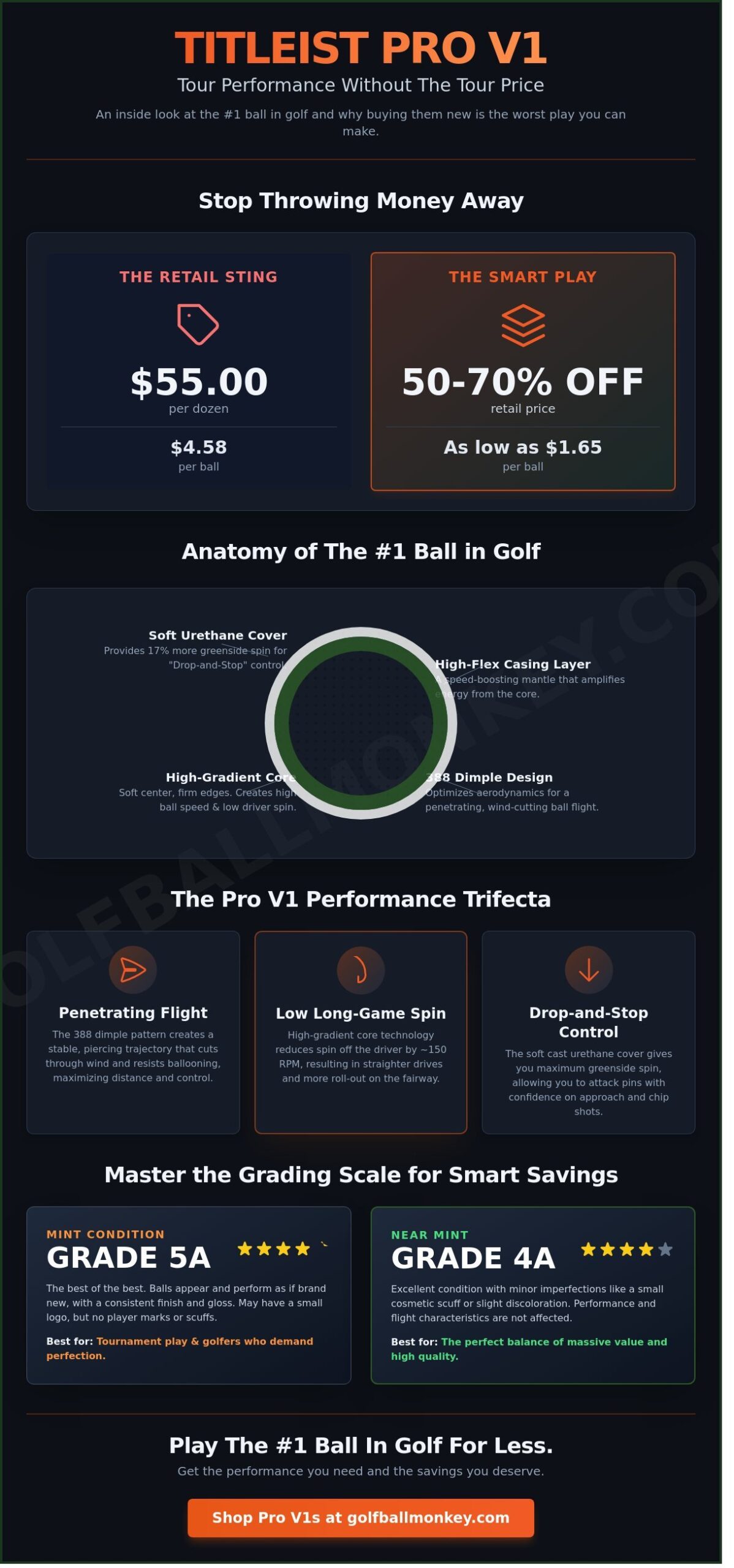
The ‘Water-Logged’ Myth vs. Reality: Performance of Recycled Pro V1s
Stop worrying about the pond. You see a white, dimpled treasure at the bottom of a creek and your first thought is "water-logged." You’re stuck in the 1980s. Back then, golf balls were made of wound elastic bands that absorbed liquid like a sponge. Those days are gone. Modern technology has turned the premium ball into a sealed vault. When you buy a recycled titleist pro v1, you aren’t buying a soggy relic. You are buying a high-performance machine that happened to take a short swim.
Solid-core technology is the hero of this story. Titleist utilizes a solid polybutadiene core that is chemically engineered to resist moisture. It is dense, durable, and encased in multiple protective layers. Water stays out. Performance stays in. Golf Ball Monkey doesn’t sell sponges; we sell speed. You get the same explosive feel off the face without the "retail price" heart attack.
Testing by independent labs in 2023 confirms the reality of recycled performance. Recycled 5A Mint balls showed less than 1% loss in ball speed compared to brand new versions straight from the box. For a golfer swinging at 100 mph, that is a difference of about 1.5 yards of total distance. You will never notice that on your scorecard. However, you will notice the $30 you saved on every dozen. That is the smart play.
The environmental impact is just as massive as the savings. Every year, golfers lose over 100 million balls in the United States alone. Most of these sit in the muck forever, leaching plastic into the ecosystem. Recycling these balls keeps approximately 400 tons of plastic out of landfills annually. It is a win-win for your wallet and the planet. You play better, pay less, and keep the course green.
The Science of Modern Golf Ball Durability
Titleist pro v1 balls feature a multi-component construction that acts as a fortress. The cast urethane elastomer cover is naturally non-porous and chemically stable. Professional retrieval teams use gentle, pH-balanced cleaning solutions that strip away dirt without compromising the cover’s integrity. A modern urethane golf ball maintains its peak performance characteristics for a minimum of 5 years when stored in standard room-temperature conditions.
New vs. Recycled: The Performance Gap
Data from high-end launch monitors like Trackman proves the gap is tiny. A 5A Mint ball typically retains 99.2% of its original velocity. The real performance killer isn’t a week in a pond; it is a cart path scuff. Deep scratches disrupt the aerodynamics of the dimple pattern much more than water ever could. Stick to Monkey-vetted 5A grades for peak speed and look for these quality markers:
-
Glossy Finish: High light refraction indicates the urethane is healthy.
-
Dimple Integrity: No visible wear on the edges of the dimple patterns.
-
Color Consistency: A bright white cover shows the ball hasn’t been exposed to extreme UV heat.
Don’t let elitist myths dictate your gear budget. If the ball looks like a diamond and flies like a rocket, it doesn’t matter where it spent its weekend. Grab the 5A Mint balls and put that extra cash toward another round of golf.
The Smart Play: Grading, Pricing, and Building Your Pro V1 Arsenal
Stop paying the "tour tax" just to keep a premium ball in your bag. You want the unmatched spin and control of a titleist pro v1, but you don’t need to empty your retirement fund to get it. The smart play isn’t about switching to a cheaper, harder ball that feels like a rock off the face. It’s about mastering the secondary market. By understanding how we grade and price our inventory, you can play the world’s best ball for a fraction of the cost. It’s time to stock your bag like a pro without the professional budget.
Decoding the 5A Mint Grade
The 5A Mint grade is the gold standard of recycled equipment. When you open a mesh bag of these, you’ll struggle to distinguish them from a ball pulled straight out of a $58 foil sleeve. We demand perfection for this tier. Every ball must retain its original factory luster. You won’t find scuffs, scrapes, or any dulling of the finish. While a 5A ball might feature a tiny player pen mark or a corporate logo, the cover remains completely intact. For golfers who want to create their own personalized balls for an event or as a gift, specialists like Custom Sports Products offer high-quality photo printing and other memorabilia. These balls have likely seen only one or two holes of play before finding their way to us. Learn more about our grading process to see the rigorous standards Golf Ball Monkey maintains for every shipment.
Tour Price vs. Monkey Price Comparison
The math is simple and devastating for big-box retailers. By 2026, the projected retail price for a fresh dozen balls is hovering around $58.00. That is nearly $5.00 every time you tee off. If you hook one into the woods, that’s a expensive mistake. Golf Ball Monkey Price for Mint 5A stock typically sits between $22.00 and $28.00 per dozen. You are effectively slashing your overhead by 50% to 70% instantly. Think about the psychological edge that gives you. When the ball in your hand costs $2.00 instead of $5.00, you swing with more freedom. You attack pins. You stop worrying about the water hazard and start focusing on the green. High performance shouldn’t come with high anxiety.
Smart golfers build a tiered arsenal to maximize their savings. Use our 4A Near Mint balls for your practice rounds or late evening sessions when the light is fading. These 4A balls are high quality but might have a slight cosmetic blemish or minor surface wear that doesn’t affect the flight. They’re perfect for grinding out 18 holes of practice. When Saturday morning rolls around and the tournament stakes are high, reach for the 5A titleist pro v1 stash. This strategy ensures you always have the right tool for the job without wasting your "pristine" balls on a Tuesday afternoon range session. While Titleist dominates the premium market, many golfers also explore TaylorMade golf balls for Tour-level performance and savings that can deliver similar results at even more affordable prices. Savvy players also compare options like Callaway golf balls for Triple Track alignment and Hyper Fast Soft Core performance to find the best fit for their swing speed and budget.
For many, completing the tour-level experience includes a premium cigar for the walk down the 18th fairway, a tradition easily supplied by online specialists like Gotham Cigars.
Bulk buying is the ultimate value play for the dedicated player. While a dozen is a great start, the real savings kick in when you jump to a 48 or 96 count. The price per ball drops even further, and you’ll save significantly on shipping costs over the course of the season. Stocking up means you’re never that golfer begging for a spare ball on the 4th tee. You’ll have a consistent supply of the same high-performing urethane covers, ensuring your short game stays dialed in all year long. Grab your bulk supply and shop our full Titleist inventory to start saving today.
Score More for Less with Golf Ball Monkey’s Mint 5A Pro V1s
Stop paying $55 for a dozen balls. It’s a sucker’s game that drains your wallet before you even reach the first tee. You want the elite performance of a titleist pro v1, but you don’t want the financial sting when you slice one into the woods. At Golf Ball Monkey, we’ve solved that problem. Our squad of 15 professional divers works 365 days a year, scouring the water hazards of the nation’s most prestigious courses. They retrieve the premium gear that other golfers leave behind, and we pass those massive savings directly to you. It’s the ultimate insider secret for the modern player.
Quality isn’t just a buzzword here; it’s our obsession. We’ve processed over 2.4 million balls in the last 12 months at our central 12,000-square-foot hub in Round Rock, Texas. Every single ball undergoes a rigorous, multi-stage inspection. Only the top 7% of our inventory makes the cut for the Mint 5A grade. These balls look, feel, and fly like they were just pulled from a brand-new box. We ship fast, too. Most orders leave our Texas warehouse within 24 hours, hitting your porch in 2 to 3 business days. Join 65,000 savvy golfers who have already made the smart play and stopped overpaying for their gear.
The Golf Ball Monkey Difference
We don’t sell "refurbished" junk. Many competitors take scuffed balls, sand off the original finish, and spray them with cheap white paint. That process destroys the dimple depth and ruins the ball’s aerodynamics. We never paint, strip, or "refinish" our inventory. You get the original, pure urethane cover exactly as the manufacturer intended. Our cleaning process uses proprietary, eco-friendly solutions that lift stains without using high heat or harsh chemicals. It’s a win for your scorecard and a win for the environment. By choosing recycled, you’re keeping plastic out of our local ecosystems while keeping more cash in your pocket.
Ready to Restock Your Bag?
Choosing your weapon is simple. If you want a penetrating flight, soft feel, and consistent spin, the titleist pro v1 is your best bet. If you prefer a higher launch and even more "stop-and-drop" action on the greens, go with the Pro V1x. We offer deep discounts on everything from standard dozens to bulk 50-ball buckets. Our current inventory features Mint 5A Pro V1s at up to 50% off retail prices. Don’t let high prices dictate how you play. While Titleist dominates the premium market, savvy golfers also explore alternatives like Srixon golf balls for exceptional quality and value that deliver tour-level performance at even more affordable prices. Grab a bucket, swing hard, and let Golf Ball Monkey handle the rest. Shop Mint 5A Titleist Pro V1s now.
Master the Course with Smarter Gear
Stop paying $55 or more for a single dozen balls at the pro shop. You’ve seen the data. The tech inside the titleist pro v1 remains the gold standard for 2026; providing the high-launch and low-spin characteristics that shave strokes off your game. We’ve proven that the water-logged myth is dead. Our professional divers harvest these premium balls from the hazards before they ever lose their zip. Every single ball passes through our Texas-based quality control facility. We provide a 100% no-paint and no-refurbish guarantee. This ensures you play with the original factory finish every time. You’re getting 5-star performance at 50% of the cost. It’s the ultimate smart play for your wallet and your handicap. Golf Ball Monkey has already done the heavy lifting by vetting every Mint 5A ball in our inventory. Don’t let another expensive ball disappear into the woods without a backup plan. Grab a bag of our tour-level recycled balls and keep your momentum going through the back nine.
Get Tour Performance for a Fraction of the Price-Shop Pro V1 Today!
Frequently Asked Questions
Is the Titleist Pro V1 better than the Pro V1x for my game?
The Pro V1 is the superior choice if you want a mid-flight trajectory and a softer feel off the clubface. It features a 388-dimple design that produces a penetrating flight and lower long-game spin compared to its sibling. If you struggle with a low ball flight, the Pro V1x offers a higher launch and more spin to help you hold greens. Most golfers find the standard titleist pro v1 provides the most consistent distance and control for a wide range of swing speeds.
How many hits can a Titleist Pro V1 take before it loses performance?
A titleist pro v1 stays in peak condition for about 7 to 9 full holes or 50 high-velocity impacts. Titleist engineers confirmed that the solid core does not lose its resilience or "pop" during a typical round of golf. You will usually lose the ball in a hazard or scuff it on a cart path before the internal technology fails. Check your cover every 3 holes for deep abrasions that can cause a 4-yard loss in carry distance.
What is the difference between recycled and refurbished Titleist balls?
Recycled balls are recovered from courses, cleaned, and graded without changing their original factory finish or aerodynamics. Refurbished balls are sandblasted and repainted, which often covers up structural flaws and ruins the consistency of the dimple patterns. Golf Ball Monkey only sells recycled balls because they maintain the 100 percent urethane performance you expect. Buying recycled is the smart play that saves you 60 percent compared to buying a new box at the pro shop.
Does the year of the Pro V1 model matter for an average golfer?
The model year makes almost no difference for any golfer with a handicap of 10 or higher. Testing shows the 2023 model only offers a 1.5 mph increase in ball speed over the 2021 version. You get the same premium urethane cover and drop-and-stop control regardless of the release date. Stick with the older generations to keep an extra $20 in your pocket while enjoying the same tour-level performance on every shot.
Can I buy Titleist Pro V1 balls in bulk for a driving range?
Yes, you can purchase bulk bags of 50 or 100 balls to practice with the same gear you play on the course. Buying in bulk drops your cost per ball to approximately $1.60, which is a massive steal compared to retail prices. Serious players avoid range rocks and use these bulk packs to dial in their distances within 3 yards. It is the most cost-effective way to build a professional-grade practice bag without breaking your budget.
Why are Titleist Pro V1 balls so expensive at retail stores?
Retail stores charge $55 per dozen to cover massive corporate marketing budgets and expensive TV commercial spots. You are paying a 40 percent markup just to see a famous pro wear the logo on their hat. Golf Ball Monkey cuts out the middleman and the fancy packaging to deliver the exact same balls for a fraction of the cost. Stop subsidizing the big brands and start paying Monkey prices to get more rounds of golf for your money. For a deeper dive into the complex world of golf balls and their performance technology, check out our comprehensive guide that breaks down everything from compression ratings to urethane covers.
How does Golf Ball Monkey ensure the quality of Mint 5A balls?
Golf Ball Monkey uses a rigorous 5-point inspection process where every ball is hand-sorted by experts. We reject any ball with visible scuffs, discoloration, or player markings that cover more than 5 percent of the surface. This grading scale ensures that every Mint 5A ball looks and feels like it just came out of a fresh sleeve. Our team handles over 10,000 balls every week to ensure only the absolute best make it into your bag.
What is the compression rating of the 2026 Pro V1?
The 2026 model will likely feature a compression rating between 87 and 90 to match the successful profile of previous generations. Titleist traditionally updates this line every 2 years, with the official 2026 specs expected to be announced in January 2025. While the factory keeps the exact numbers secret until the PGA Show, historical data suggests a focus on maintaining that 88-compression sweet spot. You can expect the same soft feel and high-speed core that has dominated the tour for decades. If you’re confused about compression ratings and other golf balls performance specifications, our ultimate guide explains how these technical details actually impact your game on the course.
- golfballmonkey@gmail.com
- (512) 593-8401
- Mon – Fri, 9:00 AM – 5:00 PM

All product and company names are trademarks™ or registered® trademarks of their respective holders.
Use of them does not imply any affiliation with or endorsement by them.