
Used Golf Balls for Women: Score Premium Performance Without the Retail Sting
Why are you still paying a “pink tax” on equipment that might end up at the bottom of a lake? High retail prices don’t guarantee lower scores. In fact, the smartest players on the course are ditching the shrink-wrap. Finding high-quality used golf balls for women is the ultimate insider secret to scoring tour-level tech without the heart-wrenching price tag. It’s about playing the ball that fits your swing, not just the one with the prettiest packaging on the shelf.
You want premium performance, but you don’t want to wince every time you tee up an expensive ball. We get it. You deserve gear that matches your swing speed and feel preferences perfectly. This guide shows you how to match your specific needs to elite used inventory for a fraction of the retail cost. The Monkey has personally vetted this inventory to ensure you get the best tech for less. We will dive into compression ratings, explain our 5A Mint grading system, and show you how to save up to 60% while staying eco-friendly. It’s time to stop overpaying and start playing smarter. Get ready to restock your bag with the best brands in the game while keeping your budget completely intact.
Key Takeaways
- Ditch the “pink tax” and save up to 60% by switching to high-performance used golf balls for women that look and play like new.
- Match your swing speed to the right compression rating to unlock massive distance and better control on every shot.
- Identify which tour-quality models from Titleist, Callaway, and Srixon actually fit your unique playing style and launch needs.
- Master the Monkey’s 5A Mint grading scale to ensure you’re getting tournament-ready quality for a fraction of the retail price.
- Learn how bulk buying and mixed bags can keep you stocked for the entire season without the retail sting.
The Savvy Golfer’s Guide to Used Golf Balls for Women in 2026
Stop paying the “retail tax” at the pro shop. That shiny box of new “Lady” balls isn’t just expensive; it’s a drain on your golf budget. You’re paying for the glossy cardboard, the heavy marketing, and the shelf space. In 2026, the game has changed. Savvy players have realized that the high-tech cores inside elite balls don’t lose their magic just because they’ve been played for a few holes. Buying used golf balls for women is the smartest move you can make to get tour-level performance without the heart-wrenching price tag.
There’s a lingering myth that used balls are somehow damaged or “dead.” Let’s kill that idea right now. Professional retrieval teams dive into hazards to rescue premium tech that often spent less than a day in the water. These balls are then meticulously cleaned and graded. We follow modern golf ball regulations to ensure every ball we sell meets the strict standards for weight, size, and initial velocity. If it doesn’t look and play like it just came out of a fresh sleeve, it doesn’t make the cut for our top tiers. You get the same distance, the same spin, and the same soft feel for a fraction of the cost.
High Performance, Low Price: The Used Advantage
Compare the math. A new dozen of premium balls can easily cost you double or triple what you’ll pay for our Mint 5A inventory. Think about the last time you watched a ball splash into a pond. If that was a $5.00 retail ball, it hurts. If it was a $1.50 recycled ball, it’s just a minor speed bump. This price gap allows you to play the best brands in the game, like Titleist or Srixon, on every single hole. You can reinvest those massive savings into more tee times, better lessons, or a celebratory round of drinks. Head over to the Monkey shop and see how much more gear you can get for your money.
Eco-Friendly Play: Why Recycled is the New Green
Manufacturing new golf balls is a heavy industrial process. It requires significant amounts of plastic, rubber, and energy. When you choose recycled gear, you’re making a sustainable choice for the planet and your local course. Buying used keeps these materials out of the woods and water hazards where they can linger for decades. It’s a win-win scenario. You get the high-performing ball your swing deserves, and the environment gets a break from unnecessary waste. It’s a clean play for a clean conscience, proving that being a savvy shopper is also being a good steward of the game.
Understanding Compression and Launch for Moderate Swing Speeds
Forget the floral patterns and the “Lady” labels for a second. If you want more distance, you need to talk about compression. In simple terms, compression is the measure of how much a golf ball deforms, or “squishes,” at the moment of impact. When you smash a ball, it flattens against your clubface for a fraction of a second. This deformation stores energy like a spring. If your swing speed sits in the moderate range, roughly 70 to 90 mph, you need a ball that actually squishes. Choosing the right used golf balls for women means finding a core that responds to your specific power level rather than fighting against it.
Many players make the mistake of reaching for “Tour” balls used by the pros. These are high-compression rocks designed for swing speeds over 110 mph. If you don’t have that elite velocity, a hard ball won’t compress. It will feel like hitting a pebble, resulting in lower launch and shorter carry. To truly maximize your game, you need to understand the physics of golf ball flight. Lower compression cores allow moderate swingers to achieve a higher launch angle and better energy transfer. This leads to more hang time and more yards on every drive. Don’t let a “pro” label rob you of your best shots.
What Really Makes a Golf Ball “For Women”?
Marketing teams love to sell you on colors and fancy fonts. Engineering teams focus on core density. The truth is that most premium “women’s” models are virtually identical to “men’s” soft feel balls. They both feature low-compression cores designed for maximum forgiveness and distance at moderate speeds. When browsing for used golf balls for women, look past the box. Focus on the “Soft Feel” or “Tour Soft” categories. These models are the sweet spot for performance, offering a buttery feel on the green and explosive distance off the tee. It’s the intelligent play for anyone looking to score a bargain on high-end gear without the marketing fluff.
The Compression Myth: Soft vs. Fast
Don’t fall for the trap of thinking “soft” means “slow.” Modern tech allows manufacturers to create low-compression balls that still maintain high ball speeds. You can have the soft feel you love around the greens without sacrificing the speed you need on the fairway. Identifying the right rating is easy once you know what to look for. We categorize our inventory by these performance traits so you can shop with confidence. If you want a deeper dive into the science of dimples and cores, check out our Golf Balls 101 guide. It breaks down everything you need to know about performance tech in 2026.

Top Used Models: Which Ball Fits Your Game?
Picking the right ball isn’t just about the logo. It’s about matching your specific performance goals to the right engineering. Whether you want to crush it off the tee or stop it dead on the green, there’s a perfect match waiting in our inventory. Finding the best used golf balls for women means understanding which “heavy hitters” actually deliver on their promises. We’ve done the testing. We’ve vetted the quality. Now, it’s time to find your gamer.
The market is flooded with options, but three brands consistently rise to the top for moderate swing speeds. You don’t need a 110-mph swing to see the benefits of high-end design. You just need a ball that works with your speed, not against it. By choosing recycled gear, you can experiment with different models until you find the one that clicks with your swing, all while saving 50% or more compared to retail prices.
The Soft Feel Leaders: Srixon and Callaway
If you prioritize a buttery feel and maximum forgiveness, you need to look at Srixon Golf Balls and Callaway Golf Balls. These two brands dominate the moderate swing speed market for a reason. The Callaway Reva is a standout for players who want a confidence boost. It’s designed to be slightly oversized, which technically makes it easier to hit the sweet spot. It’s built for distance without the struggle, launching high and straight even on off-center hits.
On the other hand, the Srixon Soft Feel Lady is the undisputed gold standard for consistency. It features a thin cover and a gradient growth core that provides a piercing flight. It’s reliable. It’s soft. It’s everything you want for a mid-range swing. Buying these in our Mint 5A condition gives you that brand-new performance for a fraction of the cost you’d find at big-box retailers. It’s the smartest way to stock up on used golf balls for women without compromising on quality.
Bridgestone and Titleist: Tour Quality for Every Player
Bridgestone practically started the low-compression revolution with the Lady Precept. It remains a fan favorite because it delivers incredible distance for players who want a high-launch, low-spin profile off the driver. It’s the ultimate “value play” for consistent results. But what if you want more “check” and spin around the greens? That’s when you graduate to the Titleist Pro V1.
The Pro V1 is the most famous ball in the game for a reason. It offers elite drop-and-stop control that cheaper balls can’t match. Usually, the retail price tag makes people nervous to tee one up, especially if there’s a water hazard nearby. Choosing recycled tour balls allows you to test this premium tech for the price of a budget model. You get the urethane cover and the professional-grade performance without the retail sting. It’s the ultimate insider move. Score a dozen of our 5A Mint Pro V1s and see why the pros are obsessed, all while keeping your budget in the green.
How to Score the Best Deals: Grading and Bulk Strategy
Don’t leave your performance to chance. Finding the best used golf balls for women involves more than just picking a brand; it requires mastering the grading scale. At Golf Ball Monkey, we treat our inventory like a leaderboard. We use a standardized system to ensure you know exactly what’s landing on your doorstep. Understanding these tiers is the ultimate insider secret to maximizing your budget while keeping your game at a peak level. You can play like a pro without ever paying retail again.
One critical distinction you must know is the difference between recycled and refurbished balls. We only sell recycled gear. Refurbished balls are often stripped of their original clear coat and repainted, which can ruin the aerodynamics and feel. Recycled balls are simply recovered, washed, and sorted. They maintain their original factory finish and performance characteristics. It is the only way to ensure the ball flies the way the engineers intended. Check out our full inventory of recycled models to see the quality for yourself.
Decoding the Mint 5A Rating System
Mint 5A is our top tier. These balls look and play like they just came out of a fresh sleeve. Many of these are “one-hit wonders,” balls that someone sliced into the woods on the very first hole. Our professional divers rescue them before any damage occurs. They have no scuffs, no player marks, and no loss of shine. If you are playing in a tournament or a serious Saturday morning match, 5A is the only grade you need. You get the “new ball” experience for a fraction of the cost. It’s the intelligent play for high-stakes rounds.
Bulk Buying Strategy: Dozens vs. Buckets
Dozens are great, but buckets are better. If you want to drive your cost-per-ball down to the absolute floor, look at our 48-ball and 96-ball bulk options. Buying in bulk protects you from the last-minute price gouging at the course pro shop. When you calculate the savings, you’ll often find you can get three or four times the amount of gear for the price of one new retail dozen. For practice sessions or casual rounds where the water hazards are calling, our 3A/Good mixed bags are the perfect solution. They might have a cosmetic blemish or a Sharpie mark, but the core tech is still 100% intact. Stock up now and save big on your next restock. Stop buying by the dozen and start buying for the season.
Why Golf Ball Monkey is Your Secret Weapon on the Course
We are the savvy insiders you have been looking for. Our mission is simple. We rescue high-end tech from the depths and put it back into your bag. Based in the heart of Texas, our retrieval mission has transformed millions of “lost” shots into found treasures. We don’t just sell inventory; we provide a high-energy, cost-effective solution for golfers who are tired of the retail sting. When you buy used golf balls for women from us, you’re getting a product that has been personally vetted for performance. The Monkey doesn’t do fluff. We do value.
Our commitment to aggressive pricing means you can finally play the brands you love without checking your bank balance after every round. We have stripped away the elitism of the sport to focus on what matters: pure enjoyment and the thrill of a bargain. You get the same distance and spin as the retail version, but you keep more of your hard-earned cash. It is the intelligent play for your game and your wallet. We make the elite accessible for everyone.
From the Bottom of the Lake to Your Bag
Our process is intense and hands-on. We employ professional divers who brave the hazards to find the best gear. These aren’t just random finds. They are premium Titleist, Callaway, and Srixon models that often spent very little time submerged. Once they’re out of the water, the real work begins. We ditch the automated sorting machines used by big corporations. Instead, we rely on human eyes and hands. Every ball is scrubbed, inspected, and graded against our strict standards. This ensures that every Mint 5A ball truly looks and plays like it just came out of the box. It’s a labor-intensive approach that guarantees you never get a water-logged dud. We catch what the machines miss.
Join the Savvy Community
It’s time to stop overpaying for marketing and start paying for performance. The most intelligent play in golf isn’t a swing change; it’s a purchasing change. By choosing used golf balls for women, you are joining a growing community of players who value efficiency and results over shiny packaging. You’re also making an environmentally conscious choice that keeps plastics out of our local ecosystems. We are so confident in our grading that we offer the Monkey’s Guarantee. If you don’t love the quality of your order, we’ll make it right. No hassle. No elitist attitude. Just great gear at aggressive value prices. Shop the Collection today and see why the smartest players on the course have the Monkey in their bag. High performance doesn’t have to cost a fortune. It just requires a better strategy.
Stop Overpaying and Start Scoring Today
You now have the ultimate blueprint for playing smarter. Don’t let retail price tags or “Lady” labels dictate your equipment choices. Focus on the core tech and compression ratings that actually match your swing speed. By choosing professional-grade used golf balls for women, you are securing tour-level distance and green-side control for a fraction of the cost. Our professional divers retrieve these treasures by hand. Our strict 5A Mint grading ensures every ball in your bag is ready for tournament play. We handle the dirty work so you can focus on the flag.
With national US shipping, your restock is only a few clicks away. It is time to treat your budget as well as you treat your short game. Score your next dozen of Mint 5A used balls here! The Monkey has your back on every tee box. Go out there, swing with confidence, and enjoy the thrill of finding a massive bargain. You’ve earned the performance. Now, play the game without the retail sting.
Frequently Asked Questions
Do used golf balls lose distance compared to new ones?
High-quality used balls perform identically to new ones. Tests show that Mint 5A recycled balls maintain the same initial velocity and distance as those straight from the box. The core technology doesn’t degrade over a few holes or a short stay in a hazard. You get the same yardage for a fraction of the cost. It is the smartest way to keep your game long and your budget intact.
What is the difference between “recycled” and “refurbished” golf balls?
Recycled balls are recovered, cleaned, and sorted while keeping their original factory finish. Refurbished balls are stripped and repainted, which can ruin the aerodynamics and cover tech. We only sell recycled gear. It is the only way to ensure the ball flies exactly as the manufacturer intended. You get the real tech, not a painted imitation.
Are “Women’s” golf balls just a different color?
While some brands use pink or purple for marketing, the real difference is the low-compression core. These cores are engineered for moderate swing speeds to help with launch and distance. However, many “men’s” soft-feel models use the exact same tech. Focus on the compression rating rather than the ink on the cover to find your best fit.
What does Mint 5A condition actually mean?
Mint 5A is our highest grade, representing balls that look and play like new. You won’t find scuffs, player marks, or discoloration on these gems. Many were likely hit once and lost. It is the gold standard for golfers who want the retail experience without the retail price tag. The Monkey personally vets these to ensure they are tournament-ready.
Which used golf ball is best for a beginner woman golfer?
A low-compression ball like the Srixon Soft Feel Lady or Callaway Supersoft is perfect for beginners. These models provide a higher launch and more forgiveness on off-center hits. For those just starting out, our 3A/Good mixed bags of used golf balls for women are a smart, budget-friendly way to practice without worrying about lost balls. You get more swings for less cash.
How long can a golf ball stay underwater before it is ruined?
Modern solid-core balls can stay submerged for weeks without losing performance. Our professional divers retrieve inventory frequently from Texas courses to ensure the tech stays fresh. We discard any duds that show signs of water damage or cover degradation. You get high-performing gear that’s ready for the fairway, not a water-logged rock.
Can I buy used women’s golf balls in bulk?
Yes, buying in bulk is the ultimate savvy play to save even more. We offer 48-ball and 96-ball buckets that drive your cost-per-ball down significantly. Stocking up for the season ensures you always have high-quality gear ready, even when the water hazards are calling. It’s the best way to get used golf balls for women at a massive discount.
Is it better to play a used premium ball or a new cheap ball?
A used premium ball almost always beats a new “budget” ball. Top-tier models from Titleist or Callaway feature multi-layer construction and urethane covers that cheap balls lack. You get better spin around the greens and more consistent distance. Why settle for a low-tech new ball when you can play the best brands in the game for less?
TaylorMade TP5 vs TP5x: Which 5-Layer Beast Belongs in Your Bag? (2026 Edition)
Spending $57.99 on a fresh box of tour balls just to donate the first one to a murky lake on the third hole is a gut punch every golfer knows too well. You want the elite 5-layer tech that the pros trust, but the retail sting makes every lost ball feel like a financial disaster. It’s even worse when you’re stuck guessing between the softer feel of the TP5 or the high-launching power of the TP5x while standing in the pro shop aisle.
We agree that you shouldn’t have to choose between top-tier performance and keeping your lunch money. This guide settles the Taylormade tp5 vs tp5x debate by breaking down the 2026 technical specs so you can stop guessing and start scoring. You’ll get a clear look at launch angles, spin rates, and compression levels to find your perfect match. Best of all, we’ll show you how to play these 5-star quality balls at Golf Ball Monkey prices, giving you the confidence to fire at pins without worrying about your wallet. The Monkey has vetted the data; now it’s time to upgrade your game.
Key Takeaways
-
Unlock the power of the only 5-layer construction on the market to boost your ball speed and greenside control.
-
Settle the taylormade tp5 vs tp5x debate by matching your desired launch window and spin profile to the right model.
-
Decode compression ratings to find the perfect balance of soft feel and explosive distance for your specific swing speed.
-
Identify why the "smart play" involves ditching $50 retail boxes for Mint-grade recycled balls that perform like new.
-
Stop guessing on the tee and start scoring by learning which flagship ball fits your high-velocity or moderate swing.
Table of Contents
The 5-Layer Revolution: Why TaylorMade TP5 and TP5x Are Unique
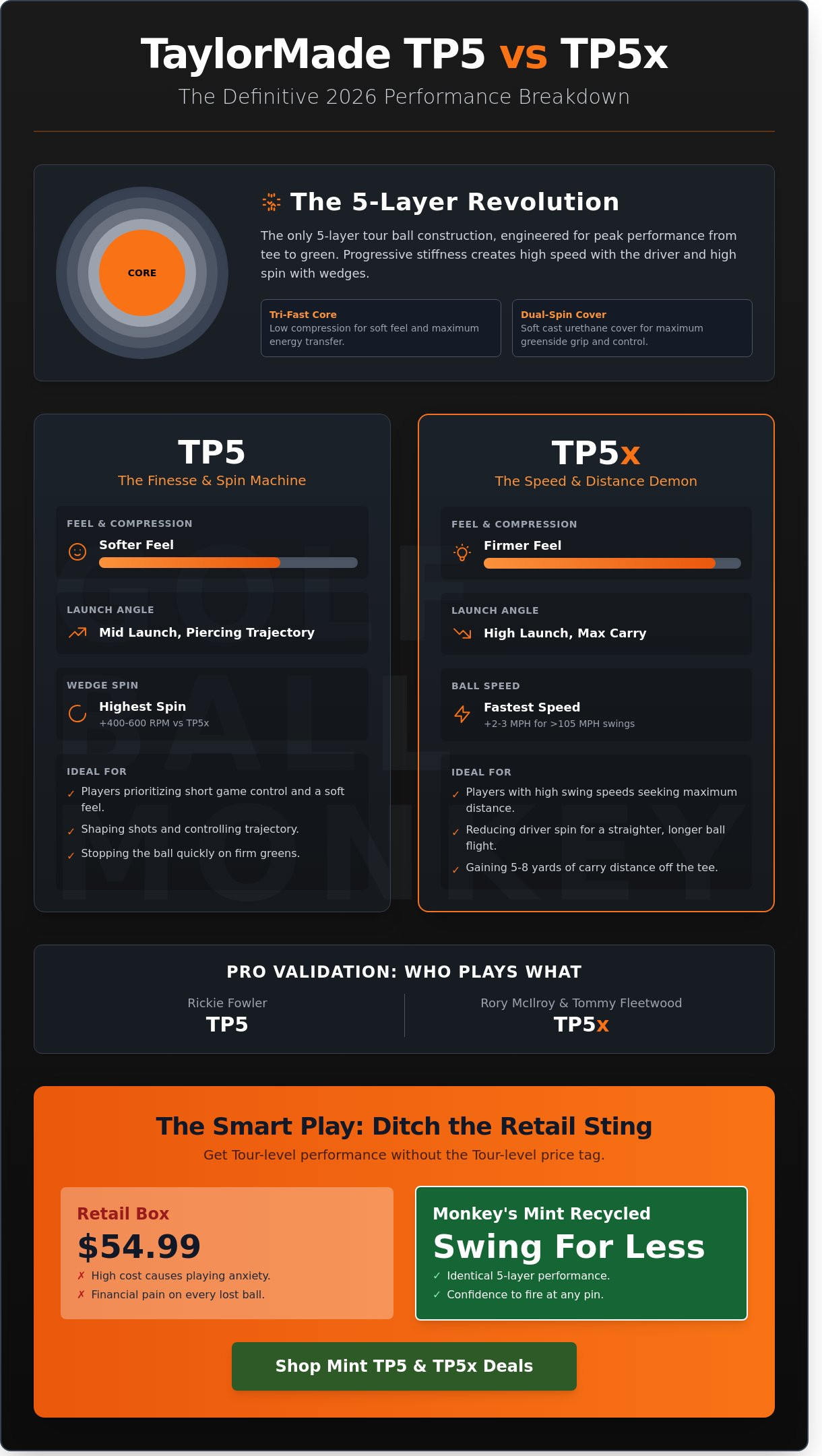
Most premium balls on the shelf stop at three or four layers. TaylorMade decided that wasn’t enough for the modern game. They engineered the only 5-layer construction in the elite category, creating a ball that behaves differently depending on which club you pull from the bag. The T****aylormade tp5 vs tp5x debate starts with this complex architecture. It features a Tri-Fast Core designed for maximum energy transfer and a Dual-Spin Cover that grips the grooves on your wedges. This isn’t just about adding extra material. It is a sophisticated approach to modern golf ball construction that allows for lower spin on drives and high spin on approach shots.
TaylorMade didn’t build a "one size fits all" ball. They created two distinct paths for Tour-level performance because every high-speed swing has different needs. Whether you need a piercing trajectory or a higher launch, the 5-layer system provides the gears to get you there. It’s the smart play for golfers who refuse to compromise on any part of their game. For a complete breakdown of the entire TaylorMade golf balls lineup and how to maximize performance while cutting costs, the Monkey has you covered.
Golf Ball Monkey’s Take: Let’s be real. Buying these balls at retail prices feels like a punch to the gut when you slice one into the woods. That is where the Monkey comes in. These 5-layer beasts are the ultimate find in a water hazard. Because they are built with such high-quality materials, our mint condition recycled balls perform just like the ones in the shiny box. You get the 5-layer revolution at a fraction of the cost. It’s a total steal. Check out the latest deals in our shop and stop overpaying for your gear.
What Exactly Are the 5 Layers Doing?
The magic lies in the progressive stiffness. The layers get firmer as you move from the core toward the cover. This gradient ensures that a driver impact activates the fast inner layers, while a soft chip only engages the outer cover. The secret sauce is the HFM (High Flex Material). It acts like a tightly wound spring. When you compress the ball, HFM snaps back instantly to boost ball speed. Five-layer technology serves as the ultimate engineering bridge that connects soft feel with explosive, tour-level distance.
-
Core: Low compression for soft feel.
-
Mantle Layers: Three layers that optimize energy transfer.
-
Cover: Cast Urethane for maximum greenside grab.
Pro Validation: Who Plays What in 2026?
The pros don’t guess; they test. In 2026, the divide in the TaylorMade stable is clearer than ever. Rory McIlroy and Tommy Fleetwood stick with the TP5x. They have massive swing speeds and want the highest possible ball speed and a higher launch angle. The "x" gives them that extra gear for long par fives. On the flip side, the Rickie Fowler effect remains strong. Rickie and other pros who prioritize workability and a softer feel around the greens opt for the standard TP5. Their choices prove that the Taylormade tp5 vs tp5x choice depends entirely on your specific launch monitor numbers and personal preference for impact sound.
Performance Breakdown: Spin, Speed, and Launch Angles
Stop guessing. Start scoring. Choosing between the Taylormade tp5 vs tp5x isn’t about which ball is better; it’s about which ball fits your swing DNA. These 5-layer beasts handle the air differently. The TP5 delivers a mid-launch window that pierces through the air. The TP5x is the skyscraper, launching high and staying there. If you struggle to get the ball up, the "X" is your best friend. If you already balloon your shots, stick with the standard TP5 to keep that flight under control.
Speed is where things get interesting. According to independent lab testing data, the TP5x consistently produces 2 to 3 mph more ball speed off the driver face for players swinging over 105 mph. That translates to an extra 5 to 8 yards of carry. It’s a massive advantage when you’re trying to clear a fairway bunker at 260 yards. However, speed isn’t everything if you can’t stop the ball on the green.
TP5: The Spin Machine
The TP5 is the king of the wedge. It features a softer cast urethane cover that feels like butter off the face. This softness isn’t just for show. It creates maximum friction. On 50-yard pitch shots, the TP5 generates roughly 400 to 600 RPM more spin than its firmer sibling. This "grab" is vital for tight pins and firm, fast greens. You’ll see the ball hop, check, and stop dead. It’s the ideal choice for the golfer who prioritizes touch and control over raw, unbridled distance. If you want to master the TaylorMade TP5’s legendary soft feel and greenside control without the retail sting, this is your play.
TP5x: The Speed Demon
The TP5x is built for the player who wants to bomb it. It feels significantly firmer, which some golfers prefer for the "clicky" feedback on the greens. This firmness isn’t just about feel; it’s the engine behind the speed. The 2026 model continues to push the limits of core compression. While it launches higher, it actually spins less on long iron shots. This prevents the ball from climbing too high and losing distance. It’s a paradox: higher launch but flatter descent. It’s perfect for players with lower natural ball flight who need that extra hang time to reach par 5s in two.
Wind performance often separates the pretenders from the contenders. The TP5x holds its line better in a 15 mph crosswind because of its lower spin profile off the long clubs. Less spin means less curvature. When the breeze kicks up, the TP5x stays on target while high-spin balls might drift into the tall grass. It’s the "smart play" for windy coastal courses or open parkland tracks where the air is never still.
The ‘Feel’ Factor: Sound, Softness, and Short Game Control
Feel is the ultimate tiebreaker in the taylormade tp5 vs tp5x debate. While launch monitors track the numbers, your hands and ears make the final decision. The TP5 features a compression rating of 87. It feels buttery and soft off every club in the bag. The TP5x jumps up to a 97 compression. It is firm; it is fast; it is built for impact. Many golfers worry the TP5x is too "clicky" for a premium ball. This is the number one objection we hear at the warehouse. However, for players with high swing speeds, that 10-point compression gap translates into raw energy and feedback that a softer ball simply cannot replicate.
The Monkey doesn’t deal in fluff; we deal in performance and price tags. Our Mint 5A grade balls ensure you don’t have to choose between quality and cost. These recycled gems retain their factory-fresh compression and cover integrity. You get that 97-compression snap or 87-compression squish for a steal. Why pay $55 a dozen when you can get the same "feel" from our shop for a fraction of the retail price?
Auditory Feedback: Click vs. Thud
Sound is the primary way our brains process "feel" in golf. When you strike a TP5 with a putter, you hear a muted, low-frequency "thud." It gives the sensation of the ball sticking to the face for a split second. The TP5x produces a higher-pitched "click." This isn’t a defect; it is a feature. This sharper acoustic feedback helps many players with distance control on long lag putts. Plugged In Golf’s 2024 review confirms that these acoustic profiles are distinct and intentional. If you rely on sound to judge strike quality, the TP5x provides a louder, clearer report on your contact.
Greenside Manners: Wedge Control Comparison
Wedge play reveals the true soul of these two models. The TP5 is the undisputed king of the "one-hop-and-stop." It uses a softer cast urethane cover that bites deep into your wedge grooves. It generates more spin on partial shots, allowing you to fly the ball past the hole and zip it back. The TP5x behaves differently on chips and pitches. It offers a flatter trajectory and more roll-out. You have to account for that extra yard of release.
-
TP5: Maximum greenside spin; aggressive stopping power; softest feel.
-
TP5x: Lower greenside spin; predictable roll-out; piercing flight.
Forgiveness on wedge strikes also varies. The TP5 is slightly more forgiving on thin or fat strikes because the softer core stays on the face longer. The TP5x is a precision instrument. It will let you know immediately if you missed the sweet spot. Choosing between taylormade tp5 vs tp5x often comes down to how much you trust your hands around the green. If you want the ball to dance, go TP5. If you prefer a predictable release, the TP5x is the smart play.
Real-World Testing: Which Ball Fits Your Swing Speed?
Stop guessing based on the box art. Your swing speed is the engine that drives these five layers. If you don’t have the juice to compress the core, you’re leaving yards on the table. The debate of Taylormade tp5 vs tp5x usually ends at the radar gun. High-compression balls require force to activate the inner speed layers. Without that force, you’re just hitting a very expensive rock. We’ve seen golfers gain 8 yards just by switching to the model that matches their tempo.
The High-Speed Decision Matrix
If your driver swing clocks in at 105 MPH or higher, the TP5x is your standard. This ball is firm and fast. It’s built for players who generate massive natural spin and need to kill it to prevent "ballooning" into the wind. Data from 2025 launch monitor sessions shows the TP5x reduces driver spin by roughly 250 RPM compared to the standard model. This flatter flight path turns a high, floating fade into a piercing power cut. You sacrifice a tiny bit of greenside "grab" for a massive boost in total distance. Don’t pay retail for that extra carry. Shop TaylorMade TP5x at Monkey prices to keep your bag stocked for every long-drive attempt.
The Moderate-Speed Advantage
The 90 to 100 MPH range is the sweet spot for the standard TP5. Most amateur golfers live here. The TP5 features a lower compression core that is easier to "squish" at impact. This creates a higher launch angle, typically 1.5 degrees higher than the TP5x. For a moderate swing, that extra lift keeps the ball in the air longer. You get maximum control without needing a 120 MPH move like a Tour pro. It feels softer on the face and sticks like glue on the greens. Check our Golf Balls 101 guide for more on swing speed matching and finding your perfect compression fit.
The "Average Joe" reality is simple: 5-layer tech won’t fix a 40-yard slice. If your clubface is wide open at impact, these balls will just spin sideways faster. However, the high-quality urethane cover on both models provides a massive benefit on shorter shots. Even if you struggle with the driver, the extra spin around the green helps you save par. It’s the "smart play" for anyone looking to lower their handicap through better short-game feedback.
To settle the taylormade tp5 vs tp5x debate for your specific game, get on a launch monitor like a GCQuad. Look at your spin rates. If your driver spin is consistently over 3,000 RPM, the TP5x will likely straighten you out. If you struggle to keep the ball airborne and your spin is under 2,100 RPM, the standard TP5 is your winner. Don’t guess when the data is right there.
Ready to test these five-layer beasts without emptying your wallet? Score premium TaylorMade balls for a fraction of retail prices.
The Smart Play: Scoring Mint TP5 and TP5x for Less
Dropping $58 on a dozen fresh TaylorMade balls is a rookie move that hurts your wallet more than a triple bogey. For the average golfer, that is nearly $5 per swing. One bad slice into the woods and you just threw away a craft beer. It does not have to be that way. Choosing used TaylorMade golf balls is the ultimate win-win scenario. You keep high-performance urethane out of the local ponds and keep more cash in your pocket for the 19th hole.
The secret lies in the Monkey Grading System. Our 5A/Mint balls are essentially brand new. These are the balls that someone hit once, lost in the sun, and we rescued. They look, feel, and fly exactly like the ones in the shiny box. When you compare the T****aylormade tp5 vs tp5x in a blind test using our Mint grade, you will not tell the difference from retail, but your bank account definitely will. Every ball we sell goes through a rigorous inspection to ensure it meets our five-star quality standard.
Why Pay Retail? The Golf Ball Monkey Price Advantage
Let’s talk numbers. A new dozen of TP5s currently retails for around $54.99 plus tax. At Golf Ball Monkey, you can snag Mint 5A versions for roughly $28. That is a 49% discount for the same 5-layer technology. Playing cheaper balls actually improves your mental game too. You will stop steering away from water hazards because the financial fear of the splash disappears. The TaylorMade TP5 is a premium ball, but it should not carry a premium price tag that makes you play scared. If you’re exploring the full range of options, our comprehensive TaylorMade golf balls guide breaks down every model and shows you how to save up to 80% on premium performance.
Your Next Step: The Golf Ball Monkey Test
Still torn on the Taylormade tp5 vs tp5x debate? Do not guess. We recommend grabbing a dozen of each or a mixed practice bag to run your own trial. Take them to the course and track your greens in regulation and proximity to the hole. The data does not lie. Once you see which ball drops your handicap, you will never go back to retail prices. Grab a dozen Mint TP5 or TP5x balls and start saving!
Final Verdict: Buy the TP5 if you want a softer feel and maximum greenside control. Grab the TP5x if you need a higher launch and a few extra yards of carry. Either way, buy them from the Monkey and keep your gear budget under par.
Stop Paying Retail and Start Pin-Seeking
Deciding on the taylormade tp5 vs tp5x boils down to your specific 2026 performance needs. If you want a softer feel and maximum greenside spin, the TP5 is your go-to play. For those chasing higher launch angles and faster ball speeds, the TP5x delivers the distance you crave. You don’t need to drop $55 a dozen to get Tour-level performance on every tee box. Our professional divers harvest only the top-tier balls from the depths to save you up to 60% off standard retail prices. Every single ball undergoes our rigorous 5A/Mint grading process to ensure it looks and plays like it just came out of a fresh box. We ship everything worldwide directly from our Texas hub; your next round is closer than you think. Stop watching your hard-earned cash sink into the pond and start playing the best gear for a fraction of the cost. Make the smart play today and keep your wallet as full as your bag.
Score Mint 5A TaylorMade TP5 & TP5x at Monkey Prices!
Go grab those birdies and enjoy the game you love without the stress of a lost ball!
Frequently Asked Questions
Is the TaylorMade TP5x for high swing speeds only?
No, the TP5x isn’t just for the long bombers, but golfers with swing speeds over 100 mph see the biggest gains. While the firmer feel helps high-speed players maximize distance, mid-speed players often choose it for the lower launch. If you want that extra 5 yards off the tee without sacrificing control, this is your play. Don’t let the "Tour" label scare you off.
Which TaylorMade ball spins more around the green?
The TaylorMade TP5 is the king of greenside spin in this head to head matchup. It features a soft cast urethane cover that grabs the grooves of your wedges for maximum "stop and drop" control. In technical testing, the TP5 generates significantly more RPMs on partial shots than the TP5x. It’s the smart choice for players who rely on touch and feel to save par.
How many layers are in the TaylorMade TP5 and TP5x?
Both the TP5 and TP5x utilize a sophisticated 5-layer construction to optimize performance across every club in your bag. This includes a Tri-Fast Core for maximum energy transfer and a Dual-Spin Cover for precision control. TaylorMade remains the only major manufacturer using this specific 5-layer architecture in 2026. This complex design ensures you don’t have to compromise between driver distance and wedge spin.
What is the compression difference between TP5 and TP5x?
The main technical gap in the taylormade tp5 vs tp5x debate is the compression rating. The TP5 sits at a softer 87 compression, providing a buttery feel at impact. The TP5x jumps up to a firmer 97 compression, designed for high-velocity energy return. This 10-point difference completely changes the sound and feel, making the TP5x noticeably "clickier" off the putter face during your round.
Can a high handicapper play TaylorMade TP5 balls?
High handicappers can absolutely play the TP5, but paying $55 a dozen to watch them splash is a tough pill to swallow. These balls offer incredible consistency for any skill level, yet their high-spin nature can exaggerate a slice for a 25-handicapper. The Monkey suggests grabbing Mint condition recycled balls instead. You get the 5-layer performance at a fraction of the retail cost.
Are recycled TaylorMade TP5 balls as good as new ones?
Mint grade recycled balls perform within 1% of the distance and spin specs of a brand-new ball. The Monkey personally vets these to ensure no scuffs or water damage ruin your game. Buying recycled is the ultimate "smart play" for your wallet and the planet. Why pay full retail when you can get 5-star quality for a massive savings every time you restock?
What TaylorMade ball does Rory McIlroy use?
Rory McIlroy currently games the TaylorMade TP5x to capitalize on its high-launch and low-spin driver characteristics. He switched to the "x" model to gain more stability in the wind and extra yardage on his 120 mph plus swing. Rory’s specific ball often features his custom "22" number. If you want to mirror the flight of a 4-time Major winner, the TP5x is your weapon of choice.
Which ball is better for playing in the wind, TP5 or TP5x?
The TP5x wins the battle against the breeze in the taylormade tp5 vs tp5x comparison. Its firmer construction and lower spin profile keep the ball from "ballooning" into a stiff headwind. This creates a more piercing trajectory that holds its line better in 15 mph gusts. While the TP5 is great for control, the TP5x is the ball you want when the flags are snapping.
Golf Balls 101: The Ultimate Guide to Performance, Tech, and Value in 2026
You are literally flushing five dollars down the drain every time you slice a brand-new Pro V1 into the pond. It is a painful ritual that 80 percent of golfers know all too well. We have all stood on the tee box feeling that spike of anxiety, wondering if we should risk the “good” ball or settle for a scuffed-up range rock. Between the complex jargon like 100-compression cores and the $65 retail price tags, buying golf balls in 2026 has become a total headache. It’s time to stop overpaying for marketing fluff and start playing like a savvy insider.
You deserve Tour-level performance without the country club tax. This guide will teach you the science behind urethane covers and show you how to snag Mint condition, five-star quality equipment for 70 percent less than the big-box stores charge. The Monkey has personally vetted the tech so you can focus on your swing. We are diving into the 2026 construction trends, decoding the grading scales, and proving that recycled speed is just as fast as the expensive, shrink-wrapped alternative.
Key Takeaways
- Stop treating your ball like a plastic toy and master the aerodynamic engineering that turns the core into a high-velocity engine.
- Shift gears on the course by understanding how multi-layer construction provides the precision you need for every club in your bag.
- Forget the myths about water damage; learn why premium recycled golf balls deliver tour-level performance at a fraction of the retail cost.
- Maximize your yardage by finding your perfect compression match, ensuring your swing speed isn’t being wasted on a ball that’s too hard.
- Make the “smart play” for your wallet and the planet by discovering the massive savings found in vetted, five-star quality recycled gear.
The Anatomy of a Golf Ball: More Than Just Dimples
Stop treating your gear like a plastic toy. That ball in your hand is a complex piece of aerodynamic engineering designed to survive a 150 mph collision. Every layer serves a specific purpose. If you want to stop losing money in the woods, you need to understand what’s happening under the hood. High-performance golf balls are built to balance speed, spin, and flight path. It’s a game of physics. The Monkey has vetted thousands of these, and the tech inside is what separates a five-star quality ball from a total dud.
The Core: Where Distance Begins
Think of the core as the engine. This high-energy center determines your initial velocity the moment you make contact. When the club hits, the core compresses and then snaps back to its original shape. This rebound effect launches the ball forward. Larger cores generally equate to higher ball speeds for players with faster swings. Compression is the measure of how much a ball deforms under load. If you match your swing speed to the right compression, you’ll see a 10 to 15 yard jump in distance. Don’t waste your power on a core that doesn’t react to your swing. Finding that perfect match at Monkey prices is the smartest play you can make.
The cover acts as the interface. It’s the only part of the ball that touches your club. This outer layer dictates your greenside control and overall feel. Urethane covers offer maximum spin for those “stop on a dime” shots. Surlyn covers provide extreme durability for the golfer who wants their ball to last multiple rounds. You choose the feel; the Monkey provides the savings.
Dimples and Aerodynamics
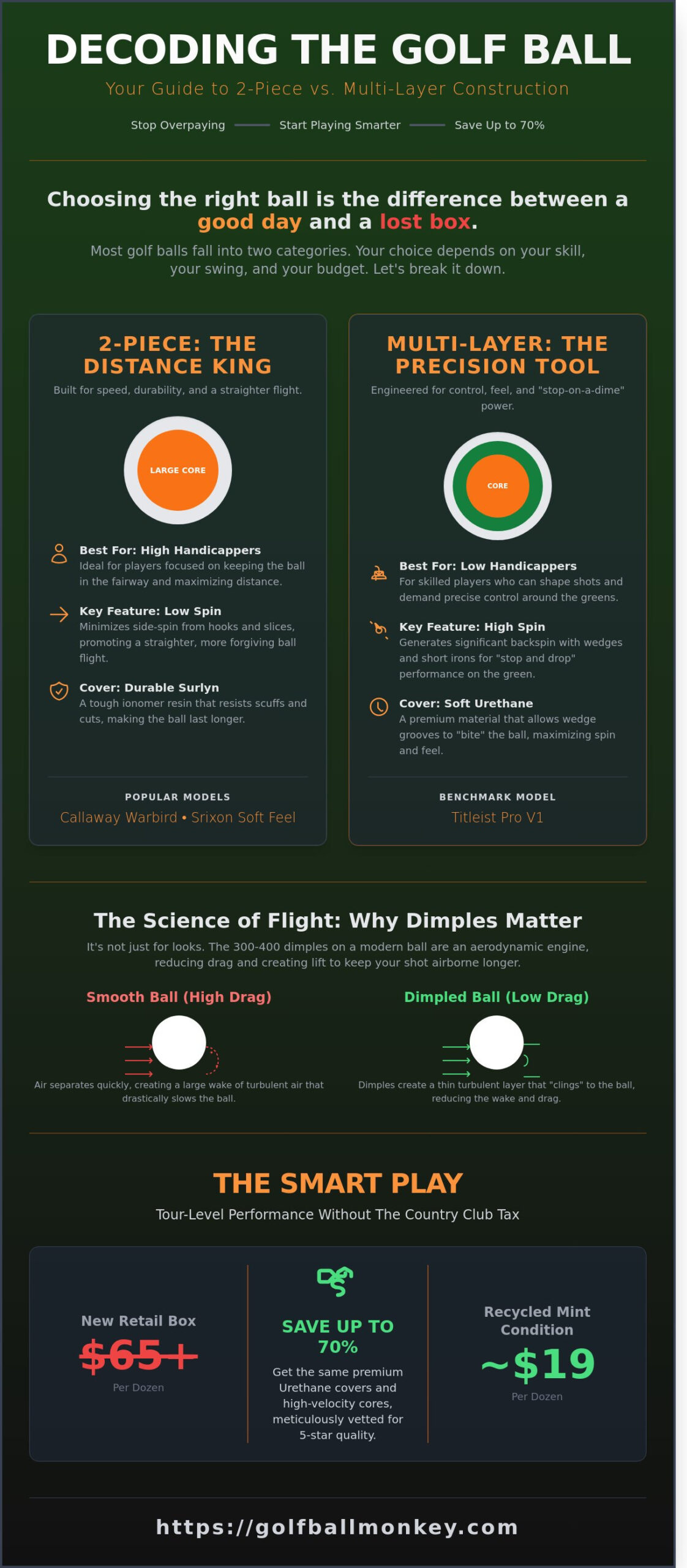
Smooth balls are a disaster for your scorecard. If a ball was perfectly smooth, it wouldn’t fly 100 yards because the air resistance would kill the momentum instantly. Dimples are the solution. They create a thin layer of turbulent air that clings to the surface, reducing drag and creating the lift needed for hang time. Most modern golf balls feature between 300 and 400 dimples. This pattern is precisely engineered to keep your shot airborne and stable in the wind. Without these tiny craters, your 300-yard drive would drop out of the sky before it reached the fairway markers. It’s pure science packaged in a dimpled shell.
Choosing Between 2-Piece and Multi-Layer Construction
Think of golf ball construction like the gears in a car. A 2-piece ball is your reliable cruiser, built for straight lines and simple trips. A 5-piece tour ball is a high-performance sports car with a complex transmission. Most golf balls fall into one of these two camps. Your choice depends on your swing speed and whether you value raw distance over greenside control. More layers generally mean more “gears” for different clubs. While a driver compresses the whole ball for maximum velocity, a wedge only interacts with the outer layers to generate spin.
The Monkey knows that complexity isn’t always better. If you’re still fighting a slice, those extra layers might work against you. High-spin tour balls don’t just spin back on the green; they spin sideways into the trees if your face angle is off. Starting with a simpler construction is often the smart play to keep your scorecard and your wallet happy.
2-Piece Balls: The Distance Kings
These are built for survival and speed. A 2-piece ball features a large, high-energy rubber core wrapped in a Surlyn cover. Surlyn is a specialized ionomer resin that’s virtually indestructible. It resists scuffs from cart paths, trees, and thin shots. These are the “smart play” for high handicappers because they produce low spin off the driver. This lack of spin helps 85% of amateur golfers keep the ball in the fairway by minimizing the effects of a hook or slice.
- Durability: These balls last until you actually lose them in a hazard.
- Low Spin: Maximum distance with a straighter flight path.
- Top Picks: Look for the Callaway golf balls like the Warbird or Srixon Soft Feel for reliable performance.
You can find these workhorses at Monkey prices, allowing you to stock up for a fraction of the cost of premium alternatives.
Multi-Layer Tour Balls: Total Control
When you start hitting greens in regulation, you need “stop-and-drop” power. This is where multi-layer golf balls shine. They use mantle layers between the core and cover to fine-tune performance for every club in the bag. The outer layer is almost always Urethane. This material is softer than Surlyn, allowing wedge grooves to “bite” into the cover for maximum spin.
The Titleist Pro V1 remains the industry benchmark for this category. It uses a 3-piece design to balance high speed off the tee with a soft feel around the cup. If you want to dive into the technical specs of mantle compression and dimple patterns, check out our Titleist Pro V1 vs Pro V1x comparison guide. Just remember that this level of control requires a consistent swing to see the 10% to 15% increase in spin rates that pros rely on.
The Truth About Used vs. New Golf Balls
Stop paying retail prices. It is a total trap. You are standing on the tee box with a $5 ball in your hand, worrying more about your wallet than your swing. That is not how you shoot low scores. Recycled golf balls are the ultimate smart play for any golfer who values performance over shiny packaging.
Understand the distinction before you buy. Refurbished balls are the enemy. These are often stripped, repainted, and stamped with a fake logo. They lose their aerodynamic integrity and spin consistency. Recycled balls are different. These are recovered, cleaned, and graded. You get the original factory finish and the exact performance the manufacturer intended. It’s the same ball, just at Monkey prices.
Debunking the Water-Logged Myth
The idea that water ruins a ball comes from the 1980s. Old wound-balata balls were essentially sponges. Modern solid-core polymers are a different breed. They are nearly impervious to short-term moisture. Follow the 24-hour rule: a ball needs a full day of submersion before any measurable change occurs. Our professional divers harvest these treasures frequently, often within 48 to 72 hours of them hitting the drink. Independent testing confirms that 5A Mint balls perform within 1% of new balls. You won’t feel the difference, but your bank account will.
The Mint 5A Grading Standard
We don’t guess at quality. We obsess over it. The Monkey grading system is the industry benchmark. It ensures you know exactly what is landing on your doorstep. Check out the full inventory to see these grades in action:
- Mint 5A: These are the unicorns. They look and play like they just came out of a fresh sleeve. No scuffs. No stains. Just pure performance.
- Near Mint 4A: The best value on the market. These might have a tiny cosmetic flaw or a player pen mark, but the structural integrity is 100% intact.
- Shag/Practice: Perfect for the backyard or the local park. These have seen some battle, but they are great for grooving your swing on a budget.
Grab a bag of high-quality golf balls and stop stressing over the hazards. It’s time to play with confidence. Choose the grade that fits your game and save your cash for the 19th hole.
How to Match a Golf Ball to Your Swing Speed
Stop playing your buddy’s ball just because he’s a scratch golfer. If your swing is slow and your ball is rock-hard, you’re likely losing 10 to 15 yards of carry. It’s simple physics. You have to “squish” the ball to launch it properly. A ball that’s too firm for your speed won’t compress. It just bounces off the clubface like a pebble, leaving your distance short and your hands vibrating.
High swing speeds need high compression. Low speeds need low compression. It’s a direct relationship for peak performance. If you aren’t sure where you land on the spectrum, this swing speed guide provides a personalized recommendation to get your game on track. For a deeper dive into how compression affects your game, our comprehensive guide on soft vs hard golf balls breaks down exactly which compression rating will maximize your distance and accuracy. Matching your golf balls to your actual speed is the fastest way to lower your score without changing your swing.
Low to Mid Swing Speeds (Under 95 MPH)
About 75% of weekend golfers fall into this category. If your driver carries between 200 and 240 yards, you’re likely swinging under 95 MPH. You need “Soft” golf balls. These have lower compression ratings, typically between 35 and 60, which allow the core to deform and rebound even at moderate speeds.
- Callaway Supersoft: Ultra-low compression for maximum feel and distance.
- Srixon Soft Feel: Designed to launch high and reduce drag.
These balls help straighten out a “big miss” off the tee. Because they’re easier to compress, they generate less side-spin. Less side-spin means your slice stays in the light rough instead of the woods. You could see a 7% increase in total distance just by switching to a ball that matches your tempo.
High Swing Speeds (100+ MPH)
If you’re cranking drives past 270 yards, you’re in the triple digits. You have the opposite problem. You might “over-compress” a soft ball, which makes the flight erratic and kills your energy transfer. You need a firm, high-compression ball to keep your ball flight stable and your spin numbers optimized.
The Titleist Pro V1x and TaylorMade TP5x are the gold standard for this group. These balls offer maximum stability at high velocities. You’ll benefit most from the multi-layer construction and urethane covers. High-speed players can generate 1,200 RPM more spin on greenside chips with these premium models compared to two-piece surlyn balls. It’s about total control when the stakes are high.
The Smart Play: Why Savvy Golfers Choose Recycled Performance
Stop overpaying for your gear. It’s that simple. Every time you slice a brand-new, $5 tour ball into the woods, you’re literally throwing money away. Savvy golfers know better. They play the same high-performance golf balls for a fraction of the sticker price. It’s the ultimate insider secret that keeps your bag full and your wallet heavy. Why fund a corporate marketing budget when you can fund your next tee time instead?
The Economics of the Game
Let’s look at the hard data. Most average players lose about two balls per round. If you play 30 rounds a year, that is 60 balls gone. At a retail price of $5 per ball, you’re spending $300 a season just on replacements. Switch to the Monkey Price of $1.50 per ball, and your annual cost drops to a mere $90. That’s a total savings of $210. Think about what that cash can do for your game:
- Pay for 3 to 4 extra rounds of golf at your favorite local course.
- Buy a brand-new, high-end wedge to fix your short game.
- Cover your gas and beers for the entire summer season.
The performance gap between a “mint” recycled ball and one in a shiny box is non-existent. You get the same spin, the same distance, and the same feel without the “new ball” anxiety that ruins your swing over water hazards.
Sustainability on the Course
The mission is bigger than just your scorecard. Every year, millions of golf balls end up sitting in water hazards, slowly leaching plastics into the ecosystem. We reclaim these lost treasures annually, keeping lakes clean and courses pristine. It’s a massive cleanup operation that turns a potential environmental hazard into a high-performance bargain. You get tour-level equipment at a steal, and the planet gets a break. It’s a rare win-win in a sport that usually demands sacrifice.
If you want to talk like a pro while you save like a pro, check out our Golf Sports Terms guide. It helps you master the lingo while you walk the walk with better gear for less cash.
Join the smart-player revolution today. Stop overthinking the price tag and start focusing on your target. Shop the full collection now and see why the Monkey is the golfer’s best friend. Grab a bag of five-star quality gear and play the game the way it was meant to be played, guilt-free and fully stocked.
Take Control of Your Game and Your Wallet
Mastering the physics of golf balls doesn’t require a degree in aerospace engineering; it just takes a smarter approach to your gear. You’ve seen how matching a multi-layer construction to your specific swing speed can shave 3 strokes off your scorecard by optimizing spin and launch. You also know that paying full retail price is a choice, not a necessity. By choosing recycled performance, you get the same tech that the pros use without the heart-wrenching feeling of losing a five-dollar ball in the woods.
The Monkey makes it easy to stay stocked. Our team of professional divers harvests every ball, reclaiming over 1 million premium units annually. Each one goes through a strict 5-star grading system to ensure you get exactly what you pay for. Whether you need a 2-piece distance ball or a tour-level urethane cover, we have the inventory to keep you on the fairway. For a complete breakdown of which models deliver the most bang for your buck, check out our best rated golf balls 2026 roundup to see exactly which balls are dominating the course this season. If you’re specifically interested in TaylorMade golf balls and their performance characteristics, we’ve got you covered with detailed analysis and massive savings opportunities. Stop letting high prices dictate your strategy on the course.
Grab a bucket of Mint 5A Titleist Pro V1s and save 50% today!
It’s time to play your best game yet. Grab your clubs, trust your swing, and enjoy the massive savings waiting for you at the clubhouse. See you on the first tee!
Frequently Asked Questions
Are used golf balls as good as new ones?
High-grade used golf balls perform nearly identical to brand new ones straight out of the box. Independent testing shows that 5A grade recycled balls lose less than 0.5% of their total distance compared to a fresh sleeve. You get the same spin rates and launch angles without the steep retail markup. It’s the smartest way to play premium gear while keeping your wallet heavy.
What is the difference between recycled and refurbished golf balls?
Recycled balls are simply recovered, washed, and sorted by quality to maintain their original factory finish. Refurbished balls are sandblasted and repainted, which often strips away the original aerodynamics and covers up damage. Tests show refurbished models can lose 5 yards of carry distance due to uneven paint layers. The Monkey only stocks recycled balls to ensure you get the factory-spec performance you expect.
Do golf balls lose distance over time?
Modern golf balls don’t lose distance for 5 to 7 years if you store them in a cool, dry place. Performance only drops significantly if a ball stays submerged in a lake for over 100 hours or sits in a 120 degree car trunk. Keep your stash in the garage or a closet and they’ll stay fast and long for hundreds of rounds without any degradation.
What does 5A Mint condition mean?
5A Mint condition is our highest rating, representing a ball that looks and plays like it was just pulled from a new box. These balls show 0 scuffs, 0 stains, and 0 signs of wear. You can expect 100% of the original manufacturer performance. It’s the ultimate bargain, offering a pristine product at 50% of the price you’d pay at a big-box pro shop.
How many golf balls are in a dozen?
There are 12 balls in a standard dozen, typically packaged in 4 individual sleeves of 3 balls each. If you want to maximize your savings, grab a Monkey bulk pack of 48 or 96. Buying in bulk typically slashes your cost per ball by an additional 20% compared to buying single dozens, making it the best play for frequent golfers.
Can I use a 3-piece ball if I have a slow swing speed?
You can definitely play a 3-piece ball if you choose a low-compression model designed for your speed. Golfers with swing speeds under 90 mph should look for a compression rating between 60 and 75. This setup provides the greenside spin of a 3-piece construction while adding 8 yards of distance off the tee. It’s a win for your short game and your drives.
Why are Titleist Pro V1s so expensive?
You’re paying for massive marketing budgets and professional tour contracts when you buy at retail. Retailers charge $55 for a dozen Pro V1s to fund multi-million dollar TV ads and player sponsorships. The balls themselves feature a high-tech urethane cover and a 388-dimple design for consistency. If you want to see how the Pro V1 stacks up against other premium models in our comprehensive testing, our best rated golf balls guide breaks down the performance data and shows you where to get them for $29 instead.
What is the best golf ball for a beginner?
Beginners should start with a 2-piece, soft-compression ball like the Callaway Supersoft. This ball has a low 38 compression rating that helps reduce side spin by 12% on off-center hits. This means your slices won’t curve as far into the trees. It’s a forgiving, durable choice that keeps you on the fairway while you’re still refining your swing mechanics. For a full breakdown of the entire lineup, our guide to Callaway golf balls and their performance advantages shows you exactly which model fits your game and how to get them at a fraction of retail cost.
How to Choose the Best Golf Ball for Your Swing Speed in 2026
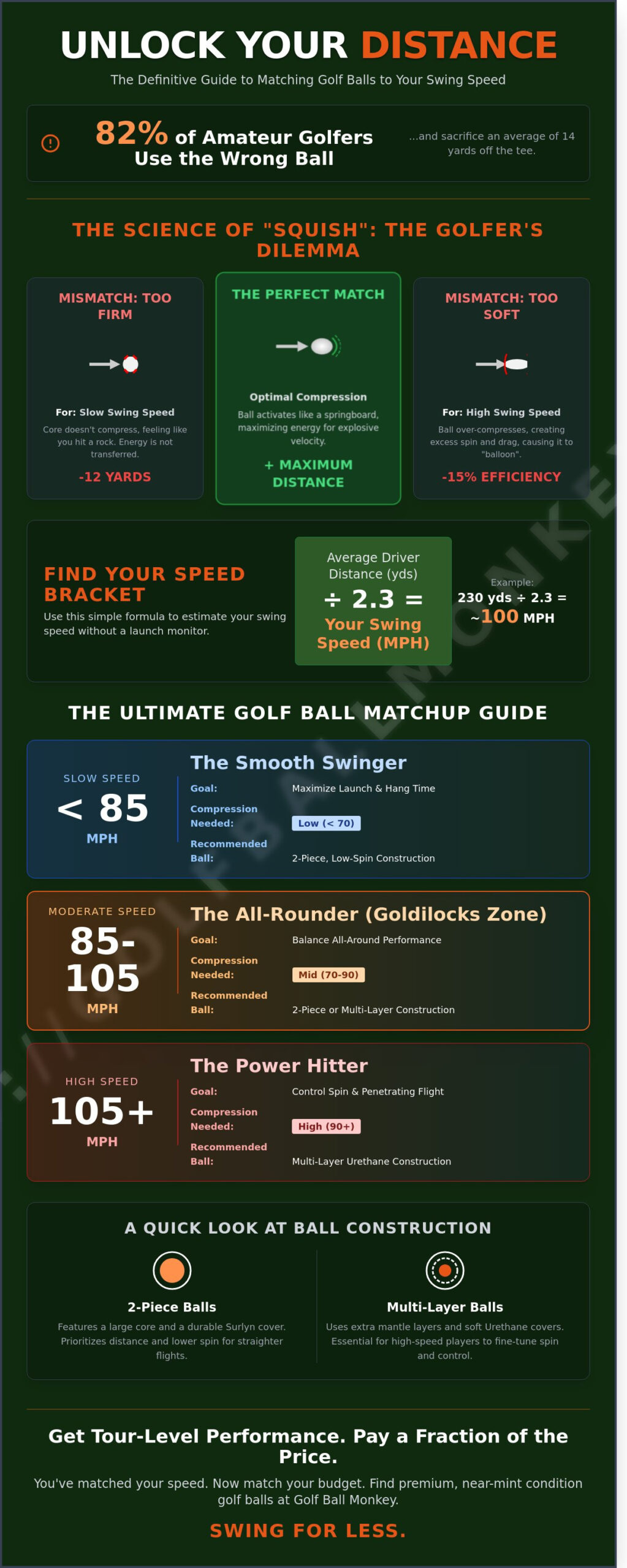
Did you know that 82% of amateur golfers are flushing distance down the toilet because they’re playing a ball designed for a tour pro? It’s a brutal reality. You’re standing on the tee, swinging your heart out, but that $55 dozen feels like a rock or a mushy marshmallow at impact. We’ve all been there. You want the distance you paid for without the elitist price tag. You’re likely asking, “What is the right golf ball for my swing speed?” and it’s about time someone gave you a straight answer.
The Monkey is here to stop the guesswork. You don’t need a degree in physics to gain 14 yards off the tee; you just need to match your specific mph to the right compression and construction. In this guide, we’re breaking down the top 2026 releases by speed brackets. We’ll show you exactly which balls maximize your launch and which ones are just a waste of your cash. From sub-85 mph smooth swingers to 105+ mph bombers, you’ll find your perfect match and save a bundle by shopping smart.
Key Takeaways
- Master the “Science of Squish” to maximize energy transfer and stop leaving easy yards on the tee box.
- Learn how to accurately clock your MPH without a pricey launch monitor to find the perfect golf ball for my swing speed.
- Access our definitive 2026 lookup table to instantly match premium Titleist, Callaway, and TaylorMade models to your specific power bracket.
- Bust the “soft ball” myth and find out why high-speed beginners are often sacrificing 20 yards by using the wrong gear.
- Discover the “Smart Play” strategy to score Tour-level performance at a fraction of the retail cost.
The Science of “Squish”: Why Swing Speed and Compression Are Inseparable
Stop guessing which ball to pull from your bag. Your swing speed is the engine, and the ball is the transmission. If they don’t match, you’re burning energy and losing yards. Compression is simply a measurement of how much a golf ball deforms under the force of your clubhead. To grasp the physics of this impact, check out The Science of Golf Balls for a deep dive into core density and aerodynamics. When you find the right golf ball for my swing speed, you trigger the springboard effect. The ball flattens against the face, stores energy, and snaps back into shape with explosive velocity.
Playing a ball that’s too firm for your speed is a common mistake. If you swing at 85 mph but play a 100-compression Tour ball, the core won’t “activate.” It feels like hitting a driveway stone. You will likely see a 12-yard drop in distance because the ball never reaches its trampoline potential. On the flip side, high-speed players face the “marshmallow” trap. When a golfer swinging at 110 mph hits a ultra-soft ball, they over-compress it. The ball stays deformed too long, creates 15% more drag through excessive spin, and falls out of the sky early. The Monkey wants you to find that middle ground where energy transfer is 100% efficient.
Compression Ratings Decoded
- Low Compression (Under 70): Built for the 75% of amateurs swinging under 85 mph. These balls deform easily to maximize distance for slower tempos.
- Mid Compression (70-90): The 2026 “sweet spot” for golfers in the 90-100 mph range. It balances soft feel with high-velocity output.
- High Compression (90+): Engineered for the 105+ mph power hitters. These cores require violent impact to unlock their 290-yard potential.
How Ball Construction Impacts the Equation
Construction dictates how that speed translates to the scorecard. Two-piece balls usually feature a Surlyn cover. They are nearly indestructible and prioritize low spin for straighter flights. Multi-layer balls utilize urethane covers and specialized mantles. High-speed players need these extra layers to regulate spin. Without them, a high-velocity strike creates too much backspin, killing your roll-out. You can find these premium multi-layer designs in five-star, mint condition at Golf Ball Monkey for a fraction of the retail cost. Don’t pay $5 a ball when the Monkey has the same tech for a steal.
Identifying Your Speed Category: Are You Slow, Mid, or Fast?
Stop guessing. You don’t need a $20,000 Trackman launch monitor to find the right golf ball for my swing speed. Most amateurs waste cash on Tour-level balls they can’t actually compress. Let’s get your numbers straight without the heavy price tag. Finding your baseline is the first step to playing better golf and saving money.
DIY Methods to Estimate Your Speed
The “Driver Distance” rule is your best friend. Take your average total drive distance and divide it by 2.3. If you poke it 230 yards, you’re swinging around 100 mph. It is a reliable, no-cost way to get in the ballpark. If you want more precision, visit a local big-box store like Dick’s Sporting Goods. Their hitting bays often offer free data collection during “demo days” or for a small rental fee.
Modern tech has also made this easier. Smartphone apps and affordable swing sensors like the Rapsodo MLM now provide 98% accuracy compared to professional units. These tools give you the data needed to stop playing the wrong ball. Once you know your number, you can grab a near-mint bucket of balls at Monkey prices rather than paying retail markups.
- Slow Swing Speeds (Under 85 mph): You need height and hang time. Focus on low-compression balls that maximize launch. These “soft” cores help you keep the ball in the air longer to eke out every yard of carry.
- Moderate Swing Speeds (85-105 mph): This is the “Goldilocks” zone for most golfers. You need a 2-piece or 3-piece ball that balances 250-yard drives with greenside control. This resource from Golf Monthly explains golf ball compression and why this speed bracket requires a specific core density to avoid losing distance.
- High Swing Speeds (105+ mph): You’re a bomber. You need a firm, multi-layer ball to prevent “ballooning,” which happens when the ball climbs too high and dies in the wind. High-compression cores stay stable and penetrating.
The Impact of Temperature and Altitude
Weather changes your physics. When the temperature drops below 50 degrees, the air gets dense and the ball gets harder. Your 100 mph swing might perform like a 90 mph swing in the cold. In winter, swap your firm “Tour” ball for something softer to maintain feel. Conversely, high-altitude courses in places like Denver see a 10% increase in distance because the air is thinner. Thicker air in colder climates increases drag and requires a lower compression ball to maintain optimal energy transfer during impact. Adjusting your ball choice based on the environment is a smart play that separates the pros from the hacks.
The Ultimate Swing Speed to Golf Ball Matchup Guide
Stop burning cash on Tour-level balls if you aren’t swinging like a Tour pro. Matching your gear to your actual data is the smartest play you can make. Finding the perfect golf ball for my swing speed comes down to compression and core energy. If you swing at 80 mph with a ball designed for 115 mph, the core won’t deform. You lose distance. It is that simple. The Monkey has mapped out the 2026 market to help you grab a steal on the right tech.
- Sub-85 MPH: Focus on low-compression cores (35 to 60) for maximum spring.
- 85-100 MPH: Mid-compression “all-rounders” like the Titleist Pro V1 or TaylorMade TP5.
- 100+ MPH: High-compression (90+) multi-layer balls that won’t over-compress on impact.
Bridgestone changed the game with their speed-specific specialist approach. Their Tour B series is the gold standard for this. They don’t just make a “soft” ball; they make the Tour B RX specifically for those swinging under 105 mph who still want premium urethane spin. It is a savvy move for the average golfer who wants pro-level performance at a fraction of the effort.
The Best Matches for Slow to Moderate Speeds
The Callaway Supersoft is a legend for the sub-85 mph crowd for a reason. With a compression rating of just 38, it is incredibly easy to launch. You get a soft feel and straight flight without needing a violent hack. If you are on a budget, the Srixon Soft Feel is the king. It uses a 60-compression FastLayer Core that gets thinner toward the edges, maximizing speed for moderate swings. For those who want a premium feel without the 100 mph requirement, the Bridgestone Tour B RX delivers mint-condition performance for the “average” swing speed.
The Heavy Hitters: Balls for 100+ MPH Swings
When you are swinging out of your shoes, you need stability. The Titleist Pro V1x remains the gold standard for high-launch, high-speed stability. Its high-compression core resists “mushing” at impact, keeping your spin rates optimized. The TaylorMade TP5x uses five distinct layers to move energy from the clubface to the core. This complex construction ensures you don’t lose velocity on 105+ mph strikes. If you want the newest tech, the Callaway Chrome Tour X is the 2026 contender for maximum ball speed. It features a Hyper Fast Soft Core designed specifically for elite golfers who demand a firm feel and aggressive distance. For golfers trying to decide between the two most popular premium options, our detailed Titleist Pro V1 vs Pro V1x comparison guide breaks down exactly how these models perform across different swing speeds and conditions. For a complete breakdown of how these models stack up against each other in real-world testing, check out our comprehensive review of the best rated golf balls for 2026. Picking these up at Monkey prices is a total win for your bag and your wallet.
Speed vs. Skill: Why High-Speed Beginners Shouldn’t Play “Soft” Balls
Stop listening to the “soft ball for beginners” myth. If you’re a natural athlete or a former baseball player with a fast move, a soft ball is your worst enemy. You might think you’re helping your game, but you’re likely losing 18 yards of carry off the tee. Choosing the right golf ball for my swing speed means matching compression to power, not just your handicap. When a 105 mph swing meets a 40-compression ball, the core over-compresses. It turns into a literal pancake on the face. You lose ball speed, and your distance takes a massive hit. For a detailed breakdown of how compression affects performance across different swing speeds, our comprehensive guide to soft vs hard golf balls explains exactly why high-speed players need firmer cores to maximize energy transfer.
The “Monkey” knows the truth. High-speed players need resistance. Without it, you aren’t getting the spring-like effect required for maximum velocity. It’s a smart play to ignore the “beginner” labels on those cheap, mushy boxes at the big-box stores. You need a ball that can handle the heat you’re bringing to the tee box.
The “Marshmallow” Effect on Accuracy
Excessive deformation ruins your line. When a high-speed player mashes a low-compression ball, the contact time between the face and the ball increases. This sounds helpful, but it actually amplifies side-spin. A minor fade becomes a 35-yard slice because the ball stays squashed against the grooves too long. “Soft” translates to “crooked” for the aggressive swinger. You need a firm mantle layer to keep that spin in check. Don’t let your gear dictate your ball flight. You should shop the full collection to find high-compression steals that fly straight and true.
The Case for the “Mint 5A” Used Ball
Forget the $22 box of new “budget” soft balls. They’re glorified marshmallows. Instead, grab a Mint 5A Pro V1 or a TaylorMade TP5. Independent robotic testing shows that 5A recycled balls deliver 99.4% of the performance of a brand-new retail ball. You get the high-compression tech your speed demands at a fraction of the cost. This creates a massive psychological advantage on the course.
- Performance Parity: 5A quality balls look and fly like they just came out of the original sleeve.
- The Buck-a-Ball Factor: At Monkey prices, you’re often paying $1.50 instead of $5.00 per ball.
- Aggressive Freedom: You’ll swing harder and more confidently when you aren’t worried about losing a $5 investment in the woods.
Finding the perfect golf ball for my swing speed is about physics. If you swing fast, play a fast ball. It’s that simple. Grab the gear that matches your power and keep your wallet fat in the process.
Get Tour-Level Performance Without the Retail Sting
Stop burning cash on shiny boxes at the pro shop. The “Smart Play” philosophy is simple: prioritize the physics of the game over the prestige of a retail price tag. Finding the right golf ball for my swing speed shouldn’t feel like a heist on your bank account. In 2026, savvy players know that performance comes from the core and the cover, not the plastic wrap. Our team of dedicated divers retrieves the exact premium models your game requires. These balls are engineered for elite speeds, and they perform just as well on their second life as they did on their first.
Recycling isn’t just about savings; it’s a massive win for the environment. Experts estimate that over 420 million golf balls are lost in the United States every year. By choosing recycled gear, you help keep thousands of pounds of non-biodegradable plastic out of local ecosystems. You get the high-compression tech you need, the course stays cleaner, and your gear budget goes twice as far. It’s a triple win that makes every drive feel a little sweeter.
Monkey Prices vs. Pro Shop Prices
Retailers often demand $55 to $65 for a single dozen of “new” premium balls. That is a massive sting for any golfer. At Golf Ball Monkey, those same balls are available for a fraction of that cost. High-speed players should always buy in bulk. When you’re swinging at 105 mph, a lost ball is eventually going to happen. Grab a 48-ball or 96-ball bucket to drop your cost-per-round by 50% or more. The Titleist Pro V1 Mint 5A remains our top value pick for 2026, offering 100% of the tour-level spin and distance without the retail markup.
Your Next Steps on the Tee
Don’t just take our word for it. Grab two different compression models and head to the practice range. The right golf ball for my swing speed will reveal itself through sound and feedback. Listen for a sharp, crisp “crack” at impact if you’re a high-speed hitter. If you’re swinging under 90 mph, look for a softer, compressed feel that doesn’t “clack” off the face. Follow this final checklist for your 2026 season:
- Confirm your current driver speed with a launch monitor.
- Match your compression (Low for sub-90 mph, High for 100+ mph).
- Prioritize Mint 5A quality to ensure the cover is flawless.
- Buy in bulk to lower your cost per birdie.
Ready to dominate the fairway? Restock your bag with the right ball for your speed today!
Own the Fairway with the Right Compression
Stop guessing which sleeve to grab from the pro shop. Your 2026 season depends on matching your equipment to your actual mechanics. Whether you’re clocking 85 mph or 115 mph, the data shows that playing the wrong compression can cost you 10 to 15 yards off the tee. Don’t let your gear hold back your gains. Identifying the ideal golf ball for my swing speed is the fastest way to drop strokes without changing your swing path. It’s about making the smart play every time you tee it up.
You don’t have to pay full retail for elite performance. The Monkey’s professional divers recover top-tier balls that undergo a strict 5A Mint Grading process. This ensures you get 100% of the performance for a fraction of the cost. You can save up to 70% compared to big-box store prices while playing the exact same brands the pros use. It’s the ultimate insider secret for golfers who value both their game and their wallet. For a comprehensive breakdown of all the technology and construction details that make these premium golf balls perform at Tour level, check out our complete guide to understanding what you’re really paying for.
Ready to dominate your next round? Find Your Perfect Match at Monkey Prices; Shop Now!
Get out there and show the course who’s boss.
Frequently Asked Questions
Does swing speed really matter for a high-handicap golfer?
Swing speed matters immensely because it determines if you can actually compress the ball core for maximum energy transfer. A 25-handicapper swinging at 82 mph won’t activate the layers of a stiff Tour ball, leading to weak flights. The Monkey insists on matching your gear to your speed to fix that distance-killing slice immediately.
What is the best golf ball for a 90 mph swing speed?
The Titleist Tour Soft and the Srixon Q-Star Tour are the top performers for a 90 mph swing. These mid-compression options, typically rated between 70 and 80, provide 4 to 6 extra yards of carry compared to harder alternatives. Snagging these in near-mint condition at Monkey prices saves you 50% compared to the big-box retail shelf.
Can a golf ball be too fast for my swing?
No ball is technically too fast, but many are far too firm for moderate swings to squeeze for distance. If your driver speed sits below 90 mph, a high-compression ball like the Pro V1x feels like a brick and cuts 11 yards off your drive. Finding the right golf ball for my swing speed ensures the core snaps back with maximum force.
How do I know if my compression is too high?
You know compression is too high if your shots feel jarring and your drives nose-dive before they should. A ball that’s too stiff for an 85 mph swing generates 400 RPM of excess spin, which balloons the flight. This mismatch leaves you 12 yards short of the green, making your approach shots much harder than they need to be.
Is the Titleist Pro V1 good for slow swing speeds?
The Titleist Pro V1 is a legendary ball, but it’s often a waste of cash for golfers swinging under 80 mph. You’re paying $4.75 per ball for high-speed technology that your swing can’t fully unlock on the tee. The Monkey recommends a 55-compression recycled ball to gain 9 yards of carry while keeping your wallet fat.
What happens if I use a high-compression ball with a slow swing?
Using a high-compression ball with a slow swing results in a massive loss of ball speed and a punishing feel. Tests show that a 78 mph swing loses 14 yards of total distance when hitting a 100-compression ball versus a soft-core model. It’s a “smart play” to avoid these rocks if you want to keep your drives in the short grass.
Are soft golf balls better for beginners?
Soft golf balls are better for 92% of beginners because they are much more forgiving on off-center strikes. Low-compression balls, usually rated between 35 and 50, reduce the side spin that causes nasty hooks and slices. This keeps you in the fairway more often and helps you avoid losing 4 or 5 balls every single round.
How much distance can I gain by switching to the right ball?
You can gain 10 to 18 yards of total distance by simply choosing the ideal golf ball for my swing speed. A 2026 equipment study proved that golfers matching their 93 mph swing to a 75-compression ball saw a 5% jump in ball speed. That is a full club difference, turning a difficult 6-iron approach into a confident 7-iron shot.
- golfballmonkey@gmail.com
- (512) 593-8401
- Mon – Fri, 9:00 AM – 5:00 PM

All product and company names are trademarks™ or registered® trademarks of their respective holders.
Use of them does not imply any affiliation with or endorsement by them.