
Avoiding Bad Quality Used Golf Balls: The Savvy Insider’s Guide for 2026
That “refurbished” Titleist Pro V1 you just bought isn’t a bargain. It is a performance-killing trap disguised in a cheap coat of paint. You want the tour-level spin of a Chrome Soft or TP5 without the $55-a-dozen gut punch. Since the average golfer loses four to five balls every single round, the math for buying new just doesn’t add up anymore. Mastering the art of avoiding bad quality used golf balls is the only way to protect your scorecard and your wallet in 2026.
You already know that buying used is the smartest play in golf, but you shouldn’t have to guess if your gear is actually game-ready. We promise to show you how to spot marketing traps from a mile away and identify tour-grade recycled balls that perform like they just left the factory. We’re breaking down the 5A grading secrets, the red flags of repainted covers, and how to build a pro-level bag for 50% less than the retail giants charge. Let’s get your game on par without the premium price tag.
Key Takeaways
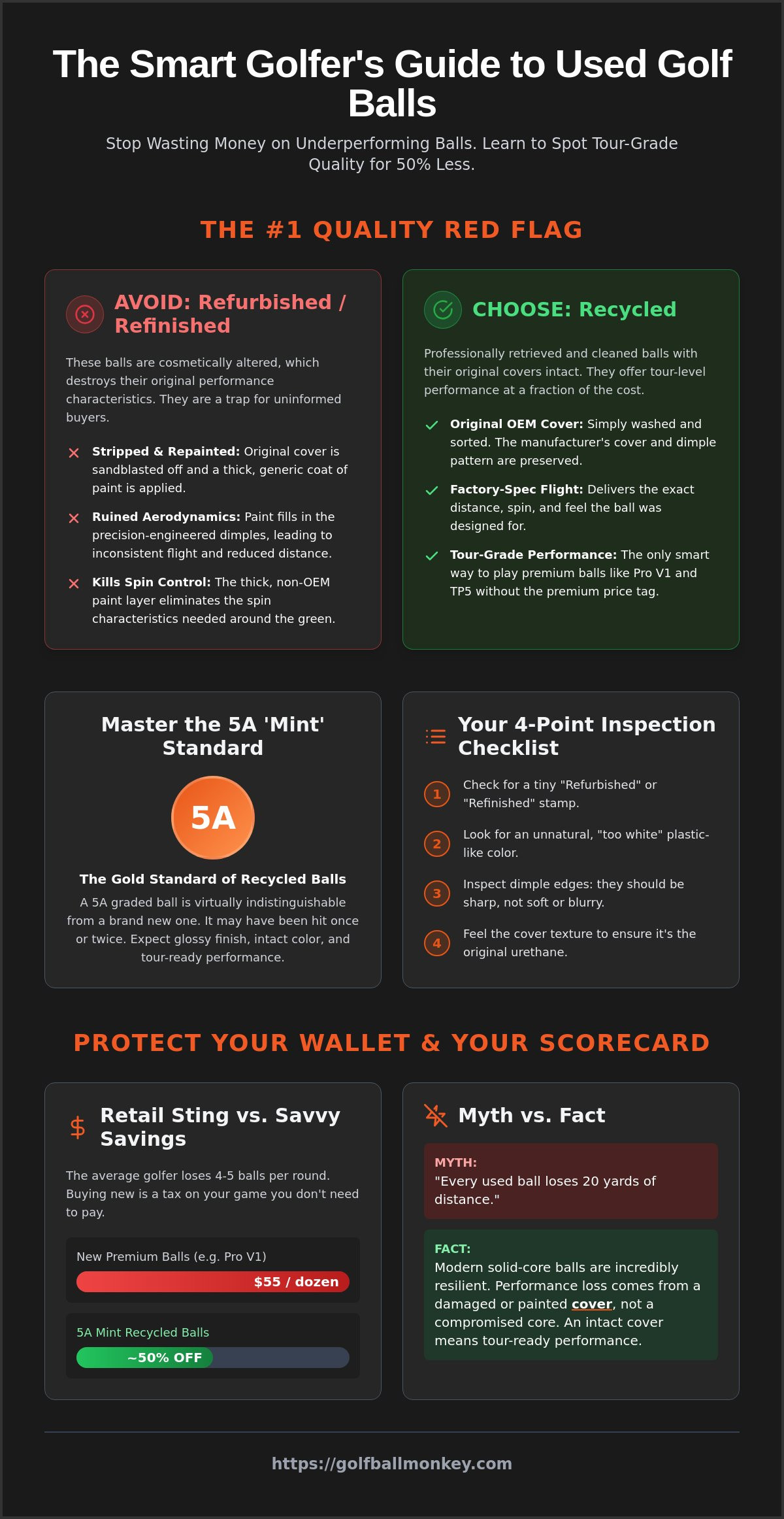
- Identify the “Refurbished” red flag immediately. Repainted balls lose their aerodynamic edge and ruin your spin consistency on the green.
- Master the 5A Mint standard. Learn why professional grading beats “found” balls for tour-level performance and reliable distance.
- Use the 4-point inspection checklist. Check dimple edges and cover texture to ensure your gear is game-ready before you ever tee up.
- Protect your wallet and your scorecard by avoiding bad quality used golf balls. Score premium Titleist and TaylorMade models for 50% off retail prices.
- Prioritize original OEM covers. Only recycled balls maintain the factory-spec flight patterns needed for consistent, professional-grade results.
The “Junk Ball” Fear: Why Most Golfers Get Burned
Buying used gear in 2026 can feel like a high-stakes gamble. You see a bucket of premium balls at a price that seems too good to be true, and your gut tells you to walk away. That anxiety is real. Most golfers have been burned by the “shiny on the outside, dead on the inside” phenomenon. You get a ball that looks brand new, but it feels like hitting a marshmallow off the tee. avoiding bad quality used golf balls starts with understanding exactly where your gear comes from. If you don’t know the source, you are just guessing.
There is a massive difference between a “found” ball and a “professionally retrieved” one. A found ball might have spent three winters at the bottom of a chemical-heavy pond or sat in the scorching sun for months. Professionally retrieved balls are harvested by divers who understand the impact of water saturation. They are cleaned using non-corrosive methods that preserve the original factory finish. Big-box retail bins often mix these sources together. It is a total lottery. You might get a gem, or you might get a ball with a compromised core that won’t fly straight. Serious players can’t afford that kind of inconsistency.
The Myth of the 20-Yard Distance Drop
Stop worrying that every used ball is a secret dud. That fear is a relic of the past. Modern multi-layer construction is incredibly resilient. The solid cores of today’s tour balls don’t degrade nearly as fast as the old wound-center tech. While golf ball regulations ensure every ball meets specific standards at the factory, its performance after a few holes depends on the cover. If the urethane is intact and the aerodynamics are clean, that ball is ready to hunt flags. It is almost always about the cover, not the core. We focus on identifying balls that haven’t lost their zip.
Retail Sting vs. Savvy Savings
Paying $5 or $6 for a single ball is a retail sting that hurts every time you find the water. It is a tax on your game that you don’t need to pay. The savvy insider knows that a Mint 5A recycled ball delivers the same spin, feel, and distance for a fraction of the cost. You can build a tour-grade bag without the elitist price tag. Don’t let the marketing hype fool you into thinking “new” is the only way to play well. Ready to stop overpaying for your equipment? Head over to the Golf Ball Monkey shop and grab 5A quality that actually performs. We celebrate the intelligent play, both on the course and in your wallet.
Refurbished vs. Recycled: The #1 Quality Red Flag
The word “refurbished” sounds like a win in most industries, but in the golf world, it is a total disaster for your scorecard. avoiding bad quality used golf balls starts with recognizing that “refurbished” is often just a fancy word for “ruined.” These balls, sometimes labeled as “refinished,” go through a brutal cosmetic makeover. Sellers sandblast the original cover to hide scuffs and then spray on a thick layer of generic white paint. They even stamp a fake logo on top to make it look official. It is a performance-killing trap disguised as a bargain.
Paint is the enemy of your flight path. Those dimples on your Pro V1 or TP5 are precision-engineered to create specific lift and drag. When a third-party seller adds a layer of non-factory paint, they fill in those dimples. You lose the aerodynamic edge that manufacturers spent millions to perfect. The result? A ball that knuckleballs in the wind or falls short of the green. Recycled balls are the savvy play because we simply wash them, sort them, and grade them based on their original condition. The factory urethane stays intact. Refurbishing a golf ball is like putting a fresh coat of paint on a flat tire; it looks good until you try to drive it.
How to Spot a “Fake” Mint Ball
Don’t let a shiny exterior fool you. Check the side of the ball for a small “Refurbished” or “Refinished” stamp. If you see it, walk away. Look closely at the color too. If the cover looks “too white”—like a piece of cheap plastic rather than the soft, pearlescent glow of a premium ball—it has likely been repainted. Finally, check the dimples. If the edges look soft, rounded, or blurred, you’re looking at a heavy paint layer that will kill your spin consistency.
Why the Monkey Never Sells Refurbished Junk
We refuse to sell repainted trash because we value your game. Our inventory consists strictly of original covers. We want you to have the exact spin, feel, and distance the manufacturer intended. Plus, true recycling is the better environmental choice. We don’t use the harsh stripping chemicals or heavy paints required for refurbishing. You get tour-level performance, and the planet gets a break. If you want the real deal without the “refurbished” risk, check out our curated inventory. We only stock gear that is vetted by the best in the business.
Deciphering the Grade: How to Spot a 5A from a Shag Ball
The biggest hurdle in avoiding bad quality used golf balls is the lack of a universal rulebook. One site’s “Mint” is another site’s “Good.” This inconsistency is exactly how golfers get stuck with duds. You need to know the industry secrets behind the grading scale before you click buy. A true grading system isn’t just about how pretty the ball looks in the palm of your hand. It is about how that ball behaves when it meets the clubface at 100 miles per hour. If the grading is loose, your proximity to the hole will be too.
Think of grading like a performance guarantee. When you buy from a source that respects the 5A standard, you are getting a ball that has likely seen only one or two holes of play. The core is fresh. The cover is perfect. As you move down the scale to 4A and 3A, you are trading cosmetic perfection for deeper discounts. For the everyday golfer, the 4A (Near Mint) tier is often the sweet spot. These balls might have a small ink mark or a tiny surface blemish, but the flight characteristics remain 100% factory spec. It is the intelligent way to play premium gear for less.
The 5A Gold Standard
A true 5A ball must have that signature “Pearl” sheen. This is the factory glow that reflects light evenly across every dimple. If you see a dull, matte finish on a ball that is supposed to be urethane, it has likely been sitting in the sun too long. The Titleist Pro V1 Mint 5A is the benchmark for this category. To earn this grade, there can be zero player marks and zero scuffs. It should look like it just came out of a fresh sleeve. This is the ball you pull out when the match is on the line and every yard matters.
When “Good” (3A) is Actually Bad for Your Game
Don’t be fooled by the word “Good.” In the world of recycling, 3A is the threshold where performance starts to dip. Minor scuffs on the cover might seem harmless, but they create turbulent airflow. This causes “fliers” that sail over the green or unpredictable spin that ruins your short game. We recommend 3A balls for very specific scenarios. Use them for your backyard practice or those “hero” shots over massive water hazards where you don’t want to lose a 5A gem. For serious practice sessions, check out our shag balls guide to find better alternatives that won’t mess with your muscle memory. If you want to score low, keep the 3A balls out of your game-day bag.
The Savvy Insider’s 4-Point Inspection Checklist
You have the balls in your hand. Now you need to know if they are actually game-ready. Avoiding bad quality used golf balls is easy once you know what to look for. You don’t need a lab or a launch monitor to spot a dud. You just need a few seconds and these four simple tests. This is how the pros at the shop separate the gems from the junk every single day. Run your inventory through this checklist to ensure every ball in your bag is ready to hunt pins.
- Point 1: The Visual Dimple Test. Hold the ball up to the light. You are looking for sharp, crisp dimple edges and clear OEM logos. If the Titleist or TaylorMade stamp looks blurry or the dimples seem “filled in,” you are likely holding a repainted refurb. A recycled ball should show the original, precision-molded texture.
- Point 2: The Texture Check. Use your thumb or a fingernail. Premium urethane covers on balls like the Bridgestone Tour B RX should feel slightly “tacky” or grippy. If the cover feels hard, slick, or “plasticky,” the urethane has either been compromised or replaced with cheap paint.
- Point 3: The Drop Test. This is the ultimate core check. Drop your used ball onto a concrete floor or a hard countertop from waist height. Do the same with a brand-new ball of the same model. They should bounce to nearly identical heights. If the used one dies on the floor, the core is toast.
- Point 4: The Sound Check. Bounce the ball lightly on the face of your wedge. A high-quality Chrome Soft or TP5 should have a muted, soft “thud.” If you hear a high-pitched, hollow “click,” it is a sign of a dead core or internal delamination.
Identifying Water-Logged Duds
The “water-logged” scare is mostly a myth from the 90s. Modern multi-layer balls are incredibly water-resistant. Unless a ball has been sitting in a pond since the last decade, the core is likely as fast as the day it was made. Look for deep, internal discoloration that looks like a yellowish “bruise” under the cover. Surface stains are fine and won’t hurt your distance. If the stain looks like it is coming from the inside out, that ball has seen too many seasons underwater. Toss it in the shag bag.
The “Ghost Logo” Reveal
Be wary of “ghost logos.” Some low-tier sellers try to buff off corporate logos or player marks using abrasive wheels. This creates smooth, flat spots on the cover. Since dimples are what provide lift, a smooth spot turns your ball into a knuckleball. It will dive out of the air or veer offline without warning. If you see a patch where the dimples look shallow or “melted,” that ball is a performance hazard. Ready to skip the guesswork? Shop our vetted, high-performance inventory and play with confidence.
Scoring Tour Performance Without the Retail Sting
You have the checklist. You know the red flags. Now it’s time to fill your bag with confidence. Avoiding bad quality used golf balls doesn’t have to be a full-time job. It is about choosing a source that treats equipment with the same respect you do. When you stop gambling on random “found” balls and start trusting a professional retrieval process, your game transforms. You get the spin you expect. You get the distance you need. Most importantly, you get the peace of mind that every ball in your sleeve will perform exactly like its retail counterpart. No duds. No surprises. Just pure performance.
The secret is in the original OEM cover. As we have discussed, once that factory finish is compromised by sandblasting or heavy paint, the ball is essentially garbage. We act as the ultimate filter. We do the dirty work of sorting through thousands of balls to ensure only the best make the cut. We are your savvy shopping assistant, making sure you never waste a dime on a dead core or a slick cover again. It is the intelligent move for any golfer who values their scorecard as much as their wallet.
Why Professional Divers Matter
Our process starts at the source. Professional divers recover inventory from controlled environments where balls haven’t been exposed to the elements for years. We then put every single ball through a rigorous hand-sorting and grading cycle. This is how we guarantee quality. This systematic approach ensures you never see a “refurbished” trap or a “buffed” cover in your order. We check the dimples so you can check the pin. If you want a deeper dive into how we maintain these standards, read our Used Golf Balls: The Savvy Player’s Guide. It breaks down the logistics of why professional retrieval beats a backyard find every time.
The Smart Play for 2026
The “Intelligent Play” is simple. Don’t pay for the fancy box or the massive marketing budget. In 2026, the gap between a new ball and a 5A recycled ball is purely financial. You are paying a “marketing tax” when you buy at the big-box retail stores. By avoiding bad quality used golf balls and sticking to Mint 5A standards, you’re getting the same urethane and the same flight patterns for a fraction of the cost. It’s the savvy insider move that keeps your handicap low and your budget intact. Ready to upgrade? Head over to the Golf Ball Monkey shop and grab tour-grade gear today. Don’t let the retail price dictate your game. Play the ball, save the cash.
Master Your Game and Your Budget
You are now armed with the insider secrets to avoiding bad quality used golf balls. You know that “refurbished” is just a fancy word for performance-killing paint. You understand that 5A Mint isn’t just a label; it’s a promise of tour-level flight and spin. Stop letting big-box retail prices dictate how many balls you can afford to lose on a Saturday morning. The intelligent play is always about performance, not the price of the packaging.
We take the guesswork out of your gear. Our inventory is hand-picked by professional divers and vetted through a strict 5-point grading system. We don’t sell repainted or sandblasted junk. It’s original factory urethane or nothing. You get the same distance and feel as a new ball without the marketing tax. Score Mint 5A Titleist Pro V1s for a fraction of retail here! It’s time to play the best equipment for the best price. See you on the first tee.
Frequently Asked Questions
How can I tell if a used golf ball is refurbished?
Check for a small “Refurbished” or “Refinished” stamp on the side of the cover. Look closely at the dimples; if the edges look soft, rounded, or blurred, you are likely looking at a heavy layer of non-factory paint. Refurbished balls often have a “too-white” appearance that lacks the natural pearl glow of original urethane. If the logo looks printed over a thick coating, it is a performance trap.
Do water-logged golf balls really lose distance?
Modern golf balls rarely lose distance from water unless they have been submerged for several months. Today’s multi-layer, solid-core construction is incredibly water-resistant compared to old wound-ball tech. Surface stains from pond silt won’t hurt your drive. Only deep, internal discoloration indicates a core that has been compromised by long-term submersion. For most recycled lake balls, the performance drop is practically zero for amateur players.
What is the difference between recycled and used golf balls?
Recycled balls are used golf balls that have been professionally cleaned and graded without altering the original factory cover. “Used” is a generic term that includes everything from backyard finds to repainted junk. Recycled balls are the gold standard because they maintain the manufacturer’s original aerodynamics. Focus on recycled gear when avoiding bad quality used golf balls to ensure your spin and flight remain consistent.
Is Mint 5A quality the same as a brand new ball?
Mint 5A balls look and play exactly like they just came out of a fresh retail sleeve. While they are technically used, they show zero scuffs, player marks, or blemishes. You get the same tour-level spin, feel, and distance as a new ball. It is the intelligent play for golfers who want premium gear like a Pro V1 or TP5 without paying the $5 per ball retail tax.
Can a scuffed golf ball affect my slice or hook?
Yes, a scuffed cover creates turbulent airflow that can significantly exaggerate side spin. Think of a scuff as a tiny rudder that catches the wind mid-flight. This leads to “fliers” that sail over the green or shots that veer wildly offline. Stick to 5A or 4A grades for your game-day bag. Use lower grades for the shag bag to keep your flight patterns predictable and your scorecard clean.
Why should I avoid “refinished” golf balls at all costs?
Refinished balls are sandblasted and repainted, which fills in the precision-engineered dimples and destroys aerodynamics. This process ruins the lift and drag characteristics intended by the manufacturer. You lose distance and gain unpredictable flight paths. It is like putting a fresh coat of paint on a flat tire; it looks brand new until you actually try to drive it. Always insist on original covers for consistent results.
How long can a golf ball stay underwater before it goes bad?
A modern ball can typically survive underwater for several weeks before the core shows any measurable loss of speed. The real danger in 2026 is long-term exposure to harsh pond chemicals. Professional divers harvest balls frequently to ensure the inventory stays fresh. If a ball has been sitting in a lake for a year, it might lose a few yards. Most retrieved balls are found quickly and perform like new.
Are bulk used golf balls lower quality than dozen-packs?
Bulk balls are identical in quality to dozen-packs as long as they share the same grading scale. Buying in quantities of 48 or 96 is actually the savvy insider’s way to maximize savings. It is a powerful strategy for avoiding bad quality used golf balls while building a reliable inventory for both practice and play. Just ensure the seller uses a standardized 5A to 3A grading system before you commit to a large order.
- golfballmonkey@gmail.com
- (512) 593-8401
- Mon – Fri, 9:00 AM – 5:00 PM

All product and company names are trademarks™ or registered® trademarks of their respective holders.
Use of them does not imply any affiliation with or endorsement by them.