
New vs. Used Golf Balls Performance: The Savvy Golfer’s Guide to Gear
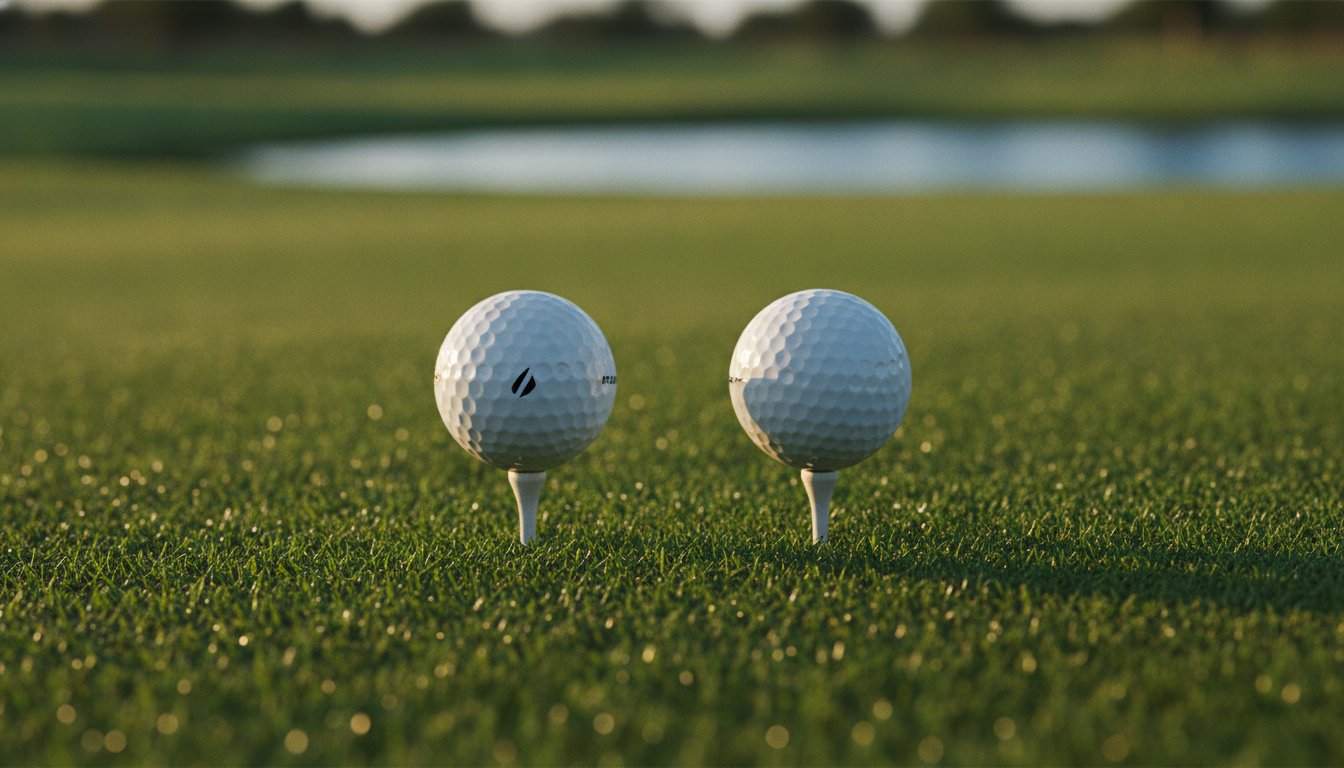
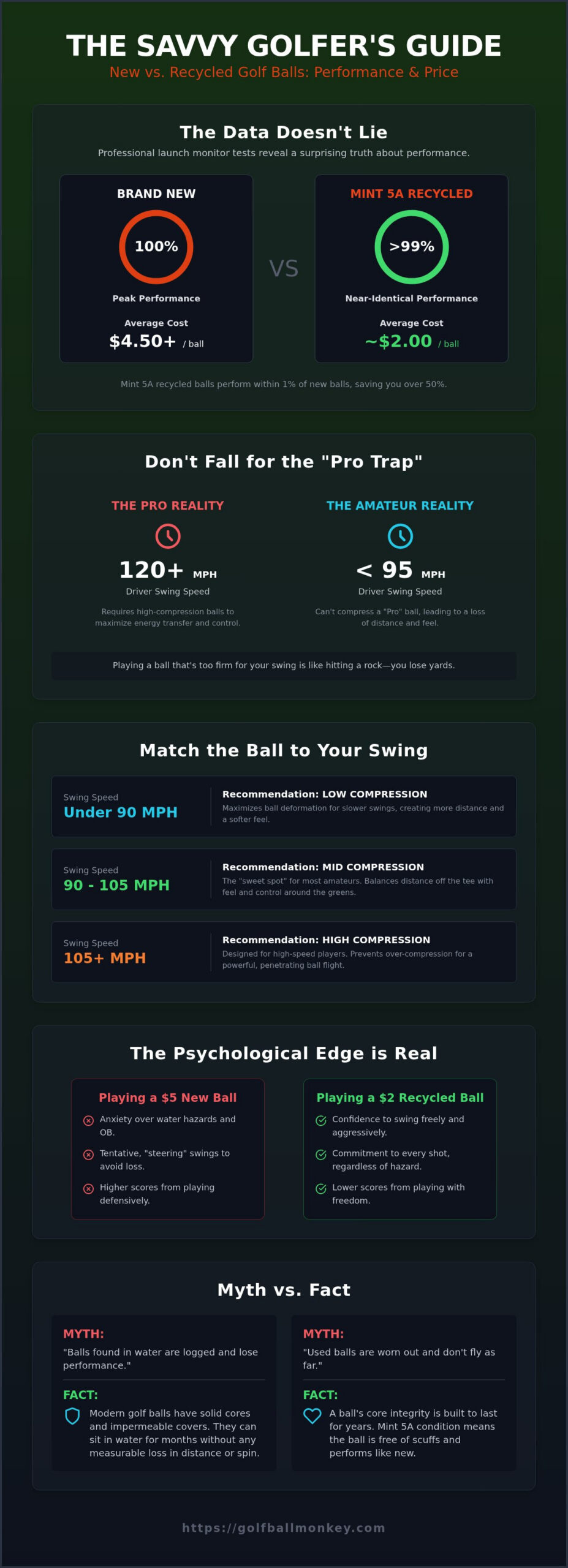
What if that $5 sleeve of brand-new Pro V1s in your bag is actually holding your game back? It sounds crazy, but the anxiety of losing a “money ball” often leads to tentative swings and higher scores. When we look at new vs used golf balls performance, the data proves you’re likely paying a massive premium for a shiny box rather than better stats. Professional launch monitor tests show that Mint 5A recycled balls perform within 1% of their brand-new counterparts. You get the same distance. You get the same greenside bite. You just don’t get the heart palpitations when you see a water hazard.
We’ve all been there, standing over a forced carry and praying we don’t donate a fiver to the pond. It is time to stop the retail madness. You deserve to play Tour-level gear without the “Pro Shop” tax. This guide shows you how to play like a savvy insider. We’ll help you match ball compression to your actual swing speed and explain why Mint 5A grade is the ultimate secret weapon for your scorecard. Stop burning cash and start swinging with total confidence.
Key Takeaways
- Learn why chasing the marketing hype of Tour-level balls can actually hurt your game if you don’t have the swing speed to compress them.
- Discover the data behind new vs used golf balls performance that proves Mint 5A recycled balls deliver pro-level results for a fraction of the retail price.
- Stop worrying about the “water-logged” myth; modern golf ball tech is built to withstand months in the drink without losing distance or spin.
- Master the “Work Backwards” method to select your equipment based on greenside control rather than just tee-box distance.
- Gain a massive psychological edge by playing premium gear you aren’t afraid to lose, allowing you to swing freely over every hazard.
The Pro Trap: Why Copying the PGA Tour Can Hurt Your Score
You see the winner on Sunday hoisting a trophy and a sleeve of premium balls. You head to the shop on Monday. You shell out $55 for a dozen. This is the “Pro Trap.” Tour-level gear is engineered for elite athletes who generate 120mph driver head speeds and make center-face contact nearly 100% of the time. For the rest of us, playing these balls brand-new often means paying for technology we can’t actually use. When comparing new vs used golf balls performance, the biggest factor isn’t just the age of the ball. It’s whether the ball matches your swing. If you aren’t swinging like a pro, you shouldn’t be paying like one.
The Marketing Mirage vs. On-Course Reality
Big brands spend millions to convince you that you need the exact same ball as the world’s best. It is a brilliant marketing mirage. If you can’t compress a high-compression Tour ball, you will actually lose distance. A ball designed for Rory McIlroy might cost you 10 yards of carry because your swing doesn’t activate the core. Beyond the physics, there’s the mental tax. Standing over a 150-yard carry with a brand-new $5 ball creates unnecessary tension. You steer the club. You decelerate. You chunk it into the drink. Understanding the history of the golf ball shows us that tech has evolved to help us, but only if we choose the right fit for our actual game.
The Skill Gap: Consistency is King
Pros are machines. They hit the center of the face with surgical precision. Amateurs? We use the whole face. Premium Tour balls are optimized for control and workability. This sounds great until that “workability” turns your slight fade into a massive slice. Forgiveness matters. High-spin balls accentuate every mistake. If you aren’t striking it pure, you’re better off with a ball that helps you stay in the short grass. This is where the savvy play comes in. By shopping the Golf Ball Monkey store, you can test different premium models like the Titleist Pro V1 or Callaway Chrome Soft at a fraction of the price. It allows you to find the ball that fits your swing without the financial sting of a retail markup.
Our philosophy is simple. Play the tech, but skip the “new ball” tax. Buying Mint 5A recycled balls lets you access the same multi-layer construction used on Tour. You get the greenside spin you need. You get the aerodynamic consistency you crave. Most importantly, you get the confidence to swing aggressively. When new vs used golf balls performance is nearly identical, the real winner is the golfer who keeps their cash in their pocket. Stop being a marketing victim. Start being a savvy player who knows that a ball retrieved by a professional diver performs just as well as one from a cardboard box.
Physics of the Tee: Compression, Swing Speed, and Spin
Stop guessing and start knowing. Your golf ball isn’t just a white sphere; it’s a high-tech engine designed to react to specific forces. To understand new vs used golf balls performance, you have to understand compression. Simply put, compression is the ball’s ability to deform and rebound for energy transfer. If you can’t squeeze the ball at impact, you’re leaving yards on the tee box. Most weekend warriors play balls that are far too firm for their swing speed, essentially hitting a rock with a stick. You need to match the ball’s “squish” to your “whoosh.”
The 90mph driver swing is the great divide in golf. If you swing under 90mph, you need a lower compression ball to maximize distance. If you’re north of 100mph, you need a firmer ball to prevent over-compression and loss of control. Despite what marketing says, high-quality used balls maintain their internal core integrity. While some worry about the performance degradation of used golf balls, modern manufacturing ensures that the core’s rebound remains consistent for years. This means a Mint 5A ball provides the same physics as a brand-new one, provided you choose the right model for your speed.
Finding Your Compression Sweet Spot
You don’t need a $20,000 launch monitor to find your fit. If your 7-iron carries about 150 yards, you’re likely in the 90-95mph driver range. Under-compressing a high-end Tour ball is a common mistake; it feels like hitting a stone and results in a weak, low flight. The Titleist Pro V1 remains the gold standard for versatility because it balances a soft feel with enough firmness to handle higher speeds. It’s the “Goldilocks” of golf balls for a massive range of players.
The Spin Struggle: Control vs. Chaos
Spin is a double-edged sword. Multilayer balls use a soft urethane cover to grab the grooves of your wedges for that “one hop and stop” action on the green. However, that same high-spin tech can turn a small slice into a trip to the woods off the tee. Cheap Surlyn-covered balls spin less, which helps you stay straight but makes the ball roll off the back of the green like it’s on ice. The savvy play is choosing a premium used urethane ball. You get the short-game control you need without the retail price tag. If you want to see how these specs stack up on the course, grab a bag of Mint 5A premiums and feel the difference for yourself. When the physics of new vs used golf balls performance are this close, your wallet should be the deciding factor.
Used vs. New Golf Balls: Breaking Down the Performance Data
Let’s kill the biggest ghost in the clubhouse: the water-logged ball. Years ago, balata covers were porous. They soaked up water like a sponge. Modern tech changed the game. Today’s solid-core balls are essentially sealed in high-grade polymers. Testing shows that a premium ball submerged for a full month loses just 1.2 yards of carry. After three months? The loss is only half a yard. When you analyze new vs used golf balls performance, the “pond ball” fear is just a marketing tool to keep you buying retail. Unless a ball has been sitting in a lake since the 90s, the core is ready to rock.
Calculate your personal “Lost Ball Tax.” If you lose three balls a round and play twice a week, you’re burning through six balls. At retail prices for brand-new premium dozens, that’s nearly $30 a week. Switching to a Mint 5A used ball cuts that cost by nearly 50%. You get the same ball speed, launch angle, and descent profile for half the cash. It is the ultimate insider secret for playing a premium game on a beer budget.
The Heavy Hitters: Pro V1, TP5, and Chrome Soft
These aren’t just for the guys on TV. They offer the highest level of greenside spin and aerodynamic consistency. If you want the peak of engineering, look at the TaylorMade TP5. Its 5-layer construction is designed to optimize speed without sacrificing a soft feel. When we test these in Mint 5A condition, the new vs used golf balls performance gap is less than 1%. You get the same tour-level bite on the green for a fraction of the retail markup.
The Mid-Handicap Heroes
Not everyone needs a high-compression tour ball. For players with swing speeds sub-105mph, the Bridgestone Tour B RX is a game changer. It provides the same urethane cover benefits as the big names but is easier to compress. Another fantastic option is the Srixon Z-Star, which consistently ranks as a high-value alternative for serious players. If you’re still working on your consistency, a “Mixed Bag” of Good 3A balls is the smartest way to practice. You get to test different brands and covers in real-world conditions without worrying about the cost of a lost ball.
- Mint 5A: Looks and plays like it just came out of the box.
- Modern Tech: Multi-layer construction resists water damage for months.
- Value Play: Premium used balls outperform brand-new budget balls every time.
The Monkey’s Guide to Choosing Your Perfect Ball
Forget the driver for a second. Most golfers choose their gear based on the “long ball” marketing they see on TV. If you want to lower your score, you need to use the “Work Backwards” method. Start at the pin and move to the tee. How does the ball feel off your putter? Does it hop and stop on a 20-yard chip? When we talk about new vs used golf balls performance, the real difference is felt within 50 yards of the cup. A premium used ball with a urethane cover will outperform a brand-new, cheap “distance” ball every single time when you’re trying to save par.
There is also a massive psychological edge to playing recycled gear. We call it “The Fearless Swing.” When you’re standing over a narrow fairway with a brand-new $5 ball, your brain focuses on the cost of failure. You get tight. You steer the club. By playing Mint 5A balls, you remove that financial anxiety. You can swing aggressively over hazards because you aren’t worried about throwing five bucks into the woods. This mental freedom often results in better strikes and lower scores than playing a pristine ball with a trembling grip. For those looking to optimize their mental performance even further, learn more about Nootropics Today and their cognitive-supporting mushroom gummies. It is the ultimate insider secret for consistent play.
The Short Game Test
Your choice of ball should be decided by your chips and pitches. Take a few different models to the practice green. Listen for the sound. A “clicky” Surlyn cover feels hard and rolls out too far. Soft urethane feels like it sticks to the face. If you want to master this feel without spending a fortune, grab some shag balls for your backyard or the local park. Practice makes permanent. Knowing exactly how your ball will react on the green is the fastest way to shave strokes off your handicap.
Balancing Performance and the Pocketbook
Every savvy golfer should track their “Cost Per Hole.” If you’re losing a ball every few holes, retail prices are a death sentence for your budget. Consistency is more important than “newness.” Playing the same model of Mint 5A used ball for every round helps your brain calibrate distance and spin. Don’t jump between different brands just because they’re on sale. Stick to a model that fits your swing speed and buy in bulk. It saves your sanity and your wallet. Ready to find your match? Shop our Mint 5A inventory and start playing the same ball every round for half the price. When you look at the facts of new vs used golf balls performance, the smart play is clear.
Play Like a Pro (Without the Pro Price Tag)
Your golf ball has a secret life. It starts in a fancy retail box, takes a quick detour into a pond, and eventually meets one of our professional divers. This retrieval process is the backbone of the secondary market. We reclaim millions of balls annually, ensuring that high-performance tech doesn’t just sit at the bottom of a lake. When you evaluate new vs used golf balls performance, remember that the core of a modern ball is built to last. It doesn’t expire after a dip in the water. We bring that performance back to the surface and put it straight into your bag.
There is a significant environmental impact to consider as well. Every ball we rescue is one less piece of plastic degrading in a local ecosystem. It is a win-win for the planet and your scorecard. You get to play premium Titleist Pro V1s for the same price as a budget box of rocks from a big-box shop. It is the ultimate insider play for any golfer who values their cash as much as their handicap.
The Mint 5A Standard: Quality You Can Trust
We don’t just rinse these balls off and call it a day. Our grading process is a science. We use a rigorous Mint 5A scale to ensure that every ball looks, feels, and flies like new. This involves a multi-stage inspection to check for cover integrity and dimple consistency. We also have a zero-tolerance policy for refurbished balls. Unlike recycled balls, refurbished ones are often stripped and repainted; this ruins their aerodynamics and consistency. We only deal in authentic, recycled gear. Our team ensures that the quality matches the promise of tour-level performance every time you tee it up.
Join the Monkey Crew: Smart Golf Starts Here
The movement is growing. Thousands of savvy players have realized that retail markups are a trap. They’ve embraced the freedom of the fearless swing. Imagine standing on a tee box with a forced carry over a deep ravine. If you’re playing a $5 ball, you’re already mentally defeated. If you’re playing a Mint 5A recycled ball, you can rip it without a second thought. The new vs used golf balls performance data proves you aren’t sacrificing distance or greenside control. You’re just gaining sanity. It is time to stop overpaying for a cardboard box and start paying for your score. Check out our latest Mint 5A arrivals here and join the crew today.
Stop Paying the Retail Tax and Start Scoring
The secret is out. You don’t need to drop sixty bucks at the pro shop to play like a champion. Real performance comes from matching your ball to your actual swing speed, not from the shiny box it came in. When you analyze new vs used golf balls performance, the gap is practically non-existent for the average player. You get the same spin, the same launch, and the same distance. Most importantly, you get the mental freedom to swing hard without worrying about your bank account or the cost of a lost ball.
By choosing professional diver-retrieved gear, you’re making the smart play for your wallet and the planet. We reclaim over 1 million balls annually, bringing unbeatable value to golfers across the country. Ditch the elitism of the retail rack. Grab some premium gear that has been vetted for quality and graded for excellence. It is time to step onto the tee box with total confidence. Stop overpaying and start playing; Shop Mint 5A Tour Balls Now!
Your best round is waiting. Go out there, swing freely, and let the scoreboard do the talking. See you on the fairway.
Frequently Asked Questions
Is there a real performance difference between a Pro V1 and a cheap ball?
Yes, the difference is massive, especially around the green. Premium balls like the Pro V1 use thin urethane covers that “grab” your wedge grooves for maximum spin and stopping power. Cheap “distance” balls use hard Surlyn covers that feel like rocks and roll off the back of the green. You don’t need to be a pro to see the difference; you just need to appreciate a ball that actually stops where it lands.
What golf ball should I play if I have a slow swing speed?
If you swing under 90mph, look for a low-compression ball. Options like the Callaway Chrome Soft or Bridgestone Tour B RX are engineered to deform more easily at impact. This allows players with moderate speeds to activate the core and maximize their distance. Playing a ball that is too firm for your swing will feel harsh and result in a weak, low ball flight that loses carry yards.
Are used golf balls as good as new ones?
High-quality recycled balls are indistinguishable from new ones for the vast majority of golfers. When comparing new vs used golf balls performance, launch monitor data shows that Mint 5A balls deliver nearly identical ball speeds and spin rates. Unless you are competing for a jacket on Sunday, the tiny variance is impossible to notice. You get the same premium technology for about half the cost of a retail box.
Do golf balls lose distance if they have been in the water?
Modern solid-core balls are incredibly water-resistant compared to the old balata style. Research indicates that distance loss from submersion is negligible, often measuring less than a single yard of carry after weeks underwater. You will see more distance variance from a slight change in air temperature than you will from a ball that took a dip. Our diver-retrieved inventory is vetted to ensure the core integrity remains 100% intact.
What does Mint 5A condition actually mean?
Mint 5A is the top tier of the recycled ball world. These balls look and play like they were just pulled out of a brand-new sleeve. They have no scuffs, no scratches, and no discoloration. While they might have a small sharpie mark from a previous player, the cover and dimple pattern are perfect. It is the gold standard for savvy golfers who want “new” quality on a used ball budget.
Why do pros play such high-compression balls?
Professional golfers generate extreme clubhead speeds, often exceeding 120mph. They need a high-compression ball that can withstand that massive force without over-deforming. A firmer ball provides them with a more stable flight and predictable spin rates at high velocities. For the average player, however, these “pro” balls can feel like hitting a marble and might actually result in less distance off the tee.
Can the wrong golf ball cause a slice or hook?
The wrong ball can definitely make your misses worse. High-spin Tour balls are designed for workability, which means they react more to the side-spin you put on the ball. If you already struggle with a slice, a high-spin ball will accentuate that curve and send you deeper into the woods. Switching to a lower-spin “straight” ball can help dampen that side-spin and keep your shots closer to the target line.
How many golf balls does the average player lose per round?
The average amateur golfer loses between three and five balls during a typical round. If you are buying new premium dozens at the pro shop, that is a $20 “tax” every time you play. This is why new vs used golf balls performance matters so much for your wallet. Switching to recycled gear allows you to swing with total confidence over water hazards because a lost ball doesn’t mean a lost meal.
- golfballmonkey@gmail.com
- (512) 593-8401
- Mon – Fri, 9:00 AM – 5:00 PM

All product and company names are trademarks™ or registered® trademarks of their respective holders.
Use of them does not imply any affiliation with or endorsement by them.