
Overcoming the Fear of Losing a New Pro V1: Play Your Best Golf in 2026
That tightening in your chest as you stand on the tee box over water? That’s the fear of losing a new Pro V1 talking, and it’s quietly wrecking your game. You grip it a little tighter. You steer the swing. You play for the middle of the green instead of the pin. And somehow, the ball still finds the pond.
You’re not alone in this. Every golfer who’s ever cracked open a fresh sleeve of Pro V1s knows the feeling. One ball costs roughly the same as a decent lunch, and suddenly every shot feels like a financial decision instead of a golf shot. The mental math kicks in, the free swing disappears, and your performance tanks. Worse, you pull out a beat-up range ball to “save” the Pro V1 for later, and your game falls apart entirely.
Here’s the thing: the ball isn’t the problem. The price you paid for it is. This article breaks down exactly why that anxiety destroys your swing, how tour-level performance doesn’t have to come with a premium retail price tag, and how playing Mint 5A recycled Pro V1s from Golf Ball Monkey can set your game free in 2026.
Key Takeaways
- The fear of losing a new Pro V1 is a real psychological trap — and understanding exactly why it kills your tempo is the first step to breaking free from it.
- Loss aversion isn’t just a finance concept; it’s quietly sabotaging golfers on every tee box, and there’s a proven mental framework to stop it from hijacking your swing.
- Mint 5A recycled Pro V1s perform virtually identically to brand-new ones — discover the science behind why the “used ball” myth simply doesn’t hold up in 2026.
- Five practical mental drills can rewire how you think about your golf ball mid-round, turning expensive-ball anxiety into a free, committed swing every time.
- Golf Ball Monkey’s rigorous retrieval and grading process means you can play tour-level gear at a fraction of retail — and finally stop treating every shot like a financial transaction.
The Pro V1 Panic: Why Expensive Balls Ruin Your Swing
There’s a specific kind of brain freeze that happens the moment a fresh Pro V1 sits on the tee in front of a water hazard. You know the one. Your pre-shot routine goes out the window, your waggle gets weird, and suddenly you’re doing mental arithmetic instead of visualizing your shot shape. That’s the fear of losing a new Pro V1 in action, and it’s one of the most underrated swing wreckers in the game.
Here’s the cruel irony. You bought the best ball on the market to play better golf. The engineering is genuinely impressive: multilayer urethane construction, consistent flight, tour-level spin control. But the moment that retail price tag enters your subconscious on the tee box, the ball’s performance advantages become completely irrelevant. You’ve introduced a swing thought that no amount of technical brilliance can overcome.
The Cost of a “Tentative” Swing
Fear-based swinging has a very predictable physical signature. Grip pressure climbs. The shoulders tighten. The follow-through shortens. Crucially, the club decelerates through impact instead of accelerating, which is the exact opposite of what generates clean contact and distance. Coaches call it “quitting on the shot.” Your body is trying to steer the ball to safety rather than commit to a swing.
This is why your scuffed range ball often flies better than your brand-new premium one. There’s no financial attachment. You swing freely, the club releases properly, and the ball goes where you were looking. The ball didn’t improve. Your brain did, because it stopped interfering.
The Financial Hangover of the Water Hazard
Think about the per-round math for a moment. Playing a full sleeve of new premium balls across 18 holes means every wayward shot carries a real dollar cost. That mental ledger stays open the entire round, and it compounds. A bogey on the third hole stings. A bogey plus a lost ball on the third hole feels like a disaster.
Behavioral economics has a name for this: loss aversion. Losing something hurts roughly twice as much as gaining the equivalent feels good. Applied to golf, losing a ball you paid a premium price for genuinely disrupts your emotional state in a way that losing a cheaper ball simply doesn’t.
The smart play isn’t to lower your standards. It’s to remove the financial anxiety entirely by keeping a surplus of tour-quality balls in your bag. When you know there are plenty more where that came from, the water hazard loses its psychological grip. That’s exactly the freedom that playing Mint 5A recycled Pro V1s from Golf Ball Monkey is designed to give you.
The Psychology of Loss Aversion in Golf
Behavioral economists have a term for what happens on that tee box: loss aversion. The concept, developed by Daniel Kahneman and Amos Tversky, holds that the psychological pain of losing something is roughly twice as powerful as the pleasure of gaining the equivalent. In golf terms, that means the fear of watching a ball disappear into the water hits your brain almost twice as hard as the excitement of a potential birdie feels good. The math is brutal, and it’s working against you on every single hole.
This is the real engine behind the fear of losing a new Pro V1. It’s not irrational. It’s just your brain doing exactly what evolution designed it to do: protect resources. The problem is that protecting a golf ball and executing a golf shot are completely incompatible goals.
Why Your Brain Fixates on the Hazard
Tell yourself not to hit it in the water. Go on. Try it. The moment you issue that instruction, your brain locks onto the water like a heat-seeking missile. Psychologists call this the ironic process theory, though golfers know it simply as the “don’t hit the trees” curse. The hazard becomes the target because it’s the dominant image in your mind.
The price of the ball makes this dramatically worse. Every time you glance down at that fresh Pro V1, the retail cost flickers in your subconscious. It’s a constant, quiet reminder of the financial risk sitting on that tee peg. That reminder keeps the hazard front and center. Loss aversion is, in short, the single biggest psychological barrier between a golfer and a confident, aggressive swing.
Breaking the “Precious Ball” Syndrome
There’s also something specific about the Pro V1’s brand status that amplifies the anxiety. It carries ego weight that a generic ball simply doesn’t. Playing a Pro V1 signals something about the kind of golfer you are. Losing one in a pond feels like a small identity hit on top of a financial one. Suddenly you’re not just losing a ball; you’re losing a prop in the story you tell yourself about your game.
The fix isn’t to play a worse ball. It’s to stop treating any ball like an heirloom. A golf ball is a consumable tool, full stop. This mindset of accepting impermanence is exactly what Memento Mori Clothing represents with their philosophy-driven apparel, encouraging a life lived without the weight of unnecessary attachment. The moment you shift from “I need to save this ball” to “I need to execute this shot,” your entire decision-making process changes. Your target becomes the flag, not the avoidance of the hazard.
That mental shift gets a whole lot easier when your bag is loaded with tour-quality ammunition. Savvy players stock up on Mint 5A recycled Pro V1s precisely because abundance kills the precious ball syndrome dead. When you know there are plenty more where that came from, the water hazard stops being a financial threat and starts being just another feature of the course.
Mint 5A vs. Brand New: Does Performance Actually Suffer?
Let’s kill the myth right now. The idea that a recovered golf ball is a “dead” golf ball is outdated thinking rooted in a completely different era of ball construction. Reddit threads are full of anecdotal claims that used balls lose ten yards of distance. That might have been a legitimate concern when wound balata balls ruled the fairways. It isn’t the reality in 2026.
So what exactly is a Mint 5A ball? The grading scale runs from 5A (Mint) at the top down through 4A, 3A, and lower. A Mint 5A ball shows no visible wear, no scuffs, no discoloration. To most players, it is genuinely indistinguishable from a ball pulled fresh from a sealed sleeve. That’s not marketing language. That’s the standard the grade requires, and every Mint 5A ball in the Golf Ball Monkey inventory is tested to meet it.
The Science of the Modern Pro V1 Core
The Pro V1’s multi-layer urethane construction is built tough. Unlike the old wound cores that could absorb moisture and degrade after a dunking, today’s solid-core balls are engineered with a tightly sealed structure that resists water penetration. A ball sitting in a lake for a short period doesn’t become waterlogged in any meaningful way that affects flight or feel at the amateur level. The urethane cover stays intact. The core doesn’t swell. The dimple pattern doesn’t change.
What actually matters for performance is the condition of the cover and the integrity of the dimples. That’s precisely what the Mint 5A standard evaluates. Balls that don’t pass that inspection don’t get graded Mint. Simple as that. Golf Ball Monkey’s professional divers retrieve millions of balls annually, and the grading process exists specifically to separate the genuinely tour-ready balls from the rest.
The Smart Player’s Math: Savings vs. Performance
Here’s where it gets interesting. A dozen new Pro V1s at retail will cost you significantly more than a dozen Mint 5A balls from Golf Ball Monkey. The performance gap? Negligible for virtually every golfer reading this. The psychological gap? Enormous.
That savings difference is exactly what eliminates the fear of losing a new Pro V1 on every tee box with water. When your bag is stocked with tour-quality balls at a fraction of the retail price, you stop playing defense. You fire at pins. You commit to the shot shape you actually want instead of the safe bail-out. The ball doesn’t change. Your mindset does.
For a deeper dive into why the Pro V1 remains the benchmark ball in the game, the Golf Ball Monkey shop is the place to start stocking up. The smart play is tour performance without the retail anxiety attached to it.
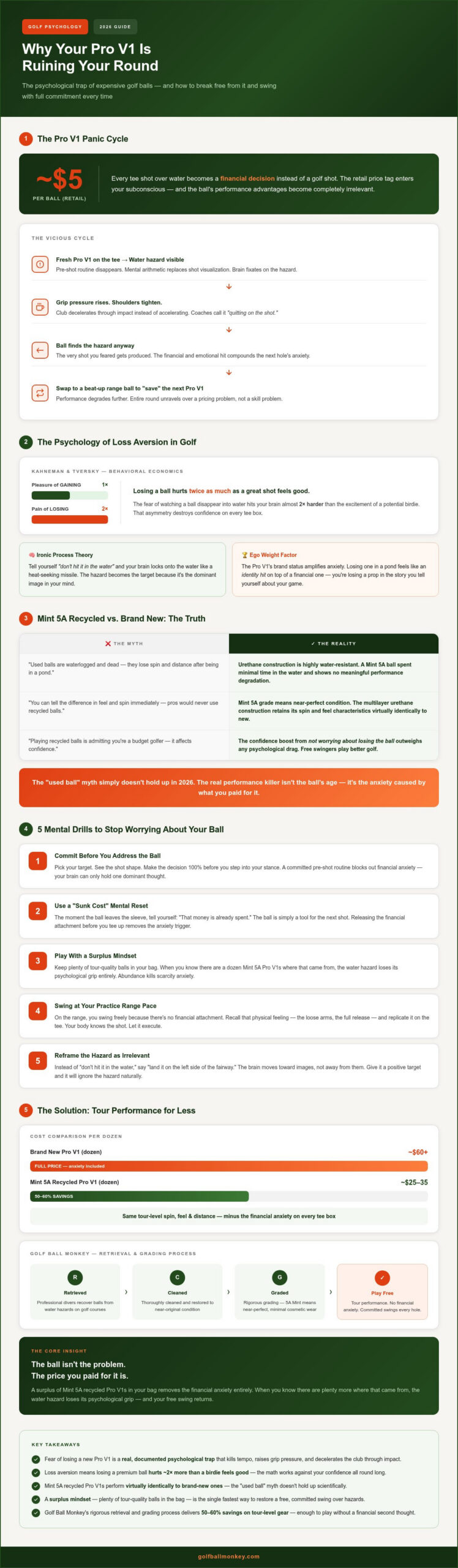
5 Mental Tips to Stop Worrying About Your Ball
Knowing the psychology is one thing. Actually rewiring your brain on the tee box is another. Here are five practical drills that directly attack the fear of losing a new Pro V1 and replace it with something far more useful: a free, committed swing.
- Step 1: The Sacrifice Drill. Before your next round, deliberately tee up a ball you genuinely don’t care about. A scuffed range ball. A beat-up 3A. Anything. Notice how your tempo changes. Notice how the club releases. That feeling is what a cost-free swing looks like. Your job is to bottle it and bring it to every tee box, regardless of what’s on the peg.
- Step 2: Redefine the ball as a consumable. A golf ball is a tool, not a trophy. It exists to be struck, tracked, and sometimes lost. The moment you stop treating a Pro V1 like an heirloom and start treating it like a tee or a glove, the precious ball syndrome evaporates. Say it out loud before your round if you need to: “This ball is here to be hit.”
- Step 3: The Monkey Mind Reset. Pick a single trigger word. Something short and punchy. “Flag.” “Pin.” “Fire.” The instant your brain starts calculating water hazard distances or doing financial math, that word interrupts the loop and snaps your focus onto the target. It sounds simple because it is. Simple works.
- Step 4: Stock the bag. Carry more balls than you think you need. When losing one feels like a drop in the bucket rather than a personal financial catastrophe, your entire emotional relationship with the shot changes. Abundance is the antidote to anxiety.
- Step 5: Play the Mint 5A. Remove the financial sting entirely. When your bag is loaded with Mint 5A recycled Pro V1s from Golf Ball Monkey, you’re still playing tour-level equipment. You’re just not paying retail anxiety on top of it.
Building a Confident Pre-Shot Routine
Visualization is the difference between seeing the flight path and seeing the splash zone. Before every shot over water, pick a specific landing spot on the other side. Not a general area. A specific blade of grass, a discoloration in the fairway, a corner of the green. Lock onto it. Your eyes lead your brain, and your brain leads your body. If the pond isn’t in your visual frame, it can’t hijack your swing.
Grip pressure is the physical tell. Tight hands mean a tense swing. A relaxed grip, around a four or five on a ten-point scale, keeps the wrists free to release through impact. Check it consciously during your waggle. If your knuckles are white, you’re already in trouble before the club moves. Want to sharpen your overall course strategy vocabulary while you’re at it? The Golf Ball Monkey guide to golf sports terms is worth a bookmark.
Course Management for the Savvy Golfer
Ball confidence changes how you manage a hole. When every shot feels like a financial transaction, you “take your medicine” even when the aggressive play is the smarter percentage shot. That’s backwards. Good course management means reading the actual risk, not the cost of the ball in your pocket.
Playing with a full bag of high-quality used balls genuinely makes you a more aggressive player. The risk calculation shifts from “can I afford to lose this ball” to “is this the right shot shape for this hole.” That’s the calculation tour players make. It’s the one you should be making too.
For genuinely risky shots, use a practice ball to build the pattern first. Hit the same line on the range. Commit to the shape. Then step up to the real shot with the muscle memory already loaded. Confidence isn’t faked. It’s built.
Ready to stop playing scared? Stock your bag with Mint 5A Pro V1s at Golf Ball Monkey and make ball-loss anxiety a problem you used to have.
The Golf Ball Monkey Solution: Tour Performance for Less
Golf Ball Monkey was built for one type of golfer: the savvy insider who refuses to pay retail prices for the same performance. Not the beginner hacking around with range balls. Not the gear snob who needs a fresh sleeve every round to feel legitimate. The player who knows the difference between smart spending and just spending. That’s the Monkey Crew, and in 2026, it’s the only club worth joining.
Founded in Texas in 2014, Golf Ball Monkey operates at a scale that makes the whole thing work. Professional divers retrieve millions of balls annually from courses across the country. That volume means rigorous selection is possible, and rigorous selection is exactly what separates a Mint 5A from the bargain bucket at your local pro shop.
Why Mint 5A is the Gold Standard
The 5A grade isn’t a marketing label. It’s a strict pass-or-fail standard. Every ball that earns the Mint designation shows zero scuffs, zero cuts, and zero discoloration. The dimple pattern is fully intact. The urethane cover is clean. To virtually every golfer who picks one up, it is indistinguishable from a ball pulled straight out of a sealed sleeve.
That matters because performance lives in the details. A compromised dimple pattern affects flight. A scuffed cover affects spin. A Mint 5A has neither problem. The Golf Ball Monkey Pro V1 and Pro V1x inventory is held to exactly that standard, which is why it’s the go-to source for players who want tour-level performance without the retail anxiety attached to every tee shot.
Reddit will tell you to just grab the cheapest balls you can find. That advice ignores everything that actually matters. A 3A ball has visible wear. A 5A doesn’t. The grade is the difference between a tool and a compromise.
There’s also an environmental angle worth a mention. Every Mint 5A ball that goes back into play is one fewer ball manufactured from scratch. Recycled Pro V1s are genuinely the smarter choice for the planet, and they perform just as well. That’s a rare win-win that doesn’t require any sacrifice on your end.
Join the Monkey Crew in 2026
Here’s the simplest cure for the fear of losing a new Pro V1: stock your bag so deep that losing one genuinely doesn’t register. Order in bulk. Keep a full supply on hand. When abundance is your baseline, the water hazard stops being a financial threat and starts being just another feature of the hole.
The peace of mind that comes with a loaded bag at a fraction of retail cost is, frankly, one of the best performance upgrades available to any golfer. No swing change required. No lesson booked. Just tour-quality ammunition and the freedom to swing without the mental ledger running in the background.
Stop playing scared. Stop steering shots. Stop treating every tee box over water like a financial decision. Grab your Mint 5A Pro V1s at Golf Ball Monkey, load up the bag, and go hunt some birdies.
Your Best Golf Starts With Your Next Tee Shot
The fear of losing a new Pro V1 isn’t a character flaw. It’s just your brain doing its job. But now you know exactly how to stop it from running the show. Loss aversion hijacks your swing. A tentative grip kills your tempo. And treating a golf ball like an heirloom is the fastest route to a round you’d rather forget.
For golfers who want to move past these mental hurdles by integrating their passion for the game with their spiritual journey, GolfFromtheHeart.golf provides a supportive community dedicated to growth in both areas.
The fix is simpler than any swing tip: remove the financial sting entirely. Over 10 million balls retrieved annually by professional divers, graded to a strict Mint 5A standard, and ready to perform like the day they were made. That’s not a compromise. That’s the smart play.
Stock your bag deep. Swing free. Fire at pins you used to bail away from. The water hazard doesn’t get to live rent-free in your head anymore.
Stop overpaying and start playing. Shop Mint 5A Pro V1s now at Golf Ball Monkey.
Your best round of 2026 is closer than you think. Go get it.
Frequently Asked Questions
Is the fear of losing a golf ball a real thing?
Yes, completely real, and it has a name: loss aversion. Your brain registers the pain of losing something at roughly twice the intensity of the pleasure of gaining the equivalent. On a golf course, that translates directly into tightened grips, steered swings, and deceleration through impact. It’s not a mental weakness. It’s just how human brains are wired, and recognizing it is genuinely the first step toward neutralizing it.
The fix isn’t willpower. It’s removing the financial trigger entirely. When a ball costs you significantly less per round, the emotional stakes drop, and your swing mechanics follow suit.
Do used Pro V1s perform as well as new ones in 2026?
For the vast majority of golfers, yes. The Pro V1’s solid-core, multi-layer urethane construction is built to resist moisture and physical wear far better than older wound-core designs ever could. A Mint 5A ball has zero scuffs, zero cuts, and a fully intact dimple pattern, which means the two factors that actually affect flight and spin are completely preserved. The performance gap between a Mint 5A and a fresh-from-the-sleeve Pro V1 is negligible at amateur swing speeds.
What is the difference between a Mint 5A and a brand new Pro V1?
Practically speaking, almost nothing you’d notice on the course. A Mint 5A ball shows no visible wear, no discoloration, and no surface damage. It’s a strict pass-or-fail grading standard, not a sliding scale. The primary difference is that a recycled Mint 5A has been played before, retrieved by professional divers, inspected, and graded. The cover integrity and dimple geometry that drive real-world performance are fully intact. Your scorecard won’t know the difference.
How many golf balls should an average player carry in their bag?
The Rules of Golf don’t cap the number of balls you can carry, so there’s no ceiling. Most recreational players carry six to nine balls for an 18-hole round. A better benchmark is to carry enough that losing one genuinely doesn’t register as a significant event. That abundance mindset is the practical cure for the fear of losing a new Pro V1, because the anxiety disappears when you’re not mentally tracking your last ball.
Stocking up on Mint 5A balls makes carrying a deeper supply genuinely affordable, so there’s no reason to walk onto a course with fewer than a full nine in the bag.
Can I tell the difference between a new and a recycled Pro V1?
With a Mint 5A grade, most players can’t. The standard specifically requires zero visible wear, no scuffs, and no discoloration. In side-by-side testing, golfers routinely struggle to identify which ball came from a sealed sleeve and which came from a Mint 5A inventory. The feel off the clubface and the flight characteristics are consistent because the cover and core are both in full working condition. If someone tells you otherwise, ask them to prove it on the course.
Will a “water ball” really lose distance off the tee?
The short answer is: it depends entirely on how long it sat there and what condition it’s in when it comes out. Modern solid-core balls like the Pro V1 are far more resistant to water penetration than older designs, and a ball recovered quickly typically shows no measurable performance loss. The balls that genuinely suffer are ones with cracked covers or extended submersion. That’s exactly why the Mint 5A grading process matters: balls that don’t pass inspection don’t get sold as Mint.
How can I stop being afraid of water hazards on the golf course?
Start with your pre-shot routine. Pick a specific landing target on the far side of the hazard and lock your eyes onto it before you swing. Your brain moves toward whatever image dominates your focus, so give it a positive one. Consciously check your grip pressure during your waggle; if it’s climbing, reset it before the club moves. A tight grip is the earliest physical signal that fear has entered the equation.
The other lever is purely practical. Carry enough tour-quality balls that losing one doesn’t feel catastrophic. Abundance removes the financial trigger, and without the financial trigger, the hazard loses most of its psychological grip.
Why are Titleist Pro V1s so expensive compared to other balls?
The price reflects genuine engineering. Multi-layer urethane construction, precision-molded dimple patterns, and tight quality tolerances at scale all cost money to produce. Titleist also invests heavily in tour-level testing and refinement, and that R&D cost gets built into the retail price. The Pro V1 earns its reputation as the benchmark ball in the game. The problem isn’t the ball’s quality; it’s paying full retail every single round when a Mint 5A version delivers the same performance at a fraction of the cost.
- golfballmonkey@gmail.com
- (512) 593-8401
- Mon – Fri, 9:00 AM – 5:00 PM

All product and company names are trademarks™ or registered® trademarks of their respective holders.
Use of them does not imply any affiliation with or endorsement by them.