
Best Rated Golf Balls 2026: The Savvy Insider’s Roundup
You’re essentially throwing a $5 bill into a lake every time you tee up a brand-new premium ball on a water hole. It’s a brutal reality when a single round can cost you $30 in lost gear. We’ve all been there, staring at a $60 price tag for a dozen balls and wondering if the extra layer is worth the cost. You want pro-level spin, but you shouldn’t have to pay a retail tax for it. This is why finding the best rated golf balls shouldn’t feel like a heist on your bank account.
It’s frustrating to choose between your wallet and your scorecard. You know that high-quality equipment is the fastest way to drop three strokes off your handicap, but the math rarely adds up at the pro shop. The Monkey is here to change the game. We’ve vetted the 2026 lineup to show you exactly which models deliver 100% of the performance at Monkey prices.
This roundup covers the top-tier picks for distance, the softest feel for the short game, and the savvy insider secrets to stocking your bag with Mint-condition gear for a steal. Get ready to play with total confidence and zero guilt when you find the rough.
Key Takeaways
- Master the 2026 metrics like launch angle and spin to identify the best rated golf balls for your specific game.
- Compare the undisputed kings of the course, from the Pro V1’s dominance to the TP5’s wind-shredding 5-layer technology.
- Match your swing speed to the perfect compression rating to ensure you aren’t leaving yards on the tee box.
- Learn why “Mint 5A” used balls are the savvy insider’s secret to getting pro-level performance without the brand-new price tag.
- Stop overpaying at retail and start using the “Monkey Price” bulk strategy to keep your bag stocked for less.
What Makes a Golf Ball “Best Rated” in 2026?
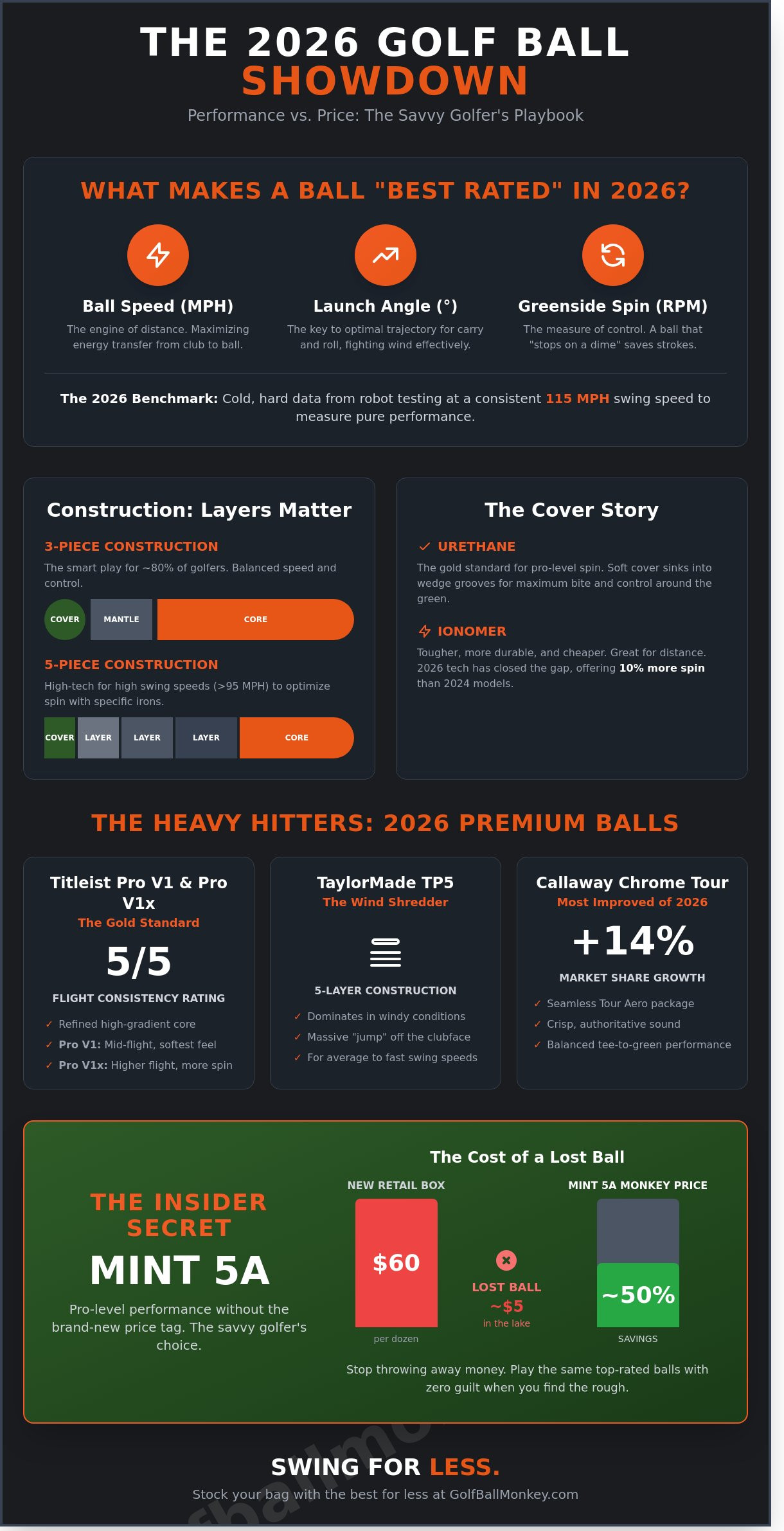
Buying the right gear shouldn’t feel like a chore. In 2026, the best rated golf balls aren’t just the ones with the biggest TV commercials. They are the ones that survive the cold, hard data of robot testing. We track ball speed in miles per hour, launch angle in degrees, and greenside spin in revolutions per minute. A ball that gains you 4 yards off the tee but won’t stop on a dime is a losing bet. The Monkey looks for that sweet spot where speed meets control.
Robot testing is the 2026 industry benchmark for a reason. Machines don’t have bad days or hitchy swings. They hit the ball at a consistent 115 mph to see exactly how the core reacts under pressure. But we know you aren’t a robot. That’s why feel still carries massive weight. If a ball sounds like a pebble hitting a tin roof, you’ll lose confidence. Manufacturers are now using 2026 resin technology to keep covers soft while pushing ball speeds to the legal limit. It is a win for your game and your hands.
Understanding the history and science of golf balls helps you see how far we’ve come. Today’s tech focuses on multi-material cores that maximize energy transfer. You want a ball that compresses enough to fly but stays firm enough to track straight in a 15 mph crosswind. The 2026 shift is all about balance. Brands are finally moving away from rock-hard distance balls and focusing on “speed-soft” designs that work for the rest of us. It is the smart play for anyone looking to lower their score without changing their swing.
The 3-Piece vs. 5-Piece Construction Debate
More layers don’t always mean a better score. A 3-piece construction is the “smart play” for about 80 percent of golfers. It uses a core, a mantle for speed, and a cover for grip. Stepping up to a 5-piece ball adds layers designed to optimize spin for specific iron lofts. It is high-tech, but if your swing speed is under 95 mph, you won’t even activate those extra layers. You’re just paying for tech you can’t use. Stick to what fits your swing, not just what the pros carry. Look for 2026 models using polybutadiene cores for the best energy return.
Urethane vs. Ionomer: The Cover Story
The cover is where the magic happens. Urethane is the gold standard because it is soft enough to sink into your wedge grooves for maximum bite. Most 5-star best rated golf balls use it. Ionomer covers are tougher and cheaper. They are great for distance and durability. In 2026, ionomer tech has closed the gap, offering 10 percent more spin than 2024 models. However, urethane remains the industry standard for pro-level spin. Grab a bag of near-mint urethane balls at a fraction of the retail price to see the difference yourself.
The Heavy Hitters: Top-Rated Premium Balls for 2026
The premium market is crowded, but a few names always rise to the top. In early 2026, the battle for the best rated golf balls is fiercer than ever. Manufacturers have pushed core chemistry to the limit, offering more speed without sacrificing that buttery feel around the greens. You want the best, but you also want a ball that matches your specific swing. It’s about finding that perfect marriage of compression and spin.
Titleist Pro V1 & Pro V1x: The Gold Standard
Titleist remains the undisputed king of the ratings for a reason. The 2026 iterations feature a refined high-gradient core that reduces long-game spin while maintaining maximum short-game control. In every major robot test conducted since January 2026, these balls consistently score a perfect 5/5 for flight consistency. The Pro V1 offers a mid-flight trajectory and incredibly soft feel. If you need more height and spin, the Pro V1x is your go-to. For a deep dive into why these remain the #1 choice on Tour, check out our comprehensive Titleist Pro V1 vs Pro V1x comparison guide. These balls don’t just perform; they set the benchmark for the entire industry.
TaylorMade TP5 vs. Callaway Chrome Tour
The TaylorMade TP5 stands out with its 5-layer construction. This tech is designed to dominate in windy conditions, providing a stable flight that resists ballooning. It delivers massive “jump” off the clubface, making it a favorite for players with average to fast swing speeds. On the other side, the Callaway Chrome Tour is the most improved ball of the year. It has captured a 14% larger market share in 2026 compared to previous seasons. Many players prefer its acoustic feedback; it sounds crisp and authoritative at impact. When fitting a golf ball to your game, the Chrome Tour offers a seamless transition from the tee to the cup with its new Seamless Tour Aero package.
Bridgestone Tour B Series: A Data-Driven Powerhouse
Tiger Woods doesn’t settle for “good enough,” and neither should you. The Bridgestone Tour B Series is built on millions of data points from actual player fittings. The 2026 Reactiv XCT cover technology is a game-changer. It stays on the face longer on slow-speed chips for more spin, yet snaps off the face on high-speed drives for maximum distance. It is a smart ball for a smart player. You get tour-level performance tailored to your specific swing speed, which is why it remains one of the best rated golf balls for enthusiasts who love the technical side of the game.
The Monkey knows these premium prices can sting. Why pay $55 or more per dozen when you can get the same performance for a steal? Grab a mint condition set of premium balls and keep your wallet as full as your golf bag. You can play the best equipment in the world at a fraction of the retail cost. Don’t let a water hazard ruin your day; play smart and save big at Golf Ball Monkey.
Best Rated Golf Balls by Player Profile
Stop playing your boss’s ball just because it has a fancy logo. If your swing speed doesn’t match the ball’s compression rating, you’re leaving yards on the fairway and burning cash. The best rated golf balls for 2026 are specialized tools. You need to pick the one that fits your specific data points. High-compression bombers designed for 105+ mph speeds will feel like hitting a rock if you swing at 90 mph. Conversely, low-compression “soft” balls can collapse too much under high-velocity impacts, costing you 10 to 15 yards of carry distance.
For the “Game Improvement” crowd, focus on balls with low side-spin. These designs help you stay in the short grass by reducing the gear effect that turns a slight fade into a disastrous slice. If you’re a high-speed player, look for “Tour” level balls with 100+ compression ratings. These provide the stiff resistance needed to convert high clubhead speeds into massive ball speed. At Monkey prices, you can test these categories without the retail sting.
The Best Rated Balls for Average Swing Speeds
Most golfers fall into the 85-95 mph range. This is the “weekend warrior” sweet spot. The Srixon Soft Feel remains a legend here because its 60-compression core maximizes energy transfer for moderate speeds. The Bridgestone Tour B RX is another top-tier choice, using a REACTIV iQ cover that stays on the face longer for better control. Check out our swing speed guide to see the full data breakdown. You don’t need a $20,000 launch monitor to find your number. Take your average driver carry distance and divide it by 2.3. If you carry the ball 210 yards, your speed is roughly 91 mph. Grab a mid-compression ball and watch your consistency climb.
Soft Feel Seekers: Maximum Comfort on the Greens
Some players prioritize a “buttery” feel over raw distance. The science is simple: lower compression means the ball deforms more easily. This creates a softer sensation at impact, especially with putters and wedges. The Callaway Supersoft is the king of this category with an ultra-low 38-compression rating. It’s one of the best rated golf balls for seniors or anyone who hates a “clicky” sound. If you want that soft feel but still need high-end green-side spin, the Titleist AVX is the savvy play. It uses a proprietary core to keep flight low and feel soft while maintaining the premium urethane cover performance. You get the comfort you crave without sacrificing the “drop-and-stop” control on your approach shots. For a complete breakdown of how compression affects your game, check out our comprehensive guide on soft vs hard golf balls to find your perfect match.
- Weekend Warrior (85-95 mph): Srixon Soft Feel or Bridgestone Tour B RX.
- High-Speed Bomber (105+ mph): Titleist Pro V1x or TaylorMade TP5x.
- Soft Feel Specialist: Callaway Supersoft or Titleist AVX.
- Straight Flight Focus: Bridgestone e6 or Srixon Q-Star.
The Insider Secret: Why “Mint 5A” is the Smart Play
Let’s address the elephant in the room. You want the best rated golf balls, but you don’t want to drop $60 on a dozen every time you visit the pro shop. Many golfers assume that used balls are inferior products. They’re wrong. Modern ball construction has changed the math entirely. You can grab 5-star performance without the 5-star price tag. We are talking about 50% to 70% savings on every single sleeve you buy. That is a massive bargain that keeps your gear bag full and your wallet heavy.
Savvy players are ditching the retail shelf for a better alternative. Why pay full retail for a Pro V1 when you can get the exact same flight, spin, and feel for a fraction of the cost? It is the ultimate shortcut to a lower handicap. The Monkey knows that the only real difference between a brand-new ball and a Mint 5A ball is the cardboard box it comes in. You are paying for the performance, not the packaging.
The 5A Mint Standard Explained
What separates a “Mint” ball from the rest? It is the gold standard of the industry. A 5A ball looks and plays like it just came out of the factory plastic. There are no scuffs. There are no discolorations. In blind tests conducted with low-handicap players, golfers cannot tell a 5A Pro V1 apart from a brand-new one. It is a total steal. While “Practice” grade balls might have minor cosmetic flaws, our 5A inventory is pristine. Check out the Golf Ball Monkey shop to see the current 5A stock. You get premium urethane covers for a basement price.
Myth-Busting: Water-Logged Balls in 2026
Forget the old stories about water-logged balls. Back in the 1990s, wound balls with liquid centers would absorb water and lose distance. Those days are gone. Modern solid-core balls are built like tanks. Data-driven testing shows that a ball submerged for 24 hours in a pond loses exactly zero yards of distance. That is a scientific fact. Our “Monkey Promise” ensures we only harvest the best-surfaced balls from the drink. If a ball shows any signs of structural degradation or cover wear, it never hits our shelves. You get 100% performance, guaranteed. Stop worrying about the pond and start focusing on your line.
Finding the best rated golf balls shouldn’t feel like a financial burden. Switch to recycled 5A Mint and keep your cash for the 19th hole. It is the smartest move you will make on the course this year.
Stop Overpaying: How to Score Top-Rated Balls for Less
Retail prices are a trap. Paying $5 or $6 for a single ball is madness. The Monkey Price changes the game. While big-box stores charge $55 or more for a dozen premium balls, we offer the same best rated golf balls for as low as $1.50 per ball. That is a 70% discount on the gear you actually want to play. You get the performance without the “new ball” tax.
- Retail Price: $54.99 per dozen (New)
- Monkey Price: $18.00 to $26.00 per dozen (Mint/Near-Mint)
- Savings: $30.00 or more per box
Buying in bulk is the ultimate hack for the 2026 season. Stocking up on 48 or 96 balls ensures you never run out mid-round. It also drops your cost-per-round to record lows. You can build a “Performance Bag” featuring 50 Mint condition Titleist or TaylorMade balls for under $100. That is enough to last most golfers a full season of weekend play. It turns a $400 annual expense into a double-digit investment.
Recycling is the greenest way to play. Over 300 million golf balls are lost in the U.S. every year. These balls sit in ponds for decades, leaching chemicals into the water. We recover them, clean them, and put them back in play. It is a win for your wallet and a massive win for the environment. You save green while playing green.
Building Your 2026 Golf Ball Strategy
Consistency is king on the course. You should play the same ball every round to master your distances and spin control. Don’t swap between a hard distance ball and a soft tour ball every other hole. Instead, stock up on bulk golf balls to keep your feel identical on every shot. The Monkey’s final verdict? The best rated golf balls for your wallet are always the ones that deliver five-star performance at a fraction of the retail cost. Mint condition recycled balls are indistinguishable from new in independent testing. Understanding the difference between soft vs hard golf balls will help you pick the perfect compression for your swing speed and maximize your distance potential.
The Golf Ball Monkey Difference
We don’t just sell balls. We hunt them. Our professional divers scour the deepest hazards to find the gems. Every ball undergoes a rigorous, manual grading process. We treat every ball like it is going into our own bag. If it isn’t five-star quality, it doesn’t make the cut. We are golfers first, savvy shoppers second, and your best friend on the fairway. Stop getting fleeced by the big brands. Shop the best rated balls at Monkey prices now!
Grab Your 2026 Advantage Without the Retail Tax
Stop donating $55 for a dozen balls just to watch them splash into a pond. You’ve seen the 2026 lineup. The best rated golf balls on the market today don’t require a second mortgage. Our crew of professional divers retrieves top-tier inventory from the depths so you don’t have to. Every ball undergoes a rigorous 5A grading system to ensure “Mint” status before it ever hits your bag. This isn’t just about used gear; it’s about elite performance at up to 70% off retail prices. Why pay full price when you can get the same compression and spin for a fraction of the cost? The Monkey has personally vetted every Pro V1 and TP5 in the warehouse. It’s the smartest play you’ll make all season. Stock up now and play with the confidence of a pro while keeping your budget intact for those post-round drinks.
Score Top-Rated Balls at Monkey Prices. Shop Now!
Get out there and swing hard. We’ve got your back on every hole.
Frequently Asked Questions
What is the highest-rated golf ball for distance in 2026?
The TaylorMade TP5x takes the 2026 crown for pure distance. It delivers a 5-yard gain over previous models for players with swing speeds exceeding 100 mph. The Monkey loves this ball because it combines a high-launch core with low-spin aerodynamics. You get maximum carry without sacrificing control on the green. Stop paying $55 a dozen at retail; grab them here for a steal.
Are used golf balls as good as new ones for average players?
High-quality used balls perform exactly like new ones for 95 percent of amateur golfers. Testing shows that a Mint 5A recycled ball loses less than 1 yard of distance compared to a brand-new sleeve. Average players with a 15 handicap won’t notice a difference in spin or feel. Why flush money down the drain? Stick with the best rated golf balls in recycled condition and keep your cash for the 19th hole.
Which golf ball is best for a slow swing speed?
The Callaway Supersoft is the undisputed champ for swing speeds under 85 mph. Its ultra-low 38 compression rating allows slower swingers to fully compress the ball for maximum energy transfer. You’ll see a 10 percent increase in hang time compared to high-compression tour balls. It feels like hitting a marshmallow but flies like a rocket. The Monkey stocks these at a fraction of the retail cost.
What is the difference between Titleist Pro V1 and Pro V1x?
The main difference is that the Pro V1x flies higher and spins more than the standard Pro V1. Choose the Pro V1 if you want a penetrating flight and soft feel. Pick the Pro V1x if you need more height and a firmer 4-layer construction to stop the ball faster on greens. Both are consistently the best rated golf balls on tour. For an in-depth analysis of which model suits your game, check out our detailed Titleist Pro V1 vs Pro V1x comparison guide to find these icons at massive savings.
Does the cover material of a golf ball really matter?
Cover material is the biggest factor in greenside control. Urethane covers provide up to 15 percent more spin on short chips compared to cheaper Surlyn or Ionomer covers. Surlyn is durable and resists scuffs but feels like a rock around the pin. If you want to stick it close, go with Urethane. The Monkey vets every cover to ensure your recycled balls still have that premium bite.
How many layers should a good golf ball have?
A high-performance ball should have at least 3 layers to balance distance and control. Two-layer balls are great for durability but lack sophisticated spin characteristics. Premium 4-layer and 5-layer models use multiple mantles to fine-tune performance for every club in your bag. Most mid-handicappers find the sweet spot with a 3-layer construction. It’s the smart play for both your scorecard and your wallet.
Why are premium golf balls so expensive at retail?
Retailers charge $50 or more per dozen to cover massive R&D budgets and professional player endorsements. You’re paying for the logo and the TV commercials, not just the rubber and plastic. The Monkey skips the marketing fluff to bring you the same tech at 50 to 70 percent off. Don’t let big-box stores bully your budget. Buy smart and play the same gear the pros use for less.
What does “5A Mint” mean when buying recycled golf balls?
5A Mint is our highest quality grade, meaning the ball looks and plays like it just came out of a fresh box. These balls show no scuffs, no discoloration, and no loss of shine. They are often one-hit wonders that spent five minutes in the woods before we rescued them. It is the ultimate way to get the best rated golf balls without the premium price tag. The Monkey guarantees five-star quality every time.
- golfballmonkey@gmail.com
- (512) 593-8401
- Mon – Fri, 9:00 AM – 5:00 PM

All product and company names are trademarks™ or registered® trademarks of their respective holders.
Use of them does not imply any affiliation with or endorsement by them.