
Golf Balls 101: The Ultimate Guide to Performance, Tech, and Value in 2026
You are literally flushing five dollars down the drain every time you slice a brand-new Pro V1 into the pond. It is a painful ritual that 80 percent of golfers know all too well. We have all stood on the tee box feeling that spike of anxiety, wondering if we should risk the “good” ball or settle for a scuffed-up range rock. Between the complex jargon like 100-compression cores and the $65 retail price tags, buying golf balls in 2026 has become a total headache. It’s time to stop overpaying for marketing fluff and start playing like a savvy insider.
You deserve Tour-level performance without the country club tax. This guide will teach you the science behind urethane covers and show you how to snag Mint condition, five-star quality equipment for 70 percent less than the big-box stores charge. The Monkey has personally vetted the tech so you can focus on your swing. We are diving into the 2026 construction trends, decoding the grading scales, and proving that recycled speed is just as fast as the expensive, shrink-wrapped alternative.
Key Takeaways
- Stop treating your ball like a plastic toy and master the aerodynamic engineering that turns the core into a high-velocity engine.
- Shift gears on the course by understanding how multi-layer construction provides the precision you need for every club in your bag.
- Forget the myths about water damage; learn why premium recycled golf balls deliver tour-level performance at a fraction of the retail cost.
- Maximize your yardage by finding your perfect compression match, ensuring your swing speed isn’t being wasted on a ball that’s too hard.
- Make the “smart play” for your wallet and the planet by discovering the massive savings found in vetted, five-star quality recycled gear.
The Anatomy of a Golf Ball: More Than Just Dimples
Stop treating your gear like a plastic toy. That ball in your hand is a complex piece of aerodynamic engineering designed to survive a 150 mph collision. Every layer serves a specific purpose. If you want to stop losing money in the woods, you need to understand what’s happening under the hood. High-performance golf balls are built to balance speed, spin, and flight path. It’s a game of physics. The Monkey has vetted thousands of these, and the tech inside is what separates a five-star quality ball from a total dud.
The Core: Where Distance Begins
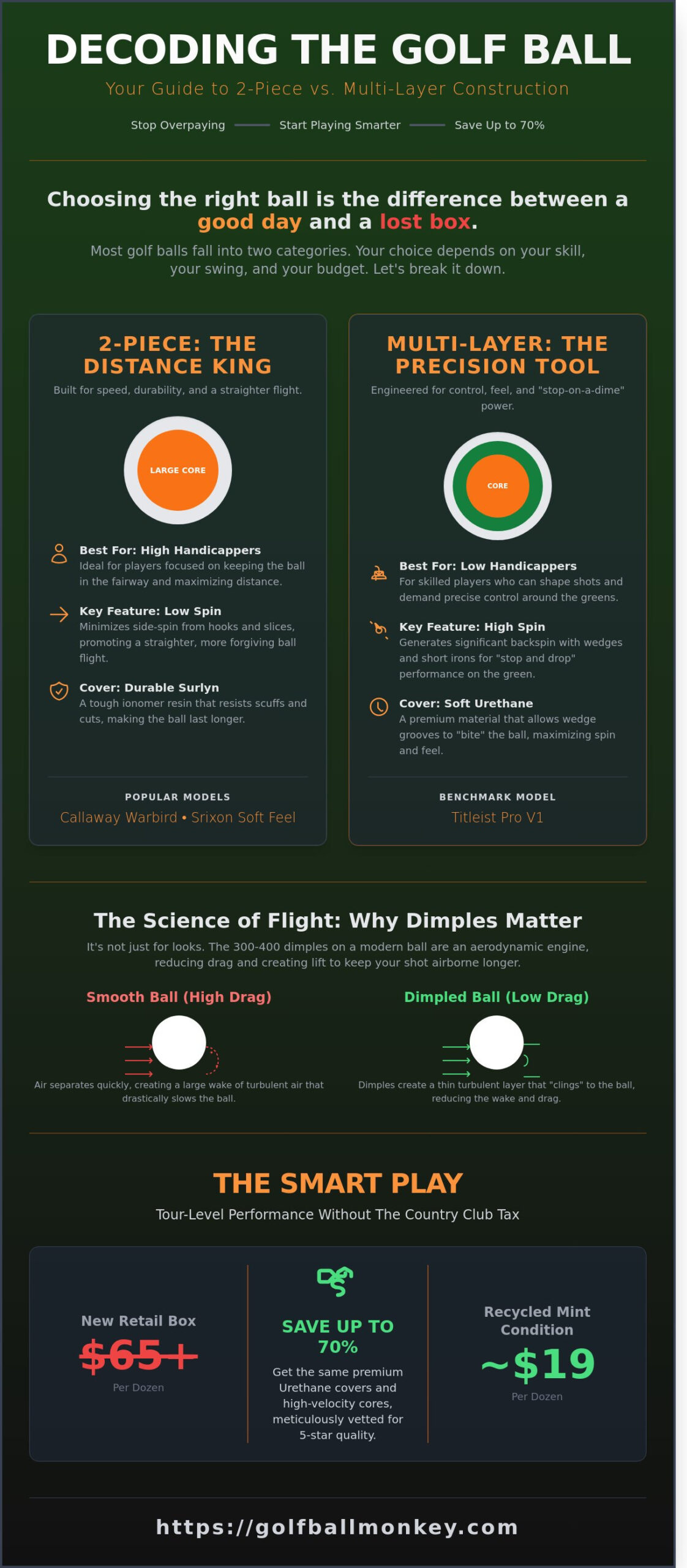
Think of the core as the engine. This high-energy center determines your initial velocity the moment you make contact. When the club hits, the core compresses and then snaps back to its original shape. This rebound effect launches the ball forward. Larger cores generally equate to higher ball speeds for players with faster swings. Compression is the measure of how much a ball deforms under load. If you match your swing speed to the right compression, you’ll see a 10 to 15 yard jump in distance. Don’t waste your power on a core that doesn’t react to your swing. Finding that perfect match at Monkey prices is the smartest play you can make.
The cover acts as the interface. It’s the only part of the ball that touches your club. This outer layer dictates your greenside control and overall feel. Urethane covers offer maximum spin for those “stop on a dime” shots. Surlyn covers provide extreme durability for the golfer who wants their ball to last multiple rounds. You choose the feel; the Monkey provides the savings.
Dimples and Aerodynamics
Smooth balls are a disaster for your scorecard. If a ball was perfectly smooth, it wouldn’t fly 100 yards because the air resistance would kill the momentum instantly. Dimples are the solution. They create a thin layer of turbulent air that clings to the surface, reducing drag and creating the lift needed for hang time. Most modern golf balls feature between 300 and 400 dimples. This pattern is precisely engineered to keep your shot airborne and stable in the wind. Without these tiny craters, your 300-yard drive would drop out of the sky before it reached the fairway markers. It’s pure science packaged in a dimpled shell.
Choosing Between 2-Piece and Multi-Layer Construction
Think of golf ball construction like the gears in a car. A 2-piece ball is your reliable cruiser, built for straight lines and simple trips. A 5-piece tour ball is a high-performance sports car with a complex transmission. Most golf balls fall into one of these two camps. Your choice depends on your swing speed and whether you value raw distance over greenside control. More layers generally mean more “gears” for different clubs. While a driver compresses the whole ball for maximum velocity, a wedge only interacts with the outer layers to generate spin.
The Monkey knows that complexity isn’t always better. If you’re still fighting a slice, those extra layers might work against you. High-spin tour balls don’t just spin back on the green; they spin sideways into the trees if your face angle is off. Starting with a simpler construction is often the smart play to keep your scorecard and your wallet happy.
2-Piece Balls: The Distance Kings
These are built for survival and speed. A 2-piece ball features a large, high-energy rubber core wrapped in a Surlyn cover. Surlyn is a specialized ionomer resin that’s virtually indestructible. It resists scuffs from cart paths, trees, and thin shots. These are the “smart play” for high handicappers because they produce low spin off the driver. This lack of spin helps 85% of amateur golfers keep the ball in the fairway by minimizing the effects of a hook or slice.
- Durability: These balls last until you actually lose them in a hazard.
- Low Spin: Maximum distance with a straighter flight path.
- Top Picks: Look for the Callaway golf balls like the Warbird or Srixon Soft Feel for reliable performance.
You can find these workhorses at Monkey prices, allowing you to stock up for a fraction of the cost of premium alternatives.
Multi-Layer Tour Balls: Total Control
When you start hitting greens in regulation, you need “stop-and-drop” power. This is where multi-layer golf balls shine. They use mantle layers between the core and cover to fine-tune performance for every club in the bag. The outer layer is almost always Urethane. This material is softer than Surlyn, allowing wedge grooves to “bite” into the cover for maximum spin.
The Titleist Pro V1 remains the industry benchmark for this category. It uses a 3-piece design to balance high speed off the tee with a soft feel around the cup. If you want to dive into the technical specs of mantle compression and dimple patterns, check out our Titleist Pro V1 vs Pro V1x comparison guide. Just remember that this level of control requires a consistent swing to see the 10% to 15% increase in spin rates that pros rely on.
The Truth About Used vs. New Golf Balls
Stop paying retail prices. It is a total trap. You are standing on the tee box with a $5 ball in your hand, worrying more about your wallet than your swing. That is not how you shoot low scores. Recycled golf balls are the ultimate smart play for any golfer who values performance over shiny packaging.
Understand the distinction before you buy. Refurbished balls are the enemy. These are often stripped, repainted, and stamped with a fake logo. They lose their aerodynamic integrity and spin consistency. Recycled balls are different. These are recovered, cleaned, and graded. You get the original factory finish and the exact performance the manufacturer intended. It’s the same ball, just at Monkey prices.
Debunking the Water-Logged Myth
The idea that water ruins a ball comes from the 1980s. Old wound-balata balls were essentially sponges. Modern solid-core polymers are a different breed. They are nearly impervious to short-term moisture. Follow the 24-hour rule: a ball needs a full day of submersion before any measurable change occurs. Our professional divers harvest these treasures frequently, often within 48 to 72 hours of them hitting the drink. Independent testing confirms that 5A Mint balls perform within 1% of new balls. You won’t feel the difference, but your bank account will.
The Mint 5A Grading Standard
We don’t guess at quality. We obsess over it. The Monkey grading system is the industry benchmark. It ensures you know exactly what is landing on your doorstep. Check out the full inventory to see these grades in action:
- Mint 5A: These are the unicorns. They look and play like they just came out of a fresh sleeve. No scuffs. No stains. Just pure performance.
- Near Mint 4A: The best value on the market. These might have a tiny cosmetic flaw or a player pen mark, but the structural integrity is 100% intact.
- Shag/Practice: Perfect for the backyard or the local park. These have seen some battle, but they are great for grooving your swing on a budget.
Grab a bag of high-quality golf balls and stop stressing over the hazards. It’s time to play with confidence. Choose the grade that fits your game and save your cash for the 19th hole.
How to Match a Golf Ball to Your Swing Speed
Stop playing your buddy’s ball just because he’s a scratch golfer. If your swing is slow and your ball is rock-hard, you’re likely losing 10 to 15 yards of carry. It’s simple physics. You have to “squish” the ball to launch it properly. A ball that’s too firm for your speed won’t compress. It just bounces off the clubface like a pebble, leaving your distance short and your hands vibrating.
High swing speeds need high compression. Low speeds need low compression. It’s a direct relationship for peak performance. If you aren’t sure where you land on the spectrum, this swing speed guide provides a personalized recommendation to get your game on track. For a deeper dive into how compression affects your game, our comprehensive guide on soft vs hard golf balls breaks down exactly which compression rating will maximize your distance and accuracy. Matching your golf balls to your actual speed is the fastest way to lower your score without changing your swing.
Low to Mid Swing Speeds (Under 95 MPH)
About 75% of weekend golfers fall into this category. If your driver carries between 200 and 240 yards, you’re likely swinging under 95 MPH. You need “Soft” golf balls. These have lower compression ratings, typically between 35 and 60, which allow the core to deform and rebound even at moderate speeds.
- Callaway Supersoft: Ultra-low compression for maximum feel and distance.
- Srixon Soft Feel: Designed to launch high and reduce drag.
These balls help straighten out a “big miss” off the tee. Because they’re easier to compress, they generate less side-spin. Less side-spin means your slice stays in the light rough instead of the woods. You could see a 7% increase in total distance just by switching to a ball that matches your tempo.
High Swing Speeds (100+ MPH)
If you’re cranking drives past 270 yards, you’re in the triple digits. You have the opposite problem. You might “over-compress” a soft ball, which makes the flight erratic and kills your energy transfer. You need a firm, high-compression ball to keep your ball flight stable and your spin numbers optimized.
The Titleist Pro V1x and TaylorMade TP5x are the gold standard for this group. These balls offer maximum stability at high velocities. You’ll benefit most from the multi-layer construction and urethane covers. High-speed players can generate 1,200 RPM more spin on greenside chips with these premium models compared to two-piece surlyn balls. It’s about total control when the stakes are high.
The Smart Play: Why Savvy Golfers Choose Recycled Performance
Stop overpaying for your gear. It’s that simple. Every time you slice a brand-new, $5 tour ball into the woods, you’re literally throwing money away. Savvy golfers know better. They play the same high-performance golf balls for a fraction of the sticker price. It’s the ultimate insider secret that keeps your bag full and your wallet heavy. Why fund a corporate marketing budget when you can fund your next tee time instead?
The Economics of the Game
Let’s look at the hard data. Most average players lose about two balls per round. If you play 30 rounds a year, that is 60 balls gone. At a retail price of $5 per ball, you’re spending $300 a season just on replacements. Switch to the Monkey Price of $1.50 per ball, and your annual cost drops to a mere $90. That’s a total savings of $210. Think about what that cash can do for your game:
- Pay for 3 to 4 extra rounds of golf at your favorite local course.
- Buy a brand-new, high-end wedge to fix your short game.
- Cover your gas and beers for the entire summer season.
The performance gap between a “mint” recycled ball and one in a shiny box is non-existent. You get the same spin, the same distance, and the same feel without the “new ball” anxiety that ruins your swing over water hazards.
Sustainability on the Course
The mission is bigger than just your scorecard. Every year, millions of golf balls end up sitting in water hazards, slowly leaching plastics into the ecosystem. We reclaim these lost treasures annually, keeping lakes clean and courses pristine. It’s a massive cleanup operation that turns a potential environmental hazard into a high-performance bargain. You get tour-level equipment at a steal, and the planet gets a break. It’s a rare win-win in a sport that usually demands sacrifice.
If you want to talk like a pro while you save like a pro, check out our Golf Sports Terms guide. It helps you master the lingo while you walk the walk with better gear for less cash.
Join the smart-player revolution today. Stop overthinking the price tag and start focusing on your target. Shop the full collection now and see why the Monkey is the golfer’s best friend. Grab a bag of five-star quality gear and play the game the way it was meant to be played, guilt-free and fully stocked.
Take Control of Your Game and Your Wallet
Mastering the physics of golf balls doesn’t require a degree in aerospace engineering; it just takes a smarter approach to your gear. You’ve seen how matching a multi-layer construction to your specific swing speed can shave 3 strokes off your scorecard by optimizing spin and launch. You also know that paying full retail price is a choice, not a necessity. By choosing recycled performance, you get the same tech that the pros use without the heart-wrenching feeling of losing a five-dollar ball in the woods.
The Monkey makes it easy to stay stocked. Our team of professional divers harvests every ball, reclaiming over 1 million premium units annually. Each one goes through a strict 5-star grading system to ensure you get exactly what you pay for. Whether you need a 2-piece distance ball or a tour-level urethane cover, we have the inventory to keep you on the fairway. For a complete breakdown of which models deliver the most bang for your buck, check out our best rated golf balls 2026 roundup to see exactly which balls are dominating the course this season. If you’re specifically interested in TaylorMade golf balls and their performance characteristics, we’ve got you covered with detailed analysis and massive savings opportunities. Stop letting high prices dictate your strategy on the course.
Grab a bucket of Mint 5A Titleist Pro V1s and save 50% today!
It’s time to play your best game yet. Grab your clubs, trust your swing, and enjoy the massive savings waiting for you at the clubhouse. See you on the first tee!
Frequently Asked Questions
Are used golf balls as good as new ones?
High-grade used golf balls perform nearly identical to brand new ones straight out of the box. Independent testing shows that 5A grade recycled balls lose less than 0.5% of their total distance compared to a fresh sleeve. You get the same spin rates and launch angles without the steep retail markup. It’s the smartest way to play premium gear while keeping your wallet heavy.
What is the difference between recycled and refurbished golf balls?
Recycled balls are simply recovered, washed, and sorted by quality to maintain their original factory finish. Refurbished balls are sandblasted and repainted, which often strips away the original aerodynamics and covers up damage. Tests show refurbished models can lose 5 yards of carry distance due to uneven paint layers. The Monkey only stocks recycled balls to ensure you get the factory-spec performance you expect.
Do golf balls lose distance over time?
Modern golf balls don’t lose distance for 5 to 7 years if you store them in a cool, dry place. Performance only drops significantly if a ball stays submerged in a lake for over 100 hours or sits in a 120 degree car trunk. Keep your stash in the garage or a closet and they’ll stay fast and long for hundreds of rounds without any degradation.
What does 5A Mint condition mean?
5A Mint condition is our highest rating, representing a ball that looks and plays like it was just pulled from a new box. These balls show 0 scuffs, 0 stains, and 0 signs of wear. You can expect 100% of the original manufacturer performance. It’s the ultimate bargain, offering a pristine product at 50% of the price you’d pay at a big-box pro shop.
How many golf balls are in a dozen?
There are 12 balls in a standard dozen, typically packaged in 4 individual sleeves of 3 balls each. If you want to maximize your savings, grab a Monkey bulk pack of 48 or 96. Buying in bulk typically slashes your cost per ball by an additional 20% compared to buying single dozens, making it the best play for frequent golfers.
Can I use a 3-piece ball if I have a slow swing speed?
You can definitely play a 3-piece ball if you choose a low-compression model designed for your speed. Golfers with swing speeds under 90 mph should look for a compression rating between 60 and 75. This setup provides the greenside spin of a 3-piece construction while adding 8 yards of distance off the tee. It’s a win for your short game and your drives.
Why are Titleist Pro V1s so expensive?
You’re paying for massive marketing budgets and professional tour contracts when you buy at retail. Retailers charge $55 for a dozen Pro V1s to fund multi-million dollar TV ads and player sponsorships. The balls themselves feature a high-tech urethane cover and a 388-dimple design for consistency. If you want to see how the Pro V1 stacks up against other premium models in our comprehensive testing, our best rated golf balls guide breaks down the performance data and shows you where to get them for $29 instead.
What is the best golf ball for a beginner?
Beginners should start with a 2-piece, soft-compression ball like the Callaway Supersoft. This ball has a low 38 compression rating that helps reduce side spin by 12% on off-center hits. This means your slices won’t curve as far into the trees. It’s a forgiving, durable choice that keeps you on the fairway while you’re still refining your swing mechanics. For a full breakdown of the entire lineup, our guide to Callaway golf balls and their performance advantages shows you exactly which model fits your game and how to get them at a fraction of retail cost.
- golfballmonkey@gmail.com
- (512) 593-8401
- Mon – Fri, 9:00 AM – 5:00 PM

All product and company names are trademarks™ or registered® trademarks of their respective holders.
Use of them does not imply any affiliation with or endorsement by them.