
Which Golf Balls Should a Handicapped Golfer Play With? The 2026 Strategy Guide

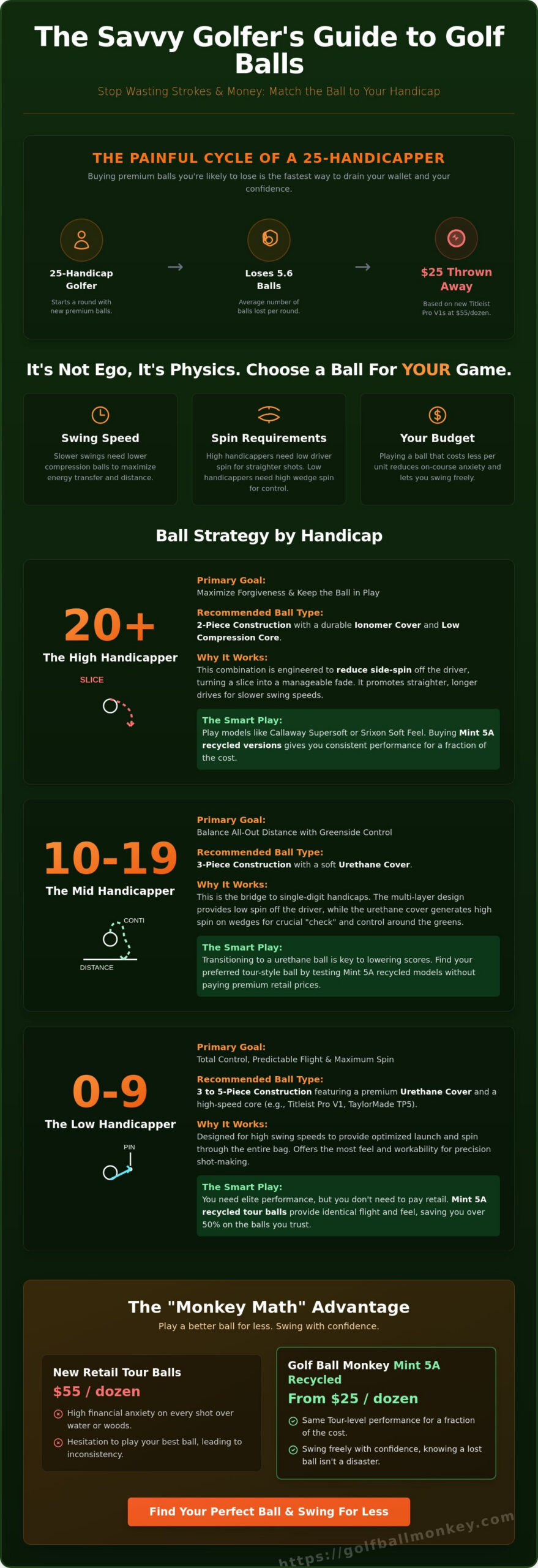
A 25-handicap golfer loses an average of 5.6 balls every single round. If you’re buying brand-new Titleist Pro V1s at $55 a dozen, you’re essentially handing $25 to the water hazards every weekend. It’s a painful cycle that leaves most players asking: which golf balls should a handicapped golfer play with? You want the performance of a tour ball, but you’re tired of feeling like your equipment is too expensive for your current game.
This 2026 strategy guide will show you how to find your perfect match. We’ll dive into the best options for high, mid, and low handicappers. You’ll learn how to save money without sacrificing greenside spin and discover why 5A Mint recycled balls are the ultimate secret weapon for the savvy golfer.
Key Takeaways
- Stop burning cash on tour-level balls your swing doesn’t need. Learn how to match ball construction to your actual skill level to save money and strokes immediately.
- High handicappers should prioritize forgiveness and low side-spin. Discover which golf balls should a handicapped golfer play with to keep more shots in the fairway and fewer in the drink.
- Mid-handicappers need the perfect balance of distance and greenside check. We break down why transitioning to 3-piece urethane balls is the secret to breaking into the single digits.
- Low handicappers don’t have to pay retail prices for elite performance. Get the predictable flight of a Titleist Pro V1 or TP5 for a fraction of the cost by choosing Mint 5A recycled options.
- Master the “Monkey Math” of equipment. See how playing high-quality used balls lets you maintain a consistent game without the financial sting of a lost ball.
Handicap vs. Performance: Does the Number on Your Card Dictate the Ball in Your Bag?
Your handicap is a strategy guide for your wallet. It’s not just a skill marker. Playing the wrong ball is a fast track to wasted strokes and a lighter bank account. The “one size fits all” approach is dead. You need a ball that matches your typical miss, not just your best drive of the year. Deciding which golf balls should a handicapped golfer play with? isn’t about ego. It’s about physics and smart spending.
Three core factors dominate this decision: swing speed, spin requirements, and your actual budget. If you’re losing five balls a round, playing retail-priced premiums is financial suicide. We advocate for the “Monkey Strategy.” This means making the intelligent play. Stop buying for the pro you see on TV. Start buying for the player standing on the first tee today. Understanding the history and technology of golf balls reveals that modern gear is specialized. You can’t just grab any box and expect results.
The Myth of the “Beginner Ball”
Don’t let the price tag fool you. “Cheap” doesn’t have to mean low quality. It usually just means a different construction. High-handicap players often benefit from ionomer covers. These materials are durable and spin less off the driver. That means your slice stays a little closer to the fairway. Urethane is the gold standard for greenside “check,” but it’s less forgiving on mishits. In 2026, your handicap dictates the ball’s layer count and cover material to minimize your specific “miss” while maximizing your distance.
Why Compression Matters for Amateurs
Compression isn’t just technical jargon. It’s about energy transfer. If you have a moderate swing speed but play a high-compression “Tour” ball, it feels like hitting a brick. You won’t activate the core. You’ll lose distance. Matching ball “softness” to your actual impact force is the easiest way to find an extra 10 yards off the tee. When the ball compresses fully, it springs off the face with maximum velocity. If you’re still confused about core tech, check out our Golf Balls 101 guide for a deep dive into the specs that actually matter for your game.
High Handicap Strategy: Prioritizing Forgiveness and Value
If you’re a 25-handicap, statistics show you’re likely losing an average of 5.6 balls per round. That is a brutal reality for your wallet if you’re buying brand-new retail boxes at $55 a dozen. When asking which golf balls should a handicapped golfer play with?, the answer isn’t about the highest price tag. It’s about minimizing the damage of your miss. For players in the 20+ range, side-spin is the enemy. High-performance Tour balls are designed to spin. For you, that spin often translates into a slice that ends up two fairways over. You need a ball that stays straight and doesn’t break the bank when it disappears into the woods.
Losing a ball shouldn’t be a financial tragedy. Think of it as “Monkey Math.” If you buy Mint 5A recycled balls, you’re getting like-new performance without the retail sting. This reduces tee box anxiety. When you aren’t worried about losing a five-dollar ball, you swing more freely. That confidence alone can shave strokes off your score. Stop playing the random “found” balls you scavenged from the tall grass. Every ball reacts differently. Playing the same model every hole builds the muscle memory you need to improve. You can score a deal on a fresh dozen and finally get some consistency in your bag.
Low Spin for Straighter Drives
For high handicappers, 2-piece balls are the secret to staying in play. Models like the Callaway Supersoft or Srixon Soft Feel use a low-compression core and a durable ionomer cover. This construction is specifically designed to reduce side-spin off the driver. It turns a massive slice into a manageable fade. These balls are built for maximum distance at slower swing speeds. They provide a soft feel without the “clicky” sound of old-school distance balls. Even the Kirkland Signature offers incredible value here, providing a balanced performance that won’t punish your scorecard or your budget.
Building Confidence with Mint 5A Recycled Balls
Buying in bulk is the ultimate power move for the high-handicap player. It removes the stress of the water hazard. There is a massive quality difference between a “found” ball that has been sitting in a pond for months and our professional 5A grading. A Mint 5A ball is indistinguishable from a new ball in performance and appearance. It’s the savvy way to play premium brands like Srixon or Maxfli without the premium price. For a deeper look at how to pick the best second-market gear, check out our Used Golf Balls Guide. It’s time to stop overpaying for gear you’re destined to lose and start playing the smart way.
The Mid-Handicap Sweet Spot: Balancing Distance and Greenside Control
You’ve broken 90. Now you’re hunting for 80. This is the “sweet spot” where your equipment choice starts to seriously impact your scorecard. For the 10-20 handicap bracket, the game changes. You aren’t just trying to survive the tee box anymore. You want to attack the pin. Research shows a 15-handicap golfer loses about 2.8 balls per round. At retail prices, that is still a $15 tax on every game. When deciding which golf balls should a handicapped golfer play with?, you need to stop settling for “distance” balls and start looking for greenside check.
The transition to 3-piece urethane balls is the hallmark of a mid-handicapper’s upgrade. These balls offer a softer cover that grabs the grooves of your wedges. This creates the “drop and stop” action you see on TV. But don’t get trapped by the $55-per-dozen retail price tag. Our Mint 5A grading allows you to play elite, multi-layer technology for roughly half the cost of a new box. It’s the ultimate insider move. You get the tour-level performance required to lower your handicap without the financial stress of a water hazard. Before you buy, evaluate your swing speed. Are you “Mid” (under 105 mph) or “Fast”? Matching your compression to your speed is the difference between a birdied hole and a frustrated par.
Top 5A Mint Picks for Mid-Handicappers
We’ve vetted the inventory to find the best performers for this skill level. These three models consistently top the charts for mid-handicap players:
- Bridgestone Tour B RX: This is the secret weapon for moderate swing speeds. It’s designed to maximize distance for players who don’t swing like pros but still want tour-quality spin.
- TaylorMade TP5: Featuring a unique 5-layer construction, this ball excels in the “all-around” game. It provides a massive boost in wind stability and soft feel.
- Srixon Z-Star: A high-value powerhouse. It offers incredible greenside control and durability. If you want a deep dive into why this brand dominates the mid-tier, check out our Srixon Golf Balls Guide.
The Urethane Advantage
Mid-handicappers often struggle to lower their scores because their approach shots roll off the back of the green. Ionomer covers are great for distance, but they lack the friction needed for control. Upgrading to a Mint 5A Titleist Pro V1 gives you the urethane advantage. You get predictable flight windows and the ability to stop the ball on a dime. Compare that to a brand-new, mid-tier ionomer ball from a big-box store. The price is similar, but the performance isn’t even close. Play the better ball. Keep the extra cash. That’s the smart play.
Low Handicap Logic: Why Tour Performance Doesn’t Have to Cost Retail Prices
Precision is everything once you hit a single-digit handicap. You aren’t just trying to hit the green; you’re trying to hit a specific quadrant. A 5-handicap golfer loses approximately 0.9 balls per round. While that is significantly better than the average player, it doesn’t mean you should ignore the price tag. When experts discuss which golf balls should a handicapped golfer play with?, the conversation for low handicappers always centers on consistency. You need predictable flight windows. You need total control over spin. Titleist Pro V1 and Pro V1x remain the gold standard for a reason. They offer the most reliable performance in the game. But elite players are waking up to a secret: you don’t have to pay $55 a dozen to get that reliability.
The “water-logged” myth is a relic of the past. Independent testing proves that high-quality recycled balls lose less than one yard of distance compared to new ones. Professional retrieval services act fast. They get the balls out of the environment before any structural damage occurs. This allows savvy low-handicappers to maintain a “practice like you play” mentality. Why switch to a cheaper, lower-performing ball for your casual rounds when you can play Mint 5A tour balls every day? It keeps your feel sharp without draining your wallet. Being a low-handicapper means making the intelligent play on every hole. That logic should extend to your gear, too.
Pro V1 vs. Pro V1x: Choosing Your Trajectory
Matching your ball to your desired launch is the final step in optimization. The Pro V1 is the choice for players seeking a penetrating flight and a softer feel. If you need more height and a firmer strike, the Pro V1x is the savvy choice. It provides the extra spin required to stop long irons on firm greens. Don’t guess which one fits your game. Check out our Titleist Pro V1 Guide to see the technical breakdown of the world’s most popular ball.
The Performance of Mint 5A Recycled Balls
Professional recovery operations use rapid retrieval protocols to ensure balls aren’t submerged long enough to absorb moisture, while our 5A grading scale acts as a verbal seal of approval that guarantees the same aerodynamic integrity as a ball fresh out of the sleeve. The math is simple. A season’s worth of retail Titleist balls can easily top $500. Choosing Mint 5A brings that cost down to roughly $300 for the same performance. Low-handicap “savviness” means knowing when to pay for the tech, not the fancy cardboard box. It’s time to restock your bag with Mint 5A Titleist balls and keep your game—and your budget—at an elite level.
The Smart Play: Building a High-Performance Bag for Less with Golf Ball Monkey
The ultimate answer to which golf balls should a handicapped golfer play with? is simple. Play the ball you can afford to lose. If you’re standing over a forced carry with a $5 retail ball, you’re already tense. Tension kills golf swings. By choosing Mint 5A recycled balls, you remove the financial fear. You get to play Titleist, Srixon, or TaylorMade tech without the retail markup. This isn’t just about saving money; it’s about playing with a clear head. Consistency comes from playing the same model every single round. We make that consistency affordable.
Our grading system acts as a verbal seal of approval. A Mint 5A ball is the gold standard. It looks, feels, and flies like it just came out of a fresh sleeve. We don’t do “refurbished” junk that hides scuffs under paint. We provide genuine, reclaimed performance. Beyond your wallet, this is a win for the environment. Every recycled ball you play is one less piece of plastic sitting in a pond or a landfill. It’s a sustainable way to fuel your obsession. It’s the intelligent play for the planet and your pocketbook. Stop overpaying. Start playing smarter.
Why Every Golfer Needs a “Practice Bag”
Don’t waste your Mint 5A stash on the range or in your backyard. Every savvy player keeps a separate stash of Shag/Practice balls for wood-work and chipping drills. It’s about tiered strategy. Use your 5A balls for tournament rounds or matches with friends. Switch to 3A or 4A “Good” condition balls for those “risky” holes where the water is calling your name. This keeps your best gear fresh for when the score really matters. To round out your setup, check out our guide on Golf Ball Accessories to find the gear that actually improves your routine.
Join the Monkey Community
The smartest players in the game don’t wait for retail sales. They stay updated on our bulk deals and fresh inventory drops. Whether you’re hunting for a 48-ball bucket of Kirkland Signature or a dozen Mint Srixon Z-Stars, we’ve got you covered. This is the savvy insider approach to equipment in 2026. Join the community of golfers who value performance over fancy packaging. You can shop the full range of Mint 5A golf balls here and finally build the high-performance bag you deserve. Grab a deal. Hit the links. Repeat.
Master the Course Without the Retail Sting
You have the strategy. Now you just need the equipment. Whether you are battling a slice with a low-spin 2-piece ball or hunting for birdies with a high-performance urethane cover, the intelligent play is clear. Millions of balls are reclaimed annually by our professional divers. Our Texas-based, family-operated team vets every single one to ensure it meets our professional 5A Mint grading standards. This gives you the savvy insider edge on every tee box without the elitist price tag.
Deciding which golf balls should a handicapped golfer play with? is no longer a guessing game. It is about matching your equipment to your actual swing speed and typical miss. You deserve tour-level performance that fits your budget. Don’t let the fear of a water hazard hold your game back. Play the same model every hole and watch your consistency soar while your costs drop. We have done the dirty work so you can enjoy the pure thrill of a bargain. It is time to stop overpaying for the box and start playing for the score.
Grab a bucket of Mint 5A Titleist Pro V1s and save 50% today!
Go get ’em. The fairway is waiting, and your next personal best is just a dozen balls away.
Frequently Asked Questions
Do used golf balls lose distance compared to new ones?
High quality recycled balls lose less than one yard of distance compared to brand new ones. Independent testing confirms that modern core technology remains stable even after being submerged for short periods. Professional retrieval services act fast to pull these balls before any structural damage occurs. You get the same aerodynamics and velocity as a retail ball but without the steep price tag.
What is the best golf ball for a 20 handicap player?
The best choice for a 20 handicap player is a low compression, 2-piece ball like the Srixon Soft Feel or Callaway Supersoft. These models are engineered to minimize side-spin, which helps keep your slices and hooks closer to the fairway. When asking which golf balls should a handicapped golfer play with?, the priority at this level is staying in play while keeping your cost per round manageable.
Should I use a soft or hard golf ball if I have a slow swing speed?
You should play a soft, low compression ball if you have a slow swing speed. Soft balls allow you to fully compress the core at impact, which maximizes your distance off the tee. Harder “Tour” balls require high impact force to activate the technology. If you don’t swing fast, a hard ball will feel like a rock and likely cost you 10 or more yards in total distance.
How many golf balls does the average handicapped golfer lose per round?
A 25-handicap golfer loses an average of 5.6 balls per round, while a 15-handicap loses about 2.8. These statistics from the 2026 season highlight why buying expensive retail boxes is a losing game for most amateurs. Switching to Mint 5A recycled balls lets you maintain your equipment quality without the financial sting that comes with every water hazard and out-of-bounds stake.
What is the difference between Mint 5A and 4A grade balls?
Mint 5A balls are the gold standard and look virtually indistinguishable from a new ball fresh out of the sleeve. They have no scuffs, no discolorations, and no player markings. 4A Near Mint balls are still high performance but might have a slight cosmetic blemish or a previous owner’s Sharpie mark. Both grades offer massive savings, but 5A is for the player who demands perfection.
Is the Titleist Pro V1 too much ball for a high handicapper?
The Titleist Pro V1 is designed for high spin, which can actually make a high handicapper’s slice significantly worse. While it is a legendary ball, its multi-layer technology is optimized for greenside control rather than maximum forgiveness. If you are still losing several balls a round, a low-spin 2-piece ball is usually the smarter play for both your scorecard and your equipment budget.
Can playing the same ball model every round really lower my handicap?
Playing the same ball model every round builds essential consistency for your short game and putting. Every ball reacts differently off the wedge face and the putter. When you switch models every few holes, you can’t develop a reliable feel for distance and check. Sticking to one model is a proven way to shave strokes by making your results more predictable on the green.
Are recycled golf balls better for the environment?
Recycled golf balls are a massive win for the planet because they keep plastic and rubber out of sensitive water ecosystems. Millions of balls are lost in ponds every year where they can slowly degrade over decades. By playing reclaimed gear, you are participating in a sustainable cycle that reduces manufacturing waste and cleans up our local courses. It is the savvy, eco-conscious move for every player.
- golfballmonkey@gmail.com
- (512) 593-8401
- Mon – Fri, 9:00 AM – 5:00 PM

All product and company names are trademarks™ or registered® trademarks of their respective holders.
Use of them does not imply any affiliation with or endorsement by them.