
What to Look for When Buying Used Golf Balls: The Insider’s Buying Guide for 2026
You are literally flushing five dollars down the drain every time your brand new Pro V1 splashes into a pond. It’s a gut punch every golfer knows. You want the elite performance of a 2026 TaylorMade TP5, but your bank account hates the retail price. Knowing exactly what to look for when buying used golf balls is the secret to scoring “Mint 5A” quality at Monkey prices.
We know the frustration of confusing grading systems and the fear of hidden water damage. You want the “smart play” that keeps your cash in your pocket. This guide will teach you how to master the art of spotting recycled gems and avoid the “refurbished” traps that ruin your game. You can save 50 to 80 percent off retail prices while maintaining tour-level distance.
We will break down why a 2026 Titleist Pro V1 at $22.99 performs just as well as a full-price box. You will get the full scoop on 5A versus 3A grading scales, the truth about internal ball damage, and which 2026 models deliver the most bang for your buck. It is time to stock your bag like a pro for a fraction of the cost.
Key Takeaways
- Master the 5A grading scale to identify Mint condition balls that look and play like they were pulled straight from a fresh sleeve.
- Avoid the “refurbished” trap by choosing recycled balls that retain their original factory finish and tour-level performance.
- Learn our pro-level 5-point inspection to know exactly what to look for when buying used golf balls to ensure maximum distance.
- Score elite performance from brands like Titleist and TaylorMade at Monkey prices, saving you up to 80% compared to retail.
The Smart Play: Why Used Golf Balls Are the Insider Secret in 2026
Stop lighting your money on fire every time you step onto the first tee. Paying $5 for a single ball is a sucker play, especially for the average amateur who loses three or four per round. In 2026, the smart money is on recycled gear. It is the ultimate insider secret that bridges the gap between high performance and a healthy bank account. At Golf Ball Monkey, we believe in the smart play: getting Tour-level equipment without the country club price tag. You can shop our full inventory to see the savings for yourself.
The environmental angle is just as massive. Millions of golf balls are lost in hazards annually, leaching plastics into delicate ecosystems. Reclaiming these balls saves the planet and your wallet simultaneously. Modern ball construction has changed the game. Unlike old-school balata balls that went “dead” after a week in the pond, today’s high-tech urethane covers are built to last. When you understand what to look for when buying used golf balls, you realize that a ball’s performance doesn’t vanish just because it took a quick swim. Our process ensures you only get the cream of the crop.
New vs. Used: What the Data Actually Says
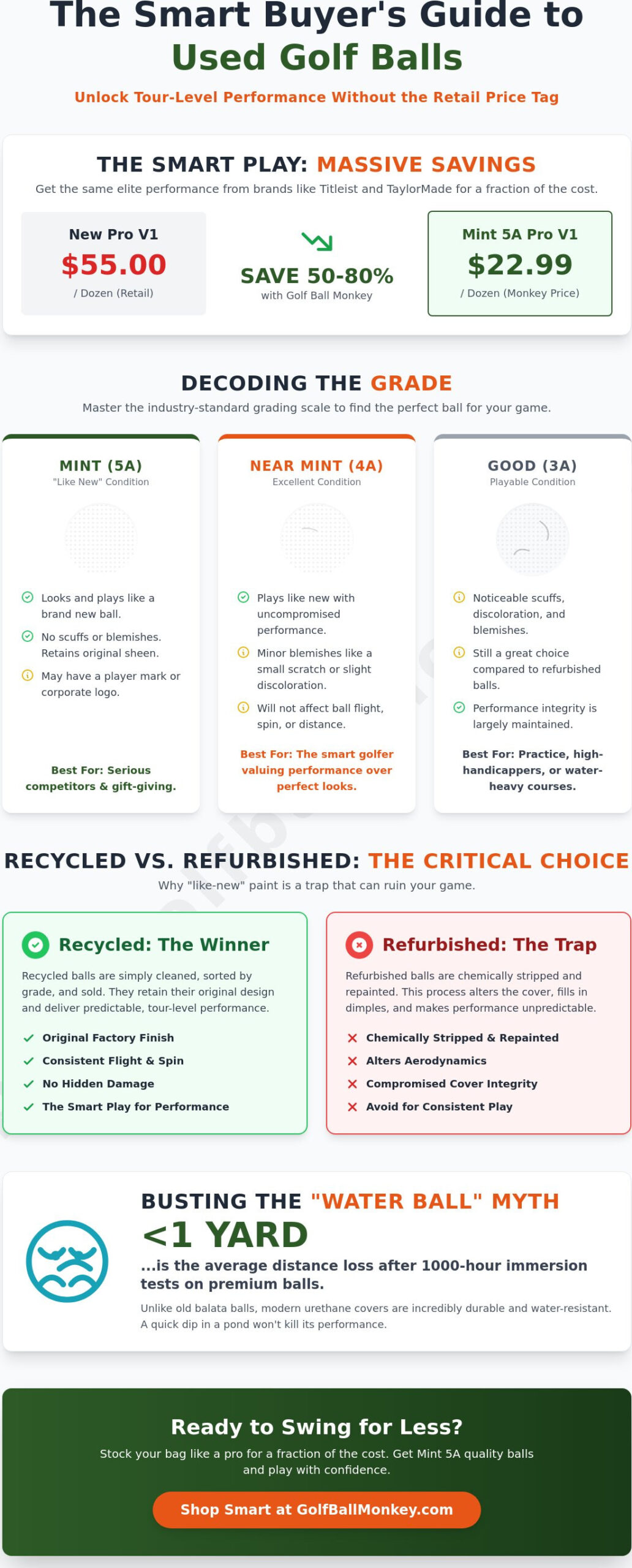
Learning what to look for when buying used golf balls starts with trusting the data over the marketing hype. The numbers don’t lie. Independent 1000-hour immersion tests show that high-end balls like the 2026 Titleist Pro V1 experience less than one yard of distance loss after being submerged. Modern manufacturing follows strict official golf ball regulations to ensure core consistency and aerodynamic stability. For a pro, that one yard might matter. For the rest of us, it is totally imperceptible. A Mint 5A ball retains its “pop” and spin characteristics perfectly. You are getting 99% of the performance for a fraction of the retail cost.
The Psychology of the “Water Ball”
Let’s talk about “swing tension.” It’s a real game-killer. When you stand over a narrow fairway with a $5 ball, your grip tightens and your tempo falls apart. You’re playing scared. Switching to a $1.50 used ball changes your entire mental approach. You play more aggressively. You go for the green over the hazard because the financial risk is gone. Confidence is the best club in your bag. The “Smart Play” is simply the intersection where peak performance meets a price point that lets you swing freely.
Decoding the Grade: Understanding Mint 5A vs. Near Mint 4A
The used ball market can feel like a wild jungle. Every retailer seems to have their own “special” system, which makes it hard for you to compare apples to apples. To cut through the noise, we use the 5A through 3A scale. It is the industry gold standard for transparency. It’s the only way to ensure you aren’t getting cleaned-up junk. Knowing what to look for when buying used golf balls starts with mastering these specific grades. It’s the difference between a steal and a waste of cash.
The Anatomy of a Mint 5A Ball
A Mint 5A ball is the crown jewel of the recycled world. These are virtually indistinguishable from a brand-new ball pulled straight from a $55 box. You won’t find scuffs, scrapes, or any loss of that factory sheen. However, don’t be surprised to see a corporate logo or a small Sharpie mark. These “player markings” are actually a great sign. They prove the ball was likely played for only one or two holes before finding a hazard. It means the core is fresh and the cover is perfect. For an immediate visual reference of this high-end quality, check out our Mint 5A golf balls. You get the same performance as retail for a fraction of the cost.
Near Mint 4A balls are for the golfer who values performance over vanity. These might have a slight cosmetic blemish or a tiny surface scratch that occurred during its short life on the course. They won’t affect your flight path or spin rates at all. If you’re looking for a massive bargain on a premium model, this is your sweet spot. You still get the “pop” of a 2026 model without the “new ball” price tag.
Grade 3A and Shag: The Budget King
Good 3A balls and Shag bags serve a specific purpose in your bag. A 3A ball will have visible scuffing and some discoloration. They are the perfect “Mixed Bag” for high-handicappers who might lose 6 or more balls per round. Even at this level, they are a better choice than “refurbished” alternatives. Industry case studies on recycled and refurbished balls highlight that refurbished balls often have compromised covers due to the stripping and repainting process. A recycled 3A ball maintains its original factory integrity.
Shag balls are strictly for the practice range or backyard drills. Don’t take them to the first tee unless you’re attempting a risky “hero shot” over a 200-yard lake. They’re built for volume, not scorecards. If you want to stock up without breaking the bank, grab a bulk bag and start swinging. Understanding what to look for when buying used golf balls means knowing when to prioritize “minty” freshness and when to settle for “good enough” for the chipping green.
Recycled vs. Refurbished: Why Like-New Paint is a Trap
Don’t let a shiny finish fool you. When you’re learning what to look for when buying used golf balls, the word “Refurbished” should be a massive red flag. At Golf Ball Monkey, we only deal in recycled balls for a very specific reason. There is a huge difference between a ball that has been cleaned and one that has been surgically altered. Recycled balls are professionally retrieved, hit with ultrasonic cleaning, and hand-sorted. They keep their original factory cover and high-performance urethane. Refurbished balls are the Frankensteins of the fairway. They get sandblasted and repainted to look new, but the performance is often trashed in the process.
The refurbishing process involves stripping the original clear coat and applying a fresh layer of paint. This might make the ball look pristine, but it’s a “sucker play” for your scorecard. Manufacturers spend millions perfecting the aerodynamics of their dimple patterns. When a third party sprays on a new coat of paint, they fill in those dimples. This kills your lift and creates erratic flight patterns. You might save a few bucks, but you’ll lose them in the woods when your ball doesn’t fly true. You can find high-quality, non-altered options in our Mint 5A collection.
Aerodynamics and Dimple Depth
Physics doesn’t care how pretty your ball looks. Dimples are engineered to create a thin turbulent boundary layer of air that clings to the ball’s surface. This reduces drag and increases lift. Even a tiny variation in dimple depth can cause your 2026 TaylorMade TP5 to drop out of the sky ten yards early. The original manufacturer’s cover is the most critical part of the ball’s design. Thick, aftermarket paint jobs ruin the “micro coating” technology found in modern 2026 models. For a deeper dive into why the cover matters, check out our guide on Recycled vs Used Golf Balls: What’s the Diff?
Spotting the Refurbished Fakes
The most dangerous part of a refurbished ball is what the paint hides. Structural failures like hairline cracks in the cover or core are easily masked by a fresh coat of white paint. A recycled ball shows you exactly what it is. If it has a crack, it gets tossed during our rigorous hand-sorting process. To protect your game, you need to know what to look for when buying used golf balls at other shops. Look for the “Refurbished” or “Refinished” stamp on the side. Check the logos; if they look dull, blurry, or the paint feels slightly tacky, put them back. We only sell 100% recycled balls because the Monkey wants you to play with the same integrity the pros do.
The 5-Point Inspection: What to Look for Before You Buy
Finding a massive bargain shouldn’t be a guessing game. When you’re ready to restock your bag, you need a system. Our 5-point inspection is the exact protocol the Monkey uses to vet every batch of inventory. Mastering what to look for when buying used golf balls keeps you from wasting cash on duds that won’t fly straight. Follow these steps to ensure your “steal” actually performs like a champion on the green. It’s the only way to guarantee you’re making the smart play.
- Step 1: Surface Integrity. Run your thumb over the cover. You are looking for deep scuffs that cut through the urethane layer. If the dimple edges are sharp and the texture is smooth, the ball is golden.
- Step 2: Discoloration. A little dirt is fine; a “mud stain” washes off in seconds. Look out for “burn” or deep yellowing. That is permanent UV or chemical damage from sitting in a hazard for too long.
- Step 3: The “Click” Test. Drop the ball on a concrete floor. It should produce a crisp, high-pitched “click.” A dull, hollow thud often signals a cracked internal core or a waterlogged center.
- Step 4: Logo and Marking Check. Keep an eye out for corporate logos. These are often “corporate overstock” balls. Companies buy them in bulk, hand them out at events, and they get lost on the very first hole. They’re a total steal.
- Step 5: Seller Reputation. Avoid the “mystery bag” trap from random eBay sellers. Professional divers use ultrasonic cleaners and rigorous hand-sorting. This is the only way to guarantee consistency in every dozen.
Identifying Cover “Burn” and Scrapes
Distinguishing between a ball that played 18 holes and one that hit a cart path is vital for your score. A cart path scrape is jagged and deep. It ruins your putting alignment and creates unnecessary drag in the air. Minor surface scuffs are usually fine for your mid-iron game, but they shouldn’t be on your 5A Mint balls. Interestingly, a “player mark” from a Sharpie is actually a sign of a high-quality, high-spin ball. It means a serious golfer was playing it, and they likely didn’t keep it in play long enough to wear it out. If you want to see what pro-vetted quality looks like, grab a dozen Mint 5A balls today and feel the difference.
The Hidden Danger of “Range” Balls
Range balls are the ultimate imposters in the used market. Some sellers sneak them into mixed bags to pad their numbers. Look for the “Practice” stamp or those tell-tale stripes. These balls are designed for extreme durability and high-volume washing, not for distance or greenside spin. They have completely different flight characteristics that will sabotage your scorecard. Knowing what to look for when buying used golf balls means spotting these fakes before they hit your bag. Check out our Golf Balls 101 guide to learn more about how cover materials and core tech impact your swing speed and trajectory.
Matching Your Ball to Your Game: Premium Performance at Monkey Prices
The Pro V1 is the undisputed heavyweight champion of the fairway. It is the #1 ball in golf and, unsurprisingly, the #1 used ball we sell. But blindly following the crowd isn’t always the smart play. Part of knowing what to look for when buying used golf balls is matching the ball’s compression and spin profile to your actual swing speed. If you aren’t swinging at 105 mph or faster, a used Bridgestone Tour B RX will likely give you more distance than a Pro V1. It is engineered for the amateur speed, and at Monkey prices, it is an absolute steal.
Don’t get trapped by the “Tour” label if your game doesn’t match the specs. A high-compression ball feels like a rock if you don’t have the speed to compress the core. Conversely, high-speed hitters need the stability of a 2026 TaylorMade TP5x or a Titleist Pro V1x to keep their spin rates from ballooning. Getting this right is the difference between a 280-yard bomb and a weak slice into the trees. We’ve vetted every model in our inventory to ensure you get the performance you pay for.
Top Used Brands for Every Player
For those who demand elite consistency, our Titleist Pro V1 Guide breaks down why this ball remains the gold standard for 2026. If you prefer a softer feel around the greens, the Callaway Chrome Soft is a high-value alternative that offers incredible “stop and drop” control. TaylorMade fans usually hunt for the TP5 for its five-layer construction and explosive speed. If you are a high-handicapper looking for the ultimate budget-on-budget play, Kirkland Signature balls provide urethane performance at a price point that makes losing a ball feel like a minor inconvenience rather than a financial disaster.
Stocking Your Bag the Monkey Way
The smartest financial move you can make for the 2026 season is buying in bulk. Why buy a single dozen when you can grab a 50-pack or a 100-pack of your favorite model? You can easily stock your bag for the entire year for under $100. This is the ultimate “smart play” that takes the stress out of every hazard-heavy hole. When you know what to look for when buying used golf balls, you realize that bulk buying recycled 5A Mint balls is the only way to play premium gear without the premium guilt.
High-handicappers should consider the “Mixed Bag” strategy. It lets you test different brands and models to see which one actually clicks with your swing. Once you find your “soulmate” ball, come back and load up on a bulk order of Mint 5A quality. Ready to stop overpaying and start playing better? Shop the full Monkey collection and start saving today!
Take Control of Your Scorecard and Your Wallet
You now have the roadmap to the ultimate smart play on the course. Understanding exactly what to look for when buying used golf balls means you never have to choose between elite performance and a reasonable budget again. Stick to the 5A Mint grade for that “straight from the box” feel. Always prioritize recycled balls over the refurbished trap to ensure your 2026 gear maintains its factory aerodynamics. Confidence comes from knowing your equipment is vetted by the best in the business.
Since 2014, our industry-leading experts have served as the savvy insider for golfers nationwide. Our professional divers harvest millions of balls annually; each one undergoes a rigorous 5 stage hand sorting and cleaning process. We take the guesswork out of the grading scale so you can focus on your swing. It is time to stop flushing cash down the hazard and start playing with the same high performance urethane the pros use for a fraction of the cost.
Stop overpaying for your balls; grab a Mint 5A dozen at Golf Ball Monkey!
Now get out there and swing with total freedom. The Monkey has your back for every round.
Frequently Asked Questions
Do used golf balls lose distance if they have been in the water?
Modern golf balls do not lose significant distance after being submerged. Tests conducted in 2024 show that even after 1000 hours underwater, the distance loss is less than 1 yard. This is totally imperceptible to 99% of golfers. The core remains protected by the waterproof urethane cover, so you still get that explosive “pop” off the tee without the retail price tag.
What is the difference between Mint 5A and Near Mint 4A grades?
Mint 5A balls are virtually indistinguishable from new, while Near Mint 4A balls have minor cosmetic imperfections. A 4A ball might have a small felt tip mark or a tiny surface blemish that occurred during a single hole of play. Neither grade suffers from performance loss. Knowing what to look for when buying used golf balls means recognizing that a 4A ball is the best value for your weekend round.
Are refurbished golf balls the same as recycled golf balls?
Recycled balls are simply cleaned and sorted; refurbished balls are stripped and repainted. Refurbishing often fills in the dimples and ruins the aerodynamics of the ball. We only sell recycled balls because they maintain the original factory integrity. You get the real deal, not a sandblasted imposter with a fake finish that could sabotage your flight path.
How many rounds can I play with a high quality used golf ball?
You can typically play 36 to 54 holes with a high quality used ball before the cover shows significant wear. Modern covers are incredibly resilient to high swing speeds. Unless you hit a cart path or a tree, a Mint 5A ball will last just as long as a new one. It is the smartest way to keep your bag stocked for the 2026 season.
Is it better to buy used premium balls or brand new budget balls?
Used premium balls offer far better greenside control than brand new budget balls. Budget balls use Surlyn covers that are hard and low spin. A recycled Titleist Pro V1 or TaylorMade TP5 provides the “stop and drop” spin you need to score. Choosing premium recycled gear is the ultimate insider secret to lowering your handicap without spending a fortune.
Can I use used golf balls in a professional or amateur tournament?
Yes, recycled golf balls are perfectly legal for tournament play. As long as the original model is on the USGA Conforming List, you are good to go. Most amateur tournaments follow standard USGA rules which allow for used equipment. Just avoid refurbished balls, as the repainting process can sometimes lead to disqualification under specific equipment regulations.
How do I know if a used golf ball has a cracked core?
The “Click Test” is your best tool for identifying internal damage. Drop the ball from waist height onto a hard concrete surface and listen closely. A healthy ball makes a sharp, high pitched “click” sound. If you hear a dull, hollow thud, the core is likely compromised or waterlogged. This is a vital part of what to look for when buying used golf balls from unverified sources.
Why do some used golf balls have corporate logos or player markings?
Logos and player markings usually indicate “corporate overstock” or balls that were lost almost immediately. Companies buy thousands of balls for outings and hand them out to players who might lose them on the first swing. These markings have zero impact on aerodynamics or spin. They are actually a “green light” for quality because they often signify the ball has very little flight time.
- golfballmonkey@gmail.com
- (512) 593-8401
- Mon – Fri, 9:00 AM – 5:00 PM

All product and company names are trademarks™ or registered® trademarks of their respective holders.
Use of them does not imply any affiliation with or endorsement by them.