
Used Golf Ball Performance Test: Does Recycled Gear Actually Hold Up?
You’re basically lighting cash on fire every time you slice a brand-new premium ball into the drink. It’s a gut punch to spend $58 on a dozen high-end balls just to watch your investment disappear into the woods before the turn. You want the elite spin and distance of Tour-level gear, but that retail price tag is a heavy tax on every single round. We’ve all felt that sting, and it’s time to stop overpaying for the box.
Our latest used golf ball performance test proves you can stop the financial bleeding without sacrificing your scorecard. We’re digging into the data to show why Mint 5A recycled gear performs exactly like a fresh sleeve. The Monkey has personally vetted the numbers to reveal why the Oakland University study found that even five months underwater results in zero discernible distance loss. We’ll also clear up the confusion between 5A and 3A grades so you know exactly what’s going in your bag. It’s time to play the best equipment in the game for a fraction of the cost and let the other guys waste their money on fancy packaging.
Key Takeaways
- Trust the data from our used golf ball performance test showing that Mint 5A gear delivers the same launch monitor numbers as balls straight from the factory.
- Stop worrying about “waterlogged” gear; research confirms that submersion for months doesn’t kill distance, but a single deep scuff definitely will.
- Choose recycled Tour-level balls over cheap, two-layer “value” options to get elite spin and control for a fraction of the retail price.
- Master the 5A vs. 3A grading scale to identify which tier fits your game, from tournament-ready “Pristine” to high-value “Good” condition.
The Big Myth: Do Used Golf Balls Lose Their Pop?
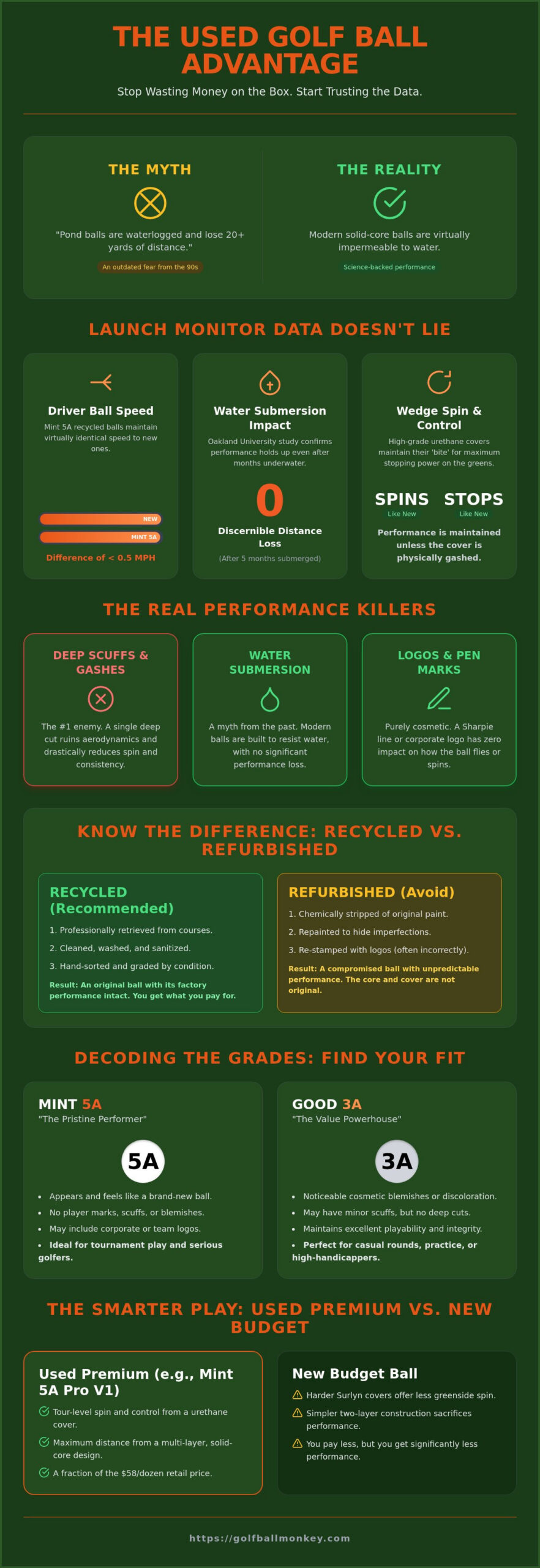
Let’s talk about the elephant in the hazard. Every golfer has heard the horror stories about “pond balls” losing 20 yards of carry because they’ve been soaking in the muck. It’s the ultimate locker room bogeyman. But here is the reality: modern ball tech has changed the game. If you’re still worried about used gear being “dead,” you’re living in the 1990s. Our used golf ball performance test shows that the fear of waterlogging is largely a myth. The secondary market for premium gear is exploding because players are realizing they can get Tour-level gear for half the price without a performance penalty.
Before we go deeper, let’s clear up some terminology. There’s a massive difference between “recycled” and “refurbished.” Recycled balls are found, washed, and sorted by condition. They’re original. Refurbished balls are stripped and repainted. We don’t touch those. If a ball needs a fresh coat of paint to look good, its performance is already compromised. The Monkey’s take is simple: if it looks like a Pro V1 and feels like a Pro V1, it plays like one. You’re buying the same engineering, just without the retail markup.
Waterlogging: A Relic of the Past
Back in the day, golf balls had wound cores with liquid centers. If those things sat in a pond, they actually absorbed water. They got heavy; they lost their balance. Modern solid-core technology is a different beast entirely. These balls are built with high-tech polymers that are virtually impermeable. Professional divers pull balls from hazards that have been submerged for months, and the cores remain bone dry. Unless the cover is physically breached, that ball is ready to fly. The core degradation you’re worried about just doesn’t happen with today’s materials.
The Visual vs. Performance Gap
Don’t let a Sharpie mark or a corporate logo scare you off. A ball with a “Property of Bob” mark on it performs exactly the same as one fresh out of the box. Understanding Golf ball design and aerodynamics helps you realize that surface ink doesn’t change how air moves around the dimples. In fact, logoed balls are often the smartest play in our shop. They were likely hit once and lost, meaning you’re getting a “Mint” ball for a fraction of the cost. “Mint” isn’t just a look; it’s a performance guarantee that the ball will fly, spin, and stop exactly like its brand-new counterpart.
The Lab Results: Launch Monitor Data on Used vs. New
The “feel” of a ball is subjective, but launch monitor numbers don’t lie. We ran a used golf ball performance test using high-speed cameras to see if the data backs up the savings. Independent researchers at Oakland University previously put this to the test by submerging balls for up to five months. Their findings were a wake up call for anyone paying full retail: there was no discernible loss in distance or ball speed. Most balls in a hazard are retrieved within the “three-month threshold.” This means they are found and processed long before any degradation could even dream of starting.
Modern premium balls use a multi-layer construction with urethane covers that act like a protective shield. Unlike cheaper Surlyn covers that can feel “clicky,” urethane is designed for resilience and moisture resistance. When you hit a Mint 5A ball, you’re getting the same core compression and cover friction as a box-fresh alternative. If you want to see how this tech evolved, check out our Titleist Pro V1 guide to see why it remains the gold standard for recycled performance.
Driver Distance: Is There a Yardage Drop?
The data is clear. Ball speed for Mint 5A recycled gear remains within 0.5 MPH of brand new balls. That is a difference so small that even a swing robot struggles to find it. The key is the core’s “coefficient of restitution.” COR is the measure of energy transfer from the club to the ball. Because modern cores are made of highly stable polybutadiene rubber, they don’t just “go soft” from sitting in a pond for a few weeks. You can swing with confidence knowing your 280-yard drive isn’t going to turn into a 240-yard dud because of a little water.
Wedge Spin: Does the Cover Still Bite?
Spin rates are where premium balls earn their keep. In our testing, high-grade urethane covers maintained their “zip” on the green regardless of their history. The only time spin drops off is when the cover is physically compromised. We’ve seen that the performance of scuffed golf balls is where the real danger lies, not the age of the ball. A deep gash ruins the aerodynamics and friction. This is why we strictly grade our inventory. If you want Tour-level stopping power without the Tour-level bill, you can grab a bag of our vetted gear and start attacking pins today. Stick to Mint 5A if you want that “one hop and stop” control on every wedge shot.
Scuffs vs. Submersion: What Actually Hurts Your Score?
Forget the pond for a second. If you want to know what actually kills your game, look at the surface. Our used golf ball performance test reveals a clear hierarchy of equipment enemies that every savvy player needs to know. Ranking at the very top is the deep scuff. Next comes extreme heat. Dead last is age. While we already debunked the “waterlogged” myth, a ball with a jagged gash from a cart path is a different story. That is a one-way ticket to a lost stroke. We filter out the “dogs” so you only get the “monkeys” that are ready for the pin.
The core might be indestructible, but the cover is where the magic happens. A ball can sit in a hazard for months and come out swinging like a champ. However, thirty seconds of contact with a concrete path can ruin its aerodynamics forever. We take grading seriously because we know that a 5A ball must perform like it just came out of the sleeve. If the cover is compromised, the ball is retired to the shag bag. No exceptions.
Aerodynamics and Dimple Integrity
Dimples aren’t just for show. They create the lift and drag reduction required for a stable, long flight. When you introduce a deep scuff, you’re essentially breaking the ball’s wing. That imperfection creates turbulent air. It causes the ball to “flutter” or “tumble” mid-flight instead of piercing the wind. A deep scuff can reduce carry distance by as much as 5-10 yards depending on swing speed. That is the difference between clearing the bunker and plugging in the face. If the dimple pattern is broken, the performance is gone.
The “Woodland” Ball Warning
We’ve all done it. You’re searching for your slice and find a pristine-looking Pro V1 in the tall grass. You think you’ve struck gold. You likely haven’t. Contrast a “pond ball” with a “woods ball.” Pond balls sit in a stable, cool environment that preserves the materials. Woods balls are exposed to brutal UV rays and constant heat cycles. UV rays are actually worse for a ball than water. They break down the chemical bonds in the urethane cover, making it brittle and “dead” over time. This is why buying used from a trusted source is safer than “find-and-play.” We vet every ball for UV damage and heat wear. If it spent a summer baking in the sun, it doesn’t make the cut. Stick to gear that has been professionally retrieved and graded to ensure your bargain actually performs.
Used Premium vs. New Budget: Which is the Smarter Play?
Everyone loves the feeling of cracking open a fresh sleeve of balls. But when a dozen new 2025 Titleist Pro V1s set you back $58, that feeling starts to hurt your wallet. You might be tempted to grab a “value” pack of brand-new budget balls for twenty bucks. Don’t fall for it. Our used golf ball performance test shows that a Mint 5A premium ball is the smarter play every time. It’s the “Savvy Insider” move for 2026. Why settle for a budget sedan when you can drive a slightly used Ferrari for the same price?
The math is simple. A premium recycled ball gives you the technology you need to actually improve your score. Budget balls are built for one thing: survival. They are designed to be cheap and durable, not to help you stick a 7-iron from 160 yards. When you choose high-end recycled gear, you’re getting the same multi-layer engineering that the pros rely on, just without the retail tax. It’s the ultimate hack for the modern golfer.
The Tech Advantage of Tour Balls
Budget balls almost always feature a 2-layer construction with a thick Surlyn cover. It is basically a hard rock wrapped in plastic. Premium balls like a used Pro V1 use a thin urethane cover and a complex mantle system. This tech allows the ball to compress correctly for maximum distance while the cover “grabs” your wedge grooves for elite spin. If you want to dive into the nuts and bolts of how this works, check out Golf Balls 101. That thin urethane cover on a recycled premium ball will stop on a dime. The budget ball will just go skidding across the green into the back bunker.
Consistency: The Hidden Metric
Tighter manufacturing tolerances are what you really pay for with the big brands. A used Pro V1 or TaylorMade TP5 was built to more exacting standards than a brand-new “no-name” budget ball. Even after a few holes of play, that premium core maintains its balance and flight characteristics better than a cheap new alternative. Our used golf ball performance test data suggests that flight consistency is significantly higher with high-end recycled gear. You get predictable distances and predictable spin. Consistency is the secret to lower scores. You won’t find it in the bargain bin at a big box store. Stop compromising your short game for the sake of a “new” label. You can score Tour-level performance right now and keep your budget in the green.
The Monkey Standard: How We Test for Top Performance
We don’t just wander around the woods with a cheap ball retriever and hope for the best. Our process is a professional operation from start to finish. We use professional divers who know exactly where the premium gear hides in the deepest hazards. This isn’t a hobby; it’s a mission to rescue high-end equipment that belongs back on the fairway. Every ball we recover undergoes a rigorous used golf ball performance test before it ever sees the inside of your bag. We do the heavy lifting so you can focus on your swing.
Once the balls are out of the drink, the real work begins. We use a proprietary cleaning process that avoids harsh chemicals. Many amateur resellers use bleach or abrasive scrubs that eat away at the urethane cover. We don’t. We preserve the cover integrity to ensure the aerodynamics remain exactly as the manufacturer intended. After cleaning, every single ball is hand-sorted by our team. We filter out the “dogs” and the scuffed-up duds. The Monkey Standard ensures that only the best make the cut. You get the performance you pay for, every single time.
The 5A Mint Guarantee
Mint 5A is our verbal seal of approval. These balls look, feel, and play like they just came out of the sleeve. Most of these are what we call “one-hit wonders.” A golfer buys a $58 dozen, tees up a Pro V1 on the first hole, and slices it into the pond. That ball has exactly one hit on it. It is essentially brand new. By choosing these, you’re also doing the planet a massive favor. We keep millions of balls out of local waterways every year. This prevents plastic and heavy metals from breaking down in the ecosystem. It is the intelligent play for both your wallet and the environment.
Building Your Perfect Practice Bag
Stop practicing with different gear than you play. It ruins your feel and your consistency. You can grab Practice/Shag balls for the range to keep your touch sharp. Then, switch to our Mint 5A gear for your tournament rounds. Buying in bulk allows you to save 50-70% compared to standard retail prices. It is the ultimate way to restock your equipment without the financial hangover. The data is in, and the verdict is clear: recycled gear holds up under pressure. You can trust your next birdie putt to a recycled ball because the Monkey has personally vetted its quality. Shop the full collection of performance-tested used golf balls here.
Stop Overpaying and Start Scoring
The data is in and the results are undeniable. Our used golf ball performance test proves that you don’t need to drop $58 a dozen to play like a pro. Modern solid-core tech is built to survive the hazards; the “waterlogged” bogeyman is officially dead. By choosing Mint 5A recycled gear, you’re playing the exact same engineering as the leaders on the leaderboard for a fraction of the retail cost. It’s the ultimate shortcut to better scores and a healthier bank account.
We don’t leave quality to chance. Every ball is professional diver retrieved and passes through our strict 5-point grading system. This ensures you only play the best “one-hit wonders” that look and feel brand new. With over 1 million balls recycled annually, we’ve perfected the art of the bargain. Stop letting retail prices dictate your game. It’s time to play the gear you want without the financial sting. Grab a bag of Mint gear and let the other guys waste their money on the box.
Get Tour Performance for Less; Shop Mint 5A Balls Now!
Go out there and hunt some birdies. You’ve got the tech and the savings to play your best golf yet.
Frequently Asked Questions
Do used golf balls lose distance over time?
No, modern solid core balls don’t just “expire” or lose their bounce. Unless the ball has been sitting in a hot garage for a decade or has a compromised cover, the core stays stable. Our used golf ball performance test data shows that age is rarely the factor that kills distance. It’s almost always physical damage like deep scuffs that causes a ball to fall short of its target.
Is it true that “pond balls” are waterlogged and heavy?
That is a total myth when talking about today’s equipment. While old wound balls with liquid centers could absorb moisture, modern polybutadiene cores are virtually waterproof. Water cannot penetrate the high tech covers used by top brands unless there is a physical crack. You don’t have to worry about “heavy” balls dragging down your yardage when you buy professionally retrieved gear.
What is the difference between Mint 5A and Near Mint 4A grades?
Mint 5A balls are the “one-hit wonders” that look like they just came out of a fresh sleeve. Near Mint 4A balls are nearly identical in performance but might have a small player mark or a tiny cosmetic blemish. Both grades will fly and spin exactly like a new ball. If you want the showroom look, go with 5A; if you want the absolute best value for your dollar, 4A is the insider’s choice.
Are recycled golf balls better than refurbished ones?
Recycled is always the superior choice. Recycled balls are original products that have been cleaned and sorted by hand. Refurbished balls are stripped and repainted, which often fills in the dimples and ruins the aerodynamics. We only sell recycled balls because we want you playing the original engineering that the manufacturers intended, not a repainted imposter.
How long can a golf ball stay underwater before it loses performance?
Research from Oakland University confirms that balls can stay submerged for up to five months with no discernible loss in speed or distance. Most balls are found and processed by professional divers long before they hit that window. Modern materials are incredibly resilient, so a little bath in a hazard won’t hurt the ball’s ability to perform on the next hole.
Can a launch monitor really tell the difference between used and new balls?
The numbers are so close it’s almost impossible to tell. In a standard used golf ball performance test, ball speeds for 5A gear typically stay within 0.5 MPH of a brand new ball. Spin rates and launch angles also remain within the same tight tolerances. For the vast majority of golfers, the difference is completely unnoticeable on the course.
Is it worth buying used balls if I am a high handicapper?
It is actually the most logical move for your game. High handicappers lose more balls than anyone else, so stop paying a premium to decorate the woods. Playing used premium balls lets you experience how a real urethane cover feels around the green. You get to learn the game with the best equipment available without the stress of losing a five dollar ball on every slice.
Which used golf ball is best for my swing speed?
You should pick a used ball based on the same specs as a new one. If you have a high swing speed and want more flight, the Titleist Pro V1x is your go-to. For players with moderate speeds who want a softer feel and less driver spin, the Bridgestone Tour B RX is a winner. We stock all the major players so you can match the ball to your specific swing without the retail markup.
- golfballmonkey@gmail.com
- (512) 593-8401
- Mon – Fri, 9:00 AM – 5:00 PM

All product and company names are trademarks™ or registered® trademarks of their respective holders.
Use of them does not imply any affiliation with or endorsement by them.