
Understanding Used Golf Ball Grades: The Savvy Player’s 2026 Guide
Did you know that golfers in the U.S. lose an estimated 300 million balls every single year? It’s a brutal reality of the game. You drop $50 on a fresh dozen of premium balls, only to watch half of them vanish into the woods before the back nine. It feels like tossing twenty dollar bills directly into a pond. We’ve all been there, and we’re all tired of the “new ball tax” that drains your budget before you even reach the first tee. That’s why understanding used golf ball grades is the ultimate secret weapon for your scorecard and your wallet.
You don’t have to settle for scuffed junk or mystery buckets. You can snag Tour level performance for a fraction of the retail price without worrying about “dead” or water logged duds. This guide will show you how to master the grading scales so you can score Mint 5A quality with total confidence. We’ll break down the difference between tournament ready 5A and practice perfect 3A. You’ll learn exactly what to look for to avoid common traps and start saving hundreds of dollars every season. It’s time to play the smart way and get the gear you deserve.
Key Takeaways
- Stop overpaying at the pro shop. Learn how to secure premium Titleist and TaylorMade performance for a fraction of the retail cost.
- Get the facts on understanding used golf ball grades so you can confidently choose between Mint 5A, Near Mint 4A, and practice-ready 3A balls.
- Bust the “water ball” myth. Modern multi-layer construction means recycled balls retain their distance and spin far better than most players realize.
- Develop a “mixed-bag” strategy. Save your Mint 5A balls for the tournament and use Near Mint 4A for those casual Saturday morning rounds.
- Understand the value of hand-checked quality. Discover why a multi-point inspection beats machine sorting every time when it comes to finding hidden gems.
Cracking the Code: Why Used Golf Ball Grades Matter in 2026
Stop burning cash at the pro shop. Paying $50 or more for a dozen new balls is a tactical error for the average player. It’s the “Retail Trap.” You are paying for a shiny box and a massive marketing budget. By understanding used golf ball grades, you can bypass those inflated prices and play premium equipment for less. Grading is simply a system used to categorize the cosmetic and structural integrity of reclaimed balls. It lets you swap out those rock-hard, budget ionomer balls for high-performance urethane covers like the Titleist Pro V1 or TaylorMade TP5. You get the spin, the feel, and the distance without the financial sting.
The secret is knowing that a ball doesn’t lose its magic just because it left the box. Most amateurs can’t tell the difference in performance between a brand-new ball and a high-grade recycled one. When you shop at our shop, you’re making the intelligent play. You’re getting Tour-level tech for the price of a generic “value” ball. It’s the ultimate insider move for anyone looking to level up their game without draining their bank account.
The Economics of the Tee Box
Think about your cost per round. If you lose three balls a game, you’re essentially throwing away a lunch every time you play. Switching to Mint 5A balls slashes those costs instantly. This isn’t just about money; it’s about your mental game. The “fear of losing a ball” creates tension in your swing. When you aren’t worried about a $5 splash into the lake, you swing faster and more fluidly. Plus, it’s a massive environmental win. With 300 million balls lost annually in the U.S., choosing recycled gear keeps plastic out of our ecosystems and off the ocean floor.
Standardization vs. Subjectivity
The tricky part is that no official governing body regulates these ratings. One site’s “Mint” might be another site’s “Near Mint.” This subjectivity makes understanding used golf ball grades even more vital. To get the best value, you need to look at how the balls are sourced. Automated machines often miss small structural flaws that a human eye catches instantly. This is why diver-sourced quality control is superior.
Understanding the history and construction of golf balls helps you realize that a ball’s core and cover are resilient. They don’t just “die” after a few days in the grass. The 5A scale is the gold standard for recycled equipment in 2026, representing a ball that is virtually indistinguishable from a new one. Trust a grader who hand-checks every dimple to ensure you’re getting exactly what you paid for. It’s the only way to ensure your “bargain” actually performs on the green.
From Mint to Practice: The Definitive 5A Grading Scale Breakdown
The used ball market can feel like a guessing game if you don’t know the rules. That’s where the 5A scale comes in. It’s the industry’s shorthand for quality. Understanding used golf ball grades is about matching the condition to your specific needs on the course. Whether you’re hunting for a tournament ready ball or something to whack into the woods, there’s a grade for that. Think of it as a decoder ring for value. You stop guessing and start saving.
The 5A (Mint) Standard
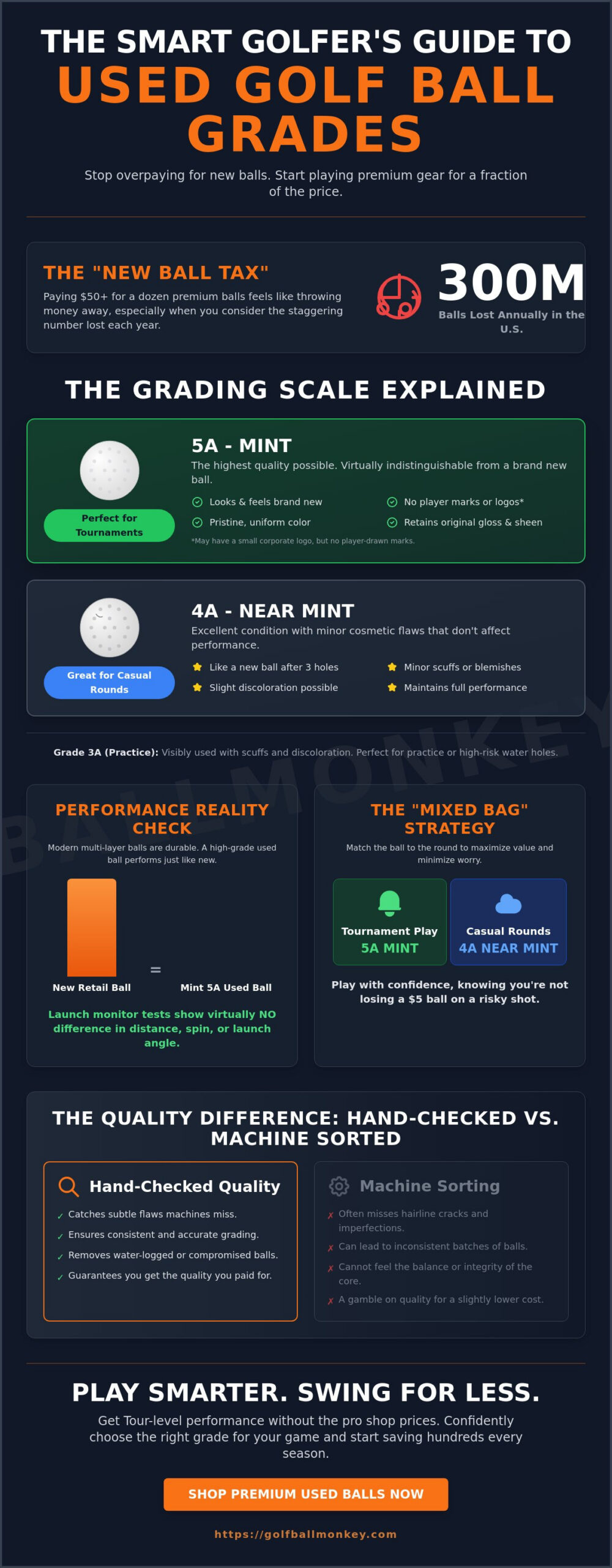
This is the peak of the mountain. A Mint 5A ball looks and feels like it just popped out of a fresh sleeve. You’ll see the original factory sheen. There are no scuffs. There are no scratches. You might find a small corporate logo or a previous player’s ink mark, but the cover is pristine. This is why the Titleist Pro V1 (Mint 5A) is the most popular choice for savvy players. Launch monitor testing shows these are indistinguishable from brand new retail balls. You get the same launch angle, the same spin rate, and the same distance. It’s the ultimate way to play a premium ball without the premium price tag.
The 4A (Near Mint) Reality Check
If you want the best “bang for your buck,” look at the 4A grade. These balls have minor cosmetic blemishes. Maybe there’s a slight discoloration or a tiny surface scratch. We call this the “3-Hole Rule.” A 4A ball looks exactly like a brand new ball you’ve played for three holes. The aerodynamics remain intact. The core is still explosive. It’s the smart money choice for practice rounds or casual weekend games. You won’t feel the sting if it ends up in the tall grass, but you’ll still get the performance you need on the green. Understanding used golf ball grades means recognizing that a tiny scuff won’t kill your drive.
3A (Good) and Practice Grades
Sometimes you just need a ball that works. The 3A (Good) grade is for the high-handicapper or the golfer facing a daunting 200-yard carry over water. These balls have visible scuffs or shading, but they aren’t “dead.” They are perfectly playable for low consequence rounds. For everything else, there are Shag or Practice balls. These are the ultimate utility tools for your backyard or the local range. Check out our Golf Balls Used: The Savvy Player’s Guide for a deeper dive into these value tiers. If you’re ready to restock, grab a dozen today and see the difference for yourself.
- Mint (5A): The gold standard. Perfect condition, maximum performance.
- Near Mint (4A): The value play. Minor cosmetic flaws, zero performance loss.
- Good (3A): The budget builder. Visible wear, great for high-risk holes.
- Practice/Shag: The utility workhorse. Best for the range or the backyard.
Performance vs. Aesthetics: Does a 4A Ball Actually Fly Shorter?
Let’s tackle the elephant in the fairway. Most golfers worry that a used ball is a “dead” ball. They fear the water hazard has sucked the life out of the core. This is the “Water Ball” Myth, and it’s time to bust it. Modern multi-layer balls are built differently than the old wound-core relics. They don’t absorb water like a sponge. Understanding used golf ball grades means knowing that a 4A ball isn’t a performance compromise; it’s a cosmetic one. You’re getting the same high-compression engine in a slightly scratched chassis.
Launch monitor data from 2026 confirms this reality. In head-to-head tests, Mint 5A balls showed zero statistical difference in distance or spin compared to brand-new retail versions. Even 4A balls, with their minor surface blemishes, typically lose less than 1% of their total distance. That’s about two yards on a 250-yard drive. For most amateurs, the “mud ball” sitting in your bag right now is doing more damage to your aerodynamics than a clean 4A scuff ever could. You get the performance you need without the “new ball” tax.
Aerodynamics and Surface Wear
Dimples are there for a reason. They create the lift that keeps your ball airborne. While a massive gash might cause a wobble, a minor surface scratch rarely impacts the drag coefficient enough to matter. Modern urethane covers are designed for extreme durability. They can withstand high-speed impacts and cart path scrapes while maintaining their flight characteristics. Focus on your swing, not the surface of the sphere. A graded ball ensures your equipment isn’t the reason for a missed green.
The “Pop” Factor: Compression and Core Integrity
Core integrity is what gives a ball its “pop.” People often blame water for a dead feel, but extreme temperature is the real enemy. A ball left in a frozen garage or a sweltering trunk suffers more than one sitting in a pond for a week. This is why professional divers are crucial. They harvest balls regularly, ensuring our inventory hasn’t been submerged for years. For a deeper look at the tech, check out Are Used Golf Balls Worth It? A Data Dive for all the technical specs.
There’s also a massive psychological edge to understanding used golf ball grades. When you play a ball that costs half the retail price, you swing with freedom. You aren’t “scared” of the woods or the water. That lack of tension leads to faster clubhead speed and better scores. You stop playing defensive golf and start attacking the pin. It’s the ultimate performance hack: play a better ball, spend less money, and swing without fear. Your scorecard will thank you.
The Savvy Player’s Strategy: Matching Grades to Your Game
Stop treating your golf ball order as a single-choice decision. Most retailers want you to pick one grade and stick to it for the whole season. That is a rookie mistake. Understanding used golf ball grades gives you the power to build a strategic arsenal. It is about matching the ball to the specific shot you are facing. Why fire a pristine 5A ball into a 200-yard forced carry over a lake? That is just bad math. Savvy players know that a diverse bag is a profitable bag.
Adopt the Mixed-Bag Approach. Carry a sleeve of Mint 5A for the tournament rounds where every stroke counts. Keep a pocket of 4A or 3A balls for those “danger zones” where the risk of loss is high. You maintain the same feel and compression of your preferred model while protecting your wallet. It is the ultimate tactical play for the modern golfer. You are playing the same tech; you are just being smarter about when you deploy it.
Practice consistency is another secret of the pros. Range balls are often “rocks” with inconsistent flight and zero spin. They lie to you about your swing. Instead, practice with 3A or 4A versions of your actual game ball. If you play a Pro V1 on Sundays, practice with a 3A Pro V1 on Tuesdays. You get the same feedback on your chips and putts without the high cost. It is about building muscle memory that actually transfers to the scorecard.
The “Risk-Reward” Grading Framework
Think of your bag like a toolbox. Use 5A for the first tee to set the tone. It gives you that mental boost of playing a perfect ball. When you reach that tight par 4 with out-of-bounds on both sides, swap to a 4A. If you are warming up your short game or practicing chips in the backyard, use 3A “Shag” balls. This hierarchy ensures you never waste high-value equipment on low-consequence shots. It keeps your head in the game and your money in your pocket.
Skill-Level Recommendations
Your handicap should dictate your buying habits. Low handicappers need the surgical precision of 5A. You want consistent spin rates on every approach shot to stick those greens. For mid-to-high handicappers, the savings from a Mixed Bag (Good 3A) or 4A pack far outweigh any minor performance gaps. If you are a high-spin seeker on a budget, grabbing the Titleist Pro V1x in a 4A grade is the ultimate cheat code. You get the elite performance of a premium urethane cover without the fear of the “retail tax” when you miss the fairway. Grab your strategic stash today and play without limits.
The Monkey’s Guarantee: Why Our Grading Process Wins
Most used ball sites are black boxes. You click “buy” and hope for the best. We do things differently. Understanding used golf ball grades is only half the battle; you also need to trust the people doing the grading. While others rely on automated machines that miss the small stuff, we put every ball through a rigorous multi-point inspection. It’s hand-checked by experts who know exactly what a Titleist or TaylorMade should look like. If it isn’t perfect, it doesn’t get the 5A badge. Simple as that.
Our secret weapon? The pros. We don’t just wait for balls to float to the surface. Our team of professional divers hits the ponds to find the “hidden gems” that others miss. These are balls that haven’t been sitting in the mud for years. They’re fresh, high-performance pieces of gear that just happened to take a wrong turn. By sourcing directly from the source, we ensure our inventory stays fresh and our quality stays elite. You get the best of the best because we go where the best balls are hiding.
From Pond to Pro Shop
The journey from the water to your bag is a science. We’ve perfected a cleaning process that restores that factory sheen without damaging the cover or the core. No harsh chemicals. No abrasive scrubbing. Just a clean, bright finish that looks great on the tee. Our Texas-based operations lead the industry in quality control because we treat every dozen like it’s going into our own bags. We stand by our work. If a ball doesn’t look like the grade you bought, we fix it. That’s our no-hassle promise to you.
This isn’t just about saving you money; it’s about the planet. Every ball we reclaim is one less piece of plastic sitting in a local ecosystem. You get to play better golf while doing right by the environment. It’s a win-win that makes every birdie feel a little bit sweeter. Understanding used golf ball grades means recognizing the value of a recycled product that performs like new but leaves a smaller footprint.
Ready to Restock?
Your bag is waiting. Don’t let another round go by while you’re overpaying for the “new ball” experience. Head over to our Shop All page to browse our current 2026 stock. Whether you need the high-spin performance of a Pro V1 or a reliable mixed bag for practice, we’ve got you covered. Don’t forget to grab a pack of Golf Ball Monkey Performance Tees to complete your setup. Stop overpaying. Start playing like a pro. The fairway is calling, and now you have the gear to conquer it.
Own the Fairway Without the Retail Tax
You’ve officially cracked the code. By understanding used golf ball grades, you’ve moved past the retail trap and into the savvy insider circle. You now know that Mint 5A balls deliver Tour level performance for a fraction of the cost, while Near Mint 4A is the ultimate workhorse for your daily rounds. Stop letting the fear of a lost ball dictate your swing mechanics. We recycle millions of balls annually to keep your bag stocked and the planet clean.
Every ball we sell is professional diver-sourced and hand-inspected to ensure it hits our strict standards. We back every order with a 100% Satisfaction Guarantee because we know you’ll love the performance as much as the price. It’s time to stop overpaying and start playing the game you love with the best gear available. Score Tour Performance for Less. Shop Our 5A Mint Collection Now!
Grab your gear, head to the first tee, and swing with total confidence. Your best round is just one smart purchase away.
Frequently Asked Questions
What is the difference between 5A (Mint) and 4A (Near Mint) golf balls?
5A balls are virtually indistinguishable from new balls. They have the full factory sheen and no scuffs. 4A balls are the “smart money” choice. They have minor cosmetic blemishes like slight discoloration or small surface scratches that don’t affect flight. Understanding used golf ball grades means knowing that 4A offers the best value for casual play while 5A is for the perfectionist.
Do used golf balls lose distance if they have been in the water?
Modern multi-layer balls don’t lose distance from being submerged for short periods. Their solid core construction and durable covers prevent water absorption. Tests show that recycled balls perform nearly identically to new ones. Professional divers retrieve these balls frequently to ensure they haven’t been underwater for years. You get the same “pop” off the tee without the retail price tag.
Can I play used 5A golf balls in a sanctioned tournament?
Yes, you can play used 5A golf balls in sanctioned tournaments. As long as the ball model is on the USGA Conforming Ball List, it is legal for play. Recycled balls are not altered structurally; they are simply cleaned and sorted. Avoid “Refurbished” balls for competitive play as their covers have been repainted, which can change their performance characteristics.
What are “Shag” or “Practice” grade golf balls used for?
Shag or Practice grade balls are best for low-consequence repetition. Use them for chipping in the backyard or hitting into a practice net. These balls have visible wear, scuffs, or discoloration. They are the ultimate budget choice for building muscle memory. You get the feedback of a real ball without worrying about losing premium equipment in the bushes.
Are “Refurbished” or “Refinished” balls the same as Recycled balls?
No, they are completely different. Recycled balls are simply cleaned and sorted by condition. Refurbished or refinished balls have been sandblasted and repainted with a new clear coat. This process can alter the ball’s weight and aerodynamics. We focus on recycled balls to ensure you get the original factory performance and spin every time you swing.
Is it better to buy used premium balls or brand-new budget balls?
Used premium balls almost always outperform brand-new budget balls. A recycled Pro V1 offers better spin control and greenside feel than a new two-piece ionomer ball. Understanding used golf ball grades helps you get Tour-level technology for the price of a generic “rock.” It is the intelligent play for anyone serious about dropping their handicap this season.
How many holes can I expect to play with a 4A grade golf ball?
You can play a 4A ball for several rounds if you keep it out of the woods. The performance won’t degrade over 18 holes. Modern covers are incredibly durable. You typically lose the ball or hit a cart path long before the ball’s structural integrity fails. It is a reliable partner for your entire weekend of golf.
Does Golf Ball Monkey offer a guarantee on their grading accuracy?
Yes, we offer a 100% Satisfaction Guarantee on all our grading. Our team hand-checks every ball to ensure accuracy. If a shipment doesn’t meet the grade you ordered, we will fix it immediately. We take pride in our multi-point inspection process to ensure you get exactly what you paid for. Trust the monkey to keep your bag stocked with quality gear.
- golfballmonkey@gmail.com
- (512) 593-8401
- Mon – Fri, 9:00 AM – 5:00 PM

All product and company names are trademarks™ or registered® trademarks of their respective holders.
Use of them does not imply any affiliation with or endorsement by them.