
Urethane vs. Ionomer Used Golf Balls: The Savvy Player’s Guide (2026)
What if the “budget” balls you just bought are actually the reason you can’t stick a green? It is a frustrating cycle. You buy cheap ionomer covers to save money, but then you watch your chips scream past the hole because they won’t spin. Most golfers think they have to choose between their wallet and their scorecard. When comparing urethane vs ionomer used golf balls, the savvy player knows a secret that changes everything: the used ball hack.
We know the pain of watching a five-dollar ball vanish into a lake. You’re tired of technical jargon like “Surlyn” and want tour-level control without the elitist retail markup. It’s time to stop settling for rocks. This guide will show you exactly how to get premium performance for a fraction of the cost. You will learn why the cover material is the single most important factor for lower scores and how to grab 5A Mint balls that play like they just came out of the box.
We are breaking down the technical differences between covers and explaining why independent tests show that high-grade recycled balls perform within 1% of brand-new ones. It is time to start playing Titleist Pro V1, TaylorMade TP5, or Callaway Chrome Soft for the price of a basic ionomer ball.
Key Takeaways
- Stop guessing at the pro shop; learn why the cover is the only part of the ball that matters for greenside “drop and stop” control.
- Discover how ionomer covers act as the “tanks” of the golf world, offering maximum durability and straighter shots for players struggling with sidespin.
- Unlock the ultimate savvy player’s secret: comparing urethane vs ionomer used golf balls to score Mint 5A tour performance at basic retail prices.
- See why independent testing proves that high-grade recycled urethane balls perform almost identically to brand-new premium options.
- Gain the confidence to choose the right ball for your specific playing style, ensuring you never overpay for performance you don’t need.
The Science of the Cover: Why Urethane and Ionomer Matter
Your club never actually touches the core of your golf ball. It only makes contact with the cover. That thin outer layer is the most overworked part of your equipment. It handles every high-speed impact, every scuff from a cart path, and every splash into a water hazard. When you weigh the differences of urethane vs ionomer used golf balls, you’re deciding how your ball talks back to your club. The material dictates if your ball will stick to the green like glue or roll off the back into a bunker. It is the handshake between your swing and the scorecard.
The history of golf ball materials shows a constant evolution from leather and feathers to the high-tech polymers we use today. Modern technology has split the market into two main camps: Ionomer and Urethane. One is built for survival; the other is built for precision. Understanding which one fits your game is the fastest way to stop wasting money and start dropping your handicap.
What is an Ionomer (Surlyn) Cover?
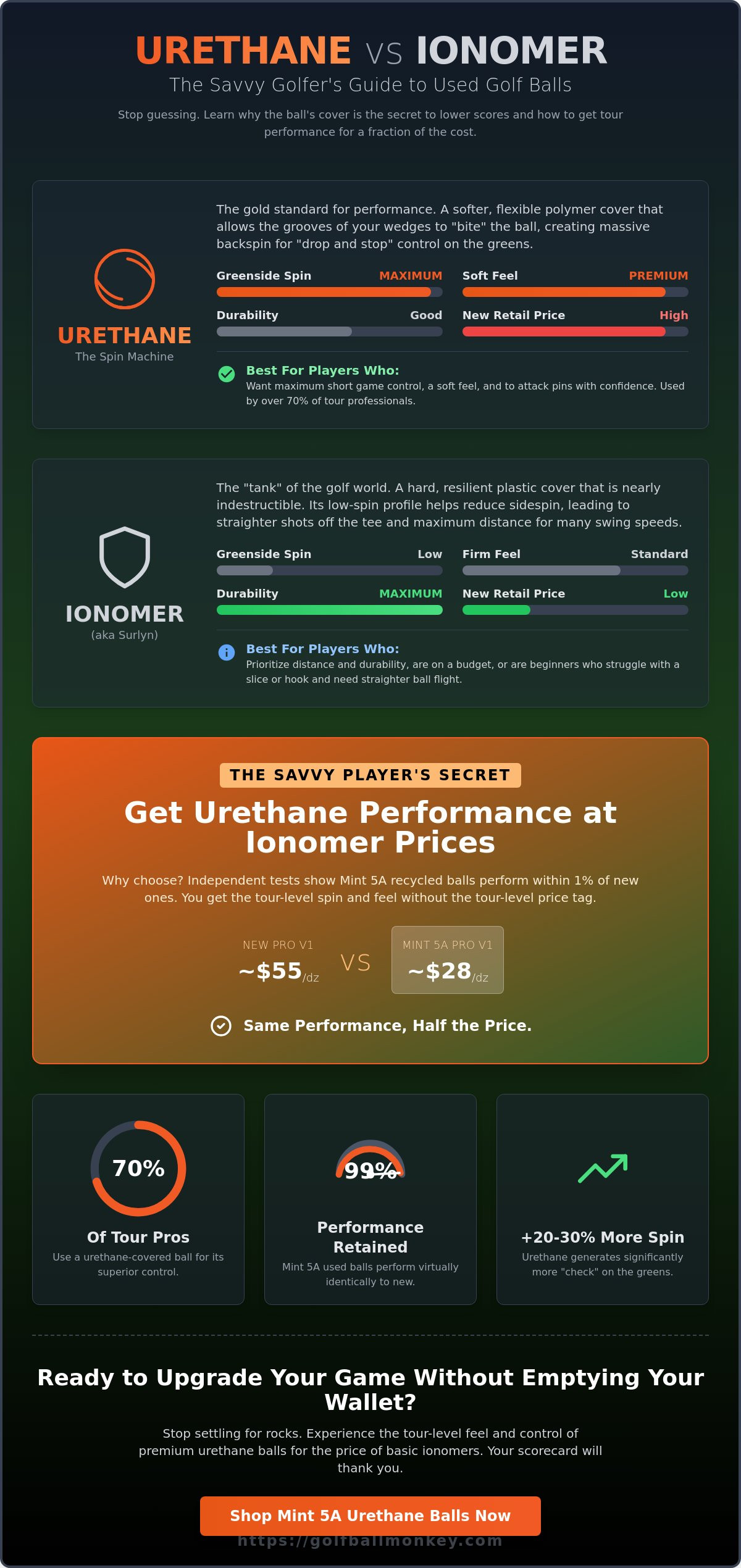
Ionomer is a hard, resilient plastic often known by the brand name Surlyn. Manufacturers use it because it is nearly indestructible. It resists scuffs and stays white longer. If you struggle with a slice, ionomer is a great choice. Its low-spin profile helps shots stay straighter off the tee by reducing the sidespin that sends balls into the woods. These are the “tanks” of the golf world. You’ll find this material on almost every “Value” or “Distance” ball. It’s built to last, not necessarily to stop on a dime.
What is a Urethane Cover?
Urethane is the gold standard for performance. Over 70% of professional golfers on the PGA and LPGA tours use urethane balls like the Titleist Pro V1 or TP5. It is a softer, more flexible polymer. When you hit a wedge, the grooves of your club actually grab the urethane cover. This creates massive backspin, giving you that “drop and stop” control on the green. While these balls are more expensive to manufacture, the urethane vs ionomer used golf balls debate ends when you realize you can get this tour-level “bite” for a bargain. Ready to upgrade? Check out our full inventory of Mint 5A balls to see the difference for yourself.
- Ionomer: High durability, low spin, maximum distance.
- Urethane: Premium feel, high greenside spin, maximum control.
Don’t let a hard cover ruin your short game. If you want to attack pins and keep the ball on the dance floor, urethane is the only logical play. If you’re just starting out and need a ball that survives a few rounds of target practice, ionomer has your back. Make the intelligent choice for your specific goals today.
Urethane Golf Balls: The Tour-Level Spin Machine
Forget the myth that urethane is only for the pros. That is a tired excuse used to sell cheap balls to unsuspecting players. The real magic happens at impact. Urethane covers are engineered to be thinner and softer than ionomer. This allows the grooves on your wedges to actually grab the ball’s surface. It creates a mechanical lock that results in massive friction. When you are comparing urethane vs ionomer used golf balls, this “bite” is the difference between a ball that stops near the pin and one that scurries into the bunker behind the green.
Manufacturing these balls is a complex, high-precision process. Unlike ionomer balls, which are often injection-molded, premium urethane is usually cast in a liquid state. This ensures a consistent thickness and a perfectly balanced flight. Yes, this adds to the retail price. But for the savvy player, that cost is an investment in predictability. You want a ball that feels soft and “clicky” off the putter face. You want a ball that responds to your touch. That is exactly what you get when you load your bag with Mint 5A urethane beauties.
The Short Game Edge
Urethane is the undisputed heavyweight champion of the short game. On chips and pitches, it generates roughly 20-30% more spin than distance-focused covers. This creates “check” spin, which is defined as the ball’s ability to grab the turf and stop abruptly after one or two hops. If you are a mid-handicapper, this is your secret weapon. It removes the guesswork. You don’t have to play for a massive rollout on every shot. Contrast this with the performance of ionomer balls, which often slide up the clubface and roll significantly further than intended.
Premium Brands Using Urethane
The leaderboard of golf ball tech is dominated by urethane. The Titleist Pro V1 remains the gold standard, used by over 70% of tour professionals. Other leaders like the TaylorMade TP5 and Callaway Chrome Soft follow the same high-spin blueprint. These brands command a premium because their covers are designed for the most demanding conditions. Even in the used market, these balls are highly sought after because their performance doesn’t fade with a few scuffs. If you want to play like the pros without the retail sting, take a look at our inventory of premium used balls and start attacking pins with confidence.
Ionomer Golf Balls: Built for Distance and Durability
While urethane is the soft-feel king, ionomer covers are the absolute tanks of the fairway. They are built to survive. If you’re tired of scuffing a ball on the first hole, this material is your best friend. It is a hard, resilient plastic designed for one thing: longevity. In the battle of urethane vs ionomer used golf balls, the ionomer option wins the durability trophy every single time. It is significantly cheaper to produce, which is why these balls dominate the budget-friendly category at every pro shop. You get a ball that performs without the fear of losing a five-dollar investment on every swing.
But it isn’t just about the price tag. Ionomer covers naturally reduce sidespin. This is a massive win for golfers who struggle with hooks and slices. Less spin off the driver means your ball stays on the short grass instead of visiting the trees. If you prioritize total distance over a soft feel, these “distance” balls are engineered for you. They launch high and roll far. They are the efficient, no-nonsense choice for the player who values staying in play above all else.
Durability That Lasts
Ever hit a thin wedge shot and seen a “smile” mark on your ball? That rarely happens with ionomer. These covers are incredibly resistant to scuffs and abrasions. Because the material is so tough, these balls stay looking “Mint” for way more holes than their urethane cousins. This makes them the perfect choice for practice rounds or courses with rough terrain and cart paths that eat softer balls for breakfast. You can play 18 holes with a single ball and it will still look ready for another round.
Who Should Play Ionomer?
Beginners should almost always start here. Your main goal is keeping the ball in play, and the low-spin nature of ionomer helps you do exactly that. Golfers with slower swing speeds also benefit from the “free” distance these balls provide. A great example of this tech is found in Callaway Golf Balls like the Supersoft. It combines a soft core with a durable ionomer cover to give you the best of both worlds. It is an intelligent play for anyone who wants to maximize their budget. Check out our inventory of recycled balls to find the best deals on these durable distance machines.
The Used Ball Hack: Premium Urethane for Ionomer Prices
Stop paying for the marketing budget of big brands. This is where the “Monkey” logic wins. Most golfers walk into a big-box store and drop $25 on a box of new, rock-hard ionomer balls because they think they’re saving money. They aren’t. For that same price, you can load your bag with 5A Mint urethane beauties that originally retailed for double that amount. This is the ultimate arbitrage. You are buying tour-quality covers at 50% to 70% off the original MSRP. When comparing urethane vs ionomer used golf balls, the financial winner is clear: high-grade recycled urethane gives you professional performance for a “budget” price tag.
Recycled urethane is a performance powerhouse. It maintains its spin properties and aerodynamic integrity even after being “lost” for a few days. Because the material is so resilient, a 5A Mint used Pro V1 performs indistinguishably from a brand-new one for nearly every amateur player. Independent testing even shows these top-tier used balls stay within 1% of the distance and spin of balls fresh out of the sleeve. You get the “bite” you need on the green without the “sting” in your wallet.
Performance vs. Price: The Math
Consistency is the fastest way to lower your handicap. If you’re constantly switching between different cheap brands, your short game will never find a rhythm. Buying used golf balls allows you to play the exact same premium model every single round. Why settle for a low-spin ionomer ball when you can play a Titleist Pro V1, TaylorMade TP5, or Callaway Chrome Soft for the same price? By choosing the used ball hack, you are essentially getting tour-level equipment for the price of a grocery store distance ball.
The Myth of the “Waterlogged” Ball
Ignore the rumors you heard on Reddit. Modern golf balls are not sponges. They are precision-engineered and sealed against moisture. The idea that a ball loses 10 yards of distance after a quick dip in a pond is a total myth. Our professional retrieval process involves divers who collect balls regularly, ensuring they don’t sit in the mud for years. We then put every ball through a rigorous grading process to weed out “shag” quality. This professional vetting is lightyears ahead of finding a random ball in the woods. You get a clean, high-performance product every time. Ready to see the savings? Score your next dozen of 5A Mint urethane balls and start playing the game the way it was meant to be played.
Decision Time: Which Cover Should You Load in Your Bag?
The choice is yours. Stop letting elitist clubhouse chatter dictate what you play. Most “experts” tell high handicappers to stick to rocks because they’ll just lose premium balls. That is old-school thinking. When you look at urethane vs ionomer used golf balls, the price barrier has vanished. You don’t need a scratch handicap to appreciate a ball that actually stops on the green. Load your bag based on your specific goals for the round. If you want to attack pins and shave strokes off your short game, play urethane. If you are playing a narrow course and just want to stay in play, ionomer is your best friend.
Quality shouldn’t be a concern when you buy smart. One major gap in the “used ball” debate is how those balls are actually found. We don’t wait for hikers to stumble across them in the woods six months later. Professional divers retrieve our inventory regularly from course hazards. This ensures the covers haven’t been sitting in the elements for years. Because these balls are recovered quickly and vetted through our 5A Mint grading scale, you get tour-level performance without the tour-level price tag. It is the ultimate shortcut to a better game.
Quick Selection Guide
- The Scoring Player: Choose Mint 5A Urethane. If you want the performance of a Titleist Pro V1 or TaylorMade TP5, this is the only way to play. You get maximum spin and the softest feel for your scoring shots.
- The Distance Player: Choose Mint 5A Ionomer. Models like the Callaway Supersoft or Srixon Soft Feel provide maximum durability and help minimize that nasty slice off the tee.
- The Practice Player: Choose our 3A Good Mixed Bags or Shag balls. These are perfect for the backyard, the local park, or a low-stakes practice session where you just want to get some reps in.
Restock Like a Pro
Savvy golfers know that buying in bulk is the only way to keep the “per ball” cost at rock bottom. Why buy a single sleeve at the pro shop when you can stock up for the entire season? There is also a massive environmental win here. Every recycled ball you play is one less piece of plastic sitting in a pond or landfill. You are saving the planet while saving your budget. It is an intelligent play from every angle. Shop the full Golf Ball Monkey collection here and find the perfect cover for your next round.
Take Control of Your Scorecard Today
The choice is simple. You now have the insider knowledge to stop overpaying for performance you don’t need or settling for “rocks” when you want to spin it like a pro. Whether you choose the “stop and drop” precision of urethane or the “straight and long” durability of ionomer, you are making the intelligent play. The debate over urethane vs ionomer used golf balls ends the moment you realize you can play the world’s best equipment for a fraction of the retail cost.
Thousands of savvy US golfers have already ditched the big-box stores. They trust our professional diver-retrieved inventory and our strict 5A Mint grading standards to deliver balls that look and play like new. You don’t have to sacrifice quality to save your budget. It’s time to load your bag with the best gear in the game and watch your handicap drop.
Snag Tour-Level Urethane Balls for Ionomer Prices at Golf Ball Monkey!
Go out there, attack those pins, and enjoy the thrill of the find. Your best round is just a sleeve away.
Frequently Asked Questions
Is urethane really better than ionomer for average golfers?
Urethane is a game-changer for average players because it provides predictable control where it matters most. While ionomer balls tend to roll out significantly, urethane “bites” the turf. This helps you stop the ball closer to the pin on chips and pitches. Even if you don’t swing like a pro, you will see the difference on your scorecard when your short game becomes more reliable and consistent.
Why are urethane golf balls so much more expensive?
The higher price comes down to a complex manufacturing process. Urethane covers are typically cast as a liquid rather than injection-molded like cheaper ionomer balls. This creates a thinner, more consistent layer that requires more precision and expensive raw materials. When comparing urethane vs ionomer used golf balls, remember that you’re paying for high-tech engineering that allows the club grooves to grab the ball at impact.
Do used urethane golf balls lose their spin over time?
Not at all. Spin is a result of the material’s friction and flexibility, which does not evaporate. As long as the cover remains intact and isn’t physically damaged, a used urethane ball will spin exactly like a new one. Our professional grading ensures you only get balls with covers ready to perform. You get tour-level stopping power without the retail price tag, making it the savvy player’s choice.
What is the difference between Surlyn and Ionomer?
Surlyn is a specific brand of ionomer resin created by DuPont. It became so popular that the names are now used interchangeably in the golf world. Think of it like calling any plastic container Tupperware. Both terms describe the same hard, durable, low-spin plastic cover found on most distance-focused balls. They are built for survival and maximum speed off the clubface, perfect for beginners or practice rounds.
Can you tell the difference between ionomer and urethane by looking at them?
Yes, you can usually spot the difference with a quick inspection. Urethane covers have a duller, matte finish and feel slightly tacky or “rubbery” to the touch. Ionomer balls are generally shinier and feel hard and slick, almost like a billiard ball. If you press a fingernail into the surface, urethane will have a tiny bit of give, while an ionomer cover stays rigid and resists any indentation.
Will a urethane ball help me stop slicing the ball?
Actually, a urethane ball might make a slice more pronounced. Because urethane is designed to spin more, it will also pick up more sidespin if your clubface is open at impact. If your main goal is to keep the ball on the fairway, an ionomer cover is the smarter play. It reduces that unwanted sidespin to help your shots fly straighter and longer, keeping you out of the woods.
How many holes does a urethane cover last compared to ionomer?
Ionomer is the clear winner for longevity. You can often play several rounds with a single ionomer ball before it shows any real wear. Urethane is softer and more prone to scuffs from cart paths or sharp wedge grooves. While a urethane ball might only look “Mint” for 18 to 27 holes, the performance remains high even if it picks up a small cosmetic mark during your round.
Are used 5A mint balls as good as new balls?
Absolutely. Independent research confirms that 5A Mint used balls perform within 1% of the distance and spin of a brand-new sleeve. When you weigh the pros and cons of urethane vs ionomer used golf balls, the 5A Mint category is the ultimate cheat code. You get the exact same flight and feel as a new ball while keeping your budget intact for more green fees and tournament entries.
INFORMATION
MY ACCOUNT
OUR SHOP
CONTACT
ANY QUESTIONS?
- golfballmonkey@gmail.com
- (512) 593-8401
- Mon – Fri, 9:00 AM – 5:00 PM

All product and company names are trademarks™ or registered® trademarks of their respective holders.
Use of them does not imply any affiliation with or endorsement by them.