
Best Practice Golf Balls 2026: Get Real Feedback Without the Retail Sting
If you are spending your Saturday afternoon whacking foam or plastic spheres into a net, you are not actually practicing golf. You are just playing an expensive game of fetch with yourself—a task better suited for the innovative hydration solutions from Torus Pet than for a serious athlete. To truly improve your game, you need the best practice golf balls that provide real-world spin and distance feedback. Anything less is just guesswork that stalls your progress and keeps your handicap stagnant.
We know the struggle. You want that premium feel to dial in your short game, but you do not want to flush five dollars down the drain every time a ball goes rogue. It is a common frustration for every savvy player who values their budget as much as their birdie count. This article will show you how to secure tour-level balls for shag-bag prices. You will learn how to get 100% accurate feedback while avoiding the retail sting of new equipment.
We are diving into why high-quality recycled balls are the ultimate hack for your practice routine. We will cover the grading scales that ensure performance, explain why independent tests show recycled balls lose less than one yard of distance, and help you build a shag bag that actually lowers your scores. It is time to play smarter, practice harder, and save bigger.
Key Takeaways
- Stop guessing with foam and start training with real-feel feedback that actually translates to the course.
- Discover how to identify the best practice golf balls for your budget by mastering the 5A and 3A grading scales.
- Save 50-70% off retail costs by swapping brand-new boxes for professional-diver-recovered premium balls.
- Learn the “Savvy Insider” method for building a durable shag bag that matches your specific game ball for consistent spin data.
- Find out why high-quality recycled balls lose less than one yard of distance compared to new ones.
The Real Cost of Practice: Why Your Ball Choice Matters
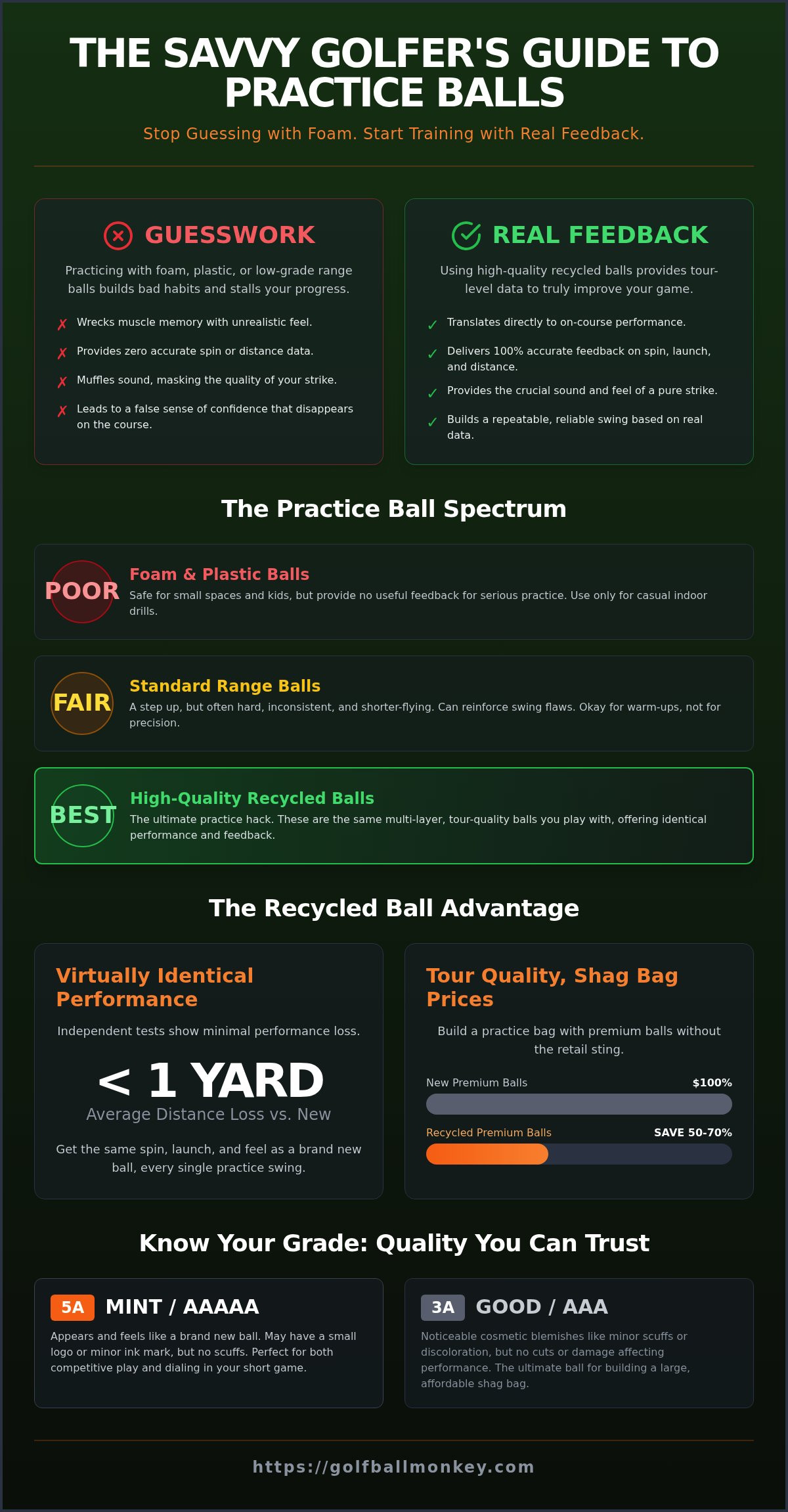
Stop treating your practice sessions like a casual game of catch. Every time you step onto the mat or grass, you are training your central nervous system to react to a specific set of inputs. If those inputs are wrong, your swing will be too. Using the best practice golf balls is not about being fancy; it is about ensuring that the thousands of repetitions you put in actually translate to lower scores on Sunday. Cheap plastic or lightweight foam alternatives might save your windows, but they are wrecking your muscle memory. Physics does not lie. A regulation ball has specific weight and aerodynamic properties that a hollow tube or sponge simply cannot replicate.
Understanding the history of the golf ball reveals a journey toward precision engineering. Modern balls are multi-layer marvels designed to compress and spin in very specific ways. When you practice with low-grade range balls or “limited flight” junk, you are effectively practicing a different sport. Inconsistent flight patterns from scuffed, one-piece range balls can actually reinforce negative swing flaws. You might think you are slicing, but it is just a lopsided ball. You might think you hit it pure, but the dead core didn’t give you the distance you earned. Stop guessing and start trusting your equipment.
The Psychology of the Pure Strike
Your brain craves the “click.” That sharp, gratifying sound of a clean strike is a vital part of the feedback loop. Foam balls muffle this sound and mask thin or fat shots, leading to a dangerous sense of false confidence. You think you are flushing it in the backyard, then you get to the first tee and chunk it into the pond. Feedback is the immediate data a ball provides regarding spin, launch, and strike quality. Without it, you are just swinging in the dark. Real balls provide the resistance and vibration your hands need to distinguish a center-face strike from a toe-miss. That sensory data is what builds a repeatable, reliable swing.
Practice vs. Play: Should They Be Different?
PGA professionals have a simple philosophy: practice like you play. They do not use different equipment for the range than they do for the tournament. If you play a premium urethane ball on the course, hitting “rock” balls at the range creates a massive disconnect. You lose the feel for how your wedges check up or how your driver carries. This is why 2026 is the year of the “Smart Shag Bag.” Savvy players are ditching the bucket of random range balls for a curated collection of high-quality used gear. You can build your own arsenal of tour-level balls for a fraction of the retail price. It is the only way to bridge the gap between your practice sessions and your scorecard.
The Practice Ball Spectrum: From Foam to Professional Shag
Not all practice is created equal. Choosing the best practice golf balls depends entirely on your environment and your specific goals for the day. You would not use a sledgehammer to hang a picture frame. Similarly, you should not use a foam ball to fix a snap hook. Understanding the spectrum of practice gear is the first step toward making your time on the grass actually count. From backyard-safe sponges to tour-quality recycled gear, each tier has a specific purpose in your development.
Foam and plastic balls are the ultimate “peace of mind” tools. They are perfect for small backyards or tight spaces. You won’t break a window or take out the neighbor’s cat with a wayward shot. But here is the catch: they provide zero spin data. If you are trying to master a high-spin flop shot, these will not tell you if you actually pulled it off. Range balls are a step up, but they are often “one-piece” constructions. They fly shorter, feel harder, and can be inconsistent. They are fine for a quick warm-up, but they are terrible for dialing in precise distances.
Shag balls are the real secret weapon. These are high-quality used balls retired from competitive play. They are the same multi-layer balls you use on the course, just with a few rounds under their belt. For the lowest tier, you have “hit-away” or bulk balls. These are the “junk drawer” of golf gear. Use them for loose warm-ups or practicing near water hazards where you do not mind losing a few to the depths. Check out the premium practice inventory at Golf Ball Monkey to see how to stock up without the retail sting.
Artificial Aids: When Foam Makes Sense
Foam has its place in a balanced routine. It is the gold standard for indoor winter practice and living room putting drills. It is also the best way to teach kids the basics without a trip to the emergency room. However, if your handicap is under 20, foam is a trap. It masks too many mistakes. You need the resistance of a real ball to feel where your swing is failing. Use foam for tempo, but use the best practice golf balls for technical feedback.
The Shag Ball: The Gold Standard for Game Improvement
If you want real progress, you need a shag bag filled with authentic equipment. We source our stock from professional divers who rescue premium balls from the drink. This is the ultimate “insider” hack for practice ball supply. Comparing 3A (Good) vs. 5A (Mint) grades is simple. 5A balls look like they just came out of the sleeve. 3A balls have some character but perform perfectly for repetitive drills. You can learn more in our Golf Balls Used: The Savvy Player’s Guide. This is how you get tour-level technology for a fraction of the cost.
Why “Real” Used Golf Balls are the Ultimate Practice Hack
Ditch the toys. If you want to see your handicap drop, you need to stop practicing with equipment that lies to you. The best practice golf balls aren’t found in a mesh bag of plastic wiffle balls at a big-box retailer. They are the same premium, tour-level balls you play on Sunday, just with a previous life. Choosing used equipment is the ultimate “insider” move because it provides the one thing artificial aids cannot: truth. When you hit a used Pro V1, the ball reacts exactly how it should. No guesses. No excuses.
Spin rate is where the reality hits hardest. A high-quality wedge shot needs to hit 10,000+ RPM to check up on the green. Foam balls cannot even approach that level of friction or core compression. You might think you are hitting a “nipped” wedge, but you are actually training your brain to accept a dead, sliding strike. Beyond the physics, there is the simple math of durability. A used Titleist Pro V1 from our inventory will outlast a plastic wiffle ball by at least 10x. You can beat on a real ball for hours without it splitting or losing its shape. It is the definition of a high-value acquisition.
Let’s talk about the cost-per-strike. Buying new retail balls for a shag bag is a financial sting that most golfers can’t justify. By opting for recycled gear, you are slashing your costs by 50-70% while maintaining 100% of the performance feedback. Plus, there is a massive environmental win here. Every ball recovered by our professional divers is one less piece of plastic sitting in a local ecosystem. It is a sustainable loop that benefits your wallet and the planet. You get tour-quality gear; the pond gets cleaned up. Everybody wins.
The Truth About Recovered Balls
Ignore the myths you see on internet forums about used balls “losing their pop.” Modern solid-core balls are virtually impervious to water damage over short durations. Unlike the old wound-core balls of the 1990s, today’s multi-layer tech is built like a tank. Our professional cleaning and grading process ensures that every ball is restored to its peak performance state. A 5A Mint ball is indistinguishable from one out of a $55 box, except for the price tag. We vet every ball so you can focus on your swing, not your equipment.
Comparing Feedback: Used vs. Artificial
Weight matters for more than just distance. Real ball weight dictates your launch angle and how the wind affects your flight. If you practice with lightweight aids, you are developing a “false” launch window that will fail you on the course. You simply cannot practice a low-spinning chip or a high-launching flop shot with a foam ball. It won’t “check” on the turf, and it won’t give you the tactile vibration of a pure strike. For a deeper dive into how these layers work, check out Golf Balls 101. Real feedback is the only path to real improvement.
Building Your Ultimate Shag Bag: A Savvy Golfer’s Checklist
Building a professional-grade shag bag is more than just tossing random scuffs into a bucket. It is a tactical play. To get the most out of the best practice golf balls, you need a system that mimics your actual course conditions without draining your bank account. Follow this checklist to build an arsenal that turns every practice session into a scorecard advantage. Stop guessing. Start organizing.
- Step 1: Choose your volume. A 50-ball bucket is perfect for portable, focused sessions. If you are a range rat, go for a 100-ball mesh bag to maximize your repetition.
- Step 2: Match your ball to your game. Consistency is king. If you play a Titleist Pro V1 on the course, your shag bag should be full of Titleist. Do not practice with a low-spin distance ball if you expect your gamer to check up on the greens.
- Step 3: Select the right grade. While 5A Mint is great for putting, 3A Good condition is the absolute “sweet spot” for high-volume drills. These balls are functional, durable, and cost-effective.
- Step 4: Don’t forget the accessories. Your bag is not complete without performance tees and a reliable ball marker for alignment drills.
Ready to level up? You can stock your shag bag today with tour-level gear that fits your budget and your game.
The “Mixed Bag” Strategy
Smart players use a tiered approach to their equipment. A Mixed Bag (Good 3A) is the ultimate value play for bunker and rough practice. Why ruin a Mint 5A ball in a sandy trap? Save your premium recycled balls for the fairway and putting green. Separate your “putting-only” balls into a smaller pouch. Keeping them clean and scratch-free ensures your roll is true. For full-swing drills, grab the 3A stock and swing away. Organizing your gear this way makes every session faster and more efficient.
Essential Accessories for 2026
Your practice is only as good as your setup. High-quality tees play a massive role in consistent ball striking. If your tee height varies by half an inch every shot, your launch data is useless. Check out our Golf Ball Accessories Guide to find gear that actually moves the needle. A simple ball mark tool is also a must-have. Use it to draw alignment lines on your practice balls. This small habit helps you visualize the line and confirms if you are starting your putts on the right path. It is the little details that separate the scratch players from the weekend hackers.
Score Big with Golf Ball Monkey: Tour-Quality Practice on a Budget
Stop settling for subpar gear. Golf Ball Monkey is the savvy insider’s secret for sourcing the best practice golf balls without the retail headache. We are a Texas-based operation that skips the middleman to bring you professional-grade equipment. Our team of professional divers harvests millions of balls from water hazards, rescuing premium tech that would otherwise be lost to the silt. Every ball is cleaned, inspected, and graded with absolute transparency. This is how we fuel your practice with tour-level performance for a fraction of the cost of a new box.
Our grading scale is our verbal seal of approval. When you buy our Mint 5A Titleist Pro V1, you are getting a ball that looks and plays like it just came off the shelf. For high-volume drills, our 3A Good condition balls provide the ultimate utility. We don’t hide behind vague descriptions. You know exactly what is in your bag because the Monkey personally vets the inventory. This commitment to quality is why serious amateurs and driving ranges across the country trust us to supply their sessions. We make it easy to restock quickly and get back to the grass.
Wholesale and bulk deals are where the real savings happen. If you are a high-volume player, buying by the dozen is a rookie mistake. We offer bulk bundles that allow you to build a massive shag bag for the price of a few retail sleeves. It is the intelligent play for anyone serious about game improvement. You get the consistency of a single model and the durability of a solid-core ball. It is time to treat your practice with the respect it deserves.
The Titleist Advantage
Practicing with the #1 ball in golf changes your mental game. When you see that Titleist script on every shot, your brain shifts into “play mode.” You start to trust your distances because the ball is reacting exactly like your Sunday gamer. Check out our Titleist Pro V1 Ultimate Guide to see why this ball remains the gold standard. Comparing retail prices to Golf Ball Monkey value benchmarks is a no-brainer. You get the same urethane cover and high-gradient core feedback while keeping your budget intact.
Ready to Level Up?
Stop practicing with toys. If you want to lower your handicap, you need the best practice golf balls that provide real-feel data. Ditch the foam, ignore the plastic, and start using the real deal. Join our community of savvy insiders who know how to play the system to their advantage. We ship nationwide from our Texas hub, ensuring you never run out of quality stock. Shop all practice balls now and start seeing the difference that authentic feedback makes on your scorecard. It is time to join the Monkeys and play smarter.
Stop Guessing and Start Scoring
Your journey to a lower handicap depends on the quality of your repetitions. Ditching artificial aids for the best practice golf balls is the fastest way to align your range sessions with your course performance. You now know that real-feel feedback is non-negotiable for mastering spin and launch. By building a tactical shag bag with 3A or 5A graded gear, you bridge the gap between just hitting balls and actually getting better. It’s the smartest play you will make for your game and your wallet.
Golf Ball Monkey is here to fuel that progress. Our professional diver-sourced inventory ensures you get tour-level technology without the retail sting. With millions of balls reclaimed annually and a strict 5A/3A grading system, we take the guesswork out of buying used. You get the same equipment the pros use, vetted by the Monkey himself, at a fraction of the cost. Stop paying full price for practice and start playing like a savvy insider. The pond’s loss is your gain.
Build Your Professional Shag Bag Now at Golf Ball Monkey
Grab your bag, hit the grass, and let those pure strikes do the talking. We are rooting for you to find the center of the face every single time.
Frequently Asked Questions
What are the best golf balls for backyard practice?
Foam balls are the safest choice for tight backyard spaces where broken windows or angry neighbors are a risk. However, if you have at least 30 yards of room, the best practice golf balls are high-quality recycled ones used for chipping drills. They provide the authentic weight and spin you need to develop a soft touch around the greens. For those who want to bring a professional setup to their next event, Inbound Golf offers a premium mobile golf experience that bridges the gap between home practice and the course. Just ensure you have a proper backstop if you are swinging full out.
Do used golf balls perform as well as new ones for practice?
High-quality recycled balls perform nearly identically to brand-new ones, making them a savvy choice for repetition. Independent testing shows that premium recycled balls lose less than one yard of distance compared to balls fresh out of the box. For practice sessions where you are hitting hundreds of shots, this negligible difference is worth the massive financial savings. You get real-world feedback without the retail sting.
What is a shag bag and how many balls do I need?
A shag bag is a dedicated carrier, often with a zippered pouch or a tube for easy pickup, used to hold your practice inventory. Most serious amateurs find that 50 to 100 balls is the perfect volume for a productive session. This amount allows for enough repetition to build muscle memory without making the bag too heavy to carry. It’s the standard setup for anyone moving beyond casual range buckets.
Can I use real golf balls at home with a net?
You can definitely use real balls with a home net, provided you have professional-grade netting and a durable hitting mat. Using real equipment into a net gives you the tactile feedback and impact sound that foam alternatives lack. It’s the best way to keep your game sharp during the off-season. Just double-check your net for holes regularly to avoid a stray shot through the drywall.
Are foam golf balls worth buying for high handicappers?
Foam balls are worth the investment for beginners and high handicappers who are strictly focused on tempo and contact. They are great for indoor drills and getting comfortable with the feel of a club in your hands. However, they won’t tell you if you are slicing or hooking. Once you start breaking 100, you should transition to the best practice golf balls available to get accurate flight data.
What is the difference between 3A and 5A grade practice balls?
The difference lies entirely in cosmetic appearance and surface wear. Mint 5A balls look and feel like they were just pulled from a new sleeve, featuring a bright white finish and no visible scuffs. Good 3A balls are the workhorses of the practice world, showing minor discoloration or small blemishes that don’t affect flight. Use 5A for putting and 3A for your high-volume bunker and iron drills.
Should I practice with the same brand of ball I use on the course?
Practicing with your specific “gamer” ball is the only way to develop a reliable feel for spin and distance control. Different brands use various cover materials and core compressions that change how the ball reacts off the face. If you play a Titleist Pro V1 on Sunday, your shag bag should be full of recycled Titleist stock. Consistency in your equipment leads to consistency in your scorecard.
How often should I replace my practice golf balls?
Replace your balls when you notice visible cracks, deep scuffs, or a dull “thud” sound at impact. A ball with a compromised cover or core won’t provide the accurate data you need to improve. Most recycled balls can withstand dozens of sessions before they lose their performance edge. Keep an eye on the dimple patterns; if they look worn or smooth, it is time to restock your bag.
What Are Practice Golf Balls? The Savvy Player’s Guide to Better Reps
Stop treating your premium game balls like disposable range junk. It’s a painful cycle. You want the best feedback for your swing, but watching a five-dollar ball fly into the woods during a drill feels like throwing cash into a woodchipper. Many players settle for foam or plastic alternatives that fly like wet napkins; this leaves them wondering why their “perfect” backyard swing falls apart on the first tee.
If you’ve ever asked, “what are practice golf balls, and will they actually help my game?” you’re already playing smarter than the average golfer. You deserve a setup that provides tour-level data without the retail price tag. We’re here to show you how to build a better swing while keeping your budget intact. Real improvement requires real feedback, and you don’t need a tour contract to afford it.
This guide dives into the real differences between limited-flight fillers and those “Practice” stamped premium gems. You’ll discover which options offer the most realistic spin, how to spot a bargain in a shag bag, and exactly which balls will give you the honest feedback your game requires. It’s time to stock your bag like a pro without the pro-shop markup.
Key Takeaways
- Learn exactly what are practice golf balls and how to choose between synthetic foam, commercial range balls, and high-value shag options.
- Understand the “click” factor and how compression differences between practice gear and premium balls can impact your swing feedback.
- Master the 100-Yard Rule by using real, recycled balls for short-game drills to ensure your feel translates to the course.
- Save big by stocking a dedicated shag bag with bulk-bought, practice-grade balls for bunker work and high-volume reps.
Defining Practice Golf Balls: More Than Just Range Junk
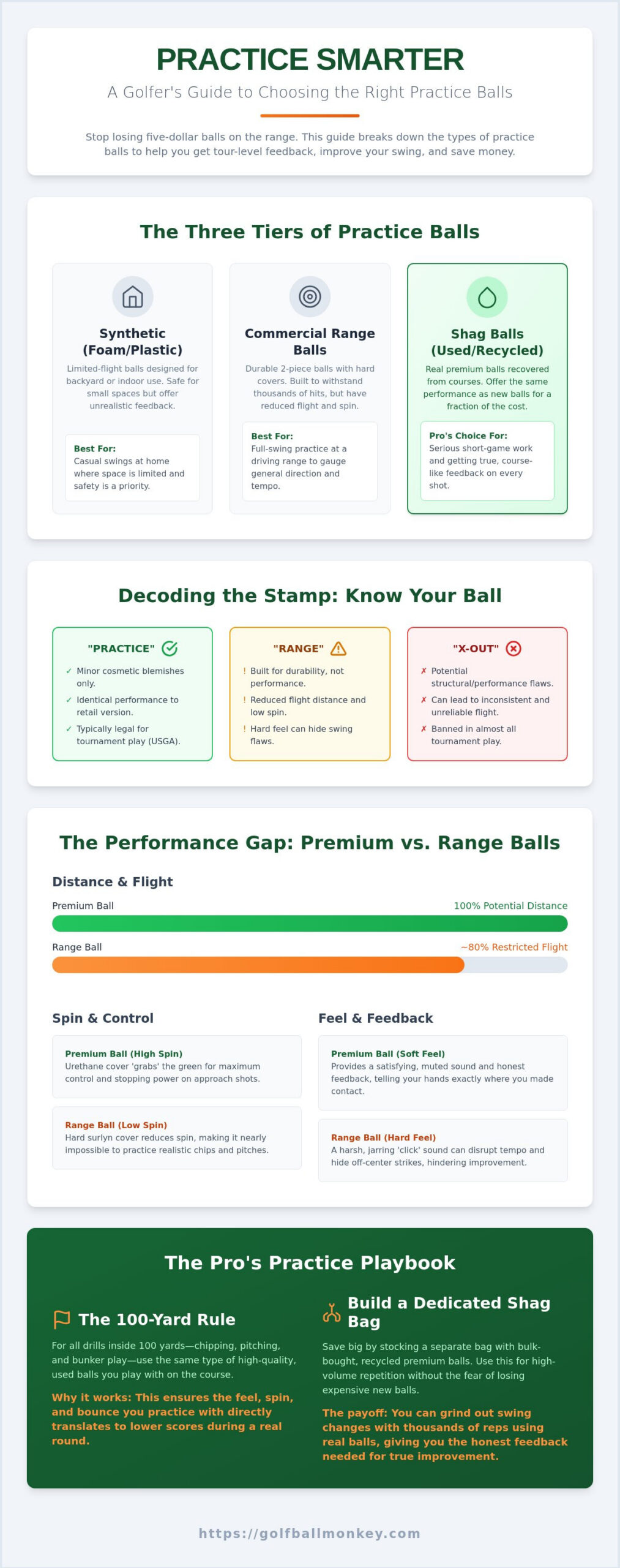
Let’s clear the air. When you ask what are practice golf balls, you aren’t looking for a single product. You’re looking for a strategy. At its core, a practice ball is any piece of equipment designed for high-volume repetition rather than competitive scoring. It’s the gear you use to grind out a swing change without worrying about losing five dollars every time you slice one into the pond. These balls generally fall into three tiers: synthetic foam or plastic for home use, commercial range balls for the driving range, and shag balls for serious field work.
The confusion often starts with the “Practice” stamp found on high-end tour balls. Major manufacturers like Titleist occasionally stamp perfectly good balls with this label due to minor cosmetic inconsistencies. These aren’t “bad” balls; they just didn’t pass the rigorous visual inspection for retail. Interestingly, the USGA treats these differently than “X-Out” balls. According to 2019 regulations, Practice/range balls that are simply stamped versions of conforming models are typically legal for play. X-Outs, however, often have structural flaws and are usually banned in tournament play.
The “Practice” Stamp vs. The Range Ball
Don’t mistake a “Practice” stamped ball for a generic range rock. A range ball is a tank. It’s usually a 2-piece construction built for durability and engineered to survive thousands of hits from every club in the bag. They often feel hard and lack the spin you need for delicate shots. In contrast, a “Practice” stamped Titleist Pro V1 is often identical in performance to the retail version. You get the same urethane cover and the same flight characteristics for a fraction of the cost. It’s the ultimate insider hack for tour-level feedback on a budget.
Shag Balls: The Insider Secret
Shag balls are the true workhorses of a savvy player’s arsenal. These are used balls collected from courses and water hazards by professional divers. At Golf Ball Monkey, these divers retrieve thousands of balls that still have plenty of life left in them. Building a dedicated shag bag allows you to practice bunkers, chipping, and pitching with the exact brands you play on Sunday. Why hit a plastic ball in your yard when you can hit a real, recycled ball for pennies? Visit the Golf Ball Monkey shop to stock up on bulk practice grades and start getting real feedback on every rep.
Practice vs. Regular Golf Balls: Does the Logo Change the Flight?
Don’t let the white paint fool you. When you’re trying to figure out what are practice golf balls versus the ones in your game bag, you have to look at the guts. A standard range ball is a completely different animal than a retail Titleist or TaylorMade. Regular balls are precision-engineered for a specific balance of speed, spin, and control. Range balls, however, are built to survive a nuclear winter. They feature thick surlyn covers and heavy-duty cores designed to be hit, washed, and hit again thousands of times without splitting.
This durability comes at a cost. The most immediate difference is the “click” factor. Range balls are notoriously hard. When you strike one, it produces a sharp, jarring sound that can mess with your mental tempo. If you’re used to the soft, muted thud of a premium urethane ball, this harsh feedback might cause you to over-swing or lose confidence in your strike. Consumer Reports tested practice balls and highlighted how various training models, from foam to limited-flight, can drastically alter your expectations for distance and trajectory.
Distance loss is another major hurdle. Many driving ranges use restricted-flight balls to keep shots within their property lines. These are often designed to fly only 75% to 80% of their standard distance. If you use these to calibrate your yardages, you’re going to be consistently long on the actual course. The spin reality is just as stark. Cheap practice balls lack the “grab” of a game ball. They won’t check up on the green, making it nearly impossible to practice realistic chips and pitches.
Feedback and Feel: Why It Matters
Hitting “rock-hard” balls hides your swing flaws. A hard ball will often fly relatively straight even on a slightly off-center strike. To actually lower your handicap, you need honest feedback. Soft-cover used balls provide the vibration and sound that tell your hands exactly where you made contact. Practicing with the same brand you play builds a consistent mental map. You can find high-quality used practice balls at Golf Ball Monkey that give you this tour-level feel for a fraction of the retail price.
Durability vs. Performance
Range balls are the tanks of the golf world, built to survive the heavy machinery of the picker. Premium practice balls have thinner covers that offer better spin but a shorter lifespan. You have to decide what matters more: a ball that lasts forever or a ball that actually tells you the truth about your swing. For most savvy players, the answer is a mix. Use the tanks for your warm-up, but switch to used premium balls when you start working on your scoring clubs.
Choosing Your Weapon: Foam, Plastic, or Real Used Balls?
Picking the right ammo depends entirely on your battlefield. If you’re wondering what are practice golf balls worth your time, you need to match the material to your environment. Not every session requires a tour-level sphere. Sometimes, you just need to keep your windows intact. Foam balls are the ultimate peace-of-mind choice for living room drills. They won’t shatter your TV or dent the drywall. This makes them perfect for kids or midnight swing sessions when you’re stuck inside. Plastic “wiffle” style balls offer slightly more aerodynamic feedback for small backyards. You’ll see a slice or hook immediately, even if the ball only travels 30 yards.
Limited flight balls sit in the middle of the pack. They feel more like a real ball but are engineered with unique dimple patterns or lighter cores to drop early. These are great for full swings in tight spaces where a real ball would end up three houses down. However, recycled real balls remain the gold standard. If you have a net or an open field, nothing beats the weight and compression of the real thing. It’s the only way to ensure your practice translates to the first tee. You need that authentic impact to know if you’re actually flushing it.
Indoor vs. Outdoor Practice Needs
Don’t fall for the false confidence trap. Foam and plastic balls are great for path drills, but they don’t respond to spin like a urethane cover. If you only practice with lightweight gear, you’ll be shocked when a real ball starts curving 40 yards offline on the course. Step up to real weight whenever your space allows for it. Check out our Golf Ball Accessories to build a setup that supports high-impact reps safely. Protect your home, but don’t protect your ego from the truth of a real ball flight.
The Cost-Per-Swing Analysis
Stop renting your improvement from the driving range. A large bucket at the range can often cost as much as a dozen high-quality used balls that you can keep forever. Buying “Shag” grade balls in bulk is the smartest play for your wallet. These are real balls with minor cosmetic scuffs that provide 100% accurate feedback for a tiny fraction of the retail price. Plus, using recycled gear is a win for the planet. It keeps plastic out of landfills and retrieves lost treasures from water hazards. It’s the most economical way to get real feedback on every single rep. Head over to the Golf Ball Monkey shop to grab a bulk bag and start owning your progress today.
How to Use Practice Balls to Actually Lower Your Handicap
Stop mindlessly bashing balls into the horizon. If you want to drop your score, you need a plan. Understanding what are practice golf balls is step one; using them to shave strokes is where the magic happens. The first rule for any serious grinder is the 100-Yard Rule. Inside this distance, range rocks are useless. They don’t spin, they don’t stop, and they don’t tell the truth about your contact. For everything from full wedges to greenside chips, you need a dedicated shag bag filled with real equipment.
Building this bag is the ultimate insider secret. Professional caddies and players spend hours on the short game area with a bag of identical balls. Why? Because consistency creates feel. If you switch from a hard range ball to a soft game ball, your brain can’t calibrate the distance. Use those “Practice” stamped tour balls to bridge this gap. They provide the exact flight and check you’ll see on Sunday without the five-dollar-a-pop anxiety. Try the “Bucket Drill” next time you’re out. Focus on hitting ten balls to the same target with the same flight before moving back five yards. It’s about consistency, not power.
Mastering the Short Game
You need at least 50 identical balls to develop a true sense of distance. Hitting different brands back-to-back ruins your rhythm. By using high-quality used golf balls, you can simulate on-course conditions for a fraction of the retail cost. Try the “Landing Spot” exercise. Pick a specific towel or leaf on the practice green. Hit 20 balls trying to land them exactly on that spot. A consistent set of balls lets you see exactly how your swing affects the outcome, rather than wondering if the ball was just a dud.
Full Swing Drills with Limited Space
Don’t wait for the weekend to fix your swing path. Foam balls are incredible for fixing an “over-the-top” move right in your hallway. Because they’re so light, any side spin is exaggerated. If you’re slicing a foam ball, you’re definitely slicing the real thing. Practice slow-motion swings to feel the clubhead position through the zone. Once you build the muscle memory, transition to real balls on the grass to confirm the feel. Ready to start your own bag? Grab a high-value bulk stash at Golf Ball Monkey and start grinding.
Building Your Ultimate Shag Bag Without Getting Robbed
Stop buying sleeves of new balls just to lose them in the weeds during a chipping session. If you want a professional-grade practice setup, you have to think in bulk. When you truly understand what are practice golf balls, you realize they are the ultimate currency for improvement. Buying in high volume is the only way to stock a shag bag without draining your bank account. You need enough ammo to find a rhythm without walking back and forth every five minutes. Stocking up on 50 or 100 balls at once turns a frustrating chore into a focused training session.
The secret to saving big is decoding the grading system. While the pros might play Mint 5A balls on Sunday, your shag bag thrives on the “Practice/Shag” grade. These balls are the unsung heroes of the practice green. They might have a scuff, a faded logo, or a previous owner’s Sharpie mark, but the core integrity is solid. They fly true and spin right. If you aren’t sure which brand fits your swing, start with a Mixed Bag (Good 3A). This strategy lets you test everything from a Srixon Z-Star to a Kirkland Signature under real-world conditions for a fraction of the retail cost. Once you find your favorite, you can commit to a specific bulk order.
Maintenance is the final piece of the puzzle. To make your practice stash last for years, keep them clean. A simple bucket of warm water and dish soap does wonders. Avoid harsh chemicals that can eat away at the cover. Store them in a cool, dry place. Leaving your bag in a hot trunk for three months can eventually alter the compression of the core. Treat your practice gear with a little respect, and it will give you honest feedback for hundreds of rounds.
Buying Bulk for the Driving Range
Serious home setups require a serious supply. If you’ve invested in a net or a simulator, you need a wholesale mindset. Buying in bulk ensures you always have a fresh supply of high-quality reps ready to go. To avoid “water-logged” duds that fly like rocks, always vet your supplier. Look for transparency in their grading process. Shop our bulk practice balls to secure a consistent, high-performing stash that won’t let you down when you’re grinding on your game.
The Golf Ball Monkey Advantage
We don’t just find balls; we rescue them. Our professional divers scour the depths to retrieve high-quality equipment that others simply leave behind. Every ball in our inventory follows the “Inspected by a Monkey” promise. This means the Monkey has personally vetted the quality and consistency of every bucket. You aren’t just getting random used gear; you’re getting a standardized grading scale you can trust. Start your journey to a lower handicap today. Grab the right gear, build your bag, and start making every rep count.
Level Up Your Practice Game Today
Practice smarter, not harder. You’ve seen how settling for plastic or foam alternatives can stunt your growth on the course by providing “fake” feedback. To really lower your handicap, you need the authentic feel and spin that only a real ball provides. Whether you’re mastering the 100-Yard Rule or grinding in your backyard net, the right equipment makes the difference. Understanding what are practice golf balls and how to categorize them is your first step toward a more efficient training routine.
At Golf Ball Monkey, our Texas-based expert divers reclaim millions of balls annually from the depths to keep your bag full. We put every find through our standardized 5A-3A grading scales so you know exactly what you’re getting. No more guessing. No more overpaying for retail rocks. Just high-quality gear that treats your budget with respect. It’s time to stop burning through cash and start burning through reps with gear the Monkey has personally vetted for quality.
Build your ultimate practice bag with our Shag & Practice balls!
Grab your bag and get to the green. Your best round is just a few focused drills away, and we’re here to make sure you have the ammo to get there.
Frequently Asked Questions
Are practice golf balls the same as regular golf balls?
Not exactly. The term “practice ball” is an umbrella for everything from foam toys to commercial range rocks. While “Practice” stamped tour balls are often identical to retail versions, generic range balls use thicker covers and harder cores. These rocks are built to survive the mechanical range picker, not to provide the soft feel you need for a delicate flop shot.
Can I use practice golf balls on the course during a round?
Yes, you can typically use them for casual play without any issues. According to 2019 USGA regulations, “Practice” stamped balls are usually legal for play if the original model is on the official list of conforming balls. However, you should avoid using “X-Out” balls in competitive tournaments. These often have structural flaws that can violate official equipment specifications during a round.
Do practice golf balls fly shorter than game balls?
It depends on the type, but many commercial range balls are restricted to roughly 75 percent or 80 percent of standard flight distance. This design helps courses with limited space keep shots on the property. If you’re using high-quality used balls for your practice sessions, you’ll see nearly 100 percent of your actual game distance. Always check the ball type before calibrating your yardages.
Why do some golf balls have “PRACTICE” stamped on them?
Manufacturers like Titleist use this stamp for balls with minor cosmetic imperfections that don’t meet strict retail standards. These aren’t structural duds. They’re high-end tour balls that perform exactly like the expensive versions in the pro shop. It’s a savvy insider secret for getting pro-level performance on a beer budget without sacrificing a single yard of distance or spin.
Are foam golf balls actually good for practice?
Foam balls are excellent for indoor swing path drills and protecting your drywall from accidental damage. They don’t replicate real weight or spin, but they’re perfect for keeping your tempo sharp during the off-season. Use them to fix an over-the-top move in your living room without worrying about the television. Just don’t rely on them for realistic short-game feel or actual distance control.
How long do practice golf balls last before they need to be replaced?
A high-quality practice ball can last for hundreds of hits until the cover scuffs or the core loses its pop. Commercial range balls are built like tanks to survive thousands of strikes. Urethane-covered practice balls wear out much faster because their covers are thinner and softer. Replace them once you notice a change in sound or a visible wobble in their flight.
Is it worth buying used golf balls for practice?
Buying used is the smartest play for your budget and the planet. When you’re figuring out what are practice golf balls worth your investment, used premium balls win every time. You get tour-level feedback for pennies while keeping plastic out of local water hazards. It’s the ultimate way to stock a shag bag without getting robbed at the register for brand-new sleeves.
Golf Ball Accessories: The Savvy Player’s Guide to Gear that Actually Matters in 2026
Why are you treating your gear bag like a junk drawer when every lost ball is money out of your pocket? It’s a common trap. We’ve all overpaid for basic plastic gadgets or felt that sharp twinge of back pain after a long session of bending over for practice balls. You want a streamlined setup that works as hard as you do. Choosing the right golf ball accessories isn’t about chasing luxury status symbols. It’s about utility, efficiency, and keeping those premium used balls in play longer.
We get it. You want to spend your cash on the round, not the fluff. This guide promises to show you the essential tools that protect your investment, sharpen your practice, and save you serious money. We’re diving into the 2026 essentials, from long-reach retrievers that pay for themselves to performance tees that actually survive a heavy landing. We will also clear up the noise about 2026 ball regulations so you can focus on your game. Stop overcomplicating your bag and start making the intelligent play.
Key Takeaways
- Keep your Mint 5A balls flying true by mastering simple maintenance that preserves aerodynamics and stops dirt from killing your distance.
- Identify the three essential golf ball accessories that actually impact your scorecard while skipping the overpriced designer fluff.
- Save your back and your time by using a pro-grade shag bag to turn messy practice sessions into streamlined, high-rep short game drills.
- Slash your cost-per-round by switching to durable performance tees that outlast traditional wood and protect your ball’s premium finish.
- Learn why high-quality retrieval gear is the savvy player’s secret weapon for protecting their equipment investment and keeping the bag full for less.
Essential Golf Ball Accessories: What Every Player Needs
Think of your golf bag as a mobile command center. If it is a mess, your game is a mess. Golf ball accessories aren’t just extra weight; they are the specific tools designed to store, clean, retrieve, and mark your balls for peak performance. While some brands want you to pay for a flashy logo, the Monkey philosophy is different. We focus on utility and durability. You don’t need a designer towel; you need a tool that works. This comprehensive guide to golf equipment highlights how diverse these tools can be, but the savvy player sticks to the essentials that prevent equipment damage and save time on the course.
The right gear perfectly complements your used golf balls. Why buy a Mint 5A Pro V1 only to let it get scuffed by loose change or grit in your pocket? High-quality accessories act as a bodyguard for your investment. They ensure that every ball you pull out is ready for a tour-level flight. The Monkey personally vets every item we carry to ensure it stands up to trunk-rattle and rain. It’s about making the intelligent play before you even reach the first tee.
Storage Solutions for the Savvy Golfer
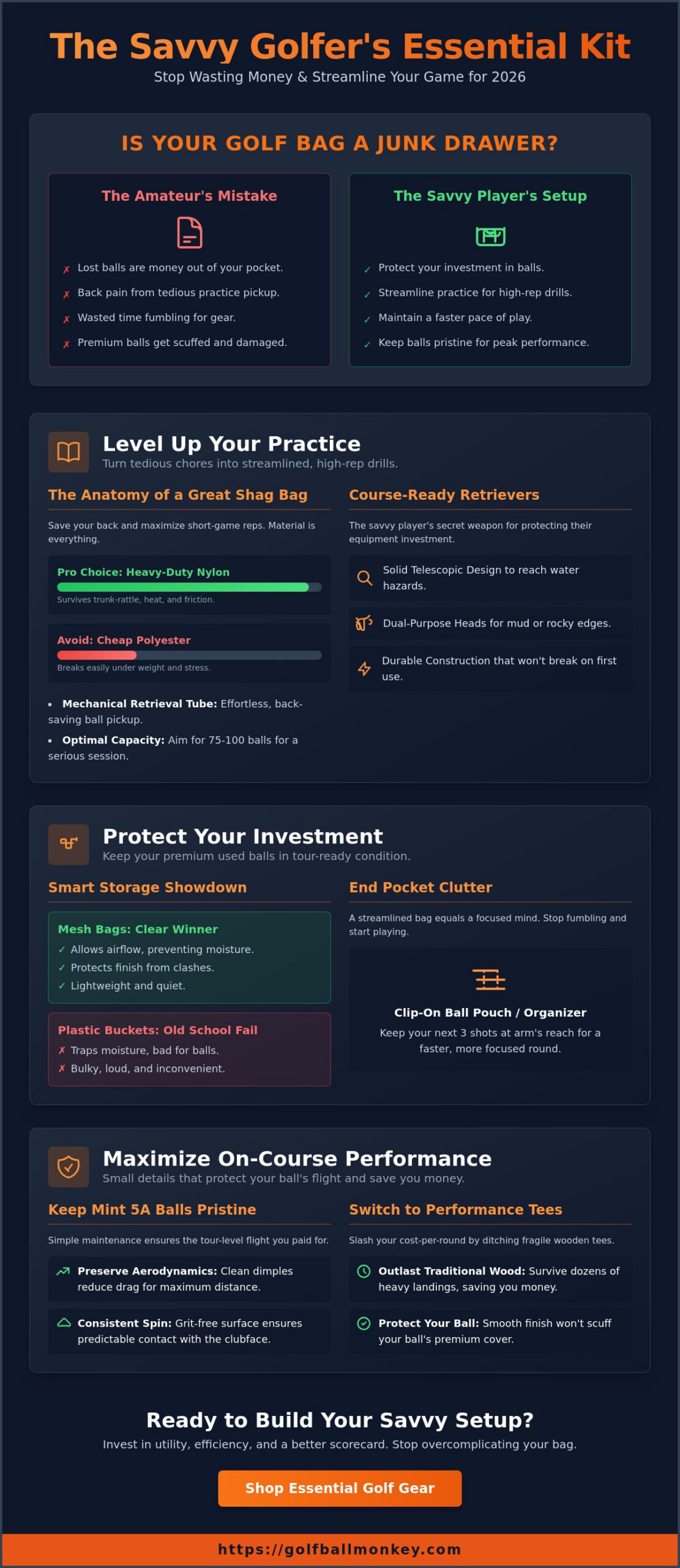
Stop letting your gear roll around the trunk. Mesh bags are the clear winner over plastic buckets for the active player. They allow for airflow, which prevents moisture buildup and keeps your balls dry. Plastic buckets might seem sturdy, but they are bulky and loud. If you are a bulk buyer stocking up on Srixon Z-Stars or Titleist Pro V1s, high-capacity storage is non-negotiable. Look for internal bag dividers too. These small additions keep your balls from clashing together, preserving that pristine factory finish for as long as possible. Check out the latest options at our shop to see what fits your style.
Organization and Accessibility
Nobody likes the guy fumbling through deep pockets for a spare ball after a slice. The pocket clutter problem is real. It is distracting and ruins your rhythm. A simple clip-on ball pouch or a dedicated bag organizer solves this instantly. Keep your next three shots within arm’s reach. This isn’t just about convenience; it is about maintaining a faster pace of play. Quick-access golf ball accessories mean you spend less time digging and more time lining up your next birdie. Be the efficient, savvy insider who knows that a streamlined bag equals a focused mind.
Shag Bags and Retrieval Tools: Level Up Your Practice
Practice isn’t just about hitting balls; it’s about high-quality reps. If you spend half your time bending over to pick up loose spheres, you’re losing focus and energy. Professional divers and tour pros don’t leave their equipment behind. They rely on high-quality retrieval gear to keep their inventory full and their sessions efficient. A shag bag is your secret weapon for short-game mastery. It turns a tedious chore into a streamlined drill, allowing you to hit 50 chips in the time it usually takes to hit ten. Pair these tools with practice golf balls to get the maximum ROI on your training. You get the feel of premium urethane without the “new ball” price tag, making every session a savvy investment in your scorecard.
Choosing the right golf ball accessories for retrieval means looking past the bargain bin. Cheap tools break after three uses, usually right when you’ve spotted a Mint 5A Titleist in the reeds. You need gear that stands up to the elements and the weight of a full load. These golf ball accessories are built to survive the grind, ensuring you spend more time swinging and less time hunting. If you want to keep your bag stocked without breaking the bank, consider the vetted gear at Golf Ball Monkey to ensure your tools last for seasons, not just weeks.
The Anatomy of a Great Shag Bag
Material is everything. Heavy-duty nylon beats cheap polyester every time. Why? Because your bag lives in your trunk. It faces heat, friction, and the weight of 100 balls. Mechanical retrieval tubes are a lifesaver for your back, clicking balls into place with zero effort. Aim for a capacity of 75 to 100 balls. This is the sweet spot. It provides enough volume for a serious session without becoming an anchor you have to drag across the green.
Ball Retrievers for the Course
Reaching those “monkey” spots in water hazards requires a solid telescopic design. Look for heads with dual-purpose designs, like cups for soft mud or claws for rocky edges. Etiquette matters here. Don’t be the player holding up a foursome to fish for a buck-fifty ball. Use your retriever when there’s a backup at the tee or during a solo round. A savvy player knows when to hunt and when to move on to keep the game moving for everyone.
Maintenance Tools: Keeping Your Mint 5A Balls Pristine
A mud-caked ball is a flight disaster. Dimples aren’t just for show. They create the lift and drag needed for that piercing trajectory. When dirt fills those tiny pockets, your aerodynamics go out the window. Accuracy drops. Distance dies. Keeping your Mint 5A balls in peak condition is the difference between a birdie look and a bunker recovery. A simple towel often fails to reach the deep-seated grass stains that bake on during a hot summer round. You need specialized golf ball accessories to maintain that professional-grade finish.
Protecting the cover is vital. Avoid abrasive cleaners or harsh chemicals. They can strip the urethane and ruin the spin rates you paid for. Stick to gentle, effective tools that prioritize the integrity of the ball. If you want to keep your recycled gear looking and playing like it just came out of the box, visit our shop for the right maintenance gear. Every scuff you prevent is money saved. The Monkey personally vets these tools to ensure they don’t damage your high-value acquisitions.
Portable Ball Washers and Cleaners
On-bag ball washers are great for the cart, but they add bulk. If you’re a walker, look at pocket-sized cleaners. These small pouches use a damp microfiber lining to scrub away debris before you putt. It is a must-have for the green. DIY kits work, but professional-grade solutions are usually more durable and less messy. Every second you spend cleaning your ball is an investment in your next shot’s physics. Don’t let a stray bit of grit ruin a perfect roll.
Marking Tools for Better Putting
Alignment stencils are the cheapest way to lower your score instantly. They provide a clear visual path for your putter face. You don’t need a steady hand when you have a high-quality stencil. Permanent markers are the standard, but specialized ball stamps offer a cleaner, more professional look. Many pros use the Triple Track method to create three parallel lines. This visual aid helps you square the face and trust your line. These simple golf ball accessories turn a standard used ball into a precision-guided tool. Stop guessing on the green. Mark your ball like a pro and watch the putts drop. It’s the ultimate savvy move for any budget-conscious player.
Performance Tees and On-Course Add-Ons
Do performance tees really add 10 yards to your drive? Let’s get real. Physics doesn’t lie, but marketing often does. A tee won’t turn a snap-hook into a 300-yard bomb. However, these golf ball accessories provide the one thing every amateur needs: consistency. When you use the same height every time, you find the sweet spot more often. That is where the distance comes from. If you are launching a Titleist Pro V1, the way it leaves the tee matters. Too much friction can mess with the spin rate of that premium urethane cover. You want a clean release to let the ball’s tech do the heavy lifting.
The budget breakdown is simple. Wood tees are cheap upfront. You get a bag for a few bucks, but you break three per hole. Plastic performance tees are the savvy play. They are nearly indestructible. One pack can last you an entire season if you don’t lose them. Your cost-per-round drops significantly when you stop burning through timber. It is an intelligent play for your wallet and the planet. Check out our high-durability golf ball accessories at the shop to see the latest in tee tech.
The Science of the Tee
Zero-friction designs aren’t just hype. By reducing the surface area touching the ball, you minimize drag at the moment of truth. It is a marginal gain, but in golf, margins matter. Height-consistent “step” tees are the real MVP. They take the guesswork out of your setup. Stick it in the ground until it stops. Perfect height. Every. Single. Time. For the eco-conscious, bamboo tees offer the durability of plastic with the sustainability of natural materials. They are tougher than standard wood and won’t sit in a landfill for a thousand years.
Green-Side Essentials
Etiquette is the soul of the game. Fix your marks. The classic two-prong divot tool remains the gold standard because it effectively heals the turf without tearing the roots. Magnetic ball markers are another game-changer. Clip them to your hat or a tool and stop digging through your pockets like you’re looking for lost keys. Multi-tools that combine a brush, marker, and divot tool are the ultimate space-savers. They keep your bag organized and your focus on the pin. Ready to upgrade your on-course kit? Grab your performance gear from Golf Ball Monkey and start playing smarter today.
The Savvy Golfer’s Kit: Building Your Setup for Less
Stop wasting your hard-earned cash on bag flair. The “Starter Monkey” kit isn’t about looking like a tour pro; it’s about playing like one on a budget. To build a solid foundation, you only need three golf ball accessories: an alignment stencil, a pack of performance tees, and a pocket-sized ball cleaner. These tools directly impact your score and your wallet. Everything else is just noise. Strategic spending means putting your money into the balls that actually fly, not the gadgets that just sit in your bag. Why pay a “Hype Tax” for a $50 designer towel when a standard microfiber version does the same job? Smart players know that a Mint 5A Titleist Pro V1 delivers more value than a gold-plated ball marker ever could.
Building your setup is about finding the sweet spot between utility and cost. You want gear that works as hard as your swing. Every dollar you save on fluff is a dollar you can spend on high-quality recycled gear. Check out the Golf Ball Monkey shop to find the best deals on the essentials. We’ve stripped away the elitism to focus on the gear that actually matters for your 2026 season. It’s the intelligent play for anyone who values performance over prestige.
Cost-Benefit Analysis of Common Accessories
Think about the “Value-to-Play” ratio before you tap your card. Some items pay for themselves in a single round. A high-quality retriever pays for itself after you fish out just five or six premium balls. Alignment stencils lower your score by giving you a clear path on the green. These are utility wins. On the other hand, designer headcovers and specialized leather pouches are pure luxury. They look great in the cart but do zero for your handicap. Focus on the golf ball accessories that offer a tangible return on investment. This philosophy of choosing high-utility items over luxury fluff applies to all areas of a savvy shopper’s life, including when choosing high-quality pet supplies from Panda Cows.
Building Your Practice Arsenal
Your home or range setup needs to be as efficient as your on-course kit. Combine bulk shag balls with breathable mesh storage to keep your inventory ready for action. Understanding the basics in our golf balls 101 guide will help you choose the right practice gear for your specific needs. Don’t buy tour-level gear if you’re just working on contact in the backyard. Use a mix of Good 3A balls for high-volume drills and save the Mint 5A stock for the short game. Here is your final savvy checklist for a value-driven bag:
- A long-reach telescopic retriever for “monkey” spots.
- Durable performance tees to lower your cost-per-round.
- A simple alignment stencil for precision putting.
- High-capacity mesh bags for organized storage.
Master the Intelligent Play for 2026
You now have the map to a streamlined, high-performance bag. The secret isn’t spending more; it’s spending smarter. Focus on the golf ball accessories that provide a tangible return on investment, like retrievers that pay for themselves and stencils that shave strokes off your putting. Stop paying the retail hype tax for designer labels. Real value comes from tools that protect your gear and maximize your practice time. Every piece of equipment should earn its place in your bag by making the game more efficient and your wallet heavier.
We bring genuine Texas-born grit to every item we carry. Our quality is vetted by professional divers who understand durability better than any big-box retailer. With our national reach, we deliver massive savings compared to standard retail prices. You don’t have to choose between tour-level performance and a sensible budget. Gear up and save! Shop the full collection at Golf Ball Monkey to restock your arsenal with gear that actually works. Get out there, keep your head down, and enjoy the thrill of the bargain while you hunt for that next birdie.
Frequently Asked Questions
Do I really need a golf ball retriever?
A retriever is a must-have for any player using premium urethane balls. It pays for itself after you pull just a handful of Mint 5A Titleist or Callaway balls from the water. Think of it as an insurance policy for your gear. It keeps your bag stocked without a trip to the shop. A savvy player knows that fishing out one high-end ball covers the cost of the tool in no time.
What is the best way to clean used golf balls without damaging them?
Warm water and a mild detergent are your best friends for maintenance. Use a soft microfiber towel to scrub away grass stains and mud. Stay away from harsh solvents or bleach. These chemicals can eat into the cover and ruin the spin performance of your recycled balls. Keeping the dimples clear ensures the aerodynamics work exactly as the manufacturer intended for every shot.
Are plastic golf tees better than wooden ones?
Plastic tees are the superior choice for the budget-conscious golfer. They outlast wood by a mile and rarely break on impact. One pack of high-durability golf ball accessories like our performance tees can last an entire season. It lowers your cost-per-round and provides a more consistent launch height. You spend less time searching for broken bits and more time focusing on your drive.
How do I mark my golf ball to improve my putting alignment?
Snap an alignment stencil onto your ball and draw a clear, straight line with a permanent marker. This visual aid helps you square your putter face to the target. Many pros use the “Triple Track” method with three parallel lines to create a better path for their eyes. It removes the guesswork on the green and builds confidence in your line before you ever make a stroke.
What should I look for in a high-quality shag bag?
Focus on heavy-duty nylon and a solid mechanical retrieval mechanism. Cheap polyester bags tear quickly under the weight of a full load. You want a bag that stands up on its own and clicks balls into the tube with minimal effort. A sturdy handle is a non-negotiable for long treks to the practice green. Invest in quality once and it will survive years of trunk-rattle and range sessions.
Can dirty golf balls actually affect my swing speed or distance?
Dirt in the dimples creates uneven drag and kills your lift. Your swing speed might stay the same, but the ball won’t fly true or far. Even a small amount of dried mud can cause a massive drop in distance and accuracy. It’s a physics problem. Keep your gear clean to ensure the aerodynamics work exactly as intended. A clean ball is a predictable ball.
What are the most essential accessories for a beginner golfer?
Beginners only need the basics: a divot tool, a ball marker, and a few performance tees. Don’t get distracted by high-end gadgets yet. Focus on the golf ball accessories that help you follow course etiquette and maintain a good pace of play. A simple pocket-sized cleaner is also a smart move to keep your shots consistent. Master the basics before you worry about the rest of the kit.
How many golf balls can a standard shag bag hold?
A standard shag bag typically holds between 75 and 100 balls. This capacity provides enough volume for a comprehensive short-game session without becoming too heavy to carry. It is the sweet spot for most players. If you are doing high-volume range work, look for a bag with a reinforced base to handle the extra weight. Keeping your practice balls organized makes every session more productive.
- golfballmonkey@gmail.com
- (512) 593-8401
- Mon – Fri, 9:00 AM – 5:00 PM

All product and company names are trademarks™ or registered® trademarks of their respective holders.
Use of them does not imply any affiliation with or endorsement by them.