
Golf Balls with Alignment Markers: Sink More Putts for Less in 2026
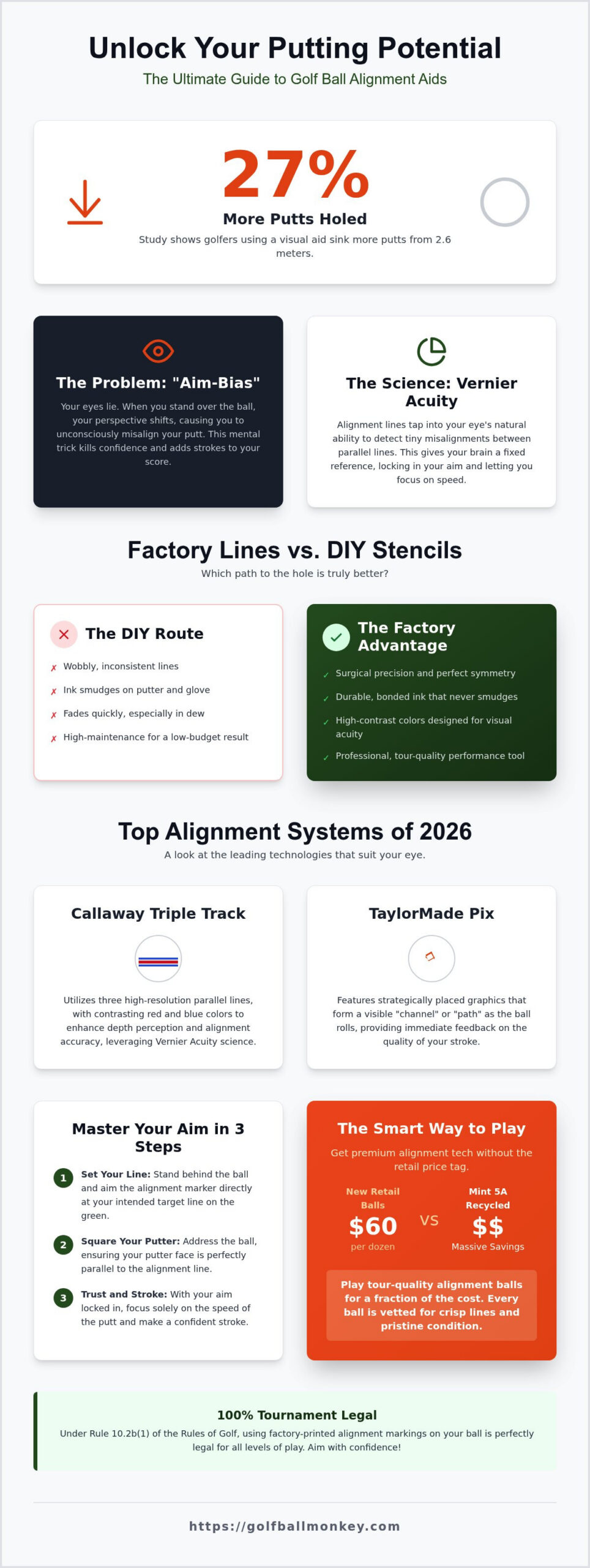
A recent study found that golfers using a visual aid holed 27 percent more putts from 2.6 meters compared to those staring at a blank white sphere. That is the difference between a career round and another “what if” story at the 19th hole. You already know that putting accounts for about 40 percent of your total strokes. Yet, most players still struggle with inconsistent eye positioning and second-guessing their line the moment they stand over the ball. It is a mental grind that kills your confidence. Finding the right golf balls with alignment marker technology is the ultimate shortcut to better scores, but the retail price tags on premium models are often a total buzzkill.
We agree that paying sixty dollars for a dozen balls feels like a trap. You want the performance of Triple Track or Pix patterns without the “new ball” tax. This guide will show you how to master the green and sink those tricky 5-10 footers by choosing the right tech for your eye. The Monkey has personally vetted our inventory to ensure every line is crisp and every cover is tour-quality. We are previewing the best alignment systems of 2026 and revealing how to score Mint 5A recycled gems at a massive discount.
Key Takeaways
- Stop the “aim-bias” that ruins your stroke. Use secondary reference points to keep your eyes honest over every putt.
- Upgrade from messy Sharpie stencils to factory-printed lines for better durability and pro-level precision on the green.
- Compare the visual systems of Callaway Triple Track and TaylorMade Pix to see which tech suits your eyes best.
- Master the legal way to use your golf balls with alignment marker to lock in your line from behind the ball every time.
- Beat the retail markup. Learn why Mint 5A recycled balls are the smartest way to play premium alignment tech for way less cash.
Why Your Putting Depends on a Clear Alignment Line
Your eyes are lying to you. It is a harsh truth every golfer has to face. When you stand behind the putt, the line looks like a highway to the hole. The moment you step over the ball, the perspective shifts and the cup seems to move. This is “aim-bias” in action. Your brain tries to compensate for the side-on view, which usually leads you to aim too far right or left without realizing it. A golf balls with alignment marker acts as a reliable diagnostic tool. It gives your brain a fixed, secondary reference point that stays constant even when your head moves. It is the closest thing to a “cheat code” for your short game.
The Science of Visual Alignment
Human vision relies on something called Vernier Acuity. This is our eye’s incredible ability to detect tiny misalignments between two parallel lines. It is significantly more precise than trying to center a round object in front of a flat putter face. When you use a linear marker, you drastically reduce “parallactic error.” This is the optical illusion where an object’s position seems to change based on your viewpoint. By locking the ball’s line onto your target from behind, you ensure the putter face is actually square at impact. You stop guessing and start trusting your setup. It simplifies the mental load so you can focus on speed instead of direction.
Legality Under the Rules of Golf
Some purists might tell you that using high-tech visual aids feels like an unfair advantage. Don’t listen to them. Under the rules of golf, specifically Rule 10.2b(1), you are perfectly entitled to use alignment markings to help your aim. You can use the factory stamps or even draw your own lines. The only restriction is that you cannot use an external object, like a club laid on the ground, to help you line up. Factory-printed lines are 100 percent legal for tournament play and offer a permanent, durable solution. They won’t smudge off on your glove like a DIY Sharpie mark after three holes in the dew.
There is also a big difference between “spot aiming” and “line aiming.” Spot aiming involves picking a blade of grass or a blemish a few inches in front of the ball. While helpful, it doesn’t help you square the putter. Line aiming uses the entire axis of the ball to create a direct path. If you want to test this tech without the retail sting, check out the golf balls with alignment marker options in our shop. The Monkey personally vets every Mint 5A ball to ensure the alignment lines are crisp and ready for the 18th green.
Factory Lines vs. DIY Stencils: Which Path to the Hole?
Every golfer has been there. You buy a plastic stencil for ten bucks, grab a Sharpie, and try to draw a straight line while sitting in your cart. It usually ends in a wobbly mess. While a DIY golf balls with alignment marker is better than nothing, it lacks the surgical precision of factory-printed tech. Plus, there is the dreaded ink smudge. Fresh ink transfers to your putter face or your expensive white glove faster than a bad slice finds the woods. It is a messy, inconsistent solution for a game that demands perfection.
The DIY Route: Stencils and Sharpies
DIY stencils come in three main flavors: single lines, triple lines, and cross-hair patterns. Single lines are the old-school choice for minimalist aim. Triple lines try to mimic the high-end “Triple Track” look, while cross-hairs help you square the putter face perfectly. If you insist on the Sharpie route, use ultra-fine point permanent markers. Avoid the cheap knock-offs that bleed into the dimples. Pro tip: rotate the ball slowly inside the stencil to keep the line crisp. Just remember that even the best DIY job fades after a few holes in the morning dew. It is high-maintenance work for a low-budget result.
The Factory Advantage
Factory lines are a different beast entirely. Specialized machines print these with perfect symmetry and digital precision. You get consistent visual feedback on every single green. Major manufacturers use industrial inks that bond with the ball’s cover. They don’t smudge, and they don’t fade. Some brands use multi-color contrast, specifically red and blue, to trick the brain into seeing depth more clearly. Others use graphics that create a visible “channel” when the ball rolls purely. These aren’t just decorations. They are performance tools designed by engineers, not a guy with a shaky hand in a golf cart.
Some players worry that thick ink lines or graphics might mess with aerodynamics. Relax. The weight of the ink is statistically zero. It won’t affect your launch angle or spin rate. The only thing it affects is your confidence. Why spend your Saturday morning playing arts and crafts with a marker? You can skip the mess and get the real deal for way less than retail. If you want pro-level precision without the headache, check out our Mint 5A inventory. The Monkey personally vets every alignment line to ensure it is sharp and ready to hunt birdies. Stop drawing and start sinking more putts.
The Best Golf Balls with Built-in Alignment Markers
Forget the wobbly Sharpie lines. The big brands have already done the heavy lifting for you. In 2026, factory-printed tech has evolved far beyond a simple side stamp. These designs are engineered to sync with your brain’s natural processing power. Whether you want bold stripes or subtle cues, there is a golf balls with alignment marker built for your specific eye. It is time to stop guessing and start trusting your equipment.
Callaway Triple Track Technology
Callaway Triple Track remains the undisputed heavyweight champion of visual aids. This system uses Vernier Hyperacuity, the same tech used by pilots to land on aircraft carriers. The specific red and blue line pattern makes it incredibly easy for your brain to detect even a one-degree misalignment. While it works with any putter, it is most effective when paired with a Triple Track putter head for a seamless “track” from ball to blade. You can find this tech on premium models like the Chrome Soft, ERC Soft, and the high-performance Chrome Tour.
TaylorMade Pix and ClearPath
If you want more than just a line, TaylorMade Pix is your go-to. Their ClearPath Alignment uses strategically placed graphics to create a “swirl” effect. When you strike the ball purely, the graphics form a clear channel as the ball rolls. If your roll is wobbly, the graphics blur, giving you immediate feedback on your strike quality. It is a favorite for players who find traditional straight lines too distracting but still want a reliable aim point. The TP5 and TP5x Pix models offer this feedback without sacrificing tour-level spin.
Srixon Divide and Titleist Enhanced Alignment
For the traditionalists, Titleist offers an “Enhanced Alignment” version of the Pro V1. It is subtle, clean, and keeps the classic look while providing a longer, more defined side stamp. On the opposite end of the spectrum is the Srixon Divide. This ball features a 50/50 matte cover design that acts as a massive 360-degree alignment tool. It is perfect for lining up putts and visualizing spin on chips around the green. The Srixon Divide stands as the most visual ball in the 2026 market.
The only downside to these high-tech balls is the retail sting. Paying nearly sixty dollars a dozen just for some printed lines feels wrong. That is where we come in. You can snag these exact models, including Triple Track and Pix patterns, in our Mint 5A inventory for a fraction of the cost. The Monkey personally vets every ball to ensure the alignment graphics are sharp, clear, and ready to find the bottom of the cup. Get the tech. Skip the tax.
Master the Aim: How to Use Your Ball Marker Like a Pro
You have the tech. You have the ball. Now you need the technique. Reading the green from behind is non-negotiable if you want to lower your scores. If you try to align your ball while standing over it, you’ve already lost the battle against perspective. Get into a crouch. Use your golf balls with alignment marker to pick a specific target. This isn’t always the hole. If the putt breaks six inches left, aim that line six inches right of the cup. That is your “apex” point. Lock it in before you ever take your stance.
The Pre-Shot Routine
Precision starts before you touch your putter. Place your ball marker firmly behind the ball. While the ball is lifted, take a second to visualize the track. Rotate the ball so the line points exactly where you want to start the putt. If you’re using a golf ball alignment tool, ensure the mark is perfectly centered on the axis. Stand back five feet and check the perspective. Does it look right? If not, go back and fix it. Never settle for “close enough” when your birdie is on the line.
Executing the Stroke
Now comes the hardest part: trusting your work. When you stand over the ball, the line might look like it’s pointing to the wrong zip code. That is the parallactic error we discussed earlier. Ignore it. Square your putter face until the lines on the putter match the lines on the ball perfectly. This is the 90-degree rule. If they’re parallel, you’re golden. Most players miss because they second-guess their aim at the last second and try to “steer” the putter. Don’t be that guy. Trust the line.
Watch the ball as it leaves the face. If you’re playing a TaylorMade Pix or a Callaway Triple Track, you’ll see a steady, end-over-end roll. This is the “Pure Roll” test. If the lines are wobbling or blurring sideways, you’ve mis-hit it. This immediate feedback is why pros love these balls. It tells you exactly what went wrong so you can fix it on the next hole. Make a confident stroke and listen for the rattle in the cup. It is the most satisfying sound in the game. Ready to start draining more putts? Grab a bag of Mint 5A alignment balls and start practicing your routine today.
Score Tour-Level Alignment Balls Without the Retail Sting
Retailers love the “Alignment Tax.” They take a standard tour ball, print three lines or a fancy pattern on it, and suddenly the price jumps toward sixty dollars a dozen. In 2026, premium models like the TaylorMade TP5 Pix and Callaway Chrome Soft Triple Track are hitting retail shelves at $54.99 to $64.99. That is a steep price to pay for a visual aid, no matter how much it helps your aim. You want the performance of a premium golf balls with alignment marker without the financial hangover. The smartest play this season isn’t buying new; it is buying smart. Recycled premium balls offer the exact same technology for a fraction of the retail cost.
The Savvy Choice for 2026
Our professional divers are the unsung heroes of your short game. They retrieve thousands of high-tech balls from water hazards every week. Many of these were lost on the very first hole, meaning the covers and alignment graphics are still in pristine condition. Choosing a used Titleist Pro V1 with a factory marker is the ultimate value play for the serious golfer. You get the #1 ball in golf and a professional aim point without the retail markup. It is also the environmentally conscious choice. You are keeping plastic out of the local ecosystem while keeping more cash in your pocket. It is a win for the planet and a win for your scorecard.
Stock Up and Sink More
The key to consistent putting is using the same ball every time. If you switch between different alignment styles, your brain has to recalibrate on every green. This is where bulk buying becomes your secret weapon. When you find a pattern that clicks with your eye, buy it in bulk. Our Mint 5A grading system is the gold standard of quality. It means the ball is virtually indistinguishable from a new one. The Monkey personally vets every ball to ensure the alignment lines are crisp, clear, and perfectly centered. You won’t find smudges, fades, or wobbly DIY marks here.
Stop overpaying for ink and branding. Focus on the physics of a pure roll and the psychology of a perfect aim. By choosing recycled gear, you can play the best tech in the game every single weekend. Ready to restock your bag and start hunting more birdies? Shop our full collection of premium used balls and accessories here! We have the inventory, the quality, and the prices that make the “Alignment Tax” a thing of the past.
Stop Guessing and Start Sinking More Putts
You have seen the science and the tech. Finding the right golf balls with alignment marker isn’t just a visual aid; it’s a mental reset that kills aim-bias and builds pure confidence. Whether you choose the bold stripes of Triple Track or the feedback-rich Pix pattern, you’re giving your brain the reference point it needs to square the face and trust the stroke. Remember to read the break from behind and commit to your line once you’re over the ball. Trust the work you did behind the putt.
You don’t need to drop sixty dollars at a big-box store to get this advantage. Our professional divers harvest these high-tech gems from the hazards so you can play the best equipment for a fraction of the cost. Every ball goes through our strict Mint 5A grading process to ensure like-new performance and crystal-clear graphics. You can save up to 50 percent compared to retail prices while keeping your game sharp and the planet green. Stop overpaying for alignment and grab your Mint 5A balls at Golf Ball Monkey now! Go out there and hunt some birdies.
Frequently Asked Questions
Is it legal to use a golf ball with an alignment marker in a tournament?
Yes, it is 100 percent legal under USGA Rule 10.2b(1). You can use factory stamps or Sharpie marks to point your ball toward the hole. The only illegal move is using a club or external tool on the green to line up your stance. Stick to the markings on the ball and you are tournament-ready. The Monkey only stocks legal, high-performance gear that clears every rulebook hurdle for competitive play in 2026.
Does the Callaway Triple Track really help with putting?
Absolutely. Independent tests show golfers hole about 27 percent more putts from roughly 8 feet when using visual aids. The Triple Track system uses red and blue lines to trigger Vernier Hyperacuity. This is the same tech pilots use to land on carriers. It makes a one-degree error look obvious. It is a massive upgrade over staring at a plain white ball and guessing your line while standing over the putt.
Can I draw my own alignment lines on a used golf ball?
You can, but you probably shouldn’t if you value your gear. DIY ink smudges on your putter face and stains your glove. It is hard to get a perfectly straight line in a shaky golf cart. A factory-printed golf balls with alignment marker is permanent and digitally precise. Why play arts and crafts when you can get pro-level tech for a bargain price? Our Mint 5A balls keep your gear clean and your lines sharp.
What is the best golf ball for putting alignment?
The “best” is whatever clicks with your eyes. Callaway Triple Track is the king of linear aim. TaylorMade Pix is the winner for roll feedback. If you want maximum visibility for chipping and putting, the Srixon Divide is a 360-degree beast. We recommend testing a few different patterns of golf balls with alignment marker from our shop to see which one helps you find the bottom of the cup consistently during your rounds.
Do alignment lines on golf balls affect their flight or distance?
Not at all. The weight of the ink is statistically zero and does not change the ball’s center of gravity. It won’t mess with your launch angle, spin rate, or total distance off the tee. It is purely a visual tool for the short game. You get all the alignment benefits without sacrificing a single yard of performance. It is all upside and zero drag for your long game, regardless of the pattern you choose.
How do I use the TaylorMade Pix ClearPath alignment?
Start by crouching behind the ball and pointing the graphics toward your apex point. When you make a stroke, the orange and black graphics should form a steady, clear “channel” as the ball rolls. If that channel looks wobbly or blurry, you didn’t hit it pure. It is like having a putting coach built right into your equipment for immediate feedback. It helps you diagnose strike errors instantly so you can adjust on the next hole.
Are used golf balls with alignment markers as good as new ones?
Yes, provided you stick to our Mint 5A grading. Many of these balls were lost on the first or second hole. Our professional divers retrieve them, and we vet them to ensure the covers are pristine and the alignment lines are sharp. You get the same tour-level performance and visual tech as a brand-new box but save about 50 percent off the retail price. It is the smartest way to play premium tech without the sting.
What is the difference between a ball marker and an alignment marker?
They serve two different purposes. A ball marker is a small flat object, like a coin, used to mark your ball’s spot on the green. An alignment marker is the line or pattern printed on the ball’s cover to help you aim. You use the ball marker to stay legal while you rotate your alignment marker toward the hole. Both are essential for a professional routine. Master the use of both to look like a pro and score like one.
How to Draw a Line on a Golf Ball: The Savvy Player’s Guide to Better Putting
The most expensive putter in the world won’t fix a three-putt if you’re aiming at the wrong zip code. It’s a common frustration that haunts every green; you read the break perfectly, but your ball starts two inches off-line. You don’t need a $500 club to fix this. You just need a Sharpie and a steady hand. Learning how to draw a line on a golf ball is the ultimate low-cost performance upgrade that transforms your confidence before you even take a stroke.
We’ve all been there, staring down a short birdie putt only to watch it wobble away because of poor alignment. It’s time to stop guessing and start draining. This guide teaches you how to master the art of ball marking to sink more putts and save strokes without spending a fortune on fancy gadgets. You’ll learn the best DIY methods to get perfectly straight lines and understand the current USGA regulations, including the upcoming 2028 ODS changes. The Monkey has vetted these techniques to ensure they work on everything from a Mint 5A Titleist Pro V1 to a recycled Srixon. Let’s get your aim on point.
Key Takeaways
- Identify the “True Roll” feedback that reveals exactly how pure your strike is on every putt.
- Master the savvy insider secrets on how to draw a line on a golf ball using simple DIY hacks like the 1/2 inch PVC pipe trick.
- Eliminate second-guessing on the green by using the “Point and Step Back” method to align your ball perfectly with the hole.
- Learn the “blackout” method to refresh used golf balls and create a professional-grade alignment aid on any budget.
Why Draw a Line? The Science of Putting Alignment
Squaring your putter face is the single hardest part of the short game. Most golfers miss because they’re aimed at the fringe while thinking they’re dead center. An alignment line is your secret weapon to fix this. It’s a simple visual aid drawn on the ball to help you square your face perfectly every time. When you master how to draw a line on a golf ball, you’re essentially adding a high-tech navigation system to your recycled balls. While the design of a putter often includes built-in sightlines, they only work if the ball is pointing the same way. This line bridges the gap between your intent and your execution.
Knowing how to draw a line on a golf ball isn’t just about aesthetics; it’s about the “True Roll” feedback. If you strike the ball purely, that line will roll end-over-end like a perfect tire. It looks like a solid, unmoving stripe heading toward the cup. If you cut across the ball or hit it off the toe, the line will wobble or “flutter” in the air. This instant data tells you exactly what went wrong with your stroke. You don’t need an expensive launch monitor to diagnose a bad putt when you have a sharp line to guide you.
Psychologically, the line is a game-changer. It allows you to commit to your read before you even take your stance. Pros use these lines to eliminate second-guessing once they’re over the ball. Once that line is set, your only job is to match the putter face to it and swing. This removes the “did I aim right?” panic that leads to tentative, shaky strokes. You’ve already done the hard work behind the ball; now you just have to trust the savvy prep you’ve put in.
Eliminating the ‘Optical Illusion’ on the Green
Your eyes lie to you on the green. When you stand over a putt, the perspective shifts significantly. What looked like a straight line from six feet behind the ball suddenly feels like it’s pointing way left when you’re in your stance. This optical illusion causes thousands of missed shorties every weekend. A pre-set line acts as a reliable second opinion. You aim the ball with a clear head from behind the hole; then you trust that line when you’re under pressure. There is a massive difference between aiming the ball and aiming the putter. One is a calculated decision, while the other is often a panicked guess.
Visual Feedback for Better Practice
Practice shouldn’t be a guessing game. Use your line to identify “skidding” versus immediate forward roll. If the line stays blurry for the first foot of the putt, your ball is skidding or hopping. You want to see that line start spinning immediately. A wobbling line is a red flag for a toe or heel strike that ruins your distance control. Grab some used golf balls to practice your marking without the stress of ruining a brand-new sleeve. This visual feedback accelerates muscle memory by giving your brain a clear, immediate grade on every single stroke you take.
Essential Tools: Stencils, Sharpies, and DIY Hacks
You don’t need a massive budget to get a Tour-level alignment aid. The secret to how to draw a line on a golf ball is consistency, not the price tag of your gear. While specialized golf ball pens exist, a standard Sharpie is the industry workhorse. Go for the ultra-fine point. It creates a crisp, thin line that doesn’t look like a toddler’s crayon project. If you want to stand out or struggle with color contrast, swap the black marker for red or blue. These colors often pop better against the emerald green of a well-manicured putting surface.
If you’re feeling crafty, skip the retail markup on plastic stencils. The legendary ‘PVC Pipe’ Hack is a favorite among savvy players. Grab a 1/2 inch PVC coupling from the hardware store. It fits the diameter of a golf ball almost perfectly. Simply drop the ball in, trace the edge, and you’ve got a flawless 360-degree stripe. For those who prefer commercial options, there are several popular styles:
- Triple Track: Three parallel lines for maximum visual focus.
- 360-Degree: A continuous loop around the equator for visibility from any angle.
- T-Square: A tool that ensures your line is perfectly perpendicular to the putter face.
Check out the golf ball accessories in our shop to find the right fit for your bag. Learning how to draw a line on a golf ball with these tools is a badge of honor for the budget-conscious golfer. It turns a standard ball into a precision instrument.
The Best Markers for the Job
Precision is everything in the short game. Thick, bleeding lines can actually distort your perception of the target. Stick to ultra-fine points for that surgical look. Always perform the ‘smudge test’ before you head to the first tee. Give the ink at least 30 seconds to bond, especially on premium covers like a Titleist Pro V1. Nothing ruins a round faster than a black streak across your white putter face. If you mess up or find a used ball with a previous owner’s messy markings, don’t toss it. A little rubbing alcohol on a cotton ball will strip that ink right off, giving you a clean canvas for your own markings.
DIY vs. Store-Bought Stencils
Tiger Woods famously draws his lines freehand, but unless you have the hands of a surgeon, use a tool. A 360-degree stencil is arguably the most accurate for long-range alignment because you can see the line as you walk up to the green. It’s a huge advantage for visualizing the break early. If you’re stuck on the course without a tool, try the ‘Bottle Cap’ method. A standard water bottle cap can act as a makeshift guide in a pinch. For more pro insights, Titleist has a great breakdown on Marking Golf Balls to Hole More Putts. It’s a solid resource for anyone serious about upgrading their performance without the premium price tag.

Step-by-Step: How to Draw the Perfect Alignment Line
Ready to upgrade your gear for the cost of a cup of coffee? Perfect. Getting the line right is about precision, not luck. Before you even touch a marker to the dimples, you have to prep the canvas. A dirty ball is the enemy of a clean line. Wipe your ball down with a microfiber cloth or a quick splash of rubbing alcohol to remove oils and dirt. This ensures the ink bonds properly to the cover, giving you a mark that lasts the whole round without fading. If you skip this, your line will be a smudged mess by the third hole.
Once the ball is clean, lock it down. Using a stencil or your DIY PVC coupling is non-negotiable here. If the ball moves even a millimeter, your “straight” line becomes a curve that will betray you on the green. When you’re ready to mark, apply the pen in one smooth, continuous motion. Don’t sketch or use short strokes. A single, confident pass creates a crisp edge that looks professional and is easier for the eye to track. For more expert tips for marking your golf ball, check out what the pros suggest for maintaining a consistent routine. Knowing how to draw a line on a golf ball correctly is the first step toward a more reliable short game.
Finally, be patient. Give the ink at least 60 seconds to fully cure. If you’re using a high-quality used ball from our online shop, like a Srixon Z-Star or a TaylorMade TP5, the urethane cover is designed to be grabby. This means wet ink will smudge onto your putter face instantly if you don’t wait. Let it dry, then get to work. A little patience in the locker room saves a lot of frustration on the green.
Finding the Equator of the Ball
Most players use the manufacturer’s side-stamp as a natural guide, but savvy players look deeper. Find the seam of the ball where the two halves of the mold meet; aligning your mark here can help with the ball’s natural balance during the roll. It’s a small detail that builds massive confidence. Center your line perfectly between the dimples to avoid any visual “jumping” as the ball rotates toward the cup.
Advanced Marking: The Triple Track Technique
One line is good, but three can be better. The Triple Track technique uses Vernier Hyperacuity, which is how your brain processes parallel lines to find the center. It’s the same tech used to help pilots land on aircraft carriers. Space your lines to match the width of the alignment aid on your putter for a seamless visual transition. Try using a red center line flanked by two blue lines to make the mark pop against the grass. This high-contrast setup makes it nearly impossible to misalign your face at address. Mastering how to draw a line on a golf ball with multiple tracks gives you a professional edge without the retail price tag of pre-marked balls.
Mastering the Green: How to Use Your New Line
You’ve prepped the ball. You’ve drawn a perfect stripe. Now it’s time to actually sink some putts. Knowing how to draw a line on a golf ball is only half the battle; you have to trust it when the pressure is on. The gold standard for using your new aid is the ‘Point and Step Back’ method. Crouch behind your ball on the green. Aim that fresh line exactly at your chosen start point. Stand up, walk back a few feet, and verify the aim. If it looks off, go back and fix it now. Don’t wait until you’re over the ball to start doubting your work.
Once you step into your stance, the hole becomes irrelevant. Your only job is squaring your putter face to that line. Focus entirely on that 1-inch mark on the ball. If the face is square to the line, the ball will start on your intended path. It’s a simple mental shift that eliminates the ‘aiming anxiety’ that ruins so many rounds. However, be smart about when to use it. On extreme breaks or complex double breakers, a straight line can sometimes be a distraction. If the read feels too funky, don’t be afraid to flip the ball to a blank side and play by feel. Use the tool for the 90% of putts where it provides a clear advantage.
Ready to test your new skills? Stock up on Mint 5A used balls and start draining more putts this weekend.
Trusting the Process
Commitment is everything in putting. If you stand over the ball and it looks “wrong” from your address position, do not try to manipulate your hands mid-swing. This is a classic amateur mistake. Your eyes lie to you when you’re standing sideways to the target. Trust the work you did while standing behind the ball. Adopt a ‘Set it and Forget it’ mindset. Once the ball is placed, stop fiddling with it. Align the putter, take a breath, and stroke it. Lower stress leads to lower scores.
The Rulebook: Staying USGA Compliant
Is drawing on your ball actually legal? Absolutely. USGA Rule 14.1 makes it clear: drawing lines or other marks for identification or alignment is 100% legal. You aren’t “altering” the ball’s performance; you’re simply adding a visual aid. You can also clean and re-mark your ball whenever the rules allow you to lift it. This usually happens once you’ve reached the putting surface. Just remember that you cannot mark the ball while it is in play in the fairway or rough. Wait until you’ve reached the green, mark your spot, and then feel free to freshen up that line if it’s starting to fade. Stay savvy, stay legal, and keep the Monkey on your side.
Pro Tips for Marking Recycled and Used Balls
The savvy player knows that retail prices are for suckers. You’re already ahead of the game by playing used golf balls. But what happens when your favorite recycled Titleist comes with a previous owner’s messy markings? Don’t sweat it. Mastering how to draw a line on a golf ball includes knowing how to reclaim the cover. If a ball has a shaky old mark, use the ‘blackout’ method. Simply draw a slightly thicker line or a solid block over the old ink. It creates a bold, high-contrast alignment aid that completely hides the past. This turns a second-market find into a custom-tuned weapon that looks as sharp as anything on Tour.
Marking a Mint 5A ball makes it feel like a fresh Tour ball the second it leaves your bag. When the cover is pristine, your line sits flatter and looks sharper. This is the ‘Monkey Play’ in action. You save a massive percentage on the ball, which leaves plenty of cash in your pocket for the high-end markers and stencils we discussed earlier. You get the same performance as the guys paying $5 a ball, but with a custom alignment setup they wish they had. It is the intelligent play for both your score and your wallet.
Dealing with Previous Markings
Recycled gear often comes with personality. To get the best result, identify the cleanest area on the ball for your new line. High-quality Srixon or TaylorMade balls provide a superior canvas because their urethane covers are designed to hold ink exceptionally well. If you encounter a stubborn side-stamp, don’t fight it. Use a thicker marker to mask the text entirely. This creates a “fat” alignment line that many pros actually prefer for short-range accuracy. It simplifies the visual and helps you focus on the center of the putter face. Be resourceful and make the ball work for you.
The Intelligent Play: Performance for Less
Drawing a line on a used Pro V1 is the ultimate savvy move. You’re taking the best ball in the world and adding a personalized performance feature for pennies. It’s about building a consistent ‘look’ across your entire bag. When every ball in your pocket has the same professional stripe, your brain enters ‘scoring mode’ faster. You aren’t just playing golf; you’re executing a strategy. This is the shortcut to better putting that the big brands don’t want you to know. Why pay for their pre-printed lines when you can do it better yourself? Restock your bag with premium used balls today! and start playing like an insider.
Start Sinking More Putts Today
You’ve got the tools and the technique. Now it’s time to take this savvy strategy to the course. Mastering how to draw a line on a golf ball is the fastest way to turn those frustrating lip-outs into center-cut birdies. By combining a perfect alignment mark with high-performance used balls, you’re playing the same equipment as the pros for a fraction of the retail price. It’s the intelligent play that separates the weekend warriors from the savvy insiders who know how to maximize every dollar spent on their gear.
Every ball in our inventory is professional diver harvested and put through a rigid 5A grading scale to ensure Tour-level quality. This is how you get Texas-sized savings while keeping your short game surgical. Don’t let another short putt wobble off-line because of poor aim or a shaky mark. Grab a dozen Mint 5A Pro V1s and start marking like a pro! Trust your new alignment, commit to your stroke, and watch your handicap drop. We’ll see you on the 18th green with a lower score and a heavier wallet.
Frequently Asked Questions
Is it legal to draw a line on your golf ball in a tournament?
Yes, it is 100% legal under USGA and R&A Rule 14.1. You can add any identification or alignment marks you like as long as you don’t fundamentally change the ball’s properties. Most pros on Tour use this exact trick to stay locked in on the greens. Just make sure the manufacturer’s original markings remain visible to keep the ball conforming to equipment standards.
Does drawing a line on a golf ball actually help putting?
It absolutely helps by removing the guesswork from your alignment. Squaring the putter face is the primary challenge on every green. A line gives you a clear target to match your putter face against; this creates a more consistent starting line. It also provides immediate feedback on your roll quality. If the line wobbles, you know you didn’t hit it pure.
What is the best marker to use on a golf ball that won’t smudge?
A Sharpie Ultra-Fine Point is the industry standard for a reason. It creates a crisp, thin line that dries quickly and resists moisture. Specialized golf ball pens are also available, but they often cost more for the same result. Always give the ink at least 60 seconds to cure before you put the ball in play. This prevents black streaks on your expensive putter face.
How do I get a perfectly straight line without a stencil?
Use a thick rubber band or a 1/2 inch PVC coupling to get a steady guide for pennies. Learning how to draw a line on a golf ball without fancy tools is a true savvy insider move. Simply wrap the rubber band around the equator or drop the ball into the coupling. Trace the edge slowly with your marker. It’s a fast, field-expedient way to get pro-level results on the fly.
Can I use a line on my golf ball for tee shots?
Yes, you can and should use the line for alignment on the tee box. Point the line exactly where you want the ball to start its flight. This helps you square your clubface at address and gives you a specific target to focus on. It builds a consistent visual routine that carries over from the tee to the green. Trust your aim and swing away.
How do I remove a Sharpie line from my golf ball?
Rubbing alcohol or nail polish remover will strip the ink off in seconds. Just apply a small amount to a cotton ball and wipe the mark away. This is the best way to refresh the canvas when you’re playing how to draw a line on a golf ball on used or recycled gear. It allows you to remove a previous owner’s messy marks and replace them with your own professional alignment aid.
Does the color of the line on the ball matter?
Color is entirely about personal preference and visual contrast. Black is the most common, but red or blue often “pop” better against the green grass. Some players find that a brighter color helps them track the roll of the ball more easily. Experiment with different shades to see which one helps your eyes lock onto the target line faster. There are no rules against using multiple colors.
Will drawing a line on my ball affect its flight or balance?
No, a marker line is essentially weightless and does not change the ball’s aerodynamics. The ink is so thin that it doesn’t fill the dimples or alter the spin rate. It is a purely visual aid designed to help your brain process the target path. You get all the alignment benefits without any technical downside. It’s a low-cost upgrade that only affects your confidence, not the ball’s physics.
- golfballmonkey@gmail.com
- (512) 593-8401
- Mon – Fri, 9:00 AM – 5:00 PM

All product and company names are trademarks™ or registered® trademarks of their respective holders.
Use of them does not imply any affiliation with or endorsement by them.