
Best Practice Golf Balls 2026: Get Real Feedback Without the Retail Sting
If you are spending your Saturday afternoon whacking foam or plastic spheres into a net, you are not actually practicing golf. You are just playing an expensive game of fetch with yourself—a task better suited for the innovative hydration solutions from Torus Pet than for a serious athlete. To truly improve your game, you need the best practice golf balls that provide real-world spin and distance feedback. Anything less is just guesswork that stalls your progress and keeps your handicap stagnant.
We know the struggle. You want that premium feel to dial in your short game, but you do not want to flush five dollars down the drain every time a ball goes rogue. It is a common frustration for every savvy player who values their budget as much as their birdie count. This article will show you how to secure tour-level balls for shag-bag prices. You will learn how to get 100% accurate feedback while avoiding the retail sting of new equipment.
We are diving into why high-quality recycled balls are the ultimate hack for your practice routine. We will cover the grading scales that ensure performance, explain why independent tests show recycled balls lose less than one yard of distance, and help you build a shag bag that actually lowers your scores. It is time to play smarter, practice harder, and save bigger.
Key Takeaways
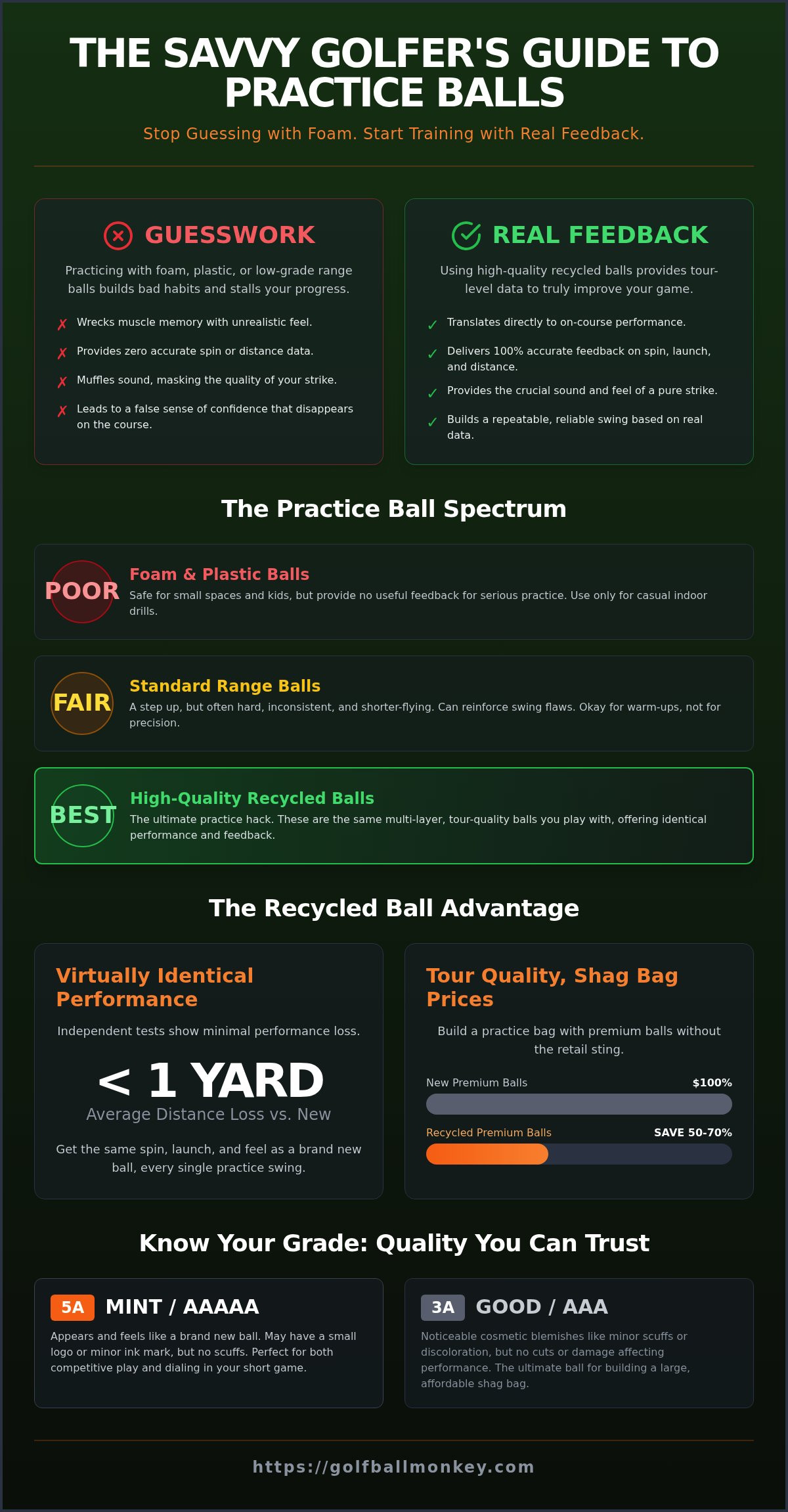
- Stop guessing with foam and start training with real-feel feedback that actually translates to the course.
- Discover how to identify the best practice golf balls for your budget by mastering the 5A and 3A grading scales.
- Save 50-70% off retail costs by swapping brand-new boxes for professional-diver-recovered premium balls.
- Learn the “Savvy Insider” method for building a durable shag bag that matches your specific game ball for consistent spin data.
- Find out why high-quality recycled balls lose less than one yard of distance compared to new ones.
The Real Cost of Practice: Why Your Ball Choice Matters
Stop treating your practice sessions like a casual game of catch. Every time you step onto the mat or grass, you are training your central nervous system to react to a specific set of inputs. If those inputs are wrong, your swing will be too. Using the best practice golf balls is not about being fancy; it is about ensuring that the thousands of repetitions you put in actually translate to lower scores on Sunday. Cheap plastic or lightweight foam alternatives might save your windows, but they are wrecking your muscle memory. Physics does not lie. A regulation ball has specific weight and aerodynamic properties that a hollow tube or sponge simply cannot replicate.
Understanding the history of the golf ball reveals a journey toward precision engineering. Modern balls are multi-layer marvels designed to compress and spin in very specific ways. When you practice with low-grade range balls or “limited flight” junk, you are effectively practicing a different sport. Inconsistent flight patterns from scuffed, one-piece range balls can actually reinforce negative swing flaws. You might think you are slicing, but it is just a lopsided ball. You might think you hit it pure, but the dead core didn’t give you the distance you earned. Stop guessing and start trusting your equipment.
The Psychology of the Pure Strike
Your brain craves the “click.” That sharp, gratifying sound of a clean strike is a vital part of the feedback loop. Foam balls muffle this sound and mask thin or fat shots, leading to a dangerous sense of false confidence. You think you are flushing it in the backyard, then you get to the first tee and chunk it into the pond. Feedback is the immediate data a ball provides regarding spin, launch, and strike quality. Without it, you are just swinging in the dark. Real balls provide the resistance and vibration your hands need to distinguish a center-face strike from a toe-miss. That sensory data is what builds a repeatable, reliable swing.
Practice vs. Play: Should They Be Different?
PGA professionals have a simple philosophy: practice like you play. They do not use different equipment for the range than they do for the tournament. If you play a premium urethane ball on the course, hitting “rock” balls at the range creates a massive disconnect. You lose the feel for how your wedges check up or how your driver carries. This is why 2026 is the year of the “Smart Shag Bag.” Savvy players are ditching the bucket of random range balls for a curated collection of high-quality used gear. You can build your own arsenal of tour-level balls for a fraction of the retail price. It is the only way to bridge the gap between your practice sessions and your scorecard.
The Practice Ball Spectrum: From Foam to Professional Shag
Not all practice is created equal. Choosing the best practice golf balls depends entirely on your environment and your specific goals for the day. You would not use a sledgehammer to hang a picture frame. Similarly, you should not use a foam ball to fix a snap hook. Understanding the spectrum of practice gear is the first step toward making your time on the grass actually count. From backyard-safe sponges to tour-quality recycled gear, each tier has a specific purpose in your development.
Foam and plastic balls are the ultimate “peace of mind” tools. They are perfect for small backyards or tight spaces. You won’t break a window or take out the neighbor’s cat with a wayward shot. But here is the catch: they provide zero spin data. If you are trying to master a high-spin flop shot, these will not tell you if you actually pulled it off. Range balls are a step up, but they are often “one-piece” constructions. They fly shorter, feel harder, and can be inconsistent. They are fine for a quick warm-up, but they are terrible for dialing in precise distances.
Shag balls are the real secret weapon. These are high-quality used balls retired from competitive play. They are the same multi-layer balls you use on the course, just with a few rounds under their belt. For the lowest tier, you have “hit-away” or bulk balls. These are the “junk drawer” of golf gear. Use them for loose warm-ups or practicing near water hazards where you do not mind losing a few to the depths. Check out the premium practice inventory at Golf Ball Monkey to see how to stock up without the retail sting.
Artificial Aids: When Foam Makes Sense
Foam has its place in a balanced routine. It is the gold standard for indoor winter practice and living room putting drills. It is also the best way to teach kids the basics without a trip to the emergency room. However, if your handicap is under 20, foam is a trap. It masks too many mistakes. You need the resistance of a real ball to feel where your swing is failing. Use foam for tempo, but use the best practice golf balls for technical feedback.
The Shag Ball: The Gold Standard for Game Improvement
If you want real progress, you need a shag bag filled with authentic equipment. We source our stock from professional divers who rescue premium balls from the drink. This is the ultimate “insider” hack for practice ball supply. Comparing 3A (Good) vs. 5A (Mint) grades is simple. 5A balls look like they just came out of the sleeve. 3A balls have some character but perform perfectly for repetitive drills. You can learn more in our Golf Balls Used: The Savvy Player’s Guide. This is how you get tour-level technology for a fraction of the cost.
Why “Real” Used Golf Balls are the Ultimate Practice Hack
Ditch the toys. If you want to see your handicap drop, you need to stop practicing with equipment that lies to you. The best practice golf balls aren’t found in a mesh bag of plastic wiffle balls at a big-box retailer. They are the same premium, tour-level balls you play on Sunday, just with a previous life. Choosing used equipment is the ultimate “insider” move because it provides the one thing artificial aids cannot: truth. When you hit a used Pro V1, the ball reacts exactly how it should. No guesses. No excuses.
Spin rate is where the reality hits hardest. A high-quality wedge shot needs to hit 10,000+ RPM to check up on the green. Foam balls cannot even approach that level of friction or core compression. You might think you are hitting a “nipped” wedge, but you are actually training your brain to accept a dead, sliding strike. Beyond the physics, there is the simple math of durability. A used Titleist Pro V1 from our inventory will outlast a plastic wiffle ball by at least 10x. You can beat on a real ball for hours without it splitting or losing its shape. It is the definition of a high-value acquisition.
Let’s talk about the cost-per-strike. Buying new retail balls for a shag bag is a financial sting that most golfers can’t justify. By opting for recycled gear, you are slashing your costs by 50-70% while maintaining 100% of the performance feedback. Plus, there is a massive environmental win here. Every ball recovered by our professional divers is one less piece of plastic sitting in a local ecosystem. It is a sustainable loop that benefits your wallet and the planet. You get tour-quality gear; the pond gets cleaned up. Everybody wins.
The Truth About Recovered Balls
Ignore the myths you see on internet forums about used balls “losing their pop.” Modern solid-core balls are virtually impervious to water damage over short durations. Unlike the old wound-core balls of the 1990s, today’s multi-layer tech is built like a tank. Our professional cleaning and grading process ensures that every ball is restored to its peak performance state. A 5A Mint ball is indistinguishable from one out of a $55 box, except for the price tag. We vet every ball so you can focus on your swing, not your equipment.
Comparing Feedback: Used vs. Artificial
Weight matters for more than just distance. Real ball weight dictates your launch angle and how the wind affects your flight. If you practice with lightweight aids, you are developing a “false” launch window that will fail you on the course. You simply cannot practice a low-spinning chip or a high-launching flop shot with a foam ball. It won’t “check” on the turf, and it won’t give you the tactile vibration of a pure strike. For a deeper dive into how these layers work, check out Golf Balls 101. Real feedback is the only path to real improvement.
Building Your Ultimate Shag Bag: A Savvy Golfer’s Checklist
Building a professional-grade shag bag is more than just tossing random scuffs into a bucket. It is a tactical play. To get the most out of the best practice golf balls, you need a system that mimics your actual course conditions without draining your bank account. Follow this checklist to build an arsenal that turns every practice session into a scorecard advantage. Stop guessing. Start organizing.
- Step 1: Choose your volume. A 50-ball bucket is perfect for portable, focused sessions. If you are a range rat, go for a 100-ball mesh bag to maximize your repetition.
- Step 2: Match your ball to your game. Consistency is king. If you play a Titleist Pro V1 on the course, your shag bag should be full of Titleist. Do not practice with a low-spin distance ball if you expect your gamer to check up on the greens.
- Step 3: Select the right grade. While 5A Mint is great for putting, 3A Good condition is the absolute “sweet spot” for high-volume drills. These balls are functional, durable, and cost-effective.
- Step 4: Don’t forget the accessories. Your bag is not complete without performance tees and a reliable ball marker for alignment drills.
Ready to level up? You can stock your shag bag today with tour-level gear that fits your budget and your game.
The “Mixed Bag” Strategy
Smart players use a tiered approach to their equipment. A Mixed Bag (Good 3A) is the ultimate value play for bunker and rough practice. Why ruin a Mint 5A ball in a sandy trap? Save your premium recycled balls for the fairway and putting green. Separate your “putting-only” balls into a smaller pouch. Keeping them clean and scratch-free ensures your roll is true. For full-swing drills, grab the 3A stock and swing away. Organizing your gear this way makes every session faster and more efficient.
Essential Accessories for 2026
Your practice is only as good as your setup. High-quality tees play a massive role in consistent ball striking. If your tee height varies by half an inch every shot, your launch data is useless. Check out our Golf Ball Accessories Guide to find gear that actually moves the needle. A simple ball mark tool is also a must-have. Use it to draw alignment lines on your practice balls. This small habit helps you visualize the line and confirms if you are starting your putts on the right path. It is the little details that separate the scratch players from the weekend hackers.
Score Big with Golf Ball Monkey: Tour-Quality Practice on a Budget
Stop settling for subpar gear. Golf Ball Monkey is the savvy insider’s secret for sourcing the best practice golf balls without the retail headache. We are a Texas-based operation that skips the middleman to bring you professional-grade equipment. Our team of professional divers harvests millions of balls from water hazards, rescuing premium tech that would otherwise be lost to the silt. Every ball is cleaned, inspected, and graded with absolute transparency. This is how we fuel your practice with tour-level performance for a fraction of the cost of a new box.
Our grading scale is our verbal seal of approval. When you buy our Mint 5A Titleist Pro V1, you are getting a ball that looks and plays like it just came off the shelf. For high-volume drills, our 3A Good condition balls provide the ultimate utility. We don’t hide behind vague descriptions. You know exactly what is in your bag because the Monkey personally vets the inventory. This commitment to quality is why serious amateurs and driving ranges across the country trust us to supply their sessions. We make it easy to restock quickly and get back to the grass.
Wholesale and bulk deals are where the real savings happen. If you are a high-volume player, buying by the dozen is a rookie mistake. We offer bulk bundles that allow you to build a massive shag bag for the price of a few retail sleeves. It is the intelligent play for anyone serious about game improvement. You get the consistency of a single model and the durability of a solid-core ball. It is time to treat your practice with the respect it deserves.
The Titleist Advantage
Practicing with the #1 ball in golf changes your mental game. When you see that Titleist script on every shot, your brain shifts into “play mode.” You start to trust your distances because the ball is reacting exactly like your Sunday gamer. Check out our Titleist Pro V1 Ultimate Guide to see why this ball remains the gold standard. Comparing retail prices to Golf Ball Monkey value benchmarks is a no-brainer. You get the same urethane cover and high-gradient core feedback while keeping your budget intact.
Ready to Level Up?
Stop practicing with toys. If you want to lower your handicap, you need the best practice golf balls that provide real-feel data. Ditch the foam, ignore the plastic, and start using the real deal. Join our community of savvy insiders who know how to play the system to their advantage. We ship nationwide from our Texas hub, ensuring you never run out of quality stock. Shop all practice balls now and start seeing the difference that authentic feedback makes on your scorecard. It is time to join the Monkeys and play smarter.
Stop Guessing and Start Scoring
Your journey to a lower handicap depends on the quality of your repetitions. Ditching artificial aids for the best practice golf balls is the fastest way to align your range sessions with your course performance. You now know that real-feel feedback is non-negotiable for mastering spin and launch. By building a tactical shag bag with 3A or 5A graded gear, you bridge the gap between just hitting balls and actually getting better. It’s the smartest play you will make for your game and your wallet.
Golf Ball Monkey is here to fuel that progress. Our professional diver-sourced inventory ensures you get tour-level technology without the retail sting. With millions of balls reclaimed annually and a strict 5A/3A grading system, we take the guesswork out of buying used. You get the same equipment the pros use, vetted by the Monkey himself, at a fraction of the cost. Stop paying full price for practice and start playing like a savvy insider. The pond’s loss is your gain.
Build Your Professional Shag Bag Now at Golf Ball Monkey
Grab your bag, hit the grass, and let those pure strikes do the talking. We are rooting for you to find the center of the face every single time.
Frequently Asked Questions
What are the best golf balls for backyard practice?
Foam balls are the safest choice for tight backyard spaces where broken windows or angry neighbors are a risk. However, if you have at least 30 yards of room, the best practice golf balls are high-quality recycled ones used for chipping drills. They provide the authentic weight and spin you need to develop a soft touch around the greens. For those who want to bring a professional setup to their next event, Inbound Golf offers a premium mobile golf experience that bridges the gap between home practice and the course. Just ensure you have a proper backstop if you are swinging full out.
Do used golf balls perform as well as new ones for practice?
High-quality recycled balls perform nearly identically to brand-new ones, making them a savvy choice for repetition. Independent testing shows that premium recycled balls lose less than one yard of distance compared to balls fresh out of the box. For practice sessions where you are hitting hundreds of shots, this negligible difference is worth the massive financial savings. You get real-world feedback without the retail sting.
What is a shag bag and how many balls do I need?
A shag bag is a dedicated carrier, often with a zippered pouch or a tube for easy pickup, used to hold your practice inventory. Most serious amateurs find that 50 to 100 balls is the perfect volume for a productive session. This amount allows for enough repetition to build muscle memory without making the bag too heavy to carry. It’s the standard setup for anyone moving beyond casual range buckets.
Can I use real golf balls at home with a net?
You can definitely use real balls with a home net, provided you have professional-grade netting and a durable hitting mat. Using real equipment into a net gives you the tactile feedback and impact sound that foam alternatives lack. It’s the best way to keep your game sharp during the off-season. Just double-check your net for holes regularly to avoid a stray shot through the drywall.
Are foam golf balls worth buying for high handicappers?
Foam balls are worth the investment for beginners and high handicappers who are strictly focused on tempo and contact. They are great for indoor drills and getting comfortable with the feel of a club in your hands. However, they won’t tell you if you are slicing or hooking. Once you start breaking 100, you should transition to the best practice golf balls available to get accurate flight data.
What is the difference between 3A and 5A grade practice balls?
The difference lies entirely in cosmetic appearance and surface wear. Mint 5A balls look and feel like they were just pulled from a new sleeve, featuring a bright white finish and no visible scuffs. Good 3A balls are the workhorses of the practice world, showing minor discoloration or small blemishes that don’t affect flight. Use 5A for putting and 3A for your high-volume bunker and iron drills.
Should I practice with the same brand of ball I use on the course?
Practicing with your specific “gamer” ball is the only way to develop a reliable feel for spin and distance control. Different brands use various cover materials and core compressions that change how the ball reacts off the face. If you play a Titleist Pro V1 on Sunday, your shag bag should be full of recycled Titleist stock. Consistency in your equipment leads to consistency in your scorecard.
How often should I replace my practice golf balls?
Replace your balls when you notice visible cracks, deep scuffs, or a dull “thud” sound at impact. A ball with a compromised cover or core won’t provide the accurate data you need to improve. Most recycled balls can withstand dozens of sessions before they lose their performance edge. Keep an eye on the dimple patterns; if they look worn or smooth, it is time to restock your bag.
What Are Practice Golf Balls? The Savvy Player’s Guide to Better Reps
Stop treating your premium game balls like disposable range junk. It’s a painful cycle. You want the best feedback for your swing, but watching a five-dollar ball fly into the woods during a drill feels like throwing cash into a woodchipper. Many players settle for foam or plastic alternatives that fly like wet napkins; this leaves them wondering why their “perfect” backyard swing falls apart on the first tee.
If you’ve ever asked, “what are practice golf balls, and will they actually help my game?” you’re already playing smarter than the average golfer. You deserve a setup that provides tour-level data without the retail price tag. We’re here to show you how to build a better swing while keeping your budget intact. Real improvement requires real feedback, and you don’t need a tour contract to afford it.
This guide dives into the real differences between limited-flight fillers and those “Practice” stamped premium gems. You’ll discover which options offer the most realistic spin, how to spot a bargain in a shag bag, and exactly which balls will give you the honest feedback your game requires. It’s time to stock your bag like a pro without the pro-shop markup.
Key Takeaways
- Learn exactly what are practice golf balls and how to choose between synthetic foam, commercial range balls, and high-value shag options.
- Understand the “click” factor and how compression differences between practice gear and premium balls can impact your swing feedback.
- Master the 100-Yard Rule by using real, recycled balls for short-game drills to ensure your feel translates to the course.
- Save big by stocking a dedicated shag bag with bulk-bought, practice-grade balls for bunker work and high-volume reps.
Defining Practice Golf Balls: More Than Just Range Junk
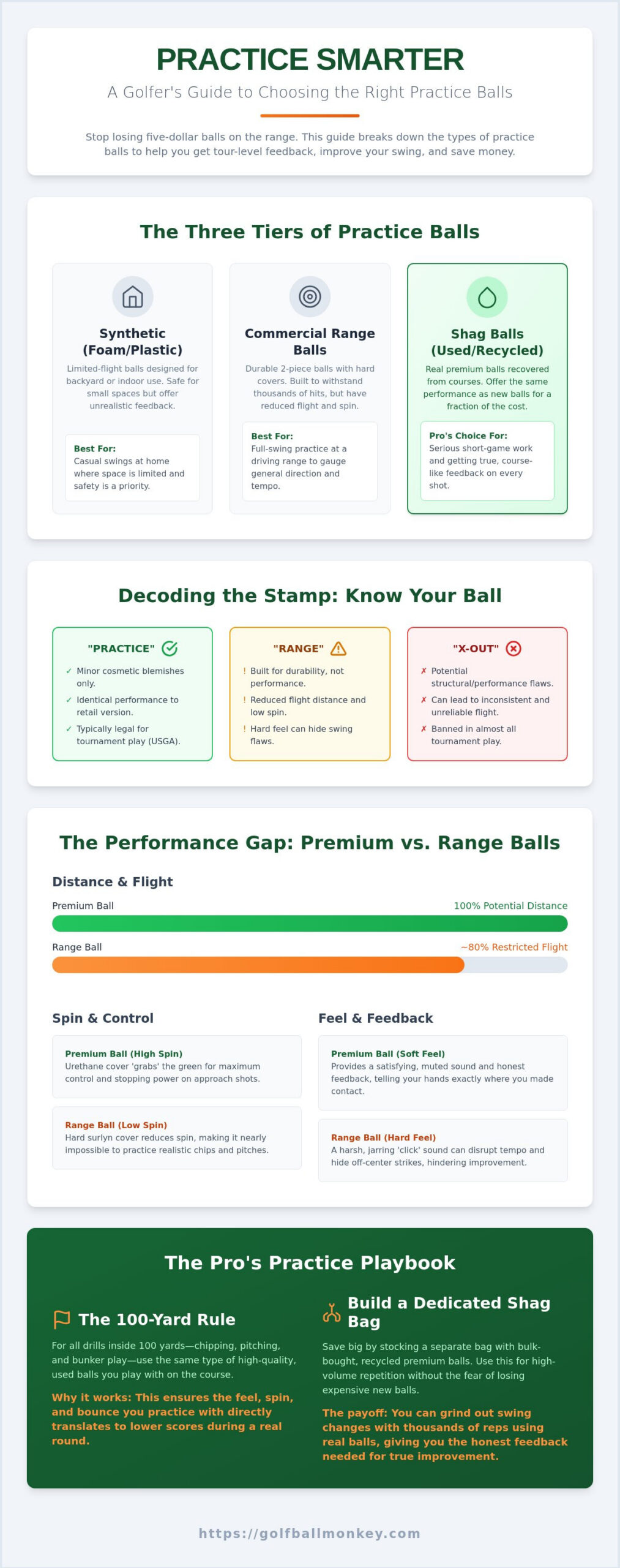
Let’s clear the air. When you ask what are practice golf balls, you aren’t looking for a single product. You’re looking for a strategy. At its core, a practice ball is any piece of equipment designed for high-volume repetition rather than competitive scoring. It’s the gear you use to grind out a swing change without worrying about losing five dollars every time you slice one into the pond. These balls generally fall into three tiers: synthetic foam or plastic for home use, commercial range balls for the driving range, and shag balls for serious field work.
The confusion often starts with the “Practice” stamp found on high-end tour balls. Major manufacturers like Titleist occasionally stamp perfectly good balls with this label due to minor cosmetic inconsistencies. These aren’t “bad” balls; they just didn’t pass the rigorous visual inspection for retail. Interestingly, the USGA treats these differently than “X-Out” balls. According to 2019 regulations, Practice/range balls that are simply stamped versions of conforming models are typically legal for play. X-Outs, however, often have structural flaws and are usually banned in tournament play.
The “Practice” Stamp vs. The Range Ball
Don’t mistake a “Practice” stamped ball for a generic range rock. A range ball is a tank. It’s usually a 2-piece construction built for durability and engineered to survive thousands of hits from every club in the bag. They often feel hard and lack the spin you need for delicate shots. In contrast, a “Practice” stamped Titleist Pro V1 is often identical in performance to the retail version. You get the same urethane cover and the same flight characteristics for a fraction of the cost. It’s the ultimate insider hack for tour-level feedback on a budget.
Shag Balls: The Insider Secret
Shag balls are the true workhorses of a savvy player’s arsenal. These are used balls collected from courses and water hazards by professional divers. At Golf Ball Monkey, these divers retrieve thousands of balls that still have plenty of life left in them. Building a dedicated shag bag allows you to practice bunkers, chipping, and pitching with the exact brands you play on Sunday. Why hit a plastic ball in your yard when you can hit a real, recycled ball for pennies? Visit the Golf Ball Monkey shop to stock up on bulk practice grades and start getting real feedback on every rep.
Practice vs. Regular Golf Balls: Does the Logo Change the Flight?
Don’t let the white paint fool you. When you’re trying to figure out what are practice golf balls versus the ones in your game bag, you have to look at the guts. A standard range ball is a completely different animal than a retail Titleist or TaylorMade. Regular balls are precision-engineered for a specific balance of speed, spin, and control. Range balls, however, are built to survive a nuclear winter. They feature thick surlyn covers and heavy-duty cores designed to be hit, washed, and hit again thousands of times without splitting.
This durability comes at a cost. The most immediate difference is the “click” factor. Range balls are notoriously hard. When you strike one, it produces a sharp, jarring sound that can mess with your mental tempo. If you’re used to the soft, muted thud of a premium urethane ball, this harsh feedback might cause you to over-swing or lose confidence in your strike. Consumer Reports tested practice balls and highlighted how various training models, from foam to limited-flight, can drastically alter your expectations for distance and trajectory.
Distance loss is another major hurdle. Many driving ranges use restricted-flight balls to keep shots within their property lines. These are often designed to fly only 75% to 80% of their standard distance. If you use these to calibrate your yardages, you’re going to be consistently long on the actual course. The spin reality is just as stark. Cheap practice balls lack the “grab” of a game ball. They won’t check up on the green, making it nearly impossible to practice realistic chips and pitches.
Feedback and Feel: Why It Matters
Hitting “rock-hard” balls hides your swing flaws. A hard ball will often fly relatively straight even on a slightly off-center strike. To actually lower your handicap, you need honest feedback. Soft-cover used balls provide the vibration and sound that tell your hands exactly where you made contact. Practicing with the same brand you play builds a consistent mental map. You can find high-quality used practice balls at Golf Ball Monkey that give you this tour-level feel for a fraction of the retail price.
Durability vs. Performance
Range balls are the tanks of the golf world, built to survive the heavy machinery of the picker. Premium practice balls have thinner covers that offer better spin but a shorter lifespan. You have to decide what matters more: a ball that lasts forever or a ball that actually tells you the truth about your swing. For most savvy players, the answer is a mix. Use the tanks for your warm-up, but switch to used premium balls when you start working on your scoring clubs.
Choosing Your Weapon: Foam, Plastic, or Real Used Balls?
Picking the right ammo depends entirely on your battlefield. If you’re wondering what are practice golf balls worth your time, you need to match the material to your environment. Not every session requires a tour-level sphere. Sometimes, you just need to keep your windows intact. Foam balls are the ultimate peace-of-mind choice for living room drills. They won’t shatter your TV or dent the drywall. This makes them perfect for kids or midnight swing sessions when you’re stuck inside. Plastic “wiffle” style balls offer slightly more aerodynamic feedback for small backyards. You’ll see a slice or hook immediately, even if the ball only travels 30 yards.
Limited flight balls sit in the middle of the pack. They feel more like a real ball but are engineered with unique dimple patterns or lighter cores to drop early. These are great for full swings in tight spaces where a real ball would end up three houses down. However, recycled real balls remain the gold standard. If you have a net or an open field, nothing beats the weight and compression of the real thing. It’s the only way to ensure your practice translates to the first tee. You need that authentic impact to know if you’re actually flushing it.
Indoor vs. Outdoor Practice Needs
Don’t fall for the false confidence trap. Foam and plastic balls are great for path drills, but they don’t respond to spin like a urethane cover. If you only practice with lightweight gear, you’ll be shocked when a real ball starts curving 40 yards offline on the course. Step up to real weight whenever your space allows for it. Check out our Golf Ball Accessories to build a setup that supports high-impact reps safely. Protect your home, but don’t protect your ego from the truth of a real ball flight.
The Cost-Per-Swing Analysis
Stop renting your improvement from the driving range. A large bucket at the range can often cost as much as a dozen high-quality used balls that you can keep forever. Buying “Shag” grade balls in bulk is the smartest play for your wallet. These are real balls with minor cosmetic scuffs that provide 100% accurate feedback for a tiny fraction of the retail price. Plus, using recycled gear is a win for the planet. It keeps plastic out of landfills and retrieves lost treasures from water hazards. It’s the most economical way to get real feedback on every single rep. Head over to the Golf Ball Monkey shop to grab a bulk bag and start owning your progress today.
How to Use Practice Balls to Actually Lower Your Handicap
Stop mindlessly bashing balls into the horizon. If you want to drop your score, you need a plan. Understanding what are practice golf balls is step one; using them to shave strokes is where the magic happens. The first rule for any serious grinder is the 100-Yard Rule. Inside this distance, range rocks are useless. They don’t spin, they don’t stop, and they don’t tell the truth about your contact. For everything from full wedges to greenside chips, you need a dedicated shag bag filled with real equipment.
Building this bag is the ultimate insider secret. Professional caddies and players spend hours on the short game area with a bag of identical balls. Why? Because consistency creates feel. If you switch from a hard range ball to a soft game ball, your brain can’t calibrate the distance. Use those “Practice” stamped tour balls to bridge this gap. They provide the exact flight and check you’ll see on Sunday without the five-dollar-a-pop anxiety. Try the “Bucket Drill” next time you’re out. Focus on hitting ten balls to the same target with the same flight before moving back five yards. It’s about consistency, not power.
Mastering the Short Game
You need at least 50 identical balls to develop a true sense of distance. Hitting different brands back-to-back ruins your rhythm. By using high-quality used golf balls, you can simulate on-course conditions for a fraction of the retail cost. Try the “Landing Spot” exercise. Pick a specific towel or leaf on the practice green. Hit 20 balls trying to land them exactly on that spot. A consistent set of balls lets you see exactly how your swing affects the outcome, rather than wondering if the ball was just a dud.
Full Swing Drills with Limited Space
Don’t wait for the weekend to fix your swing path. Foam balls are incredible for fixing an “over-the-top” move right in your hallway. Because they’re so light, any side spin is exaggerated. If you’re slicing a foam ball, you’re definitely slicing the real thing. Practice slow-motion swings to feel the clubhead position through the zone. Once you build the muscle memory, transition to real balls on the grass to confirm the feel. Ready to start your own bag? Grab a high-value bulk stash at Golf Ball Monkey and start grinding.
Building Your Ultimate Shag Bag Without Getting Robbed
Stop buying sleeves of new balls just to lose them in the weeds during a chipping session. If you want a professional-grade practice setup, you have to think in bulk. When you truly understand what are practice golf balls, you realize they are the ultimate currency for improvement. Buying in high volume is the only way to stock a shag bag without draining your bank account. You need enough ammo to find a rhythm without walking back and forth every five minutes. Stocking up on 50 or 100 balls at once turns a frustrating chore into a focused training session.
The secret to saving big is decoding the grading system. While the pros might play Mint 5A balls on Sunday, your shag bag thrives on the “Practice/Shag” grade. These balls are the unsung heroes of the practice green. They might have a scuff, a faded logo, or a previous owner’s Sharpie mark, but the core integrity is solid. They fly true and spin right. If you aren’t sure which brand fits your swing, start with a Mixed Bag (Good 3A). This strategy lets you test everything from a Srixon Z-Star to a Kirkland Signature under real-world conditions for a fraction of the retail cost. Once you find your favorite, you can commit to a specific bulk order.
Maintenance is the final piece of the puzzle. To make your practice stash last for years, keep them clean. A simple bucket of warm water and dish soap does wonders. Avoid harsh chemicals that can eat away at the cover. Store them in a cool, dry place. Leaving your bag in a hot trunk for three months can eventually alter the compression of the core. Treat your practice gear with a little respect, and it will give you honest feedback for hundreds of rounds.
Buying Bulk for the Driving Range
Serious home setups require a serious supply. If you’ve invested in a net or a simulator, you need a wholesale mindset. Buying in bulk ensures you always have a fresh supply of high-quality reps ready to go. To avoid “water-logged” duds that fly like rocks, always vet your supplier. Look for transparency in their grading process. Shop our bulk practice balls to secure a consistent, high-performing stash that won’t let you down when you’re grinding on your game.
The Golf Ball Monkey Advantage
We don’t just find balls; we rescue them. Our professional divers scour the depths to retrieve high-quality equipment that others simply leave behind. Every ball in our inventory follows the “Inspected by a Monkey” promise. This means the Monkey has personally vetted the quality and consistency of every bucket. You aren’t just getting random used gear; you’re getting a standardized grading scale you can trust. Start your journey to a lower handicap today. Grab the right gear, build your bag, and start making every rep count.
Level Up Your Practice Game Today
Practice smarter, not harder. You’ve seen how settling for plastic or foam alternatives can stunt your growth on the course by providing “fake” feedback. To really lower your handicap, you need the authentic feel and spin that only a real ball provides. Whether you’re mastering the 100-Yard Rule or grinding in your backyard net, the right equipment makes the difference. Understanding what are practice golf balls and how to categorize them is your first step toward a more efficient training routine.
At Golf Ball Monkey, our Texas-based expert divers reclaim millions of balls annually from the depths to keep your bag full. We put every find through our standardized 5A-3A grading scales so you know exactly what you’re getting. No more guessing. No more overpaying for retail rocks. Just high-quality gear that treats your budget with respect. It’s time to stop burning through cash and start burning through reps with gear the Monkey has personally vetted for quality.
Build your ultimate practice bag with our Shag & Practice balls!
Grab your bag and get to the green. Your best round is just a few focused drills away, and we’re here to make sure you have the ammo to get there.
Frequently Asked Questions
Are practice golf balls the same as regular golf balls?
Not exactly. The term “practice ball” is an umbrella for everything from foam toys to commercial range rocks. While “Practice” stamped tour balls are often identical to retail versions, generic range balls use thicker covers and harder cores. These rocks are built to survive the mechanical range picker, not to provide the soft feel you need for a delicate flop shot.
Can I use practice golf balls on the course during a round?
Yes, you can typically use them for casual play without any issues. According to 2019 USGA regulations, “Practice” stamped balls are usually legal for play if the original model is on the official list of conforming balls. However, you should avoid using “X-Out” balls in competitive tournaments. These often have structural flaws that can violate official equipment specifications during a round.
Do practice golf balls fly shorter than game balls?
It depends on the type, but many commercial range balls are restricted to roughly 75 percent or 80 percent of standard flight distance. This design helps courses with limited space keep shots on the property. If you’re using high-quality used balls for your practice sessions, you’ll see nearly 100 percent of your actual game distance. Always check the ball type before calibrating your yardages.
Why do some golf balls have “PRACTICE” stamped on them?
Manufacturers like Titleist use this stamp for balls with minor cosmetic imperfections that don’t meet strict retail standards. These aren’t structural duds. They’re high-end tour balls that perform exactly like the expensive versions in the pro shop. It’s a savvy insider secret for getting pro-level performance on a beer budget without sacrificing a single yard of distance or spin.
Are foam golf balls actually good for practice?
Foam balls are excellent for indoor swing path drills and protecting your drywall from accidental damage. They don’t replicate real weight or spin, but they’re perfect for keeping your tempo sharp during the off-season. Use them to fix an over-the-top move in your living room without worrying about the television. Just don’t rely on them for realistic short-game feel or actual distance control.
How long do practice golf balls last before they need to be replaced?
A high-quality practice ball can last for hundreds of hits until the cover scuffs or the core loses its pop. Commercial range balls are built like tanks to survive thousands of strikes. Urethane-covered practice balls wear out much faster because their covers are thinner and softer. Replace them once you notice a change in sound or a visible wobble in their flight.
Is it worth buying used golf balls for practice?
Buying used is the smartest play for your budget and the planet. When you’re figuring out what are practice golf balls worth your investment, used premium balls win every time. You get tour-level feedback for pennies while keeping plastic out of local water hazards. It’s the ultimate way to stock a shag bag without getting robbed at the register for brand-new sleeves.
Cheap Practice Golf Balls: Build Your Ultimate Practice Bag for Less in 2026
The average golfer loses four to five balls every single round, which can turn a casual hobby into a $600-a-year equipment drain. If you’re still cracking open a fresh sleeve of expensive tour balls just to work on your chipping, you’re essentially lighting money on fire. It’s time to stop overpaying for practice and start hunting for cheap practice golf balls that actually deliver. You shouldn’t have to choose between high-end performance and your monthly budget.
We know the frustration of trying to decode cryptic grading systems or worrying that discount gear means a ball is water-logged and useless. You deserve the same spin and feel you get on Sunday without the retail price anxiety. This guide will show you exactly how to score premium-brand performance for pennies per ball, helping you save 50% to 80% off standard shop prices. We’ll break down the 3A vs 5A mystery, identify which brands offer the best used value, and help you find a reliable source for all your bulk equipment needs. Get ready to build a pro-level practice bag for less.
Key Takeaways
- Slash your equipment costs by 50% to 80%. Stop overpaying for retail sleeves and start hitting premium-brand performance for pennies per ball.
- Crack the code on grading scales. Understand the difference between Mint 5A and Shag grade so you never buy more quality than a specific drill requires.
- Build a smarter bag with cheap practice golf balls. Segment your gear by drill type to maximize your budget and your practice time.
- Trust the Monkey’s vetting process. Get pro-vetted, recycled gear that keeps plastic out of ponds and high-performance tech in your hands.
Why Cheap Practice Golf Balls Are the Smartest Play in Your Bag
Every time you thin a brand-new tour ball into the woods, you’re not just losing a stroke; you’re losing the price of a decent lunch. That financial sting creates a “price anxiety” that kills your swing. It’s hard to stay loose when you’re worried about five dollars per swing. Smart players ditch the retail ego and stock up on cheap practice golf balls to free their minds. When the cost per ball drops to pennies, you can finally focus on your tempo instead of your bank account.
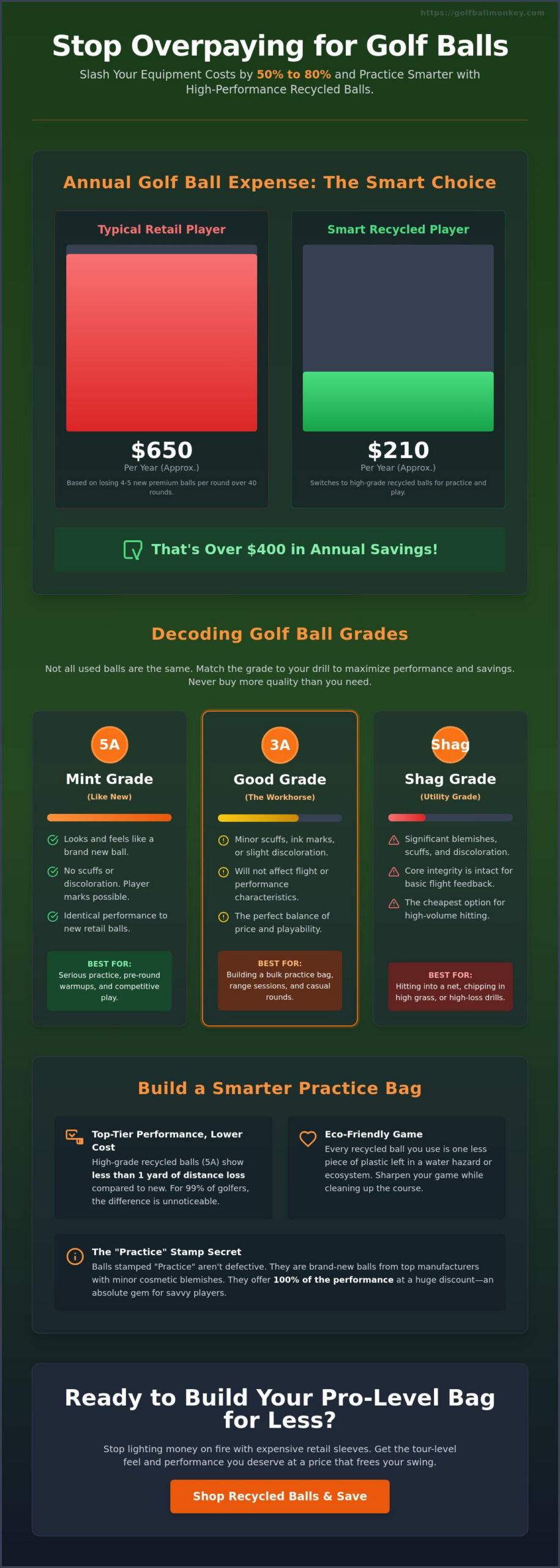
The math is undeniable. Switching to high-grade recycled balls can save you between 50% and 80% compared to buying new premium gear. According to industry data, an average golfer playing 40 rounds a year could cut their annual ball spend from $650 down to approximately $210. That is extra cash for green fees, lessons, or a celebratory round at the 19th hole. The Monkey’s squad of professional divers are the unsung heroes of this equation. They rescue thousands of high-end balls from water hazards, allowing us to pass those Texas-sized savings directly to you.
Choosing recycled gear is also the ultimate green play. Every ball retrieved is one less piece of plastic degrading in a local ecosystem. You’re cleaning up the course while you sharpen your game. It’s a win-win for your handicap and the planet. Check out our Mixed Bag (Good 3A) options to start building your stash today.
The Retail Trap: Why New Balls Are Overkill for Practice
Retailers want you to believe you need a fresh box for every range session. They’re wrong. Modern ball construction is incredibly resilient. Looking back at the history of the golf ball shows us that we’ve moved from fragile designs to high-tech urethane and ionomer covers built for punishment. A ball doesn’t lose its magic just because it took a quick dip in a pond. The retail markup on new boxes covers massive marketing budgets and athlete endorsements. You shouldn’t have to pay for a pro’s private jet just to work on your short game.
Performance Reality Check
Research shows that high-quality recycled balls have a negligible performance difference, often losing less than one yard of distance compared to new ones. For 99% of practice drills, that gap is totally imperceptible. Savvy insiders know that a Mint 5A Titleist Pro V1 performs exactly like a new one, but at a fraction of the cost. A practice ball is a high-value, secondary-market alternative to retail gear that delivers tour-level feedback without the premium price tag. Stop paying for the shiny box and start paying for the performance inside.
Decoding Practice Grades: Shag vs. Practice vs. Mint
Not all cheap practice golf balls are created equal. If you’ve ever stared at a bin of used gear wondering what the heck “3A” or “Shag” means, you aren’t alone. Industry grading scales aren’t just for show. They are your roadmap to saving money without sacrificing the feedback you need. From the pristine “Mint 5A” to the beat-up “Shag” grade, each tier has a specific job in your bag. The Monkey doesn’t do guesswork, and neither should you.
You might also see the “Practice” stamp on certain premium balls. Don’t let that label scare you off. These are often factory-fresh balls that had minor cosmetic blemishes during manufacturing. They aren’t duds. They aren’t damaged. They just didn’t pass the “beauty pageant” at the factory. For a savvy player, these are absolute gold. You get the exact same aerodynamics and compression as the retail version but at a massive discount.
Grade 5A (Mint): The ‘Sunday Best’ for Your Practice
Mint 5A balls are the elite of the recycled world. These look and feel like they just came out of a fresh sleeve. No scuffs. No discoloration. You might find a tiny player mark or a logo, but that’s it. Use these for your high-stakes practice sessions. When you’re working on delicate greenside chips or calibrating your putter, you need the true feel of a premium cover. Check out our Mint 5A grading guide to see how we vet these beauties for your bag.
Grade 3A and Shag: The Workhorses
Now, let’s talk about the grinders. Grade 3A balls, often called “Good” grade, have visible scuffs, ink marks, or slight tan lines from the sun. Shag grade is even more utility-focused, featuring significant blemishes. But here is the secret: the core is still there. If you’re hitting into a net or doing “bomb and gouge” sessions in high grass, why pay for a pretty face? You can get premium cores at rock-bottom prices. These are the ultimate cheap practice golf balls for high-volume reps where ball loss is a guarantee.
Grade 3A is the undisputed sweet spot for building a bulk practice bag. It offers the best balance of performance and price. You get a ball that flies true enough for full-swing feedback but costs so little you won’t blink if it disappears into the pond. It’s about being smart with your equipment. Save the 5A for the short game and load up on 3A for the heavy lifting. If you’re ready to restock, grab a bulk bag from the Monkey and stop worrying about your wallet.
The Best Cheap Practice Golf Balls by Brand
Picking the right brand for your practice bag isn’t just about loyalty. It’s about data. While some golfers think any round object works for drills, savvy players know that brand-specific tech still matters when you’re grinding. You want the same compression and spin profile you’ll see on the course. Loading up on cheap practice golf balls from top-tier brands ensures your practice translates to lower scores. Don’t settle for generic rocks when you can hit the real deal for less.
Callaway is a massive favorite for value hunters. The Chrome Soft offers tour-level spin, while the Supersoft is a dream for players with moderate swing speeds who want a buttery feel. TaylorMade and Srixon also provide high-performance alternatives that frequently cost less in bulk than their Titleist counterparts. If you want the absolute disruptor, look at Kirkland Signature. These urethane-cover balls already have a cult following for their low retail price. When you buy them used, the savings become almost criminal. You get premium greenside control for a price that makes you want to buy a thousand.
Titleist Pro V1: Practice Like a Pro
The Titleist Pro V1 is the gold standard for a reason. If you play it on Sunday, you should hit it on Tuesday. Practicing with the ball you play is vital for consistency. It builds muscle memory for how the ball reacts off the face, especially around the greens. You don’t always need Mint 5A for the range, though. Finding a balance is key. Use 5A for your putting and chipping drills, but grab a 3A Practice Titleist for your full-swing reps. You get the same tour-level core at a fraction of the cost. Check out our Titleist Pro V1 guide to see why this ball continues to dominate the market.
The ‘Mixed Bag’ Strategy
Buying mixed buckets is the ultimate budget move for beginners and high-handicappers. It’s the smartest way to find your preferred “feel” without buying full boxes of every brand. You might discover you love the soft compression of a Bridgestone or the piercing flight of a Srixon just by working through a bucket. Our Mixed Bag (Good 3A) is a top-tier value option for this exact reason. It’s perfect for high-volume reps where you need reliable flight and soft landings. Stop overthinking the brand and start focusing on the reps. The Monkey has already vetted the quality, so you just have to pick your target and fire away.
How to Build Your Ultimate Practice Bag for Pennies
Stop dumping loose gear into your trunk and hoping for the best. A pro-level practice routine requires an organized bag. You don’t need a massive budget to look like a tour player; you just need a strategy. Building a bag with cheap practice golf balls is about matching the ball’s condition to the specific drill you’re grinding on. If you use the same ball for a 300-yard drive that you use for a three-foot putt, you’re flushing money down the drain.
Follow these four steps to maximize your training budget:
- Step 1: Segment your bag. Divide your storage by drill type. Keep your “gamers” separate from your “grinders.”
- Step 2: Assign ball grades. Match quality to consequence. High-stakes drills get high-grade balls.
- Step 3: Buy in bulk. Never buy by the dozen for practice. Savvy players know that 50 or 100-count buckets are the ultimate play for driving down the cost per shot.
- Step 4: Rotate your stock. Move your gear down the ladder of utility. When a chipping ball gets a fresh scuff, demote it to the full-swing bucket.
This rotation ensures you never waste a single core. You’re always practicing with the right level of feedback without overpaying for the privilege.
The Short Game Pocket: Premium Only
You cannot calibrate your hands with a rock. For putting and chipping, only use Mint 5A or high-grade balls. You need that consistent spin and that specific “click” off the wedge face to build real muscle memory. If the ball doesn’t react the way it will on Sunday, your Tuesday practice is useless. Keep these pristine. Use Golf ball accessories like a dedicated towel or pocket brush to keep them clean. Dirt and sand change aerodynamics and ruin your feedback. Treat these like your Sunday best.
The Full Swing Bucket: Quantity Over Quality
When you’re working on your path or contact at the range, cosmetic perfection is a luxury you don’t need. This is where 3A or “Practice” grade cheap practice golf balls shine. They fly true enough to show your shot shape but cost so little you won’t mind if one ends up in the tall grass. Store these in a dedicated shag bag or a sturdy bucket for easy transport. It’s about volume and reps here. Focus on the strike and the flight path rather than the ink marks on the cover. Ready to build your ultimate setup? Score your bulk practice balls from the Monkey and start training like a pro today.
Why Golf Ball Monkey is Your Practice Partner
Choosing where to buy your cheap practice golf balls is just as important as the drills you run. At Golf Ball Monkey, we aren’t just moving inventory. We are fellow enthusiasts who got tired of the retail racket. The “Monkey’s Promise” is simple: we employ professional divers to rescue premium gear, apply a rigorous grading scale, and deliver Texas-sized savings directly to your door. By skipping the retail middleman, we strip away the unnecessary markups that bloat the price of a standard sleeve. You get the performance. We handle the mud.
Our mission is also deeply rooted in the health of the sport. Every ball you buy from our online shop is one less piece of plastic sitting in a water hazard. Golf balls don’t decompose. Left alone, they become permanent pollutants in the very landscapes we love. When you choose recycled gear, you are actively participating in a nationwide cleanup effort. It’s the ultimate way to play a greener game while keeping your bank account in the black. You’re doing right by the planet and your handicap at the same time.
From the Pond to Your Shag Bag
Our retrieval and cleaning process is designed to preserve the physical integrity of every ball. We don’t use harsh chemicals or abrasive stripping methods that ruin aerodynamics. Instead, we focus on careful cleaning and expert grading. Our divers have insider knowledge of the best courses, meaning our inventory is packed with high-end tour balls that were barely used before taking a dip. Buying from us is the smart play for 2026. You get pro-vetted gear without the pro-shop invoice. It is about getting the most reps for the least amount of cash.
Ready to Level Up Your Practice?
Stop lighting money on fire at the retail counter. Start practicing with purpose and a full bag of premium gear. As we discussed earlier, matching your ball grade to your drill is the fastest way to see results without draining your wallet. Whether you need a 100-count bucket of 3A grinders for the range or a fresh set of Mint 5A Pro V1s for your putting mat, we have you covered. Grab a bucket and start saving today. The Monkey has your back, your bag, and your budget.
Take Command of Your Practice Budget
You’ve got the strategy. Now it’s time to execute. Smart practice isn’t about hitting the most expensive ball; it’s about hitting the right ball for the right drill. By segmenting your bag and matching your equipment to your specific training goals, you’ve already won half the battle. You’re saving significant cash and helping the planet one retrieved ball at a time. Every piece of inventory we offer is professional diver retrieved and vetted to meet our rigorous 5A/3A grading standards. This eco-friendly recycling process ensures you play gear that’s as good for the environment as it is for your scoring average.
Don’t let retail markups dictate your progress or limit your reps. Grab the high-performance gear that lets you swing freely without the financial sting of a lost sleeve. It’s the ultimate insider move for any golfer looking to level up. Build your practice bag with the Monkey’s best deals and start shaving strokes off your game today. Your research has led you to the best cheap practice golf balls on the market. Now, get out there, trust your gear, and make every single rep count.
Common Questions About Practice Gear
Are cheap practice golf balls actually good for my game?
Yes, they are a massive win for your handicap. High-quality recycled gear shows a negligible performance difference. Research confirms you lose less than one yard of distance compared to new balls. This allows you to focus on high-volume reps and swing mechanics instead of worrying about the price per swing. It is the smartest way to build muscle memory without the retail sting.
What is the difference between used and recycled golf balls?
Recycled balls are simply used balls that have been professionally retrieved, washed, and graded by condition. They maintain their original factory finish and cover. You should avoid “refurbished” balls. Those are stripped and repainted, which can ruin aerodynamics and lead to inconsistent flight. Stick with recycled gear to ensure you’re getting the true performance of the original core and cover.
Will water-logged practice balls fly shorter distances?
Modern solid-core balls don’t absorb water like the old wound-core versions did decades ago. Studies show that high-grade retrieved balls perform nearly identically to brand-new ones. You won’t see a distance drop that affects your practice feedback. The Monkey ensures every ball is vetted for structural integrity so your flight paths stay true during every session.
How many practice balls should I keep in my shag bag?
Aim for a stash of 50 to 100 balls. This volume lets you find a rhythm during a session without stopping to pick up gear every five minutes. It is also the perfect weight for a standard shag bag or bucket. Keeping this many cheap practice golf balls on hand ensures you always have enough for a full range of drills, from putting to long drives.
Which brand offers the best value for cheap practice balls?
Kirkland Signature is the undisputed disruptor for raw value. They offer urethane covers that react like tour balls for a fraction of the cost. Srixon also provides incredible performance for the price. If you want tour-level feedback, look for 3A Titleist Pro V1s. You get the world’s most popular core at a price point that makes sense for high-volume training.
Can I use ‘Practice’ stamped balls in a tournament?
Yes, you generally can. Most “Practice” stamped balls from major brands are simply cosmetic blems of conforming tour balls. They are identical in construction to the retail versions. Unless a specific event has a “one ball rule” or requires balls to be on a specific list, they are perfectly legal. Check the USGA Conforming Ball List if you’re playing in a high-level sanctioned event.
How often should I replace the balls in my practice bag?
Switch them out when you see deep scuffs, cuts, or cracks. A ball with a compromised cover won’t fly true and will give you bad feedback. You can extend the life of your gear by rotating. Move your slightly worn chipping balls into your full-swing bucket. This ensures you get every cent of value out of your equipment before they hit the retirement bin.
Is it better to buy practice balls in bulk or by the dozen?
Bulk is the only savvy way to buy cheap practice golf balls. Purchasing 50 or 100-count buckets significantly reduces your cost per ball compared to buying dozen packs. It is the smartest way to stock up for a full season of training. Buying in bulk also means you’ll always have a consistent supply, so you never have to skip a session because you’re low on gear.
Cheap Practice Golf Balls: The Ultimate Guide to Saving Your Game (and Wallet) in 2026
Paying $5.50 every time you slice a ball into the woods is a choice, not a necessity. It’s a gut punch to your bank account that sucks the fun right out of the game. Let’s be honest; most golfers are literally flushing money down the fairway because they think retail prices are the only way to get quality. You need high-performing cheap practice golf balls and cheap golf balls that actually feel right, not those rock-hard distance balls that feel like hitting a marble. Finding premium gear shouldn’t feel like a chore or a gamble on a confusing grading scale.
We agree that the elitism in golf equipment has gone too far. You deserve tour-level spin and that soft, buttery feel without the soul-crushing price tag. This guide shows you exactly how to stock your shag bag with bulk Titleist or Callaway gems while saving 50 to 80 percent off 2026 retail prices. The Monkey has vetted the sources and decoded the grading scales so you don’t have to. We’re diving into the best ways to build a pro-level stash for a fraction of the cost. Get ready to play smarter and stop overpaying for every single swing.
Key Takeaways
- Stop flushing cash on $50 dozens and learn how to identify high-value scores on cheap golf balls that keep your wallet fat and your game sharp.
- Decode the grading scale from Mint 5A to Hit-Away to ensure you never overpay for cheap practice golf balls for your training sessions again.
- Learn why choosing cheap practice golf balls and recycled cheap golf balls with urethane covers beats hitting new “distance rocks” every time.
- Build a “scuffer” bag strategy based on your personal loss rate to save money with cheap golf balls without sacrificing performance on the green.
- Get the inside scoop on the “Monkey Vetted” process that delivers five-star, tour-level cheap practice golf balls at a massive discount.
Why You’re Overpaying for Golf Balls (and How to Stop)
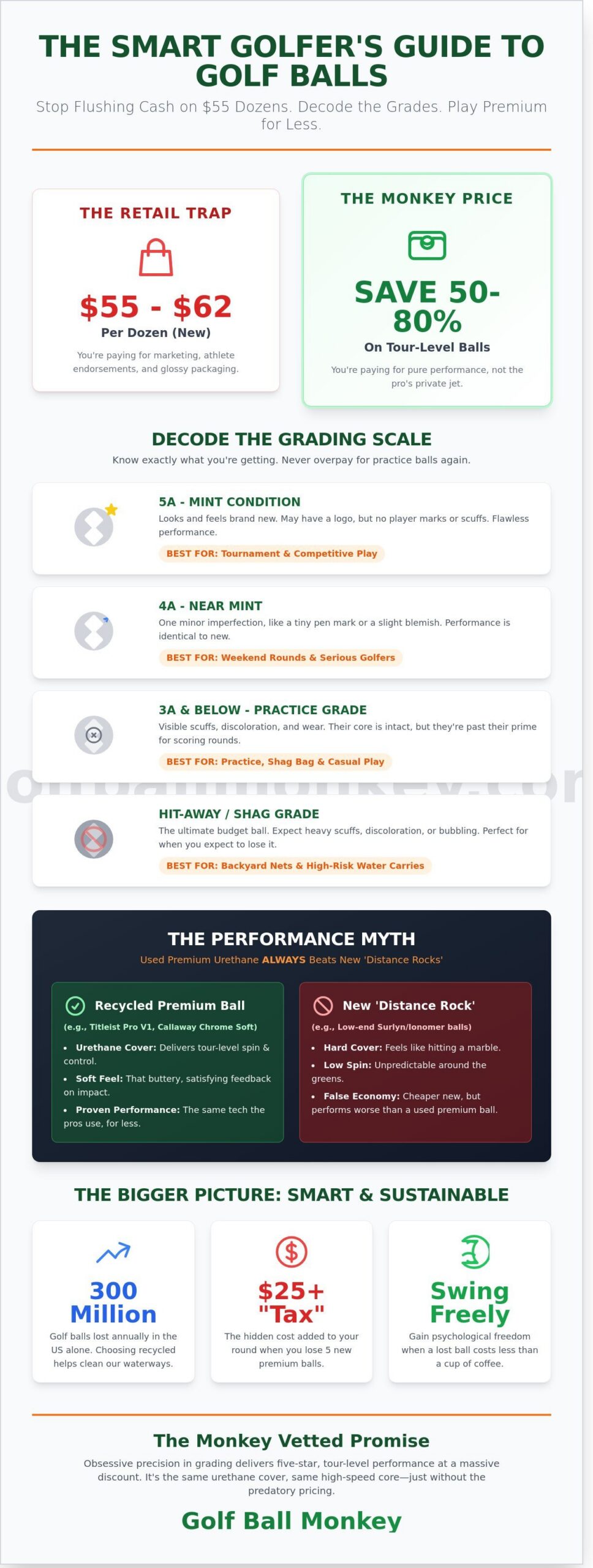
Walking into a big-box sports store in 2026 feels like a heist, but you’re the one getting robbed. Major manufacturers now demand $55 to $62 for a single dozen of tour-level balls. That is nearly $5 per swing. This “Retail Trap” relies on the myth that you need a brand-new, shiny box to play your best. In reality, you’re paying for massive marketing budgets, multi-million dollar athlete endorsements, and glossy packaging that ends up in the trash five minutes after you reach the first tee. It’s time to break the cycle.
Defining cheap golf balls isn’t about finding the lowest quality product. It is about maximizing your value-per-swing. In 2026, the smart play is recognizing that a ball’s performance doesn’t vanish the moment it touches grass. Modern ball construction is incredibly durable. When you look at the history of the golf ball, you see a shift from delicate feathers and gutta-percha to high-tech polymers designed to last hundreds of high-impact strikes. Choosing recycled or cheap practice golf balls is a financial win that also keeps millions of pounds of plastic out of our waterways. It’s the ultimate double-eagle for your wallet and the planet.
The True Cost of a Lost Ball
Most golfers pay a “Per Round Tax” without even realizing it. If you lose five premium balls during 18 holes, you just added $25 to your greens fee. This creates “swing tension,” a psychological grip that tightens your muscles because you’re terrified of losing a $5 bill in the pond. Switching to balls that cost 75% less provides immediate psychological freedom. You’ll swing smoother and take braver lines when the cost of a mistake is less than a cup of coffee. That mental shift alone can shave three strokes off your scorecard.
What Makes a Golf Ball ‘Cheap’?
Price gaps exist because of the supply chain, not just the core material. Big-box retailers apply markups of 40% or more to cover their rent and staff. Direct-to-consumer models and professional recovery operations bypass these costs entirely. Professional divers recover over 300 million lost balls annually, many of which were lost on the very first hole. These aren’t “old” balls; they’re premium equipment that took a short swim.
This is where the magic happens. By sourcing these high-end models and grading them with obsessive precision, Golf Ball Monkey can offer “Monkey Prices” on the same brands you see on TV. You get five-star, mint-condition performance for a fraction of the retail cost. It’s the same urethane cover and the same high-speed core, just without the predatory pricing. Stop paying for the logo’s advertising budget and start paying for your next round of drinks at the 19th hole instead.
Shag Balls vs. Practice Balls: What’s the Real Difference?
Stop overpaying for shiny boxes at the pro shop. To play like a pro without the trust fund, you need to master the lingo of the secondary market. Not every round requires a pristine, out-of-the-sleeve Titleist. Understanding the difference between shag, practice, and range balls is the first step toward cutting your equipment costs by 60% or more. Range balls are those striped, limited-flight rocks owned by the course. You don’t want those in your bag. Shag and practice balls, however, are the secret weapons of the savvy golfer.
Grading scales are the industry standard for quality. Most reputable sellers use a 5-point system. 5A (Mint) balls look and feel brand new. 4A (Near-Mint) might have a tiny pen mark or a microscopic blemish. Once you hit 3A and below, you enter the territory of cheap practice golf balls. These are the workhorses. They have seen some action, but their cores remain intact. The Monkey Grade promise ensures transparency; if a ball is graded for the backyard, we won’t tell you it’s ready for the club championship.
Every year, golfers lose an estimated 300 million balls in the United States alone. This creates a massive environmental impact of lost golf balls, particularly in fragile ecosystems. Choosing recycled cheap golf balls isn’t just a smart financial play; it’s a rescue mission for the planet. By 2026, the demand for recycled gear has surged by 22% as players realize that a few scuffs don’t dictate their handicap.
The Shag Bag Essential: Hit-Away Grade
Hit-Away grade balls are the ultimate budget solution. Expect heavy scuffs, significant discoloration, or even some bubbling on the cover. These aren’t for your Sunday morning foursome. Use these for backyard practice, hitting into a net, or those “dangerous” 180-yard carries over a lake where the survival rate is less than 10%. At a price point typically between $0.15 and $0.25 per ball, you can lose a dozen without a second thought. They are structurally sound enough to provide real feedback on your contact without the $5.00-per-swing anxiety.
Practice Grade: The Mid-Tier Workhorse
Practice grade is the “Goldilocks” zone for high-handicappers. These balls are perfect for short game drills and chipping greens. You’ll find minor surface abrasions, but the aerodynamics remain reliable for shots under 100 yards. The key is identifying the difference between a cosmetic scuff and a performance-limiting scar. A scuff is just a “grass burn” on the finish. A scar is a deep cut that catches your fingernail; those belong in the woods. For most players, these offer the best bang for your buck because they behave predictably on the green. If you’re looking to sharpen your game, it’s time to consider restocking your bag with a bulk bucket of these reliable performers. You get the spin you need at a fraction of the retail cost.
- Mint 5A: The “Wedding Day” ball. Flawless.
- Near-Mint 4A: The “Daily Driver.” High quality, low ego.
- Practice 3A: The “Drill Master.” Best for chipping and high-volume reps.
- Hit-Away: The “Water Hazard Hero.” Cheap, functional, and disposable.
The Performance Myth: Used Premium Balls vs. Cheap New ‘Rocks’
Don’t let the shiny cellophane at the big-box store fool you. Those $20-a-dozen “distance” balls are often nicknamed “rocks” for a reason. They feel like hitting a marble with a hammer. When you hunt for cheap golf balls, you usually choose between a brand-new ball with zero tech or a premium used ball that actually performs. The choice is easy. A used Titleist Pro V1 outperforms a new value-brand ball on every single metric that matters to your scorecard. The Monkey knows that smart players prioritize construction over a “new” label every time.
The core issue is the cover material. Most budget balls use Surlyn, a hard ionomer resin. It’s durable and cheap to produce, but it has the friction coefficient of a slip-and-slide. Premium balls use Urethane. This softer material allows the club grooves to “grab” the ball, creating the backspin required to stop a shot on the green. Even a three-year-old Urethane ball provides more greenside control than a Surlyn ball fresh out of the factory. If you check the USGA rules on practice golf balls, you’ll see that many of these high-performing “practice” stamped balls are identical in construction to their tour-level siblings. They aren’t broken; they’re just a massive bargain.
Spin, Feel, and Control
Golf is won inside 100 yards. Premium used balls keep their spin. A 5-star quality used Pro V1 still generates 10,000+ RPM on a full wedge shot. A new “rock” might struggle to hit 6,500 RPM. That is the difference between a hop-and-stop birdie putt and a ball that screams off the back of the green into a bunker. You also have to consider the “click” factor. Cheap balls sound harsh and metallic at impact. Premium Urethane balls offer a muted, soft thud that provides instant feedback. Practicing with the same ball you play on the weekend is the fastest way to dial in your distances. Using inconsistent cheap practice golf balls just confuses your internal clock.
Dispelling the ‘Water-Logged’ Myth
Many golfers fear that a ball found in a pond is a heavy, water-logged sponge. This is a myth left over from the days of wound-balata balls. Modern multi-layer balls use solid cores and high-tech polymers that are virtually impermeable. In a 2023 performance test, balls submerged for 24 hours showed zero weight gain and exactly 0.0% distance loss. Even after a full weekend in the drink, the performance drop-off is less than 1%, which is a distance change of about 2 feet for a 250-yard drive. Most golfers cannot hit their driver with 2-foot precision anyway.
The Monkey has vetted the data so you don’t have to worry. According to current polymer research, a golf ball must be submerged in a high-pressure environment for over 72 hours before moisture begins to penetrate the protective outer mantle and affect core resilience. This means that 99% of recycled balls are ready to rip. You get 100% of the performance for a fraction of the cost. Stop paying the “new ball tax” and start playing the smart play. It’s a steal for your game and a win for your wallet.
How to Build Your Perfect Practice Bag for Less
Stop flushing your hard earned cash down the drain. If you want to play like a pro without the country club bill, you need a system. Building a practice bag isn’t just about grabbing the first bag of cheap golf balls you see. It is about strategy. Follow these four steps to optimize your inventory and keep your wallet fat.
Step 1: Audit your loss rate. Track your stats for exactly five rounds. If you are losing an average of 4.2 balls per 18 holes, you are burning through a dozen balls every three games. At retail prices, that is a $55 tax on your hobby every two weeks. Identifying this number tells you exactly how many cheap practice golf balls you need to order to survive the season.
Step 2: Segment your bag. Don’t use a Mint-grade ball for a 170-yard shot over a lake. Keep two “Game Balls” for clean fairways and use “Scuffers” or Grade B balls for the hazard-heavy holes. This simple split can extend the life of your premium stash by 40%.
Step 3: Buy in bulk. Shipping costs are the silent killer of golf savings. Ordering a single dozen is a rookie mistake. Moving to 48 or 96-ball increments usually triggers free shipping and drops your price-per-ball by an average of $0.15. That adds up to $14.40 in pure savings on a 96-count order.
Step 4: Match your swing speed. A cheap ball that doesn’t fit your swing is a waste of money. If your swing speed is under 90 mph, look for low-compression ionomer covers. If you are swinging at 105 mph or higher, hunt for recycled urethane models to maintain control. The Monkey ensures every ball is graded accurately so you get the performance you pay for.
The Bulk Buying Strategy
The 48 and 96-ball buckets are the undisputed champions of value. In 2026, logistics costs make small orders inefficient. Buying 96 balls at once reduces the packaging waste and maximizes the weight-to-shipping ratio. Store your bulk stash in a cool, dry place like a climate-controlled garage. Keep temperatures between 60 and 75 degrees Fahrenheit to ensure the core integrity remains perfect for years. Small clubs can save an additional 12% by setting up wholesale accounts for their junior programs.
Practice Drills for Cheap Balls
Use your bulk stash for the “100 Ball Challenge.” Set up 20 yards from a target and chip 100 balls in a single session. This high-volume repetition builds muscle memory that you just can’t get when you’re worried about losing a $5 ball. Use your mixed bags to test different brands during these sessions. It is the ultimate low-risk way to find a new favorite brand without paying the $50 retail entry fee. For high-pressure practice, hit 20 balls over a water hazard. Removing the financial fear of a “splash” allows you to focus entirely on your tempo and swing path.
Ready to stop overpaying and start playing? The Monkey has already vetted the best inventory for your next session. Grab a bulk bucket of practice balls and save 60% compared to retail prices today.
Join the Troop: Why Golf Ball Monkey is the Smart Play
Golf Ball Monkey didn’t start in a corporate boardroom. We started in the humid ponds of Texas back in 2014. We were golfers first, and we were tired of the “retail tax” on every round. Why pay $55 for a box of balls when you might lose three of them before the turn? We decided to change the game. Today, we operate across 14 different states, recovering the high-performance equipment that other players leave behind. We’ve turned a local diving operation into a massive mission to make golf accessible for everyone, regardless of their budget.
Quality control is where we separate ourselves from the pack. Our “Monkey Vetted” process is legendary in the industry for its strictness. We process over 5.2 million balls annually, and every single one passes through a 10-step manual inspection. We don’t use automated scanners that miss hairline cracks or scuffs. Our team handles every ball to ensure the grading is honest. When you buy from us, you aren’t getting a mystery bag. You’re getting gear that has been verified for flight stability and cover integrity. If a ball doesn’t meet our Five-Star or Near-Mint standards, it gets demoted immediately.
Speed matters when you have a tee time on Saturday. We pride ourselves on a 24-hour shipping turnaround for 98% of our orders. You won’t be waiting weeks to restock your bag. Plus, our Monkey Price guarantee ensures you’re always getting the best deal in the industry. If you find a lower price on the same grade of recycled balls, we want to hear about it. We keep our overhead low and our volume high so we can pass those savings directly to you.
Beyond the savings, your purchase makes a real impact on the environment. A single golf ball can take between 100 and 1,000 years to decompose in a water hazard. They leach heavy metals and microplastics into the ecosystem. This year alone, our divers have pulled 12 tons of plastic out of American waterways. By choosing recycled gear, you’re helping us clean up the courses we all love. It is a rare win-win situation where you save money while protecting the local wildlife and water quality.
Our Most Popular Value Picks
If you need cheap practice golf balls for the backyard or the local range, our Mixed Bag (Good 3A) is the ultimate choice. These balls show some cosmetic wear but offer 100% functional performance for a fraction of the retail cost. For the brand loyalists, our Premium Practice Buckets feature Titleist, Callaway, and TaylorMade models at up to 70% off MSRP. Our professional divers spend over 1,500 hours underwater each year to find these gems, ensuring our inventory is always stocked with the names you trust.
Ready to Restock?
Don’t let the high cost of equipment keep you off the fairway. Check out our current deals on cheap golf balls and find the perfect grade for your next round. For even deeper savings, sign up for the “Monkey Mail” newsletter. Our subscribers get first dibs on bulk discounts and exclusive alerts when we drop new Mint-condition inventory. Stop overpaying for shiny packaging and start playing smarter today. Your wallet, and your scorecard, will thank you.
Stop Donating Your Paycheck to the Water Hazard
Stop overpaying for brand-new “rocks” when you can get tour-level performance for a fraction of the cost. You now know that the performance gap between a $5 retail ball and our reclaimed gems is a total myth. Our Texas-based professional diving team recovers over 10 million balls annually; giving you access to the best brands at Monkey prices. Every ball in our Mint 5A selection comes with a quality guarantee that ensures it looks, feels, and flies like it just came out of the box. Building a perfect bag for 2026 means being smart with your spend. By stocking up on cheap practice golf balls, cheap golf balls, and premium recycled gear from a trusted source, you save enough cash to book an extra round every month. Don’t let elitism ruin your handicap or your bank account. It’s time to play the smart way and keep your head in the game, not in your wallet.
Get Tour Performance at Monkey Prices: Shop Our Bulk Deals Now!
Grab a bag, hit the links, and go low without the stress of a lost ball.
Frequently Asked Questions
Are cheap practice golf balls good for actual rounds of golf?
Yes, you can absolutely use high-grade cheap practice golf balls for your Sunday round. Our 5A Mint balls deliver 99% of the performance of a brand-new sleeve at a 60% discount. The Monkey vets every ball to ensure the cover is intact and the core is solid. You get tour-level spin without the heart-wrenching $5 per ball price tag when you inevitably find the water.
What is the difference between recycled and refurbished golf balls?
Recycled balls are recovered, washed, and sorted by grade, while refurbished balls are stripped and repainted. We focus on recycled stock because it preserves the original factory finish and clear coat. Data shows that recycled balls maintain their aerodynamic properties better than repainted ones. You get the authentic feel of a premium ball for a fraction of the cost, keeping your game and the planet green.
How much can I save by buying used golf balls in bulk?
You can save as much as 75% compared to big-box retail prices by purchasing in bulk. While a new dozen might cost $55, our bulk bags of 100 cheap golf balls often bring the price down to just $0.45 per unit. This massive savings means you can swing aggressively over hazards without sweating the cost. It is the smartest play for golfers who play 2 or more rounds per week.
Will using scuffed practice balls damage my clubs?
Scuffed balls won’t break your expensive titanium driver, but they will definitely ruin your scorecard. A single deep scratch can cause a ball to deviate 10 yards offline during a 250-yard drive. We recommend using our 3A grade for backyard chipping and saving the 5A Mint balls for the course. Your clubs stay safe; however, your accuracy depends on the quality of the surface you hit.
How do I know which grade (5A, 4A, 3A) I should buy?
Choose your grade based on your specific needs for the day. Buy 5A Mint for tournament play where you want zero imperfections. Select 4A Near-Mint for casual rounds with friends where a tiny ink mark doesn’t matter. Grab the 3A grade for high-volume practice sessions. This grading system ensures you never pay for more quality than you actually need, keeping your wallet heavy and your bag full.
Does Golf Ball Monkey offer shipping discounts for large bulk orders?
The Monkey loves a big haul, so we offer free shipping on all orders over $99. Most bulk bags of 50 or 100 balls easily hit this threshold, meaning you don’t pay a cent for delivery. We ship 95% of orders within 24 hours of purchase. It’s a fast, efficient way to restock your garage without driving to the pro shop and paying those inflated retail markups.
Can I find specific brands like Titleist Pro V1 in the practice ball section?
You will frequently find Titleist Pro V1, TaylorMade TP5, and Callaway Chrome Soft in our inventory. These premium models make up about 40% of our recycled stock at any given time. You get the same dual-core technology and urethane covers used by the pros for a steal. Check our site daily, as these high-demand Monkey prices on premium brands tend to disappear faster than a slice into the woods.
What happens if I’m not happy with the quality of my used balls?
We offer a 100% satisfaction guarantee with a 30-day return window if the balls don’t meet your expectations. If your 5A order looks more like a 4A to you, we will make it right immediately. Our goal is to build a community of savvy golfers, not just sell a single bag. We stand behind every ball the Monkey sorts, ensuring you feel confident with every swing you take.
- golfballmonkey@gmail.com
- (512) 593-8401
- Mon – Fri, 9:00 AM – 5:00 PM

All product and company names are trademarks™ or registered® trademarks of their respective holders.
Use of them does not imply any affiliation with or endorsement by them.