
Used Golf Balls for Driving Range: The Savvy Guide to Bulk Savings in 2026
Why are you still shelling out premium prices for “new” range buckets that look like they’ve been through a blender after three swings? It is a common trap. You want to dial in your yardages, but you’re stuck hitting “hit-away” rocks that feel like marbles and fly like wounded ducks. We know the frustration of overpaying for equipment that scuffs on the first impact. Finding reliable used golf balls for driving range practice shouldn’t feel like a gamble. You deserve a consistent flight path without the retail markup or the soul-crushing shipping costs of heavy bulk orders.
The smartest play happens before you even reach the tee box. We agree that it is time to stop subsidizing the golf industry’s “new ball” obsession and start practicing like a pro on a budget. This savvy guide will show you exactly how to source high-quality 3A or 4A practice balls in bulk while slashing your expenses. We will dive into the truth about grading scales, reveal the best ways to avoid shipping sticker shock, and help you find a supplier that treats your game with the respect it deserves. Get ready to stock up and swing with confidence.
Key Takeaways
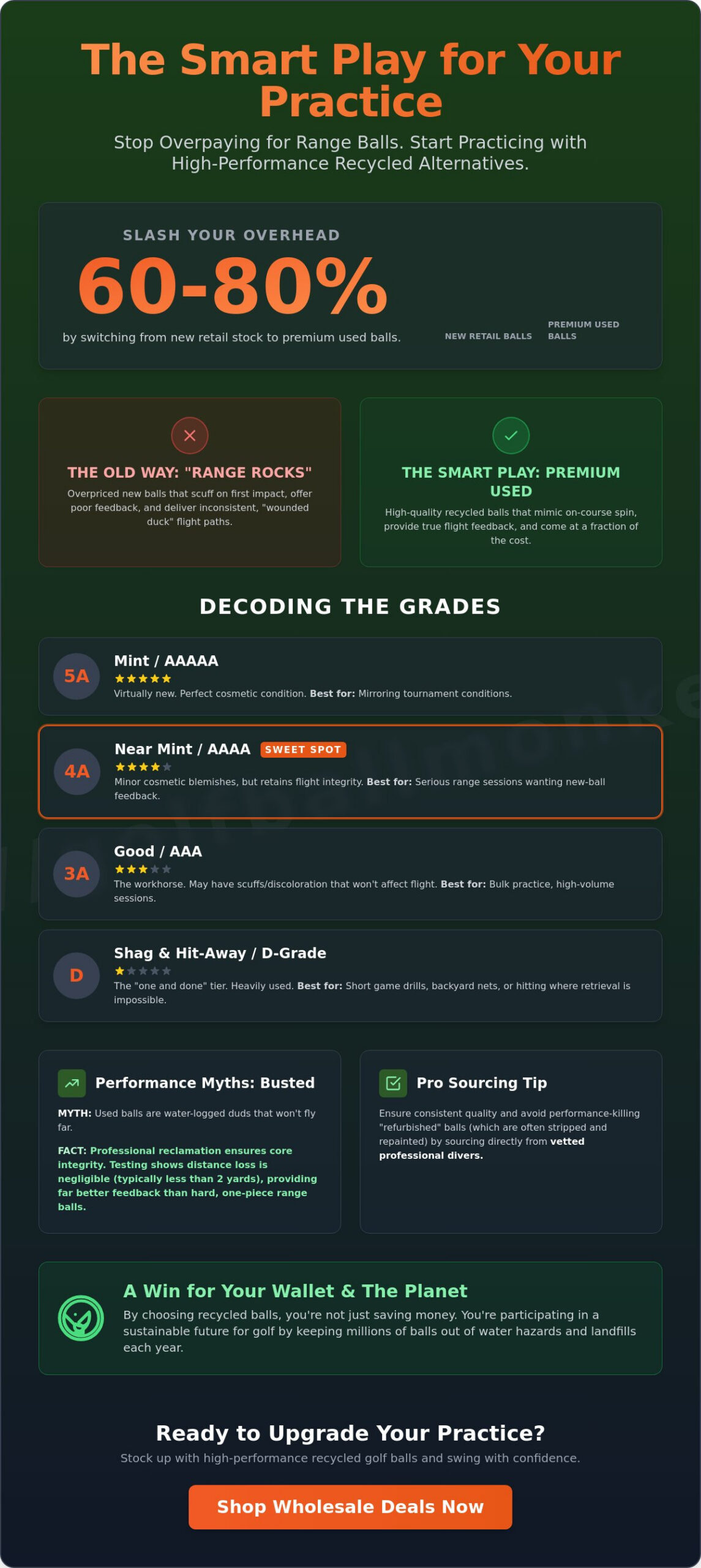
- Slash your practice overhead by 60 to 80 percent by switching from overpriced retail stock to high-performance recycled alternatives.
- Master the grading system to distinguish between high-quality 4A practice balls and “one-and-done” hit-away options.
- Improve your practice feedback by using premium used golf balls for driving range sessions that mimic real-course spin and launch.
- Streamline your inventory by calculating weekly ball loss and rotation rates to maximize bulk savings on every order.
- Source directly from vetted professional divers to avoid performance-killing refurbished balls and ensure consistent quality.
Stop Wasting Money: Why Used Golf Balls for Driving Range Use are the Smart Play
Stop burning cash on overpriced buckets. Retail range balls are a recurring nightmare for your bottom line. They scuff, they’re expensive, and they vanish into the woods before you can say “fore.” 2026 is the year to pivot. Savvy operators and serious players are switching to used golf balls for driving range use because the math simply doesn’t lie. You get premium performance without the premium tax. It’s the ultimate hack for anyone looking to maximize their practice hours without draining their bank account.
The Economics of the Practice Tee
Think about your cost per hit. Buying brand new range stock is a high-stakes game. You’re paying for “newness” that disappears after the first wedge shot. Reclaimed premium stock changes the equation. You can slash your overhead by 60 to 80 percent. That is a massive win for your margin. Stop paying the “lost ball” tax. Every ball that goes over the fence or into the pond hurts less when you didn’t pay retail prices for it. Finding a reliable source for used golf balls for driving range inventory means you can restock without the financial headache. Grab the same quality at a fraction of the cost at our online shop.
Performance Myths Debunked
Let’s kill the rumors. People think used balls are water-logged duds that won’t fly. That’s a myth. Professional reclamation focuses on Golf ball design and regulations to ensure the core integrity remains intact. Testing shows distance loss is negligible. It’s usually less than a couple of yards; nothing that will ruin your practice session. In fact, hitting a 3A or 4A used Titleist or Srixon provides way better feedback than those hard, one-piece “range rocks” that feel like hitting a brick. You want consistent spin and launch. Used premium balls deliver exactly that. Our grading system ensures you get exactly what you pay for, whether it’s a Near-Mint 4A or a solid 3A “Good” condition ball.
It isn’t just about the money. Millions of balls end up in water hazards every year. They sit there, doing nothing but taking up space and creating environmental waste. We send in the divers. We bring them back to the surface. It is a massive environmental win that keeps the course clean and your bag full. You’re saving the planet while saving your wallet. That’s what we call a win-win. By choosing recycled gear, you are actively participating in a more sustainable future for the sport. It’s the intelligent play for 2026.
Decoding the Grades: Shag, Practice, and Hit-Away Balls Explained
Don’t just buy a bucket of mystery spheres. Understanding the grading system is the secret to getting the most bang for your buck. When you’re sourcing used golf balls for driving range use, you’ll see everything from “Mint” to “D-Grade.” Each tier serves a specific purpose. Buying a 5A ball for a lake-front target is a waste of money. Conversely, hitting D-Grade rocks for your launch monitor calibration will give you junk data. Match the ball to the drill. It’s the intelligent way to train.
At the top of the food chain, you have Mint 5A. These are basically brand new. If your practice session needs to mirror tournament conditions exactly, this is your play. Moving down, 3A and 4A grades represent the “Practice” sweet spot. These balls have minor cosmetic blemishes but retain their flight integrity. They are the workhorses of serious range sessions. They fly true, spin right, and won’t break the bank. Most golfers find that 4A balls provide identical feedback to new balls at half the cost.
What is a Shag Ball?
Shag balls are the utility players of your equipment bag. These are often scuffed, discolored, or carry a stray Sharpie mark from a previous owner. They are perfect for repetitive drills where you’re hitting hundreds of shots into a backyard net or working on your short game. If you’re working on your chipping or pitching, a few scuffs won’t kill your progress. Shag balls are the ultimate value play for high-volume practice.
Hit-Away vs. Range Grade
Hit-Away balls, also known as D-Grade, are the “one and done” option. These are the lowest tier. Use them in places where you won’t retrieve them, like hitting off a pier or into a canyon. However, be mindful of the environmental impact of lost golf balls as they break down into microplastics. While they are incredibly cheap, they are basically rocks. Don’t expect a consistent flight path. They are strictly for the thrill of the hit, not for sharpening your swing.
In contrast, Range Grade balls are built for uniformity. Commercial setups love these because they provide a consistent experience for every customer. They are durable enough to survive the mechanical picker and the wash cycle a thousand times over. If your retrieval setup involves a tractor and a cage, stick to Range Grade or high-quality 3A mixes. This ensures your clientele gets a predictable flight without you overpaying for “Mint” aesthetics. Ready to restock your supply? Check out the latest inventory tiers and make the smart play for your game today. You can always find a better deal when you shop with the insiders.
Range Balls vs. Premium Used Balls: Which One Sharpens Your Game?
Stop settling for the “range rock” lie. Most standard range balls are designed for one thing: survival. They have hard, thick covers meant to withstand a beating from the mechanical picker and the wash cycle. But that durability comes at a heavy cost to your performance. They don’t spin. They don’t feel right. They fly like stones. If you’re trying to dial in your wedge game or work on shot shaping, those generic yellow spheres are actively working against you. They provide junk feedback that simply doesn’t translate to the course.
Switching to premium used golf balls for driving range sessions changes the entire dynamic of your practice. When you hit a recycled urethane ball, you get real data. You see the true launch angle. You feel the soft compression. Most importantly, you see the actual spin rate. A standard range ball might slide up the club face, giving you a high, weak flight. A premium used ball bites. It reacts the way a ball should. This creates a meaningful feedback loop that helps you make real adjustments to your swing instead of chasing “range-only” yardages.
Why Practice with Titleist Pro V1?
Consistency is the name of the game. If you play a Pro V1 on Sundays, you should be hitting them on Tuesdays. Practicing with the same ball you play builds a deep “feel” for distance control and trajectory. You’ll know exactly how the ball will behave when it lands on the green because you’ve seen it a thousand times on the range. Check out our guide on Titleist Pro V1 for the full tech specs on why this ball dominates. Comparing used Pro V1s to brand new generic range balls is a no-brainer. For a similar price, you get the top ball in golf instead of a nameless one-piece sphere. It’s the ultimate performance upgrade for your practice routine.
The “Range Rock” Problem
Generic range balls usually feature a one-piece construction. They are solid cores of synthetic material. Premium balls are multi-layered masterpieces. They have soft inner cores and thin urethane covers. Hitting “rocks” all day isn’t just bad for your feel; it’s tough on your gear. Those hard covers can accelerate club face wear over thousands of reps. Recycled used golf balls for driving range use are softer on your irons. They take the hit so your clubs don’t have to. You get better practice, better feedback, and a psychological edge when you step onto the first tee knowing your game is tuned for the real thing. Make the smart play and ditch the rocks for good.
Buying in Bulk: How to Source Thousands of Practice Balls
- Step 1: Calculate your burn rate. Determine your weekly ball loss and rotation rate. If you’re losing 10 percent of your stock to the woods or ponds every month, you need a replenishment plan that keeps pace.
- Step 2: Pick your lane. Match your grade to your clientele. If you’re a high-end club, stick to 4A Near-Mint. For a local muni, a 3A “Good” mix provides the best ROI.
- Step 3: Go wholesale. Don’t wait until your bins are empty. Set up recurring deliveries to ensure you never run dry. This keeps your practice sessions consistent and your customers happy.
- Step 4: Audit your shipping. 1,000 golf balls weigh roughly 100 pounds. Bulk weight can kill your margins if you aren’t careful. Look for suppliers with national reach and optimized freight to keep those costs down.
Wholesale vs. Retail Bulk
There is a massive difference between a “bulk pack” at a big-box store and a true wholesale crate. When you move from the 100-pack to the 1,000-count crate, you unlock a new tier of savings. View our Bulk Golf Balls section for current inventory and blowout pricing. We handle custom requests too. Whether you need specific striped range balls for visual tracking or mixed brand buckets for maximum variety, we have the stock to fill your order. Buying at this level turns a recurring expense into a manageable asset.
The Monkey’s Logistics Tips
Storage is key. Use stackable, ventilated bins to prevent moisture buildup and keep your inventory organized. Clean your stock regularly. A quick wash keeps the dimples clear and the flight true, extending the life of your balls. Our professional divers work around the clock to maintain a steady supply for our used golf balls inventory. They brave the hazards so you get the best gear. It is a dirty job, but it ensures you always have access to high-performance equipment at the lowest possible price point. Secure your wholesale shipment and start saving today.
The Golf Ball Monkey Difference: Wholesale Quality for Every Range
We don’t just sell gear. We hunt it. While other retailers wait for shipments to arrive at their warehouse, we are in the water. Our team of professional divers braves the hazards of top-tier courses to bring you the best used golf balls for driving range use in the country. We are the savvy insider’s first call. Why? Because we cut out the middleman and pass every cent of those savings directly to you. It is the intelligent play for your budget and your game.
The Monkey personally vets every batch. We use a standardized grading scale that acts as a verbal seal of approval. When you order a 4A “Near Mint” crate, you get exactly that. No filler. No “hit-away” surprises hidden at the bottom of the bin. Our Texas-based operation has a national reach, ensuring fast, reliable shipping across the USA. We know bulk weight can be a margin-killer. That is why we’ve optimized our logistics to keep your equipment costs low and your inventory high.
Our Professional Retrieval Process
Success starts at the source. We harvest millions of balls every year from exclusive clubs and premium resorts. These aren’t your average scuffed-up finds. Our cleaning and sorting tech is state-of-the-art. We strip away the grime without damaging the cover integrity. This ensures “Monkey Approved” quality in every shipment. Our Shag and Practice balls outlast the competition because they were high-performance balls to begin with. We prioritize the core physics. You get a ball that maintains its flight characteristics long after generic alternatives have given up. It is recycled performance at a blowout price.
Ready to Stock Up?
Stop overpaying for retail fluff. Whether you are a solo stick looking to sharpen your short game or a commercial range manager needing thousands of units, we have you covered. We offer direct-to-consumer savings on the biggest names in the sport. Titleist, Callaway, TaylorMade; they are all here. For those managing high-traffic facilities, our wholesale agreements provide a steady, recurring supply of used golf balls for driving range rotations. Never run dry again. Experience the thrill of a significant bargain without sacrificing a single yard of distance. Your game deserves the best, and your wallet deserves a break. Grab your bulk practice balls today and save!
Level Up Your Practice Game Today
You’ve got the blueprint. Now it’s time to execute. Stop letting “range rocks” dictate your swing and start practicing with the same gear you play on Sundays. Matching your drill to the right grade, whether it’s Shag balls for chipping or 4A Near Mint for the long game, is the savvy way to sharpen your skills. Finding high-quality used golf balls for driving range sessions has never been easier or more cost-effective. You’re saving the planet and your wallet with every swing.
The Monkey has your back with professional diver-retrieved inventory and strict 5A to 3A grading scales. We handle the heavy lifting with reliable national US shipping on all bulk orders so you can focus on your follow-through. It’s the intelligent play for 2026. Ready to restock? Shop Bulk Practice & Range Balls Now and join the community of smart players who refuse to pay retail. Keep it light. Keep it fast. Your best season is just one bucket away.
Frequently Asked Questions
Are used golf balls good for driving ranges?
Yes, they are actually better for your game than standard “range rocks.” Using used golf balls for driving range practice gives you realistic spin and launch data that generic one-piece balls can’t match. You get the same feedback you’d feel on the course. It’s the smart way to ensure your range sessions actually translate to lower scores on the weekend.
What is the difference between practice balls and regular golf balls?
Practice balls are usually recycled premium balls with minor cosmetic flaws, while regular balls are brand new retail stock. Generic range balls are a different beast entirely. They use a durable one-piece construction meant to survive a tractor picker. Recycled practice balls use the same multi-layer tech as the balls in your tournament bag, giving you a massive performance edge during training.
Will used golf balls damage my golf simulator or net?
No, provided you choose high-grade options like our 4A or 5A inventory. Dirty or cracked balls can scuff a screen, but our professionally cleaned recycled balls are safe for indoor use. In fact, the softer urethane covers on premium used balls are often easier on your simulator screen than the hard, abrasive covers found on generic new range balls.
How many golf balls come in a bulk range order?
Bulk orders typically start at 300 balls and can go up to 1,200 or more per crate. We offer various tiers to fit your storage capacity and burn rate. For commercial ranges, we coordinate massive shipments that arrive in large containers. For home setups, the 300-count “Mixed Bag” is the most popular choice for keeping the bins full without taking up the whole garage.
Do used range balls lose their compression over time?
Compression loss is almost non-existent in modern multi-layer balls. Unless a ball has been submerged in a pond for several years or left in a boiling trunk for a decade, the core stays snappy. Professional reclamation ensures you aren’t getting “water logs.” You’ll get consistent distance and feel that lasts through hundreds of heavy practice reps.
Can I buy specific brands like Titleist or Callaway in bulk for practice?
Yes, you can snag specific premium brands like Titleist Pro V1 or Callaway Chrome Soft in bulk quantities. We specialize in providing brand-specific inventory so you can practice with the exact ball you play. This builds a consistent “feel” for your yardages. It’s the ultimate insider secret for serious players who want tour-level practice on a muni budget.
How long do used practice balls typically last before needing replacement?
A high-quality used ball can handle dozens of full-swing impacts before scuffing affects its flight path. High-volume ranges usually rotate their stock every few months to keep the bins fresh for customers. For a home net setup, a 100-pack of 3A or 4A balls could easily last you an entire season. Just keep them clean to maximize their lifespan.
Is it cheaper to buy used golf balls than new range balls?
Absolutely, it’s the biggest cost-saver in the game. You can expect to save 60 to 80 percent by choosing used golf balls for driving range inventory over new retail stock. You get higher-performing equipment for a fraction of the price. It’s the intelligent play that keeps your overhead low and your practice quality high for the long haul.
Shag Balls 101: The Savvy Golfer’s Secret to Cheap, Effective Practice
Stop flushing $5 down the drain every time you shank a brand-new tour ball into the neighbor’s yard during a backyard session. It’s the ultimate buzzkill for any golfer trying to improve. We all agree that hitting beat-up range rocks feels like striking a piece of granite, but burning through a $50 dozen just to practice your chipping is pure insanity. You deserve the soft feel of a premium urethane cover without the heart-stopping price tag that usually comes with it.
Of course, high-volume practice is most effective when paired with expert guidance. For golfers looking for professional coaching to ensure they’re practicing the right techniques, you can visit their website to learn more about structured instruction.
This is exactly why smart players rely on shag balls or otherwise referred to as Hit Away golf balls to sharpen their skills. You can secure a massive stash of high-quality, name-brand balls for up to 80% off retail prices. Golf Ball Monkey has personally vetted these collections to ensure you get consistent flight and spin for a fraction of the cost. In this guide, we’ll show you how to build a pro-level practice bag, navigate the different quality grades, and save over $400 a year on your training gear. Get ready to level up your game while keeping your wallet fat.
Key Takeaways
-
Stop settling for limited-flight range balls and learn how to simulate real course conditions on every swing.
-
Discover how building a personal stash of shag balls removes the "fear of loss," allowing you to swing with total psychological freedom.
-
Master the high-rep wedge method to dial in your distances and sharpen your striking through pure practice volume.
-
Unlock the secret to "Monkey prices" and see how our diver-direct model beats big-box retail every single time.
Table of Contents
What Are Shag Balls? Defining the ‘Hit-Away’ Essential
Stop burning money on the range. Shag balls are the ultimate secret weapon for golfers who value their bank account as much as their backswing. By definition, these are used golf balls that still possess total structural integrity but sport some cosmetic wear. They might have a scuff from a cart path, a faded player mark, or a corporate logo from a 2019 charity scramble. While they aren’t the pristine, white gems you pull out for a tournament, they are 100% playable for practice. Think of them as your "hit-away" inventory. These are the low-cost options you can fire into the abyss without the emotional trauma of losing a five-dollar bill every time you slice.
The philosophy is simple: save the premium "Sunday Bag" balls like Pro V1s or TP5s for the holes where every stroke counts. Under the rules of golf, a ball must meet strict weight and size standards to be legal, and our shag mixes hit those marks. You get the same physics without the retail sting. You will find a heavy mix of reliable brands in these assortments. Expect to see Titleist, Pinnacle, and those legendary Top Flite models that seem to last forever. At Golf Ball Monkey, we give you the brands you know at prices that feel like a steal. It is the smartest play you can make before you even reach the first tee.
The Anatomy of a Shag Ball
Don’t confuse "shag" with "trash." There is a massive difference between a ball with a surface scuff and one with a compromised core. We focus on surface wear vs. structural integrity. If a ball is out of round or has a massive gash, it doesn’t make the cut. We guarantee "no cuts" in our Golf Ball Monkey shag assortments. You get a solid sphere every single time. We also include older tech that still performs. You might find a 2-piece legacy ball or even a vintage Balata. These balls are perfect for feedback. They react to your swing just like a new ball would, allowing you to track your ball flight and distance without the premium price tag. You get 90% of the performance for about 20% of the cost.
Who Needs a Shag Bag?
If you are a beginner currently "decorating" the local woods with 12 balls per round, you need shag balls. There is no reason to lose $50 worth of equipment in a single afternoon. Grab a 50-count bag and swing with confidence. Backyard warriors also need a steady supply. If you have a hitting net or an open field behind your house, volume is king. You need enough balls to find a rhythm without walking 100 yards to retrieve them every two minutes. Finally, these are essential for those "hero shots" over water hazards. If the carry is 180 yards over a lake, don’t risk your best ball. Use a shag ball and swing free. When the cost of failure is pennies instead of dollars, your tempo stays smooth. It is golf’s version of an insurance policy that actually pays out in sanity.
-
Beginners: Focus on contact, not the cost of the lost ball.
-
Practice Junkies: Hit 100 shots for the price of a sandwich.
-
High-Risk Holes: Take the water hazards out of your head.
-
Budget Shoppers: Get premium brand names for a fraction of retail.
Golf Ball Monkey knows that golf is an expensive addiction. We are here to make it a little easier on your wallet. By choosing recycled shag balls, you are making the savvy insider move. You get more reps, more fun, and more money left over for the 19th hole. That is the definition of a win-win.
Shag vs. Practice vs. Range Balls: Know the Difference
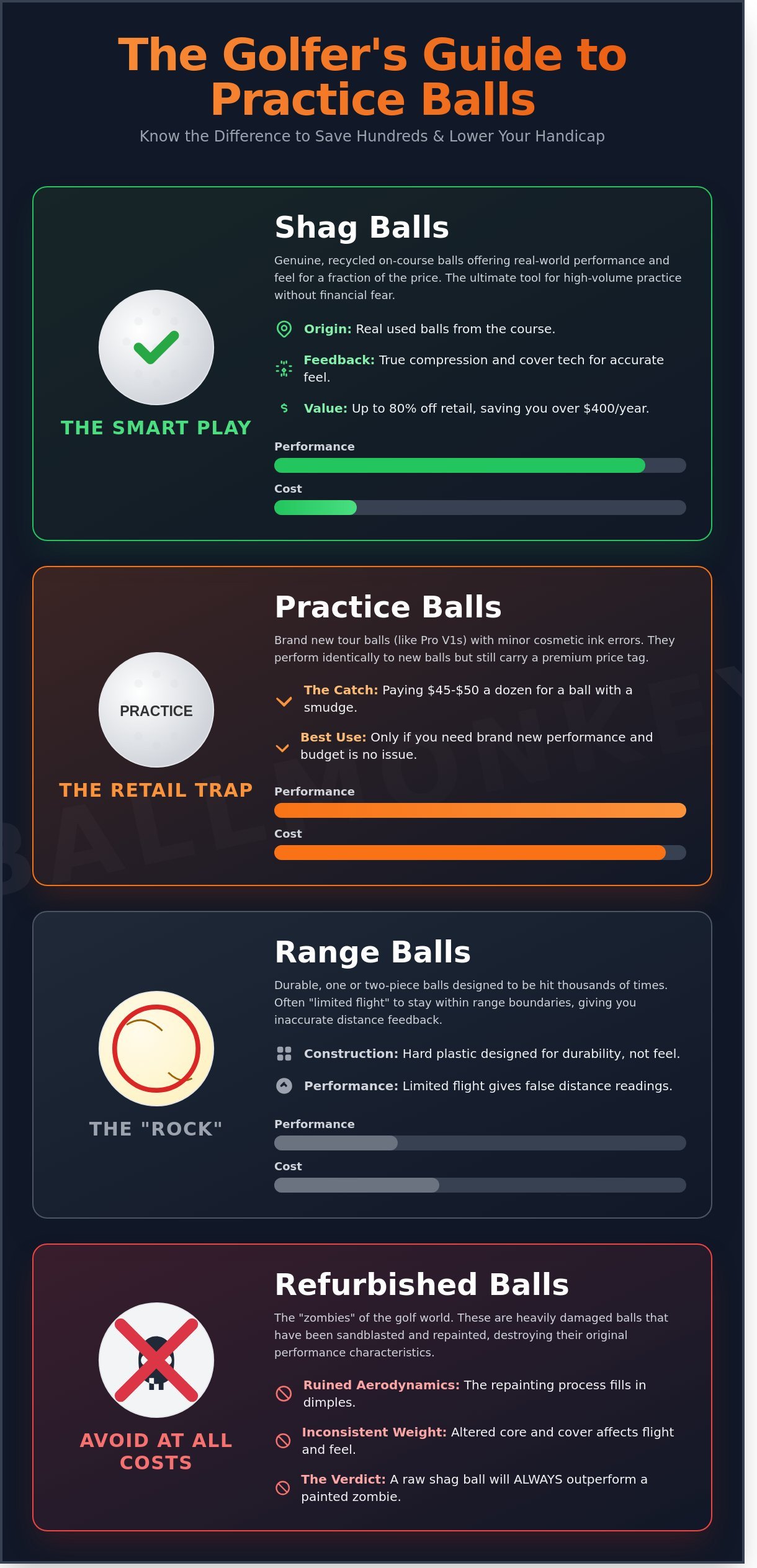
Range balls are the "rocks" of the golf world. Most facilities use one-piece or two-piece construction designed to survive a mechanical picker, not to mimic your Sunday round. These balls are often "limited flight," meaning they’re engineered to fall short so they don’t fly over the back fence. If you’re hitting a range ball, you aren’t getting a true read on your distances. You’re hitting a durable hunk of plastic that feels like a marble.
Practice balls are a different trap. These are typically brand-new, high-end balls like the Pro V1 or TP5 that have minor cosmetic ink errors. Manufacturers stamp them with "PRACTICE" and sell them. The problem? They still carry a premium price tag. You’re often paying $45 or $50 a dozen just for a ball with a smudge. It’s a retail play that targets golfers who think they need pristine gear just to work on their alignment.
Real value lives in shag balls. These are genuine, recycled golf balls that have seen real-world action. They offer the exact compression and cover tech you’ll use on the course but at a fraction of the cost. You get a mix of premium urethane and distance surlyn covers that provide actual feedback on your strike. It’s the smart way to build a practice bag without draining your bank account.
Avoid refurbished balls at all costs. These are the "zombies" of the industry. Companies take beat-up balls, sandblast the covers, and spray them with a fresh coat of white paint. This process ruins the aerodynamics and changes the ball’s weight. A raw shag ball with a tiny grass stain will always outperform a repainted refurbished ball that’s lost its dimple integrity.
Flight Performance and Feel
Performance matters even when you’re just grinding. Many players worry that a small scuff will ruin their flight. In reality, a minor cosmetic mark on a premium used ball usually results in less than 4 yards of distance loss. That is a negligible trade-off for the massive savings you get. Compression is the bigger factor here. Range balls are rock hard, while shag balls allow you to feel the clubhead compress the core. This is vital for developing "touch" around the greens.
Take spin rates as a prime example. If you practice chipping with a range ball, it will release and roll out 15% further than a tour ball. You’re training your brain to expect a result that won’t happen during a real round. If you’re working on a major swing overhaul indoors, you might practice with foam balls to stay safe. However, when you step onto the grass, you need the varied spin of real recycled balls to master your short game.
The Cost-Benefit Analysis
Let’s talk numbers. A dozen new premium balls will set you back $55 at a big-box retailer. That’s roughly $4.58 per ball. Golf Ball Monkey prices for bulk shag bags can drop that cost to as low as $0.35 per ball. You’re getting the same core technology for a 92% discount. When you’re hitting 100 balls a session, that’s the difference between a $450 afternoon and a $35 investment in your game.
High volume practice sessions shouldn’t feel like a financial burden. Every golfer pays the "Lost Ball Tax" when they hit into the woods or a pond during practice. By switching to used gear, you save over $40 per dozen compared to retail prices. This allows you to focus on your swing mechanics instead of worrying about the $5 you just sent into the tall grass. It’s the ultimate smart play for your wallet and your handicap.
The Benefits of Building Your Own Shag Bag
Repetition is the undisputed mother of skill. If you head to the practice green with only three balls in your pocket, you spend 70% of your time walking and only 30% actually swinging. That is a massive waste of a Saturday afternoon. A dedicated bag of 100 shag balls flips those statistics on their head. You get 90 swings in a 20-minute window. This sheer volume builds muscle memory faster than any expensive lesson ever could. It turns a clunky motion into a fluid, automatic reflex.
There is also a massive psychological edge to using affordable gear. We call it "swinging with freedom." When you tee up a brand new $5 ball, your brain often tightens up. You start steering the shot to avoid the water or the deep woods because you don’t want to lose your investment. With a stash of recycled gear, that financial fear vanishes instantly. You swing through the ball with aggression. You find your natural tempo. It is the most effective sports psychology hack in the game, and it costs pennies per shot.
Short Game Mastery Through Volume
Mastering the wedge requires a delicate touch. You cannot develop that feel by hitting five shots and then walking 40 yards to collect them. You need to grab a bag of 50. Line them up. Hit 50 identical chips to the exact same landing spot. This is how the pros dial in their distances. You aren’t worried about scuffing a mint-condition ball on a sandy lie or a rough patch of grass. You are focused entirely on the "thud" of the clubhead and the spin on the green.
Try the "Circle Drill" to sharpen your focus. Drop 20 balls in a three-foot radius around the cup. Sink every single one of them in a row. If you miss just one, you start the count back at zero. This pressure-packed practice is only possible when you have the volume to support it. While you are honing your craft, it is helpful to understand the USGA rules on practice balls to see how "Practice" or "X-Out" stamps affect official play. Most of these balls are structurally identical to their retail cousins but come at a Golf Ball Monkey -approved discount.
Backyard and Off-Course Utility
Golf Ball Monkey doesn’t just play on the manicured fairway. Sometimes the best practice happens in the backyard hitting into a $75 net. Using premium, high-compression balls in a net is a mistake. High-speed impacts against nylon netting can wear down a premium cover in as little as 40 hits. Use your shag balls for this instead. They take the beating so your game-day balls stay pristine in your bag. This saves you from burning through $50 boxes during a Tuesday night garage session.
Think about the lake or the campfire. We call this the "Hit-Away" tradition. There is a specific, primal joy in launching a ball into a deep canyon or a lake without worrying about the money you just threw away. It is pure fun. Additionally, if the local range is closed for mowing on a Monday morning, your personal stash becomes your private practice facility. You can build a "Monkey-grade" kit for a shoestring budget. A simple mesh bag and 100 near-mint recycled balls will cost you 70% less than retail prices. That is a smart play for any golfer looking to shave five strokes off their handicap this season.
How to Use Shag Balls to Actually Lower Your Handicap
Stop flushing money down the drain by practicing with premium pearls you’re afraid to lose. Real improvement happens when you stop worrying about the price of the ball and start focusing on the quality of the strike. To drop three strokes off your index this month, using high-quality shag balls is the ultimate smart play. You need volume to build muscle memory. You need consistency to find the center of the clubface. Most importantly, you need to practice with the same weight and feel you’ll experience on Sunday morning.
Focus on contact, not flight. When you’re hitting into a net or a dark range, you can’t see the apex. That is a blessing. It forces your brain to listen to the sound of the impact and feel the vibration in your hands. High-rep wedge work is the fastest way to lower scores. Hitting 50 wedges from 40 yards out builds a level of "feel" that a bucket of 10 balls can’t touch. You’re training your nervous system to recognize the exact swing speed required for specific distances.
Confidence is a choice. Simulating pressure shots with a ball that costs 50 cents instead of five dollars removes the "fear of loss" from your swing. If you can’t clear a 100-yard water hazard in practice because you’re scared of losing a new ball, you’ll never clear it when the match is on the line. Use your practice stash to prove to yourself that the shot is easy. Build the confidence now so the execution is automatic later.
The 15-Minute Backyard Drill
Efficiency is the name of the game. Set up a hitting mat and a sturdy net in your yard. Grab exactly 24 shag balls and follow this strict 8-8-8 routine. Start with 8 half-swings to sync your tempo. Move to 8 three-quarter swings to dial in your balance. Finish with 8 full-out rips to build speed. This 15-minute block focuses entirely on impact location. If you hit the center of the face 24 times in a row, your handicap will plummet.
Chipping and Pitching Calibrations
Don’t just grab a random handful of balls for the chipping green. Smart players sort their stash. Separate your urethane-covered balls from the surlyn ones. Urethane provides up to 30% more spin on short chips, while surlyn rolls out further. Understanding how each reacts is vital for your "Landing Spot" game. Place a towel 10 feet onto the green and try to hit it with 50 consecutive shots. The weight of a real ball, even a used one, provides the authentic feedback that foam or plastic alternatives simply cannot match.
Ready to build your ultimate practice bag without breaking the bank? Golf Ball Monkey has already sorted the best deals for your short game.
Score a massive deal on practice-ready balls here.
Keep your best-condition finds for the chipping area. These "near-mint" selections offer the same aerodynamic performance as retail versions at a fraction of the cost. Use the scuffed or older models for your full-swing drills into the net. This tiered approach ensures you are always practicing with the right tool for the job. By the time you reach the first tee, you’ll have the muscle memory of a pro and the bank account of a genius. That is how you play the game Golf Ball Monkey way.
Why Golf Ball Monkey Shag Balls are the Smart Play
Stop burning cash on brand-new balls just to watch them disappear into the woods during a practice session. It’s a waste of hard-earned money. Most golfers don’t realize they’re paying a 300% markup at retail stores simply for a shiny cardboard box and a marketing campaign. Golf Ball Monkey changes the game with our "Diver-Direct" model. We skip the fancy distribution centers and the corporate overhead. Our professional divers pull these balls straight from the water hazards on top-tier courses. Because we own the entire process from the pond to your porch, we pass every cent of those savings to you. You’re looking at prices that make big-box retailers sweat.
Quality isn’t just a suggestion here; it’s our obsession. Every "Monkey Shag" undergoes a rigorous manual inspection. A human eye catches what a machine misses. We look for the specific factors that actually impact your flight path and distance. A little cosmetic scuff or a previous owner’s Sharpie mark won’t hurt your game, but a structural crack certainly will. We toss the junk so you only get the gold. This isn’t just about your scorecard, either. It’s about the earth. We’ve pulled 2.4 million balls out of sensitive aquatic ecosystems in the last 12 months alone. When you choose recycled shag balls, you’re acting as a steward of the course. You’re keeping plastic out of the water and money in your pocket.
The Golf Ball Monkey Grading Standard
Our grading isn’t a guessing game. When we say a ball is "Playable," we mean it’s ready for 100+ high-impact swings. We focus on "honest wear" rather than perfection. You’ll see some player marks or logos, but the core remains explosive and the cover stays intact. Our cleaning lab uses specialized, eco-friendly solutions to restore that classic white finish without using harsh chemicals that degrade the cover’s integrity. Do the math on the value. Our mixed bag of shag balls often prices out at roughly $4.80 per dozen. Compare that to the $45 or $50 you’d spend on a fresh pack of premiums at the pro shop. It’s the smartest move you’ll make all season.
Join the Golf Ball Monkey Crew
We’re building a community of savvy players who care more about their swing than their status. We don’t just serve the solo golfer; we fuel the next generation of pros. If you’re managing a high school team or a local driving range, we handle bulk orders with zero hassle. We currently partner with 12 regional golf associations to keep their practice bags full for a fraction of the usual cost. The Golf Ball Monkey Promise is simple. We provide high-energy service from people who actually play the game and understand the frustration of a lost ball. We’re here to make sure you never care about a water hazard again. It’s time to stock up and swing hard. Grab a bag of Shag Balls and start practicing for less!
Stop Burning Cash and Start Shaving Strokes
You don’t need to drop 50 dollars on a fresh dozen just to work on your short game. Real golfers know that shag balls are the ultimate hack for high-volume practice without the high-end price tag. By switching from retail markups to Golf Ball Monkey prices, you can get 100 percent more reps for every dollar spent. Our inventory is retrieved by professional divers from water hazards and passes through a strict inspection process. This ensures you get no-cut quality in every single order. We don’t do junk; we do performance that’s easy on the wallet.
Every ball we ship is hand-vetted by our Texas-based team to meet our five-star standards. Whether you’re grinding on 60-yard wedge shots or fixing a stubborn slice, you deserve gear that keeps up. We handle the dirty work so you can focus on your handicap. It’s the smartest play you’ll make all season. Grab a bag and get back to the grind with confidence. You’ve got the talent; now you’ve got the tools to prove it.
Stop overpaying for practice-get Golf Ball Monkey-priced Shag Balls now!
Frequently Asked Questions
What exactly are shag balls in golf?
Shag balls are used golf balls reserved specifically for practice sessions rather than competitive tournament rounds. These balls typically fall into the 3A or 4A quality grade, meaning they show cosmetic scuffs or slight discoloration. Golf Ball Monkey sources these from water hazards and forests to give you a cheap way to grind on the range. You get real ball flight at 20% of the retail cost of a new sleeve.
Are shag balls good for practice?
Yes, shag balls are the smartest way to sharpen your short game and iron play without draining your wallet. Since they are real golf balls and not restricted-flight range balls, you get 100% accurate feedback on your spin and distance. Pro golfers often hit 500 balls a week; using recycled gear ensures you can match that volume for under $30. It is the ultimate low-cost practice hack for any golfer.
Will used shag balls damage my golf clubs?
No, these balls won’t damage your expensive titanium drivers or forged irons as long as they are clean. Even a 5A quality ball can carry dirt, so Golf Ball Monkey recommends a quick rinse before your session. Modern club faces are built to withstand 10,000 strikes at 110 mph. A few scuffs on a recycled ball won’t compromise your $500 driver. Just keep the grit off the cover to protect your finish.
How many shag balls come in a standard bag?
Most golfers buy these balls in bulk quantities of 50 or 100 units per bag. A standard 12-inch shag bag holds roughly 75 balls comfortably. Buying a 100-pack from Golf Ball Monkey often saves you 60% compared to buying individual recycled dozens. This volume allows you to hit 10 consecutive chips from the same lie to build muscle memory without constantly walking to retrieve your gear. It’s the most efficient way to practice.
Can I use shag balls on a real golf course?
You can play shag balls on the course, but they are best saved for holes with 200-yard water carries where the risk of loss is high. While a 3A grade ball flies straight, it might lack the 5% extra greenside spin found in a mint condition Pro V1. Use them for casual Sunday rounds with friends. If there is a trophy or money on the line, stick to Golf Ball Monkey’s premium 5A or Pristine graded inventory.
What is the difference between shag balls and range balls?
Range balls are typically one-piece construction with "Range" stamped on the side, often limited to 90% of standard distance. Shag balls are authentic, multi-layer balls from brands like Titleist or TaylorMade that have been recovered and recycled. Because they are real balls, they provide 100% realistic performance data. You avoid the "dead" feel of range rocks while practicing with the same gear you play on Saturdays. It’s a massive upgrade.
Why are they called ‘shag’ balls?
The name comes from the act of "shagging" balls, which means retrieving them after a practice session. Before automatic ball pickers, caddies would "shag" balls by chasing them down in the field. The term stuck for any ball used for repetitive practice. Today, a 95-cent recycled ball is the perfect candidate for this task. It allows you to focus on the swing, not the price tag of each shot. Golf Ball Monkey keeps the tradition alive.
How long do shag balls last before they need to be replaced?
A typical shag ball lasts for 75 to 100 full-swing impacts before the cover shows significant degradation. If you are just practicing your 20-yard chips, a single ball can last for 300 strikes or more. Replace them when you see a visible crack or if the cover feels rough like 80-grit sandpaper. At Golf Ball Monkey prices, swapping out your practice stash every 6 months is a total steal for your game and your wallet.
- golfballmonkey@gmail.com
- (512) 593-8401
- Mon – Fri, 9:00 AM – 5:00 PM

All product and company names are trademarks™ or registered® trademarks of their respective holders.
Use of them does not imply any affiliation with or endorsement by them.