
Are Used Pro V1s Worth It? Cheap Golf Balls That Feel Like Tour Gear (2026)
Why are you still paying nearly $60 a dozen just to watch your money splash into a water hazard? Retail prices for premium gear have officially hit the roof; this leaves most golfers choosing between draining their bank accounts or hitting balls that feel like literal rocks. It is a mental hazard that kills your swing before you even tee off. You want the spin, the soft urethane cover, and the greenside control, but you do not want the “brand new” tax. This leads to the ultimate question for the savvy player: are used pro v1s worth it or are you just buying someone else’s leftovers?
We get it. You have been told that once a ball hits the water or a fairway, it loses its magic. That is a myth designed to keep you buying shiny new boxes. This guide proves you can snag that legendary tour feel for about half the retail price. We are breaking down the performance data of Mint 5A recycled balls, comparing 2026 retail costs to secondary market steals, and showing you exactly how to maintain a consistent feel without overpaying for a logo. Get ready to play the best ball in golf for under $35 a dozen.
Key Takeaways
- Stop overpaying for a fancy cardboard box and learn why Mint 5A condition balls are the ultimate hack for tour-level performance on a budget.
- Discover the definitive answer to are used pro v1s worth it by comparing real-world greenside control against $60-a-dozen retail alternatives.
- Master the “urethane vs. surlyn” science to ensure your short game has the professional “grab” and spin needed to stop on a dime.
- Learn why you must avoid “refurbished” balls at all costs to protect your flight path and maintain total consistency on every shot.
- Unlock the savvy insider strategy of bulk purchasing to slash your equipment costs while keeping the world’s #1 ball in your bag.
What Defines the Titleist Pro V1 Feel?
Ever since the history of the Titleist Pro V1 began in 2000, it has set the gold standard for sensory feedback. It is not just marketing hype; it is the specific way the ball speaks to you on every shot. When you strike a Pro V1, you hear a crisp, high-frequency “click” rather than the hollow, dull “thud” of a budget ball. That sound tells your brain the energy transfer was perfect. If you are standing over a $5 retail ball, that “thud” often comes with a side of anxiety. You start wondering: are used pro v1s worth it, or do I really need to fork over $60 a box to get that sound back?
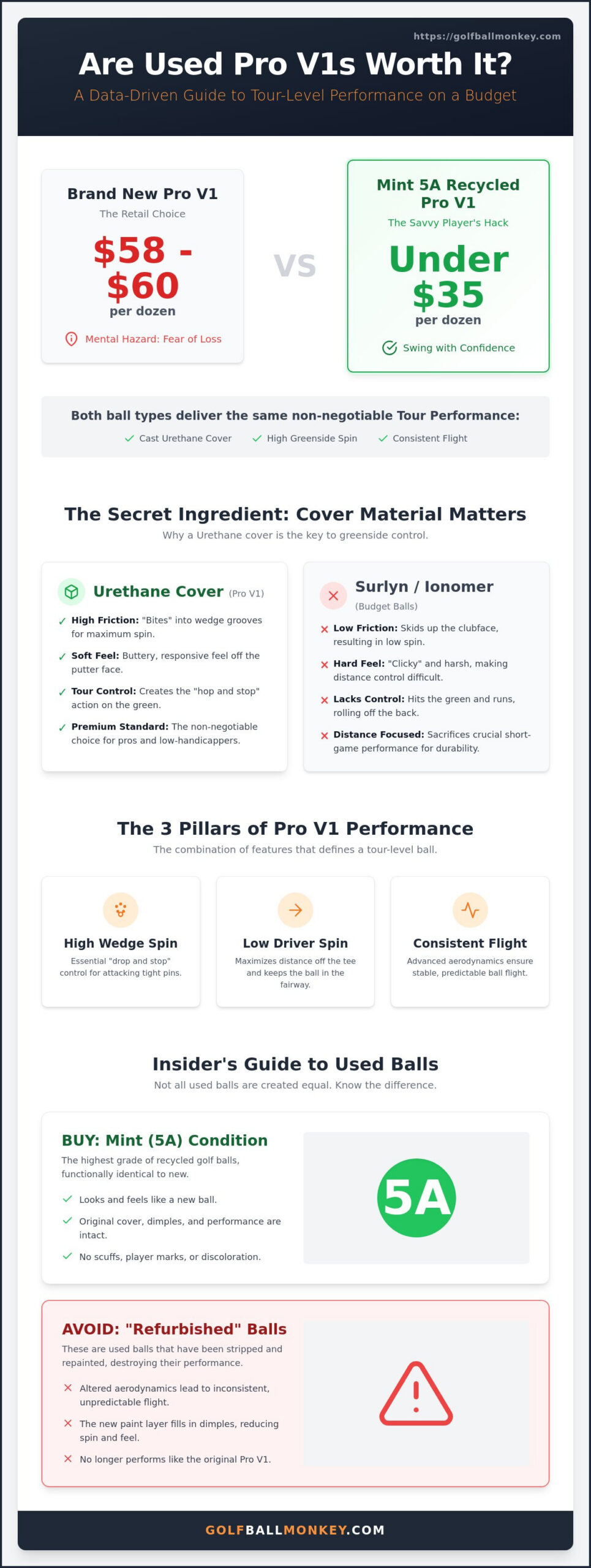
The real magic happens within 30 yards of the pin. A Pro V1 uses a cast urethane cover that practically bites into your wedge grooves. Cheap balls use Surlyn, which is essentially hard plastic. Surlyn balls might feel soft off the putter, but they lack the friction to “grab” the green. They hit and run like they have somewhere else to be. A Pro V1 hits, hops once, and stops. That predictable check-up is why pros and low handicappers refuse to play anything else. It is about confidence in your equipment.
The Three Pillars of Tour Performance
- Low driver spin: This keeps your ball in the short grass and maximizes distance off the tee by reducing side-spin.
- High wedge spin: This provides the essential “drop and stop” control required for attacking tight pin positions.
- Consistent flight: Advanced aerodynamics ensure stable flight patterns even in 2026’s unpredictable wind conditions.
Why ‘Soft’ Doesn’t Always Mean ‘Pro V1’
Do not get fooled by the “Soft” label on a $20 box of balls at a big-box retailer. Most “soft” balls are just low-compression Surlyn cores that feel mushy like a marshmallow. They might feel good on a cold morning, but they won’t give you the spin you need to save par. Urethane is the non-negotiable ingredient here. It provides the cover friction that creates “grab” on the clubface. Tour Feel is the perfect balance of a firm core and a soft urethane cover.
Let’s be real: paying $58.00 for a dozen balls is a mental hazard. Every time you see a pond, you see a five-dollar bill waiting to sink. That stress ruins your swing tempo and your enjoyment of the game. By shifting your strategy to buying Mint 5A used balls, you remove the financial fear. You get the tour-level energy transfer and the iconic “click” for a fraction of the cost. When you stop worrying about the price per sleeve, your game actually improves. So, are used pro v1s worth it? If you value your bank account as much as your backswing, the answer is a resounding yes.
The Secret Ingredient: Why Urethane is Non-Negotiable
Some websites tell you to buy cheap Surlyn balls because they are “just as soft” as premium gear. They are lying to you. Surlyn is a hard, durable ionomer resin. It is great for distance but terrible for control. Urethane is a thermoset material that allows the ball to compress and “melt” into your clubface. This creates the friction needed for high-spin wedge shots. If you are asking are used pro v1s worth it, you have to look at the cover first. Every ball on the PGA Tour uses a urethane cover for a reason.
The aerodynamic properties of a golf ball rely heavily on how the cover interacts with the air and the club. When your wedge strikes a Pro V1, the urethane actually deforms into the grooves. This creates a massive amount of spin. A Surlyn ball just skids up the face. This is the difference between a ball that stops on the third hop and one that rolls off the back of the green. If you’re ready to stop overpaying for retail boxes, grab a batch of premium recycled balls and see the spin for yourself.
The “one-hit wonder” myth needs to die. People think soft covers mean the ball is fragile. That is a 1990s mindset. Modern urethane is incredibly tough. You won’t shred a Pro V1 with one wedge shot anymore. Titleist has engineered these covers to be resilient. You can play 18 holes with one ball and it will still perform. This is exactly why are used pro v1s worth it; the performance doesn’t vanish after a few holes. It stays consistent until you lose it in the woods.
Ever felt a ball “clack” off your putter? That is the “clicky” problem of ionomer covers. It feels harsh and makes distance control a nightmare. Urethane feels like butter. It provides a muted, solid feel that helps you dial in your touch on the greens. Don’t let a cheap cover ruin your feel.
The Cost of Urethane Production
Casting urethane is a slow, expensive process. Manufacturers charge $55+ because it takes more time to bake the cover. Mid-tier balls try to bridge the gap with thinner covers, but they often sacrifice core technology. Don’t settle for plastic when you can get the real deal for less. You can find these premium builds in our Mint 5A inventory right now.
Identifying Urethane Balls at a Glance
- Check the side stamp: If it says “Ionomer” or “Soft Ionomer,” put it back.
- The Thumbnail Test: Press your nail into the cover. If it feels slick and hard, it’s Surlyn. If it feels tacky and leaves a tiny, temporary indent, it’s urethane.
- Look for the ‘Tour’ label: Most brands reserve the word “Tour” for their urethane offerings.
Top Brand Alternatives: Can You Get Pro V1 Spin for Less?
Titleist has a legendary history of Pro V1 innovation, but the 2026 retail price of $58.00 is a tough pill to swallow. If you are looking for that premium “stop on a dime” performance, you have options. Some brands try to mimic the Pro V1’s flight and friction for a slightly lower retail entry point. These alternatives offer urethane covers and multi-layer construction, but they still carry a “brand new” price tag that can be hard to justify for the casual weekend round.
The TaylorMade Tour Response is a standout alternative. It uses a 100% cast urethane cover, just like the flagship models, but it is specifically tuned for the amateur swing speed. It feels soft and provides massive greenside spin that rivals the industry leaders. For a deeper dive into these options, read our breakdown on TaylorMade Golf Balls: Performance and Savings. It is a solid play if you want a new ball with tour-level DNA without the $60 price tag.
Srixon Z-Star is another heavy hitter. It is often the balanced choice for players who want a bit more distance without losing that soft feel. Then there is the Maxfli Tour. It is the data-backed underdog of 2026. Robot testing shows it hangs right with the leaders in ball speed and spin. It is a savvy play for anyone who doesn’t care about the name on the side of the ball. These brands often run sales, but even then, you are usually paying more than you would for a recycled premium ball.
We cannot talk about value without mentioning the Kirkland Signature. It is the Costco legend. It offers incredible spin for a rock-bottom price. However, it is known for high spin off the driver, which can exacerbate a slice or hook. It is a great budget ball, but it doesn’t quite have the refined flight or the wind-fighting stability of a Titleist. You get what you pay for in terms of advanced aerodynamics.
Direct-to-Consumer (DTC) Challengers
Brands like Vice Pro and Snell MTB are the true disruptors. By cutting out the retail middleman, they usually save you about $15 per dozen compared to big-box prices. They offer legitimate tour-level performance. The catch? You have to deal with shipping costs and wait times. You can’t just pop into a pro shop and grab a sleeve when you’re running low. While their consistency has improved, many purists still find Titleist’s quality control to be the gold standard. If you lose several balls a round, the shipping fees can eat into your savings quickly.
The ‘Almost Pro V1’ Comparison Table
When you look at the numbers, the gap between premium and value is shrinking. But the question remains: are used pro v1s worth it compared to these new alternatives? A Mint 5A used Pro V1 often costs less than a brand-new TaylorMade Tour Response or Srixon Z-Star. You get the #1 ball in golf for the price of a mid-tier rival. If you want the best performance for the lowest price per dozen, the secondary market is the clear winner. You stop paying for the marketing budget and start paying for the performance.
- Titleist Pro V1: Max spin, premium feel, ~$58.00 retail price.
- Srixon Z-Star: High spin, firm feel, ~$48.00 retail price.
- TaylorMade Tour Response: High spin, soft feel, ~$43.00 retail price.
- Kirkland Signature: Extreme spin, soft feel, ~$18.00 retail price.
The Insider Play: Are Used Pro V1s Worth It?
Stop paying for the cardboard. Seriously. When you buy a brand-new box of Titleist Pro V1s at the pro shop, you are funding a massive marketing budget and a shiny box you will throw away in five minutes. If you want to know are used pro v1s worth it, look at the math. You can get the world’s #1 ball for under $2 per ball. Meanwhile, your buddies are sweating over every water hazard because they just dropped $58.00 on a dozen. That is the definition of the “Monkey Way.” You get the performance without the retail tax.
Let’s clear up the confusion between “Recycled” and “Refurbished.” This is where most golfers get burned. Refurbished or “Refinished” balls are the enemy. These balls are stripped and repainted to look new. It ruins the dimple patterns and kills the flight. Recycled balls, like our Mint 5A stock, are simply washed and sorted. They keep their original factory finish and aerodynamic integrity. If it is not recycled, it does not belong in your bag. Our grading standards ensure you only play the best.
Then there is the water myth. People on forums claim a ball in a pond is “dead.” That is old-school thinking from the wound-ball era. Modern Pro V1s have solid cores and sealed covers. A week in the water does not seep into the core. Our professional divers harvest these balls quickly, ensuring the performance remains identical to a ball fresh out of the sleeve. You get tour-level distance and spin. When you ask are used pro v1s worth it, the answer is a resounding yes, provided they are harvested correctly. For a deeper dive into how to spot the best deals, check out The Savvy Player’s Guide to Used Balls.
How Golf Ball Monkey Reclaims Performance
We do not just find balls; we rescue them. Our team of professional divers reclaims millions of balls annually from the toughest hazards. We use a proprietary cleaning and sorting process that avoids harsh chemicals. This protects the urethane cover and maintains the ball’s integrity. Our entire operation focuses on quality above everything else. You get the #1 ball in golf for a fraction of the cost. Ready to upgrade? Shop our Mint 5A Pro V1 inventory and stop overpaying for gear.
The Sustainability Bonus
Buying used is the ultimate win-win for the community. Every year, hundreds of millions of balls are lost in the U.S. alone. By choosing recycled gear, you prevent plastic and rubber from polluting local waterways. It is an environmentally conscious move that feels as good as a pure 7-iron. Save the planet, save your cash, and play better golf. It is that simple. You are making the intelligent play for your wallet and the environment simultaneously.
Restock Strategy: How to Buy Like a Savvy Insider
Buying one dozen balls at a time is a rookie move. If you want to maximize your savings, you have to think in bulk. The magic numbers for serious golfers are 48 or 96 balls. When you buy in these quantities, the per-ball price drops significantly. It is the fastest way to ensure you never run out of tour-quality gear mid-round. For anyone still asking are used pro v1s worth it, look at your trunk. A 96-ball stash of Mint 5A Pro V1s costs less than two full-price retail boxes. That is more golf for less money. Plain and simple.
Smart players also know how to mix their inventory. You don’t need a Mint 5A ball for a casual evening practice session or a risky hero shot over a canyon. Keep a stash of Mixed Bag (Good 3A) or shag balls for the practice range. Save your Mint 5A Titleist Pro V1s for tournament rounds and weekend money games. This tiered approach keeps your “game balls” in peak condition while slashing your overall equipment spend. Prioritize ball quality over that shiny new $600 driver; the ball is the only piece of equipment you use on every single shot.
Timing matters too. Stock up during the early spring before the peak 2026 golf season kicks into high gear. This ensures you have the best selection of the latest models before the summer rush drains the inventory. If you are curious about a new model, use the “Sleeve Test.” Buy a smaller quantity to test the flight and feel on your local greens before committing to a full case of 96. It is the ultimate “try before you buy” strategy for the budget-conscious athlete.
Calculating Your Yearly Savings
Let’s do some quick math. A typical golfer playing 30 rounds a year might lose three balls per round. That is 90 balls a season. At the 2026 retail price of ~$58.00 per dozen, you are looking at over $430 just in golf balls. By switching to Mint 5A recycled balls, you can cut that bill in half. That is over $200 back in your pocket. Redirect those savings into more tee times, a mid-round steak sandwich, or professional lessons. The performance remains identical; only the price tag changes. This is why are used pro v1s worth it for the long-term player.
Ready to Restock?
Stop overpaying for a logo and a cardboard box. It is time to play the “Smart Play” way. You can get the legendary feel and greenside control of the world’s #1 ball without the financial headache. Browse our current Titleist Pro V1 (Mint 5A) collection and find your next game-changer. Join the thousands of savvy insiders who have already made the switch. Play better. Spend less. Grab your bulk pack today and dominate the fairways.
Play the Best Ball for Half the Price
You now have the full playbook for smarter gear management. We have debunked the water myths and proven that urethane is the non-negotiable key to greenside spin. When you look at the performance data, the answer to are used pro v1s worth it is obvious. You get tour-level flight and that signature soft feel without the $58 retail tax. It is the ultimate insider move for any golfer who values their score as much as their budget. Stop paying for the marketing budget of giant corporations and start paying for what actually matters on the scorecard.
We are a Texas-owned operation powered by professional divers who reclaim over 1 million balls every year. Our Mint 5A Guarantee is simple: if you can tell it is used, we haven’t done our job. You get the world’s #1 ball delivered to your door with zero compromise on quality. It is better for the planet and better for your wallet. It is time to restock like a pro.
Stop Overpaying-Grab Your Mint 5A Pro V1s at Golf Ball Monkey Now!
Go out there, swing hard, and enjoy the game more knowing you made the intelligent play. We will see you on the first tee.
Frequently Asked Questions
Do used Pro V1s lose distance compared to brand-new ones?
No, high-quality recycled balls do not lose distance. Modern solid-core technology is built to last. Unless a ball has been sitting at the bottom of a lake for years, the energy transfer remains identical to a new one. This is exactly why are used pro v1s worth it for players who want tour-level distance without the retail markup. You get the same launch monitor numbers for a fraction of the cost.
Is the Kirkland Signature ball really the same as a Pro V1?
The Kirkland Signature is a value legend, but it is not a Pro V1 clone. It offers a urethane cover and high spin, but its flight characteristics are different. Kirkland balls often spin more off the driver, which can be a disaster for players with a slice. Titleist provides better aerodynamic stability in the wind. It is a great budget play, but it does not match the refined engineering of the #1 ball in golf.
What is the difference between Mint 5A and Near Mint 4A grades?
Think of Mint 5A as “showroom floor” quality. These balls are indistinguishable from new ones and often have zero player marks or scuffs. Near Mint 4A balls are the savvy insider’s secret. They might have a tiny cosmetic blemish or a Sharpie mark from a previous owner, but the flight and spin are 100% intact. If you can handle a small ink dot, 4A offers even deeper savings for your weekend rounds.
Why are Pro V1s so much more expensive than other urethane balls?
You are paying for a slow, premium manufacturing process. Titleist uses a cast urethane method that takes longer to cure than the injection-molded covers found on cheaper balls. This creates a thinner, more durable cover with better friction. You are also funding the massive R&D and quality control that makes every ball in the box fly exactly the same. It is the price of total consistency on every single shot.
Can a high-handicapper actually feel the difference in a Pro V1 alternative?
Absolutely. You don’t need a 120 mph swing to notice the “grab” of a urethane cover. High-handicappers often struggle with greenside control. A Pro V1 or a high-quality alternative stops faster on the green than a hard Surlyn ball. This helps you keep your chips closer to the pin and saves you strokes on every hole. Feel is about touch and predictable reaction, not just raw power.
What is the best cheap golf ball for a fast swing speed in 2026?
For 2026, the Srixon Z-Star or a recycled Pro V1x are your best bets. High swing speeds need a ball that won’t “mush” at impact. These firmer options maintain their structural integrity under high force, giving you lower spin off the tee and more piercing flight. Buying these as Mint 5A recycled balls is the smartest way to fuel a fast swing without draining your bank account every weekend.
Are refurbished golf balls a good alternative to used Pro V1s?
No, avoid refurbished balls at all costs. Refurbishing involves stripping the original clear coat and repainting the ball. This process often fills in the dimples, which ruins the aerodynamic properties. It makes the ball’s flight path completely unpredictable. When people ask are used pro v1s worth it, they are talking about recycled balls that keep their factory finish and original performance standards.
How many rounds can I realistically play with a single urethane-covered ball?
You can realistically play 36 to 54 holes with a single ball if you avoid the trees and cart paths. Modern urethane covers are surprisingly resilient. They don’t scuff nearly as easily as the soft balls from ten years ago. Most golfers lose the ball long before the performance actually degrades. If you play a clean round, just wash it off and tee it up again for your next tee time.
Used Golf Balls for Simulator Use: The Ultimate Guide to Performance & Protection (2026)
Your expensive impact screen isn’t a dartboard, yet those scuffed-up “bargain” balls are treating it like one. It’s the classic indoor golfer’s dilemma. You want the data accuracy of a premium Titleist Pro V1 or TaylorMade TP5, but you don’t want to burn through a premium dozen every week. Worse, you’re terrified that one tiny scuff will act like sandpaper and shred your screen. We get it. Choosing the right used golf balls for simulator use shouldn’t feel like a gamble with your gear.
You shouldn’t have to sacrifice your bank account or your equipment for a better handicap. This guide shows you how to save thousands on practice while maintaining 99% data accuracy compared to brand-new balls. We’ll dive into the specifics of Mint 5A grading. Learn why certain finishes protect your screen better and how to find the sweet spot between price and performance. It’s time to stop overpaying for air and start practicing like a pro without the pro-shop markup. The Monkey has personally vetted this gear to keep your game sharp and your screen intact.
Key Takeaways
- Stop shredding your expensive impact screen by identifying the surface-level warning signs that turn standard balls into sandpaper.
- Maintain 99% launch monitor accuracy with used golf balls for simulator use that deliver consistent spin without the retail price tag.
- Learn why Mint 5A is the only acceptable grade for indoor play and why “refurbished” balls are a total disaster for your equipment.
- Follow the “Clean Ball” rule to prevent dirt and permanent club tattoos from ruining your hitting surface.
- Score massive savings on premium urethane covers by choosing water-recovered balls vetted by our Texas-based quality control team.
Why Simulator Balls Require a Different Standard
Hitting a ball into a screen isn’t the same as launching one into the blue sky. Outdoors, a tiny scuff might cost you three yards of carry. Indoors, that same scuff is a weapon. We define “Simulator-Grade” balls as having zero surface abrasions. This isn’t just about looking pretty; it’s about mechanical integrity. The physics of impact change when your target is ten feet away. A ball hitting a screen involves intense friction and immediate deceleration. If your ball has a rough “shag bag” texture, it’s acting like 80-grit sandpaper on your impact surface.
Don’t fall for the trap of using beat-up practice balls to save money. The financial math simply doesn’t add up. You might save $30 per dozen by picking up low-grade used golf balls for simulator use, but you’re gambling with a $1,200 impact screen. One jagged wedge mark can fray your hitting surface in a single session. Premium screens are built for impact, but they aren’t designed to survive a cheese grater. Using high-quality Mint 5A balls is the intelligent play for your budget and your gear.
The Sandpaper Effect: Protecting Your Impact Screen
Every time a scuffed ball hits your screen, a mechanical disaster occurs. Microscopic burrs on the cover grab the polyester fibers of the fabric. This creates localized heat. Over hundreds of shots, those fibers fray and snap. You’ll start to see “burn” marks or thinning spots where you typically aim. It’s a slow death for your equipment. Identify “Screen Killers” early. Look for deep scratches, jagged cuts, or rough “burn” marks on the cover. If a ball feels rough to the touch, it belongs in the backyard, not the sim. Only perfectly smooth covers should make the cut for indoor play.
Data Integrity and Sensor Recognition
Your launch monitor is only as smart as the data it sees. Photometric systems like Skytrak or GCQuad rely on high-speed cameras to track dimples and logos. A dirty or refurbished ball with thick, uneven paint messes with these calculations. To get 99% accuracy, you need a pristine cover that matches the original factory specs. Radar-based tracking like Trackman also requires consistent core density to predict flight and spin. Understanding Golf ball design and aerodynamics reveals why a smooth, original urethane cover is non-negotiable. If the sensor can’t read the ball clearly, your yardages will be all over the place. Stick to Mint 5A used golf balls to keep your data honest and your game sharp. The Monkey personally vets every ball to ensure they’re sim-ready and screen-safe.
The Science of Spin: Why Pro V1s Rule the Simulator
Spin is the currency of the golf simulator. If your launch monitor can’t calculate backspin accurately, your 7-iron carry numbers are just expensive guesses. This is where the cover material makes or breaks your practice session. Most cheap distance balls use Surlyn, a hard plastic that’s great for durability but terrible for data. Surlyn covers tend to skid up the clubface indoors. This leads to “flyer” spin rates that don’t reflect your real-world swing. For serious used golf balls for simulator use, urethane is the only answer. It’s softer, stickier, and provides the friction needed for the sensor to clock every single RPM.
Elite players consistently choose Titleist Pro V1 (Mint 5A) for their home setups because of predictability. When you’re hitting into a screen, you lose the visual feedback of a ball’s flight. You’re 100% dependent on the machine. If you switch between different ball types, your data becomes a mess. Sticking to a premium used ball ensures your indoor “feel” translates perfectly to the first tee. You get the same click off the putter and the same check on your chips. It’s about building muscle memory that actually works when you leave the basement.
Urethane Covers and Launch Monitor Accuracy
High-speed cameras need a clear look at the ball’s surface to calculate movement. Premium urethane covers allow sensors to “grip” the data points more effectively than shiny, hard plastics. The specific dimple patterns on these balls are baked into the flight algorithms of top-tier monitors. If you want the most realistic descent angles and rollout, you need the real deal. Check out our Titleist Pro V1: The Ultimate Guide to see how these layers work together to stabilize your numbers.
Durability Testing: How Many Hits Can a Used Pro V1 Take?
A Mint 5A ball is the gold standard for longevity. In a high-volume simulator environment, a single Pro V1 can easily handle 300 to 500 strikes before the cover starts to fatigue. Watch for the “dull thud” sound. That’s a sign of internal core failure. Cheap “practice” range balls often crack internally after fifty high-speed impacts. Premium used balls maintain their structural integrity much longer. They offer a better return on investment and more reliable yardages over time. Grab a batch of Mint 5A used golf balls and stop worrying about your gear. The Monkey ensures every ball in your bag is ready for the long haul.

Grading for Simulators: Mint 5A vs. The Rest
Don’t treat a grading scale like a suggestion. It’s a survival guide for your simulator setup. When shopping for used golf balls for simulator use, the grade determines if you’re hitting a pro-level sphere or a screen-shredding projectile. Most retailers use a 1 to 5 scale, but for the indoor golfer, the only number that matters is 5. Anything less is a gamble with your equipment.
Refurbished balls are the ultimate simulator villain. They are stripped of their original clear coat and repainted to look new. This paint is brittle. Upon impact with a screen at high speeds, that paint can flake off or leave permanent streaks on your expensive white fabric. They also hide micro-cracks that lead to erratic flight and “dull thuds.” Stick to recycled balls. These are recovered, washed, and sorted without any structural tampering. Check out our detailed breakdown on Decoding Grades: What Mint 5A Really Means to see how we filter out the junk.
The Mint 5A Standard: What to Expect
Mint 5A is the pinnacle. Expect a ball that looks and plays like it just came out of a fresh sleeve. You want no scuffs, no cuts, and the original factory luster. Savvy shoppers look for “Logo Overruns.” These are often brand-new balls with a corporate logo that hit the water on their very first flight. Our professional divers pull these “fresh” covers from the water before the sun can degrade the urethane. It’s the smartest play in the game. You get a new ball feel at a fraction of the cost, ensuring your launch monitor reads the dimples exactly as the manufacturer intended.
Why to Avoid 3A (Good) and 4A (Near Mint) Indoors
3A and 4A balls are fine for the local field, but they’re a hazard for the sim. Small scuffs act as heat-generating abrasives against your screen fibers. Even worse is ink transfer. A scuffed logo or a sharpie mark on a 3A ball can “tattoo” your impact screen on contact. Once that ink is on your screen, it’s there for good. These lower grades also have aerodynamic inconsistencies. Your launch monitor might misread the spin axis because of a minor cover blemish. Save the lower grades for the outdoor net and keep your indoor practice sessions pristine. Grab a bucket of Mint 5A used golf balls to keep your data honest and your screen white. The Monkey personally vets every ball to make sure it meets the 5A standard before it ever reaches your mat.
Maintenance: Keeping Your Simulator Balls Sim-Ready
Buying the right gear is only half the battle. If you don’t maintain your inventory, even the best used golf balls for simulator use will eventually turn on you. The golden rule is simple: never hit a dirty ball. One tiny speck of dried mud or a single blade of grass acts like a diamond-tipped drill bit when it hits your screen at 150 mph. It doesn’t just stain the fabric; it severs the fibers. Keep a microfiber towel next to your mat. Give every ball a quick wipe before it joins the “active” pile. It’s a five-second habit that saves you a thousand-dollar headache.
Rotation is your secret weapon against cover fatigue. Don’t hit the same three balls for an entire hour. Urethane covers generate significant friction heat upon impact. If you hammer the same ball repeatedly, the cover softens and becomes more prone to “club tattoos” and scuffing. Cycle through a dozen balls during your session. This allows the material to cool down and maintains the structural integrity of the core. Store your stash in the same climate-controlled room as your sim. Extreme garage temperatures can mess with ball compression, leading to “dead” feel and wonky launch data. The Monkey recommends keeping your gear at room temperature for the most consistent carry numbers.
The 30-Second Inspection Routine
Develop a “pro-eye” for cover health. Every few sessions, perform the Fingernail Test. Run your nail across the surface of your balls. If you feel a snag, a burr, or a jagged edge, that ball is officially retired from indoor use. Check for “out of round” issues by spinning the ball on a flat surface. If it wobbles like a top, the internal balance is shot. These duds will give you “ghost” hooks and slices that aren’t actually your fault. Move these to your outdoor shag bag immediately. Your screen and your sanity will thank you.
Removing Markings and Stains
Sharpie marks are the silent killers of white impact screens. If you use balls with alignment lines, ensure the ink is 100% dry and permanent. Better yet, use 91% isopropyl alcohol to strip off old markings before they can transfer to your screen. Avoid harsh chemicals like acetone, which can eat through the clear coat and ruin the aerodynamics. For more tips on keeping your setup pristine, check out our guide to Golf Ball Accessories. Ready to restock with gear that actually passes the test? Grab a fresh batch of Mint 5A balls from Golf Ball Monkey today.
The Monkey Play: Why Our Mint 5A Balls Win the Sim Game
Finding the right used golf balls for simulator use shouldn’t feel like a side quest. We’ve simplified the process by going straight to the source. Most used ball retailers buy from massive wholesalers who let inventory bake in the sun for months. Not us. We work with professional divers who pull these gems directly from the water. This “Fresh from the Water” approach preserves the urethane cover. It prevents the UV damage that makes covers brittle and prone to cracking against your screen. It’s the intelligent play for anyone who hits hundreds of balls a week.
Our operation is rooted in Texas. Every single Titleist Pro V1 and premium ball passes through a rigorous quality control process right here. We don’t just glance at them. We vet them against the strict Mint 5A standard. This focus on performance makes us the top choice for high-volume hitters and commercial simulator centers. Choosing recycled gear isn’t just about the massive savings. It’s a win for the planet too. You’re keeping high-grade materials out of landfills while maintaining a tour-level practice environment. It’s sustainability without the performance tax.
Direct from the Divers to Your Door
We cut out the middleman to keep your costs down. By sourcing directly, we ensure you never receive “refurbished” junk. As we’ve established, those repainted duds are total screen-killers. Our Texas roots mean we understand durability in high-heat environments. We only ship balls that can handle the friction of a high-speed impact. The Monkey promise is simple: if it isn’t Mint 5A, it doesn’t touch your screen. You get the same launch data as a new ball for a fraction of the retail price. It’s a savvy move for your game and your wallet.
Start Your Simulator Season Right
New to the sim world? Don’t wait for your first screen tear to upgrade your inventory. We recommend starting with a “Sim Starter Pack” of mixed premium urethane balls. This lets you test different models on your specific launch monitor to see which spin numbers look best. Once you find your favorite, set up a recurring restock. This ensures you always have a fresh rotation and never resort to hitting “dead” balls with compromised cores. Stop overpaying for air and start practicing with purpose. Shop our Mint 5A Simulator-Ready collection now!
Master Your Indoor Game Today
Your simulator is a major investment. Don’t let a few scuffed balls turn it into a maintenance nightmare. You now have the blueprint for picking the perfect used golf balls for simulator use. Stick to Mint 5A urethane covers to protect your screen and keep your launch data honest. Remember the clean ball rule. Rotate your stash to keep friction heat down. Most importantly, stop paying retail prices for gear that hits a net ten feet away.
We take the guesswork out of the equation so you can swing with total confidence. Every ball we sell is Professional Diver Sourced and undergoes Strict 5A Mint Grading. We are a Texas-Owned & Operated shop that understands the grit and grind of daily practice. It’s time to stop worrying about your equipment and start focusing on your swing. You’ve done the research. Now it’s time to make the intelligent play for your budget and your handicap.
Score Tour Performance for Sim Prices — Shop Mint 5A Now!
Keep grinding. We’ll see you on the leaderboard soon.
Common Questions About Simulator Golf Balls
Will used golf balls damage my simulator impact screen?
Used balls only damage screens if they have surface scuffs, cuts, or jagged burrs. These imperfections act like sandpaper and fray the polyester fibers upon impact. Stick to Mint 5A used golf balls for simulator use to ensure a smooth surface that protects your hitting area. High-quality recycled balls are just as safe as new ones if the cover is pristine.
Do used golf balls provide accurate data on launch monitors like GCQuad or Trackman?
High-quality used balls provide roughly 99% data accuracy compared to brand-new ones. Launch monitors rely on tracking dimples and logos to calculate spin and launch angle. As long as the cover is original and not repainted, the sensors will read the ball correctly. Avoid refurbished balls; their thick, uneven paint can confuse sensors and lead to inconsistent yardages.
What is the best grade of used golf ball for simulator use?
Mint 5A is the only grade you should use for high-end indoor setups. This grade ensures the ball has its original factory luster and zero surface abrasions. It’s the intelligent play for protecting your $1,200 impact screen while maintaining the exact spin characteristics you’d expect from a tour-level ball.
Can I use refurbished golf balls in my simulator?
Never hit refurbished balls into an impact screen. The repainted covers are often brittle and flake off at high speeds. This paint debris can get embedded in your screen fibers and leave permanent, ugly stains. Refurbished balls also hide internal cracks that lead to erratic flight and “ghost” hooks in your data.
How many hits can a used Pro V1 take before it needs to be replaced?
A premium used Pro V1 typically handles 300 to 500 strikes before the core starts to fatigue. You’ll know it’s time to retire the ball when you hear a dull thud instead of a crisp click. Watch for “burn” marks on the cover; these are signs that friction heat is breaking down the urethane.
How do I clean used golf balls for indoor use?
Use a microfiber towel and 91% isopropyl alcohol to remove dirt and old ink. Never hit a ball that has even a speck of dried mud or grass on it. These particles act like tiny drills that sever the fabric of your screen. Clean balls ensure a white screen and honest data every time you swing.
Why do some used balls leave marks on my simulator screen?
Marks are usually caused by “ink transfer” from scuffed logos or fresh Sharpie lines. High-speed friction can also cause “club tattoos” where the ball’s cover briefly melts into the screen fibers. Rotating your inventory every few minutes keeps the balls cool and prevents these permanent marks from forming.
Is there a difference between recycled and refurbished golf balls for sims?
Recycled balls are simply recovered, washed, and sorted by grade. Refurbished balls are stripped of their original finish and repainted to look new. For simulators, recycled is the only way to go. You need the original factory cover to ensure the launch monitor reads the spin axis and aerodynamics exactly as the manufacturer intended.
Mint 5A Golf Balls: The Savvy Golfer’s Guide to Tour Performance for Less
You’ve been there. Standing over a 180-yard shot with water left, you pull out a brand-new Titleist Pro V1. You paid $5 for that ball. You take a breath, swing, and… splash. Another expensive ball gone forever. It’s the worst feeling in golf. But what if you could play that same tour-level ball for a fraction of the price, without sacrificing an ounce of performance? That’s the secret savvy golfers have unlocked with mint 5A golf balls.
Forget everything you think you know about "used" or "recycled" balls. Mint 5A is the gold standard, the absolute peak of pre-owned quality. This is your guide to getting brand-new performance at a price that lets you swing freely, even on the toughest holes.
What Are Mint 5A Golf Balls? Defining the Gold Standard
Let’s cut to the chase. A Mint 5A grade is the highest rating a recycled golf ball can receive. These aren’t just "good for the price"—they are practically indistinguishable from a ball fresh out of the sleeve. Think of it as ‘showroom condition’ for your golf game.
- **The Peak of the Pyramid:** The 5A/AAAAA grading scale was created to separate the best from the rest. It tells you a ball is free of any playability issues, unlike lower-grade "shag" or practice balls.

- **Look and Feel:** These balls look and perform as if they were hit only once or twice. The gloss is there, the cover is perfect, and the compression is true.

- **The Monkey’s Promise:** Our rule is simple. If a ball isn't pristine, it doesn’t get the 5A stamp. Period.
The 5A vs. AAAAA Naming Convention
You might see terms like 5A, AAAAA, Mint, or Pearl used across different websites. They all mean the same thing: the absolute best quality available. While the names are interchangeable, the grading standards can vary from seller to seller. That’s why it’s crucial to trust who you’re buying from and look at their specific quality definitions before you click "add to cart."
According to golf ball construction and design, this is a well-documented area of ongoing research and practical application.
Visual Expectations: What You’ll See in the Box
When you open a box of our Mint 5A golf balls, you’ll see a collection of gleaming, tour-ready equipment. You can expect the original ‘like-new’ gloss and a perfectly intact cover. The only thing that separates them from retail is that they might have a corporate logo or a small, player-applied ink mark (like a dot or a line). These marks have zero impact on aerodynamics or performance. Simply put, Mint 5A is the benchmark for tour-level recycled equipment in 2026.
The Anatomy of a 5A Grade: Our Obsessive Quality Checklist
Not all 5A grades are created equal. At Golf Ball Monkey, we have an obsessive, multi-step process to ensure every ball that earns our top grade is a certified gem. Here’s what we look for:
- **Surface Integrity:** Zero scuffs, cuts, or abrasions. Even a minor blemish that could affect ball flight is an instant disqualification.

- **Color & Shine:** The ball must have its original factory finish and color. No yellowing, no dullness, no exceptions.

- **Feel & Compression:** The ball's core and internal layers must be solid, delivering the consistent spin, distance, and compression you expect from a premium ball.

- **The Professional Diver Edge:** Our balls are sourced by professional divers who retrieve them from water hazards quickly, preventing long-term exposure and ensuring they retain their out-of-the-box performance.
The ‘No Scuff’ Policy Explained
Why are we so strict about scuffs? Because even a tiny, sandpaper-like scuff on a modern urethane cover can ruin a ball’s aerodynamics. It can decrease spin on wedge shots and increase spin on drives, leading to lost distance and control. That’s why every single ball is vetted by hand. If we can feel a scuff, it doesn’t make the 5A cut.
Logos and Player Marks: The Truth
A common question we get is about logos. Will your 5A balls have a company logo or a player’s Sharpie mark on them? Maybe. But here’s the truth: it doesn’t matter. A printed logo or a clean ink line has absolutely no measurable effect on the ball’s flight characteristics. For the purists who prefer a completely clean ball, we offer ‘No Logo’ options right in our online golf ball shop.
Mint 5A vs. Brand New: The Performance Showdown
This is where the rubber meets the road. Is a Mint 5A recycled ball really as good as a new one? The data says yes.
- **Distance Loss is a Myth:** Independent testing shows that for a premium, solid-core ball (like a Pro V1 or TP5), the distance loss from being submerged in water for a few weeks is statistically zero.

- **Spin Rates Hold True:** A Mint 5A Pro V1 still has that soft urethane cover that grabs the green and delivers tour-level spin on approach shots, just like its $5 counterpart.

- **The "Pond Myth" Debunked:** Old, wound golf balls from the 90s would get water-logged and lose performance. Modern golf balls are solid-core with non-porous covers. They don't absorb water, period.

- **The Ultimate Value:** With 5A, you can play a premium tour ball for the price of a budget Surlyn ball. Stop rationing your good balls and play every shot with confidence.
The 24-Hour Myth: Do Water Balls Die?
The fear of a "water ball" is the number one thing holding golfers back from saving a fortune. But the science is clear: modern multi-layer balls with urethane or ionomer covers are incredibly water-resistant. A ball retrieved by a professional diver after a few days or weeks in a pond is far healthier than one that’s been sitting in the woods, exposed to sun, rain, and dirt for a year. Want a deeper dive? We’ve busted this and other myths in our guide to scoring tour performance for less.
The Value Gap: Monkey Prices vs. Retail Prices
Let’s talk numbers. A dozen new 2026 Titleist Pro V1s will set you back $55 or more. At Golf Ball Monkey, you can get a dozen Mint 5A Pro V1s for less than half that price. Think about the "Lost Ball Tax" you pay each season. If you lose just four dozen balls a year, switching to 5A could save you over $100. As we like to say, "Switching to Mint 5A balls is the smartest play for anyone shooting under 100."
When to Buy Mint 5A vs. Near-Mint 4A
While 5A is the top dog, our Near-Mint 4A grade is the undisputed king of value. So, which one is right for you?
- **Buy Mint 5A for the 'Money Game':** When every shot counts—in a tournament, a club championship, or a round where you're tracking your handicap—5A is the only choice. It guarantees perfect consistency.

- **Buy Near-Mint 4A for Casual Rounds:** For your weekly game with friends or for playing high-risk holes, 4A is the ultimate value. These balls may have a minor cosmetic blemish or slight discoloration but have no performance issues.

- **Mix and Match:** The smartest golfers do both. Fill your bag with 5A balls for tournament play and have a stash of 4A balls for practice and casual weekend fun.
The Serious Golfer’s Decision Matrix
Choose 5A when consistency is your absolute priority. If you’re loyal to a specific ball model like the TaylorMade TP5 or Callaway Chrome Soft for its unique spin profile, 5A ensures you get that exact performance every time. You can often identify the quality by touch alone—the cover of a Mint 5A ball feels perfectly smooth and uniform, just like a new one.
Bulk Buying Strategies for 2026
Because of their pristine condition and incredible value, Mint 5A balls are the perfect candidates for buying in large quantities. Stocking up on bulk golf balls at the start of the season means you’re never out of premium ammo. Store them indoors at room temperature, and they’ll be ready for peak performance all year long. Plus, there’s a huge psychological benefit: playing a perfect Pro V1 without the fear of losing a $5 investment on every swing.
Score Big with Golf Ball Monkey’s Mint 5A Selection
Why buy from us? Because we’re as obsessed with quality as you are with your game.
- **Best-in-Class Sourcing:** Our professional diver network gives us first pick of the best-condition balls from courses all over the country.

- **Ironclad Grading:** Our multi-stage, hands-on grading process means you’ll never find a B-grade ball hiding in our 5A buckets.

- **The Monkey Guarantee:** We stand behind every ball we sell. If you're not happy with your order, we'll make it right.

- **Join the Movement:** Thousands of golfers have stopped paying the "Retail Tax" and started playing smarter. It's your turn.
Tour Performance for Every Brand
No matter your brand loyalty, we’ve got you covered. We stock a huge inventory of Mint 5A balls, including the most popular models on tour: Titleist Pro V1, TaylorMade TP5, and Callaway Chrome Soft. Looking for the best bang for your buck? Our 5A Kirkland Signature and Srixon Z-Star options deliver unbelievable performance at an even lower price point.
The Sustainable Choice
Choosing Mint 5A recycled golf balls isn’t just a smart move for your wallet; it’s a great move for the planet. Every ball we reclaim is one less piece of plastic waste sitting at the bottom of a pond. It’s the ultimate win-win: you get tour-level equipment for less, and we all help keep local courses clean.
Ready to make the switch? Grab your 5A balls here and save today!
Frequently Asked Questions about Mint 5A Golf Balls
Are Mint 5A golf balls refurbished or refinished?
No. This is a critical distinction. Our Mint 5A balls are never refurbished, repainted, or altered in any way that would affect performance. They are simply recovered, thoroughly cleaned, and meticulously graded based on their original condition.
Can I really play 5A balls in a sanctioned tournament?
Absolutely. Since Mint 5A balls are not altered or refinished, they are 100% conforming to USGA and R&A rules. They are the original ball, just in pre-owned condition, making them perfectly legal for any level of competition.
What happens if I find a scuffed ball in my 5A order?
While our grading process is extremely rigorous, we’re all human. If a ball that doesn’t meet our 5A standard ever slips through, just contact us. The Monkey Guarantee means we’ll do what it takes to make it right, every time.
Do 5A balls come with corporate logos on them?
Sometimes, yes. A portion of Mint 5A balls will have a corporate logo or a player’s ink mark. These do not affect performance in any way. If you prefer a completely clean ball, we offer "No Logo" options for many popular models.
How much distance will I lose with a Mint 5A recycled ball?
None. For modern, solid-core golf balls with urethane covers, extensive testing has shown there is no measurable loss of distance or performance from being submerged in water for short periods. The "water ball" myth is a relic of old wound-ball technology.
Why is there such a big price difference between 5A and 4A?
The price difference comes down to purely cosmetic condition. A 5A ball is virtually flawless. A 4A (Near-Mint) ball is a fantastic performer but will have a minor imperfection, such as a small surface scuff (that won’t affect flight), slight discoloration, or a larger logo.
Are all brands’ 5A grades the same?
The 5A grade is a consistent standard of quality, meaning a 5A Titleist and a 5A Callaway will both be in pristine condition. However, the performance characteristics of the balls themselves will still be different, just as they are when new. For more info, check out our complete guide to golf ball technology.
How do professional divers ensure the balls aren’t damaged?
Our professional divers are experts at retrieving balls efficiently. By recovering them from water hazards quickly, they prevent the balls from having prolonged exposure to the elements, which is key to preserving their original performance and finish.
- golfballmonkey@gmail.com
- (512) 593-8401
- Mon – Fri, 9:00 AM – 5:00 PM

All product and company names are trademarks™ or registered® trademarks of their respective holders.
Use of them does not imply any affiliation with or endorsement by them.