
Best Golf Balls for High Handicappers: Stop Losing Cash in the Woods (2026)
Handing over fifty bucks for a dozen “Tour” balls when you carry a 20-handicap isn’t an investment; it’s a donation to the local water hazard. You’re paying a premium for spin you can’t control and technology that actually makes your slice worse. It is time to stop the bleeding. We know the sting of watching a five-dollar ball vanish into the tall grass after one swing. You want more distance on those off-center hits and a flight path that stays on the map. Most importantly, you want to stop paying the “new ball tax” every single weekend.
The good news is that the best golf balls for high handicappers in 2026 are designed to fix exactly what is broken. This guide breaks down the top low-compression, high-forgiveness options that turn your slow swing speed into serious yardage. We will show you which covers keep it straight and how to grab three or four dozen premium balls for the price of one retail pack. From Mint 5A Titleists to the softest Callaways, here is how you play better golf without going broke. Get ready to find the perfect match for your game and your wallet.
Key Takeaways
- Stop fighting your gear and learn why low-compression tech is the secret to unlocking distance for swing speeds under 90 mph.
- Straighten out that slice by identifying the low-spin covers that help you find more fairways and fewer ponds.
- Get the lowdown on the best golf balls for high handicappers in 2026, featuring the latest from Callaway, Srixon, and Titleist.
- Beat the “new ball tax” with the Mint 5A standard, giving you tour-level performance at a fraction of the retail cost.
- Master the “Mixed Bag” strategy to test top brands and find your perfect ball without the wallet-crushing commitment.
Why High Handicappers Lose More Than Just Their Tempers
If your handicap is 20 or higher, you’re officially a high handicapper. Welcome to the club. It’s the largest segment in the game, yet most players are using gear that actively fights them. The #1 enemy isn’t necessarily your swing; it’s side spin. While “Tour” balls are designed for pros who want to “work” the ball, they’re a nightmare for the rest of us. That slight fade becomes a massive slice because high-spin balls magnify every mistake. Some experts claim beginners need spin to keep the ball airborne. They’re missing the point. For most, that spin just sends the ball further out of bounds. Understanding the history of the golf ball shows us that modern tech is amazing, but only if you choose the right category. The best golf balls for high handicappers prioritize forgiveness over workability. You don’t need a ball that curves on command. You need one that stays on the short grass. Stop trying to play like a pro and start playing for your scorecard.
The Psychology of the “Water Ball”
Ever stand over a pond and feel your grip tighten? That’s “swing tension.” It happens because you’re mentally calculating the $5 you’re about to lose. This fear ruins your tempo and practically guarantees a splash. Playing a ball you can afford to lose actually improves your score by letting you swing free and easy. A high handicapper ball is a tool for confidence, not just a piece of gear. When you aren’t worried about the “new ball tax,” you play better golf. It is that simple. Confidence comes from knowing you have a backup in the bag that didn’t cost a fortune.
The Cost of Learning the Game
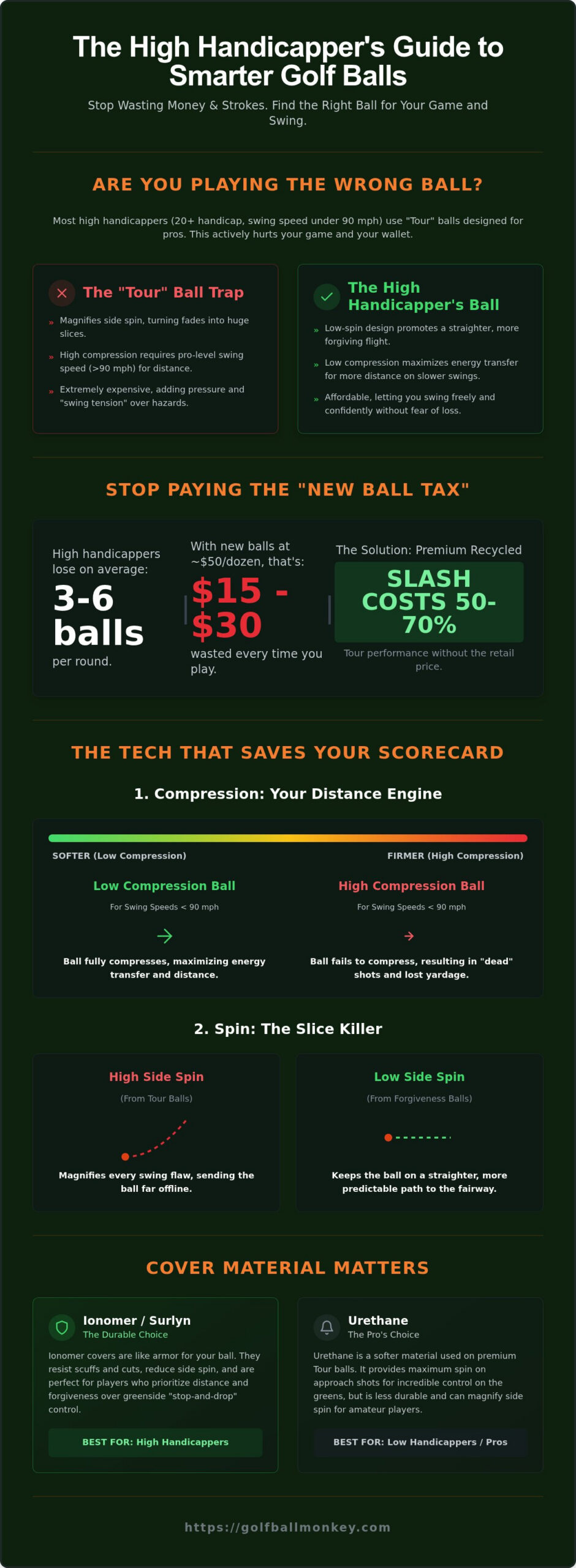
The math is brutal. High handicappers lose between 3 and 6 balls per round on average. If you’re buying retail packs at $50 a dozen, you’re lighting $30 on fire every time you tee off. Stop the financial leak. By switching to premium recycled gear from our online shop, you can slash that cost by 50-70%. Redirect that budget into more lessons or green fees. It’s the smartest play for your wallet and your game. You’ll find that playing with high-quality, recycled equipment feels just as good as a fresh box, without the mental burden of the price tag.
Compression and Spin: The Tech That Saves Your Scorecard
Think of your golf ball as a high-tech spring. To get it to fly, you have to squish it. This is compression. If you swing under 90 mph, hitting a high-compression “Tour” ball is like trying to compress a brick with a fly swatter. You won’t get the energy back, and your distance will suffer. The best golf balls for high handicappers are designed with lower compression ratings. They allow your swing to actually deform the ball, storing energy and snapping it off the face for more yards. Finding the right fit through modern golf ball fitting principles ensures you aren’t leaving distance on the tee box just because your gear is too “hard” for your speed.
Low Compression: The Distance Engine
Low compression balls maximize your “Smash Factor.” This isn’t just a cool term; it’s the ratio of ball speed to clubhead speed. When the ball is soft enough to compress, more energy transfers from the club to the core. Harder balls feel like hitting a rock and often result in “dead” shots for average golfers. If you want that satisfying “thwack” and a ball that jumps off the face, go soft. It’s the easiest way to add 10 yards without changing your swing mechanics.
Spin Rate: Friend or Foe?
Not all spin is equal. Backspin is your friend because it provides the lift needed to keep the ball in the air. Side spin is the enemy that turns a tiny mistake into a trip to the woods. Most 2-piece balls are engineered with a large, soft core and a firm cover to reduce that “wobble” in flight. This construction keeps your shots on a flatter, straighter rope. The “Monkey Tip” is simple: look for labels like “Distance” or “Soft.” These are usually 2-piece designs built for maximum forgiveness and straighter flight paths. If you’re tired of losing gear to the trees, check out the high-forgiveness options in our inventory.
Finally, consider the cover material. You’ll usually choose between Ionomer (often called Surlyn) and Urethane. Urethane is what the pros use for “stop and drop” control on the greens. However, Ionomer is much more durable. It’s like armor for your ball. It resists scuffs from cart paths, trees, and the thick rough where high handicappers often find themselves. Since you aren’t trying to stick a 6-iron from 180 yards, the durability of Ionomer is a massive win for your wallet.
The Heavy Hitters: 5 Best Golf Balls for High Handicappers in 2026
Most “best of” lists are a trap. They recommend sixty-dollar boxes that vanish into the woods before you even finish the front nine. We take a different approach. We focus on the best golf balls for high handicappers that actually balance performance with your bank account, especially when you buy them as Mint 5A recycled gear. You need a ball that stays straight and flies long, even when your swing isn’t perfect. Here are the top five models currently dominating the fairways.
- Callaway Supersoft: This is the king of feel. With an ultra-low compression rating of 38, it’s designed specifically for slower swing speeds. It feels like hitting a marshmallow but launches like a rocket.
- Srixon Soft Feel: Now in its 13th generation, this ball is a legend for a reason. Its FastLayer Core starts soft in the middle and gets firmer toward the edge, providing a great blend of distance and accuracy.
- Titleist Velocity: Forget the Pro V1 for a minute. The Velocity is built for one thing: speed. It uses a high-speed LSX core to deliver soaring flight and maximum yardage on every shot.
- Bridgestone Tour B RX: This is the “thinking man’s” tour ball. It is optimized for swing speeds under 105 mph, giving you premium urethane tech without the massive side spin that ruins your afternoon.
- Kirkland Signature: The ultimate budget disruptor. This 3-piece ball offers urethane performance that rivals the big brands, making it a favorite for those who want tour-level tech without the retail price tag.
Callaway vs. Srixon: The Battle of the “Soft” Balls
These two giants dominate the soft-compression category. Callaway utilizes HEX Aerodynamics to reduce drag and increase lift, which is a lifesaver for players who struggle to get the ball airborne. Srixon fights back with a 338 Speed Dimple pattern designed to cut through the wind. In breezy conditions, the Srixon tends to hold its line better. If you want the absolute softest feel on the face, read our Callaway Golf Balls guide to see why it remains a fan favorite. Both are elite choices for keeping your game in the short grass.
The “Secret” Performance of the Titleist Velocity
High handicappers often score better with a Velocity than a Pro V1 because the Velocity doesn’t punish a slice with excessive spin. It is engineered for high launch and low long-game spin, which translates to longer, straighter drives. The Velocity is the straight-shooting workhorse for the golfer who hates the woods. It helps you clear hazards by boosting your launch angle, turning those “maybe” shots into guaranteed carries. When you stop fighting the spin, you start finding the green.
Stop Paying the “New Ball Tax”: The Case for Recycled Premium Gear
Stop paying the “New Ball Tax.” It is the extra money you fork over at the pro shop just to be the first person to scuff a brand-new ball. For the best golf balls for high handicappers, retail prices are a trap. You are going to lose gear. It is part of the learning curve. But losing a ball that cost you a buck feels a whole lot better than watching five dollars vanish into a lily pad. This is the savvy insider’s secret: play the best brands for 50-70% less by choosing recycled gear.
Let’s clear the air on recycled vs. refurbished. Never buy refurbished balls. Those are balls that have been sandblasted, repainted, and stamped with a fake logo. It ruins the aerodynamics and the feel. Recycled balls are different. They are harvested by professional divers from course hazards, then cleaned and sorted by hand. No paint. No stripping. Just the original ball in its original state. Plus, it is the eco-friendly choice. Every ball recovered is one less piece of plastic sitting in a pond for eternity. Our divers harvest millions of balls annually, saving your wallet and the planet at the same time.
The 24-Hour Myth: Does Water Kill Distance?
Internet forums love to argue about “water-logged” balls. They claim a ball loses 10 yards after a quick dip. That is nonsense. Modern balls use solid cores and multi-layer covers that are incredibly water-resistant. A ball spent 24 hours in a pond is virtually identical to one in a box. Unless a ball has been submerged for years, the performance remains elite. If you’re still skeptical, check out our guide on Are Used Golf Balls Worth It? for the full technical breakdown. You’ll see that the “water damage” fear is mostly just marketing from the big brands.
Decoding the Mint 5A Grade
When you buy recycled, grading is your seal of approval. Our Mint 5A grade is the gold standard. These balls are indistinguishable from new. No scuffs. No player marks. Just pure, factory-level performance. If you want to save even more, look at 4A (Near Mint). These might have a tiny ink mark or a minor blemish, making them the perfect “practice round” sweet spot. Learn more about Decoding Grades: What Mint 5A Really Means to find your perfect value tier. Ready to stop overpaying? Grab a bag of premium recycled balls today and keep your cash in your pocket.
Stock Up Like a Pro: How to Build Your High-Handicap Arsenal
Buying in bulk is the ultimate power move. When you have 96 balls sitting in your garage, losing one on the first tee doesn’t ruin your day. It changes your entire psychology. You stop steering the ball and start swinging the club. For developing players, the best golf balls for high handicappers are the ones you aren’t afraid to lose. Stocking up on 48 or 96 packs of premium recycled gear is the smartest way to build a consistent game. You get the same flight, the same feel, and a massive discount compared to those overpriced 12-packs at the course pro shop.
The “Mixed Bag” Experiment
Maybe you haven’t found “the one” yet. That is perfectly fine. We recommend the Mixed Bag (Good 3A) for pressure-free practice and experimentation. It is the perfect way to test 5-6 different models on the course without a heavy financial commitment. You might find that you prefer the soft landing of a Srixon over the high launch of a Titleist Velocity. The Monkey recommends variety for the developing player. Once you find the brand that clicks with your swing, you can graduate to a bulk order of Mint 5A grades. It is an intelligent way to audition equipment before making a long-term play.
Don’t forget the supporting cast. Your arsenal needs more than just high-quality spheres. Savvy players know that the right accessories make the game easier. Consider these essentials for your next round:
- Golf Ball Monkey Performance Tees: Ensure consistent height on every drive for better contact.
- High-Quality Towel: Keep your dimples and grooves clean to maintain aerodynamic performance.
- Ball Markers: Stay prepared on the green without fumbling through your pockets.
Clean dimples are essential for flight. Dirty grooves lead to unpredictable side spin. It’s these small adjustments that turn a triple-digit score into a personal best. Focus on the details and the distance will follow. A prepared golfer is a confident golfer.
Ready to Restock?
You have the tech. You have the strategy. Now you just need the inventory. If you want the absolute peak of performance, go for the Mint 5A Titleist Pro V1. It gives you tour-level control at a fraction of the retail cost, allowing you to play the world’s #1 ball without the “new ball tax.” If you are still finding your rhythm, stick with the high-forgiveness 2-piece options we covered earlier. Head over to the Golf Ball Monkey Shop to load up your bag. Swing hard, save big, and keep it in the short grass. Play the ball that lets you swing freely. That’s the only way to truly enjoy the thrill of the game.
Level Up Your Game Without the Retail Sting
You’ve got the blueprint to stop the financial bleeding. By choosing low-compression tech and ditching high-spin covers, you’ve identified the best golf balls for high handicappers to keep your shots straight. The “new ball tax” is officially optional. You don’t need a fresh box to play your best; you just need the right gear for your swing speed. Our professional divers recover over 1 million balls annually, ensuring you get top-tier brands without the retail markup. With our Mint 5A grade guarantee, you get performance indistinguishable from new, vetted by insiders who live for the sport. It’s time to swing with total confidence knowing a splash in the pond won’t wreck your wallet. Score Tour Performance for Less-Shop Mint 5A Balls Now! Grab a bulk pack, find your rhythm, and start hunting those flags. We’ll see you in the short grass.
Golf Ball Monkey’s Insider Intel: High-Handicap FAQs
Do high handicappers really need expensive golf balls?
No, you don’t need to drop fifty bucks on a box of Tour balls. High-spin balls actually punish your mistakes by turning a slight fade into a massive slice. Focus on finding the best golf balls for high handicappers that prioritize straight flight and low-compression distance. Save your cash for green fees and buy recycled gear that performs just as well as the shiny retail packs.
What is the best compression for a high handicap golfer?
Aim for a compression rating between 35 and 70. This “soft” range is perfect for swing speeds under 90 mph. It allows you to fully compress the core, which translates to more yardage off the tee. If the ball feels like hitting a rock, the compression is too high for your speed. Low-compression balls are the easiest way to gain distance without changing your swing.
Will a low-spin golf ball actually fix my slice?
A low-spin ball won’t magically cure a bad swing path, but it will definitely minimize the damage. These balls are engineered to reduce side spin, meaning your slice won’t curve as aggressively toward the trees. It keeps your misses manageable and your scorecard cleaner. It’s the intelligent play for anyone tired of hunting through the tall grass for their equipment.
Are used golf balls as good as new ones for high handicappers?
Absolutely. Recycled balls in Mint 5A condition are indistinguishable from new gear. Since high handicappers lose balls frequently, the massive savings on recycled premium brands make them the smartest choice. You get the same aerodynamics and core performance without the “new ball tax.” It’s the savvy way to play top-tier brands like Titleist or Callaway for way less.
What is the most durable golf ball for beginners?
Balls with Ionomer or Surlyn covers are the toughest on the market. These covers act like armor, resisting the scuffs and scrapes that happen when you visit the woods or hit a cart path. They outlast soft Urethane balls by a long shot, making them ideal for the developing player. You’ll get more holes out of every ball before it needs to be retired.
How many golf balls should a high handicapper carry in their bag?
Don’t get caught empty-handed; carry at least 12 to 15 balls. High handicappers lose an average of 3 to 6 balls per round, so having a full dozen provides a necessary safety net. This prevents “swing tension” when you’re facing a forced carry over water. When you have a deep stash, you play with more confidence and fewer nerves.
Is the Titleist Pro V1 good for high handicappers?
The Pro V1 is a masterpiece, but it’s often “too much ball” for a high-handicap swing. Its high spin rate can magnify your slice and send you into the woods. Most high handicappers see better results with the Titleist Velocity or Tour Soft. These models are easier to keep straight while still offering that premium Titleist feel you want on the green.
What does Mint 5A grade mean for used golf balls?
Mint 5A is our gold standard. It means the ball looks and plays like it’s brand new. There are no scuffs, no player markings, and the cover is pristine. It’s the best way to get the best golf balls for high handicappers at a fraction of the retail cost. Our divers personally vet these to ensure they meet factory-level performance standards every time.
Best Golf Balls for High Handicapper on a Budget: 2026 Value Guide
Why are you still handing five-dollar bills to the water hazard every time you slice a drive? It’s a gut-punch that every golfer knows too well. You want the forgiveness and distance of premium equipment, but watching a brand-new ball disappear into the woods feels like throwing money into a fire. Most players think they have to choose between overpriced “Tour” balls or cheap rocks that feel like hitting a marble. Finding the best golf balls for high handicapper on a budget shouldn’t feel like a chore. You deserve a ball that stays in the fairway without making you feel guilty for every lost sleeve.
Stop overpaying for performance. You can actually get Tour-level tech on a high-handicap budget by using some savvy equipment secrets. We’ve vetted the data to show you how to save over $175 a season just by switching your “gamer” to a high-value alternative. This guide breaks down the top low-compression models for 2026, explains why “Mint 5A” recycled balls are the ultimate industry hack, and helps you pick a ball that matches your swing speed. We’re stripping away the tech jargon to find you the perfect match for your game and your wallet.
Key Takeaways
- Stop falling for the retail trap and learn why playing expensive, brand-new balls actually hurts your mental game and your bank account.
- Identify the specific low-compression tech designed to help high handicappers maximize distance and minimize the side-spin that causes slices.
- Discover why used Mint 5A models are the best golf balls for high handicapper on a budget, delivering professional performance without the pro-shop price tag.
- Master a simple testing strategy to find your “gamer” and build consistency by sticking to one model every time you tee off.
- Learn how professional divers recover and vet top-tier equipment so you can stock your bag with premium brands for half the retail cost.
Why High Handicappers Waste Money on the Wrong Balls
Stop handing five-dollar bills to the lake every time you tee off. Most high handicappers fall straight into the “Retail Trap” by buying whatever the pros play on TV. If you’re scoring 90 or higher, your needs are radically different from a scratch golfer. Buying brand-new Tour balls is a losing game for beginners. These balls are designed for high-speed impacts that most amateur swings simply can’t produce. When you play a ball that isn’t matched to your game, you aren’t just losing distance; you’re losing money. Understanding the history and design of the golf ball shows us that technology has evolved to help every skill level, yet most players still buy for the brand name rather than the performance benefit.
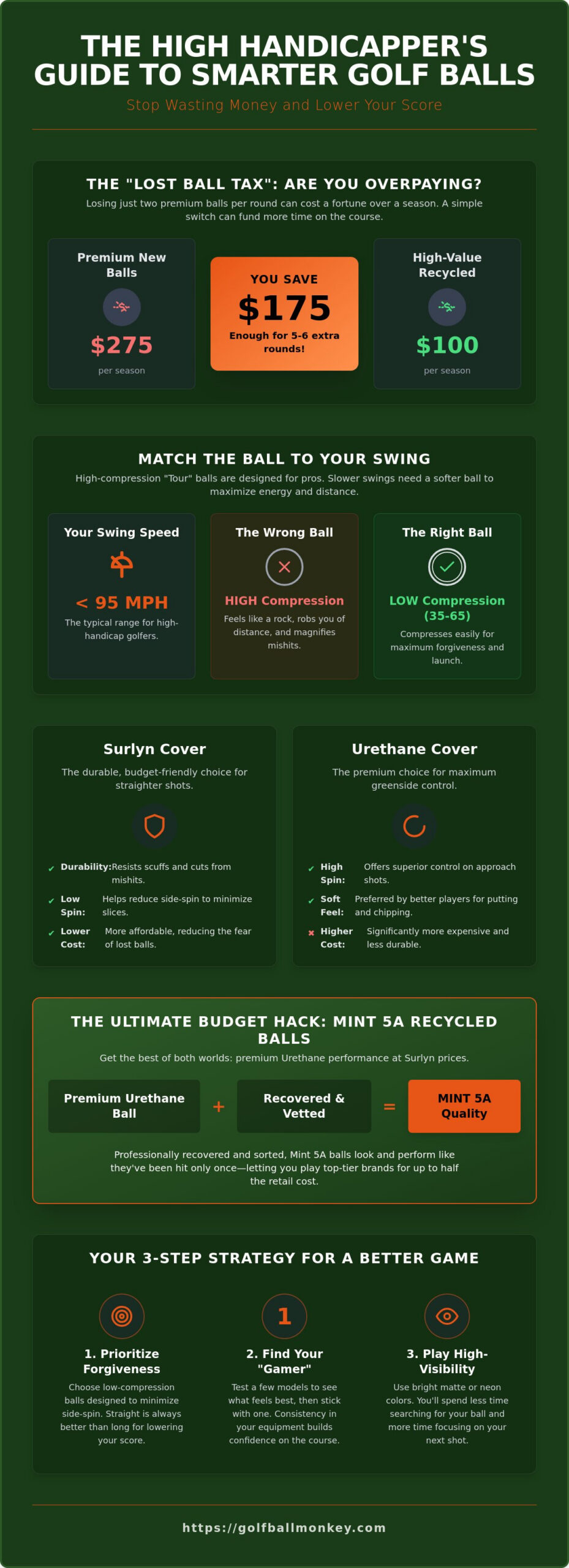
Let’s calculate the “Lost Ball Tax.” Research from April 2026 shows that losing just two premium balls per round over 30 rounds costs a golfer roughly $275. If you switch to the best golf balls for high handicapper on a budget, that cost drops to about $100 for the same period. That is a $175 difference that could pay for five or six extra rounds of golf. Beyond the math, there is a massive psychological impact. When you stand over a $5 ball, you swing tentatively. You’re terrified of the water hazard. Playing a high-value recycled ball removes that fear, allowing you to swing with the confidence you need to actually improve your score.
The Compression Myth: Is “Hard” Always Better?
Most high-handicap golfers have a swing speed under 95 mph. If you’re using a high-compression “Tour” ball, it will feel like hitting a rock. You won’t be able to compress the core, which leads to a loss of distance and more vibration on off-center hits. You need a low-compression ball, typically with a rating between 35 and 65. These “soft” balls are engineered to compress easily at slower speeds, providing the forgiveness and launch you need. It’s about making the ball work for your swing, not fighting against it.
Surlyn vs. Urethane: What Your Wallet Needs to Know
Surlyn covers are the durable, budget-friendly champions of the high-handicap world. They resist scuffs and reduce the side-spin that turns a slight fade into a massive slice. Urethane covers are softer and provide more spin for greenside control, but they cost significantly more and wear out faster. Here is the insider secret: you don’t have to choose. By shopping for Mint 5A recycled balls, you can get premium Urethane tech for Surlyn prices. It’s the smartest way to get your bag stocked with elite equipment without the retail markup. You get the performance you want without the financial sting when one inevitably finds the woods.
The Best Golf Balls for High Handicappers in 2026
Straight is always better than long. If you’re a high handicapper, your biggest enemy isn’t the distance; it’s the side-spin that sends your ball three fairways over. The best golf balls for high handicapper on a budget are designed to kill that spin and keep you in play. We rank these balls by their “forgiveness factor.” This means looking for a large, soft core that absorbs the shock of a mishit and a cover that doesn’t over-react to a glancing blow. When you play a ball built for your swing, you stop playing defensive golf. You start attacking the pin because you trust the equipment to stay on the map.
Don’t ignore high-visibility options either. Matte greens, neon yellows, and bright oranges aren’t just for show. They make tracking your shot against a cloudy sky or finding it in the thick rough much easier. Saving five minutes of searching per hole keeps your momentum alive. Ultimately, the “best” ball is the one you aren’t afraid to lose. When you stop worrying about the cost of a splash, your swing loosens up. You can find all these top-tier performers in our recycled inventory for a fraction of the pro-shop price.
Top Premium Picks for High Handicappers
Callaway Chrome Soft remains the gold standard for players who want a soft feel without sacrificing speed. It uses a Hyper Fast Soft Core that is incredibly forgiving on off-center strikes. If you want the ultimate in consistency, the Titleist Pro V1 is hard to beat. Even if you aren’t a pro, the tight manufacturing tolerances mean every ball performs exactly like the last one. This consistency is backed by official USGA golf ball testing standards, ensuring you get elite aerodynamics on every drive. For those with moderate swing speeds, the Bridgestone Tour B RX is specifically engineered to maximize distance for players who don’t swing like a long-drive champion.
Best Value-Specific Models
- Kirkland Signature: The cult-favorite budget king. It offers 3-piece urethane performance that rivals balls twice its price.
- Srixon Soft Feel: A long-time favorite for straight distance. Its 2-piece construction is built to reduce spin and launch high.
- TaylorMade TP5: This ball uses high-launch tech that helps beginners get the ball airborne quickly, even on thin shots.
Choosing between these comes down to your specific miss. If you struggle with height, go TaylorMade. If you need to kill a slice, Srixon is your best friend. The goal is to find a “gamer” that fits your eye and your swing without draining your bank account.
Used “Mint 5A” Balls: The Ultimate Budget Hack
Stop paying a “new ball tax” every time you visit the pro shop. If you want the best golf balls for high handicapper on a budget, you need to look below the surface. Literally. Professional divers recover millions of premium balls from water hazards every year. These aren’t just “found” balls; they’re high-performance equipment that was lost by someone else on their first swing. We put these through a rigorous vetting process to ensure they meet strict quality standards. This is the ultimate insider secret to playing a $5 ball for roughly half the retail cost. You get the same aerodynamics and core technology without the financial sting of a lost sleeve.
Don’t let the “water-logged” myths scare you off. Modern golf ball construction uses advanced polymers that don’t soak up water like the old wound-core balls from decades ago. A ball sitting in a pond for a few days or weeks maintains its structural integrity and compression. For the average player, the performance difference is non-existent. You’re essentially buying a “like-new” product that has just been through a very thorough wash. It’s the smartest play in the game. You save money, play better brands, and keep plastic out of the environment.
Decoding the Golf Ball Monkey Grading Scale
We take grading seriously. We use a standardized scale so you know exactly what’s landing on your doorstep. Mint 5A is our pristine tier. These balls look and play like they’re straight from a fresh box. They have no scuffs and no loss of shine. Near Mint 4A balls might have a tiny cosmetic blemish or a player pen mark, making them the best choice for casual weekend rounds where you want performance without the perfection. Good 3A balls are our “value workhorses.” They show some wear but still fly true. They are perfect for those high-risk holes where water is everywhere and you don’t want to sweat a lost shot.
Performance Testing: Used vs. New
High handicappers won’t notice a one-yard difference in carry. In fact, most amateurs can’t tell a Mint 5A recycled ball from a brand-new one in a blind test. The consistency of a used Titleist or Callaway often beats a brand-new “cheap” ball from a big-box store. Choosing recycled gear is also the most eco-conscious way to play. You’re giving a second life to high-quality materials that would otherwise sit at the bottom of a lake. For a deeper dive into how to pick your perfect set, check out our Used Golf Balls: The Ultimate Buyer’s Guide. It’s time to stock your bag like a pro while keeping your budget in the green.
Practical Tips for Choosing Your “Budget Gamer”
Stop guessing on the tee box. Finding the best golf balls for high handicapper on a budget requires a simple field test. Don’t just buy a dozen and hope for the best. Grab three different models from our “Mint 5A” inventory and head to the practice green first. Feel how they come off the putter face. Then, take them to the course for the “Fairway Test.” High handicappers often chase raw yardage, but you should prioritize straightness. A ball that goes 220 yards into the short grass is always better than a 250-yard bomb that ends up in the neighbor’s pool. If a specific ball consistently keeps you between the lines, that’s your winner.
Consistency is your secret weapon. Once you find a ball that works, stick to it. Switching brands every hole ruins your touch and makes it impossible to learn how your equipment reacts. Even if you’re playing used gear, playing the same model every round builds the muscle memory you need to drop your handicap. You’ll eventually reach a point where you need more greenside spin, but until you’re regularly breaking 90, stick with distance-oriented 2-piece balls. They are more durable and much more forgiving on those common off-center strikes.
Buying in Bulk for Maximum Savings
Smart players never buy by the sleeve. Buying bulk golf balls in 50-count buckets or large mesh bags is the ultimate financial power move. It slashes your cost per ball and ensures you always have a fresh supply in the trunk. This also allows you to build a “shag bag” for practice. Hitting the same ball you play on the course during your practice sessions is a pro-level habit that most amateurs ignore. You get the performance you need without the retail heart attack.
Visibility Matters: White vs. Yellow Balls
Don’t be too proud to play yellow. High-visibility balls are a massive advantage for anyone struggling to track their shots. If you can see exactly where your ball landed, you spend less time wandering in the tall grass. This directly reduces your “lost ball tax” because you’ll find shots that would have been abandoned if they were white. There is a psychological edge to seeing your ball clearly from the fairway; it builds confidence for your next approach. Find your favorite color and stock up at Golf Ball Monkey today to keep your bag full for less.
Stock Your Bag Like a Pro with Golf Ball Monkey
Stop settling for “good enough” equipment because you’re afraid of the retail price tag. You’ve done the math. You know the tech. Now it’s time to make the intelligent play. When you realize you can play the best golf balls for high handicapper on a budget without sacrificing the brand-name performance you see on Sunday TV, the entire game changes. You no longer have to choose between a ball that helps your slice and a ball that fits your wallet. We’ve bridged that gap by sourcing the world’s best equipment from the places other golfers leave it behind.
Our professional divers are the unsung heroes of your scorecard. They harvest millions of balls annually from US water hazards, bringing premium tech back to the surface for a second life. Every ball goes through the “Monkey” vetting process, ensuring only the highest quality makes it to our Texas-based operation. We don’t just “find” balls; we curate an inventory of elite gear that has been professionally cleaned and strictly graded. It’s a sustainable, cost-effective way to keep your bag stocked with the same urethane covers and low-compression cores that the pros use. You get the technology you need, and the planet gets a little less plastic in its ponds.
Imagine standing on a tight par-4 with a bag full of Pro V1s that cost you less than a decent steak dinner. That is the confidence of a savvy insider. You aren’t swinging tentatively because you’re worried about losing five dollars on a bad kick. You’re swinging freely because you have a 50-count bucket of Mint 5A gems waiting in the trunk. This psychological freedom is often the missing piece for high handicappers looking to break into the 80s. When the cost of failure is pennies instead of dollars, your game finally has room to grow.
The Monkey’s Guarantee
We stand behind every dimple. Our commitment to quality grading is what sets us apart from some random guy selling balls in a parking lot. If we call it Mint 5A, it means it’s pristine. Our Texas-based support team is ready to help with every order, ensuring you’re 100% satisfied with your haul. For those who want to geek out even further on the science of ball flight, check out Golf Balls 101 for a deep dive into performance tech and value. We make sure you know exactly what you’re putting into play.
Ready to Save? Shop Our Mint 5A Collection
Don’t wait for your next round to realize you’re out of ammo. Browse our Titleist Pro V1 Mint 5A inventory right now and see the savings for yourself. While you’re at it, grab some of our Golf Ball Monkey Performance Tees and accessories to round out your kit. It’s the easiest way to restock your entire bag in one go. Get Tour performance for less today and start playing the game on your own terms. Your budget, and your handicap, will thank you.
Stop Overpaying and Start Scoring
Golf doesn’t have to be a financial drain. You’ve learned that the “Retail Trap” is real and that swinging for the fences with expensive, brand-new balls usually just pads the bottom of a lake. By choosing low-compression models and sticking to a consistent “gamer,” you give your game the stability it needs to improve. The smartest play for any player is grabbing the best golf balls for high handicapper on a budget through the secondary market. You get the same Titleist or Callaway tech without the gut-punch price tag.
We take the guesswork out of your gear. Our inventory is professional diver recovered and vetted through a strict 5A grading system to ensure every ball looks and plays like new. As a Texas-owned and operated team, we’re dedicated to helping you stock your bag with premium equipment for less. Stop worrying about the “lost ball tax” and start focusing on your follow-through. You deserve to play the best brands without the pro-shop markup.
Shop Mint 5A Premium Used Golf Balls Now
See you on the fairway. Keep it straight and keep it savvy.
Frequently Asked Questions
Are used golf balls actually good for high handicappers?
Used balls are the smartest play for anyone scoring 90 or higher. High handicappers lose balls more frequently, so paying full retail price is essentially throwing money away. Playing a high-quality recycled ball allows you to use the best golf balls for high handicapper on a budget without the psychological fear of losing a five-dollar piece of equipment on every water hole.
What is the difference between recycled and refurbished golf balls?
Recycled balls are simply recovered, washed, and sorted by condition. They maintain their original factory finish and performance. Refurbished balls are often sandblasted and repainted, which can significantly alter the dimple pattern and aerodynamics. We only sell recycled balls because we believe in maintaining the integrity of the original manufacturer’s design.
Do water-logged golf balls lose distance?
Modern solid-core balls don’t absorb water like the old wound-center balls did decades ago. For the average amateur, any performance loss from a ball being in a hazard is completely unnoticeable. You’ll gain much more distance by playing a premium used ball that fits your swing than you’ll ever lose from it being a recycled find.
Which is better for a high handicapper: Titleist Pro V1 or Callaway Chrome Soft?
Callaway Chrome Soft is generally the better fit for high handicappers because it has a lower compression rating. This makes it easier to launch and more forgiving on off-center hits. While the Titleist Pro V1 is the gold standard for consistency, the Chrome Soft is engineered to help moderate swing speeds get the ball airborne with less effort.
How many golf balls should a beginner carry in their bag?
Always carry at least a full dozen. While statistics show high handicappers lose about two balls per round, a single bad hole can easily swallow a whole sleeve. Having a full bag of Mint 5A recycled balls ensures you never have to play a scuffed-up “shag” ball when the pressure is on during the back nine.
Is it worth buying Mint 5A golf balls in bulk?
Buying in bulk is the ultimate savvy move for your wallet. It slashes the cost per ball significantly and ensures you have a consistent “gamer” for every round you play. Consistency is key to dropping your handicap; playing the same model every time helps you learn exactly how your ball will react on the greens.
What is the best compression for a high handicapper swing?
A compression rating between 35 and 65 is ideal for most high-handicap players. Since most amateurs have a swing speed under 95 mph, a lower compression ball allows the core to compress fully. This creates a higher launch and more distance than a “hard” Tour ball that requires professional-level swing speeds to activate.
How do I know if a used golf ball is still playable?
Check the cover for any deep scuffs, cuts, or a loss of original shine. If the dimples are smooth or the ball feels “chalky,” it’s time to retire it to the practice bag. Our strict Mint 5A grading system does this work for you; every ball is vetted to ensure it looks and plays like it just came out of a fresh box.
Best Senior Golf Balls 2026: Get Your Distance Back Without Overpaying
What if the secret to gaining twenty yards back isn’t a thousand-dollar driver, but a ball that actually squishes when you hit it? It’s a common sting. You swing hard, but the ball feels like a rock and falls out of the sky way too early. Most senior golf balls marketed today promise the world but demand a premium price that hurts worse than a thin three-iron in January. You shouldn’t have to settle for “rocks” just because you want to save a few bucks, and you definitely shouldn’t be penalized for a swing speed that’s moved into a more refined gear.
It’s time to stop overpaying for air. You can get that buttery feel and explosive distance back without draining your savings. We’ve vetted the 2026 lineup to find the high-performance gems that work perfectly for swing speeds under 85 mph. This guide breaks down the top-tier models from Titleist, Callaway, and Srixon that offer the ideal 35 to 60 compression range. You’ll learn which Mint 5A recycled options provide the same tour-level spin and distance as brand-new boxes. We’re diving into the best ways to reclaim your game and keep your cash in your pocket.
Key Takeaways
- Ditch the age labels and optimize for swing speed. Learn why the 70 to 85 mph range is the magic number for your next big drive.
- Unlock hidden distance by matching your swing to the right compression. We’ll show you the best senior golf balls with a 35 to 65 rating for that perfect spring effect.
- Stop paying the new ball tax at retail shops. Discover how Mint 5A recycled balls deliver pro-level performance for a fraction of the sticker price.
- Identify the heavy hitters for 2026. Get the facts on why models like the Callaway Supersoft and Titleist Tour Soft dominate the senior market.
- Find your perfect match faster with a Mixed Bag. It is the smartest way to test multiple low-compression brands without breaking the bank.
Why ‘Senior’ Golf Balls Are a Game-Changer (Not Just a Label)
Let’s be real. Seeing the word “senior” on a box of balls can feel like a bit of a slap in the face. It shouldn’t. In the technical world of golf ball design and aerodynamics, that label is just shorthand for “optimized for your actual swing.” Most players sticking with “Tour” balls are leaving yards on the table. If your driver swing speed sits between 70 and 85 mph, you are in the sweet spot for senior golf balls. It’s about physics; not your birth certificate.
Standard premium balls require a 100+ mph impact to compress the core properly. If you don’t hit that threshold, the ball doesn’t deform. It stays rigid. You lose the trampoline effect that creates speed. Switching to a ball designed for your tempo can reclaim 10 to 15 yards of lost distance instantly. That is the difference between hitting a 7-iron or a 5-iron into the green. It is the smartest equipment change you can make without buying a single new club.
The Swing Speed Reality Check
You don’t need a fancy launch monitor to know where you stand. Take your average 7-iron distance. If you are hitting it 130 to 140 yards, your driver speed is likely in that 75 to 85 mph range. Hitting a “hard” ball with this speed is like hitting a marble with a fly swatter. The energy doesn’t transfer. A softer core allows for maximum energy storage at impact. It compresses, then snaps back. That snap is your distance. Don’t fight the physics; use them to your advantage.
Distance vs. Feel: Finding the Sweet Spot
Distance is great, but the short game is where you save par. A soft feel isn’t just about comfort; it’s about feedback. Senior-friendly balls offer a “thud” rather than a “click.” That lower-frequency sound profile signals a ball that stays on the clubface longer. This increased dwell time gives you more control over greenside chips. You get low spin off the tee to keep it straight, but enough grab on the wedges to stop the ball. You can shop our full inventory of low-compression balls to find your perfect match. Stop playing equipment meant for a 25-year-old pro. Play senior golf balls that actually work for your swing today.
Understanding Compression: The Secret to Senior Distance
Think of compression as the ball’s “squish” factor. It is the technical measure of how much a ball deforms when you smash it with your driver. For a ball to launch properly, your swing has to be fast enough to flatten it against the face. If you use a ball with a 90+ rating but swing at 75 mph, it won’t budge. It feels like hitting a stone. For most senior golf balls, the sweet spot for compression sits between 35 and 65. This lower threshold ensures the ball actually changes shape at impact, even with a smoother tempo.
While the official USGA golf ball regulations focus on size, weight, and initial velocity, they don’t mandate a specific compression. That is where you find your competitive edge. When a ball fully compresses, it creates a “spring-like” effect. It stores energy and then releases it as it leaves the clubface. If you aren’t compressing the ball, you aren’t getting that free energy. You are just wasting swing power on a ball that refuses to work with you. It is the difference between a ball that carries the bunker and one that finds the sand.
Why Low Compression Wins for Slower Swings
Compression is the ball’s ability to store and release energy. In low-compression cores, this rebound effect is tuned for moderate speeds. It’s not just about distance, though. A softer core actually helps you stay in the short grass. Because the ball stays on the clubface a fraction of a second longer, it reduces the glancing blow effect that causes slices and hooks. You get less side-spin and more forward momentum. It turns your “miss” into a playable shot in the fairway. It’s a simple fix for a frustrating problem.
The Myth of the ‘Hard’ Distance Ball
Forget the old days. Those 1990s “distance” balls were rock-hard because manufacturers didn’t have modern multi-layer technology. Today, senior golf balls use sophisticated layers to give you the best of both worlds. You get a soft, high-energy core for the driver and a responsive outer cover for the greens. If you want a deeper dive into how these layers interact, check out our Golf Balls 101 guide. It breaks down the tech so you can shop like a pro. Ready to see the difference for yourself? You can find all the top low-compression brands at Golf Ball Monkey for a fraction of the retail price.

Top 5 Used Golf Balls for Seniors in 2026
Stop walking into big-box stores and paying fifty bucks for a dozen balls. You’re smarter than that. To get your yardage back, you need gear that matches your speed. These senior golf balls are the top performers for 2026. We’ve vetted the flight, the compression, and the greenside spin. These five models are the clear winners for players who want premium results without the retail markup.
- Titleist Tour Soft: The gold standard for players who want the Titleist name without the Pro V1 price. It features a massive core that takes up almost the entire ball. That means more speed on moderate swings.
- Callaway Supersoft: The undisputed king of the low-compression world. With a rating of 38, it is one of the softest balls ever made. It’s designed to fly straight and long.
- Bridgestone Tour B RX: Bridgestone used thousands of ball fittings to design this for swings under 105 mph. It’s the most technical ball on the list.
- Srixon Soft Feel: A legendary 2-piece ball. It uses a core that is soft in the middle and firmer toward the edges. It optimizes your launch angle perfectly.
- TaylorMade Tour Response: This is for the senior who wants greenside spin. It has a 100% Urethane cover, just like the pro balls. It’s soft enough to compress but grippy enough to stop.
Premium Performance: Bridgestone vs. Titleist
The battle between the Bridgestone Tour B RX and Titleist Tour Soft is a clash of titans. Bridgestone uses ‘Reactiv’ cover technology. It’s a “smart” material that acts like a high-friction surface on short shots but behaves like a spring on long shots. Titleist Tour Soft focuses on a consistent, penetrating flight that handles the wind. Both offer incredible greenside ‘bite’ for mature players who rely on their short game. Take a look at our Callaway Golf Balls guide to see how they compare to other big names.
The Budget Kings: Supersoft and Srixon
If you want the best bang for your buck, the Callaway Supersoft and Srixon Soft Feel are your best friends. They are the most popular used senior golf balls on the market for a reason. Their straight-flight technology helps eliminate the side-spin that causes the senior slice. You’ll spend more time in the fairway and less time in the trees. You can grab these high-performance models for under $15 a dozen at the Golf Ball Monkey shop. It’s the easiest way to restock your bag.
The Savvy Play: Why Used Senior Balls Beat New Retail
Stop paying the “new ball tax.” It is a massive markup for a shiny box and a logo you are probably going to dunk in a pond by the fourth hole anyway. When you buy brand-new senior golf balls, you are often paying for massive marketing budgets and retail shelf space. The ball itself? It is identical to a Mint 5A used ball. In blind testing, even low-handicap players can’t tell the difference between a ball fresh out of the sleeve and one of our premium recycled gems. You get the same compression, the same dimple patterns, and the same flight without the wallet-draining price tag.
Choosing recycled gear is also the environmentally conscious play for the savvy golfer. Millions of golf balls are lost every year, sitting in woods and waterways where they don’t belong. We rescue them. By buying used, you are keeping plastic out of the ecosystem while keeping more cash in your pocket. It’s a win for the planet and a win for your scorecard. Why pay more to get the same result? It’s the most intelligent play you can make before you even reach the first tee.
Tour Performance on a Shag-Bag Budget
We take grading seriously. Our 5A Mint balls are the absolute cream of the crop. They look and play like they were just unboxed this morning. This isn’t about scuffed-up “shag” balls you’d find in a bargain bin; it’s about tour-level equipment at a fraction of the cost. You can save up to 70% compared to big-box retail stores. That means you can play the premium senior golf balls you actually want rather than settling for the cheap, hard options at the bottom of the price scale. For a deep dive into how we inspect and grade every single ball, check out our Used Golf Balls Guide.
The Truth About Water-Recovered Balls
The biggest myth in golf is “water-logging.” Modern ball covers are made of non-porous materials like Surlyn or Urethane. They are designed to be waterproof. A ball that spends 24 hours in a pond doesn’t soak up water like a sponge. Our professional divers recover these balls quickly, and our team cleans and dries them instantly to lock in their performance. Independent testing confirms that 5A Mint recovered balls show no measurable loss in yardage or velocity compared to brand-new retail versions. You get every yard of distance you paid for. Don’t let the marketing departments scare you into overspending. Make the smart move and shop the best recycled gear at Golf Ball Monkey today.
Ready to Restock? Pick Your Perfect Senior Ball at Golf Ball Monkey
Ready to get back on the course and show the group you’ve still got it? You’ve seen the tech. You’ve seen the savings. Now it’s time to stock your bag for the season. At Golf Ball Monkey, we’ve built dedicated collections of senior golf balls that take the guesswork out of your shopping experience. Whether you’re loyal to the soft flight of Callaway or the engineering of Bridgestone, we have the Mint 5A inventory ready to move. There is no reason to pay full retail when you can get the same performance for a fraction of the cost.
If you’re still not sure which model fits your tempo, don’t worry. Try our ‘Mixed Bag’ (Good 3A). It’s the perfect way to test different low-compression models in a real-world setting without committing to a full dozen of one brand. You might find that a Srixon Soft Feel works better for your launch than a Titleist Tour Soft. We provide fast shipping across the US. Your gear will be on your doorstep before your next weekend round. Join the Monkey crew. Stop overpaying for retail markups and start playing the smart way.
How to Shop Our 5A Mint Inventory
Navigate our shop with speed. Use our intuitive filters to sort by brand, condition, or specific compression level. It’s built for golfers who value their time and their budget. While the Titleist Pro V1 is a legend, it isn’t always the best choice for seniors. As we’ve covered, those balls require high speeds to unlock their potential. If you’re swinging under 85 mph, you’ll actually hit it further with a ball designed to squish. Every dozen we sell comes with our “Monkey Guarantee.” This means our team has personally vetted every ball to meet our strict 5A Mint grading scales. You get exactly what you pay for. No scuffs. No surprises. Just pure performance.
Grab a Bucket and Get Back to the Tee
Do you hit the links three or four times a week? You need a bulk solution. Our bulk buying options drive your costs down even further, making every round more affordable. It is the ultimate insider move for the frequent player. While you’re restocking, don’t forget the small stuff. Our Golf Ball Monkey Performance Tees are the perfect companion for your new senior golf balls. They’re designed to reduce friction and help you maintain that precious ball speed. Don’t let your bag run dry before the next tournament. Shop our full collection of senior-friendly golf balls now and get your distance back today.
Reclaim Your Yardage and Your Budget
The physics are clear. To hit it further, you need a ball that actually compresses at your swing speed. Stop fighting equipment meant for tour pros and start playing senior golf balls that work with your tempo. You’ve learned that low compression is the secret to that explosive “spring” effect and that Mint 5A used balls deliver that performance without the retail markup. It’s time to make the intelligent play for your game and your wallet.
We take quality seriously so you don’t have to. Our professional diver-recovered inventory undergoes a rigorous, standardized 5A Mint grading process to ensure every ball plays like new. With over 1 million balls recycled annually, we are the primary destination for savvy players who value efficiency and high-value acquisitions. Don’t let another round go by with equipment that holds you back. Score Mint 5A Senior-Friendly Balls for Less at Golf Ball Monkey today. Grab your gear, hit the tee, and enjoy the thrill of finding a significant bargain. See you on the fairway!
Frequently Asked Questions
What is the best compression rating for a senior golfer?
Target a compression rating between 35 and 65 for optimal results. This range ensures the ball deforms properly when your swing speed is under 85 mph. If you play a ball with a higher rating, you’re essentially hitting a rock that won’t launch. Lower compression is the technical secret to getting that spring effect back into your long game.
Are soft golf balls better for seniors than hard ones?
Soft balls are the superior choice for seniors with moderate swing speeds. Hard balls require immense force to activate the core. If you don’t have 100 mph speed, a hard ball stays rigid at impact. Soft senior golf balls compress fully, storing energy and releasing it for maximum carry and a better feel off the face.
Can a senior golfer still play a Titleist Pro V1?
You can play a Pro V1, but you’ll likely sacrifice total distance. These tour balls are engineered for high-speed impacts. If your swing has slowed, a Titleist Tour Soft or a Callaway Supersoft will usually give you more yardage. Stick with the Pro V1 only if you prioritize maximum greenside spin over your drive distance.
How much distance can I gain by switching to a senior golf ball?
Most players see a gain of 10 to 15 yards when they switch to a ball that matches their swing speed. This happens because you’re finally activating the core of the ball. It’s free yardage that comes from making a smarter equipment choice rather than trying to swing harder. It’s the easiest way to improve your scorecard instantly.
Is there a difference between ‘Senior’ balls and ‘Ladies’ balls?
The technology is nearly identical across both categories. Both focus on low compression and high launch to help slower swings. A “Ladies” ball often features a compression rating around 35 to 45, which is perfect for many senior men as well. Don’t let the marketing on the box stop you from playing the ball that fits your physics.
Are used golf balls safe to use for competitive senior play?
Used balls are perfectly safe and legal for tournament play, provided they are in good condition. Our Mint 5A senior golf balls are indistinguishable from new ones and meet all performance standards. As long as the model is on the USGA conforming list, you can play them in any competitive setting while saving a significant amount of cash.
How many layers should a senior golf ball have?
Focus on 2-piece or 3-piece constructions for the best results. A 2-piece ball is built for pure distance and durability, which is great for most recreational play. If you want more control and “bite” on your chips, move up to a 3-piece model. Balls with four or five layers are typically designed for high-speed pros and won’t benefit your game.
What is the best high-visibility color for senior golfers?
Matte yellow and neon green are the top choices for tracking your shot. These colors provide the highest contrast against both a blue sky and green grass. If you find yourself squinting to find your ball in the rough, switching from traditional white to a high-vis yellow can save you strokes and frustration throughout the round.
- golfballmonkey@gmail.com
- (512) 593-8401
- Mon – Fri, 9:00 AM – 5:00 PM

All product and company names are trademarks™ or registered® trademarks of their respective holders.
Use of them does not imply any affiliation with or endorsement by them.