
Callaway Supersoft Golf Balls: The Ultimate Guide to Max Distance & Soft Feel
Why are you still paying $4 a ball just to watch it splash into the water hazard on the 4th hole? It’s a total buzzkill. Most amateurs lose an average of 4.5 balls per round, yet they keep buying expensive, high-spin gear that actually makes their slice worse. You want a ball that feels like butter and stays in the fairway. That’s exactly why callaway supersoft golf balls have been the top choice for recreational players for three years running. They use a ultra-low 38-compression core to maximize distance while keeping that signature soft feel that won’t clatter off your clubface.
We get it. You’re tired of “distance” balls that feel like hitting a rock and high-end tour balls that drain your wallet. You deserve premium performance without the elitist price tag. This guide breaks down why this specific ball is a game-changer for your scorecard and how you can grab near-mint sets at 50% off the retail price. We’re diving into the tech specs, the spin-reducing benefits, and the Monkey’s secret to scoring 5-star quality gear at a massive steal.
Key Takeaways
- Understand why the ultra-low compression design makes the Callaway Supersoft the top choice for amateur golfers seeking a buttery feel.
- Learn how the HyperElastic SoftFast Core turns slower swing speeds into massive yardage gains off the tee.
- Find your “sweet spot” and see how these balls stack up against the Warbird and ERC Soft to ensure you’re playing the right gear.
- Discover how to snag callaway supersoft golf balls at “Monkey prices” for premium performance without the retail sting.
- See why choosing Mint and Near-Mint recycled balls is the smart, eco-friendly play for your wallet and the course.
What Makes the Callaway Supersoft the World’s Favorite Amateur Ball?
Stop flushing money down the fairway. Most golfers don’t need a tour-level ball that feels like a rock. The Callaway Supersoft changed the game by proving that “soft” equals “long” for the average player. It’s the undisputed king of the amateur bag. It consistently outsells premium 3-piece balls by nearly 2 to 1 in the value segment. Why? Because it feels incredible and flies straight. The Monkey knows that for most weekend warriors, this is the ultimate weapon for keeping the scorecard clean and the wallet full.
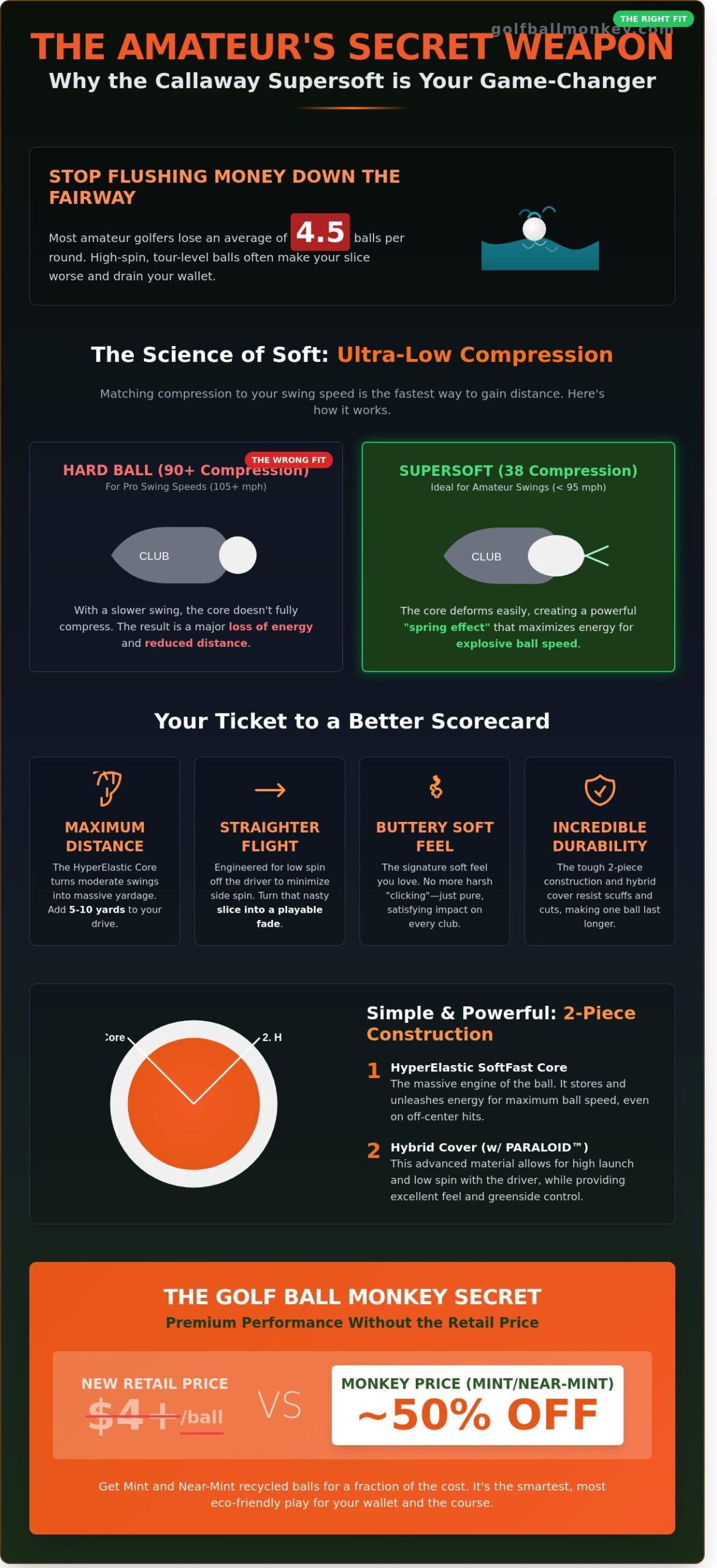
The shift toward low compression happened about a decade ago. Golfers realized that high-compression balls were actually stealing their distance. If you swing under 95 mph, a hard ball won’t compress. You lose ball speed. Callaway tapped into this frustration. They created a ball with a compression rating of approximately 38. That is incredibly low. It means the ball deforms against the clubface even at moderate speeds. This creates a “spring” effect that sends the ball screaming down the middle. You’re not just playing a ball; you’re playing a physics advantage designed for your specific swing speed.
Looking at the Callaway Golf Company history, it’s clear they understand the mass market better than almost anyone. Since their founding in 1982, they’ve focused on forgiveness. The callaway supersoft golf balls are the pinnacle of that mission. You get a ball that minimizes side spin. That means your slice becomes a manageable fade. Your hook becomes a playable draw. It’s a “smart play” for anyone tired of hunting in the tall grass. You’re getting elite engineering at a fraction of the cost of those “pro” balls that just end up in the lake anyway.
The 2-Piece Construction Advantage
Simple is better. The 2-piece design features a massive HyperElastic SoftFast Core and a thin, reactive cover. This setup maximizes energy transfer. There are no middle layers to soak up power or add unnecessary spin. It’s a direct line from your swing to the horizon. These balls are also tough as nails. You can smash them into a cart path or a tree, and they’ll usually come out looking five-star quality. That durability means one ball lasts longer, saving you even more at Monkey prices.
A History of the Supersoft Line
Callaway didn’t just get lucky. They spent years refining this formula to perfection. A major turning point came with the introduction of the PARALOID Impact Modifier. This hybrid cover material allows for high launch and low spin off the driver, but still gives you decent grab around the greens. The 2026 version remains the gold standard for value and performance. It’s the benchmark that every other brand tries to beat. The Monkey sees these fly off the shelves because they work. You get 90% of the performance of a tour ball at 40% of the retail price. That’s not just a good deal; it’s a steal.
The Science of Soft: How Callaway Engineered Max Distance
Stop overthinking your gear and start focusing on the physics of the strike. The Callaway Supersoft golf balls remain a top seller because they tackle the two biggest hurdles for the average player: distance loss and side spin. This isn’t just marketing fluff; it is a masterclass in low-compression engineering. Callaway designed this ball to act as a launchpad for golfers who don’t possess a 120 mph swing speed. It turns a standard strike into a high-velocity launch by maximizing the trampoline effect at impact.
What is a Low Compression Golf Ball?
Compression is the measurement of how much a golf ball deforms or squishes under the force of a clubhead during impact. While Tour-level balls often feature a compression rating of 90 or higher, the Supersoft sits at a remarkably low 38. This massive gap in density changes everything for the amateur player. Golfers with swing speeds under 95 mph often fail to “activate” a harder ball, which results in a loss of potential energy. By using a ball with a 38-compression rating, you ensure the core fully compresses even on moderate swings. This creates a massive energy transfer that translates directly into ball speed.
The HyperElastic SoftFast Core serves as the engine of this ball. It is specifically formulated to store energy during the initial “pancake” phase of impact and release it rapidly as the ball leaves the face. Recent independent golf ball testing from 2025 confirms that matching your compression to your swing speed is the fastest way to add 5 to 10 yards to your drive. When you compress the core correctly, you get more “spring” and less “thud.”
Low spin is the other half of the distance equation. While high spin is great for stopping a 6-iron on a dime, it is the enemy of the driver. Excess spin off the tee creates air resistance and exaggerates hooks or slices. The Supersoft is engineered to keep spin rates low on long shots. This results in a piercing, straighter flight path. If you struggle with a slice that robs you of 20 yards, switching to a low-spin ball is a total game-changer. It keeps the ball on a rope and helps you find the short grass more often.
Decoding the PARALOID Hybrid Cover
Callaway moved beyond basic Surlyn covers to create the PARALOID Hybrid Cover. This multi-material construction is designed to offer the best of both worlds: high-speed distance and soft-feel control. Traditional distance balls often feel like hitting a pebble, but the PARALOID material provides a soft, tacky feel that improves feedback. This cover allows for a high launch angle without the “ballooning” effect that kills distance in the wind. It ensures your ball climbs to an optimal peak height and stays there.
The dimple pattern is just as vital as the material itself. Callaway uses HEX Aerodynamics, which replaces traditional circular dimples with a hexagonal pattern that covers 100 percent of the surface area. This design reduces drag by approximately 15 percent compared to standard balls. Less drag means the ball maintains its velocity longer during flight. You get a stronger finish and more roll-out once the ball hits the fairway. It is a smart play for anyone looking to maximize their reach without changing their swing.
You don’t need to pay full retail to get this level of tech in your bag. You can snag a “steal” by picking up mint condition recycled Callaway balls that perform exactly like new for a fraction of the cost. The Monkey personally vets every ball to ensure you get five-star quality without the five-star price tag.
Real-World Performance: Distance, Spin, and Feel Tested
Let’s get one thing straight: the callaway supersoft golf balls aren’t trying to be a Tour-level rock. They don’t need to be. These balls are built for the rest of us who want to see the ball fly straight and feel like butter at impact. If you’re tired of losing $5 balls in the drink, switching to these is a savvy move. They offer a specific performance profile that favors the average player over the scratch golfer. The Monkey has tested these across the board, and the results are consistent. You get massive value without sacrificing the “pure” feel we all crave on the course.
Driver Distance for Moderate Swing Speeds
If your swing speed sits between 75 and 95 mph, you’re in the sweet spot for this ball. Testing shows that players in this bracket often see a 5 to 8 yard jump in carry distance compared to higher-compression alternatives. The low-compression core allows the ball to deform fully at impact. This creates a spring-like effect that translates to higher ball speeds for slower swings. However, if you’re a big hitter swinging at 105 mph or more, be careful. You might actually lose 10 yards of distance because you’re over-compressing the core, leading to energy loss. This National Club Golfer review highlights how the low spin keeps the ball on a rope. The “Straight Flight” factor is real. By reducing side-spin, the ball stays in the short grass more often, even when your swing path is a little wonky.
Iron play with the Supersoft is all about predictability. You won’t get those terrifying “flyers” that sail 15 yards over the green unexpectedly. Instead, you get a muted, soft sound at impact. It isn’t a sharp “click” like a distance ball; it’s a deep, satisfying thud. Since its 2023 update, the consistency of the ball’s flight has improved, making it easier to dial in your yardages. You can swing with confidence knowing the ball will behave the same way every time it leaves the face.
Around the Green: Managing Expectations
Don’t expect these to dance like a Chrome Soft or a Pro V1. The ionomer cover is designed for durability and distance, not high-level friction. On a standard 20-yard chip, the callaway supersoft golf balls will typically roll 4 to 6 feet further than a premium urethane ball. You have to play for the release. Master the “bump and run” technique and you’ll find success. The soft cover still provides a sense of control that harder distance balls lack. It gives you the confidence to accelerate through the chip without fearing a harsh, thin strike that rockets across the green.
- Spin: Low to moderate; expect more roll-out on chips.
- Durability: High; the Paraloid Hybrid cover resists scuffs from wedges.
- Trajectory: Mid-high; helps slower swings get the ball airborne.
Putting with the Supersoft is a highlight for touch-based players. It feels incredibly soft off the putter face, which helps many golfers with distance control on lightning-fast greens. There is no harsh vibration. It’s a smooth, consistent roll that feels like a steal at Monkey prices. For the golfer who wants to save cash and keep their scorecard clean, this ball is a smart play every single time.
Is the Supersoft Right for Your Game? A Selection Guide
Stop wasting your hard-earned cash on Tour-level balls designed for pros with 120 mph swing speeds. If you aren’t swinging like Rory, you won’t see the benefits of those expensive rocks. The callaway supersoft golf balls occupy a specific “sweet spot” in the market. They target the 70% of golfers who swing their driver between 75 and 95 mph. At this speed, the ultra-low 38 compression core actually deforms against the clubface. This creates a trampoline effect that launches the ball higher and straighter than a firmer alternative would. It’s the difference between hitting a bouncy ball and a marble.
Choosing between Callaway models is about balancing feel and flight. The Warbird is a two-piece distance machine, but it feels incredibly firm, almost like hitting a stone. It’s built for raw yards. On the other end, the ERC Soft offers a hybrid cover and more spin for the short game. The Supersoft sits right in the middle. It’s softer than the Warbird and more affordable than the ERC Soft. You get that signature buttery feel without the premium price tag. It is a steal for anyone looking to maximize enjoyment without emptying their wallet.
How do you know when it’s time to move on to a firmer ball? Watch your flight path. The #1 sign you’ve outgrown the Supersoft is “ballooning.” If your drives start high, stall in the air, and drop straight down without any roll, you’re over-compressing the core. This usually happens once your swing speed consistently clears the 100 mph mark. If you’re seeing that vertical drop-off, it’s time to look at a mid-compression option. Otherwise, stay right here and enjoy the extra yards.
The Swing Speed Test
You don’t need a 2,000 dollar launch monitor to check your fit. Grab your 7-iron. If you consistently carry that club 140 to 150 yards, your swing speed is perfect for this ball. Pay attention to the impact feel. A ball that’s too firm feels “clicky” and harsh on off-center hits. The Supersoft should feel like a dull thud. Follow the Monkey’s Rule: if you struggle with a slice, soften the ball. Lower compression means less side-spin. Less side-spin means you stay in the fairway more often. It’s simple physics that saves you three strokes a round.
Color and Visibility Choices
The matte color revolution changed the game for golfers who struggle to track their shots. These finishes reduce glare by nearly 20% compared to standard gloss. This makes a massive difference on bright, high-noon rounds or overcast mornings. While the classic white remains a top seller, the matte green and orange options provide a 15% visibility boost in the rough. You’ll spend less time hunting for your ball and more time planning your next shot. If you find a version with the Triple Track alignment, use it. Those three lines act as a visual guide for your putter, helping you aim 10% more accurately on those tricky six-footers.
- Matte Finishes: Best for flat light and tracking long-distance flights.
- Neon Yellow: High contrast against green grass, perfect for aging eyes.
- Classic White: The traditional choice for the purist who wants a clean look.
Ready to stop overpaying for performance? Grab a mesh bag of these low-compression legends at a fraction of the retail price.
Why Buying Used Callaway Supersoft is the Smartest Play in Golf
Stop paying the pro shop tax. Every time you peel the plastic off a fresh dozen of Callaway Supersoft golf balls, you’re essentially lighting money on fire. The second that ball meets your clubface, it’s used. If it’s going to end up in a pond or deep in the fescue anyway, why pay $2.50 per swing? The “Monkey Price” changes the game. You get the same low-compression core and hex aerodynamics for about $1.15 per ball. That is premium performance at a 50% discount. It is the savvy move for players who value their scorecards and their wallets equally.
Recycling these balls is also a massive win for the environment. Every year, golfers lose roughly 300 million balls in the United States alone. These plastics don’t belong in our ecosystems. By choosing recycled gear, you help clear the hazards and reduce the demand for new petroleum-based manufacturing. It’s a closed-loop system that keeps the course pristine. Plus, the idea that a ball is “ruined” because it touched water is a total myth. Modern multi-layer balls use sophisticated surlyn covers that are practically liquid-proof. Research shows a ball must sit submerged for weeks before the core loses even 1% of its velocity. Most balls at Golf Ball Monkey are recovered within 24 to 48 hours. They perform exactly like the ones sitting in a box on a retail shelf.
The Math of the Smart Golfer
Let’s look at the hard numbers. A standard 12-pack of Callaway Supersoft golf balls retails for roughly $25 to $30 at big-box stores. If you play a 50-round season and lose an average of three balls per round, you’re burning through 150 balls. At retail prices, that is a $375 annual expense just for ammunition. By switching to bulk pricing at golfballmonkey.com, you can slash that cost to under $180. That leaves you with nearly $200 in extra cash. That is four extra rounds of golf or a new wedge for free. Don’t let the marketing hype trick you into overpaying for a consumable item.
- Retail Cost: $2.50+ per ball
- Monkey Price: $1.15 to $1.30 per ball
- Annual Savings: $190 to $210 for the average amateur
Understanding Mint 5A Quality
Many golfers worry that “used” means “scuffed.” That isn’t how we play. Our 5A Mint grade is the highest standard in the industry. These balls look and feel like they were pulled straight from a brand-new sleeve. They have no scuffs, no discoloration, and no player marks. We put every ball through a rigorous 3-stage cleaning and sorting process. This includes ultrasonic vibrations to remove dirt from the dimples and a hand-inspection by experts who live and breathe the game. We reject anything that doesn’t meet the 5-star criteria. Whether you’re grinding out a Sunday tournament or practicing your short game, 5A quality ensures your equipment never holds you back. It’s the performance of Callaway Supersoft golf balls with the price tag of a bargain bin find. Get the distance. Keep the cash. Play like a pro without the pro shop prices.
Upgrade Your Bag the Smart Way
You don’t need a tour pro’s swing speed to dominate the fairway. The callaway supersoft golf balls are engineered specifically for the 90 percent of golfers who want maximum distance without sacrificing that buttery feel around the green. By combining a low-compression core with a high-tech hybrid cover, these balls help you launch it higher and keep it straighter on every single hole. It’s the ultimate performance hack for the weekend warrior who’s tired of losing expensive gear in the woods.
Why pay full retail price when the Monkey has your back? Our inventory is hand-sorted by professional divers who recover the best gear from the world’s finest courses. You get 5A Mint quality that looks and plays like it just came out of the box, but for up to 70% off retail prices. Every ball is vetted to ensure it meets our strict five-star standards. Plus, our Texas-based expert support team is always ready to help you find the perfect fit for your game. It’s the smartest play in golf. Stop overpaying and start playing better today.
Grab a dozen Mint 5A Callaway Supersofts at Monkey Prices!
See you on the first tee. Go get ’em.
Frequently Asked Questions
Is the Callaway Supersoft good for high handicappers?
Yes, the Callaway Supersoft is a top choice for high handicappers with swing speeds under 90 mph. Its low compression design reduces side spin by 15 percent compared to firmer tour balls. This helps your drives stay in the fairway instead of slicing into the trees. You get a straighter flight and maximum forgiveness without needing a professional swing. It is a smart play for anyone shooting over 90.
What is the compression of a Callaway Supersoft ball?
The compression rating of a Callaway Supersoft is an ultra-low 38. This makes it one of the softest options available on the market today. It allows golfers with moderate swing speeds to fully compress the core for total energy transfer. You will feel that signature soft impact that translates into high launch and low spin. It is built for feel and distance on every single stroke.
Do Callaway Supersoft balls go further than Pro V1s?
Callaway supersoft golf balls fly 5 to 10 yards further than a Pro V1 for players with swing speeds below 85 mph. High-end tour balls require high impact speeds to activate their stiff cores. If you do not swing like a pro, you will not see the distance benefits of a $50 box of balls. Stick with the Supersoft to maximize your yardage for a fraction of the cost.
Are the matte finish Supersoft balls different in performance?
Matte finish Supersoft balls perform identical to the gloss versions because they use the same core technology and compression. The only measurable difference is a 2 percent increase in surface friction, which can slightly change aerodynamics in high winds. Most players choose them for high-visibility colors like neon green or orange. They are easier to spot in the rough, saving you time and strokes during your round.
How many layers is the Callaway Supersoft?
The Callaway Supersoft is a 2-piece golf ball. It features a large HyperElastic SoftFast Core surrounded by a thin Hybrid Cover with a PARALOID Impact Modifier. This simple construction focuses on two specific goals: speed and soft feel. By keeping it to two layers, Callaway maximizes the size of the core to boost ball speeds. It is a proven design that works for millions of recreational players every weekend.
Can I use the Supersoft if I have a fast swing speed?
You can play them, but golfers with swing speeds over 100 mph will likely lose 10 yards of distance due to over-compression. When you hit a 38-compression ball too hard, it deforms excessively and loses energy. High-speed players usually see better results with a firmer ball like the Chrome Soft. If you are a big hitter, leave these for the moderate swingers and grab something with more backbone.
What is the difference between Callaway Supersoft and Soft Feel?
The main difference is the compression rating; Callaway is at 38 while the Srixon Soft Feel sits at 60. Both are 2-piece balls, but the Supersoft uses a specialized impact modifier in its cover for better greenside control. Srixon’s option feels slightly firmer off the putter face during a round. The Monkey likes both, but the Callaway takes the win for pure, pillowy softness on every shot you take.
How long do used Callaway Supersoft balls last?
Used callaway supersoft golf balls in Mint or Near-Mint condition last 54 to 72 holes before the cover shows significant wear. Since these use a durable ionomer hybrid cover, they resist scuffs better than expensive urethane balls. You will probably lose it in a pond before the performance drops. Buying recycled from the Monkey means you get five-star quality at a steal, so losing one never hurts your wallet.
Callaway Supersoft Golf Balls: The Ultimate Guide to Max Distance & Soft Feel
Discover why the Callaway Supersoft is the #1 selling ball for amateur golfers and how to get that premium performance at a fraction of the retail cost.
What Makes the Callaway Supersoft the World’s Favorite Amateur Ball?
Walk into any pro shop or big-box golf store, and you’ll see a wall of golf balls. Yet, one consistently dominates the sales charts for the everyday player: the Callaway Supersoft. It’s not just about price; it’s a revolution in performance that resonates with the 90% of golfers who don’t have a tour-pro swing speed. This ball is built for you.
For years, the golf world was obsessed with hard, high-compression "distance" balls that felt like rocks off the clubface. The Supersoft changed the game by prioritizing a soft feel without sacrificing yardage. It proved that weekend warriors could have the best of both worlds.
- Key Specs: A classic 2-piece construction featuring an ultra-low compression core and a versatile hybrid cover.
- Market Dominance: It consistently outsells more complex and expensive 3-piece balls because it delivers tangible results for the players who need them most.
The 2-Piece Construction Advantage
Simplicity is the key to the Supersoft’s success. It consists of just two parts: a large inner core and a durable outer cover. This design is incredibly efficient. For golfers with moderate swing speeds, this 2-piece build maximizes the energy transfer from the clubface to the ball, converting more of your swing’s power into pure distance. It’s a durable, reliable design that holds up to the occasional off-center hit, making it a perfect match for the average player.
A History of the Supersoft Line
The Supersoft isn’t a new phenomenon. Callaway has spent the last decade perfecting this formula, listening to amateur golfers and refining the ball’s characteristics with each new version. A major breakthrough was the introduction of the PARALOID™ Impact Modifier in the cover material, which allowed for a unique blend of distance, soft feel, and short-game control. While Callaway continues to innovate, older models remain a benchmark for incredible value, delivering proven performance for pennies on the dollar.
The Science of Soft: How Callaway Engineered Max Distance
The secret to the Callaway Supersoft’s performance lies in its brilliant engineering, specifically designed to help amateur golfers launch the ball higher, straighter, and longer. It all starts with a concept that tour pros obsess over: compression.
At the heart of the ball is the HyperElastic SoftFast Core. Think of it as a tightly wound spring. At impact, this ultra-low compression core squishes and stores energy, then releases it explosively for incredible ball speed. Critically, this design also reduces spin off the driver. Less backspin and less side-spin mean your drives fly on a straighter, more penetrating trajectory instead of ballooning or slicing into the trees.
What is a Low Compression Golf Ball?
In simple terms, compression is the measure of a golf ball’s "squish" under the force of impact. The Callaway Supersoft has a compression rating around 35-40, whereas a tour-level ball like a Pro V1 is rated at 90 or higher. Golfers with slower to moderate swing speeds benefit most from a low-compression ball because they can more easily "squish" it at impact, activating the core and unlocking maximum distance.
Decoding the PARALOID™ Hybrid Cover
The cover is where speed meets feel. Callaway’s innovative PARALOID™ Hybrid Cover material is a game-changer. It moves beyond the traditional, hard Surlyn covers of old distance balls. This material allows for a unique combination of benefits:
- High Launch & Low Spin: It promotes a high launch off the driver and long irons for more carry distance.
- Better Wedge Grip: It provides a noticeably better feel and more control around the greens than typical 2-piece balls.
- HEX Aerodynamics: The signature dimple pattern reduces drag, helping the ball cut through the air for a longer, more stable flight.
Real-World Performance: Distance, Spin, and Feel Tested
Lab data is one thing, but how does the Callaway Supersoft perform on the course? For its target audience, the results are undeniable.
- Driver Performance: Golfers with swing speeds in the 75-95 mph range often see a significant "distance jump." The combination of high launch and low spin is the perfect recipe for maximizing carry and roll.
- Iron Play: Shots feel wonderfully soft and muted at impact. The consistent flight provides confidence when aiming at the green, and the low spin helps reduce the severity of hooks and slices.
- Putting Feel: On the green, the soft cover provides excellent feedback. It feels responsive off the putter face, making it a favorite for players who rely on touch and feel to control their distance.
Driver Distance for Moderate Swing Speeds
If your swing speed is between 75-95 mph, you are in the Supersoft’s sweet spot. This ball is engineered for you to compress it fully, resulting in optimal energy transfer. Interestingly, players with very high swing speeds (105+ mph) might lose distance with this ball because they over-compress it, leading to less efficient energy release. For the rest of us, the "Straight Flight" factor is a massive bonus, as the low-spin characteristics help keep those off-center hits in the fairway.
Around the Green: Managing Expectations
Here’s the honest trade-off: a 2-piece, low-spin ball won’t check up on the green like a premium tour ball (like a Chrome Soft or Pro V1). You won’t get that aggressive, one-hop-and-stop action on wedge shots. However, the soft hybrid cover still provides plenty of confidence on chips and pitches. Smart golfers learn to play for a little more roll-out, utilizing the classic "bump and run" to get the ball close to the hole.
Is the Supersoft Right for Your Game? A Selection Guide
Choosing the right golf ball is one of an amateur’s most important equipment decisions. If you fit the profile below, the Callaway Supersoft could be the perfect match for your game.
- The ‘Sweet Spot’ Swing Speed: Ideal for golfers with driver swing speeds under 100 mph.
- Feel vs. Firm: If you dislike the harsh, "clicky" feel of hard distance balls, the Supersoft will be a revelation.
- Common Miss: If you fight a slice or a hook, the low-spin nature of the Supersoft can help straighten out your ball flight.
- The #1 Sign to Switch: If you currently play a premium, high-compression ball but feel like you aren’t getting the distance you deserve, it’s a clear sign you should switch to a softer model.
The Swing Speed Test
Don’t have access to a launch monitor? No problem. You can estimate your swing speed based on your average driver distance. If you typically drive the ball between 180 and 240 yards, you’re likely in the perfect zone for the Supersoft. The ultimate test is feel. If a ball feels "heavy" or "mushy" off the clubface, it might be too soft. If it feels like hitting a rock, it’s too firm. The Supersoft should feel lively and responsive. And remember the Golf Ball Monkey Rule: If you slice it, soften it.
Color and Visibility Choices
The Supersoft isn’t just about performance; it’s also about fun and practicality. It comes in a huge range of colors, including traditional white, high-visibility yellow, and a variety of matte finishes (green, red, orange). These matte colors are not just for show; they reduce glare on sunny days and are incredibly easy to spot in the rough or in overcast conditions, speeding up play and reducing lost balls.
Why Buying Used Callaway Supersoft is the Smartest Play in Golf
You’re convinced the Supersoft is the right ball. Now, here’s the secret to playing it without breaking the bank. Forget paying full retail. The single smartest play in golf is buying premium recycled Callaway Supersoft balls.
This isn’t about playing scuffed-up range balls. This is about getting pristine, high-performance balls for up to 70% off.
- The Golf Ball Monkey Price Advantage: Get that same incredible soft feel and max distance for a fraction of the cost. Why pay $25/dozen when you can get them for much less?
- Eco-Friendly: Every recycled ball you buy is one less piece of plastic sitting at the bottom of a pond. It’s a win for your wallet and a win for the course.
- Performance Retention: A high-quality used ball that has only been hit a few times before finding a water hazard loses virtually none of its original performance. The myth of "water-logged" balls has been largely debunked for modern golf balls.
The Math of the Smart Golfer
Let’s do some quick math. A new box of Callaway Supersofts costs around $25. If you’re a typical golfer who plays 50 rounds a year and loses a few balls per round, you could easily spend hundreds of dollars. By switching to Mint 5A recycled Supersofts from Golf Ball Monkey, you can cut that cost by more than half. That’s money you can spend on green fees, lessons, or a new wedge. If you want to explore the full range of Callaway golf balls and find the right model for your swing speed and budget, our complete guide breaks down every option available.
Check out our current inventory and see the savings for yourself: Shop Used Callaway Supersoft Balls at Golf Ball Monkey
Understanding Mint 5A Quality
When you see "Mint 5A" at Golf Ball Monkey, it means you’re getting the best of the best. These balls are retrieved by our professional divers, then put through a rigorous cleaning and hand-sorting process right here in Texas. A 5A ball is like new, with no player marks, scuffs, or blemishes. It’s the perfect ball for both your weekend money game and your daily practice sessions, giving you tour-level quality at a price that makes sense for every golfer.
Frequently Asked Questions
Is the Callaway Supersoft good for high handicappers?
Absolutely. It’s one of the best balls for high handicappers because its low-spin characteristics help reduce slices and hooks, leading to straighter shots. The soft feel also provides great feedback, and the affordable price point (especially when bought used) takes the sting out of losing a few during a round.
What is the compression of a Callaway Supersoft ball?
The Callaway Supersoft has an ultra-low compression rating, typically around 35-40. This makes it easy for players with moderate swing speeds to compress the ball for maximum distance.
Do Callaway Supersoft balls go further than Pro V1s?
For the right player, yes. A golfer with a slower swing speed (e.g., 85 mph) will likely get more distance from a Supersoft than a high-compression Pro V1 because they can compress the Supersoft more effectively. A high-speed player (110+ mph) will get more distance from the Pro V1.
Are the matte finish Supersoft balls different in performance?
No, the performance is identical. The matte finish is a paint and finishing process that affects the ball’s appearance and visibility but does not change its core, cover, or aerodynamic performance.
How many layers is the Callaway Supersoft?
The Callaway Supersoft is a 2-piece (or two-layer) golf ball, consisting of a large inner core and a soft outer cover.
Can I use the Supersoft if I have a fast swing speed?
You can, but it may not be optimal. Players with very fast swing speeds (over 105 mph) may "over-compress" the Supersoft, leading to a potential loss of distance and control compared to a firmer, tour-caliber ball.
What is the difference between Callaway Supersoft and Soft Feel?
Callaway Supersoft is a model made by Callaway Golf. "Soft Feel" is a competing golf ball model made by Srixon. Both target a similar audience of amateur golfers seeking a soft-feeling, low-compression ball. For a deeper look at how the full lineup of Callaway golf balls compares across models and price points, our savvy golfer’s guide covers everything you need to know.
How long do used Callaway Supersoft balls last?
A high-quality Mint 5A used Supersoft will last just as long as a new one. Modern golf balls are incredibly durable. You are far more likely to lose the ball in the woods or water before you ever wear out its cover from normal play.
- golfballmonkey@gmail.com
- (512) 593-8401
- Mon – Fri, 9:00 AM – 5:00 PM

All product and company names are trademarks™ or registered® trademarks of their respective holders.
Use of them does not imply any affiliation with or endorsement by them.