
The Environmental Benefits of Using Recycled Golf Balls: Play Green, Save Green
Did you know that an estimated 3 billion golf balls are lost globally every single year? In the U.S. alone, over 1.5 billion balls vanish into the rough and the drink, sitting there for up to 1,000 years while they slowly leak microplastics into our ecosystem. It’s a massive environmental hit that most players don’t even realize they’re contributing to. Understanding the environmental benefits of using recycled balls changes the way you look at every hazard on the course.
We’ve all been there. You watch a brand new, expensive ball splash into a pond and feel that double sting of a wasted five bucks and a bit of “littering” guilt. It’s frustrating, but you shouldn’t have to choose between a clean conscience and a clean strike. You want premium performance without the premium price tag or the plastic waste. We get it. Making the intelligent play means saving your green while keeping the course green.
This guide shows you how switching to recycled golf balls cleans our waterways, slashes plastic waste, and protects both your game and the planet. We’ll break down the specific ecological impact of lost gear and explain how our professional divers turn “plastic mines” into high-performance treasures. You’ll see exactly why a Mint 5A Titleist Pro V1 is the ultimate win-win for your bag and the earth.
Key Takeaways
- Learn how 300 million balls lost annually in the U.S. create “plastic mines” and why professional recovery is the ultimate rescue mission for our courses.
- Discover the specific environmental benefits of using recycled balls to prevent toxic chemical leaching and microplastic pollution in local ecosystems.
- See how professional divers harvest premium gear from water hazards, using eco-friendly cleaning methods to restore that factory-fresh shine without harsh chemicals.
- Compare the carbon footprint of new manufacturing against local retrieval to understand how you can slash energy waste with every swing.
- Realize that playing Mint 5A quality gear like the Titleist Pro V1 delivers pro-level performance while stripping away the guilt of losing expensive, new balls.
What Are Recycled Golf Balls and Why Do They Matter?
Recycled golf balls aren’t just “used” gear. They’re a direct rescue mission for the environment and your wallet. When we talk about recycling, we mean premium equipment like Titleist Pro V1s that took an accidental detour into a pond and got a second chance at glory. A recycled ball is professionally recovered, cleaned, and graded for reuse. It’s the ultimate insider hack. You get the same flight, the same spin, and a massive discount while keeping plastic out of the landfill. Stop paying retail for plastic that eventually ends up in a lake. Grab a bag of Mint 5A gear and play the smart way.
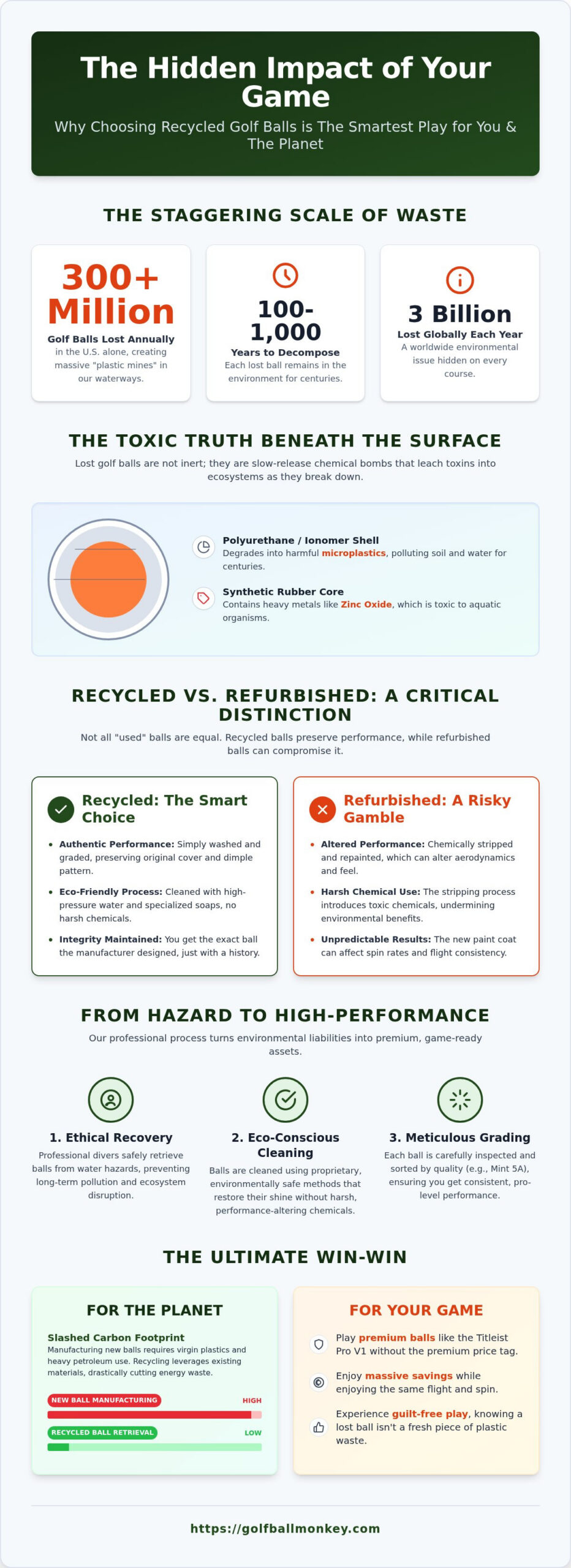
The scale of the waste is staggering. Over 300 million balls are lost in the US every single year. That is a massive pile of synthetic rubber and plastic sitting in our soil and water. Producing new balls requires virgin plastic and heavy petroleum use, which adds to a massive carbon footprint. By choosing used, you’re tapping into the environmental benefits of using recycled balls by extending the life of existing materials. It’s the intelligent play. It aligns your bank account with your values without sacrificing a single yard of distance off the tee.
Recycled vs. Refurbished: A Critical Distinction
Don’t confuse recycled with refurbished. There’s a massive difference. Recycled balls are simply washed and graded. We keep the original cover integrity exactly how the manufacturer intended. Refurbished balls are often stripped with harsh chemicals and repainted. That process can mess with dimple patterns and aerodynamic performance. We skip the chemicals and stick to high-pressure water and specialized soaps. You get a ball that performs like it just came out of the box, not one that’s been through a toxic chemical bath. It preserves the ball and the planet.
The 2026 State of Golf Waste
The game is booming. More players mean more “pond plastic” than ever before. As we move through 2026, the industry is finally waking up to the waste problem. Modern golfers are ditching the old throwaway culture. They want sustainable gear that doesn’t rot in a hazard for a century. Whether you’re looking for information on recycled and biodegradable golf balls or you’re ready to restock your bag, the shift toward eco-conscious play is real. It’s about being a savvy insider who knows that a ball’s history doesn’t dictate its future. You can find high-quality, graded options at our online shop and join the movement toward a cleaner course today.
The Toxic Truth: How Lost Balls Impact Ecosystems
Think about that ball you sliced into the pond last Saturday. It didn’t just disappear. It’s sitting there right now. It’ll stay there until the year 2126 at the earliest. Most golf balls take between 100 and 1,000 years to decompose. While they sit in the muck, they aren’t just taking up space. They’re slowly leaking synthetic chemicals into the local ecosystem. This is the dark side of the game that nobody talks about at the 19th hole. When we discuss the environmental benefits of using recycled balls, we’re talking about stopping these “plastic mines” before they poison the local flora and fauna.
Every lost ball is essentially a tiny, slow-release chemical bomb. As the outer layers degrade, they shed microplastics. These tiny particles are impossible to clean up once they enter the water column. They move through the soil and into the groundwater, affecting more than just the immediate hazard. Reclaiming these balls before they break down is the only way to mitigate the damage. It turns a potential environmental disaster into a high-performance opportunity for the next golfer who wants to play with recycled gear and save some cash.
The Chemistry of a Golf Ball
A standard ball is a complex cocktail of synthetic rubber and plastic polymers. The core usually contains heavy metals like zinc oxide to give it that high-energy bounce. The shell is typically made of ionomer or polyurethane. Over decades, water pressure and UV light break these materials down. As the cover cracks, these chemicals leach out. Zinc oxide toxicity in marine life refers to the heavy metal’s ability to disrupt respiratory and reproductive systems in aquatic organisms even at low concentrations. It’s a slow-motion chemical spill happening in every water hazard. Research like the Life Cycle Assessment of a Golf Course highlights how these materials contribute to the overall environmental footprint of the sport.
Impact on Local Waterways
When thousands of balls settle in a single pond, they create a concentrated zone of waste. This “plastic mine” effect alters the sediment health and can even shift pond PH levels. It gets worse. Fish and waterfowl often mistake deteriorating ball fragments or microplastics for food. These synthetic bits can’t be digested. They lead to blockages and starvation in local wildlife. Removing these balls is a form of active habitat restoration. It cleans the water and restores the natural balance of the course. By tapping into the environmental benefits of using recycled balls, you’re funding the divers who pull this trash out of the water and put it back into play. It’s the ultimate win for the local ecosystem.
The Rescue Mission: How We Harvest Lost Potential
Most golfers look at a water hazard and see a stroke penalty. Our professional divers look at it and see a job site. These are the unsung heroes of the course. They suit up in heavy gear and plunge into zero-visibility silt to reclaim what was lost. It is a grueling, physical mission that turns a “plastic mine” back into a premium inventory. This recovery process is the engine behind the environmental benefits of using recycled balls. Every ball pulled from the muck is one less chemical-leaking capsule left to rot in our ecosystems. We aren’t just selling gear; we’re running a massive, ongoing cleanup operation.
Once those balls leave the water, the restoration begins. We skip the toxic solvents and harsh stripping chemicals used by refurbishers. Instead, we use high-pressure water and eco-friendly soaps to restore the original shine. This preserves the factory cover and ensures the aerodynamics remain exactly as the manufacturer intended. It is a seamless lifecycle from the bottom of a pond to your first tee shot. You get a ball that looks and plays like new, while the planet gets a break from virgin plastic production. It is the ultimate insider secret for the savvy player who wants performance without the environmental baggage.
A Day in the Life of a Golf Ball Diver
Diving for golf balls is not a hobby. It is a high-stakes rescue mission. Divers navigate underwater entanglements, snapping turtles, and thick mud to find lost gear. They act as the first line of defense against the dangers of degrading golf balls that threaten aquatic life. On a good month, a single team can remove tens of thousands of balls from a single course. This massive volume of plastic removal is essential for maintaining healthy waterways and keeping course sediment clean for years to come.
The Grading Standard: Mint 5A Accuracy
We don’t just dump a bucket of pond balls on your doorstep. Every single ball undergoes a rigorous inspection process. We check for scuffs, discoloration, and structural integrity to ensure you only get the best. Our Mint 5A quality is the gold standard of the industry. For 99% of players, these balls are indistinguishable from brand-new retail options in terms of flight and spin. You can learn more about our Mint 5A grading scale to see how we filter out the duds. This ensures that the environmental benefits of using recycled balls never come at the expense of your scorecard. You play the best gear, save a fortune, and help us clean up the game one hazard at a time.
Carbon Footprint: New vs. Recycled Comparison
Every time you rip open a fresh sleeve of premium balls, you’re looking at the end of a very long, energy-heavy industrial road. The environmental benefits of using recycled balls start at the factory floor. Manufacturing a new ball isn’t just about molding plastic. It involves massive amounts of electricity and petroleum to create the core and the cover. When you choose recycled, you’re opting out of that cycle. Washing and grading a recovered ball uses roughly 90% less energy than manufacturing a new one from scratch. Same performance. Fraction of the energy. It’s the most efficient play in the game.
Think of it as a “Carbon Save” for your personal record. For every dozen balls you rescue from a landfill or a pond, you’re preventing the extraction of new raw materials. You’re also cutting out the high-heat injection molding processes that define modern golf ball production. It’s an easy way to align your game with your values. You don’t need to change your swing to lower your footprint. Just change where you get your gear. It’s the intelligent move for any player who values efficiency as much as a straight drive.
The Energy Cost of New Plastic
New balls require virgin polyurethane and synthetic rubber. These materials don’t just appear. They require petroleum extraction and intensive refining before they ever reach a mold. The injection molding process itself is a carbon-heavy operation that relies on constant high heat to shape the ball’s layers. While a single new golf ball carries a heavy carbon debt from its industrial birth, a recycled ball enters your bag with nearly zero new emissions. You’re essentially playing with “found” energy. It’s a massive win for the planet that doesn’t cost you a single yard of distance.
Shipping and Logistics Impact
New balls often take a global tour before they hit your local pro shop. They travel from overseas factories to regional distribution centers and finally to the shelf. That is a lot of jet fuel and diesel for a piece of equipment you might lose in the first three holes. Recycled balls keep the journey national. We harvest them from American courses and ship them directly to your door. Shop our bulk golf balls for the lowest footprint and cut out the unnecessary air miles. Bulk buying is the ultimate pro move. It reduces packaging waste and slashes the carbon impact per ball. Stop paying for global logistics and start supporting a cleaner, local recovery mission. Get your eco-friendly gear here and play a greener game today.
The Smart Play: Performance Without the Guilt
Choosing a Titleist Pro V1 (Mint 5A) is the ultimate power move for the modern golfer. You get the #1 ball in golf without the retail price tag or the environmental baggage. It is about making the intelligent play on every level. We’ve already covered how reclaiming these balls saves local ecosystems from toxic leaching and microplastics. But let’s talk about your scorecard. When you aren’t sweating the cost of a lost ball, you play better. You swing freer. You go for the green over the water because you aren’t throwing away five dollars with every splash. That psychological freedom is a massive advantage that retail buyers never get to experience.
Joining the Monkey crew means you’re part of a community that values the game and the planet. It is about being a savvy insider who knows the industry secrets. You understand that the environmental benefits of using recycled balls are just the beginning. The real thrill is finding a significant bargain on tour-level equipment while supporting an active cleanup effort. Transitioning your bag is easy. Start by swapping your practice balls, then move your main game to our Mint 5A tiers. You’ll never go back to paying full retail for plastic again. It is a win for your wallet and a win for the course.
Tour Performance, Recycled Soul
High-grade recycled balls maintain their spin and compression profiles. The data proves it. For the vast majority of amateurs, a Mint 5A ball is indistinguishable from one pulled off a retail shelf. Even pros are becoming more vocal about equipment sustainability. They know that a ball doesn’t lose its soul just because it spent a few weeks in a pond. If you’re still skeptical, check out our guide: Are Used Golf Balls Worth It? A Data Dive. It breaks down the numbers so you can see the performance for yourself. Stop guessing and start playing the smart way.
Make the Switch Today
Look for sellers who actually employ the divers. That is how you ensure the gear is fresh and hasn’t been sitting in a warehouse for a decade. Transitioning to 100% recycled gear gives you total financial freedom. You can afford to play the best brands in the world on every single round. It is time to stop overpaying for gear that ends up in the drink. You can find everything from Titleist to Srixon in our shop, all graded to perfection. Grab a dozen Mint 5A Titleist Pro V1s and start your eco-journey today. It is the smartest play you’ll make all season. Play green, save green, and keep the game growing.
Make the Intelligent Play for the Fairway and the Earth
Every swing is a choice. You can keep feeding the cycle of virgin plastic production, or you can join the rescue mission. We’ve seen how professional recovery stops “plastic mines” from poisoning our ponds and how local retrieval slashes the carbon footprint of your gear. The environmental benefits of using recycled balls are undeniable, and with our standardized 5A Mint Grading, your scorecard won’t know the difference. You get tour-level performance while we handle the dirty work in the hazards.
We’re a Texas-based, diver-operated team that has already rescued over 10 million balls from the muck. It’s about more than just finding a bargain; it’s about making a commitment to a cleaner game. Stop overpaying for equipment that’s destined for a water hazard. Grab the gear that has already been there and come back stronger. You’ll save your green while keeping the course green. It’s time to stock up, hit the links, and play with a clean conscience.
Ready to play the smart way? Shop our Mint 5A Recycled Collection now!
See you on the first tee. Keep it in the short grass!
Frequently Asked Questions
Are recycled golf balls actually good for the environment?
Yes, they are a massive win for course sustainability. Every ball we recover stops synthetic waste from rotting in our waterways and prevents the need for new virgin plastic production. By choosing used gear, you’re tapping into the environmental benefits of using recycled balls and directly funding the removal of millions of plastic “mines” from local ecosystems every year. It’s the ultimate win-win for your bag and the earth.
Do golf balls decompose in water?
No, they don’t break down safely. A standard ball can take anywhere from 100 to 1,000 years to fully decompose. Instead of disappearing, they sit in the muck and slowly shed microplastics and heavy metals into the water column. This is why professional recovery is so vital. A ball lost today will still be haunting that pond in the next century if a diver doesn’t pull it out first.
Is the performance of a recycled ball worse than a new one?
High-grade recycled balls perform identically to new ones for 99% of golfers. Our Mint 5A Titleist Pro V1s maintain their original factory spin, compression, and flight profiles because they haven’t been stripped or repainted. You get tour-level performance at a fraction of the retail cost. It’s the smartest performance hack in the game for players who want pro results without the elite price tag.
How many golf balls are lost in the ocean and ponds each year?
Golfers lose an estimated 3 billion balls globally every single year. In the United States alone, over 1.5 billion balls vanish into the rough and the drink annually. This creates a staggering volume of synthetic waste that threatens aquatic biodiversity. Understanding the environmental benefits of using recycled balls helps players realize that reclaiming this lost gear is the only way to mitigate the sport’s massive plastic footprint.
What is the difference between recycled and refurbished golf balls?
Recycled balls are simply washed and graded to keep their factory integrity. Refurbished balls are stripped with harsh chemicals and repainted, which can ruin the dimple patterns and aerodynamic performance. We only sell recycled gear because it’s better for your game and much safer for the planet. Stick to graded recycled balls to ensure you’re playing the equipment exactly how the manufacturer intended it to fly.
Do golf balls release toxic chemicals into the water?
Yes, they slowly leak heavy metals like zinc oxide as they degrade over decades. These chemicals can disrupt the respiratory and reproductive systems of fish and waterfowl even in low concentrations. Along with heavy metals, the deteriorating covers release microplastics that enter the local food chain. Removing these balls before they break down is a form of active habitat restoration that keeps our favorite courses healthy and thriving.
How long does it take for a golf ball to biodegrade?
A standard ball made of synthetic polymers and rubber takes between 100 and 1,000 years to biodegrade. While “biodegradable” balls exist, they aren’t approved for tournament play and often lack the distance of premium gear. The most eco-friendly move you can make is to keep existing high-performance gear in circulation. Recycling ensures that the energy and materials used to make a Titleist Pro V1 aren’t wasted after just one bad slice.
Can I recycle my own old golf balls?
You can’t just toss them in your curbside bin, but you can definitely keep them out of the landfill. Many courses have collection bins for lost gear that professional divers then harvest and grade for reuse. If you have a stash of old duds in your garage, use them for shag bag practice or donate them to local youth programs. Keeping them in play is the best way to honor the materials and the game.
Justify Buying Premium Used Golf Balls: The Savvy Player’s Guide to Tour Performance
You’re standing over a 150-yard water hazard, clutching a brand-new $5 ball like it’s a family heirloom. It’s a total buzzkill for your swing. With the average player losing four to five balls every single round, you’re essentially watching your hard-earned cash sink straight to the bottom of the pond. It’s time to stop the bleeding. You shouldn’t have to justify buying premium used golf balls when a fresh dozen of Titleist Pro V1s or TaylorMade TP5s can set you back nearly $60 at retail in 2026. You want that elite tour-level performance without the retail-level anxiety.
We get it. You’re worried about consistency and whether a ball that’s been in the drink still has its zip. This guide is your insider’s look at why Mint 5A recycled balls are the ultimate cheat code for your game. We’ll break down the science of why these balls perform like they just came off the assembly line. You’ll discover how to save 50% to 80% on the world’s best brands while keeping plastic out of our ecosystems. The Monkey has personally vetted this inventory to ensure every shot feels like a win for your scorecard and your wallet.
Key Takeaways
- Stop paying the retail tax at big-box stores and learn how to justify buying premium used golf balls to slash your equipment budget without sacrificing spin or distance.
- Bust the myth of water-logged equipment and understand why modern urethane covers maintain tour-level performance even after a dip in the pond.
- Eliminate swing fear over water hazards by playing high-quality Mint 5A balls that cost a fraction of retail, letting you swing with total confidence.
- Support eco-friendly golf by choosing recycled gear that professional divers have retrieved, keeping heavy metals and plastics out of our water hazards.
- Master the difference between recycled and refurbished balls to avoid the performance-killing traps of repainted equipment.
The Financial Play: Why Retail Golf Balls Are a ‘Tax on the Woods’
Walking into a big-box store and dropping $60 on a dozen balls feels like a robbery. You aren’t just paying for the urethane and the core; you’re paying for the flashy TV commercials and the tour pro’s endorsement deal. We call this the “Retail Tax.” In 2026, retail prices for Titleist Pro V1s have climbed to nearly $58 per dozen. For the average player who loses four or five balls a round, that is a massive financial drain. It is the smartest move of the year to stop subsidizing those massive marketing budgets. You need to justify buying premium used golf balls as a strategic equipment decision rather than just a budget hack.
Modern equipment is built to last. When you dig into the science of golf ball design, you realize these multi-layer masterpieces don’t lose their performance just because they’ve been hit once or twice. A Mint 5A ball is essentially a new ball that took a shortcut. Why pay full price for a box that’s going to be half-empty by the turn? With over 300 million balls lost in the United States every year, the secondary market is overflowing with high-quality gear that performs exactly like the stuff on the shelf.
Breaking Down the Cost Per Round
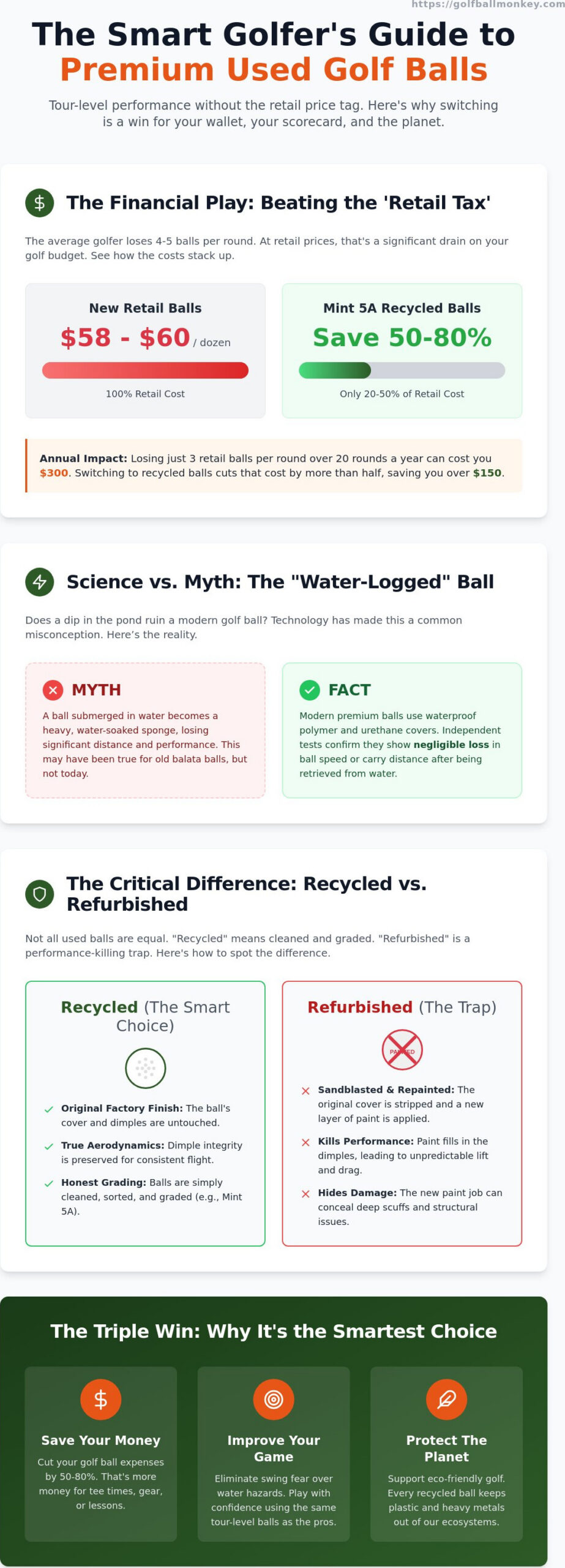
Let’s look at the “Cost-Per-Hole” reality. If you lose three balls during eighteen holes, you’ve spent roughly $15 on “ammunition” alone at retail prices. Over twenty rounds a year, that’s $300 literally lost in the woods. By switching to recycled premium balls, you cut that cost by more than half. That $150 surplus covers several extra tee times or a session with a pro to fix that slice. Savvy insiders treat their ball inventory like a business expense. They maximize the ROI on every swing. It’s about playing more golf for less money.
Recycled vs. Retail: The 60% Savings Rule
The moment a premium ball hits the water or the deep rough, it loses 50% to 60% of its retail value. But it doesn’t lose its spin rate or ball speed. Our professional divers act as the ultimate middleman-cutters. They retrieve high-end gear directly from the source. This allows us to pass those massive savings on to you. You can check the Golf Ball Monkey Shop to see how the math stacks up against current retail benchmarks. Stop paying for the packaging and start playing the same gear the pros use for a fraction of the cost.
Science vs. Myth: Does ‘Used’ Mean Less Distance?
Let’s kill the “water-logged” myth right now. Many golfers still think a ball sitting in a pond for a week turns into a heavy, water-soaked sponge. That might have been true back in the days of wound balata balls, but modern technology has changed the game. Today’s premium balls use advanced polymers and urethane covers that are essentially waterproof. Independent testing in 2026 confirms that a high-end ball retrieved from a hazard shows negligible loss in ball speed or carry distance. When you justify buying premium used golf balls, you are betting on high-tech materials that don’t quit just because they got wet.
The real performance gap isn’t between “new” and “used.” It is between “premium” and “budget.” A Mint 5A Titleist Pro V1 that has seen one or two holes of play will consistently outperform a brand-new, two-piece “distance” ball from a bargain bin. The premium ball offers superior greenside spin and a more stable flight path. Beyond the scorecard, there is a bigger picture. Every ball retrieved by a professional diver reduces the environmental impact of golf, preventing plastics and heavy metals from breaking down in our local ecosystems. You get tour-level performance, and the planet gets a break.
The Refurbished Trap: Why We Never Paint
Refurbished balls are the wolves in sheep’s clothing of the golf world. These are balls that have been sandblasted and repainted to “look” new. It is a performance killer. Painting a ball fills in the dimples, which are the engine of the ball’s aerodynamics. This leads to unpredictable lift and drag. Many low-quality retailers use this trick to hide deep scuffs or structural damage. Mint 5A grading is the only standard that matters because it ensures the ball’s original factory finish and dimple integrity remain untouched. We only sell recycled balls, never refurbished ones, so your flight path stays true.
Urethane Performance in the Secondary Market
Premium covers from brands like Callaway and TaylorMade are built to survive high-velocity impacts with clubfaces and cart paths. They are incredibly durable. Our professional divers operate on a tight “retrieval window” to ensure these balls aren’t sitting at the bottom of a lake for years. They are found, cleaned, and graded quickly. This means the compression remains optimal. If you are still asking, are used golf balls worth it?, the answer is in the data. You are getting 99% of the performance for about 40% of the price. Stop overpaying for a logo on a fresh box and start playing the smart way. Check out our latest Mint 5A inventory to see the quality for yourself.
The Mental Edge: How ‘Cheap’ Premium Balls Unlock Your Swing
Golf is 90% mental. You can have a swing like Rory, but if your brain is calculating the five-dollar “replacement cost” of your ball mid-backswing, you’re doomed. This is the “Swing Fear” phenomenon. It’s that tiny, nagging voice that tells you to steer the ball away from the water rather than attacking the flag. It leads to tentative, decelerated swings and those dreaded “shanks” born from financial anxiety. It’s incredibly easy to justify buying premium used golf balls when you realize they act as a psychological safety net. When the ball in your hand didn’t cost a small fortune, your body is free to make an aggressive, athletic move.
The massive market demand for high-performance, low-cost golf balls proves that players are waking up to this reality. You don’t need a retail box to have a Tour-level experience on every green. By removing the “price-per-shot” pressure, you unlock a level of commitment to your target that retail buyers simply don’t have. You stop playing “not to lose” and start playing to win. This mental shift is often the difference between a double bogey and a birdie putt. The Monkey has personally vetted every Mint 5A ball to ensure your equipment is the last thing on your mind when you’re standing over a crucial shot.
Aggressive Play Over Hazards
Playing scared ruins your tempo. You start guiding the ball. Your follow-through gets short. The Monkey mindset is different. You attack the pin because you have a bag full of backup gear that didn’t break the bank. If one goes for a swim, you just reach for another Mint 5A and keep your rhythm. Confidence is built on the freedom to fail without a financial penalty. When you aren’t worried about the cost of a lost ball, your swing stays fluid and your follow-through stays long. That’s how you find the center of the clubface more often.
Consistency is King
Stop playing “random found balls.” One hole you’re hitting a rock-hard distance ball, the next it’s a soft lady’s ball you found in the weeds. That’s a recipe for a terrible short game. You need predictable spin on every chip and a consistent feel on every putt. By sticking to one model, you build a reliable “feel” that translates to lower scores. You can find your specific model in our Titleist Pro V1 Guide and Shop to keep your game dialed in for every round. Playing the same model every single time is a strategic advantage that most amateurs ignore. Don’t be one of them.
Sustainable Scoring: The Eco-Friendly Case for Used Gear
Every time you slice a ball into the drink, you aren’t just losing five bucks. You’re leaving a plastic footprint that will likely outlast your grandkids. It is easy to justify buying premium used golf balls when you realize that roughly 300 million balls are lost in the United States every single year. These aren’t just harmless white spheres. They take anywhere from 100 to 1,000 years to decompose. As they sit in the muck, they release microplastics and heavy metals into the local water table. Choosing recycled gear is the single most impactful environmental choice you can make as a golfer. It turns a potential pollutant into a high-performance asset.
Our professional divers act as the ultimate clean-up crew for American golf courses. They aren’t just finding inventory; they are reclaiming hundreds of tons of plastic from sensitive ecosystems. This is the circular economy in action. We take what was lost and forgotten, clean it to a professional standard, and put it back in your bag. You get to play “Green” without sacrificing a single yard of distance or a revolution of spin. It is a rare win-win for your scorecard and the planet. By supporting the secondary market, you are directly funding the preservation of the courses you love to play.
Keeping Plastic Out of the Hazards
Buying used is a vote for sustainability. When you purchase a new box of balls, you’re demanding more raw plastic production and more manufacturing energy. When you buy recycled, you’re extending the life of a product that’s already been made. Think of it as the ultimate recycling program for athletes. Professional retrieval ensures these balls don’t sit long enough to break down or cause damage. Every Mint 5A ball we sell is one less piece of plastic rotting in a pond. It’s about being a steward of the game while keeping your equipment costs under control.
The Ethics of the Game
Joining the community of savvy, eco-conscious players means stripping away the elitism of “new-only” culture. The best players know that performance is what matters, not the shiny cardboard box. Framing the Monkey brand as a partner in course preservation makes every round feel a little better. You aren’t just a consumer; you’re part of a movement that values intelligence over marketing hype. Save the planet. Save your wallet. Play better. Shop our eco-friendly Mint 5A collection today and see how good “Green” performance really feels.
The Smart Choice: Why Golf Ball Monkey Wins the Round
We aren’t just another faceless website. We’re the source. Most retailers buy their stock from third parties, add a markup, and hope for the best. Not us. The Monkey uses professional divers to retrieve the best gear directly from the hazards. This direct-to-diver advantage is how we keep prices low while keeping quality at a tour-level peak. When you see the precision of our vetting process, it becomes simple to justify buying premium used golf balls. You aren’t just saving money. You’re getting a vetted, high-performance product that hasn’t been touched by a middleman’s markup.
Our Texas-based operation serves the entire country with speed. We know you have a tee time this weekend. You need your gear now, not in two weeks. That’s why we prioritize fast, reliable shipping. Whether you’re in Dallas or Delaware, we get the best Mint 5A balls to your doorstep before you head to the first tee. When you look at the quality we ship, it’s easy to justify buying premium used golf balls for every single round on your calendar. We take the guesswork out of the secondary market so you can focus on your swing.
Our Grading Guarantee
Our 5A Mint standard is the gold standard of the industry. We don’t mess around with “good enough.” To earn a 5A rating, a ball must look and feel like it just came out of a fresh sleeve. No scuffs. No fades. No ink marks that distract your eye. We reject thousands of balls every week that other sellers would happily ship out. This Texas-sized quality control ensures you never open a box and feel disappointed. It’s about transparency and trust. You get the spin, the distance, and the look of a new ball without the retail sting.
Ready to Play?
It’s time to stop overpaying for the privilege of losing a new ball. Stock up on bulk Titleist Pro V1s or TaylorMade TP5s and change the way you look at your equipment budget. The Monkey promise is simple: you’ll love the performance or we’ll make it right. We’re here to help you play more golf without the financial hangover. You’ve seen the science, the math, and the mental benefits. Now it’s time to pull the trigger. Justify your game and shop the Mint 5A collection now to see why the smartest players in the game have already made the switch.
Stop Subsidizing Retail Marketing and Start Scoring
The math is simple. The science is settled. It’s time to justify buying premium used golf balls and stop paying the retail tax at big-box stores. You’ve seen how modern technology keeps urethane covers performing at a tour-level peak regardless of a dip in the water. You know that shedding swing fear is the fastest way to drop your handicap. It’s about playing the best gear without the financial anxiety. Every Mint 5A ball you play is a win for your wallet and the planet.
Golf Ball Monkey is your savvy insider. We use professional divers to retrieve every ball directly from the source. Our Texas-based team provides a Mint 5A Performance Guarantee on every order. We don’t sell refurbished junk. We sell elite performance at a fraction of the cost. Stop throwing money into the woods. Start investing in more tee times. We’ve got your back on every hole. See you on the first tee.
Stop Overpaying and Start Scoring; Shop Mint 5A Premium Balls Now
Frequently Asked Questions
Is there a real difference between Mint 5A and a brand-new ball?
A Mint 5A ball is practically indistinguishable from a new ball in terms of flight, spin, and feel. These are balls that often saw only a single swing before taking a detour into the tall grass or a hazard. You get the same compression and aerodynamics without the retail mark-up. It is the easiest way to justify buying premium used golf balls for your weekly round.
Do golf balls lose distance if they stay in the water too long?
Modern urethane covers and solid cores don’t absorb water like the old wound balls did decades ago. While a ball sitting for years might see a tiny drop in zip, our professional divers pull inventory on a tight schedule. This ensures the balls haven’t been submerged long enough to impact your yardage. You’ll still clear that 200-yard carry with total confidence.
What is the difference between ‘Recycled’ and ‘Refurbished’ golf balls?
Recycled balls are washed and graded in their original factory condition, while refurbished balls are sandblasted and repainted. Never buy refurbished. Painting over a golf ball ruins the dimple pattern and kills the aerodynamics. We only sell recycled gear because we value your scorecard. Our Mint 5A standard ensures you’re playing the ball exactly as the manufacturer intended.
Why should I buy used premium balls instead of cheap new balls?
A used Titleist Pro V1 or TaylorMade TP5 offers significantly more greenside control and stable flight than a brand-new “value” ball. Cheap new balls usually have hard covers that won’t stop on the green. By choosing high-quality recycled gear, you get tour-level spin and feel at a price point that beats the bargain bin. It’s a strategic upgrade for your short game.
How do professional divers ensure the quality of retrieved balls?
Our divers act as the first line of defense, hand-retrieving balls and performing an initial sort on-site. Once they’re out of the water, every ball goes through a rigorous vetting process to meet our Texas-sized standards. We check for structural integrity and surface wear. If a ball doesn’t look like it could win a tournament, it doesn’t make the Mint 5A cut for our shop.
Which premium used golf ball is best for my swing speed?
High-speed players usually thrive with the Titleist Pro V1x or TaylorMade TP5 for maximum compression and stability. If your swing is a bit more moderate, the Callaway Chrome Soft or Bridgestone Tour B RX provides a softer feel and excellent distance. We stock the full range of tour models so you can match the ball to your specific launch conditions without breaking the bank.
Can I buy used golf balls in bulk for practice?
Absolutely, we offer Mixed Bags and Shag/Practice balls specifically for those who want to grind on the range or in the backyard. You can stock up on dozens of balls for the price of a single retail sleeve. It’s the smart way to build muscle memory with real premium covers rather than those rock-hard range balls that don’t react properly on the green.
Is playing used golf balls actually better for the environment?
Playing recycled gear is a huge win for the planet because it keeps plastic and heavy metals out of local water tables. A single ball can take centuries to decompose in a pond. By choosing used, you’re preventing new plastic production and cleaning up our courses. It’s a great way to justify buying premium used golf balls while being a genuine steward of the game.
Sustainable Golf Ball Options: Why Used Is the New Green in 2026
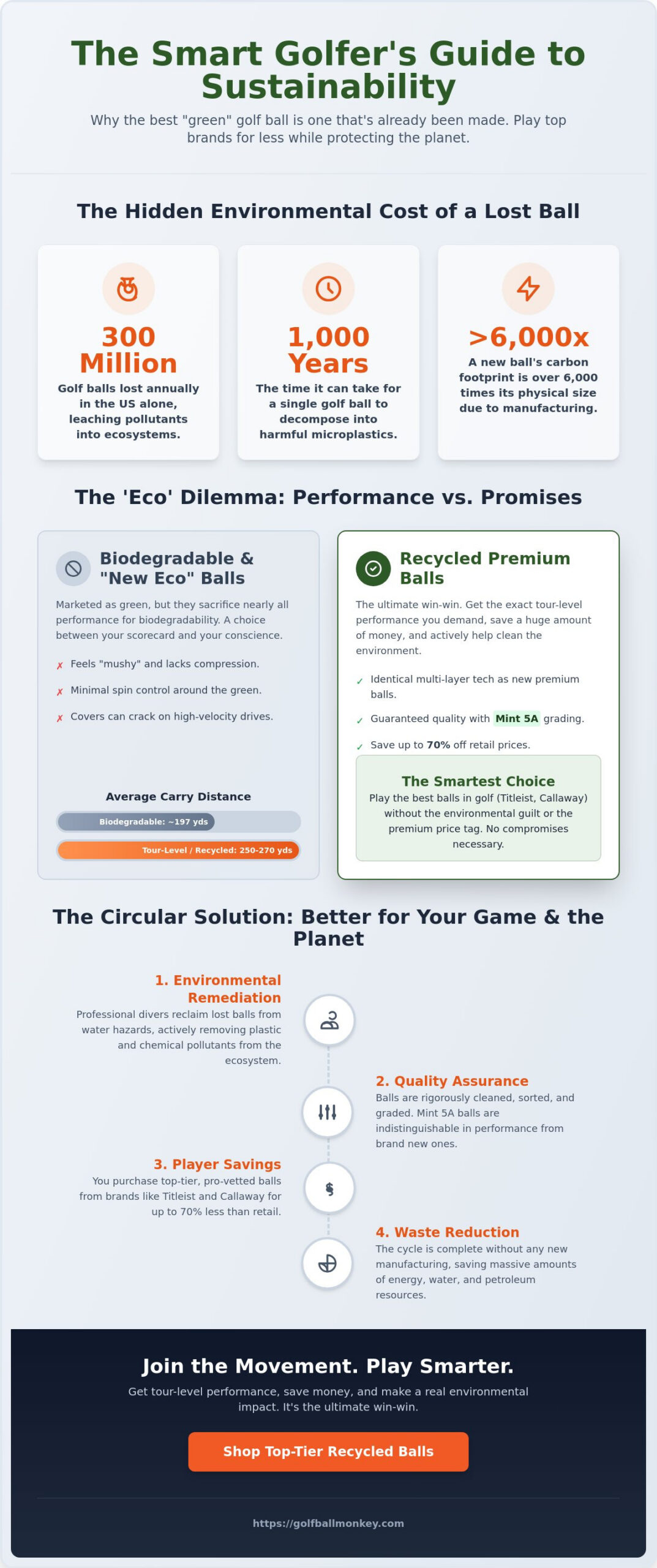
Did you know a single golf ball has a carbon footprint over 6,000 times its physical size? It is a brutal stat to keep in mind when you are watching your Titleist Pro V1 splash into a lake. You want to do right by the environment, but you also need that premium compression and spin to keep your handicap in check. Finding truly sustainable golf ball options used to mean settling for biodegradable balls that felt like hitting a rock and flew half the distance. It was a choice between your conscience and your scorecard. We are done with that compromise.
We get it. You are tired of the environmental guilt and the soaring retail prices of new gear. This guide shows you how to play the best brands in the game for a fraction of the cost while keeping plastic waste out of the landfill. We will break down why recycled is the real “green” choice in 2026. You will learn how to spot top-tier Mint 5A quality and why the smartest players on the course are stocking up on used Titleist and Callaway gems instead of buying new. It is time to play better golf for less money while doing the planet a massive favor.
Key Takeaways
- Understand the real environmental impact of lost plastic and why the most sustainable golf ball options are the ones already manufactured and waiting for a second life.
- Compare biodegradable balls against recycled premium cores to see why tour-level performance requires the multi-layer tech found in high-end used gear.
- Embrace the circular economy to save up to 70% on retail prices while significantly reducing the energy and water needed to produce new equipment.
- Match your swing speed to elite models like the Titleist Pro V1 or Callaway Chrome Soft using a standardized Mint 5A grading system for guaranteed quality.
- Discover how reclaiming balls from water hazards protects local ecosystems and provides you with pro-vetted gear that performs exactly like new.
The Hidden Environmental Cost of Lost Golf Balls
Every year, golfers in the US alone lose an estimated 300 million golf balls. That is not just a blow to your handicap; it is a massive environmental burden. When we talk about sustainable golf ball options, we mean gear that minimizes resource extraction and prevents pollution. A ball isn’t “green” just because it has a leaf on the box. It is green when it stays out of the ecosystem. Most players don’t realize that a single lost ball can take anywhere from 100 to 1,000 years to decompose. That Pro V1 you sliced into the woods during your junior year? It is still there. It’ll probably still be there for your great-great-grandchildren, too.
The problem goes deeper than just litter. As these balls sit in the elements, they break down into microplastics. These tiny particles infiltrate the soil and water, carrying chemicals like polybutadiene and various heavy metals. This is the reality of modern golf ball composition. They are engineered for speed and spin, not for biodegradability. When you buy new, you’re fueling a cycle of constant extraction and waste. Choosing a smarter path means looking at the life cycle of your equipment before you tee off. You can find better sustainable golf ball options by opting for reclaimed gear that skips the factory floor entirely.
What Happens to a Ball in a Water Hazard?
Water hazards are the primary site of environmental damage. Over time, the urethane or surlyn covers on lost balls begin to degrade. They don’t disappear. They fragment. These fragments become permanent fixtures in the local food chain, often ingested by fish and birds. This is where professional divers step in. By reclaiming these balls, we perform active environmental remediation. We pull the plastic out before it can leach more chemicals into the water. It turns a potential pollutant back into a high-performance tool. Every ball we pull out is one less piece of plastic poisoning the pond.
The Problem with “New” Production
Manufacturing a single new premium golf ball has a carbon footprint over 6,000 times its own size. Think about the petroleum-based plastics and the energy-heavy rubber processing required for every dozen. Most of these balls are made in overseas factories, then shipped thousands of miles to your local pro shop. That is a lot of emissions for something you might lose on the third hole. Check out our full inventory to see how easy it is to break this cycle. Save the planet. Save your cash. It is the ultimate win-win for any savvy player.
Biodegradable vs. Recycled: Evaluating ‘Eco-Friendly’ Golf Ball Performance
Buying “green” shouldn’t mean playing “bad.” Most golfers assume that biodegradable balls are the gold standard for sustainable golf ball options. They aren’t. In fact, trying to play a serious 18-hole round with a starch-based ball is a great way to ruin your scorecard. These balls often feel mushy off the clubface. They lack the sophisticated multi-layer construction found in a genuine tour ball. You lose compression. You lose spin. You lose significant distance. A high-velocity drive with a modern driver can literally crack an eco-ball’s cover on the first tee. It is a frustrating experience that doesn’t have to be the norm.
Then there are the “recycled core” balls. Some brands attempt to use regrind rubber from manufacturing scraps to build new cores. It is a step in the right direction, but the technology has clear limits in 2026. Even the best “new” recycled balls on the market still require over 50% virgin plastic and rubber to maintain structural integrity. They usually lack the specialized urethane covers that provide the “stop-on-a-dime” control you need around the green. If you want tour-level performance, you need a tour-level ball. Settling for a “mushy” alternative just because of the label isn’t the savvy play.
The “Fish Food” Ball: A Niche Solution
These balls have one job: to be hit into the ocean from a yacht or a cruise ship. They are designed to dissolve and release nutrients. On a boat, they are perfect. On a golf course, they are a disaster. They have zero spin control and unpredictable flight patterns. Research shows a massive performance gap; some of the highest-performing biodegradable balls only carry about 197 yards, while a standard tour-level ball carries 250 to 270 yards. There is also an environmental catch. Dumping “fish food” into a small, enclosed pond can cause nutrient loading, leading to algae blooms. It is better than plastic, but it is not a real golfing solution.
Recycled Materials in New Balls
Manufacturers are experimenting with regrind rubber, but the chemical bonds in golf balls don’t always play nice with being melted down and reformed. To get the performance you expect, you are better off sticking with the savvy insider choice. Instead of buying a “new” ball that is only half-recycled and performs poorly, buy a premium ball that has already been manufactured and rescued. You get the multi-layer tech of a Titleist or Callaway without the environmental or financial hit of buying new. Choosing reclaimed gear is one of the most effective sustainable golf ball options available because it keeps existing high-performance materials in play longer.
The Circular Economy: Why Reusing Premium Balls Beats Buying New Eco Gear
Circular economy sounds like corporate jargon, but for us, it is just common sense. Keep high-performance gear in play for as long as possible. Every time you bag a used Titleist Pro V1 (Mint 5A) or a Callaway Chrome Soft (Mint 5A), you are opting out of the carbon-heavy manufacturing cycle. These are the smartest sustainable golf ball options because they require zero new raw materials. No petroleum extraction. No intensive chemical processing. Just a professional rescue mission and a thorough quality check. It is the intelligent play for your game and the planet.
The energy savings here are astronomical. Melting down rubber and plastic to create “new” recycled balls consumes significant amounts of electricity and heat. Scrubbing a reclaimed ball uses almost none. It is the difference between building a car from scratch and giving one a quick car wash. By choosing high-quality used gear, you keep carbon in the ground and out of the atmosphere. You get the same tour-level spin and distance without the heavy environmental price tag of a factory-fresh dozen. Why pay more to pollute more?
Manufacturing vs. Retrieval: The Carbon Gap
Retrieving one golf ball from a pond uses less than 1% of the energy required to manufacture a single new ball from scratch. Professional divers are essentially the janitors of the golf course. They clear out the hazards and pull millions of units of plastic out of local ecosystems annually. This high-volume reclamation keeps our waterways healthy and our landfills significantly lighter. It is the most direct way to clean up the game we love while keeping your equipment budget intact.
Quality Control in the Circular Model
Modern cleaning technology has evolved way beyond a bucket of soapy water. We use specialized, non-abrasive methods that preserve the dimple pattern and cover integrity of every ball. Don’t listen to the locker room myths about water damage. If you are asking Are Used Golf Balls Worth It?, the data says yes. A few days in a hazard has zero measurable impact on ball speed or launch angle. Our 5A grading scale acts as a verbal seal of approval, ensuring your “Mint” find performs exactly like the retail version. We vet the inventory so you can focus on your swing.
By choosing these sustainable golf ball options, you are supporting a model that values resourcefulness over waste. You are getting pro-vetted equipment that has been personally cleared for performance. It is about making the savvy choice. You get to play the best brands in the world, save a massive amount of cash, and protect the courses you love. That is the Monkey Mission in action.
Choosing Sustainable Balls That Do Not Kill Your Distance
Stop settling for “eco” balls that feel like hitting a stale marshmallow. You want sustainable golf ball options that actually reach the green. Real performance comes from the high-tech layers inside a Titleist or a TaylorMade. The trick is matching the ball to your specific swing speed. If you are swinging over 105 mph, you need a different core compression than someone at 85 mph. Check out our guide on Which Golf Ball Should I Play? to find your perfect match. Playing the right ball is the first step to shooting lower scores while saving the planet.
The smartest players know that “used” doesn’t mean “worn out.” By choosing pro-vetted, reclaimed gear, you maintain tour-level distance while slashing your equipment budget. You get the same aerodynamics and spin rates as the pros, but without the environmental guilt of fueling new plastic production. It is the ultimate savvy play. Whether you need the piercing flight of a TaylorMade TP5 or the soft landing of a Callaway Chrome Soft, we have you covered with gear that has already been tested on the course.
The Savvy Player’s Grading Guide
We use a strict, standardized grading system so you know exactly what is landing on your doorstep. No surprises. Just high-value acquisitions.
- Mint 5A: These are the crown jewels of our inventory. They look and play like they just came out of a fresh retail sleeve. Use these for your competitive rounds or when you want peak performance.
- Near Mint 4A: These have very slight cosmetic flaws but zero performance loss. They represent the perfect balance for weekend warriors who want a premium feel without the retail price tag.
- Good 3A: These are the ultimate sustainable choice for practice. Grab a Mixed Bag (Good 3A) for your shag bag or those tight holes where the water hazard is lurking.
Sustainable Brand Spotlight
The Titleist Pro V1 is a legend for a reason. Its durable urethane cover holds up incredibly well; it is the best candidate for our reclamation process. If you prefer a softer feel off the face, the Callaway Chrome Soft offers elite sustainability with a core designed for maximum forgiveness. Don’t sleep on Bridgestone or Srixon either. These brands use high-performance materials that hold up perfectly through our specialized cleaning process. You get the tech. The planet gets a break. Shop our full inventory of pro-vetted gear here and start playing the smart way.
For high-handicappers or those just looking to stock up, the Mixed Bag approach is a total game-changer. It is the best way to test different sustainable golf ball options without committing to a single brand. You get to play the field, find what works for your swing, and keep your gear budget in the black. It is about making the intelligent play on every single hole.
Join the Monkey Mission: Premium Performance Meets Planet-First Savings
The Monkey Mission is about more than just finding a bargain. It is about cleaning up the game we love. Our professional divers have reclaimed millions of balls from water hazards across the United States. This is the most effective way to source sustainable golf ball options because it removes plastic from sensitive ecosystems and puts it back into play. Why let high-performance urethane sit in the mud for a thousand years when it could be sitting on your tee? It is time to stop overpaying for plastic and start playing the smart, green way.
Choosing used is the ultimate savvy insider move. You save anywhere from 50% to 70% off standard retail prices. It is a cheeky way to stick it to the man and those big-box retailers who want you to pay $5 a ball. You get the same Titleist or Callaway performance without the marketing markup. We vet the inventory so you can stick it close to the pin. You get to keep your gear budget in the black while keeping the courses in the green.
From the Bottom of the Lake to Your Tee
Every ball we sell follows a strict journey. First, our divers retrieve them from local hazards. Then, they undergo a specialized cleaning process that protects the dimples. Finally, they receive a “Monkey Vetted” seal of approval after being sorted by our rigorous 5A grading scale. This ensures every Mint 5A ball you buy looks and feels like it just came out of the box. Shop our full collection of sustainable premium balls and see the quality for yourself. It is the highest value acquisition in the sport.
The Future of Green Golf
The “Used” movement is the fastest-growing trend on the course in 2026. Golfers are realizing that buying new is an unnecessary environmental and financial hit. Your purchase directly supports professional divers and contributes to cleaner waterways. It is a circular model that actually works. We are stripping away the elitism and focusing on pure enjoyment. You are making the intelligent play for your scorecard and the planet. Remember; you don’t need a new ball to have a new game. Grab some pro-vetted gear and keep your game in the green.
Tee Off for a Greener Game
Playing the best round of your life shouldn’t cost the earth. You now know that the most effective sustainable golf ball options aren’t found in a lab. They’re rescued from the hazards of your favorite courses. You get tour-level spin and distance while keeping high-performance plastic out of the local ecosystem. It’s the ultimate savvy play for any serious golfer. We’ve stripped away the elitism to focus on what matters: pure enjoyment and massive value.
Our professional divers reclaim over 10 million balls annually. Every single ball is personally vetted for quality and graded to our strict standards. You can snag top-tier brands with 50-80% savings compared to standard retail prices. Why pay the big-box premium when you can get Mint 5A performance for a fraction of the cost? It’s time to join the mission. Make the intelligent move for your scorecard and the environment today.
Go Green and Save Green: Shop Mint 5A Titleist Pro V1s Now!
See you on the first tee. Play smart and save big.
Frequently Asked Questions
Are used golf balls really as good as new ones for the environment?
Yes, used balls are significantly better for the planet because they require zero new manufacturing resources. Reclaiming an existing ball uses less than 1% of the energy needed to produce a new one from scratch. By choosing these sustainable golf ball options, you prevent plastic from breaking down in ponds and stop the cycle of petroleum-based production. It is the cleanest way to play.
Do biodegradable golf balls actually work for a full 18 holes?
No, biodegradable balls are generally not built for a full round of golf. They are designed for one-off shots into the ocean or lakes and lack the multi-layer tech required for real performance. Most eco-balls will crack under high-velocity impact or offer unpredictable flight paths. If you want to finish 18 holes with the same ball, stick to a pro-vetted reclaimed Titleist or Callaway.
How long does a golf ball take to decompose in a pond?
A standard golf ball takes anywhere from 100 to 1,000 years to fully decompose in a water hazard. Because they are made of synthetic polymers and heavy metals, they don’t actually disappear. They slowly fragment into microplastics that poison aquatic life. Professional reclamation is the only way to remove this waste before it becomes a permanent part of the local food chain.
What is the most sustainable brand of golf ball to buy used?
Titleist is the gold standard for sustainability in the secondary market. The Pro V1 features an incredibly durable urethane cover that holds up better than almost any other brand during our cleaning and grading process. Any premium ball from TaylorMade or Callaway is also a great choice. Reusing these high-performance materials is much better for the earth than buying a new “eco” alternative.
Can I get tour-level spin from a recycled premium ball?
Absolutely. Our Mint 5A grading ensures you get the exact same spin and launch characteristics as a ball fresh from the retail box. Scientific testing shows that a few days in a water hazard has zero measurable impact on the aerodynamics or core compression of a premium ball. You get that “stop-on-a-dime” control on the green without the heavy environmental or financial cost.
Why are used balls considered better than new “eco-friendly” balls?
Used gear is the leader among sustainable golf ball options because it follows a circular economy model. New “eco” balls still require massive amounts of energy and water to manufacture and ship across the globe. Reclaiming a ball that is already at the bottom of a lake removes a pollutant and saves the carbon footprint of making something new. It is the smarter play.
How much money can I save by switching to sustainable used options?
You can save between 50% and 80% compared to standard retail prices at big-box stores. It is the ultimate savvy insider secret for golfers who want the best equipment without the marketing markup. You get to play with the same gear the pros use while keeping your budget in the black. Saving the planet while saving your cash is a win-win on every hole.
Eco-Friendly Golf Balls: The Savvy Player’s Guide to Sustainable Swings
Around 300 million golf balls vanish into the rough and water hazards every single year. That is a staggering amount of plastic left to sit in our ecosystems. Most players want to fix this; however, nobody wants to settle for a biodegradable ball that feels like hitting a stale marshmallow. You need a solution that protects the planet without killing your handicap. Finding the right eco-friendly golf balls shouldn’t mean compromising on the elite performance you expect from top-tier brands.
We get it. You want to ditch the guilt of lost sleeves while keeping your spin rates high and your costs low. The secret to a sustainable swing isn’t actually buying something new that dissolves in the pond. It is about reclaiming the premium tech that has already been manufactured. This guide breaks down why choosing recycled, high-grade balls is the smartest play for your bag. We will show you how to maintain 5A performance, save serious cash on brands like Titleist or TaylorMade, and slash your environmental footprint one rescued ball at a time.
Key Takeaways
- Learn the difference between dissolvable novelties and high-performance, recycled eco-friendly golf balls.
- Compare compression and trajectory stats to keep your distance and spin exactly where they belong.
- Master the grading system. Identify Mint 5A quality and snag tour-level performance at a fraction of retail prices.
- Reduce plastic waste. Discover how reclaimed equipment cleans up water hazards and cuts factory demand.
- Build a sustainable bag. Prioritize your score and your wallet without ditching the premium brands you trust.
The Environmental Impact of Golf: Why We Need Eco-Friendly Options
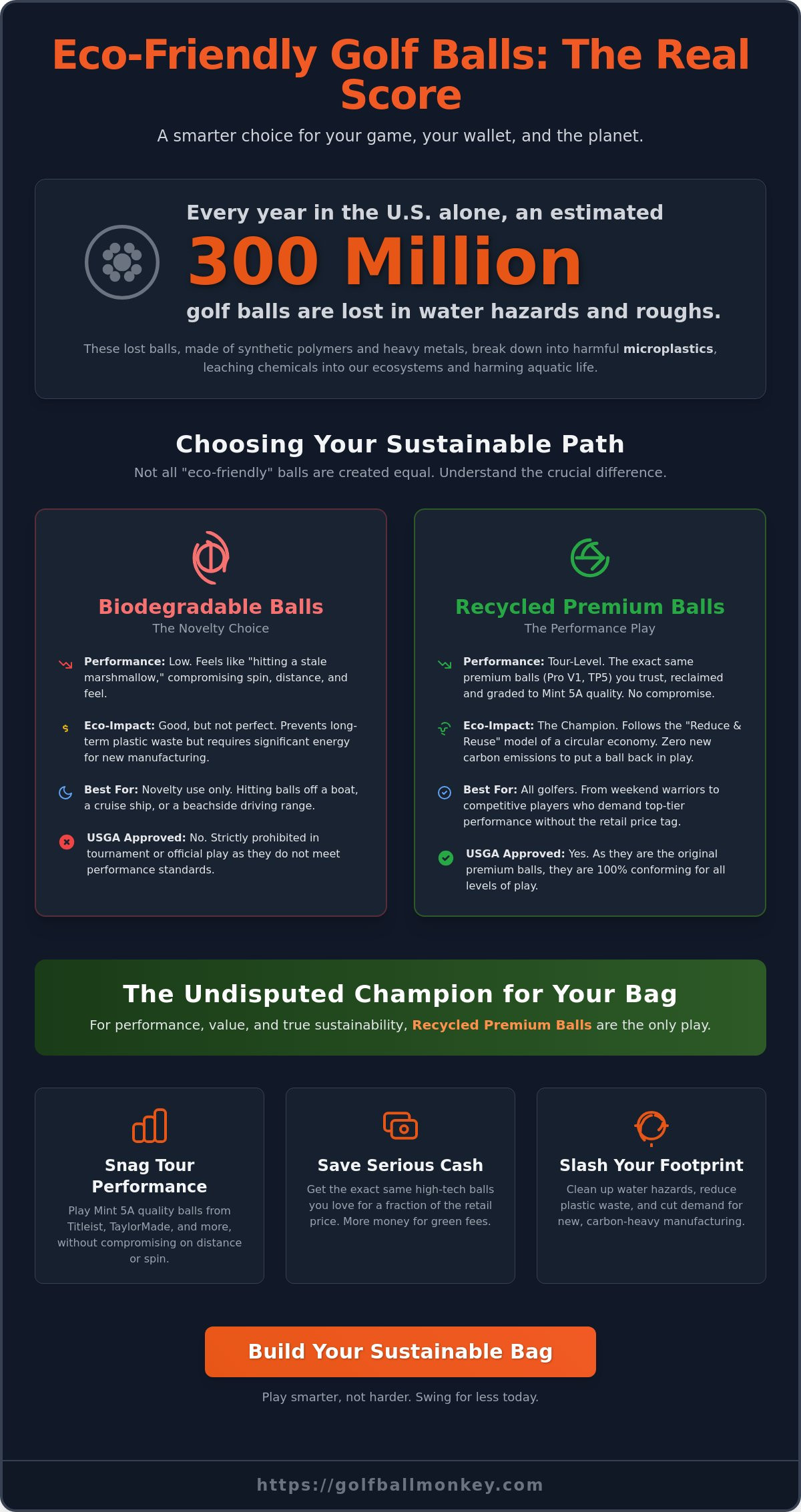
Every year, golfers in the United States lose approximately 300 million balls. That is not just a hit to your wallet; it is a massive burden on the environment. Most of these lost rounds end up at the bottom of water hazards or buried deep in the rough. When we talk about eco-friendly golf balls, we are looking at products designed to minimize plastic waste and stop chemical leaching into our local ecosystems. It is about making sure the game we love doesn’t leave a toxic legacy behind.
Standard golf balls are marvels of engineering, but they are also made of synthetic polymers and heavy metals like zinc. When a ball sits in a pond for a decade, it doesn’t just disappear. It slowly breaks down into microplastics. These tiny particles enter the food chain, affecting aquatic life and water quality. Looking back at the history of the golf ball shows how we moved from wooden or leather “feathery” balls to the plastic-heavy designs of today. Now, the trend is shifting back toward sustainability. In 2026, savvy players are demanding gear that respects the course as much as they do.
Decomposition vs. Circularity
There is a common misconception that “biodegradable” is the gold standard for the planet. While dissolvable balls prevent long-term plastic buildup, they often fail the performance test. They can also require significant energy to produce. True sustainability often looks like a circular economy. This means keeping existing materials in use for as long as possible. Reclaiming a high-performance ball from a pond is often greener than manufacturing a brand-new “eco” ball from scratch. You save the energy of production and prevent a perfectly good piece of equipment from becoming waste.
The Hidden Cost of New Equipment
Manufacturing new urethane and synthetic rubber involves high carbon emissions. Every time you buy a fresh sleeve of tour-level balls, you are supporting a heavy industrial process. Reusing what is already out there is the ultimate power move. By choosing “pre-loved” gear, you offset your carbon footprint and keep your game sharp. If you want the full breakdown on how to pick the best second-hand options, check out our Used Golf Balls: The Ultimate Buyer’s Guide. It is the smartest way to play eco-friendly golf balls without sacrificing a single yard of distance. Stop paying retail for a footprint you don’t want. The Monkey has you covered.
Biodegradable vs. Recycled: Choosing Your Sustainable Path
Choosing eco-friendly golf balls is a smart move for your game and the planet. However, you need to know which path you are taking. There are two main categories: novelty dissolvable balls and recycled premium balls. One is for fun; the other is for the scorecard. Understanding the difference helps you avoid wasting money on equipment that doesn’t fit your needs.
Standard dissolvable balls usually consist of Polyvinyl Alcohol (PVA), calcium carbonate, and glycerin. They are designed to vanish in water. Recycled balls are a different breed entirely. These are the same high-performance models you love, such as the Titleist Pro V1 or TaylorMade TP5. They are professionally retrieved from water hazards, thoroughly cleaned, and sorted by condition. This process gives you a eco-friendly golf balls solution that actually performs on the fairway.
Recycled equipment is the undisputed champion of the sustainability pyramid. It follows the “reduce and reuse” mantra perfectly. By playing a reclaimed ball, you are not just preventing plastic waste; you are stopping the demand for new manufacturing. It takes zero new carbon emissions to put a Mint 5A ball back into play. You get the same aerodynamics and spin rates without the environmental cost of creating new urethane covers from scratch.
The Novelty Trap: When to Use Dissolvable Balls
Dissolvable balls have their place, but it isn’t on a standard course. If you are hitting off the back of a boat or a beach-side driving range, they are perfect. Some brands even market a “fish food” core, though you should always check the ingredients to ensure they are truly safe. Don’t try to bring these to your local club. They are strictly prohibited in tournament play because they don’t meet USGA standards. For a list of the Best Biodegradable Golf Balls for your next lake party, do your research, but keep them away from the tee box on a Saturday morning.
The Performance Play: Why Recycled Premium Wins
This is where real golfers live. Playing recycled premium balls keeps high-performance urethane covers out of landfills and waterways. You get to play the best tech in the game without the manufacturing guilt. Our divers act as environmental cleaners. They pull millions of balls out of the muck, restoring the health of local course ponds. It is a win-win. You save money and the planet gets a breather. If you are ready to restock your bag with gear that won’t let you down, check out the shop for tour-level options that feel brand new.
The Performance Gap: Can Eco-Friendly Balls Actually Fly?
Let’s talk turkey about physics. You want eco-friendly golf balls, but you don’t want your drives falling out of the sky at 180 yards. Most 1-piece biodegradable balls made from PVA or cornstarch are effectively round rocks. They lack the sophisticated multi-layer construction found in a Titleist Pro V1 or a TaylorMade TP5. When you hit a novelty ball, the compression is all wrong. It doesn’t spring off the face; it just thuds. For a savvy player, that lack of “pop” is a total dealbreaker.
Spin rates are another scorecard killer. High-quality recycled balls are engineered for low driver spin and high wedge spin. Novelty eco-balls often do the opposite. They spin like crazy off the tee, which magnifies your slice and kills your total distance. Around the green, they have zero “bite.” Trying to stop a biodegradable ball on a fast green is like trying to stop a marble on a kitchen floor. It simply won’t happen. Plus, durability is a major concern. While a premium recycled ball can last several rounds, many eco-novelties start to scuff or even crack after just a few high-velocity impacts. They aren’t built for 95 mph swing speeds.
Testing the Distance: Recycled Pro V1 vs. Eco-Novelties
A Mint 5A recycled ball performs within 99% of a brand-new ball. That is a verified fact. Many golfers worry that a ball pulled from a pond has lost its “pop.” Science says otherwise. Research into modern urethane covers shows that the “24 hours in a pond kills distance” claim is a total myth. Unless a ball has been submerged for years and shows visible cover damage, the internal core remains perfectly intact. Recycled urethane balls retain their performance characteristics far longer than any dissolvable alternative. You get the same launch angles and ball speeds as the guys buying $50 dozens at the pro shop.
Why Serious Golfers Choose Recycled
Consistency is the king of the scorecard. If you switch between different novelty balls, your yardages will be a mess. Playing a recycled Chrome Soft or Srixon Z-Star gives you the predictable “bite” and soft feel you need for scoring. You get the tour-level tech without the retail price tag or the environmental guilt of buying new plastic. For a deep dive into the industry standard, check out our Titleist Pro V1 Guide to see why it remains the benchmark for performance. Stick with what works. Your game deserves better than eco-friendly golf balls that dissolve mid-round. Trust the tech that is already proven.
How to Build a Sustainable Golf Bag Without Sacrificing Score
Going green on the course doesn’t mean you have to play with gear that feels like a rock. Building a sustainable bag is about making the intelligent play. First, audit your game. If you are playing for a low score, you need the compression and spin of a tour ball. Reclaiming these high-performance models is the ultimate way to use eco-friendly golf balls without trashing your handicap. Second, choose the right grade. You don’t always need brand-new equipment to get brand-new results. You just need a source that knows quality.
Third, support the circular economy. Skip the mass-manufacturers who pump out millions of new plastic spheres every month. Instead, buy from retrieval specialists who pull existing inventory out of the hazards. This keeps the cycle moving and reduces the demand for new petroleum-based products. Finally, recycle your own. If you find a ball in the woods that isn’t yours, don’t leave it. Pick it up. Keep the course clean. Ensure those lost balls get back into the system where they can be cleaned and reused by another savvy player. It is a simple habit that protects the environment and the game.
Decoding the Grading System
Understanding Mint 5A quality is a game-changer for your carbon footprint. A 5A ball is the top tier. It looks and plays like it just came out of the sleeve. By choosing these, you are getting 100% of the performance with 0% of the manufacturing waste. Buying in bulk is another smart move. Snagging a 96-pack or a 144-pack reduces shipping emissions and cuts down on unnecessary packaging waste. Check out our guide on Decoding Grades: What Mint 5A Really Means to see how we vet every ball. It is the best way to maintain a pro-level bag on a beer-budget footprint.
Eco-Friendly Accessories
Your sustainability journey shouldn’t stop at the ball. Swap out those old plastic pegs for bamboo or performance recycled tees. Bamboo grows incredibly fast and biodegrades naturally, making it a far better choice for the tee box. When it comes to maintenance, skip the expensive chemical sprays. A simple wet towel and some elbow grease will keep your eco-friendly golf balls shining without leaching toxins into the turf. For more green gear, explore our collection of Golf Ball Accessories. Ready to make the switch? Grab a bag of Mint 5A recyclables today and start saving the planet while you save par.
Why Golf Ball Monkey is the Ultimate Eco-Friendly Play
At Golf Ball Monkey, we don’t just sell gear. We are on a mission to clean up the game. Our professional divers spend their days in the muck, pulling millions of lost balls out of water hazards across the country. This isn’t just about finding inventory. It is about environmental restoration. Every ball we rescue is one less piece of plastic leaching into a local ecosystem. By reclaiming these eco-friendly golf balls, we are directly reducing the demand for new factory production. It is the purest form of the circular economy in sports. We take what was lost and make it found.
You want the best brands. We have them. You can play tour-level equipment from Titleist, Callaway, and TaylorMade without the retail sting or the environmental guilt. We are based in Texas, but our reach is national. We use efficient logistics to get your “pre-loved” gear to your door with minimal fuss. This direct approach builds trust with players who value efficiency and results. It is the savvy insider’s secret to a better bag and a cleaner planet. Stop supporting the endless cycle of new manufacturing when the world’s best tech is already sitting at the bottom of a pond.
The Monkey Mission: Sustainability You Can Feel
Our retrieval process is the gold standard for the industry. We don’t just fish them out; we restore them to their former glory through a meticulous cleaning and sorting process. The Monkey personally ensures that every ball in our inventory meets our strict, standardized condition ratings. When you buy from us, “used” never means “second-rate.” It means you are making the intelligent play. You get 5A performance that has been vetted for quality and consistency. Join the troop and start making choices that benefit both your wallet and the planet. It is time to stop overpaying for new plastic when the best tech is already out there waiting for a second chance.
Shop Sustainable Now
Ready to restock your bag? Head over to our Shop to find the best recycled deals on the market. If you want the peak of performance, look no further than the Titleist Pro V1 (Mint 5A). It is our flagship choice for players who refuse to compromise on distance or spin. This is the ultimate way to play eco-friendly golf balls because you are using a premium product that already exists. You get a ball that looks and plays like it just came out of a fresh box, but with a much smaller footprint. Play better. Save money. Save the planet. The Monkey has your back.
Take Control of Your Game and Your Footprint
Playing the best equipment doesn’t have to cost the earth. You now know the real secret to a sustainable bag. Reclaiming premium tech beats buying dissolvable novelties every time. You get the tour-level spin and distance you need while keeping plastic out of our waterways. It is the ultimate win for your scorecard and the environment. By choosing eco-friendly golf balls that have been professionally rescued, you are supporting a circular economy that actually makes an impact on the course.
Golf Ball Monkey is leading the charge. Our professional divers reclaim over 1 million balls annually, preventing massive waste one pond at a time. Every single ball goes through our Texas-based quality control process to ensure it meets our strict grading standards. You get the performance of a Titleist or TaylorMade at a fraction of the retail price. It is the smartest play you can make. Stop overpaying for new plastic and start making the savvy choice for your bag and the planet. Stop paying retail and start saving the planet, Shop Mint 5A Recycled Balls now! Let’s keep the fairways green and your drives long. See you at the tee box.
Frequently Asked Questions
Are biodegradable golf balls legal for tournament play?
No, biodegradable balls are almost never legal for sanctioned tournament play. They typically fail to meet the strict USGA and R&A standards for weight, size, and initial velocity. Since they aren’t on the Conforming Ball List, you can’t use them in official competitions. Stick to recycled premium balls if you want to keep your score official and your game green.
How long does it take for a standard golf ball to decompose in water?
A standard golf ball can take between 100 and 1,000 years to decompose. They don’t truly break down; they just fragment into microplastics and leach heavy metals like zinc into the soil and water. Switching to eco-friendly golf balls that have been reclaimed from hazards stops this pollution cycle. You are literally cleaning up the course with every purchase.
Do recycled golf balls lose distance compared to new ones?
Not at all. High-quality recycled balls in Mint 5A condition perform within 99% of a brand-new ball. Modern urethane covers are incredibly resilient. Unless a ball has been sitting in a pond for several years and shows visible signs of tanning or cover damage, you won’t see a drop in ball speed or carry distance. It is pure performance for less.
What are ‘fish food’ golf balls and do they actually help fish?
‘Fish food’ balls are novelty items with a core made of actual nutrients for aquatic life. While they are a fun choice for hitting off a boat or a beach, they aren’t meant for a real round of golf. They lack the aerodynamics and durability for the course. They are better than plastic for the fish, but they won’t help your handicap.
Can I use water-soluble golf balls at a regular driving range?
No, you cannot use water-soluble balls at a standard driving range. These balls are designed to dissolve and are far too fragile for the heavy-duty machinery used at ranges. They will crack or turn to mush inside the ball-picking machines, which won’t make you any friends with the range owner. Use recycled practice balls for your training sessions instead.
Is buying used golf balls better for the environment than buying new eco-friendly brands?
Reusing existing balls is significantly better for the environment. Producing new eco-friendly golf balls still involves manufacturing energy, raw materials, and carbon emissions from shipping. By choosing recycled premium gear, you are opting into a circular economy. You prevent new plastic from being made while rescuing what is already in the hazards. It is the ultimate green play.
How does Golf Ball Monkey ensure the quality of retrieved balls?
We use a strict multi-step vetting process. It starts with professional divers who retrieve the inventory by hand. Every ball is then cleaned and subjected to a rigorous inspection. The Monkey ensures each ball is sorted according to our standardized grading scale. This means our Mint 5A balls look and feel like they just came out of a fresh sleeve.
What is the best eco-friendly alternative to a Titleist Pro V1?
The best sustainable alternative is a recycled Titleist Pro V1 in Mint 5A condition. There is no reason to switch to a lower-performing brand just to be green. Reclaiming a Pro V1 gives you the same elite spin and feel while reducing the need for new production. It is the savvy insider’s way to play the best ball in the world sustainably.
Recycled Golf Balls: The Savvy Golfer’s Guide to Performance and Savings in 2026
Why are you handing over $55 for a box of balls that might end up in a water hazard by the fourth hole? It’s a gut-wrenching feeling every golfer knows. You watch that pristine, expensive white sphere arc right into the drink. You might as well have tossed a five-dollar bill into the lake. We agree that the rising cost of premium gear is getting ridiculous. Nobody likes the thought of more plastic sitting at the bottom of a pond for the next century. Using recycled golf balls isn’t just about saving cash; it’s about being the smartest player on the tee box.
The Monkey has done the legwork to ensure you get Tour-level performance without the retail sting. You’ll discover how to score 5A Mint condition Pro V1s at nearly half the price of a brand-new box. We’ll clear up the confusion between recycled and refurbished options so you know exactly what’s landing in your bag. From decoding the 5A vs 3A grading scales to finding the best deals for 2026, you’re about to become a savvy insider who beats the system. Let’s get your bag stocked with high-performance gear that leaves your wallet heavy and the course clean.
Key Takeaways
- Stop paying the “Pro Shop Tax” and learn how to bag Tour-level performance for a fraction of the retail cost.
- Discover why “refurbished” is a trap and why keeping the original factory cover is non-negotiable for your swing.
- Bust the water-logged myth to see how premium recycled golf balls deliver the same distance and spin as brand-new sleeves.
- Master the grading code to find “Mint 5A” quality that looks and plays like it just came out of the box.
- Save the planet and your wallet by letting the Monkey’s divers find the best gear so you can focus on the flag.
The High Cost of Hitting the Drink: Why Recycled Golf Balls are the Smart Play
Watching a brand-new, five-dollar ball disappear into a murky pond is a unique kind of pain. It is a gut-punch to your scorecard and your wallet. Most golfers call this the Pro Shop Tax. We call it a choice you don’t have to make. Recycled golf balls are the ultimate workaround for savvy players who want elite performance without the elitist price tag. These are premium, name-brand balls retrieved from water hazards and woods by professional divers. We give them a rigorous, professional cleaning to remove the grit and grime without ever touching the original factory cover. No sandblasting. No cheap repainting. You get the same aerodynamics and spin rates the manufacturer intended, just at a massive discount.
The Monkey Philosophy is simple: paying retail is for chumps. When you buy a box of balls off the shelf, you are paying for the massive marketing budgets and the fancy packaging of the big brands. By the time that ball reaches your bag, the markup is astronomical. Choosing recycled balls allows you to bypass those costs. It is the smart play that keeps your game sharp and your bank account full. Why pay for the box when you only care about the birdie?
The Environmental Scorecard
The impact of the game goes beyond your handicap. Each year, golfers lose an estimated 300 million balls in the United States alone. These items can take anywhere from 100 to 1,000 years to decompose in a natural environment. That is a staggering amount of waste sitting at the bottom of our favorite courses. The Monkey’s crew works hard to pull over 30 tons of rubber and urethane out of these ecosystems annually. You help keep the ponds clear and the wildlife safe while keeping your gear budget under control. It is a rare win-win for the planet and the player.
New vs. Recycled: The Price Gap
The math is simple and the savings are loud. Walk into a big-box retailer and you might pay $5.00 for a single premium ball. That is a steep price for something that might only last one swing. Monkey prices change the game entirely. We offer the same high-end performance for a fraction of that cost, often around $1.50 per ball. This is especially true for the Titleist Pro V1, which remains the gold standard for players seeking maximum control. When a lost ball costs less than a cup of coffee, you play with more confidence and less stress. Stop overpaying and start playing smarter.
- Factory Performance: Original covers mean original spin and flight.
- Massive Savings: Save up to 70% compared to retail prices.
- Eco-Friendly: Diver-recovered balls reduce plastic waste on courses.
- Quality Tested: Every ball is hand-inspected for quality and grade.
Recycled vs. Refurbished: The Insider Secret to Performance
Listen close. Never buy refurbished balls. It’s the ultimate trap for golfers looking to save a buck. While they look shiny and new on the shelf, they are a performance nightmare in the air. Refurbished balls are stripped, sandblasted, and repainted. This aggressive process destroys the precise engineering of the dimple pattern. You might as well be hitting a lumpy potato.
The Monkey only stocks recycled golf balls for this exact reason. Recycling preserves the factory finish. We never mess with the aerodynamics. Our process involves a deep, non-abrasive clean that leaves the urethane or surlyn cover exactly how the manufacturer intended. You get factory-spec performance at a fraction of the retail price. It’s the smart play for any golfer who hates burning cash.
Think about the environmental impact of lost golf balls sitting in ponds for years. Research shows that roughly 300 million balls are lost in the United States alone every single year. These balls leach heavy metals and plastics into the water. Professional divers rescue them before they do permanent damage. It’s a massive win for the planet and a steal for your wallet.
The Danger of Repainted Covers
Paint is the enemy of flight. A heavy coat of spray paint fills in those tiny dimples. This leads to unpredictable ball flight and lost yardage on every drive. Even worse, some shady shops paint premium logos on top of low-quality cores. It is a total bait and switch. Cover integrity is the absolute foundation of consistent spin control and green-side feel.
- Paint fills dimples and kills lift.
- Refurbishing hides scuffs rather than grading them.
- Logos are often faked on cheaper ball models.
The Recycling Process: From Pond to Pouch
It starts with the hunt. Professional divers scour water hazards to find these hidden gems. Once retrieved, the balls undergo a specialized cleaning process. No harsh chemicals. No abrasive scrubbing. We use gentle methods to protect the original finish. Every ball is then graded by hand to ensure it meets our five-star quality standards. This hands-on approach ensures you get the performance you pay for.
Ready to stop overpaying for plastic? Grab a bag of mint condition recycled golf balls and keep your game on point without the retail markup. We’ve done the dirty work so you can focus on the flag.
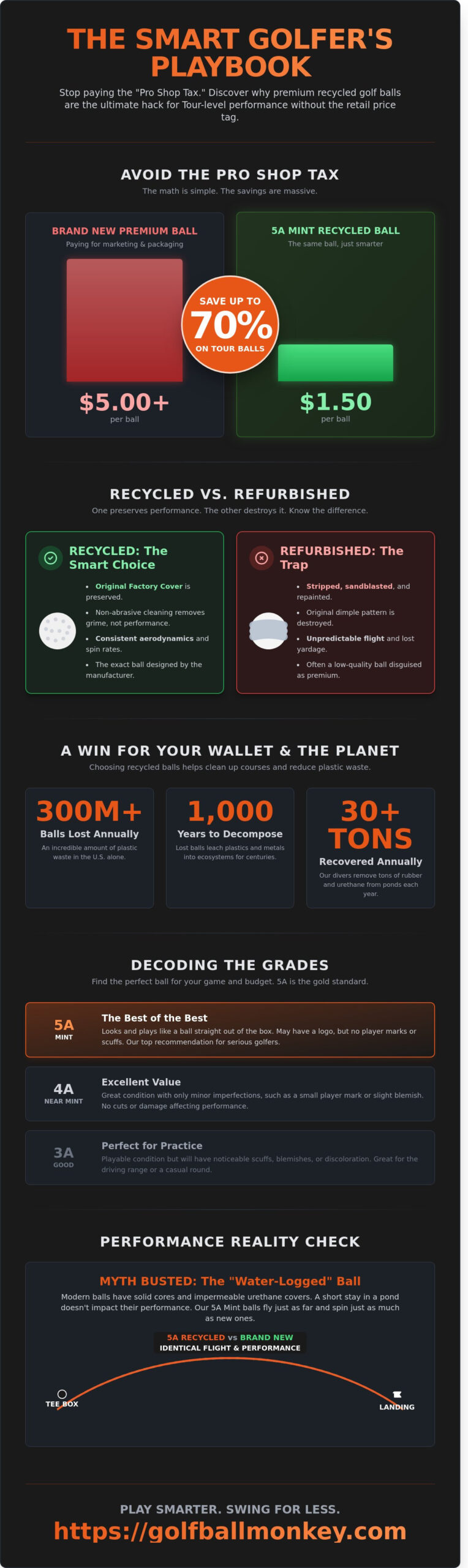
The Performance Reality: Do Recycled Golf Balls Actually Fly as Far?
You are standing on the tee box with a 240-yard carry over a lake. You reach into your bag and pull out one of your recycled golf balls. A tiny voice in your head asks if it will fall short. Did the pond it came from soak into the core? Let’s kill that fear right now. For 99% of golfers, the performance difference between a brand-new ball and a high-quality recycled one is statistically zero. You get the same flight, the same distance, and the same satisfaction of a pure strike without the “new ball tax.”
The Monkey knows the truth about distance. Most players lose yards because of a poor swing, not a slightly used ball. Professional testing shows that premium recycled balls in Mint 5A condition perform within 1% of their brand-new counterparts. On a 250-yard drive, that is a difference of 2.5 yards. Most of us can’t hit our landing spot that accurately anyway. You aren’t sacrificing your game; you are just being smart with your wallet.
Busting the Water-Logged Myth
Forget those old stories about water-logged balls from your grandfather’s era. Modern golf balls are not made of wound rubber bands that soak up liquid like a sponge. Today, we use solid-state technology. These balls feature high-tech construction with multi-layer solid cores and sealed urethane or Surlyn covers. This construction makes them virtually impervious to water damage over short periods. The 24-hour myth suggests a ball is ruined after a day in the drink, but that is simply false.
Research indicates a ball must be submerged for several weeks or even months before the core’s chemical bonds begin to shift. Most balls found in hazards are lost for just a few days before they are recovered. If you want to see the hard numbers, check out Used Golf Balls for Sale: Busting Myths for the deep data on how these balls hold up. The Monkey only picks the best, so you can swing with total confidence.
Spin, Launch, and Control
Performance is about more than just distance. You need to know your ball will stop on the green. The cover material matters more than the ball’s age. Premium recycled golf balls with urethane covers maintain their high-spin characteristics even after being hit a few times. When we grade our Mint 5A inventory, we ensure the cover is pristine. This means your backspin rates and launch angles remain consistent with what the manufacturer intended.
Take the Monkey Challenge next time you are at the range or on the practice green:
- Grab a fresh sleeve of your favorite premium balls.
- Grab a sleeve of Mint 5A recycled balls from the Monkey.
- Hit ten 50-yard wedge shots with each.
- Compare the check and roll-out.
You will find that the recycled options bite just as hard. Stop overpaying for a shiny box. Grab your gear at Monkey prices and spend that extra cash on a better lunch at the clubhouse. You get Tour-level performance for a fraction of the cost. That is the ultimate smart play.
Cracking the Code: How to Choose the Perfect Grade for Your Game
Stop overpaying for shiny cardboard boxes. You want performance, not a fancy retail experience. Understanding the grading system for recycled golf balls is your ticket to playing premium gear at a fraction of the retail cost. Most suppliers use a standard scale from 5A down to 3A. It’s a simple way to know exactly what’s landing on your doorstep. Don’t let the technical talk intimidate you; it’s all about matching the ball’s condition to your specific needs on the course.
- 5A (Mint): The gold standard. These look and play like they were just pulled from a fresh sleeve.
- 4A (Near Mint): The value champion. Expect minor cosmetic flaws that don’t affect flight or spin.
- 3A (Good): The budget play. These show visible wear, scuffs, or slight discoloration. Perfect for practice or high-risk water holes.
The Mint 5A Standard: Like New, Only Cheaper
Mint 5A is the undisputed king of the course. These balls are basically brand new. You can expect a pristine cover with no scuffs, no fading, and zero loss in performance. You might find a tiny player mark or a corporate logo, but that’s it. This grade is the ultimate choice for serious players and tournament rounds where every yard counts. It’s the smartest way to secure Titleist Pro V1 (Mint 5A) balls without the $55-a-dozen sting. The Monkey Seal means every single ball is hand-checked. If it isn’t perfect, it isn’t 5A. We obsess over the details so you can focus on your backswing.
Bulk Buying: The Ultimate Savvy Move
The math is simple: buy more, save more. Grabbing recycled golf balls in buckets of 48 or 96 drives your price-per-ball to rock-bottom levels. This is the savvy move for golfers who spend hours in home simulators or play multiple rounds every week. You won’t flinch when you see a ball splash into a lake. It’s about freedom. When the cost is this low, you play more relaxed. Check out our Bulk Golf Balls guide to see how much you can actually pocket this season. Stocking up means you never run out mid-round and your wallet stays heavy.
Ready to upgrade your bag without draining your bank account? Score premium balls at Monkey prices today.
The Monkey Way: Premium Performance Without the Pro Shop Tax
Stop flushing your hard-earned cash down the drain. Or into the lake. Golf is a game of strategy, and the smartest move starts before you even reach the first tee. Choosing recycled golf balls isn’t just a budget move; it’s a performance strategy. You’re getting the exact same urethane covers and high-speed cores found in brand-new boxes. The only difference? A previous owner had a bad slice. The Monkey’s team of professional divers spends thousands of hours every year scouring hazards to find the gems. We do the dirty work so you can reap the rewards.
Think about the math. A standard pack of premium balls can cost over $50 at a retail pro shop. That’s nearly $5 every time you tee up. When you switch to the Monkey, you’re playing the same high-end tech for a steal. Thousands of golfers have already ditched the “new ball” ego. They’ve realized that a Mint-grade ball performs identically to one pulled straight from a sleeve. Don’t pay a premium for plastic that’s destined to meet a water hazard anyway. It’s time to play smarter.
- Maximum Savings: Get top-tier brands at a fraction of the retail cost.
- Vetted Quality: Every ball is hand-inspected and graded by the Monkey.
- Proven Performance: Independent testing shows recycled balls maintain their distance and spin.
Ready to Restock Your Bag?
Your bag is looking a little light. Don’t wait until you’re digging for a scuffed range ball in your side pocket. Head over to the Golf Ball Monkey Shop right now. We stock everything from Titleist Pro V1s to Callaway Chrome Softs. Our shipping is fast, getting you back on the course in no time. We stand behind our grading scale with a 100% satisfaction guarantee. If the balls don’t meet your expectations, we’ll make it right. The only thing you’ll miss is that bloated pro shop price tag.
The Sustainable Future of Golf
Every purchase is a win for the environment. Golf balls are made of heavy plastics and rubbers that take upwards of 100 to 1,000 years to decompose in a pond. By choosing recycled golf balls, you’re directly helping to keep our courses pristine and our water hazards clean. It’s the ultimate eco-conscious choice for the modern player. You save money, you play better, and the planet stays greener. It’s a triple threat. Play smart. Play the Monkey.
Stop Funding the Water Hazard and Start Winning
Watching a $5 ball sink into the drink hurts. It’s a tax on your game that you don’t have to pay anymore. By choosing recycled golf balls, you’re grabbing the same tour-level technology for a fraction of the retail cost. Our professional divers retrieve these gems from the world’s best courses. Every single ball undergoes a rigorous inspection process to ensure it meets our hand-graded 5A quality standards. This isn’t about compromise; it’s about playing smarter. The Monkey doesn’t let a good ball go to waste, and neither should you.
The data is clear. Performance tests show that high-grade recycled options deliver the same spin rates and distance as brand-new counterparts. Thousands of 5-star reviews from golfers just like you prove that the only difference is the price tag. You’ve done the math. You’ve seen the quality. Now it’s time to stock your bag without emptying your wallet. Join the community of savvy players who refuse to overpay for the same 18 holes. Grab your gear and get back to the tee with total confidence.
Score Tour-Level Performance at Monkey Prices; Shop Now!
Frequently Asked Questions
Are recycled golf balls the same as used golf balls?
Recycled golf balls are a premium subset of used balls that have been professionally recovered, cleaned, and sorted by quality. While any ball hit once is technically used, the recycled label means the ball has gone through a rigorous quality check without any structural changes. You get the original manufacturer’s engineering at a fraction of the retail cost. It’s the smart way to play premium gear without the heart-stopping price tag.
Is there a performance difference between new and recycled golf balls?
Independent testing by Golf Laboratories Inc. showed that high-quality recycled golf balls lose less than 1 percent of their distance compared to brand new versions. A Mint 5A ball performs identically to one pulled straight from a 50 dollar box. Unless you’re a scratch golfer on the professional tour, you won’t notice a single yard of difference. You keep the performance and ditch the new ball tax.
What does ‘Mint 5A’ grade actually mean?
Mint 5A is the gold standard of grading, representing balls that look and feel like they just came out of the sleeve. These balls show no scuffs, no club marks, and no discoloration at all. They are the 10 out of 10 in our warehouse. The Monkey personally vets these to ensure the surface integrity is flawless. You get a pristine ball for a total steal.
Do recycled golf balls lose distance if they were in the water?
Modern solid-core golf balls must sit in water for over 12 hours before any measurable moisture absorption occurs. Research indicates that a ball submerged for 24 hours loses zero distance during play. We only source balls from fresh water and process them quickly to prevent any degradation. Your drives will still soar just as far as a ball kept in a dry bag all year.
Why should I choose recycled over refurbished golf balls?
Recycled balls are superior because they maintain the original factory finish and dimple pattern designed by the manufacturer. Refurbished balls are sandblasted and repainted, which can fill in dimples and ruin the aerodynamics of the shot. Stick with recycled options to ensure the ball flies exactly how the engineers intended. It’s the honest way to save money without compromising on the ball’s core physics.
Can I use recycled golf balls in a tournament?
You can absolutely use recycled golf balls in any USGA sanctioned tournament or local club event. Since the ball hasn’t been structurally altered or repainted, it remains on the official List of Conforming Golf Balls. Just check your grading to ensure there aren’t any major scuffs that might affect your flight path. Pros lose balls in the water too; playing them back is just good strategy.
What is the best way to buy recycled golf balls in bulk?
Ordering in quantities of 50 or 100 balls is the ultimate power move for your wallet. Bulk orders often trigger free shipping thresholds and can lower the price per ball by 15 percent or more. Stock up at the start of the season so you never have to pay inflated clubhouse prices again. The Monkey loves a full bag, and bulk buying is the fastest way to get there.
How do I know if a recycled ball is a ‘fake’?
Spotting a fake requires looking at the font weight and the alignment of the side stamp on the cover. Counterfeit balls often have slightly thicker lettering or inconsistent spacing on the brand logo compared to the real thing. We inspect every single ball to ensure 100 percent authenticity before they ever reach your doorstep. Trust our grading process and expert eyes to keep the fakes out of your bag.
- golfballmonkey@gmail.com
- (512) 593-8401
- Mon – Fri, 9:00 AM – 5:00 PM

All product and company names are trademarks™ or registered® trademarks of their respective holders.
Use of them does not imply any affiliation with or endorsement by them.