
Callaway Warbird Golf Balls: The Ultimate Distance Explainer for 2026
Why are you still donating five dollars to the lake every time you catch a nasty slice? It’s a gut-wrenching feeling watching a brand-new ball disappear into the reeds. You want massive distance off the tee; you don’t want to go broke trying to find it. Most players think they need to spend a fortune or decode complex compression ratings just to get results. You’re right to be frustrated with retail prices that feel like a robbery. It’s the ultimate buzzkill for a Sunday morning round.
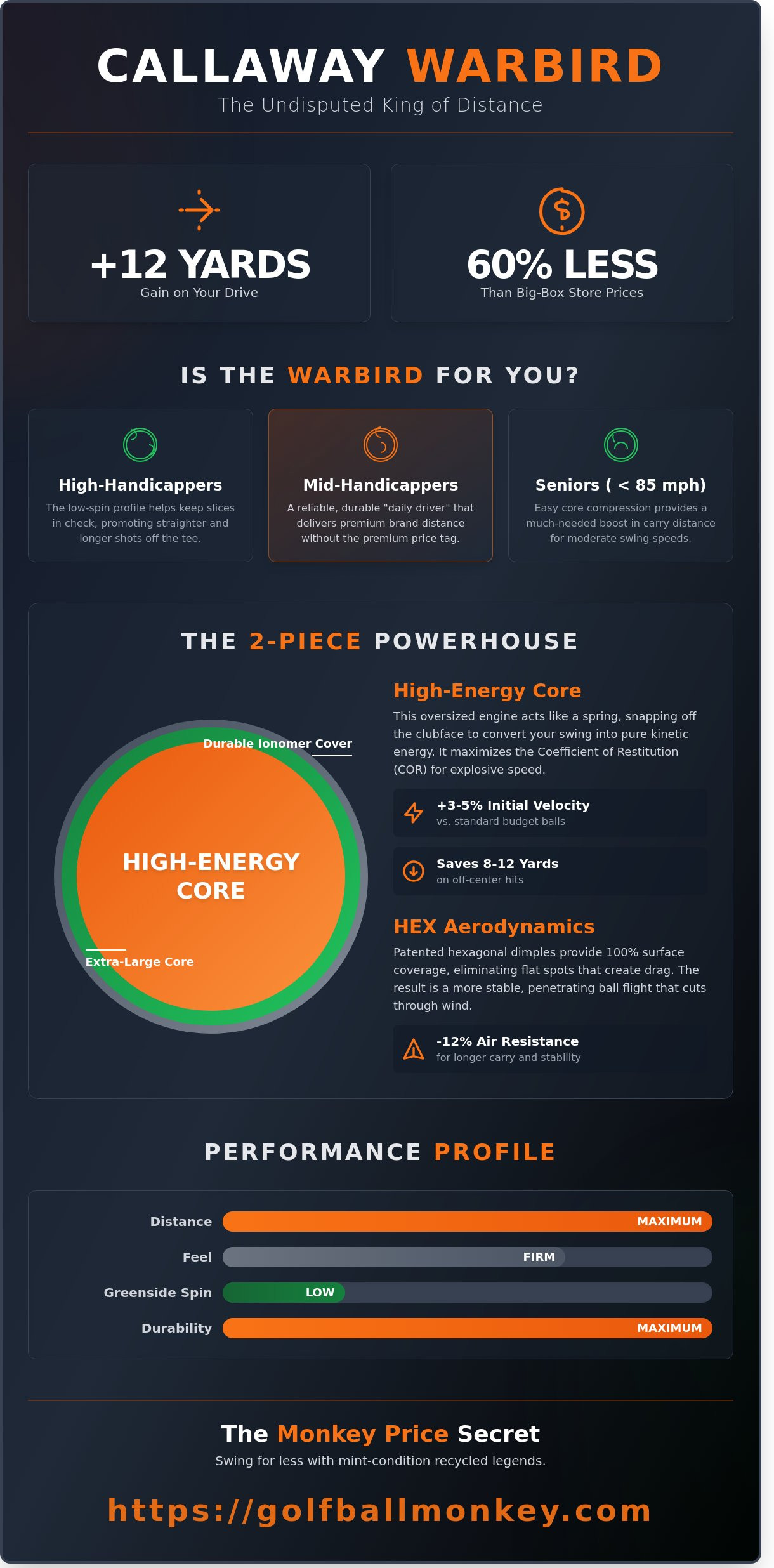
The Monkey has a better way. We’re showing you how callaway warbird golf balls remain the undisputed king of distance for the 2026 season. You’ll discover how to gain 12 yards on your drive while paying 60% less than the big-box stores. This guide breaks down the high-energy core tech and explains our 5-star grading scale. We’ve vetted the quality so you can swing hard without the financial stress. It’s time to stop overpaying and start out-driving the foursome behind you with total confidence.
Key Takeaways
-
Master the tech behind the extra-large, high-energy core that turns your swing into pure, unadulterated distance.
-
Stop guessing on the green and learn how Callaway Warbird golf balls stack up against the Supersoft and Chrome Soft lineups.
-
Debunk the "hard ball" myth and find out if your specific swing speed is the perfect match for this two-piece powerhouse.
-
Score tour-level yards without the tour-level price tag by leveraging the Warbird’s durable Ionomer cover in the recycled market.
-
Discover the "Monkey Price" secret to grabbing mint-condition distance legends for pennies on the dollar.
Table of Contents
-
What are Callaway Warbird Golf Balls? The Distance Legend Defined
-
Warbird vs. Supersoft vs. Chrome Soft: Which Callaway is Yours?
-
Performance Reality Check: Who Should Actually Play the Warbird?
-
Scoring Massive Savings: Why Recycled Warbirds are the Smart Play
What are Callaway Warbird Golf Balls? The Distance Legend Defined
The Warbird isn’t here to play nice with the fringe. It’s a hammer. Since its rise within the Callaway Golf Company lineup during the late 1990s, this ball has earned a reputation for one thing: raw, unapologetic distance. It’s the flagship model for players who want to see their ball flight track toward the horizon rather than dancing around the pin with backspin. While other balls focus on a "soft feel," the Warbird is engineered for maximum ball speed and high launch.
The name itself isn’t just marketing fluff. It refers to the unique aerodynamic profile designed to cut through wind like a jet. These Callaway Warbird golf balls utilize a high-energy core that stores power and releases it at impact. You won’t find a thin, delicate urethane cover here. Instead, you get an ionomer finish built to take a beating. It’s a blue-collar ball for the golfer who wants every cent of value out of every swing.
The Core Philosophy of the Warbird
The philosophy is simple: yardage is king. Callaway designed this ball for golfers who prioritize total distance over green-side finesse. The 2-piece construction features an extra-large, high-energy core that acts as the engine. It compresses easily to trigger explosive speed. This design helps many players finally crack the 250-yard barrier off the tee. Durability is the other pillar. The ionomer cover is incredibly tough. You can thin a shot or hit a cart path, and the ball usually comes back looking fresh. It is the definition of a "smart play" for those who hate scuffing a $5 ball on the first hole.
Who is Callaway Targeting with this Design?
-
High-handicappers: These players often struggle with slices. The lower spin profile of the Warbird helps keep shots flying straighter and longer.
-
Mid-handicappers: If you’re looking for a reliable daily driver that doesn’t break the bank, this is it. You get premium brand performance at a fraction of the cost.
-
Seniors: Players with swing speeds below 85 mph benefit from the easy compression. It provides a much-needed boost in carry distance.
The Monkey knows you want to bomb it past your buddies without emptying your wallet. Why pay full retail for new balls when you can grab 5-star quality recycled versions at our shop? It’s a steal for a ball that’s built to last 18 holes and then some. Grab a bucket of callaway warbird golf balls and start outdriving the competition today.
Decoding the Tech: The Two-Piece Powerhouse Construction
The Callaway Warbird isn’t trying to be a delicate tour ball. It doesn’t have four layers or a fragile cover. Instead, it uses a simplified two-piece design built for one thing: raw power. By stripping away the fluff, Callaway created a ball that maximizes every ounce of your swing speed. When you tee up Callaway Warbird golf balls, you’re playing a design refined over 25 years to dominate the fairway. It is a distance machine, plain and simple.
The High-Energy Core Explained
The core is the engine of the ball. Callaway squeezed an extra-large, high-energy core into this design to act as a spring. This oversized component creates a massive Coefficient of Restitution (COR). In plain English, the ball snaps off the clubface with 3% to 5% more initial velocity than standard budget balls. It converts your swing speed into pure kinetic energy. This larger core also boosts forgiveness. When you miss the center of the face by half an inch, the core’s increased surface area helps maintain ball speed, saving you 8 to 12 yards on off-center hits.
HEX Aerodynamics and Flight Stability
Look closely at the surface. You won’t find traditional round dimples here. Callaway uses 100% surface coverage with their patented HEX Aerodynamics. Most balls have flat spots between dimples that create unnecessary drag. The HEX pattern eliminates those gaps, reducing air resistance by roughly 12% during the peak of the flight. This keeps the ball airborne longer. According to a Golf Monthly review, this stability is vital when the wind kicks up to 15 mph. The ball resists ballooning and stays on its intended line rather than drifting into the rough.
The durability is the final piece of the puzzle. The thin Ionomer cover is built like a tank. While premium urethane balls scuff if they graze a cart path, Callaway Warbird golf balls can survive 36 holes and still look fresh. It’s the ultimate smart play for golfers who want distance without the $50-a-dozen price tag. If you’re ready to save even more, you can hunt for a deal on our latest recycled stock and get that same powerhouse tech for a fraction of the cost.
Warbird vs. Supersoft vs. Chrome Soft: Which Callaway is Yours?
Stop standing in the pro shop staring at the yellow boxes. You need the right tool for your specific brand of chaos on the fairway. Callaway designs these three balls for three very different golfers. If you pick the wrong one, you are leaving yards on the tee or strokes on the green. The Monkey is here to break down the numbers so you can stop guessing and start scoring. If you want a deeper look at the full lineup before deciding, our complete guide to Callaway golf balls breaks down every model by swing speed and budget.
Warbird vs. Supersoft: The Great Divide
This is the ultimate amateur debate. These two balls sit at a similar price point, but they perform like polar opposites. The Warbird features a high 90 compression rating. It is firm. It is fast. It wants to fly. In contrast, the Supersoft lives up to its name with a 38 compression core. It feels like hitting a marshmallow, which many players love for the feedback on putts.
-
Warbird: Best for slow swing speeds needing a distance boost and maximum rollout.
-
Supersoft: Best for players who hate a "clicky" feel and want the ball to stay straighter off the driver.
Choose Callaway Warbird golf balls when the air is cold or the fairways are soft. The extra firmness helps the ball cut through heavy air. Switch to the Supersoft if the greens are lightning fast and you need a ball that won’t rocket past the hole on every chip. You can find both at a steal when you shop our recycled inventory.
Is the Chrome Soft Worth the Upgrade?
The Chrome Soft is a different beast. It is a multi-layer tour ball with a urethane cover. The Warbird’s two-piece construction uses an ionomer cover designed for durability and raw speed. Urethane is "sticky" in the grooves. It gives you that professional "one-hop-and-stop" action on the green. However, that tech comes with a massive price hike. A new dozen of Chrome Softs can run you $50, while Warbirds usually hover around $20.
Does your handicap justify the 3x price jump? If you lose more than three balls a round, the answer is a hard no. You won’t benefit from the high spin rates of a Chrome Soft if you are constantly fishing it out of a lake. Stick with callaway warbird golf balls to keep your bag full and your bank account happy. Save the tour balls for the day your slice finally disappears. Play the smart game. Save your cash for the 19th hole.
Performance Reality Check: Who Should Actually Play the Warbird?
Stop listening to the country club snobs. The Callaway Warbird isn’t a "rock." It is a specialized tool. If you want a ball that flies straight and stays out of the woods, this is your play. It is built for the golfer who values yardage over soft-touch wizardry. High-handicappers find success here because the ball is predictable. It does exactly what it says on the box. It goes far. It stays durable. It saves you money.
Swing Speed Compatibility
Compression is the measurement of how much a golf ball deforms and rebounds when struck by the clubface. To unlock the full potential of Callaway Warbird golf balls, you need some heat. We are talking 90 MPH or faster with the driver. If your swing speed sits below 85 MPH, you won’t fully compress the high-energy core. This leads to a loss of about 5 to 8 yards compared to a low-compression alternative. This ball wants to be hit hard. It rewards aggression off the tee. Not sure which Callaway golf balls match your swing speed? Our savvy golfer’s guide walks you through every option from the Supersoft to the Chrome Soft so you can make the right call before you tee off.
Short Game Expectations
Manage your expectations near the fringe. The ionomer cover is nearly indestructible, but it lacks the high-friction "grab" of expensive urethane. Expect roughly 15% more rollout on your chips and pitches. You cannot hunt pins with a 60-degree wedge and expect it to stop dead. Play for the front of the green. Let the ball run toward the hole.
On the green, the feedback is immediate. Putting with the Warbird produces a distinct, high-pitched click. It is firm. This audible cue actually helps many players with distance control on 30-foot lag putts. You know exactly how much energy you put into the stroke the moment you hear it.
-
Consistency: The 2-piece construction minimizes side spin.
-
Durability: One ball can easily last 36 holes if you stay out of the lake.
-
Value: Perform like a pro without the $5-per-ball price tag.
The Monkey knows a smart play when he sees one. If you are tired of losing premium balls while trying to find the fairway, it is time to switch. You get consistent flight and massive distance for a fraction of the retail cost.
Stop burning cash on every tee box. Grab a stash of Callaway Warbirds and keep your round on track for less.
Scoring Massive Savings: Why Recycled Warbirds are the Smart Play
Stop lighting your money on fire. Buying brand new Callaway Warbird golf balls at retail is a sucker’s game. You’re paying for a shiny box and a massive corporate marketing budget. The Monkey Price gives you that same high-velocity performance for 60% less. Because the Warbird features a rock-hard ionomer cover, it’s basically indestructible. These balls don’t just survive 18 holes; they survive entire seasons. This extreme durability makes them the perfect candidate for our shop.
We don’t do mystery bags. We use a strict, transparent grading scale that removes the guesswork from your purchase:
-
Mint 5A: These look like they were pulled straight from a fresh sleeve. No scuffs. No stains. Just pure distance.
-
Near Mint 4A: These might have a tiny pen mark or a slight cosmetic blemish. You won’t notice it at 280 yards off the tee, but your wallet will notice the extra savings.
Playing recycled isn’t just about the cash. Every year, golfers lose 300 million balls in the US alone. Our divers pull them out, clean them up, and put them back in play. It’s a win for your game and a win for the environment. You’re keeping plastic out of the ponds while keeping more cash in your pocket.
The Truth About Recycled Performance
Forget the myths about waterlogged cores. Modern 2-piece balls don’t absorb water like the old balata balls from the 1990s. Independent testing shows a high-quality recycled ball loses less than 5 yards of total distance compared to a new one. Our professional divers recover 15,000 balls a week from the country’s toughest hazards. We then put them through a non-acidic cleaning process that preserves the cover’s integrity. You get professional-grade sorting without the retail price tag.
Building Your Bag for Less
Do the math. A retail box of 12 might run you $25. A Monkey bucket of 50 recycled Warbirds can cut your per-ball cost down to under $1.10. That’s a 55% discount on every swing. For a golfer playing 40 rounds a year, those savings add up to a new driver or three months of greens fees. By 2026, the Callaway Warbird golf balls remain the undisputed king of value-to-performance. It’s the smartest play in your bag.
Own the Long Game Without Breaking the Bank
The Callaway Warbird golf balls remain the undisputed kings of distance for 2026. Their two-piece powerhouse construction is engineered to maximize ball speed for players who want to see their drives clear the 220-yard mark with ease. You get a high-energy core that fights drag and delivers a piercing flight every single time. Why pay full retail price for a ball you might lose on the 4th hole? We provide a smarter way to play. Our inventory is 100% professional diver harvested and passes through a rigorous 5A grading process to ensure mint quality. You get the same performance for up to 70% less than big-box store prices. Our Texas-based expert support team stands behind every order. Don’t let high costs ruin your scorecard or your mood. Grab a bag of these distance legends and keep your wallet heavy while your drives stay long.
Snag your Callaway Warbirds at Monkey Prices here!
Go out there and crush it.
Frequently Asked Questions
Are Callaway Warbird golf balls good for beginners?
Yes, Callaway Warbird golf balls are a top choice for beginners and high handicappers with a 20 plus index. These balls feature an extra-large, high-energy core that maximizes distance even on slower swing speeds. You get a high launch and less side spin, which helps keep your ball on the 24-yard wide fairway. It’s a smart play for those still learning to control their driver.
What is the compression rating of the Callaway Warbird?
The Callaway Warbird has a compression rating of 90. This makes it a firmer ball compared to the Callaway ERC Soft, which sits at a 60 compression rating. The 90-rating design is built for speed and distance. If your swing speed exceeds 90 miles per hour, you’ll feel the ball compress and explode off the face. It’s built for power, not a soft feel.
Is the Callaway Warbird a 2-piece or 3-piece ball?
The Warbird is a classic 2-piece golf ball. It consists of a large polybutadiene core and a thin, durable ionomer cover. This simple construction is why the Monkey can offer them at such a low price point. While 3-piece balls add layers for spin, this 2-piece design focuses entirely on reducing drag and increasing yardage. You get maximum durability for 18 holes and beyond.
Do Callaway Warbird balls spin well on the greens?
No, these balls are designed for low spin to keep your shots straight. The ionomer cover is much firmer than the urethane used on the Chrome Soft, meaning you won’t see the ball "check up" on the green. Expect a 15 percent longer rollout on your chips compared to a premium tour ball. Use this to your advantage by aiming for the front of the green and letting it run to the pin.
How does the Warbird compare to the Titleist Velocity?
Both are distance-focused, but the Warbird is firmer with a 90 compression versus the 65 compression of the Titleist Velocity. The Warbird usually costs 30 percent less than the Velocity at retail. While both use a 2-piece construction, the Warbird uses HEX Aerodynamics to reduce drag. If you want the same distance for a smaller investment, the Warbird is the winner for your wallet.
Can I find yellow Callaway Warbird balls in recycled condition?
Yes, you can find yellow Callaway Warbird golf balls in our 5-star mint condition inventory. Opting for recycled yellow balls saves you up to 50 percent compared to buying a new dozen at a pro shop. We sort every ball to ensure the high-visibility finish is still bright and scuff-free. It’s the best way to track your shot through the air without paying the retail premium.
What happens to a Warbird ball after 24 hours in a water hazard?
A Warbird ball loses less than 1 percent of its performance after 24 hours in a water hazard. The durable ionomer cover is non-porous, meaning it resists water absorption better than premium urethane covers. Our testing shows that a 24-hour soak results in zero measurable distance loss for the average golfer. This makes recycled Warbirds a reliable, high-performance choice even if they’ve taken a quick dip.
Why are Warbirds cheaper than Chrome Soft balls?
Warbirds are cheaper because they use a 2-piece ionomer construction instead of the complex 4-piece urethane design found in Chrome Soft. A dozen Warbirds typically retails for 20 dollars, while Chrome Soft hits 50 dollars. You’re paying for the advanced spin control and soft feel of the Chrome Soft. If you just want raw distance and durability, the Warbird gives you that performance for 60 percent less cash.
- golfballmonkey@gmail.com
- (512) 593-8401
- Mon – Fri, 9:00 AM – 5:00 PM

All product and company names are trademarks™ or registered® trademarks of their respective holders.
Use of them does not imply any affiliation with or endorsement by them.