
Sustainable Golf Ball Options: Why Used Is the New Green in 2026
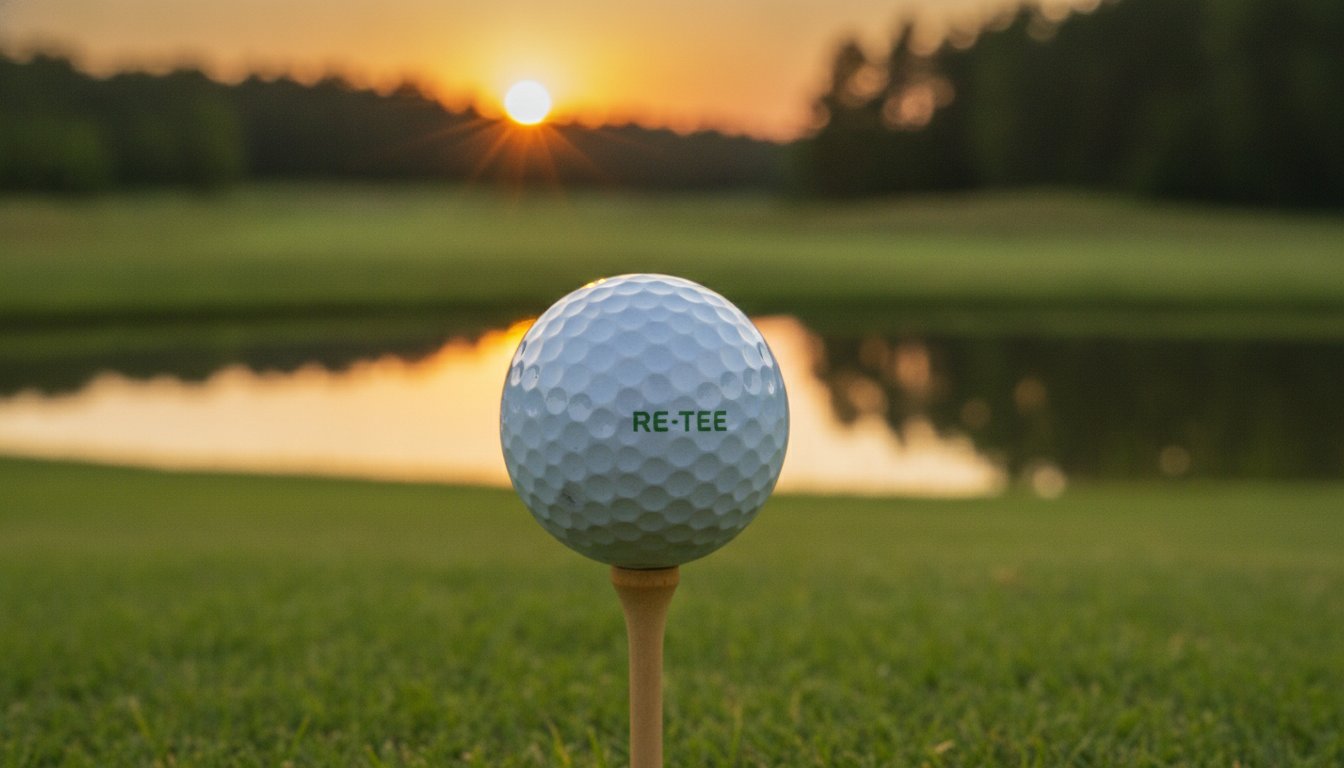
Did you know a single golf ball has a carbon footprint over 6,000 times its physical size? It is a brutal stat to keep in mind when you are watching your Titleist Pro V1 splash into a lake. You want to do right by the environment, but you also need that premium compression and spin to keep your handicap in check. Finding truly sustainable golf ball options used to mean settling for biodegradable balls that felt like hitting a rock and flew half the distance. It was a choice between your conscience and your scorecard. We are done with that compromise.
We get it. You are tired of the environmental guilt and the soaring retail prices of new gear. This guide shows you how to play the best brands in the game for a fraction of the cost while keeping plastic waste out of the landfill. We will break down why recycled is the real “green” choice in 2026. You will learn how to spot top-tier Mint 5A quality and why the smartest players on the course are stocking up on used Titleist and Callaway gems instead of buying new. It is time to play better golf for less money while doing the planet a massive favor.
Key Takeaways
- Understand the real environmental impact of lost plastic and why the most sustainable golf ball options are the ones already manufactured and waiting for a second life.
- Compare biodegradable balls against recycled premium cores to see why tour-level performance requires the multi-layer tech found in high-end used gear.
- Embrace the circular economy to save up to 70% on retail prices while significantly reducing the energy and water needed to produce new equipment.
- Match your swing speed to elite models like the Titleist Pro V1 or Callaway Chrome Soft using a standardized Mint 5A grading system for guaranteed quality.
- Discover how reclaiming balls from water hazards protects local ecosystems and provides you with pro-vetted gear that performs exactly like new.
The Hidden Environmental Cost of Lost Golf Balls
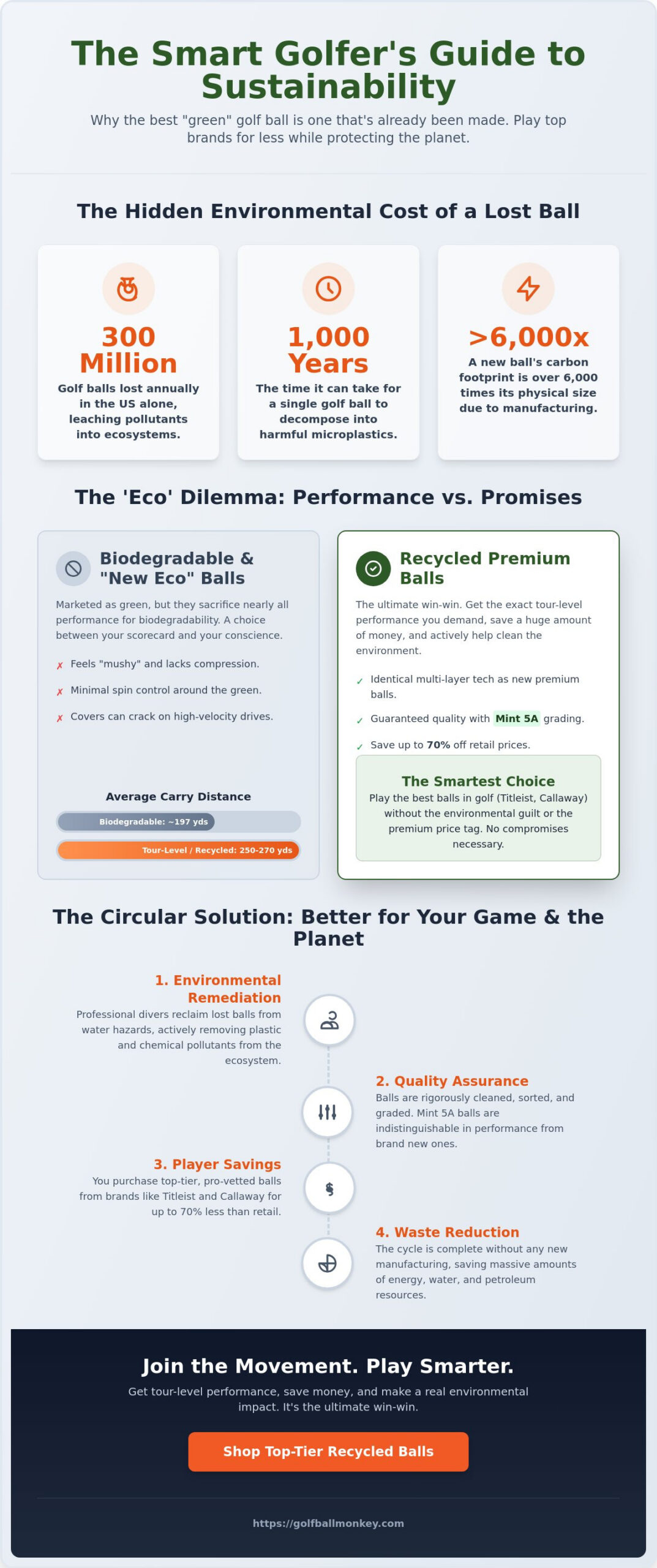
Every year, golfers in the US alone lose an estimated 300 million golf balls. That is not just a blow to your handicap; it is a massive environmental burden. When we talk about sustainable golf ball options, we mean gear that minimizes resource extraction and prevents pollution. A ball isn’t “green” just because it has a leaf on the box. It is green when it stays out of the ecosystem. Most players don’t realize that a single lost ball can take anywhere from 100 to 1,000 years to decompose. That Pro V1 you sliced into the woods during your junior year? It is still there. It’ll probably still be there for your great-great-grandchildren, too.
The problem goes deeper than just litter. As these balls sit in the elements, they break down into microplastics. These tiny particles infiltrate the soil and water, carrying chemicals like polybutadiene and various heavy metals. This is the reality of modern golf ball composition. They are engineered for speed and spin, not for biodegradability. When you buy new, you’re fueling a cycle of constant extraction and waste. Choosing a smarter path means looking at the life cycle of your equipment before you tee off. You can find better sustainable golf ball options by opting for reclaimed gear that skips the factory floor entirely.
What Happens to a Ball in a Water Hazard?
Water hazards are the primary site of environmental damage. Over time, the urethane or surlyn covers on lost balls begin to degrade. They don’t disappear. They fragment. These fragments become permanent fixtures in the local food chain, often ingested by fish and birds. This is where professional divers step in. By reclaiming these balls, we perform active environmental remediation. We pull the plastic out before it can leach more chemicals into the water. It turns a potential pollutant back into a high-performance tool. Every ball we pull out is one less piece of plastic poisoning the pond.
The Problem with “New” Production
Manufacturing a single new premium golf ball has a carbon footprint over 6,000 times its own size. Think about the petroleum-based plastics and the energy-heavy rubber processing required for every dozen. Most of these balls are made in overseas factories, then shipped thousands of miles to your local pro shop. That is a lot of emissions for something you might lose on the third hole. Check out our full inventory to see how easy it is to break this cycle. Save the planet. Save your cash. It is the ultimate win-win for any savvy player.
Biodegradable vs. Recycled: Evaluating ‘Eco-Friendly’ Golf Ball Performance
Buying “green” shouldn’t mean playing “bad.” Most golfers assume that biodegradable balls are the gold standard for sustainable golf ball options. They aren’t. In fact, trying to play a serious 18-hole round with a starch-based ball is a great way to ruin your scorecard. These balls often feel mushy off the clubface. They lack the sophisticated multi-layer construction found in a genuine tour ball. You lose compression. You lose spin. You lose significant distance. A high-velocity drive with a modern driver can literally crack an eco-ball’s cover on the first tee. It is a frustrating experience that doesn’t have to be the norm.
Then there are the “recycled core” balls. Some brands attempt to use regrind rubber from manufacturing scraps to build new cores. It is a step in the right direction, but the technology has clear limits in 2026. Even the best “new” recycled balls on the market still require over 50% virgin plastic and rubber to maintain structural integrity. They usually lack the specialized urethane covers that provide the “stop-on-a-dime” control you need around the green. If you want tour-level performance, you need a tour-level ball. Settling for a “mushy” alternative just because of the label isn’t the savvy play.
The “Fish Food” Ball: A Niche Solution
These balls have one job: to be hit into the ocean from a yacht or a cruise ship. They are designed to dissolve and release nutrients. On a boat, they are perfect. On a golf course, they are a disaster. They have zero spin control and unpredictable flight patterns. Research shows a massive performance gap; some of the highest-performing biodegradable balls only carry about 197 yards, while a standard tour-level ball carries 250 to 270 yards. There is also an environmental catch. Dumping “fish food” into a small, enclosed pond can cause nutrient loading, leading to algae blooms. It is better than plastic, but it is not a real golfing solution.
Recycled Materials in New Balls
Manufacturers are experimenting with regrind rubber, but the chemical bonds in golf balls don’t always play nice with being melted down and reformed. To get the performance you expect, you are better off sticking with the savvy insider choice. Instead of buying a “new” ball that is only half-recycled and performs poorly, buy a premium ball that has already been manufactured and rescued. You get the multi-layer tech of a Titleist or Callaway without the environmental or financial hit of buying new. Choosing reclaimed gear is one of the most effective sustainable golf ball options available because it keeps existing high-performance materials in play longer.
The Circular Economy: Why Reusing Premium Balls Beats Buying New Eco Gear
Circular economy sounds like corporate jargon, but for us, it is just common sense. Keep high-performance gear in play for as long as possible. Every time you bag a used Titleist Pro V1 (Mint 5A) or a Callaway Chrome Soft (Mint 5A), you are opting out of the carbon-heavy manufacturing cycle. These are the smartest sustainable golf ball options because they require zero new raw materials. No petroleum extraction. No intensive chemical processing. Just a professional rescue mission and a thorough quality check. It is the intelligent play for your game and the planet.
The energy savings here are astronomical. Melting down rubber and plastic to create “new” recycled balls consumes significant amounts of electricity and heat. Scrubbing a reclaimed ball uses almost none. It is the difference between building a car from scratch and giving one a quick car wash. By choosing high-quality used gear, you keep carbon in the ground and out of the atmosphere. You get the same tour-level spin and distance without the heavy environmental price tag of a factory-fresh dozen. Why pay more to pollute more?
Manufacturing vs. Retrieval: The Carbon Gap
Retrieving one golf ball from a pond uses less than 1% of the energy required to manufacture a single new ball from scratch. Professional divers are essentially the janitors of the golf course. They clear out the hazards and pull millions of units of plastic out of local ecosystems annually. This high-volume reclamation keeps our waterways healthy and our landfills significantly lighter. It is the most direct way to clean up the game we love while keeping your equipment budget intact.
Quality Control in the Circular Model
Modern cleaning technology has evolved way beyond a bucket of soapy water. We use specialized, non-abrasive methods that preserve the dimple pattern and cover integrity of every ball. Don’t listen to the locker room myths about water damage. If you are asking Are Used Golf Balls Worth It?, the data says yes. A few days in a hazard has zero measurable impact on ball speed or launch angle. Our 5A grading scale acts as a verbal seal of approval, ensuring your “Mint” find performs exactly like the retail version. We vet the inventory so you can focus on your swing.
By choosing these sustainable golf ball options, you are supporting a model that values resourcefulness over waste. You are getting pro-vetted equipment that has been personally cleared for performance. It is about making the savvy choice. You get to play the best brands in the world, save a massive amount of cash, and protect the courses you love. That is the Monkey Mission in action.
Choosing Sustainable Balls That Do Not Kill Your Distance
Stop settling for “eco” balls that feel like hitting a stale marshmallow. You want sustainable golf ball options that actually reach the green. Real performance comes from the high-tech layers inside a Titleist or a TaylorMade. The trick is matching the ball to your specific swing speed. If you are swinging over 105 mph, you need a different core compression than someone at 85 mph. Check out our guide on Which Golf Ball Should I Play? to find your perfect match. Playing the right ball is the first step to shooting lower scores while saving the planet.
The smartest players know that “used” doesn’t mean “worn out.” By choosing pro-vetted, reclaimed gear, you maintain tour-level distance while slashing your equipment budget. You get the same aerodynamics and spin rates as the pros, but without the environmental guilt of fueling new plastic production. It is the ultimate savvy play. Whether you need the piercing flight of a TaylorMade TP5 or the soft landing of a Callaway Chrome Soft, we have you covered with gear that has already been tested on the course.
The Savvy Player’s Grading Guide
We use a strict, standardized grading system so you know exactly what is landing on your doorstep. No surprises. Just high-value acquisitions.
- Mint 5A: These are the crown jewels of our inventory. They look and play like they just came out of a fresh retail sleeve. Use these for your competitive rounds or when you want peak performance.
- Near Mint 4A: These have very slight cosmetic flaws but zero performance loss. They represent the perfect balance for weekend warriors who want a premium feel without the retail price tag.
- Good 3A: These are the ultimate sustainable choice for practice. Grab a Mixed Bag (Good 3A) for your shag bag or those tight holes where the water hazard is lurking.
Sustainable Brand Spotlight
The Titleist Pro V1 is a legend for a reason. Its durable urethane cover holds up incredibly well; it is the best candidate for our reclamation process. If you prefer a softer feel off the face, the Callaway Chrome Soft offers elite sustainability with a core designed for maximum forgiveness. Don’t sleep on Bridgestone or Srixon either. These brands use high-performance materials that hold up perfectly through our specialized cleaning process. You get the tech. The planet gets a break. Shop our full inventory of pro-vetted gear here and start playing the smart way.
For high-handicappers or those just looking to stock up, the Mixed Bag approach is a total game-changer. It is the best way to test different sustainable golf ball options without committing to a single brand. You get to play the field, find what works for your swing, and keep your gear budget in the black. It is about making the intelligent play on every single hole.
Join the Monkey Mission: Premium Performance Meets Planet-First Savings
The Monkey Mission is about more than just finding a bargain. It is about cleaning up the game we love. Our professional divers have reclaimed millions of balls from water hazards across the United States. This is the most effective way to source sustainable golf ball options because it removes plastic from sensitive ecosystems and puts it back into play. Why let high-performance urethane sit in the mud for a thousand years when it could be sitting on your tee? It is time to stop overpaying for plastic and start playing the smart, green way.
Choosing used is the ultimate savvy insider move. You save anywhere from 50% to 70% off standard retail prices. It is a cheeky way to stick it to the man and those big-box retailers who want you to pay $5 a ball. You get the same Titleist or Callaway performance without the marketing markup. We vet the inventory so you can stick it close to the pin. You get to keep your gear budget in the black while keeping the courses in the green.
From the Bottom of the Lake to Your Tee
Every ball we sell follows a strict journey. First, our divers retrieve them from local hazards. Then, they undergo a specialized cleaning process that protects the dimples. Finally, they receive a “Monkey Vetted” seal of approval after being sorted by our rigorous 5A grading scale. This ensures every Mint 5A ball you buy looks and feels like it just came out of the box. Shop our full collection of sustainable premium balls and see the quality for yourself. It is the highest value acquisition in the sport.
The Future of Green Golf
The “Used” movement is the fastest-growing trend on the course in 2026. Golfers are realizing that buying new is an unnecessary environmental and financial hit. Your purchase directly supports professional divers and contributes to cleaner waterways. It is a circular model that actually works. We are stripping away the elitism and focusing on pure enjoyment. You are making the intelligent play for your scorecard and the planet. Remember; you don’t need a new ball to have a new game. Grab some pro-vetted gear and keep your game in the green.
Tee Off for a Greener Game
Playing the best round of your life shouldn’t cost the earth. You now know that the most effective sustainable golf ball options aren’t found in a lab. They’re rescued from the hazards of your favorite courses. You get tour-level spin and distance while keeping high-performance plastic out of the local ecosystem. It’s the ultimate savvy play for any serious golfer. We’ve stripped away the elitism to focus on what matters: pure enjoyment and massive value.
Our professional divers reclaim over 10 million balls annually. Every single ball is personally vetted for quality and graded to our strict standards. You can snag top-tier brands with 50-80% savings compared to standard retail prices. Why pay the big-box premium when you can get Mint 5A performance for a fraction of the cost? It’s time to join the mission. Make the intelligent move for your scorecard and the environment today.
Go Green and Save Green: Shop Mint 5A Titleist Pro V1s Now!
See you on the first tee. Play smart and save big.
Frequently Asked Questions
Are used golf balls really as good as new ones for the environment?
Yes, used balls are significantly better for the planet because they require zero new manufacturing resources. Reclaiming an existing ball uses less than 1% of the energy needed to produce a new one from scratch. By choosing these sustainable golf ball options, you prevent plastic from breaking down in ponds and stop the cycle of petroleum-based production. It is the cleanest way to play.
Do biodegradable golf balls actually work for a full 18 holes?
No, biodegradable balls are generally not built for a full round of golf. They are designed for one-off shots into the ocean or lakes and lack the multi-layer tech required for real performance. Most eco-balls will crack under high-velocity impact or offer unpredictable flight paths. If you want to finish 18 holes with the same ball, stick to a pro-vetted reclaimed Titleist or Callaway.
How long does a golf ball take to decompose in a pond?
A standard golf ball takes anywhere from 100 to 1,000 years to fully decompose in a water hazard. Because they are made of synthetic polymers and heavy metals, they don’t actually disappear. They slowly fragment into microplastics that poison aquatic life. Professional reclamation is the only way to remove this waste before it becomes a permanent part of the local food chain.
What is the most sustainable brand of golf ball to buy used?
Titleist is the gold standard for sustainability in the secondary market. The Pro V1 features an incredibly durable urethane cover that holds up better than almost any other brand during our cleaning and grading process. Any premium ball from TaylorMade or Callaway is also a great choice. Reusing these high-performance materials is much better for the earth than buying a new “eco” alternative.
Can I get tour-level spin from a recycled premium ball?
Absolutely. Our Mint 5A grading ensures you get the exact same spin and launch characteristics as a ball fresh from the retail box. Scientific testing shows that a few days in a water hazard has zero measurable impact on the aerodynamics or core compression of a premium ball. You get that “stop-on-a-dime” control on the green without the heavy environmental or financial cost.
Why are used balls considered better than new “eco-friendly” balls?
Used gear is the leader among sustainable golf ball options because it follows a circular economy model. New “eco” balls still require massive amounts of energy and water to manufacture and ship across the globe. Reclaiming a ball that is already at the bottom of a lake removes a pollutant and saves the carbon footprint of making something new. It is the smarter play.
How much money can I save by switching to sustainable used options?
You can save between 50% and 80% compared to standard retail prices at big-box stores. It is the ultimate savvy insider secret for golfers who want the best equipment without the marketing markup. You get to play with the same gear the pros use while keeping your budget in the black. Saving the planet while saving your cash is a win-win on every hole.
- golfballmonkey@gmail.com
- (512) 593-8401
- Mon – Fri, 9:00 AM – 5:00 PM

All product and company names are trademarks™ or registered® trademarks of their respective holders.
Use of them does not imply any affiliation with or endorsement by them.