
Smart Alternatives to Buying New Golf Balls: Play Premium for Less in 2026
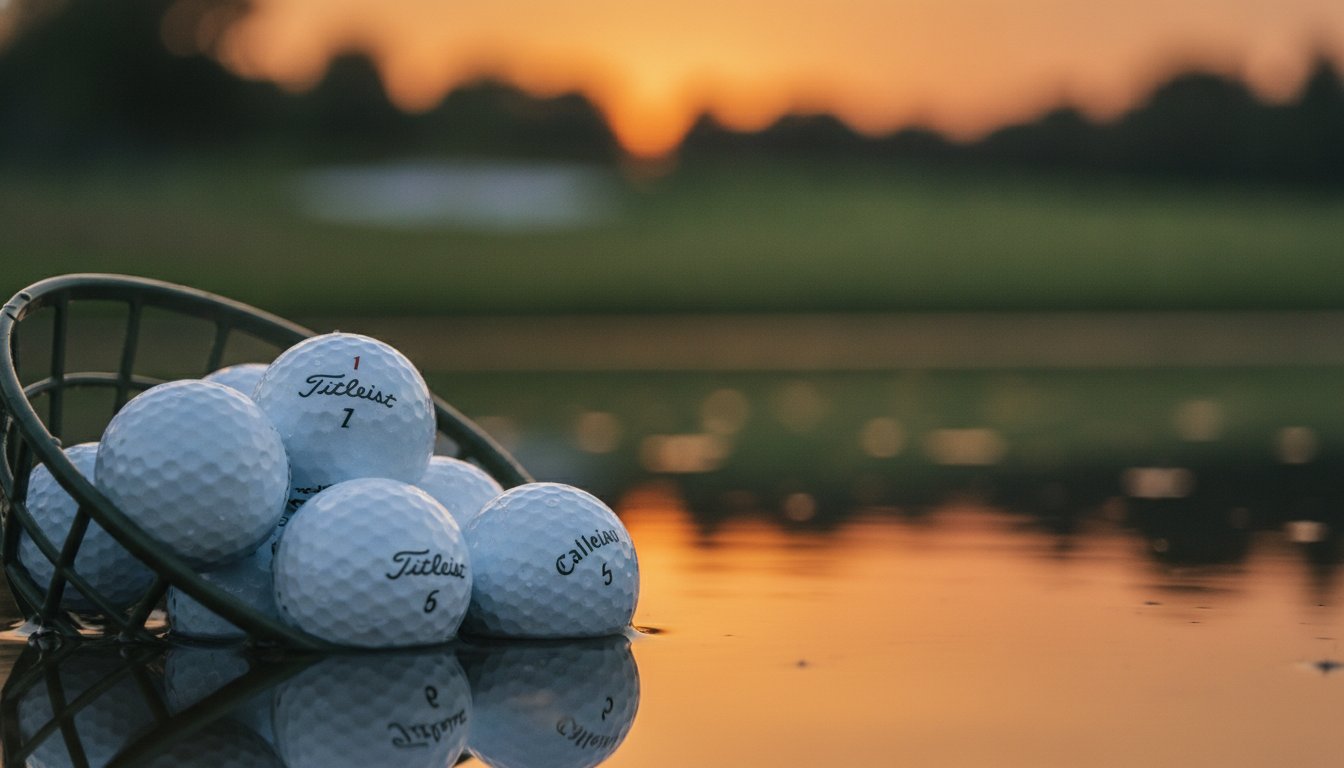
Why are you still handing over nearly $60 for a dozen balls you’re destined to lose in the drink by the turn? It’s a massive drain on your budget that doesn’t actually lower your handicap. We all know that gut-wrenching feeling of watching a brand-new, five-dollar sphere vanish into a water hazard. You want the spin and control of a Titleist or TaylorMade, but the retail price tag is getting absurd. Thankfully, there is a smarter alternative to buying new golf balls that lets you play the best gear without the “premium” tax.
Stop overpaying for a shiny box and start playing like a pro for less. You’ll discover how to master the world of premium used and alternative golf balls to maintain Tour-level performance on a budget. We’ll break down the vital difference between recycled and refurbished gear, highlight the value brands that actually deliver, and show you where to find Mint 5A quality at half the retail price. It’s time to beat the system, save the planet, and keep your cash where it belongs. Let’s get savvy.
Key Takeaways
- Stop paying the “new ball tax” and keep your greens fees from doubling by ditching retail markups.
- Discover why premium recycled gear is the ultimate alternative to buying new golf balls without sacrificing a single yard of distance.
- Learn to spot the “danger zone” of refurbished balls and why multi-layer construction beats “value” brands every time.
- Master the Mint 5A grading system to ensure you’re getting Tour-level performance at a fraction of the cost.
- Make the intelligent play for the planet and your wallet by choosing reclaimed gear vetted by professional divers.
The High Cost of Hitting the Links: Why the New Ball Tax is Optional
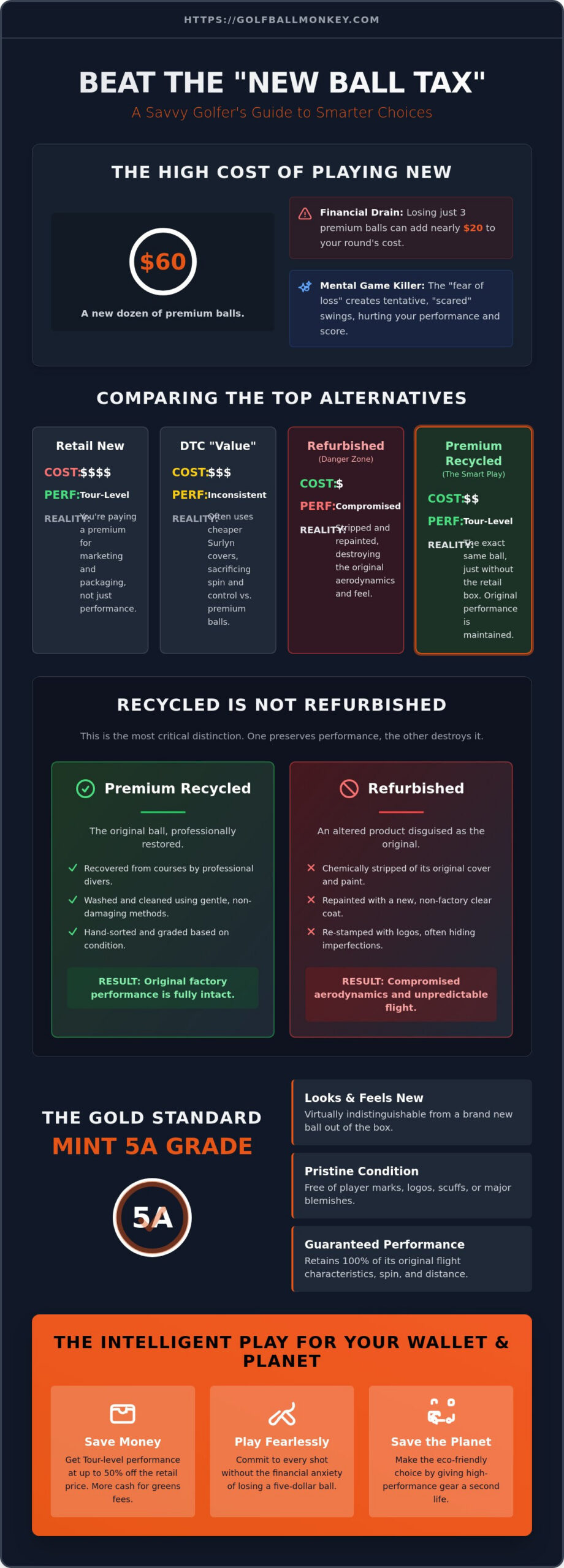
Golf is already expensive enough. Between greens fees, cart rentals, and that inevitable post-round burger, your wallet takes a beating every weekend. But the real silent killer of your budget is the “New Ball Tax.” If you’re paying retail prices for a sleeve of Tour-level balls, you’re essentially throwing money into the woods. Think about the math of a typical round. If you lose just three premium balls during a Saturday morning session, you’ve effectively added nearly $20 to your tab. That is a massive hike just for the privilege of watching white plastic sink into a lake. It’s time to find a better alternative to buying new golf balls.
2026 is the year of the savvy consumer. The old days of feeling “elite” because you bought a fresh box at the pro shop are over. Today’s intelligent players realize that the retail shelf is a trap designed to fund corporate overhead. We are moving toward a community-driven model where performance matters more than packaging. The smart play isn’t changing your ball model; it’s changing where you source it. You don’t need a shiny box to stick it close to the pin. You need the right core and cover at a price that doesn’t make you flinch.
The $60 Dozen: Breaking Down the Retail Price Tag
Why do dozen-count boxes now nudge the $60 mark? It isn’t just the R&D or the materials. When you buy from a big-box retailer, you’re subsidizing massive marketing budgets. You’re paying for the prime-time TV spots, the glossy magazine spreads, and the multi-million dollar endorsement deals for the pros. While the history and construction of golf balls shows incredible innovation over the decades, we’ve hit a tech plateau. Modern urethane covers and solid cores are incredibly durable. The “Tour Premium” you pay is mostly for the logo on the box, not a secret aerodynamic breakthrough that will fix your slice. Retail prices keep climbing because brands know golfers are creatures of habit. Break that habit and keep your cash.
How Losing Expensive Balls Ruins Your Course Strategy
The cost of your equipment shouldn’t dictate your swing. Yet, it happens every round. You’re standing over a tight tee shot with water on the left. If you’ve got a brand-new, five-dollar ball on the tee, your brain starts calculating the loss. You get tentative. You steer the ball. You play “scared” golf. This psychological fear of the water kills your tempo and ruins your score. It’s hard to commit to a hero shot when you’re worried about the literal price of failure.
Savvy players are shifting their strategy to find a smarter alternative to buying new golf balls. By opting for high-performance used gear, you regain your aggressive edge. Imagine standing over that same hazard knowing your ball cost you half of retail. You swing free. You commit to the shot. You hunt flags. The best players in the world don’t always use brand-new balls for their daily practice, so why should you? Switching to premium recycled gear from the Golf Ball Monkey shop gives you the freedom to play your best without the financial anxiety. It’s the ultimate insider secret for a better game.
Comparing the Top Alternatives to Buying Brand New Premium Balls
You’ve decided to stop donating your paycheck to the retail giants. Smart move. Now you face a crossroads. When searching for a reliable alternative to buying new golf balls, three main paths emerge: Direct-to-Consumer (DTC) brands, refurbished balls, and premium recycled gear. Each claims to save you money, but only one maintains the Tour-level performance your game deserves. Don’t get distracted by flashy “value” packaging. Performance is found in the core and the cover, not the box design. Let’s separate the winners from the junk.
DTC vs. Premium Used: Which Wins the Value War?
DTC brands like Kirkland or Maxfli have shaken up the industry. They offer brand-new balls at a lower price point. It sounds tempting. But there’s a catch. Many of these “value” newcomers use cheaper Surlyn covers or lower-grade urethane blends that simply can’t match the spin control of a Titleist or TaylorMade. Robot testing consistently shows that used premium balls maintain better consistency across the board. The Monkey’s Take? Never settle for lower tech. A Mint 5A Titleist Pro V1 (Mint 5A) from our stash will out-spin and out-perform a brand-new budget ball every single time. You get the same multi-layer construction that the pros trust, but at the price of a “cheap” new ball. That is the definition of an intelligent play.
Choosing recycled gear isn’t just about your wallet. It’s about the course. Research highlights the massive environmental impact of lost golf balls, which release microplastics into ecosystems as they degrade. By playing reclaimed balls, you’re keeping high-performance plastic out of the environment. You save money. You save the planet. You play better golf. It’s a triple win.
The Refurbished Trap: Why to Avoid Repainted Balls
This is the danger zone. Refurbished balls are the “zombies” of the golf world. They look fresh, but they are hollow shells of their former selves. To make them look new, companies sandblast the original finish and spray on a thick coat of generic white paint. This process is a disaster for your scorecard. It ruins the dimple depth and destroys the ball’s aerodynamics. You’ll see inconsistent flight, lost distance, and zero spin predictability. Recycled (used) balls are simply cleaned and graded; they keep their original factory finish. Never buy a repainted ball. It’s a trap that will haunt your short game. Stick to the premium used gear vetted by the Monkey to ensure every shot flies true.
- Recycled: Cleaned, graded, and original. High performance.
- Refurbished: Sandblasted and repainted. Avoid at all costs.
- DTC: New but often lower tech. Inconsistent spin.
If you want the best alternative to buying new golf balls, stick with the brands you know. A used premium ball with a urethane cover offers the greenside bite that “value” balls lack. Why change the ball that works? Just change the price you pay for it. Check out the full inventory at the shop to see how much you can save on the models you already love.
The Science of Used Golf Balls: Myths, Performance, and Reality
Don’t let the retail marketing departments fool you. The idea that a ball loses its “magic” the second it touches water is a total fairy tale. In 2026, a “recycled” golf ball isn’t just something found in a bush; it’s a piece of high-performance equipment that has been professionally retrieved, sanitized, and vetted for quality. If you want a genuine alternative to buying new golf balls, you need to understand the engineering under the hood. Modern balls are tanks. They are built to withstand 120 mph swing speeds and collisions with cart paths. A little dip in a pond isn’t going to stop them.
The “water-logged” myth is a relic from the days of wound-core balls. Back then, water could actually seep into the rubber bands and ruin the balance. Those days are gone. Our professional divers retrieve millions of balls annually that have spent very little time submerged. Once cleaned and graded, these balls perform exactly like they did the day they left the factory. The Monkey doesn’t just find these; we rescue them to ensure you get Tour-level performance without the retail markup.
Modern Ball Construction: Built to Last
The secret lies in the shift from liquid-filled cores to solid-core polymers. These modern materials are non-porous and incredibly stable. Modern urethane covers are essentially waterproof, acting as a high-tech shield for the layers beneath. Because modern core technology utilizes cross-linked synthetic rubber, it is chemically impossible for water to penetrate and degrade the ball’s performance over short periods. Whether it’s a Titleist Pro V1 (Mint 5A) or a Srixon Z-Star (Mint 5A), the integrity of the ball remains intact long after it leaves the box.
The Truth About Distance and Spin Retention
Robot testing data tells the real story. Independent studies show that high-quality recycled golf balls lose less than one yard of distance compared to brand-new balls fresh off the shelf. For the average amateur, a one-yard difference is literally invisible. You’ll see the same launch angles, the same spin rates on your wedges, and the same piercing flight through the wind. If you’re skeptical, check out our deep dive: Are Used Golf Balls Worth It? A Data Dive.
When you look at the numbers, the case for this alternative to buying new golf balls becomes undeniable. You are essentially paying a 50% premium for a “new” ball that offers a performance gain of less than 1%. That isn’t just bad math; it’s bad golf. Savvy players know that a Mint 5A ball is the intelligent play for both their scorecard and their wallet. Stop overpaying for the box and start playing the science.
A Savvy Player’s Guide to Sourcing and Grading Used Gear
Sourcing the right gear is about more than just a low price. It’s about trust. When you look for an alternative to buying new golf balls, you’ll see plenty of “bucket” deals on auction sites. Avoid them. These random sellers don’t use professional divers or standardized grading. You might end up with a bag of sandblasted duds or water-logged relics from a decade ago. A specialized retailer provides a verbal seal of approval. Every ball is hand-inspected and categorized so you know exactly what you’re putting into play. It’s the only way to ensure your “bargain” actually performs on the green.
The smartest move you can make is to stock up in bulk. Buying for the entire season in one go slashes your cost per ball and ensures consistency in your bag. If you play the same model every round, your short game will thank you. You’ll know exactly how that urethane cover reacts on every chip and pitch. Stop hunting for deals every Friday night and get your season sorted today. It’s the intelligent play for any serious golfer.
Understanding the Monkey’s Grading Scale
Our grading system is the backbone of the intelligent play. We don’t guess; we grade. Every ball goes through a rigorous vetting process to ensure it meets our high standards. This transparency is why savvy players trust us over random marketplace sellers.
- Mint 5A: These are the gems. They look and feel like they just popped out of a fresh sleeve. No scuffs. No stains. Just pure Tour-level performance.
- Near Mint 4A: These have minor cosmetic flaws. Maybe a tiny ink mark or a slight discoloration. The performance is identical to 5A, but the savings are even deeper.
- Good 3A: These are the “water hole warriors.” They have visible wear but still fly true. They are the perfect choice for high-risk carries where the danger is real.
Want the full breakdown of what to expect? Read our guide on Decoding Grades: What Mint 5A Really Means.
The Tactical Practice Bag: Shag Balls and Drills
Stop wasting your premium gamers on the practice green. It’s a rookie mistake. Every time you hit a 50-yard wedge shot with a Mint 5A ball, you’re putting unnecessary wear on that cover. Save those for the scorecard. For your backyard drills or short-game sessions, build a dedicated “shag bag.” Using Shag or Practice grade balls allows you to get your reps in without burning through your budget. You can Shop our Shag/Practice Balls to fill your bag for a fraction of the retail price.
The ultimate insider move is the “Bag Strategy.” Savvy players carry a mix of grades. Use your Mint 5A Titleist Pro V1 (Mint 5A) when you need maximum spin on a fast green. Switch to a 3A Mixed Bag ball when you’re staring down a forced carry over a swamp. This tactical approach makes you the smartest player on the course. Ready to restock? Browse the Golf Ball Monkey inventory today and find a better alternative to buying new golf balls.
Make the Intelligent Play: Why Premium Used is the Ultimate Alternative
Choosing a premium used ball is the only logical move left for the serious golfer. It is the ultimate alternative to buying new golf balls because it removes the only real barrier to playing your best: the cost. You get the urethane cover. You get the high-speed core. You get the spin. But you get it for a price that makes the retail shelf look like a scam. The Golf Ball Monkey promise is simple. We use professional divers and expert graders to ensure you never have to settle for “good enough” gear. It is time to stop playing scared and start playing smart.
Switching from “New” to “Mint” is seamless. Because modern solid-core balls are so durable, you won’t lose a single yard of distance or a revolution of spin. You’re simply opting out of the marketing tax. When you realize that a Mint 5A ball performs identically to a fresh sleeve, the retail store becomes a thing of the past. You gain the consistency of playing a Tour-level ball every single round, which is the fastest way to dial in your distances and lower your scores.
Sustainability on the Green
Playing recycled isn’t just a win for your wallet. It’s a massive win for the planet. Every ball we retrieve is one less piece of plastic degrading in a local ecosystem. Our professional divers act as a cleanup crew for course water hazards, removing millions of balls that would otherwise release microplastics. Being an eco-conscious golfer is now the ultimate budget-conscious move. You’re cleaning up the game while keeping your bank account green. It is the definition of a sustainable alternative to buying new golf balls.
Your 2026 Season Strategy
Ready to dominate the local leaderboard? Follow the insider blueprint. First, find your model. Whether you crave the Titleist Pro V1 (Mint 5A), the Callaway Chrome Soft (Mint 5A), or the TaylorMade TP5 (Mint 5A), stick to one ball for total consistency. Second, buy a bulk bucket. Stock up for the entire season so you never have to pay pro-shop prices in a panic before a Saturday morning tee time. Third, play with the confidence of a pro and the wallet of a genius. You can Browse the Titleist Pro V1 Collection right now to get started.
The final takeaway is simple. Spend your hard-earned savings on more tee times, better golf trips, and extra rounds with your crew. Don’t waste another cent on overpriced white boxes. Trust the Monkey, trust the science, and keep your cash where it belongs. Let’s get out there and play.
Own the Fairway for Less
You’ve seen the science and done the math. The retail shelf is a relic of the past. Choosing high-performance recycled gear is the only logical alternative to buying new golf balls if you want to play like a pro while saving like a genius. You aren’t just saving cash; you’re keeping high-tech plastic out of our oceans and getting the exact same spin and distance the big brands promise. It’s the ultimate insider move for your 2026 season.
Every ball in our inventory is professional diver retrieved and undergoes our strict 5A Mint grading process. We don’t guess on quality; we guarantee it. We even offer free shipping on bulk orders so you can stock up for the year without breaking a sweat. It’s time to stop worrying about the water hazard and start hunting flags with total confidence. The retail system is beatable, and the intelligent play is right here. Stop paying retail and grab a bucket of Mint 5A balls today!
See you on the first tee. Play smart, save big, and hit ’em straight.
Frequently Asked Questions
Are used golf balls as good as new ones for average players?
Absolutely. For the vast majority of golfers, high-grade used balls perform identically to brand-new ones fresh off the retail shelf. Unless you are a scratch player with a 120 mph swing speed, you won’t notice a difference in flight or feel. Modern urethane covers are incredibly resilient. Choosing this path is the ultimate alternative to buying new golf balls while keeping your game sharp.
How many yards do you actually lose with a used golf ball?
Practically zero. Independent robot testing confirms that Mint 5A recycled balls lose less than one yard of distance compared to new ones. That is a difference you’ll never see during a real round. Wind, humidity, and your own swing consistency have a much larger impact on your yardage than the age of the ball. Modern solid-core tech ensures the energy transfer stays consistent.
What is the difference between recycled and refurbished golf balls?
Recycled balls are simply retrieved, cleaned, and graded by quality. They keep their original factory cover and aerodynamics. Refurbished balls are sandblasted and repainted, which ruins dimple performance and spin. Always stick with recycled gear to ensure you’re getting the real deal under the hood. The Monkey only deals in high-quality recycled gear to protect your scorecard.
Can you tell the difference between a Mint 5A ball and a new one?
Not without the box. A Mint 5A ball is the highest grade available, appearing in like-new condition with its original factory luster. It might have a tiny player mark or a logo, but the cover is smooth and the core is intact. The Monkey personally vets these to ensure they meet a “just out of the sleeve” standard for every customer.
Is it better to buy a cheap new ball or a used premium ball?
Used premium wins every time. A brand-new “budget” ball usually has a cheap Surlyn cover that doesn’t spin well on the greens. A used Titleist or TaylorMade gives you the multi-layer construction and urethane bite you need for real scoring. It’s the most intelligent alternative to buying new golf balls for players who actually want to lower their handicap without overspending.
Do used golf balls lose their spin over time?
Not unless the cover is physically scuffed or worn down. Spin is a result of the friction between the clubface and the urethane cover. As long as the cover remains in Mint 5A or 4A condition, the ball will grab the greens just like it did on day one. Modern polymers don’t “dry out” or lose their grip just because they’ve been played before.
How do professional divers clean the balls without damaging them?
We use a proprietary, non-acidic cleaning process that gently removes dirt and algae without harming the finish. Unlike some DIY methods that use harsh chemicals, our professional system preserves the original clear coat. This ensures the ball keeps its factory aerodynamics and shine. Every ball is hand-inspected after the wash to verify its final condition grade.
Why is the Titleist Pro V1 the most popular used ball alternative?
It’s the gold standard for a reason. The Pro V1 is the most played ball on Tour and offers the perfect blend of distance and short-game control. Because so many are sold at retail, they are the most plentiful model in the secondary market. This high supply means you get the world’s best ball at a massive discount compared to the pro shop price.
- golfballmonkey@gmail.com
- (512) 593-8401
- Mon – Fri, 9:00 AM – 5:00 PM

All product and company names are trademarks™ or registered® trademarks of their respective holders.
Use of them does not imply any affiliation with or endorsement by them.