
How Much Should I Spend on Golf Balls in 2026? The Savvy Player’s Guide
You’re essentially lighting a twenty-dollar bill on fire every time you slice a fresh sleeve of Tour balls into the drink. It’s the “Lost Ball Tax,” and for most players, it’s the most expensive part of the game. If you’ve ever stood in the pro shop staring at a fifty-five dollar box of Titleist Pro V1s and wondered, how much should i spend on golf balls just to survive eighteen holes, you aren’t alone. Between confusing marketing jargon about compression and the fear of being judged for playing a budget brand, finding the right ball often feels like a hazard itself.
We get it. You want the spin and control of a premium cover without the soul-crushing price tag. This guide is your savvy insider shortcut to the perfect balance. You’ll discover a clear spending strategy tailored to your specific skill level and swing speed. We will show you how to identify when urethane actually matters and how to play the world’s best brands for a fraction of the retail cost. From robot testing data to the secret of Mint 5A recycled gear, we’re stripping away the elitism to help you make the intelligent play for your game and your budget.
Key Takeaways
- Stop guessing and start calculating your “Lost Ball Rate” to determine your actual cost per round.
- Discover exactly how much should i spend on golf balls based on your specific handicap and performance needs.
- Learn why cover material is the biggest factor in price and whether your game actually justifies the urethane upgrade.
- Score Tour-level performance for a fraction of the price by choosing Mint 5A recycled options instead of paying the “brand new” tax.
- Use bulk buying and off-season timing to stock your bag like a pro without the pro-shop markup.
The True Cost of Golf: Navigating the “Lost Ball Tax”
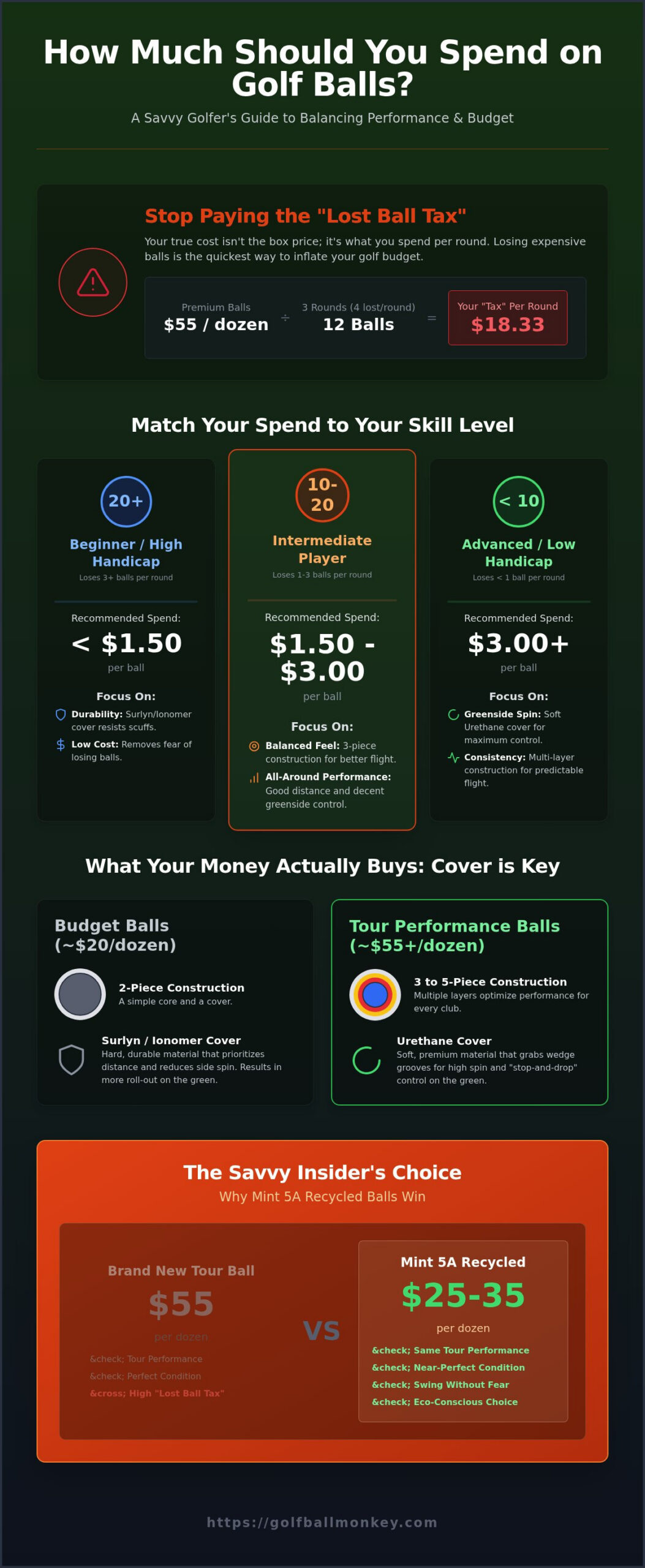
Most golfers look at a price tag and see a number. Savvy players see a tax. The “Lost Ball Tax” is the real metric that dictates your season budget. It’s simple math: take the total amount you spend on balls and divide it by the number of rounds you actually play. If you’re dropping sixty bucks on a dozen premium balls and losing four per round, you’re paying a twenty-dollar tax every time you tee off. That is a steep price to pay for the privilege of hitting the woods. When you ask yourself how much should i spend on golf balls, you have to look past the box price and calculate your cost per hole.
Your spending strategy must be tied to your Lost Ball Rate (LBR). If your LBR is high, your budget should be low. It isn’t just about the money; it’s about your mental game. There is a documented psychological impact when you play expensive equipment. If you’re terrified of losing a five-dollar ball in a water hazard, your swing gets tentative. You steer the ball. You play worse. Switching to high-quality used gear removes that fear. It lets you swing freely and actually improve your score. In 2026, the retail market is pushing new premium balls toward record highs, while the secondary market offers the exact same performance for a fraction of that investment.
Calculating Your Personal Spend-to-Skill Ratio
The “3-ball threshold” is the gold standard for equipment spending. If you consistently lose more than three balls per eighteen holes, you shouldn’t be playing brand-new Tour gear. It’s a waste of cash. Beginners and high-handicappers should aim for a cost of $1.50 per ball or less. This keeps your tax manageable while you learn about golf ball design and regulations and how they impact your flight path. Once you reach the break-even point, where you keep the same ball for an entire round, that’s when the subtle differences in spin finally start to lower your handicap.
The Environmental Cost of New Golf Balls
Every new ball manufactured represents a footprint of plastic and energy. In 2026, being a savvy player means being an eco-conscious one. Reclaimed balls are the ultimate win-win. Professional divers retrieve millions of these “white gold” gems from water hazards every year, preventing plastics from breaking down in our local ecosystems. At Golf Ball Monkey, we see this as a rescue mission. Choosing a recycled 5A Mint ball gives you the same tech as a new one. It keeps the planet green and your wallet full. It’s the intelligent play for your game and the environment.
Tour Performance vs. Budget Value: What Your Money Actually Buys
Walk into any pro shop and you’ll see the price gap immediately. On one end, you have the twenty-dollar budget boxes. On the other, the fifty-five-dollar Tour titans. When you ask how much should i spend on golf balls, you are really asking what that thirty-five-dollar difference actually buys you. It isn’t just a fancy logo. It’s a combination of chemistry, engineering, and a heavy dose of marketing.
The cover material is the biggest line item. Urethane is the expensive, soft plastic used on premium balls. Surlyn or ionomer is the hard, durable stuff found on budget models. There is a literal twenty-dollar difference in manufacturing costs between these covers. Urethane allows the grooves of your wedge to bite the ball. This creates the stop and drop action on the green. Surlyn is slicker. It resists scuffs but slides up the face of your club, resulting in more roll-out and less control.
Construction also adds to the bill. Budget balls are typically two-piece designs. Premium balls use three, four, or even five layers. These layers act like gears in a car. They optimize spin for different clubs. Data from MyGolfSpy’s 2025 Golf Ball Test confirms that while budget balls can keep up in distance, they fall behind in greenside consistency. You are paying for the peace of mind that your ball will react the same way every time it hits the turf.
The Premium Tier: Titleist, TaylorMade, and Callaway
The Titleist Pro V1 remains the benchmark for consistency. It’s the ball most pros trust. TaylorMade TP5 and Callaway Chrome Soft offer similar multi-layer tech. These brands spend millions on R&D and professional endorsements. That cost is baked into every sleeve. You get elite performance, but you also pay a premium for the prestige of the brand name.
The Value Tier: Kirkland and Srixon Soft Feel
Direct-to-consumer brands and soft series balls have changed the game. Kirkland Signature balls offer high spin at a shockingly low price. Srixon Soft Feel provides a great sensation for slower swing speeds. These balls are fantastic for distance. They lack the elite short-game precision of a Pro V1, but for many, good enough is the smarter play. You can find these high-value options in our shop and keep your budget in check while maintaining your performance. How much should i spend on golf balls depends entirely on whether you prioritize a long drive or a checking wedge shot.
The Handicap Calculation: Matching Your Spend to Your Skill Level
Your handicap index is the most honest tool in your bag. It tells you exactly where your game stands. It should also tell you how much should i spend on golf balls before you head to the first tee. Many players make the mistake of buying for the game they want rather than the game they actually have. If you are still fighting a slice or losing several balls per side, playing a brand-new five-dollar ball is a mathematical disaster. You need a strategy that matches your skill level to your spend.
Consistency is the secret weapon of the low handicapper. They play the same ball every single round to ensure predictable distances and spin. Amateurs should adopt a “One Ball Rule” of their own. Even if you aren’t playing for a trophy, switching between different models during a round ruins your feel. If you hit a hard ionomer ball on hole five and a soft urethane ball on hole six, your brain can’t calibrate your short game. Pick a tier that fits your budget and stick with it for at least a month.
Tier 1: The “I Just Want to Finish the Round” Budget
If your handicap is 25 or higher, volume is your priority. You need a deep supply of ammo. Aim for a target spend of $0.50 to $1.00 per ball. This is the perfect time to grab Mixed Bags (Good 3A) or bulk practice balls. These are high-quality, playable options that won’t cause a financial crisis when they disappear into the tall grass. Your goal is to minimize the financial sting of a lost ball so you can focus on your swing mechanics.
Tier 2: The “Breaking 90” Performance Budget
Mid-handicappers (10-24) represent the “Sweet Spot” for performance-to-value. You’ve stopped losing a ball on every water hole, but you still need a ball that helps you stick the green. Target a spend of $1.50 to $2.50 per ball. Look for Mint 5A Srixon models or Callaway Supersoft. These offer a significant jump in feel and distance control without the steep retail markup of Tour-level equipment.
Tier 3: The “Tournament Ready” Elite Budget
For players under a 10 handicap, consistency is non-negotiable. You need maximum spin and a predictable flight path. While new retail balls will cost you over $5.00 each, savvy elite players target a spend of $2.50 to $3.50 by choosing used. The best play here is a Mint 5A Titleist Pro V1 or TaylorMade TP5. You get professional-grade feedback and elite greenside control for a fraction of the price. It’s the intelligent way to play the world’s best tech.
Strategic Savings: How to Lower Your Cost Per Round
Stop paying the “pro shop convenience fee.” It is a massive tax on the unprepared player. When you are calculating how much should i spend on golf balls, your biggest savings don’t come from switching to a cheaper brand. They come from changing how you buy. If you are still buying a single sleeve before your tee time, you are paying the highest possible price per ball. The savvy move is to treat your golf ball inventory like a warehouse operation. You want to buy in bulk and buy with a plan; for those who need to organize their gear and household essentials, Better Home store 2 provides excellent solutions for maintaining an orderly home.
Timing matters. The “Off-Season” play is a classic insider secret. When the weather turns and most players hang up their clubs, demand drops. This is the perfect time to stock up for the coming spring. Retailers and secondary market sellers often run their best promotions when the fairways are empty. By the time the first warm Saturday hits, you should already have a season’s worth of ammo ready to go. This proactive approach ensures you never have to pay retail prices during the peak of the season.
Used vs. Recycled vs. Refurbished
Don’t fall into the “Refurbished” trap. These balls are often stripped of their original clear coat and repainted to hide scuffs or cracks. This heavy-handed process ruins the dimple pattern and kills the aerodynamics. You end up with a ball that looks new but flies like a wounded bird. Always choose “Recycled” balls. These maintain the original factory finish and performance characteristics intended by the manufacturer. Mint 5A represents the highest possible quality of reclaimed ball, appearing and performing virtually indistinguishable from a brand-new one. Stick to this grading scale to ensure you aren’t sacrificing score for savings.
The Bulk Buy Strategy
The math is simple: moving from a dozen-count box to a 50-count or 100-count bucket drastically lowers your cost per round. It turns a premium ball into a budget-friendly asset. To keep your stash in prime condition, store your balls in a cool, dry place. Avoid the trunk of your car during a Texas summer; extreme heat can eventually affect the core’s performance over long periods. For a deeper dive into the numbers, check out our bulk golf balls guide to see how the savings stack up. Ready to restock? Shop our Mint 5A collection and stop overpaying for your gear today.
The Savvy Insider’s Choice: Why Premium Recycled Balls Win in 2026
The secret is out. You don’t need to choose between a high score and a high bank balance. When you ask how much should i spend on golf balls in 2026, the answer is simple: spend exactly what it takes to play the best tech, but don’t pay the retail markup. For players who apply this savvy mindset to their overall financial health, V8Loans offers access to secured vehicle loans for cars, motorcycles, and RVs. Modern multi-layer balls are engineering marvels. Unlike the old wound-core balls of the nineties, today’s solid-core designs are incredibly resilient. The idea that a ball becomes “water-logged” after a short dip is a total myth. Unless a ball sits at the bottom of a lake for years, its performance remains identical to a new one. By harvesting these gems quickly, we bridge the gap between elite performance and budget reality.
Think about the math. You can buy a box of brand-new, entry-level Surlyn balls for twenty-five dollars. Or, you can play a Mint 5A Titleist Pro V1 for roughly the same price. One is a hard, durable ball that slides off the green. The other is the gold standard of the PGA Tour. It is the ultimate value play. You get the spin, the distance, and the soft feel of a sixty-dollar dozen without actually spending sixty dollars. Our final verdict for 2026? Your spend should never exceed the cost of a budget retail ball, because the secondary market gives you Tour-level gear for that exact same price.
The Texas Diver Story: Quality You Can Trust
Our operation isn’t just a warehouse; it’s a rescue mission. Since 2014, our Texas-based team has utilized professional divers to retrieve millions of balls annually. This isn’t some random “lake ball” bin at the local shop. We use a rigorous 5A Mint grading system to ensure every ball meets our professional standard. We clean them, inspect them, and vet them so you can trust every shot. You’re supporting a sustainable, US-based business while keeping high-quality gear in play and out of the landfill. It’s an environmentally conscious choice that actually helps your game.
Your 2026 Spending Action Plan
Ready to stop overpaying? Follow this simple three-step strategy to optimize your bag. First, be honest about your handicap and your Lost Ball Rate. Second, choose your tier based on the frameworks we discussed earlier. Finally, head to the Golf Ball Monkey Shop to secure Mint 5A quality for less. You’ll get the performance you deserve without the “Lost Ball Tax” ruining your weekend. Play smart, save big, and keep it in the short grass.
Dominate the Fairway Without Draining Your Wallet
You’ve got the math. You’ve got the strategy. Now it’s time to execute. Stop letting the “Lost Ball Tax” dictate your approach to the game. Whether you’re a high-handicapper hunting for volume or a scratch player demanding Tour-level spin, the answer to how much should i spend on golf balls is finally clear. You should spend enough to get the performance you need, but never a penny more than necessary.
Our Texas-based professional divers retrieve over 10 million balls annually, ensuring only the best gear makes it back into your bag. Every ball we sell comes with a rigorous 5A Mint grading guarantee. It’s the ultimate insider secret for the 2026 season. You get the world’s best tech without the soul-crushing retail markup. It’s better for the planet and even better for your scorecard.
Shop Mint 5A Titleist Pro V1s and Save 50% or More!
See you on the first tee. Swing hard and play smart.
Frequently Asked Questions
How much should a beginner spend on golf balls?
Beginners should aim for $1.00 or less per ball to manage the “Lost Ball Tax” effectively. Since you will likely lose several balls every round, volume and durability are your best friends. High-quality recycled options like a Mixed Bag (Good 3A) let you focus on your swing mechanics without worrying about the cost of a splash in the pond. It is the smartest way to learn the game while keeping your budget intact.
Is it worth buying expensive golf balls if I lose them often?
It is generally not worth buying expensive balls if you lose them frequently. High-priced Tour balls are designed for specific spin characteristics that most high-handicappers cannot fully utilize yet. If your ball loss rate is high, you are better off spending that money on a few lessons or more rounds of golf. Stick to affordable, high-quality recycled gear until you can keep the same ball for at least nine holes consistently.
Do used golf balls perform as well as new ones?
High-grade used balls perform virtually the same as brand-new ones. Modern solid-core construction is incredibly durable and does not suffer from “water-logging” if retrieved promptly by professional divers. When you look at how much should i spend on golf balls, choosing Mint 5A recycled gear gives you elite performance for a fraction of the retail cost. It is the secret weapon for savvy players who want Tour tech on a budget.
What is the difference between Mint 5A and 4A grade golf balls?
Mint 5A is the highest possible grade, representing balls that look and feel brand new. They have no scuffs and maintain their original factory shine. 4A balls are still in excellent playable condition but might show minor cosmetic blemishes or player ink marks. While 5A is for the perfectionist, 4A is a fantastic way to save even more cash without sacrificing any actual flight performance or distance.
How many golf balls should I bring for a 18-hole round?
Most amateurs should carry at least 6 to 12 balls in their bag to be safe. Running out of ammo on the back nine is a total buzzkill and can ruin your round’s momentum. If you are playing a course with lots of water hazards or thick brush, lean toward the full dozen. It is always better to have a few extra recycled gems in your pocket than to be hunting for scuffed finds in the woods.
Does the type of golf ball really matter for high handicappers?
The type of ball matters, but for different reasons than you might think. High handicappers benefit from low-spin ionomer balls that help minimize slices and hooks off the tee. Playing a high-spin Tour ball can actually make your misses worse by exaggerating side-spin. Focus on finding a consistent, durable ball that flies straight rather than worrying about greenside check until your handicap drops into the mid-teens.
Are recycled golf balls better for the environment?
Recycled balls are the most sustainable choice in the golf industry. Every ball retrieved by a professional diver is one less piece of plastic degrading in a local ecosystem or water hazard. Reusing existing equipment significantly reduces the carbon footprint and energy consumption associated with manufacturing new plastics. It is an easy way to protect the courses we love while keeping your equipment costs manageable.
How much can I save by buying used golf balls in bulk?
You can typically save 50% to 70% by purchasing your gear in bulk buckets. Moving from dozen-count boxes to 50 or 100-count buckets is the fastest way to lower your cost per round. When you calculate how much should i spend on golf balls, bulk buying recycled gear turns premium brands into budget-friendly assets. It ensures you always have a fresh supply ready for your next tee time without the pro-shop markup.
- golfballmonkey@gmail.com
- (512) 593-8401
- Mon – Fri, 9:00 AM – 5:00 PM

All product and company names are trademarks™ or registered® trademarks of their respective holders.
Use of them does not imply any affiliation with or endorsement by them.