
How Long Do Used Golf Balls Last? The Truth About Performance & Shelf Life
You just dropped $54 on a fresh box of premium balls only to watch your first drive slice directly into a lake. It’s a gut punch every golfer knows. You want the spin and speed of a tour-level ball, but you hate the retail tax that comes with every swing. We have all stood over a found ball wondering exactly how long do used golf balls last or if a few weeks in the water actually killed its pop.
The Monkey is here to settle the debate. We are breaking down the real science of ball longevity to show you why a Mint 5A ball performs within 1 percent of a brand new box. You will discover exactly how modern covers resist damage and get a clear framework for when to keep a ball in play or toss it in the shags. It is time to stop overpaying and start playing with confidence. Get ready to secure massive savings while keeping your performance at a five-star level.
Key Takeaways
- Forget the expiration myth; modern solid-core technology doesn’t spoil like milk, keeping your gear game-ready for years.
- Stop worrying about water hazards and learn the actual science behind moisture absorption and how it impacts your distance.
- Get the definitive answer on how long do used golf balls last and why “cured” cores often outperform dusty garage finds.
- Master a quick 5-point inspection routine to spot physical damage—the only real reason to retire a ball from your bag.
- Discover how to snag Tour-level performance at “Monkey prices” by leveraging a grading system that guarantees quality for a steal.
Do Golf Balls Expire? The Myth of the Expiration Date
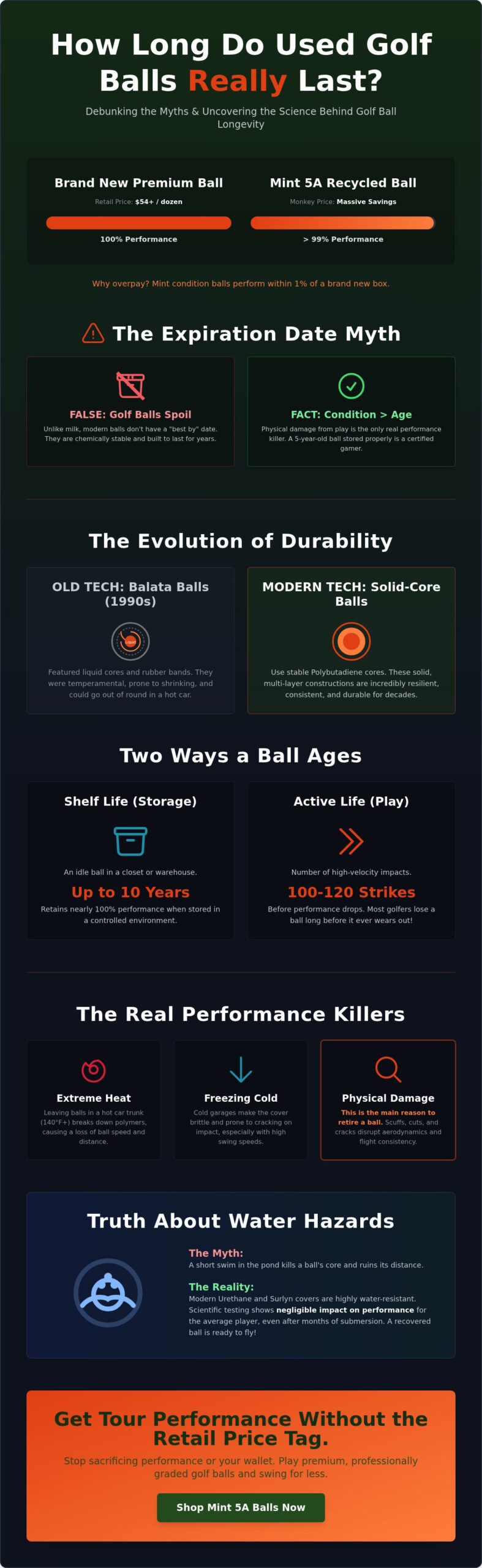
Stop worrying about the date on the box. Golf balls don’t spoil like a carton of milk or a bag of salad. If you find a sleeve of premium balls hidden in your garage from five years ago, they aren’t trash. Modern engineering ensures these things are built to survive 120-mph swings and extreme weather. When golfers ask how long do used golf balls last, they usually worry about losing distance or spin. The truth is that “age” is just a number. It’s the “condition” that actually dictates how that ball performs on the green.
Today’s equipment is chemically stable. Manufacturers design these layers to withstand incredible forces without breaking down. Unless you leave a ball at the bottom of a lake for a decade, it’s going to retain its pop. You’re looking for signs of physical trauma, not a “best by” date. For the savvy player, this means a three-year-old ball found in a dry locker is a total steal.
Balata vs. Solid Core: Why the Rules Changed
Back in the 1990s, the “expiration” myth had some truth. Old-school balata balls featured liquid-filled centers wrapped in high-tension rubber bands. These materials were temperamental. They could actually shrink or go out of round if left in a hot car trunk for a single summer. Today, that tech is ancient history. Modern balls use polybutadiene cores that stay stable for decades. Understanding Modern Golf Ball Construction helps you see why today’s gear is so resilient. Solid-core construction is the industry standard for durability and consistent flight.
Shelf Life vs. Active Life
Let’s break down the two ways a ball ages. Shelf life refers to a ball sitting idle in your bag, a closet, or a warehouse. Testing suggests these balls retain nearly 100% of their original performance for up to 10 years when kept in a controlled environment. That ball you found in a closet from 2020 is still a Monkey-approved gamer. It hasn’t lost its bounce. It hasn’t “gone soft.” It’s ready to fly.
Active life is the real metric to watch. This is the number of high-velocity strikes a ball can take before the cover or core fails. A premium multilayer ball can typically handle 100 to 120 heavy strikes before you notice a drop in performance. Most players lose the ball into a hazard long before it wears out. If you want to restock your bag with high-performance gear at a fraction of the cost, browse the full inventory of graded balls available now. Knowing how long do used golf balls last gives you the confidence to play recycled tech without sacrificing a single yard of distance.
The Science of Longevity: Why Modern Balls Outlast Your Garage Finds
Forget what your grandpa told you about balls going “dead” after a single season. Modern golf ball technology is built to last. The cores don’t simply rot or lose their bounce because the calendar turned. Most modern cores undergo a chemical curing process that actually makes them slightly firmer over several years. This means that a ball sitting in your closet for three seasons hasn’t lost its “pop.” It might actually be a fraction faster than the day it left the factory. The idea that a ball expires like a gallon of milk is a total myth. Unless you are still playing with wound-core balata balls from 1992, time is usually on your side. This is a huge reason why how long do used golf balls last is a question of storage quality rather than a ticking clock.
Compression and Temperature: The Real Performance Killers
Heat is the ultimate villain in the story of ball performance. If you leave your bag in a car trunk where temperatures hit 140 degrees, you are cooking the core. Extreme heat can break down the polymer bonds in the rubber. This leads to a measurable loss of ball speed and a drop in distance. Freezing garages aren’t much better. Cold temperatures can make the cover brittle and prone to cracking on impact. Room temperature is king for storage. High-end options like Titleist Pro V1 balls are engineered for incredible stability across different climates, but they still prefer a climate-controlled room over a sweltering shed. Even if they’ve taken an accidental swim, The Truth About Water Hazards proves that modern tech holds up better than expected. Scientific testing shows that submersion for up to 365 days has a negligible impact on distance for the average player. The Monkey doesn’t let a little water ruin a perfectly good Sunday.
Urethane vs. Surlyn: Which Lasts Longer?
Your choice of cover material dictates how your ball handles the wear and tear of a round. You generally have two paths: the soft feel of Urethane or the rugged durability of Surlyn. Urethane covers are found on premium tour balls. They scuff more easily when they meet a cart path or a fresh wedge groove. However, their internal structure is remarkably resilient. Surlyn is the undisputed distance king. It is a hard, plastic-like material designed to resist scratches, cuts, and stains. A Surlyn ball can look brand new after 54 holes of play. While Urethane might show some surface battle scars, it doesn’t mean the ball is “broken” or useless. For a deep dive into the technical specs of these materials, check out the Golf Balls 101 guide. Understanding these materials helps you determine how long do used golf balls last based on how many trees you tend to hit. If you want to test these theories yourself without the retail sting, you can grab a fresh batch of mint-grade balls and see the performance for yourself.
The Truth About Water Hazards: Does Submersion Actually Kill Distance?
Every golfer knows that sinking feeling when a brand-new, five-dollar ball splashes into the center of a lake. The immediate thought is usually that the ball is gone, or worse, that it’s “water-logged” and useless. This is the biggest myth in the game today. Many players believe that a quick dip ruins the core and kills carry distance. That’s just wrong. When you’re wondering how long do used golf balls last, don’t let a little pond water scare you off a great deal.
Modern golf balls are feats of engineering. They aren’t the porous, wound-construction relics of the 1970s. Today’s premium balls use solid-core technology and multi-layer covers designed to withstand massive impact forces. These same materials are incredibly resistant to moisture. A ball that spends a few days or even a few weeks in a water hazard suffers zero measurable performance loss. The Monkey knows the secrets of the pond, and the secret is that these balls are still absolute rockets.
The 24-Hour Myth vs. Reality
The idea that a ball becomes a “dud” after 24 hours underwater is pure fiction. A scientific assessment of golf ball performance after water submersion reveals that even after a full year in a pond, the distance loss is minimal, often less than 1 percent. For a ball that’s only been submerged for a few days, the change in ball speed and spin is non-existent. Modern urethane covers act as a waterproof suit for the high-energy core inside. The seals are nearly airtight, preventing the core from “drinking” water and losing its snap. You can’t tell the difference between a “fresh” ball and a rescued one in a blind launch monitor test. We’ve seen the data, and the data says play on.
Professional Recovery: How We Save Your Game
Golf Ball Monkey doesn’t just find balls; we rescue them. Our professional divers use specialized equipment to retrieve these treasures before they sit long enough to face any real degradation. We follow a strict, multi-step process to ensure your gear is in peak condition. We don’t use harsh chemicals that eat away at the cover. Instead, we use a gentle cleaning and drying cycle that preserves the factory finish. Every single ball passes through our rigorous five-star quality checks.
- Rapid Retrieval: Our divers hit the ponds frequently to ensure inventory is “freshly picked.”
- Precision Cleaning: We remove algae and minerals without damaging the dimple pattern.
- Quality Grading: If a ball shows signs of long-term water wear, like bubbling or discoloration, it never makes the cut for our top tiers.
You get the same performance as a retail ball for a fraction of the cost. It’s the smartest play in golf. Why pay full price when the Monkey has done the hard work for you? Stop overpaying for your mistakes and start playing premium gear for less. Shop our freshly picked premium inventory now and grab a massive bargain. Knowing how long do used golf balls last gives you the edge to play better without the stress of a lost ball.
Inspection Checklist: When to Retire a Ball and When to Keep Swinging
Stop tossing money into the woods just because a ball looks a little lived-in. Modern ball tech is incredibly resilient. Knowing how long do used golf balls last comes down to a quick physical check, not a calendar date. Use this 5-point routine on the tee box to decide if that ball stays in the bag or goes to the shag bucket.
- The Thumb Test: Run your thumb over the surface. If you feel a jagged, raised edge, it’s done.
- The Dimple Depth Check: Look for “bald” spots. Flat areas mean less lift and shorter drives.
- The Color Grade: Slight yellowing is just cosmetic. Deep brown stains or “bruises” suggest water damage.
- The Click Test: Tap two balls together. A dull, hollow “thud” instead of a crisp “click” can signal a cracked core.
- The Flight Path: If your ball develops a “wobble” or “flutter” in mid-air on a calm day, the internal balance is shot.
The Scuff Test: How Much Is Too Much?
A minor scratch from a wedge or a light brush with a cart path won’t kill your game. It’s a badge of honor. However, a “shredded” cover is a different story. When the urethane or ionomer is physically torn, it ruins your spin consistency on the green. You won’t get that predictable “drop and stop” action. The Titleist Pro V1 features a famously tough cover designed to survive high-spin shots, but even a premium ball needs to be retired if you can feel a sharp edge on the dimples. If it feels like sandpaper, swap it out.
Aerodynamics and Dimple Integrity
Dimples aren’t just for decoration. They create the lift that keeps your ball airborne. Deep gashes or caked-on mud disrupt the airflow, creating massive drag. This leads to a loss of distance and wilder curves. Keep your balls clean with a wet towel to extend their active life on the course. Dirt is the enemy of a pure flight. If the dimples are significantly smoothed down from heavy use, you’re looking at a 5 to 10 percent loss in total yardage. Don’t let a worn-out cover rob you of your best drive. If the ball looks “smooth,” it’s time for a fresh one.
Ready to restock your bag with high-performance gear at a fraction of the retail price? Check out our latest deals and grab a bag of mint-condition balls today.
Get Tour Performance Without the Retail Expiry Date
Stop burning cash on “new” gear. Most golfers don’t need a ball that was boxed yesterday. They need a ball that performs today. Used balls are the smartest play in your bag. They deliver 100% of the tech for a fraction of the retail cost. You get the same urethane covers. You get the same high-speed cores. You just skip the “new ball” tax that the big brands love to charge. People often ask how long do used golf balls last before they lose their kick. The truth is, modern manufacturing is incredibly durable. These balls are built to survive 100+ mph swings. They aren’t going to quit on you after a few holes.
For 99% of us, used balls are the logical choice. We lose them long before the performance degrades. Why pay $5 for a ball that might end up in a lake on the third hole? It doesn’t make sense. The smart play is to buy quality, play hard, and keep the extra change for the 19th hole. We’ve vetted the inventory. We’ve done the math. You get the performance without the retail sting.
Decoding Mint 5A: The Highest Standard in Used Golf
Our Mint 5A balls are the elite choice for serious players. They are virtually indistinguishable from what you find at the big-box stores. No scuffs. No player marks. No discoloration. Just pure, clean performance. This grade represents the highest remaining lifespan in the used market. You are getting a ball that likely saw one or two holes before it was recovered. It is basically a brand-new ball with a better price tag.
- Pristine Condition: No visible wear or tear on the cover.
- Maximum Longevity: These balls have the most life left of any used inventory.
- Tour Quality: Expect the exact spin and distance of a new ball.
If you are heading to the range or just want to grind out some practice, try a Mixed Bag. It is the best way to keep your wallet fat while you work on that draw. You still get great brands, but at a price point that lets you swing freely.
The Monkey Price Advantage
Let’s talk numbers. A retail Pro V1 often costs over $5 per ball. That is a steep price for something that might disappear into the woods. Our “Monkey Price” changes the game entirely. You can stock up on premium brands without the financial headache. We believe in high energy and low costs. Explore our TaylorMade inventory or see what is hot in the Callaway lineup to see the massive savings for yourself.
Stop overpaying for “freshness” that doesn’t add a single yard to your drive. The Monkey has personally vetted this quality. We don’t do fluff. We do great golf balls at prices that make sense. Grab a bag, hit the links, and stop worrying about how long do used golf balls last. With our 5A grading, they’ll last as long as you can keep them on the fairway. That’s a Monkey-approved guarantee!
Stop Overpaying and Start Swinging Smarter
Modern golf ball technology is engineered to endure. Research confirms that multi-layer urethane balls retain their core compression for 5 years or more in standard conditions. You don’t have to stress about the water hazard either. Professional divers recover roughly 100 million balls annually. Most of these balls show zero performance loss after cleaning and testing. Once you know the truth about how long do used golf balls last, paying full retail price feels like hitting into the woods on purpose. It’s about the grade, not the age.
The Monkey makes it easy to play the best for less. We utilize a strict 5A Mint grading scale to ensure every ball meets professional standards. Our team ships fast from our Texas-based warehouse to get you back on the fairway quickly. We’ve vetted millions of balls to find the ones that still have that 100 percent tour-level pop. Don’t let high prices keep you off the course. Grab a deal, trust the science, and let it rip.
Score Tour-Level Performance at Monkey Prices. Shop Now!
Frequently Asked Questions
Do golf balls actually go bad after a few years in storage?
Modern solid-core balls stay fresh for 5 to 7 years when kept at room temperature. If you find a stash in your garage from 2018, they’ll still fly true. Performance only dips when the core loses its elasticity from extreme cold or heat. This is a big part of how long do used golf balls last when they’re kept in a climate-controlled environment.
How many rounds can you play with a single used golf ball?
You can expect 7 to 9 full rounds of play from a single high-quality used ball. The cover usually gives out before the core does. Once you see 2 or 3 deep scuffs from a wedge or a cart path, the aerodynamics change. Swap it out to keep your flight path consistent. It’s the best way to maintain 100 percent control over your spin rates.
Does water submersion really ruin a golf ball’s distance?
Submersion ruins distance if the ball sits in a pond for more than 24 hours. Research shows that balls submerged for 7 days lose 6 yards of carry. The Monkey ensures our recycled stock hasn’t been sitting at the bottom of a lake for a full season. You get the distance you expect without the retail price tag. It’s a steal for your game.
Can you tell the difference between a new Pro V1 and a Mint 5A used one?
You won’t notice a difference. Robot swing tests confirm that 5A Mint recycled balls perform within 0.5 percent of brand-new retail balls. You get the same 328 dimple pattern and high-speed core for a fraction of the cost. It’s the ultimate insider secret for golfers who want Tour-level performance without paying the premium brand tax at the pro shop.
What happens to a golf ball if it gets too hot in a car trunk?
Excessive heat above 120 degrees Fahrenheit will kill your ball’s compression. A trunk in July reaches these temps in under 30 minutes. This heat breaks down the chemical bonds in the core, leading to a 10 percent loss in ball speed. Keep your gear in the house to ensure your balls stay snappy and fast for your next round.
Is it worth buying “refurbished” golf balls vs “recycled” ones?
Recycled balls are the clear winner over refurbished ones. Refurbished balls are stripped and repainted, which masks defects and alters the dimple shape by 0.002 inches. Recycled balls are just cleaned and graded by the Monkey. This preserves the original manufacturer specs so you know exactly how the ball will react on the green. Stick with recycled to keep your game honest.
How do I know if the core of my golf ball is damaged?
A damaged core shows up as a dead feel or a 20 yard loss on your drives. You can test this by dropping the ball on a concrete floor next to a new one. If the bounce height is 15 percent lower, the core is shot. It’s a quick way to gauge how long do used golf balls last before they become practice-range fodder.
Are yellow golf balls more durable than white ones?
Durability is the same for both colors. Manufacturers use the same urethane or ionomer blends for both white and yellow options. Yellow balls stay looking mint longer because the pigment hides the natural yellowing caused by 50 or 60 hours of UV exposure. They’re a smart choice for players who lose sight of white balls against the clouds or in the rough.
- golfballmonkey@gmail.com
- (512) 593-8401
- Mon – Fri, 9:00 AM – 5:00 PM

All product and company names are trademarks™ or registered® trademarks of their respective holders.
Use of them does not imply any affiliation with or endorsement by them.