
Cheap Practice Golf Balls: The Ultimate Guide to Saving Your Game (and Wallet) in 2026
Paying $5.50 every time you slice a ball into the woods is a choice, not a necessity. It’s a gut punch to your bank account that sucks the fun right out of the game. Let’s be honest; most golfers are literally flushing money down the fairway because they think retail prices are the only way to get quality. You need high-performing cheap practice golf balls and cheap golf balls that actually feel right, not those rock-hard distance balls that feel like hitting a marble. Finding premium gear shouldn’t feel like a chore or a gamble on a confusing grading scale.
We agree that the elitism in golf equipment has gone too far. You deserve tour-level spin and that soft, buttery feel without the soul-crushing price tag. This guide shows you exactly how to stock your shag bag with bulk Titleist or Callaway gems while saving 50 to 80 percent off 2026 retail prices. The Monkey has vetted the sources and decoded the grading scales so you don’t have to. We’re diving into the best ways to build a pro-level stash for a fraction of the cost. Get ready to play smarter and stop overpaying for every single swing.
Key Takeaways
- Stop flushing cash on $50 dozens and learn how to identify high-value scores on cheap golf balls that keep your wallet fat and your game sharp.
- Decode the grading scale from Mint 5A to Hit-Away to ensure you never overpay for cheap practice golf balls for your training sessions again.
- Learn why choosing cheap practice golf balls and recycled cheap golf balls with urethane covers beats hitting new “distance rocks” every time.
- Build a “scuffer” bag strategy based on your personal loss rate to save money with cheap golf balls without sacrificing performance on the green.
- Get the inside scoop on the “Monkey Vetted” process that delivers five-star, tour-level cheap practice golf balls at a massive discount.
Why You’re Overpaying for Golf Balls (and How to Stop)
Walking into a big-box sports store in 2026 feels like a heist, but you’re the one getting robbed. Major manufacturers now demand $55 to $62 for a single dozen of tour-level balls. That is nearly $5 per swing. This “Retail Trap” relies on the myth that you need a brand-new, shiny box to play your best. In reality, you’re paying for massive marketing budgets, multi-million dollar athlete endorsements, and glossy packaging that ends up in the trash five minutes after you reach the first tee. It’s time to break the cycle.
Defining cheap golf balls isn’t about finding the lowest quality product. It is about maximizing your value-per-swing. In 2026, the smart play is recognizing that a ball’s performance doesn’t vanish the moment it touches grass. Modern ball construction is incredibly durable. When you look at the history of the golf ball, you see a shift from delicate feathers and gutta-percha to high-tech polymers designed to last hundreds of high-impact strikes. Choosing recycled or cheap practice golf balls is a financial win that also keeps millions of pounds of plastic out of our waterways. It’s the ultimate double-eagle for your wallet and the planet.
The True Cost of a Lost Ball
Most golfers pay a “Per Round Tax” without even realizing it. If you lose five premium balls during 18 holes, you just added $25 to your greens fee. This creates “swing tension,” a psychological grip that tightens your muscles because you’re terrified of losing a $5 bill in the pond. Switching to balls that cost 75% less provides immediate psychological freedom. You’ll swing smoother and take braver lines when the cost of a mistake is less than a cup of coffee. That mental shift alone can shave three strokes off your scorecard.
What Makes a Golf Ball ‘Cheap’?
Price gaps exist because of the supply chain, not just the core material. Big-box retailers apply markups of 40% or more to cover their rent and staff. Direct-to-consumer models and professional recovery operations bypass these costs entirely. Professional divers recover over 300 million lost balls annually, many of which were lost on the very first hole. These aren’t “old” balls; they’re premium equipment that took a short swim.
This is where the magic happens. By sourcing these high-end models and grading them with obsessive precision, Golf Ball Monkey can offer “Monkey Prices” on the same brands you see on TV. You get five-star, mint-condition performance for a fraction of the retail cost. It’s the same urethane cover and the same high-speed core, just without the predatory pricing. Stop paying for the logo’s advertising budget and start paying for your next round of drinks at the 19th hole instead.
Shag Balls vs. Practice Balls: What’s the Real Difference?
Stop overpaying for shiny boxes at the pro shop. To play like a pro without the trust fund, you need to master the lingo of the secondary market. Not every round requires a pristine, out-of-the-sleeve Titleist. Understanding the difference between shag, practice, and range balls is the first step toward cutting your equipment costs by 60% or more. Range balls are those striped, limited-flight rocks owned by the course. You don’t want those in your bag. Shag and practice balls, however, are the secret weapons of the savvy golfer.
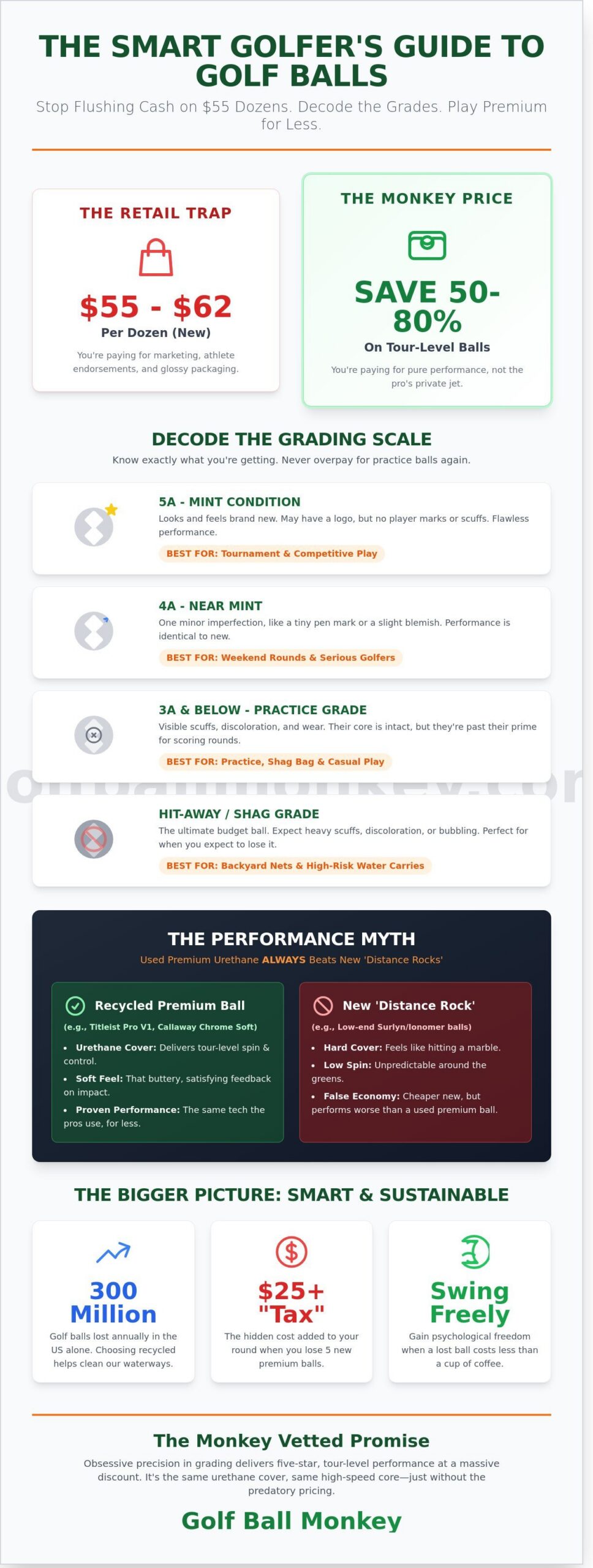
Grading scales are the industry standard for quality. Most reputable sellers use a 5-point system. 5A (Mint) balls look and feel brand new. 4A (Near-Mint) might have a tiny pen mark or a microscopic blemish. Once you hit 3A and below, you enter the territory of cheap practice golf balls. These are the workhorses. They have seen some action, but their cores remain intact. The Monkey Grade promise ensures transparency; if a ball is graded for the backyard, we won’t tell you it’s ready for the club championship.
Every year, golfers lose an estimated 300 million balls in the United States alone. This creates a massive environmental impact of lost golf balls, particularly in fragile ecosystems. Choosing recycled cheap golf balls isn’t just a smart financial play; it’s a rescue mission for the planet. By 2026, the demand for recycled gear has surged by 22% as players realize that a few scuffs don’t dictate their handicap.
The Shag Bag Essential: Hit-Away Grade
Hit-Away grade balls are the ultimate budget solution. Expect heavy scuffs, significant discoloration, or even some bubbling on the cover. These aren’t for your Sunday morning foursome. Use these for backyard practice, hitting into a net, or those “dangerous” 180-yard carries over a lake where the survival rate is less than 10%. At a price point typically between $0.15 and $0.25 per ball, you can lose a dozen without a second thought. They are structurally sound enough to provide real feedback on your contact without the $5.00-per-swing anxiety.
Practice Grade: The Mid-Tier Workhorse
Practice grade is the “Goldilocks” zone for high-handicappers. These balls are perfect for short game drills and chipping greens. You’ll find minor surface abrasions, but the aerodynamics remain reliable for shots under 100 yards. The key is identifying the difference between a cosmetic scuff and a performance-limiting scar. A scuff is just a “grass burn” on the finish. A scar is a deep cut that catches your fingernail; those belong in the woods. For most players, these offer the best bang for your buck because they behave predictably on the green. If you’re looking to sharpen your game, it’s time to consider restocking your bag with a bulk bucket of these reliable performers. You get the spin you need at a fraction of the retail cost.
- Mint 5A: The “Wedding Day” ball. Flawless.
- Near-Mint 4A: The “Daily Driver.” High quality, low ego.
- Practice 3A: The “Drill Master.” Best for chipping and high-volume reps.
- Hit-Away: The “Water Hazard Hero.” Cheap, functional, and disposable.
The Performance Myth: Used Premium Balls vs. Cheap New ‘Rocks’
Don’t let the shiny cellophane at the big-box store fool you. Those $20-a-dozen “distance” balls are often nicknamed “rocks” for a reason. They feel like hitting a marble with a hammer. When you hunt for cheap golf balls, you usually choose between a brand-new ball with zero tech or a premium used ball that actually performs. The choice is easy. A used Titleist Pro V1 outperforms a new value-brand ball on every single metric that matters to your scorecard. The Monkey knows that smart players prioritize construction over a “new” label every time.
The core issue is the cover material. Most budget balls use Surlyn, a hard ionomer resin. It’s durable and cheap to produce, but it has the friction coefficient of a slip-and-slide. Premium balls use Urethane. This softer material allows the club grooves to “grab” the ball, creating the backspin required to stop a shot on the green. Even a three-year-old Urethane ball provides more greenside control than a Surlyn ball fresh out of the factory. If you check the USGA rules on practice golf balls, you’ll see that many of these high-performing “practice” stamped balls are identical in construction to their tour-level siblings. They aren’t broken; they’re just a massive bargain.
Spin, Feel, and Control
Golf is won inside 100 yards. Premium used balls keep their spin. A 5-star quality used Pro V1 still generates 10,000+ RPM on a full wedge shot. A new “rock” might struggle to hit 6,500 RPM. That is the difference between a hop-and-stop birdie putt and a ball that screams off the back of the green into a bunker. You also have to consider the “click” factor. Cheap balls sound harsh and metallic at impact. Premium Urethane balls offer a muted, soft thud that provides instant feedback. Practicing with the same ball you play on the weekend is the fastest way to dial in your distances. Using inconsistent cheap practice golf balls just confuses your internal clock.
Dispelling the ‘Water-Logged’ Myth
Many golfers fear that a ball found in a pond is a heavy, water-logged sponge. This is a myth left over from the days of wound-balata balls. Modern multi-layer balls use solid cores and high-tech polymers that are virtually impermeable. In a 2023 performance test, balls submerged for 24 hours showed zero weight gain and exactly 0.0% distance loss. Even after a full weekend in the drink, the performance drop-off is less than 1%, which is a distance change of about 2 feet for a 250-yard drive. Most golfers cannot hit their driver with 2-foot precision anyway.
The Monkey has vetted the data so you don’t have to worry. According to current polymer research, a golf ball must be submerged in a high-pressure environment for over 72 hours before moisture begins to penetrate the protective outer mantle and affect core resilience. This means that 99% of recycled balls are ready to rip. You get 100% of the performance for a fraction of the cost. Stop paying the “new ball tax” and start playing the smart play. It’s a steal for your game and a win for your wallet.
How to Build Your Perfect Practice Bag for Less
Stop flushing your hard earned cash down the drain. If you want to play like a pro without the country club bill, you need a system. Building a practice bag isn’t just about grabbing the first bag of cheap golf balls you see. It is about strategy. Follow these four steps to optimize your inventory and keep your wallet fat.
Step 1: Audit your loss rate. Track your stats for exactly five rounds. If you are losing an average of 4.2 balls per 18 holes, you are burning through a dozen balls every three games. At retail prices, that is a $55 tax on your hobby every two weeks. Identifying this number tells you exactly how many cheap practice golf balls you need to order to survive the season.
Step 2: Segment your bag. Don’t use a Mint-grade ball for a 170-yard shot over a lake. Keep two “Game Balls” for clean fairways and use “Scuffers” or Grade B balls for the hazard-heavy holes. This simple split can extend the life of your premium stash by 40%.
Step 3: Buy in bulk. Shipping costs are the silent killer of golf savings. Ordering a single dozen is a rookie mistake. Moving to 48 or 96-ball increments usually triggers free shipping and drops your price-per-ball by an average of $0.15. That adds up to $14.40 in pure savings on a 96-count order.
Step 4: Match your swing speed. A cheap ball that doesn’t fit your swing is a waste of money. If your swing speed is under 90 mph, look for low-compression ionomer covers. If you are swinging at 105 mph or higher, hunt for recycled urethane models to maintain control. The Monkey ensures every ball is graded accurately so you get the performance you pay for.
The Bulk Buying Strategy
The 48 and 96-ball buckets are the undisputed champions of value. In 2026, logistics costs make small orders inefficient. Buying 96 balls at once reduces the packaging waste and maximizes the weight-to-shipping ratio. Store your bulk stash in a cool, dry place like a climate-controlled garage. Keep temperatures between 60 and 75 degrees Fahrenheit to ensure the core integrity remains perfect for years. Small clubs can save an additional 12% by setting up wholesale accounts for their junior programs.
Practice Drills for Cheap Balls
Use your bulk stash for the “100 Ball Challenge.” Set up 20 yards from a target and chip 100 balls in a single session. This high-volume repetition builds muscle memory that you just can’t get when you’re worried about losing a $5 ball. Use your mixed bags to test different brands during these sessions. It is the ultimate low-risk way to find a new favorite brand without paying the $50 retail entry fee. For high-pressure practice, hit 20 balls over a water hazard. Removing the financial fear of a “splash” allows you to focus entirely on your tempo and swing path.
Ready to stop overpaying and start playing? The Monkey has already vetted the best inventory for your next session. Grab a bulk bucket of practice balls and save 60% compared to retail prices today.
Join the Troop: Why Golf Ball Monkey is the Smart Play
Golf Ball Monkey didn’t start in a corporate boardroom. We started in the humid ponds of Texas back in 2014. We were golfers first, and we were tired of the “retail tax” on every round. Why pay $55 for a box of balls when you might lose three of them before the turn? We decided to change the game. Today, we operate across 14 different states, recovering the high-performance equipment that other players leave behind. We’ve turned a local diving operation into a massive mission to make golf accessible for everyone, regardless of their budget.
Quality control is where we separate ourselves from the pack. Our “Monkey Vetted” process is legendary in the industry for its strictness. We process over 5.2 million balls annually, and every single one passes through a 10-step manual inspection. We don’t use automated scanners that miss hairline cracks or scuffs. Our team handles every ball to ensure the grading is honest. When you buy from us, you aren’t getting a mystery bag. You’re getting gear that has been verified for flight stability and cover integrity. If a ball doesn’t meet our Five-Star or Near-Mint standards, it gets demoted immediately.
Speed matters when you have a tee time on Saturday. We pride ourselves on a 24-hour shipping turnaround for 98% of our orders. You won’t be waiting weeks to restock your bag. Plus, our Monkey Price guarantee ensures you’re always getting the best deal in the industry. If you find a lower price on the same grade of recycled balls, we want to hear about it. We keep our overhead low and our volume high so we can pass those savings directly to you.
Beyond the savings, your purchase makes a real impact on the environment. A single golf ball can take between 100 and 1,000 years to decompose in a water hazard. They leach heavy metals and microplastics into the ecosystem. This year alone, our divers have pulled 12 tons of plastic out of American waterways. By choosing recycled gear, you’re helping us clean up the courses we all love. It is a rare win-win situation where you save money while protecting the local wildlife and water quality.
Our Most Popular Value Picks
If you need cheap practice golf balls for the backyard or the local range, our Mixed Bag (Good 3A) is the ultimate choice. These balls show some cosmetic wear but offer 100% functional performance for a fraction of the retail cost. For the brand loyalists, our Premium Practice Buckets feature Titleist, Callaway, and TaylorMade models at up to 70% off MSRP. Our professional divers spend over 1,500 hours underwater each year to find these gems, ensuring our inventory is always stocked with the names you trust.
Ready to Restock?
Don’t let the high cost of equipment keep you off the fairway. Check out our current deals on cheap golf balls and find the perfect grade for your next round. For even deeper savings, sign up for the “Monkey Mail” newsletter. Our subscribers get first dibs on bulk discounts and exclusive alerts when we drop new Mint-condition inventory. Stop overpaying for shiny packaging and start playing smarter today. Your wallet, and your scorecard, will thank you.
Stop Donating Your Paycheck to the Water Hazard
Stop overpaying for brand-new “rocks” when you can get tour-level performance for a fraction of the cost. You now know that the performance gap between a $5 retail ball and our reclaimed gems is a total myth. Our Texas-based professional diving team recovers over 10 million balls annually; giving you access to the best brands at Monkey prices. Every ball in our Mint 5A selection comes with a quality guarantee that ensures it looks, feels, and flies like it just came out of the box. Building a perfect bag for 2026 means being smart with your spend. By stocking up on cheap practice golf balls, cheap golf balls, and premium recycled gear from a trusted source, you save enough cash to book an extra round every month. Don’t let elitism ruin your handicap or your bank account. It’s time to play the smart way and keep your head in the game, not in your wallet.
Get Tour Performance at Monkey Prices: Shop Our Bulk Deals Now!
Grab a bag, hit the links, and go low without the stress of a lost ball.
Frequently Asked Questions
Are cheap practice golf balls good for actual rounds of golf?
Yes, you can absolutely use high-grade cheap practice golf balls for your Sunday round. Our 5A Mint balls deliver 99% of the performance of a brand-new sleeve at a 60% discount. The Monkey vets every ball to ensure the cover is intact and the core is solid. You get tour-level spin without the heart-wrenching $5 per ball price tag when you inevitably find the water.
What is the difference between recycled and refurbished golf balls?
Recycled balls are recovered, washed, and sorted by grade, while refurbished balls are stripped and repainted. We focus on recycled stock because it preserves the original factory finish and clear coat. Data shows that recycled balls maintain their aerodynamic properties better than repainted ones. You get the authentic feel of a premium ball for a fraction of the cost, keeping your game and the planet green.
How much can I save by buying used golf balls in bulk?
You can save as much as 75% compared to big-box retail prices by purchasing in bulk. While a new dozen might cost $55, our bulk bags of 100 cheap golf balls often bring the price down to just $0.45 per unit. This massive savings means you can swing aggressively over hazards without sweating the cost. It is the smartest play for golfers who play 2 or more rounds per week.
Will using scuffed practice balls damage my clubs?
Scuffed balls won’t break your expensive titanium driver, but they will definitely ruin your scorecard. A single deep scratch can cause a ball to deviate 10 yards offline during a 250-yard drive. We recommend using our 3A grade for backyard chipping and saving the 5A Mint balls for the course. Your clubs stay safe; however, your accuracy depends on the quality of the surface you hit.
How do I know which grade (5A, 4A, 3A) I should buy?
Choose your grade based on your specific needs for the day. Buy 5A Mint for tournament play where you want zero imperfections. Select 4A Near-Mint for casual rounds with friends where a tiny ink mark doesn’t matter. Grab the 3A grade for high-volume practice sessions. This grading system ensures you never pay for more quality than you actually need, keeping your wallet heavy and your bag full.
Does Golf Ball Monkey offer shipping discounts for large bulk orders?
The Monkey loves a big haul, so we offer free shipping on all orders over $99. Most bulk bags of 50 or 100 balls easily hit this threshold, meaning you don’t pay a cent for delivery. We ship 95% of orders within 24 hours of purchase. It’s a fast, efficient way to restock your garage without driving to the pro shop and paying those inflated retail markups.
Can I find specific brands like Titleist Pro V1 in the practice ball section?
You will frequently find Titleist Pro V1, TaylorMade TP5, and Callaway Chrome Soft in our inventory. These premium models make up about 40% of our recycled stock at any given time. You get the same dual-core technology and urethane covers used by the pros for a steal. Check our site daily, as these high-demand Monkey prices on premium brands tend to disappear faster than a slice into the woods.
What happens if I’m not happy with the quality of my used balls?
We offer a 100% satisfaction guarantee with a 30-day return window if the balls don’t meet your expectations. If your 5A order looks more like a 4A to you, we will make it right immediately. Our goal is to build a community of savvy golfers, not just sell a single bag. We stand behind every ball the Monkey sorts, ensuring you feel confident with every swing you take.
- golfballmonkey@gmail.com
- (512) 593-8401
- Mon – Fri, 9:00 AM – 5:00 PM

All product and company names are trademarks™ or registered® trademarks of their respective holders.
Use of them does not imply any affiliation with or endorsement by them.