
Are Used Pro V1s Worth It? Cheap Golf Balls That Feel Like Tour Gear (2026)
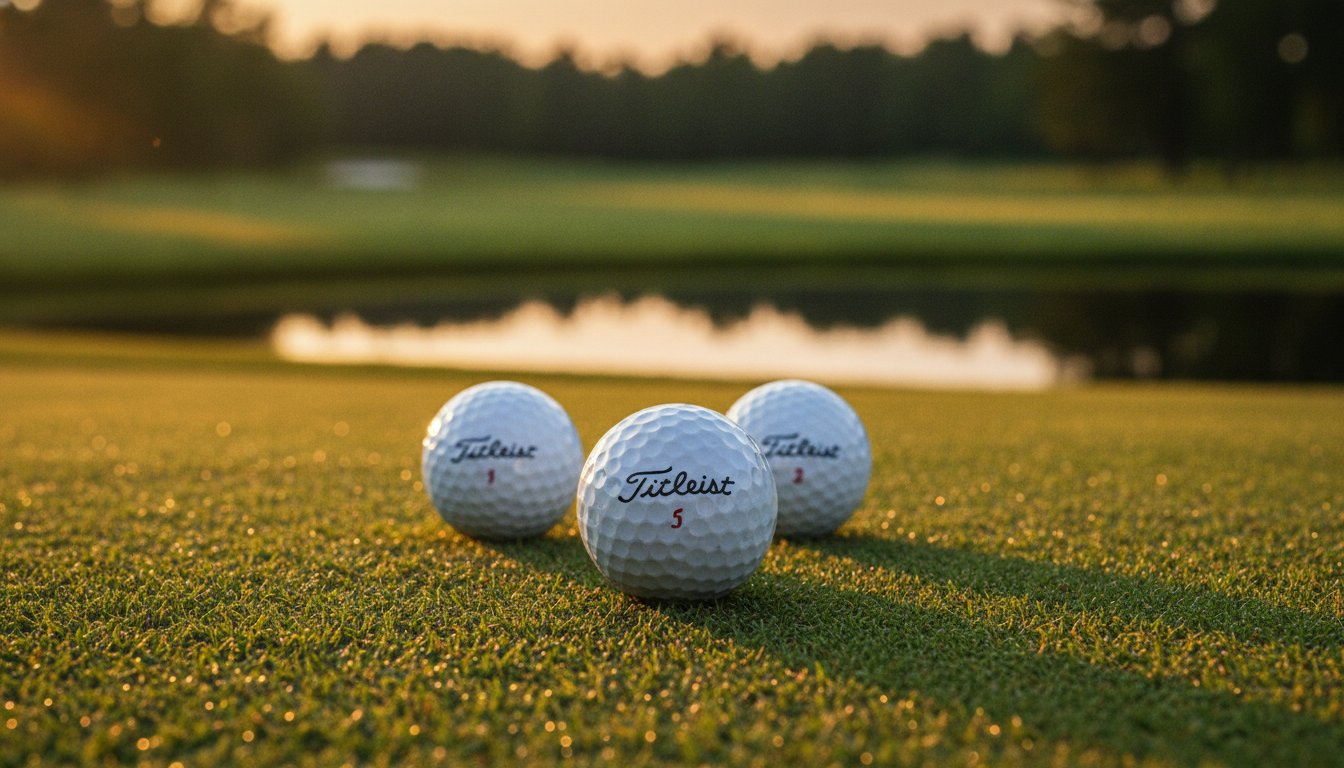
Why are you still paying nearly $60 a dozen just to watch your money splash into a water hazard? Retail prices for premium gear have officially hit the roof; this leaves most golfers choosing between draining their bank accounts or hitting balls that feel like literal rocks. It is a mental hazard that kills your swing before you even tee off. You want the spin, the soft urethane cover, and the greenside control, but you do not want the “brand new” tax. This leads to the ultimate question for the savvy player: are used pro v1s worth it or are you just buying someone else’s leftovers?
We get it. You have been told that once a ball hits the water or a fairway, it loses its magic. That is a myth designed to keep you buying shiny new boxes. This guide proves you can snag that legendary tour feel for about half the retail price. We are breaking down the performance data of Mint 5A recycled balls, comparing 2026 retail costs to secondary market steals, and showing you exactly how to maintain a consistent feel without overpaying for a logo. Get ready to play the best ball in golf for under $35 a dozen.
Key Takeaways
- Stop overpaying for a fancy cardboard box and learn why Mint 5A condition balls are the ultimate hack for tour-level performance on a budget.
- Discover the definitive answer to are used pro v1s worth it by comparing real-world greenside control against $60-a-dozen retail alternatives.
- Master the “urethane vs. surlyn” science to ensure your short game has the professional “grab” and spin needed to stop on a dime.
- Learn why you must avoid “refurbished” balls at all costs to protect your flight path and maintain total consistency on every shot.
- Unlock the savvy insider strategy of bulk purchasing to slash your equipment costs while keeping the world’s #1 ball in your bag.
What Defines the Titleist Pro V1 Feel?
Ever since the history of the Titleist Pro V1 began in 2000, it has set the gold standard for sensory feedback. It is not just marketing hype; it is the specific way the ball speaks to you on every shot. When you strike a Pro V1, you hear a crisp, high-frequency “click” rather than the hollow, dull “thud” of a budget ball. That sound tells your brain the energy transfer was perfect. If you are standing over a $5 retail ball, that “thud” often comes with a side of anxiety. You start wondering: are used pro v1s worth it, or do I really need to fork over $60 a box to get that sound back?
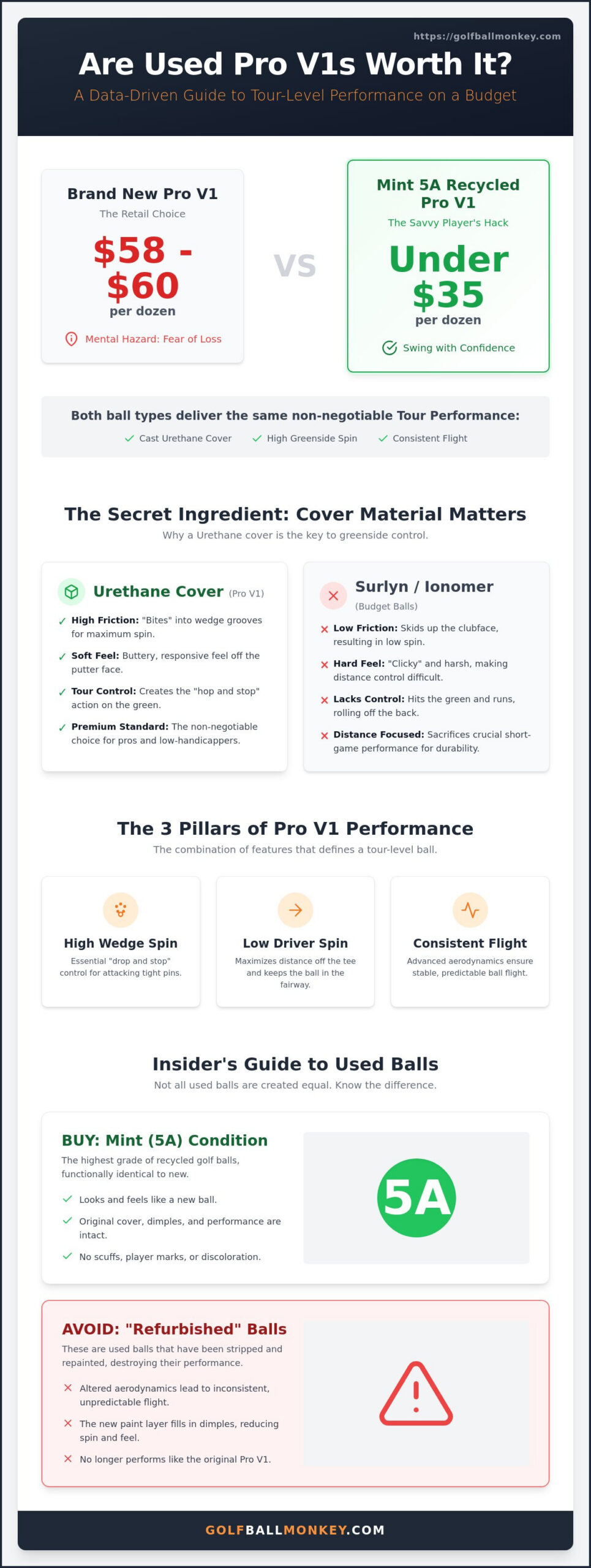
The real magic happens within 30 yards of the pin. A Pro V1 uses a cast urethane cover that practically bites into your wedge grooves. Cheap balls use Surlyn, which is essentially hard plastic. Surlyn balls might feel soft off the putter, but they lack the friction to “grab” the green. They hit and run like they have somewhere else to be. A Pro V1 hits, hops once, and stops. That predictable check-up is why pros and low handicappers refuse to play anything else. It is about confidence in your equipment.
The Three Pillars of Tour Performance
- Low driver spin: This keeps your ball in the short grass and maximizes distance off the tee by reducing side-spin.
- High wedge spin: This provides the essential “drop and stop” control required for attacking tight pin positions.
- Consistent flight: Advanced aerodynamics ensure stable flight patterns even in 2026’s unpredictable wind conditions.
Why ‘Soft’ Doesn’t Always Mean ‘Pro V1’
Do not get fooled by the “Soft” label on a $20 box of balls at a big-box retailer. Most “soft” balls are just low-compression Surlyn cores that feel mushy like a marshmallow. They might feel good on a cold morning, but they won’t give you the spin you need to save par. Urethane is the non-negotiable ingredient here. It provides the cover friction that creates “grab” on the clubface. Tour Feel is the perfect balance of a firm core and a soft urethane cover.
Let’s be real: paying $58.00 for a dozen balls is a mental hazard. Every time you see a pond, you see a five-dollar bill waiting to sink. That stress ruins your swing tempo and your enjoyment of the game. By shifting your strategy to buying Mint 5A used balls, you remove the financial fear. You get the tour-level energy transfer and the iconic “click” for a fraction of the cost. When you stop worrying about the price per sleeve, your game actually improves. So, are used pro v1s worth it? If you value your bank account as much as your backswing, the answer is a resounding yes.
The Secret Ingredient: Why Urethane is Non-Negotiable
Some websites tell you to buy cheap Surlyn balls because they are “just as soft” as premium gear. They are lying to you. Surlyn is a hard, durable ionomer resin. It is great for distance but terrible for control. Urethane is a thermoset material that allows the ball to compress and “melt” into your clubface. This creates the friction needed for high-spin wedge shots. If you are asking are used pro v1s worth it, you have to look at the cover first. Every ball on the PGA Tour uses a urethane cover for a reason.
The aerodynamic properties of a golf ball rely heavily on how the cover interacts with the air and the club. When your wedge strikes a Pro V1, the urethane actually deforms into the grooves. This creates a massive amount of spin. A Surlyn ball just skids up the face. This is the difference between a ball that stops on the third hop and one that rolls off the back of the green. If you’re ready to stop overpaying for retail boxes, grab a batch of premium recycled balls and see the spin for yourself.
The “one-hit wonder” myth needs to die. People think soft covers mean the ball is fragile. That is a 1990s mindset. Modern urethane is incredibly tough. You won’t shred a Pro V1 with one wedge shot anymore. Titleist has engineered these covers to be resilient. You can play 18 holes with one ball and it will still perform. This is exactly why are used pro v1s worth it; the performance doesn’t vanish after a few holes. It stays consistent until you lose it in the woods.
Ever felt a ball “clack” off your putter? That is the “clicky” problem of ionomer covers. It feels harsh and makes distance control a nightmare. Urethane feels like butter. It provides a muted, solid feel that helps you dial in your touch on the greens. Don’t let a cheap cover ruin your feel.
The Cost of Urethane Production
Casting urethane is a slow, expensive process. Manufacturers charge $55+ because it takes more time to bake the cover. Mid-tier balls try to bridge the gap with thinner covers, but they often sacrifice core technology. Don’t settle for plastic when you can get the real deal for less. You can find these premium builds in our Mint 5A inventory right now.
Identifying Urethane Balls at a Glance
- Check the side stamp: If it says “Ionomer” or “Soft Ionomer,” put it back.
- The Thumbnail Test: Press your nail into the cover. If it feels slick and hard, it’s Surlyn. If it feels tacky and leaves a tiny, temporary indent, it’s urethane.
- Look for the ‘Tour’ label: Most brands reserve the word “Tour” for their urethane offerings.
Top Brand Alternatives: Can You Get Pro V1 Spin for Less?
Titleist has a legendary history of Pro V1 innovation, but the 2026 retail price of $58.00 is a tough pill to swallow. If you are looking for that premium “stop on a dime” performance, you have options. Some brands try to mimic the Pro V1’s flight and friction for a slightly lower retail entry point. These alternatives offer urethane covers and multi-layer construction, but they still carry a “brand new” price tag that can be hard to justify for the casual weekend round.
The TaylorMade Tour Response is a standout alternative. It uses a 100% cast urethane cover, just like the flagship models, but it is specifically tuned for the amateur swing speed. It feels soft and provides massive greenside spin that rivals the industry leaders. For a deeper dive into these options, read our breakdown on TaylorMade Golf Balls: Performance and Savings. It is a solid play if you want a new ball with tour-level DNA without the $60 price tag.
Srixon Z-Star is another heavy hitter. It is often the balanced choice for players who want a bit more distance without losing that soft feel. Then there is the Maxfli Tour. It is the data-backed underdog of 2026. Robot testing shows it hangs right with the leaders in ball speed and spin. It is a savvy play for anyone who doesn’t care about the name on the side of the ball. These brands often run sales, but even then, you are usually paying more than you would for a recycled premium ball.
We cannot talk about value without mentioning the Kirkland Signature. It is the Costco legend. It offers incredible spin for a rock-bottom price. However, it is known for high spin off the driver, which can exacerbate a slice or hook. It is a great budget ball, but it doesn’t quite have the refined flight or the wind-fighting stability of a Titleist. You get what you pay for in terms of advanced aerodynamics.
Direct-to-Consumer (DTC) Challengers
Brands like Vice Pro and Snell MTB are the true disruptors. By cutting out the retail middleman, they usually save you about $15 per dozen compared to big-box prices. They offer legitimate tour-level performance. The catch? You have to deal with shipping costs and wait times. You can’t just pop into a pro shop and grab a sleeve when you’re running low. While their consistency has improved, many purists still find Titleist’s quality control to be the gold standard. If you lose several balls a round, the shipping fees can eat into your savings quickly.
The ‘Almost Pro V1’ Comparison Table
When you look at the numbers, the gap between premium and value is shrinking. But the question remains: are used pro v1s worth it compared to these new alternatives? A Mint 5A used Pro V1 often costs less than a brand-new TaylorMade Tour Response or Srixon Z-Star. You get the #1 ball in golf for the price of a mid-tier rival. If you want the best performance for the lowest price per dozen, the secondary market is the clear winner. You stop paying for the marketing budget and start paying for the performance.
- Titleist Pro V1: Max spin, premium feel, ~$58.00 retail price.
- Srixon Z-Star: High spin, firm feel, ~$48.00 retail price.
- TaylorMade Tour Response: High spin, soft feel, ~$43.00 retail price.
- Kirkland Signature: Extreme spin, soft feel, ~$18.00 retail price.
The Insider Play: Are Used Pro V1s Worth It?
Stop paying for the cardboard. Seriously. When you buy a brand-new box of Titleist Pro V1s at the pro shop, you are funding a massive marketing budget and a shiny box you will throw away in five minutes. If you want to know are used pro v1s worth it, look at the math. You can get the world’s #1 ball for under $2 per ball. Meanwhile, your buddies are sweating over every water hazard because they just dropped $58.00 on a dozen. That is the definition of the “Monkey Way.” You get the performance without the retail tax.
Let’s clear up the confusion between “Recycled” and “Refurbished.” This is where most golfers get burned. Refurbished or “Refinished” balls are the enemy. These balls are stripped and repainted to look new. It ruins the dimple patterns and kills the flight. Recycled balls, like our Mint 5A stock, are simply washed and sorted. They keep their original factory finish and aerodynamic integrity. If it is not recycled, it does not belong in your bag. Our grading standards ensure you only play the best.
Then there is the water myth. People on forums claim a ball in a pond is “dead.” That is old-school thinking from the wound-ball era. Modern Pro V1s have solid cores and sealed covers. A week in the water does not seep into the core. Our professional divers harvest these balls quickly, ensuring the performance remains identical to a ball fresh out of the sleeve. You get tour-level distance and spin. When you ask are used pro v1s worth it, the answer is a resounding yes, provided they are harvested correctly. For a deeper dive into how to spot the best deals, check out The Savvy Player’s Guide to Used Balls.
How Golf Ball Monkey Reclaims Performance
We do not just find balls; we rescue them. Our team of professional divers reclaims millions of balls annually from the toughest hazards. We use a proprietary cleaning and sorting process that avoids harsh chemicals. This protects the urethane cover and maintains the ball’s integrity. Our entire operation focuses on quality above everything else. You get the #1 ball in golf for a fraction of the cost. Ready to upgrade? Shop our Mint 5A Pro V1 inventory and stop overpaying for gear.
The Sustainability Bonus
Buying used is the ultimate win-win for the community. Every year, hundreds of millions of balls are lost in the U.S. alone. By choosing recycled gear, you prevent plastic and rubber from polluting local waterways. It is an environmentally conscious move that feels as good as a pure 7-iron. Save the planet, save your cash, and play better golf. It is that simple. You are making the intelligent play for your wallet and the environment simultaneously.
Restock Strategy: How to Buy Like a Savvy Insider
Buying one dozen balls at a time is a rookie move. If you want to maximize your savings, you have to think in bulk. The magic numbers for serious golfers are 48 or 96 balls. When you buy in these quantities, the per-ball price drops significantly. It is the fastest way to ensure you never run out of tour-quality gear mid-round. For anyone still asking are used pro v1s worth it, look at your trunk. A 96-ball stash of Mint 5A Pro V1s costs less than two full-price retail boxes. That is more golf for less money. Plain and simple.
Smart players also know how to mix their inventory. You don’t need a Mint 5A ball for a casual evening practice session or a risky hero shot over a canyon. Keep a stash of Mixed Bag (Good 3A) or shag balls for the practice range. Save your Mint 5A Titleist Pro V1s for tournament rounds and weekend money games. This tiered approach keeps your “game balls” in peak condition while slashing your overall equipment spend. Prioritize ball quality over that shiny new $600 driver; the ball is the only piece of equipment you use on every single shot.
Timing matters too. Stock up during the early spring before the peak 2026 golf season kicks into high gear. This ensures you have the best selection of the latest models before the summer rush drains the inventory. If you are curious about a new model, use the “Sleeve Test.” Buy a smaller quantity to test the flight and feel on your local greens before committing to a full case of 96. It is the ultimate “try before you buy” strategy for the budget-conscious athlete.
Calculating Your Yearly Savings
Let’s do some quick math. A typical golfer playing 30 rounds a year might lose three balls per round. That is 90 balls a season. At the 2026 retail price of ~$58.00 per dozen, you are looking at over $430 just in golf balls. By switching to Mint 5A recycled balls, you can cut that bill in half. That is over $200 back in your pocket. Redirect those savings into more tee times, a mid-round steak sandwich, or professional lessons. The performance remains identical; only the price tag changes. This is why are used pro v1s worth it for the long-term player.
Ready to Restock?
Stop overpaying for a logo and a cardboard box. It is time to play the “Smart Play” way. You can get the legendary feel and greenside control of the world’s #1 ball without the financial headache. Browse our current Titleist Pro V1 (Mint 5A) collection and find your next game-changer. Join the thousands of savvy insiders who have already made the switch. Play better. Spend less. Grab your bulk pack today and dominate the fairways.
Play the Best Ball for Half the Price
You now have the full playbook for smarter gear management. We have debunked the water myths and proven that urethane is the non-negotiable key to greenside spin. When you look at the performance data, the answer to are used pro v1s worth it is obvious. You get tour-level flight and that signature soft feel without the $58 retail tax. It is the ultimate insider move for any golfer who values their score as much as their budget. Stop paying for the marketing budget of giant corporations and start paying for what actually matters on the scorecard.
We are a Texas-owned operation powered by professional divers who reclaim over 1 million balls every year. Our Mint 5A Guarantee is simple: if you can tell it is used, we haven’t done our job. You get the world’s #1 ball delivered to your door with zero compromise on quality. It is better for the planet and better for your wallet. It is time to restock like a pro.
Stop Overpaying-Grab Your Mint 5A Pro V1s at Golf Ball Monkey Now!
Go out there, swing hard, and enjoy the game more knowing you made the intelligent play. We will see you on the first tee.
Frequently Asked Questions
Do used Pro V1s lose distance compared to brand-new ones?
No, high-quality recycled balls do not lose distance. Modern solid-core technology is built to last. Unless a ball has been sitting at the bottom of a lake for years, the energy transfer remains identical to a new one. This is exactly why are used pro v1s worth it for players who want tour-level distance without the retail markup. You get the same launch monitor numbers for a fraction of the cost.
Is the Kirkland Signature ball really the same as a Pro V1?
The Kirkland Signature is a value legend, but it is not a Pro V1 clone. It offers a urethane cover and high spin, but its flight characteristics are different. Kirkland balls often spin more off the driver, which can be a disaster for players with a slice. Titleist provides better aerodynamic stability in the wind. It is a great budget play, but it does not match the refined engineering of the #1 ball in golf.
What is the difference between Mint 5A and Near Mint 4A grades?
Think of Mint 5A as “showroom floor” quality. These balls are indistinguishable from new ones and often have zero player marks or scuffs. Near Mint 4A balls are the savvy insider’s secret. They might have a tiny cosmetic blemish or a Sharpie mark from a previous owner, but the flight and spin are 100% intact. If you can handle a small ink dot, 4A offers even deeper savings for your weekend rounds.
Why are Pro V1s so much more expensive than other urethane balls?
You are paying for a slow, premium manufacturing process. Titleist uses a cast urethane method that takes longer to cure than the injection-molded covers found on cheaper balls. This creates a thinner, more durable cover with better friction. You are also funding the massive R&D and quality control that makes every ball in the box fly exactly the same. It is the price of total consistency on every single shot.
Can a high-handicapper actually feel the difference in a Pro V1 alternative?
Absolutely. You don’t need a 120 mph swing to notice the “grab” of a urethane cover. High-handicappers often struggle with greenside control. A Pro V1 or a high-quality alternative stops faster on the green than a hard Surlyn ball. This helps you keep your chips closer to the pin and saves you strokes on every hole. Feel is about touch and predictable reaction, not just raw power.
What is the best cheap golf ball for a fast swing speed in 2026?
For 2026, the Srixon Z-Star or a recycled Pro V1x are your best bets. High swing speeds need a ball that won’t “mush” at impact. These firmer options maintain their structural integrity under high force, giving you lower spin off the tee and more piercing flight. Buying these as Mint 5A recycled balls is the smartest way to fuel a fast swing without draining your bank account every weekend.
Are refurbished golf balls a good alternative to used Pro V1s?
No, avoid refurbished balls at all costs. Refurbishing involves stripping the original clear coat and repainting the ball. This process often fills in the dimples, which ruins the aerodynamic properties. It makes the ball’s flight path completely unpredictable. When people ask are used pro v1s worth it, they are talking about recycled balls that keep their factory finish and original performance standards.
How many rounds can I realistically play with a single urethane-covered ball?
You can realistically play 36 to 54 holes with a single ball if you avoid the trees and cart paths. Modern urethane covers are surprisingly resilient. They don’t scuff nearly as easily as the soft balls from ten years ago. Most golfers lose the ball long before the performance actually degrades. If you play a clean round, just wash it off and tee it up again for your next tee time.
- golfballmonkey@gmail.com
- (512) 593-8401
- Mon – Fri, 9:00 AM – 5:00 PM

All product and company names are trademarks™ or registered® trademarks of their respective holders.
Use of them does not imply any affiliation with or endorsement by them.