
Are Used Golf Balls Worth It? The Truth About Performance & Savings (2026)
Buying brand-new premium golf balls is a sucker’s game. You’re paying a massive retail markup just to watch five dollars splash into a water hazard on the first par three. It’s a common frustration that keeps golfers settled for cheap, low-spin rocks instead of the gear they actually want. You might find yourself asking, are used golf balls worth it, or will they leave you short of the green?
We get it. You want the tour-level performance of a Titleist Pro V1 or a TaylorMade TP5 without the soul-crushing price tag. You shouldn’t have to choose between your bank account and your backswing. The truth is that playing premium used golf balls is the smartest move for your game. You get elite performance for half the price. Stop stressing every time you see a forest. Play the best brands. Keep your cash.
This guide breaks down why used balls are the ultimate life hack for 2026. We’ll look at independent testing that proves distance loss is less than one yard. We’ll also debunk the water-logged myth and show you how our Mint 5A grading scale ensures you get out-of-the-box quality for a fraction of the cost. Get ready to save big and play better.
Key Takeaways
- Slash your equipment costs by 50% or more. Stop paying the “Titleist Tax” at the pro shop and keep your cash for the 19th hole.
- Trust the data. Independent robot testing proves that high-quality used balls lose less than 1% of their original distance.
- Discover why are used golf balls worth it when you stick to standardized Mint 5A grading. These balls look and play like they’re fresh out of the sleeve.
- Forget the water-logged myth. Modern solid-core tech means a quick dip in a hazard won’t ruin your ball’s performance or feel.
- Master the savvy insider strategy. Buy premium brands like TaylorMade and Callaway in bulk to unlock the deepest discounts available.
The $50 Question: Why Are You Still Paying Retail for Golf Balls?
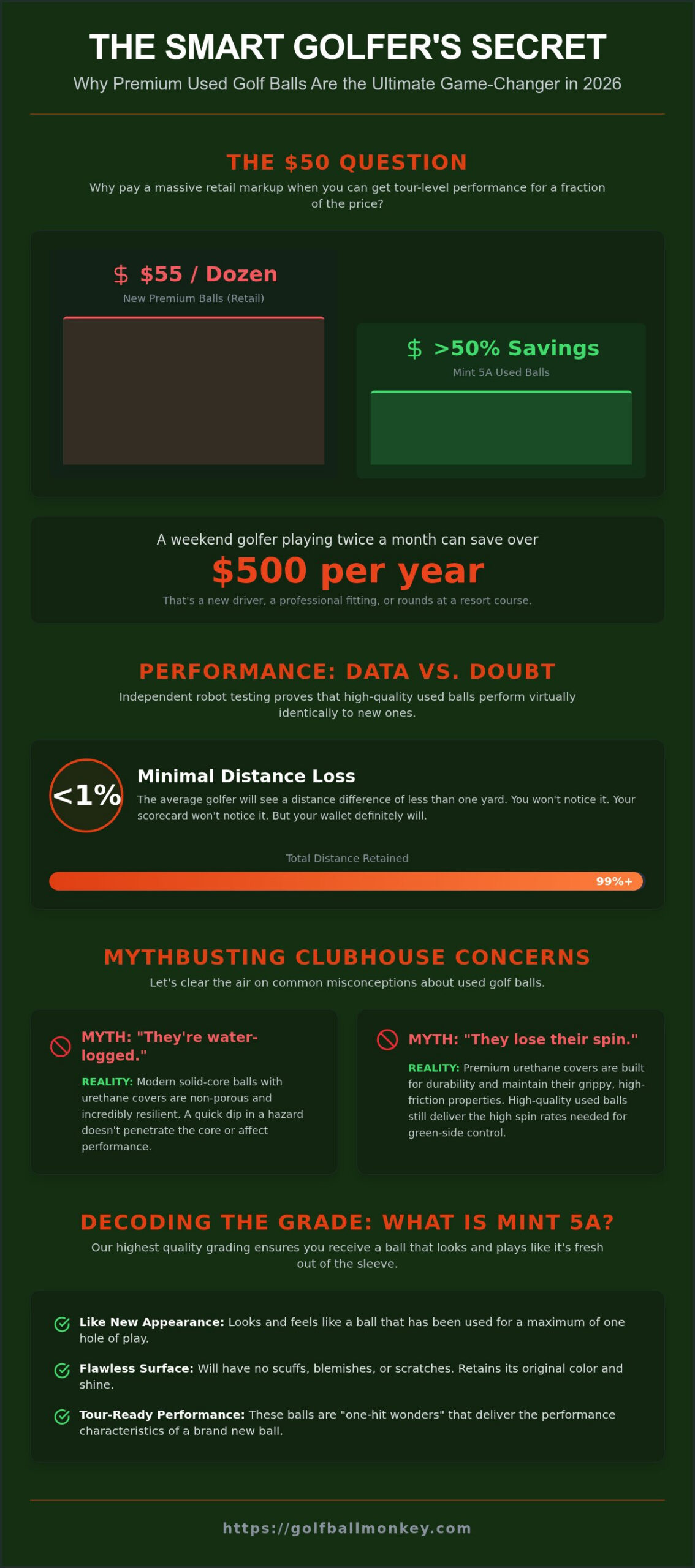
Walk into any pro shop and you’ll see the same thing. Rows of shiny boxes with price tags that make you double-take. Paying $55 or $60 for a dozen premium balls has become the “Titleist Tax” of the modern game. It’s a massive markup for a product you’re likely to lose in the first three holes. When you’re standing on a tee box staring at a forced carry over water, that $5 price tag per ball starts to mess with your head. You tighten up. You swing tentatively. You play worse because your equipment is too expensive to lose.
Let’s look at the “Monkey Math” of a typical round. Most amateur golfers lose between two and four balls every time they play eighteen holes. If you’re buying new at retail, you’re literally splashing $10 to $20 into the pond every Saturday. Over a full season, that’s a staggering amount of money. So, are used golf balls worth it? When you realize you can play the exact same tour-level gear for a fraction of the cost, the logic becomes undeniable. You gain a massive psychological edge when you stop worrying about the cost of a lost ball. You swing freer, attack pins, and actually enjoy the game.
The Real Cost of a New Sleeve
The savings add up faster than you think. A weekend golfer playing twice a month and losing three balls per round will spend over $500 a year just on new sleeves. That is cash that could pay for a brand new driver, a professional fitting, or three rounds at a bucket-list resort course. Why subsidize the marketing budgets of giant corporations when you can keep that money in your own pocket? You can shop our Titleist Pro V1 collection right now and see how much further your budget goes when you stop paying the retail premium.
New vs. Used: The Value Proposition
The secret that pro shops don’t want you to know is that most used balls are “one-hit wonders.” Most of the inventory we retrieve was lost after just one or two holes of play. Someone sliced a brand new ball into the woods or caught a gust of wind into a hazard. These balls didn’t sit in the sun for years. They are high-tech pieces of equipment that still meet the Official rules of golf for performance. The core technology in a modern urethane ball doesn’t expire on the shelf or lose its pop after a few minutes in the grass. You’re getting the same engineering for a much better price.
Performance Testing: Do Used Balls Actually Lose Distance?
The biggest fear in the clubhouse is that a used ball is a “dead” ball. People worry the core has lost its spring or the cover is too beat up to fly straight. It’s time to kill that myth with cold, hard data. Independent robot testing in 2026 confirms that high-quality used balls lose less than 1% of their total distance compared to brand-new ones. For the average golfer, that is a difference of maybe two feet. You won’t notice it. Your scorecard won’t notice it. But your wallet definitely will. So, are used golf balls worth it when the performance gap is basically invisible? Absolutely.
Modern ball engineering is incredibly resilient. Manufacturers build these things to withstand 120mph swing speeds and high-impact collisions with trees and cart paths. A few days in the grass doesn’t change the molecular structure of the core. The compression remains stable even after the ball has been struck a few times. When you play a Mint 5A ball, you’re getting a product that flies as true as any fresh box. The “pop” is still there. You get the same launch angle and the same ball speed you’d expect from a $5 retail ball. There is zero evidence to suggest that a ball loses its energy transfer properties just because it was previously owned.
The Science of the Urethane Cover
Premium balls like the Titleist Pro V1 use advanced urethane covers that resist chemical and physical degradation. Urethane is the gold standard material for golf ball covers because it provides the perfect balance of soft feel, high spin, and extreme durability. Unlike cheaper ionomer or surlyn covers, urethane doesn’t get brittle or lose its aerodynamic properties after a little use. It stays pliable and grippy. This ensures your flight path remains predictable shot after shot. Even after being retrieved from a hazard, the cover maintains its integrity. It continues to provide the friction needed for elite control.
Spin Rates and Green-Side Control
Amateurs need spin to keep the ball on the green. Many golfers think a used ball loses its “bite,” but testing shows that tour-level used balls maintain their high spin rates. You can still pull off that “stop and drop” wedge shot on a firm green. The dimple patterns are intact. The cover still interacts with your grooves exactly as designed. You get the same check-up on chips and the same consistent roll on putts. If you want to see how these balls perform for yourself, check out our latest inventory and test them on your local range. You’ll find that the only thing you’re losing is the high price tag.
Decoding the Grades: What Mint 5A Really Means
Stop buying “mystery buckets” from the guy at the end of the road. If you want to know are used golf balls worth it, you have to look at the grade. Not all used gear is created equal. A ball that sat in a swamp for three years isn’t the same as one that took a quick dip yesterday. That is why we use a standardized grading system. It takes the guesswork out of your purchase and ensures you get exactly what you pay for. Grading is the single most important factor in deciding are used golf balls worth it for your specific skill level and budget.
Our grading scale is the verbal seal of approval you need to buy with confidence. We break it down into tiers that match your needs on the course:
- Mint 5A: This is the “Like New” standard. These balls look and play like they just came out of a fresh sleeve. No scuffs. No player marks. Just pure, tour-level performance for half the retail price.
- Near Mint 4A: These have minor cosmetic flaws. You might see a tiny scuff or a Sharpie mark from the previous owner. They fly perfectly and maintain 100% of their original performance and spin.
- Good 3A: These show visible wear and some discoloration. They are the perfect choice for practice rounds, shag bags, or high-handicappers who prioritize savings over a pristine look.
Recycled vs. Refurbished: The Critical Difference
Never buy refurbished balls. It’s a trap. Refurbished balls are often stripped of their original clear coat and repainted to look new. This process ruins the aerodynamics. It fills in the dimples and changes how the ball interacts with the air. You might get a shiny ball, but you’ll get unpredictable flight and zero spin control. We only sell recycled balls. These are cleaned, vetted, and graded without ever altering the original factory finish or cover integrity. For a deeper dive into the technical details, check out our guide on Decoding Grades: What Mint 5A Really Means.
The Golf Ball Monkey Inspection Process
We don’t just find balls; we curate them. Our professional divers retrieve millions of balls from hazards across the country. Every single ball goes through the “Monkey Vetting” process. We hand-sort every Titleist, Callaway, and TaylorMade to ensure they meet our strict quality control standards. We check for cover integrity, core stability, and surface texture. If it doesn’t pass the test, it doesn’t make the bag. This commitment to quality is why savvy players trust us to restock their equipment quickly and reliably. Stop settling for “average” and start playing the best for less.
Debunking the “Water Logged” Myth Once and for All
Old-school golfers love to tell horror stories about “water-logged” balls. They claim 24 hours in a pond ruins the compression and kills the distance. It’s time to call out this outdated nonsense. This myth comes from the days of wound-core balls that would actually absorb moisture and expand. Modern solid-core technology has made water-logging a thing of the past for today’s golfer. If you’re asking are used golf balls worth it after they’ve been in a hazard, the answer is a resounding yes. You aren’t playing with 1990s tech anymore.
Solid Core Technology vs. Old Wound Balls
Today’s premium balls are multi-layer marvels. They feature high-tech mantle layers and durable urethane covers designed to keep the elements out. Research shows it takes weeks, or even months, of continuous submersion before water can even begin to impact the flight characteristics of a modern ball. A quick dip in the drink doesn’t turn your Titleist into a sponge. These balls are virtually waterproof. You get the same launch, the same spin, and the same distance regardless of where the ball spent its last weekend. Modern solid-core technology has made water-logging a thing of the past for today’s golfer.
The Retrieval Process
We don’t just wait for balls to wash up on the shore. Our professional divers are the elite special forces of the golf world. They dive deep into US hazards to harvest these “lost treasures” before any long-term exposure can occur. This “Diver-to-Door” journey is fast and efficient. Once retrieved, the balls are immediately dried, cleaned, and put through our rigorous grading process. We ensure they haven’t sat at the bottom of a lake for a decade. We only sell the freshest finds.
Hazard-retrieved balls are often the best-performing used balls in our inventory. Why? Because they were usually lost by golfers who were playing premium gear but couldn’t keep it in the short grass. Most of these balls were in the water for less than 48 hours before being rescued by our team. You get a ball that is chemically and physically identical to a new one at a fraction of the cost. When you look at the tech, are used golf balls worth it? The science says yes. If you want to stop overpaying for equipment that performs exactly like our recycled stock, grab a bag of Mint 5A balls today and prove the myths wrong.
The Smart Play: How to Build Your Bag for Less
You’ve seen the data. You know the myths are busted. Now it’s time to build your bag like a pro. The smartest players don’t just grab whatever is on sale at the big box store. They curate their gear. You can easily test different premium models to find your perfect match. Try the spin of a Titleist, the soft feel of a Callaway, or the explosive speed of a TaylorMade. When you buy used, you can experiment without the financial sting. This flexibility allows you to dial in your equipment for specific course conditions or weather. It’s the ultimate insider advantage that retail shoppers never get to experience.
Building a high-performance bag shouldn’t require a second mortgage. By bypassing the retail markup, you’re making the intelligent play for your game. You get 99% of the performance for 50% of the cost. That is a trade-off any savvy golfer would make. When you consider the sheer volume of balls the average player goes through in a season, the answer to are used golf balls worth it becomes crystal clear. It’s the only way to play premium gear on a realistic budget.
Bulk Buying for Maximum Savings
Ordering a single dozen is a beginner move. If you want the deepest discounts, you need to think bigger. Ordering 50 or 100 balls at a time is the ultimate “monkey move.” It slashes your cost per ball even further and ensures you never run out mid-round. We also recommend keeping a Mixed Bag (Good 3A) in your trunk. These are perfect for low-stakes practice sessions, hitting into the net, or warming up at the range. Save your Mint 5A Titleists for the first tee and use the 3A stock for the grind. This tiered approach keeps your costs low and your performance high.
The Sustainable Choice
There is a bigger picture here. Every ball we retrieve is one less piece of plastic sitting in our waterways. Golf balls can take centuries to decompose. By choosing recycled gear, you’re helping preserve the very courses we love to play. It’s a rare win-win for your wallet and the planet. You get elite equipment. The environment gets a break. It’s a sustainable cycle that keeps the game healthy for the next generation of hitters. Stripping away the elitism of “new only” equipment makes the sport more accessible and eco-friendly for everyone.
The verdict for 2026 is in. Stop overpaying for marketing and start paying for performance. When you look at the savings, the durability, and the environmental impact, are used golf balls worth it? The smart money says yes every single time. Grab your bulk bag, hit the links, and swing with the confidence of a player who knows they’ve made the smartest play on the course. Your scorecard and your bank account will thank you.
Stop Overpaying and Start Pin-Seeking
The days of paying a retail premium for gear you might lose in a water hazard are over. You’ve seen the data. Modern tech keeps performance high. Our grading system protects your scorecard. When you consider the massive savings and the environmental impact, it’s clear that are used golf balls worth it for any golfer who values their wallet as much as their swing. Why play a cheap ball when you can play a Pro V1 for half the price?
We’ve done the heavy lifting for you. Our professional divers retrieve the best gear from across the country. We recycle over 1 million balls annually to keep your bag full. Every order is backed by our 5-star Mint 5A grading guarantee and ships fast from our Texas headquarters. Don’t let pro shop prices dictate your performance. Make the savvy play and join the community of insiders who know the truth about used gear.
Score Mint 5A Titleist Pro V1s for 50% Off at Golf Ball Monkey!
Grab your bulk bag and hit the links with total confidence. We’ll see you on the fairway.
Frequently Asked Questions
Do used golf balls lose distance compared to new ones?
High quality used balls show less than 1% distance loss in independent robot testing. This translates to a difference of about one yard or less. For the vast majority of golfers, this gap is completely invisible during a round. You get the same launch and speed without the retail markup. It is the smartest way to keep your game long and your wallet full.
What is the difference between recycled and refurbished golf balls?
Recycled balls are simply cleaned and graded, while refurbished balls are stripped and repainted. You should always choose recycled. Refurbishing can fill in dimples and ruin the aerodynamics of the cover. This leads to unpredictable flight and less spin. We only sell recycled gear to ensure you get the original factory performance every time you tee it up.
Is it true that golf balls become water-logged if they stay in a pond?
Modern solid core balls do not become water-logged. This is an old myth from the era of wound core balls. Research shows it takes weeks of submersion to even begin affecting the performance of a modern urethane ball. Most balls retrieved by professional divers are found and dried long before any moisture can penetrate the protective mantle layers.
What does Mint 5A condition actually mean?
Mint 5A is the highest possible grade for a used ball. It means the ball is in pristine, like-new condition with no visible scuffs or player marks. These balls look and play like they just came out of a fresh box. If you’re wondering are used golf balls worth it, our Mint 5A stock is the definitive proof that you can play the best for less.
Can I use used golf balls in a tournament?
Yes, you can absolutely use recycled balls in competitive play. As long as the original model is on the USGA conforming list, it is legal. Most major brands like Titleist and TaylorMade are always cleared for play. Just avoid refurbished balls in tournaments. The repainting process can technically change the ball’s properties, which might cause issues with strict equipment rules.
How much money can I really save by buying used golf balls?
You can typically save 50% or more compared to buying new at a pro shop. For instance, premium models that retail for nearly $60 a dozen can often be found as high grade used balls for about half that price. These savings add up to hundreds of dollars over a single season. It’s the easiest way to upgrade your gear without increasing your budget.
How long do used golf balls last before they need to be replaced?
A used ball lasts exactly as long as a new one. You only need to replace it if you see significant cover damage or deep scuffs that might affect flight. Modern urethane is incredibly tough. Most golfers will actually lose the ball in a hazard or the woods long before the performance of the ball itself starts to degrade from normal play.
Which used golf ball brand offers the best value for average players?
Kirkland Signature and Srixon are top contenders for the best value in 2026. Research shows Kirkland balls offer a high consensus score for a very low price point. Srixon also provides tour-level spin and control at a fraction of the cost of other premium names. When asking are used golf balls worth it, these brands provide the most bang for your buck.
- golfballmonkey@gmail.com
- (512) 593-8401
- Mon – Fri, 9:00 AM – 5:00 PM

All product and company names are trademarks™ or registered® trademarks of their respective holders.
Use of them does not imply any affiliation with or endorsement by them.