
Best Golf Balls for Dealing with a Slice: Stop the Curve in 2026

How many sleeves of premium balls have you sacrificed to the local forest this month? Watching a high-priced ball take a hard right turn into the weeds isn’t just frustrating; it’s expensive. You’re likely tired of the embarrassment that comes with every “provisional” shot and the constant drain on your equipment budget. While no ball can magically fix a swing path, choosing the best golf balls for dealing with a slice can significantly tame that side-spin. Engineering for 2026 has delivered low-compression tech that can reduce your curve by 5 to 15 yards. That is often the difference between a lost ball and a manageable lie in the rough.
We know the struggle of trying to play a tour-level ball when your swing isn’t quite there yet. You end up with more side-spin than you can handle, and your scorecard pays the price. This guide shows you how to stop the bleeding and find the short grass consistently. We will preview the top low-spin models like the Srixon Soft Feel and Bridgestone e6 that prioritize straight flight over ego. You will discover which covers grip the air less and which budget-friendly options keep you in the game. Let’s get your rounds back on track and your golf balls out of the woods.
Key Takeaways
- Stop fighting your equipment and learn why high-spin “tour” balls are actually sabotaging your game by exaggerating every miss.
- Master the tech by choosing low-compression cores and Ionomer covers that dampen side-spin to help you find the short grass more often.
- Identify the best golf balls for dealing with a slice, including high-performance options like the Bridgestone Tour B RX and Callaway Chrome Soft.
- Protect your wallet by switching to Mint 5A recycled balls, securing premium anti-slice technology without the “retail tax” when you lose a ball.
- Go beyond the ball with savvy setup tips and performance tees that help you manage your miss and keep the momentum moving forward.
Why Your Ball Choice Matters When You Slice
Your swing path is the boss, but your golf ball is the employee that either follows orders or starts a riot. If you are struggling with a banana ball that carves through the air, your equipment might be pouring gasoline on the fire. Understanding the science of golf ball aerodynamics is the first step to reclaiming your Saturday mornings. Most amateurs assume a “better” ball means a better score. In reality, playing a high-spin tour ball while fighting a slice is like trying to put out a fire with a blowtorch.
The difference between a manageable fade and a round-ruining slice often comes down to how much the ball resists horizontal rotation. While backspin provides the lift needed to keep the ball airborne, side-spin is the enemy of the fairway. When you hunt for the best golf balls for dealing with a slice, you are essentially looking for a ball that refuses to dance. High-spin balls are a savannah of trouble for the average player; they reward every mistake with extra curvature that lands you two fairways over.
The Spin Axis Explained
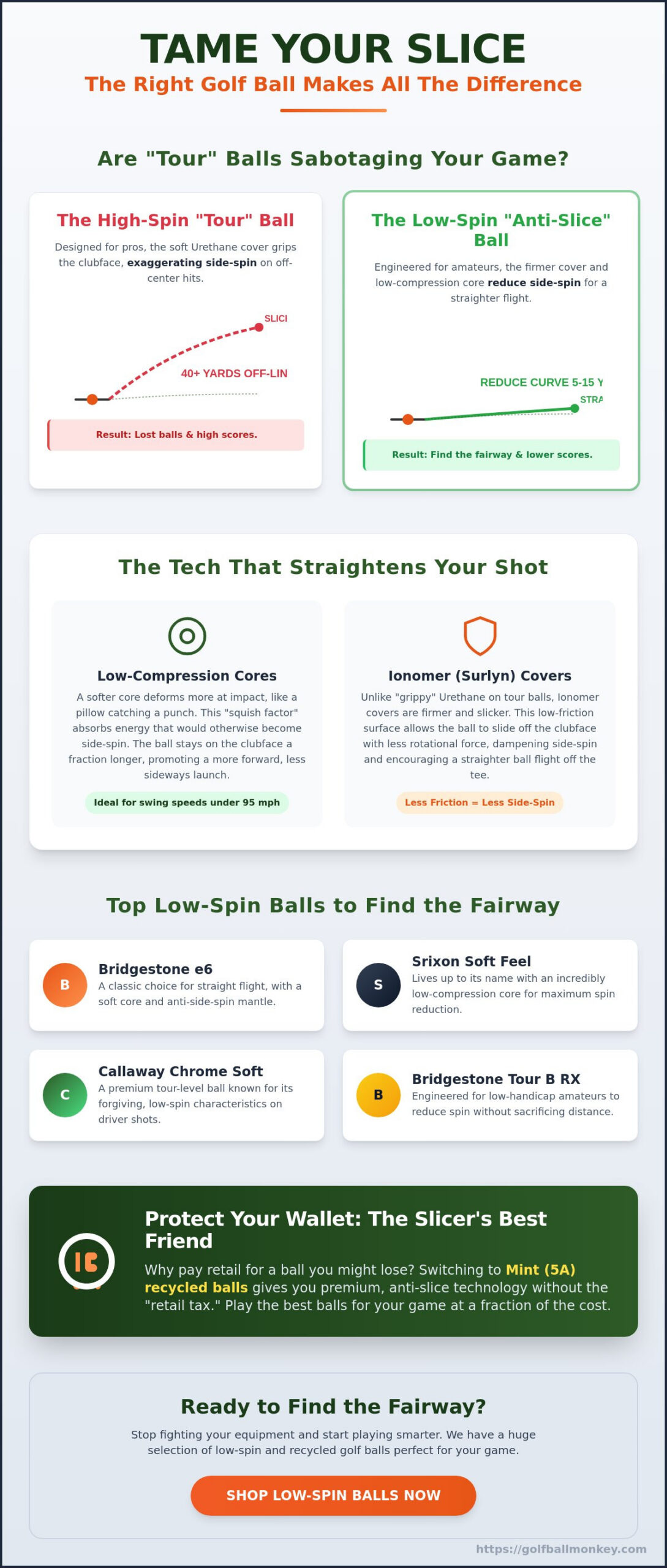
Visualize your golf ball as a spinning top rather than a bicycle wheel. It doesn’t actually have two different types of spin. Instead, it has a single spin axis that gets tilted at impact. If your clubface is open relative to your path, that axis tilts hard to the right. Side-spin is a component of the total spin vector that dictates how much the ball planes away from your target. The more the ball spins overall, the more that tilt matters. Lowering the total spin rate makes that tilted axis less punishing, keeping your misses closer to the short grass.
Tour Balls vs. Distance Balls
We all want to play what the pros play. Seeing a Titleist Pro V1 in your bag feels great until you watch it slice 40 yards into the pond. These premium tour balls are engineered for maximum spin. Pros need that spin to stop the ball on firm greens. You, however, need to survive the tee box. Using a high-spin urethane ball when you have a swing fault is a recipe for a high handicap. You are trading greenside control for a one-way ticket to the woods.
Switching to a lower-spin distance ball or a specialized “soft” model changes the math. These balls use firmer covers and specific core tensions to dampen the spin off the driver. You might lose a bit of “zip” on your chip shots, but you gain the ability to actually find your ball after a drive. If you want to stop donating cash to the local water hazard, check out our full inventory of low-spin options. It’s time to stop playing the “spin monster” and start making the smart play for your game and your wallet.
The Tech Behind Straight-Flight Golf Balls
Engineering a straight flight isn’t magic; it’s physics. When you hunt for the best golf balls for dealing with a slice, you’re actually shopping for specific materials that fight your swing’s worst tendencies. Manufacturers use a combination of core density and cover hardness to keep you out of the trees. It’s about reducing the friction and “grab” that happens at the moment of impact. While high-end balls focus on “workability,” these straight-flight options focus on stability. They want to stay on a rail, even when your swing path says otherwise.
Compression and Spin Reduction
Low compression is the secret sauce for the average golfer. When a high-compression tour ball is struck with an “out-to-in” path, it resists deformation and slides across the face, generating massive side-spin. A softer core does the opposite. It deforms more easily under the pressure of the strike. This “squish factor” allows the ball to stay on the clubface slightly longer, absorbing energy that would otherwise translate into horizontal rotation. If your swing speed is under 95 mph, a low-compression ball is a literal game-changer. It turns a glancing blow into a focused strike. Matching your swing speed to core density ensures you aren’t leaving distance on the table while you’re trying to stay straight.
Cover Materials: Ionomer vs. Urethane
Forget the hype about “professional” urethane covers for a moment. Urethane is designed to be soft and “sticky” to help pros stop the ball on a dime. For a slicer, that stickiness is a liability. It grips the grooves and amplifies the physics of a golf slice. Ionomer covers, often known by the brand name Surlyn, are much firmer and slicker. This lower friction means the ball slides off the face with less lateral grip. Two-piece golf balls utilize a large, low-compression core paired with a firm ionomer cover to maximize energy transfer while minimizing the friction that generates lateral rotation. This construction is the gold standard for anyone trying to tame a curve.
Don’t fall for the “self-correcting” myth. No ball can physically steer itself back to the middle if your swing path is 20 degrees left. Technology can mitigate the damage, turning a 30-yard slice into a 15-yard fade, but it won’t fix a fundamental swing flaw. It’s a tool to keep you in play while you work on your game. It keeps your confidence high and your ball count low. If you’re ready to test these theories without spending a fortune, grab a few dozen recycled low-spin balls and see the difference for yourself. Straight flight is often just a gear change away.
The Top 5 Golf Balls for Dealing with a Slice
Finding the right gear shouldn’t feel like a chore. If you want to keep your rounds on the fairway, you need a ball that matches your swing speed and mitigates that lateral movement. We have vetted the market to find the best golf balls for dealing with a slice in 2026. These picks range from high-performance tour tech to the budget-friendly staples that every weekend warrior needs in their bag. Stop guessing and start playing the equipment that actually fits your miss.
The Performance Picks
For players with faster swing speeds who still struggle with a curve, the Bridgestone Tour B RX is a standout choice. It utilizes specialized ‘Contact Force’ dimples to increase surface contact at impact. This stabilizes the ball and reduces the “wobble” that leads to a slice. It’s a high-tech answer for the golfer who wants distance without the penalty of extreme side-spin. If you want a slightly softer feel without sacrificing accuracy, the Callaway Chrome Soft is the “Goldilocks” ball. It uses a specialized core to dampen the spin off the driver while maintaining a buttery feel around the greens. These models prove that you don’t have to choose between professional performance and a straight flight path.
The Value Straight-Shooters
You don’t always need to drop fifty bucks a dozen to find the short grass. The Srixon Soft Feel is now in its 14th generation for 2026. With a low compression rating of 58, it’s specifically designed to help moderate swing speeds keep the ball on a rail. It’s a classic 2-piece construction that eliminates the “spin monster” tendencies of more expensive three-piece balls. If you’re a fan of big-box value, Maxfli offers specialized “Straight” models that prioritize a slick ionomer cover to minimize lateral drag. Even the Kirkland Signature has its place. While it has a reputation for being a bit spinnier, the value is unbeatable if you’re still losing a few balls per round. Finally, if you’re a Titleist loyalist, step away from the Pro V1 and try the Velocity or the AVX. These are engineered for a lower, more piercing flight that resists the wind and the curve better than their high-spin siblings. You get the brand prestige without the “provisional” headache. Check out our full inventory to stock up on these fairway finders for a fraction of the retail price.
The Budget Reality: Why Used Balls are a Slicer’s Best Friend
If you are fighting a slice, you are essentially a philanthropic donor to your local forest and pond ecosystem. Every time you tee up a five-dollar retail ball and carve it into the tall grass, you’re throwing money away. Finding the best golf balls for dealing with a slice is only half the battle; the other half is making sure your equipment budget doesn’t hit zero before the turn. There is a massive psychological edge to playing a ball that didn’t cost a fortune. When the financial stakes are lower, you swing freer. You stop “steering” the ball out of fear and start making the confident, aggressive moves needed to actually fix your swing path.
Switching to used golf balls is the smartest play an amateur can make. You get the exact same low-spin tech found in brand-new boxes for a fraction of the cost. Beyond the savings, it’s a win for the environment. Recycling these balls keeps the hazards clean and prevents thousands of pounds of plastic from sitting in the woods for decades. You get the performance you need, the planet gets a break, and your wallet stays heavy.
Saving Money While You Fix Your Swing
The math is simple. Over a full season, a slicer losing three balls a round could save hundreds by ditching retail. While you work on your mechanics, you need volume. Shag balls are the perfect companion for your range sessions, allowing you to practice with real-feel equipment instead of beat-up range rocks. Don’t worry about the “water-logged” myth, either. Modern ball construction is incredibly resilient. Our Mint 5A inventory performs identically to new balls in launch monitor testing. You get the “squish” and the straight-flight aerodynamics without the retail tax.
The Monkey’s Grading Secret
We take quality seriously. Every ball in our inventory goes through a rigorous vetting process to earn its rank. Here is how we break it down:
- Mint 5A: These are the cream of the crop. They look and feel like they just came out of the sleeve. Perfect for your competitive rounds.
- Near Mint 4A: Slight cosmetic blemishes only. No scuffs or structural damage. These are the workhorses of the savvy golfer’s bag.
- Good 3A: These show some wear but still fly true. These are your secret weapon for those tight, tree-lined “death holes” where a slice is likely.
Building a mixed-bag strategy is a pro move. Use your 5A balls on the wide-open par 5s and save the 3A balls for the narrow chutes. It’s about being a savvy insider who knows how to manage the course and the budget. If you’re ready to stop the financial bleeding, restock your bag with our premium recycled inventory today and start swinging with confidence.
Beyond the Ball: Mastering Your Misses with Golf Ball Monkey
You have done the research. You have identified the best golf balls for dealing with a slice. Now, it is time to look at the rest of your game. Even the most advanced low-spin technology needs a little help from the player behind the club. Improving your accuracy isn’t just about what is inside the ball; it is about how you present that ball to the clubface. From your choice of accessories to your mental strategy on the tee box, every small adjustment keeps your equipment working for you instead of against you. Technology mitigates the damage, but your setup determines the starting line.
The Savvy Player’s Setup
Your hardware choices extend beyond the ball itself. Many golfers overlook how golf tees and tee height affect their launch conditions. Tying your tee height to your swing path can drastically change your results. A higher tee often encourages an upward strike. This helps reduce the downward friction that generates excessive side-spin. Use the alignment aids on your ball to square the face at address. It is a simple, free trick that ensures you aren’t starting the hole with an open face. Playing smarter doesn’t mean playing pricier; it means using every tool in your bag to your advantage.
There is also a time to stop fighting and start managing. If your slice is particularly stubborn today, aim down the left side and let the equipment mitigate the curve. The best ball is the one that stays in your bag, not the one left behind in the woods. By pairing a low-spin ball with a smart setup, you turn a 40-yard disaster into a 15-yard fade that stays in play. Building the ultimate “anti-slice” bag on a budget is about variety. Carry a few Mint 5A Bridgestones for those wide-open holes where you want maximum performance. Keep a pocket full of 3A “Good” condition balls for the narrow chutes where the trees are hungry. This strategy keeps your confidence high and your replacement costs low.
Ready to Find the Fairway?
You are ready to stop the curve and start saving. Whether you need a Mint 5A Callaway or a bulk bag of Srixon Soft Feels, we have you covered. Our bulk packs are the ultimate safety net for the developing player. You can’t fix a swing if you’re too scared to swing hard. By stocking up on premium used inventory, you remove the financial fear that causes “steering.” Browse our full shop inventory today to find the specific models we’ve discussed. The fairway is much closer than you think. Swing big, save bigger, and keep your balls in the short grass.
Reclaim the Fairway and Stop the Donation Cycle
You have the blueprint to beat the curve. Switching to low-compression cores and ionomer covers isn’t just a gear change; it’s a strategic move to keep your score low and your confidence high. You now know that the best golf balls for dealing with a slice are engineered to dampen side-spin and keep you in the short grass. Don’t let the “provisional” shots drain your bank account or your spirit. By mastering your setup and choosing equipment that fits your miss, you turn forest-bound disasters into playable lies on the fairway.
We believe in professional performance without the retail markup. The Monkey personally vets every haul to ensure our Texas-born team delivers professional diver-harvested quality. Our standardized Mint 5A grading acts as a seal of approval, giving you player-approved value that performs exactly like new. Stop donating premium balls to the hazards. Shop the Best Low-Spin Balls for Your Slice at Golf Ball Monkey and restock your bag for a fraction of retail prices. The fairway is waiting; go get it.
Frequently Asked Questions
Do ‘straight’ golf balls actually work to fix a slice?
Straight golf balls mitigate the curve by reducing side-spin, but they won’t fix a fundamental swing path error. They use low-spin technology to reduce lateral movement by roughly 5 to 15 yards. This often keeps you in the rough instead of the deep woods. Think of it as damage control while you work on your mechanics.
Is a soft or hard golf ball better for a slice?
A soft, low-compression ball is usually better for a slice. These balls deform more easily at impact, which reduces the glancing friction that creates side-spin. Harder tour-level balls often resist that squish, causing them to slide across the face and spin wildly off-target. It’s about finding the right density for your speed.
Why do I slice my expensive Titleist Pro V1 more than cheap balls?
Expensive balls like the Pro V1 are designed to spin as much as possible for greenside control. If you slice, that high-spin core and sticky urethane cover amplify your mistake. Cheap balls often use slicker ionomer covers that naturally resist the lateral grip needed to create a massive curve.
How much distance do I lose using a low-spin golf ball?
You might lose a few yards of total carry, but you gain massive effective distance. A ball that flies 250 yards into the woods is useless. A low-spin ball that flies 240 yards and stays in the fairway is a massive win. You’re trading excessive curvature for forward momentum and a better second shot.
Can a golf tee help reduce my slice?
Teeing the ball higher can definitely help. It encourages an upward angle of attack, which naturally reduces the downward spin that fuels a slice. Combine a high tee with the best golf balls for dealing with a slice to give yourself the best chance of finding the short grass consistently.
Are used golf balls as good as new ones for fixing a slice?
Absolutely. A Mint 5A used ball has the exact same aerodynamic properties as a retail ball. Since slicers lose more equipment, buying premium recycled versions of the best golf balls for dealing with a slice is the only way to play top-tier tech without going broke. It’s the smartest play for your budget.
What is the best compression rating for a golfer who slices?
Aim for a compression rating between 40 and 60 if you have a moderate swing speed. This lower density allows the ball to compress fully at impact, dampening the side-spin. Faster swingers should look for low-spin models in the 70 to 80 range to avoid over-compressing and losing ball speed on long drives.
Should I use a 2-piece or 3-piece ball to stop a slice?
Stick with a 2-piece ball for maximum accuracy off the tee. These balls have a large core and a thin cover, lacking the extra layers designed to generate high spin. While 3-piece balls offer more feel around the green, they often introduce the lateral spin that makes your slice much harder to control.
- golfballmonkey@gmail.com
- (512) 593-8401
- Mon – Fri, 9:00 AM – 5:00 PM

All product and company names are trademarks™ or registered® trademarks of their respective holders.
Use of them does not imply any affiliation with or endorsement by them.