
Pro V1x vs. Pro V1x Left Dash: The Ultimate Comparison for Savvy Golfers

What if the most popular ball on Tour is actually sabotaging your scorecard? It’s a common trap. You see the pros playing a specific model and assume it’s the gold standard for your game too. When comparing the used pro v1 vs pro v1x, most players default to the “x” for that high launch. But if your driver spin is through the roof or your long irons are ballooning into the wind, you’re likely overpaying for performance that doesn’t fit your swing.
We get it. Titleist nomenclature is confusing, and nobody wants to waste cash on premium balls that don’t fit their swing. This guide stops the guessing game. You’ll discover the technical differences between the Pro V1x and the specialty Left Dash so you can start scoring for less. We’re breaking down everything from the 348 tetrahedral dimple design of the 2026 Left Dash to the firm feel that kills spin. You’ll see exactly why the Left Dash is the ultimate spin-killer hack for high-speed players looking for a high-launch, low-spin miracle at a recycled price.
Key Takeaways
- Learn how the Left Dash evolved from a pro-only secret into a retail powerhouse designed specifically to kill excessive long-game spin.
- Master the technical split of used pro v1 vs pro v1x to identify which high-launch model keeps your ball from ballooning into the wind.
- Evaluate the “Feel Factor” to decide if a firmer cover and auditory “click” will help your distance control on the putting surface.
- Use the Monkey’s Decision Matrix to match your swing speed with the right Titleist model so you stop overpaying for the wrong tech.
- Discover the ultimate gear-head hack for scoring Mint 5A Tour performance at a massive discount compared to retail prices.
What is the Pro V1x Left Dash? The Insider Story
The Left Dash didn’t start on a retail shelf next to the standard Pro V1. It began its life in the Titleist Tour Van as a Custom Performance Option (CPO). For years, this was a secret weapon for PGA Tour pros who needed a very specific flight window. These players loved the high launch of the standard Pro V1x but struggled with too much spin on their long irons and drivers. Titleist engineers tweaked the recipe, added a specific marking to the sidestamp, and the Left Dash was born. Eventually, the demand from the gear-head community became too loud to ignore. Titleist released it to the public in limited runs, and now it’s a staple for golfers who want to kill spin without losing height.
When you’re looking at a used pro v1 vs pro v1x comparison, you’re usually choosing between soft feel and high spin. The Left Dash throws a wrench in that simple choice. It’s the specialty spin-killer designed for the high-speed player who wants the ball to stay in the air but stop ballooning. It offers a unique profile that the two flagship models simply don’t cover.
The Evolution of Titleist Specialty Balls
Titleist has a long history of fine-tuning performance through these specialty models. While the history of the Titleist Pro V1 is built on the success of the two main flagship models, the Left Dot and Left Dash allow for surgical precision in ball fitting. The Left Dash specifically uses a high-gradient dual core and a thin cast urethane cover to maintain greenside control while drastically dropping long-game spin. With the release of the 2026 Pro V1x Left Dash on January 21, 2026, this technology became even more refined. The latest 348 tetrahedral dimple design ensures a stable flight that resists the wind. It makes the transition from tour-van secret to retail favorite complete for high-speed swingers.
The Core Difference in One Sentence
The Pro V1x Left Dash is the firmest, lowest-spinning variant in the Pro V1 family, engineered specifically for high-swing-speed players who need to maximize distance by neutralizing excessive spin.
If you find yourself constantly fighting a ball that climbs too high and stalls out, the Dash is your answer. It features a thicker, high-flex casing layer that acts as a speed engine. This layer is the secret sauce that reduces spin on full shots while keeping ball speeds high. By grabbing these in Mint 5A condition from our shop, you get that Tour-level performance without the retail sting. It is the ultimate insider move for the savvy shopper who knows their numbers. Why pay full price when you can get the same used pro v1 vs pro v1x performance for a fraction of the cost?
Pro V1x vs. Pro V1x Left Dash: The Technical Showdown
Choosing between a used pro v1 vs pro v1x usually comes down to a simple trade-off between spin and feel. But the Left Dash isn’t a standard choice. It’s a specialized tool. While both the standard Pro V1x and the Left Dash are built for high flight, their DNA is fundamentally different. If you’re tired of seeing your ball climb into the clouds and stall out, you need to look at the numbers. The Left Dash is engineered to take that high launch and strip away the excessive spin that kills your total distance.
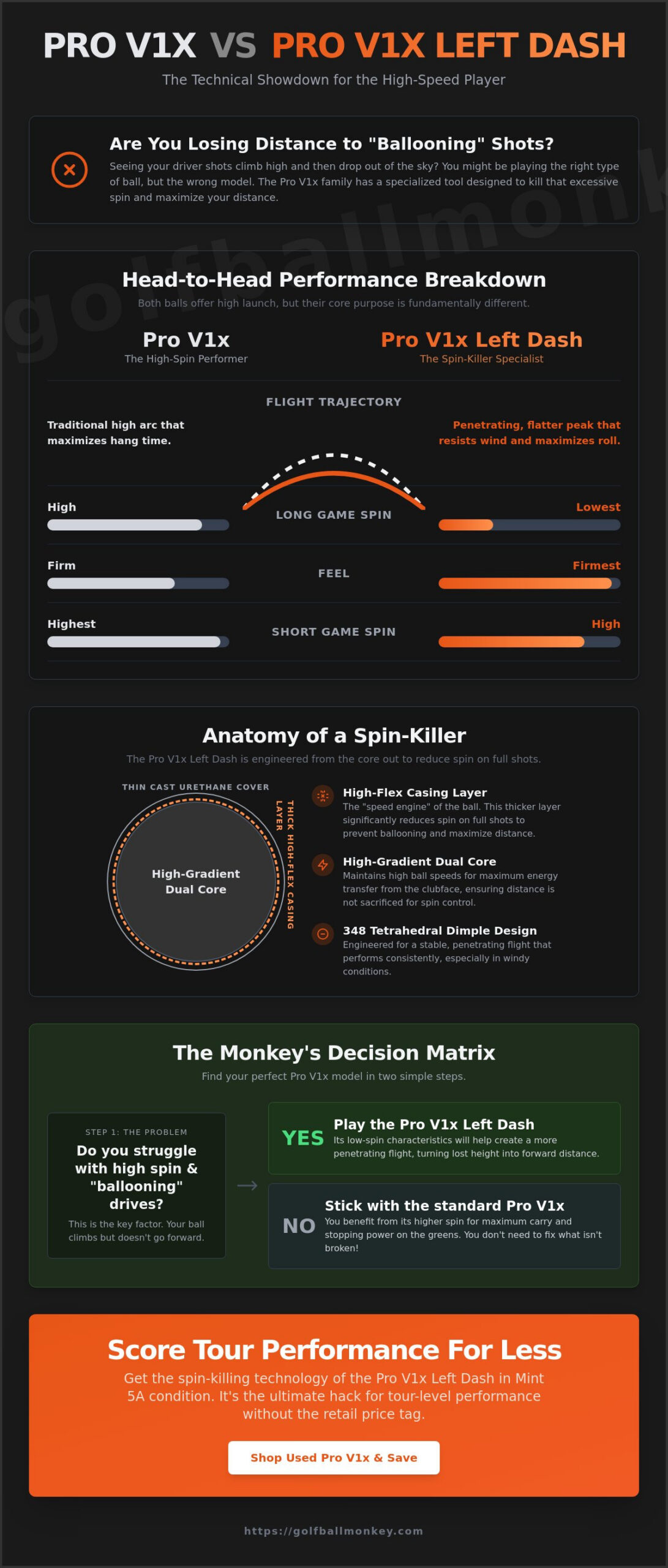
According to technical data on the Pro V1x Left Dash, the spin reduction on full swings is the primary differentiator. Here is how they stack up side-by-side:
- Flight: Both models launch high. The standard Pro V1x has a traditional high arc, while the Left Dash produces a more penetrating, “flatter” peak that resists wind.
- Spin: The Left Dash significantly reduces long-game spin. It’s designed to stay low-spin off the tee and with long irons.
- Feel: The standard Pro V1x is firm. The Left Dash is noticeably firmer. Many players describe it as having a distinct “click” off the face.
- Short Game: The standard Pro V1x wins on greenside grab. It offers the highest spin in the Titleist family for those checking chips, whereas the Left Dash offers high spin but slightly less than the standard X.
Driver Performance: Killing the Spin
Ballooning is the enemy of distance. For golfers with high swing speeds, the standard Pro V1x can sometimes generate too much backspin, causing the ball to rise too steeply and drop out of the sky. The Left Dash solves this with a thicker, high-flex casing layer. This casing layer acts as a speed engine that dampens spin. High-spin players often see 5-10 extra yards of carry simply by switching to the Dash. It uses the same high-gradient dual core found in the 2026 models to keep ball speeds peaking without the “balloon” effect. If you want to see these gains for yourself, check out our latest inventory at Golf Ball Monkey.
Iron Play and Approach Shots
Expect a high, steep landing angle with both of these premium models. This is a massive advantage when you’re trying to hold firm greens with a long iron. However, the Left Dash stays in the air longer during the mid-flight phase. This is due to its spherically-tiled 348 tetrahedral dimple design. This dimple pattern is optimized for stability. When you’re comparing a used pro v1 vs pro v1x or Left Dash, remember that the Dash might require a small yardage adjustment. Because it spins less, your mid-irons might carry 3-4 yards further than you’re used to. It’s an easy adjustment to make once you realize your “misses” are now clearing the front bunkers. Ready to restock? Grab a dozen in Mint 5A condition from our shop and start scoring for less.
The Feel Factor: Is Firmness Your Friend?
Golfers often obsess over launch monitors, but your ears tell a different story on the course. Deciding on a used pro v1 vs pro v1x involves more than just looking at spin charts; it’s about how the ball communicates with your hands. The Left Dash is the undisputed heavyweight champion of firmness in the Titleist lineup. It delivers a distinct auditory “click” at impact that provides immediate feedback. If you hit it flush, you know it. If you’re a fraction off, the ball tells you. This crispness is a massive confidence booster for players who find softer balls “mushy” or unresponsive at high swing speeds.
Let’s bust a common gear-head myth right now. Firmness does not mean this ball feels like a 1990s distance rock. We aren’t talking about those old-school range balls that vibrate through your teeth. The Left Dash is a sophisticated, multi-layer piece of technology. It feels substantial and heavy through the strike. You feel like you are actually compressing the core rather than just glancing off the cover. This “heavy hit” is exactly why many high-speed swingers have made the switch to the Dash.
Green-Side Control and Urethane Tech
Both models utilize a premium cast urethane elastomer cover. This is the same high-end material that defines the Pro V1 brand. However, the standard Pro V1x feels slightly stickier on short chips and pitches. It seems to linger on the wedge face for a millisecond longer, providing that classic “grab” sensation. If your short game relies on that aggressive one-hop-and-stop check, Shop Titleist Pro V1x for that classic tour feel. The Left Dash still offers high short-game spin, but it requires a slightly more deliberate strike to get the same level of greenside bite.
Feedback and Confidence
Your putter choice should play a major role in your decision. If you use a putter with a soft polymer insert, the firmer Left Dash provides much-needed distance feedback. It helps you “hear” the distance on 30-footers. Conversely, if you use a heavy milled steel putter, the Dash might feel a bit loud or jumpy. This is where testing a used pro v1 vs pro v1x in a Mint 5A condition really pays off. You can test the auditory feedback on your specific flatstick without committing to a full-price retail box. Confidence on the green is 90% mental, and if the sound of the ball doesn’t match your stroke, your distance control will suffer. Find the “click” that fits your game and stop guessing on the greens.
Which Ball Should You Play? The Monkey’s Decision Matrix
Stop guessing. Start scoring. When you’re weighing the used pro v1 vs pro v1x debate, the decision usually boils down to how much you’re fighting your own spin rates. Titleist didn’t create the Left Dash to replace the Pro V1x; they built it to solve a specific problem. If your driver swing speed is north of 100 mph, you’re in the prime target zone for this spin-killing machine. High speed often creates high spin, and if that spin isn’t controlled, you’re leaving 15 yards in the fairway every time you tee it up.
Use this simple breakdown to pick your weapon:
- Play the Standard Pro V1x if: You want high launch, high spin, and that firm, responsive feel. It is the best choice for players who need help keeping the ball in the air or want maximum “stop” on firm, fast greens.
- Play the Left Dash if: You already launch the ball high but see it “climb” too much and lose distance. It is also the ultimate wind ball. Because it generates significantly lower long-game spin, it cuts through a breeze without getting pushed offline or ballooning into the clouds.
The High-Spin Struggle
Is your ball curving more than a mountain road? Side spin is really just backspin tilted on an axis. If you struggle with a “leaking” slice or a hooking draw, the Left Dash can actually help straighten those lines by reducing the total spin profile. It won’t fix a bad swing, but it will certainly minimize the punishment. To see how this fits into your overall equipment strategy, check out our Golf Balls Used guide for more fitting tips. Making the right choice here is the fastest way to find more fairways without changing your move.
Testing Both Without Breaking the Bank
Don’t trust the simulator alone. Mat-side data is useful, but it doesn’t account for a 15-mph crosswind, thick rough, or the pressure of a 4-foot par putt. The simulator often struggles to capture the true nuance of the used pro v1 vs pro v1x flight path. We recommend the “Sleeve of Each” strategy. Grab a small batch of Mint 5A balls from our shop and head to the course.
Track your fairways hit and your greens in regulation over three rounds with each ball. Pay attention to how the ball reacts on your typical approach shots. If the Left Dash is carrying too far or not stopping on the greens, the standard Pro V1x is your winner. If the Pro V1x is ballooning into the wind, make the switch to the Dash. Ready to stop overpaying for performance? Grab your tour-level used balls here and let the scoreboard do the talking.
Scoring Tour Performance for Less: The Used Ball Advantage
Stop paying the retail tax on high-performance gear. The Pro V1x Left Dash is a specialized piece of equipment, and that makes it the perfect candidate for the used market. Many golfers buy a dozen at retail prices, realize they don’t have the swing speed to compress a ball this firm, and promptly donate them to the local water hazard. Their loss is your gain. When you’re looking at used pro v1 vs pro v1x options, the specialty Left Dash is the ultimate treasure for the savvy shopper. You get the exact same spin-killing technology found in a fresh box, but you keep your bank account in the green.
Every ball in our inventory has been hand-selected by professional divers and vetted through a rigorous grading process. The Monkey doesn’t do “refurbished” or “refinished” junk that hides scuffs under a layer of cheap paint. We sell the real deal. By choosing recycled, you’re also making the environmentally conscious play. You are keeping premium urethane out of the ecosystem and back on the fairway. It is the intelligent move for your game, your wallet, and the planet.
Why Mint 5A is Practically New
We take our grading scales seriously. Our Mint 5A balls are the cream of the crop. They look and play like they were just pulled from a sleeve, often showing no signs of use at all. If you want to dive deeper into the tech behind the cover, read more in Golf Balls 101. There is a common myth that used balls are “water-logged” and lose distance. Modern multi-layer balls like the Pro V1x use solid-core technology that doesn’t absorb water like the old wound balls of the 90s. In a blind test, you won’t know the difference. Your scorecard won’t either.
The Smart Player’s Play
Think about the math. A dozen new Titleist balls can cost you a fortune. When you buy a bucket of our Mint 5A stock, you’re getting tour-level performance for a fraction of that retail sting. This creates a massive mental advantage. Losing a brand-new five-dollar ball on the first hole can ruin your focus. Losing a high-quality used ball? That’s just part of the game. You’ll swing freer and play better when you aren’t worried about the cost of a reload. Stop overpaying for the logo and start paying for the performance. Grab your Pro V1x and Left Dash balls at Golf Ball Monkey today!
Level Up Your Game Without the Retail Sting
You’ve got the data. Now make the play. Choosing between the used pro v1 vs pro v1x family doesn’t have to be a gamble. If you’re fighting excessive driver spin and want a penetrating flight, the Left Dash is your specialized solution. If you crave that high-arc launch and maximum greenside check, stick with the standard Pro V1x. Both deliver Tour-level performance that can transform your scorecard. You know your numbers; now pick the ball that protects them.
Don’t let retail prices keep you from playing the best tech in the game. Every ball we sell is recovered by professional divers and vetted by the Monkey to ensure professional 5A Mint grading. You can save up to 50% compared to standard retail prices while keeping premium urethane out of the ponds. It’s the smartest move you’ll make all season. Stop overpaying for a fresh box and start scoring for less with gear that’s been personally vetted for quality.
Shop Mint Condition Pro V1x and Left Dash Balls Now and take control of your spin today. We’ll see you on the fairway.
Frequently Asked Questions
Is the Pro V1x Left Dash longer than the standard Pro V1x?
The Pro V1x Left Dash is longer only for high-speed players who struggle with excessive backspin. By neutralizing the spin that causes a ball to “balloon” and stall, the Left Dash stays in the air longer and rolls further. If you already have a low-spin profile, you might not see a distance gain. It’s a specialty tool designed to kill spin and maximize carry for the heavy hitters.
What does the Left Dash actually mean on the golf ball?
The “Left Dash” refers to the specific marking on the ball’s sidestamp. It identifies the ball as a Custom Performance Option (CPO) originally created for PGA Tour pros. This marking tells you the ball has a unique internal construction, specifically a firmer feel and a thicker casing layer. It’s the factory’s way of distinguishing this spin-killer from the standard high-spin Pro V1x.
Is the Pro V1x Left Dash discontinued in 2026?
No, the Pro V1x Left Dash is very much alive. Titleist released the latest 2026 version of the Pro V1x Left Dash on January 21, 2026. This updated model features a spherically-tiled 348 tetrahedral dimple design for even more stability in the wind. It remains a key part of the Titleist lineup for golfers who need high launch with extremely low long-game spin.
Does the Left Dash spin less with wedges?
The Left Dash spins slightly less on short shots than the standard Pro V1x. It still features a cast urethane cover for premium greenside control, so it isn’t a “distance rock” by any means. However, when comparing a used pro v1 vs pro v1x, the standard X will always offer that extra bit of “grab” and “check” on the greens that the firmer Left Dash lacks.
Can an average golfer play the Pro V1x Left Dash?
Average golfers can play it, but it’s really built for swing speeds north of 100 mph. If you don’t swing fast enough to compress this firm core, the ball might feel unresponsive and drop out of the sky too early. Savvy players with moderate speeds usually find better results with the standard Pro V1x. High-speed swingers are the ones who truly unlock the Dash’s distance potential.
What is the compression of the Pro V1x Left Dash vs Pro V1x?
The Left Dash is the firmest ball in the Pro V1 family. While Titleist doesn’t publish exact compression ratings, testing shows the Left Dash is noticeably firmer than both the Pro V1 and the standard Pro V1x. This firmness comes from a high-gradient dual core and a high-flex casing layer. This construction produces the distinct “click” sound and the heavy feel preferred by high-speed players.
How can I tell the difference between a Pro V1x and a Left Dash by looking at them?
Check the sidestamp on the side of the ball. The standard Pro V1x features a simple model name, while the Left Dash has a literal dash mark to the left of the Pro V1x text. When you’re sorting through a used pro v1 vs pro v1x haul, that tiny dash is your only visual clue that you’re holding the specialty spin-killer model. Look closely before you tee it up.
- golfballmonkey@gmail.com
- (512) 593-8401
- Mon – Fri, 9:00 AM – 5:00 PM

All product and company names are trademarks™ or registered® trademarks of their respective holders.
Use of them does not imply any affiliation with or endorsement by them.