
Is It Safe to Buy Used Golf Balls Online? The Savvy Golfer’s Guide to Savings
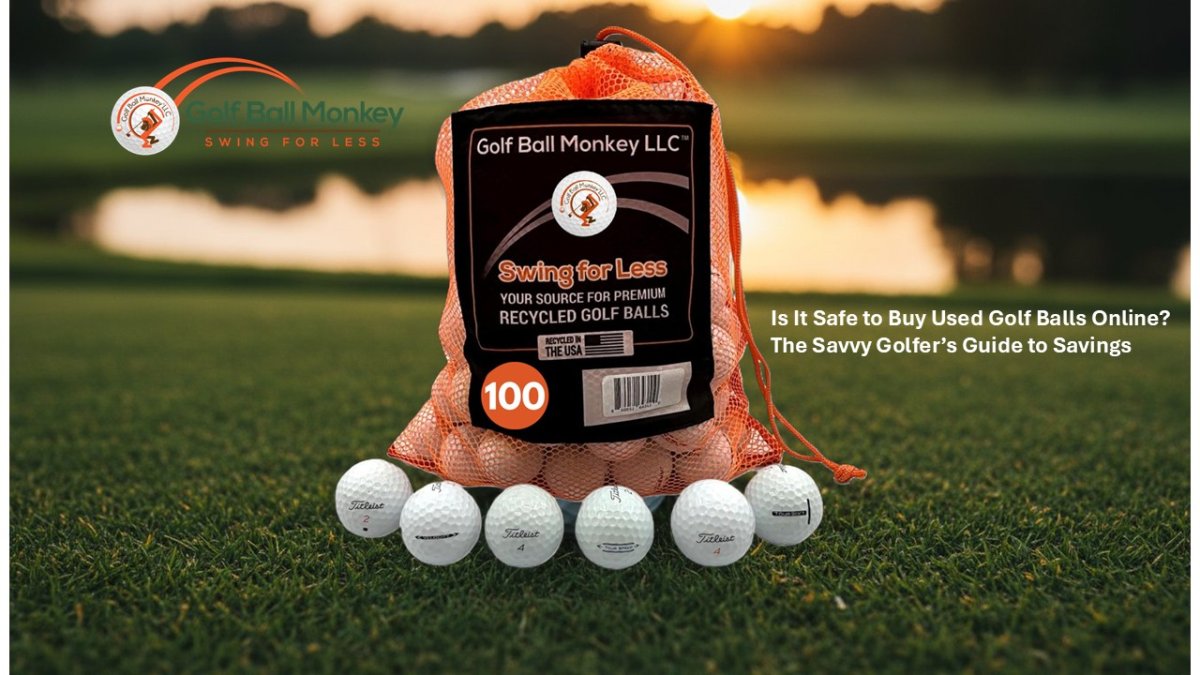
What if you could stop lighting fifty-dollar bills on fire every time you slice a brand-new Titleist into the woods? With an estimated 300 million golf balls lost in the US every single year, the smart play isn’t buying retail. It’s raiding the lost-and-found at a fraction of the cost. As online sales hit 52% of all golf equipment purchases in 2025, one question keeps every savvy player awake at night: is it safe to buy used golf balls online or are you just buying a box of water-logged duds?
We know the frustration of watching an expensive ball disappear into a murky hazard. It’s a gut punch to your wallet that takes the joy out of the game. We’re here to prove that buying used isn’t just a bargain; it’s the ultimate insider secret to playing premium gear like Pro V1s for as low as $25.99 per dozen. This guide breaks down the performance truth, explains why you must avoid refurbished balls at all costs, and reveals the grading secrets to getting Mint 5A quality at Monkey prices. Restock your bag with confidence and keep your cash for the 19th hole.
Key Takeaways
- Understand the “One Hit” reality and why used balls maintain the same flight and spin as brand-new retail versions.
- Discover how modern polymer covers have killed the water-logged myth, keeping the core dry and your distance explosive.
- Determine once and for all is it safe to buy used golf balls online by learning why recycled balls beat refurbished ones every time.
- Follow a 5-point checklist to verify sources and demand clear grading scales like Mint 5A to guarantee five-star quality.
- Slash your equipment spend and grab premium brands at Monkey prices without sacrificing a single yard of distance.
The Used Golf Ball Stigma: Is It Safe for Your Scorecard?
The stigma is real. Many golfers believe that if a ball isn’t pulled fresh from a sleeve of retail-priced Titleists, it’s somehow compromised. But let’s look at the numbers. The used ball market is exploding, with an estimated 500 million golf balls sold annually. This shift is happening because players are finally asking: is it safe to buy used golf balls online or am I sabotaging my handicap? The answer depends on how you define safety. In this game, safety means maintaining consistent flight, spin, and durability characteristics every time you make contact.
There’s a psychological barrier to playing “second-hand” gear, but it’s time for a reality check. We call it the One Hit reality. The very second you tee off with a brand-new, six-dollar ball, it becomes a used ball. It has been struck, compressed, and potentially scuffed. If you wouldn’t throw that ball away after the first hole, you’ve already admitted that a used ball is perfectly safe for your scorecard. The only difference is the price tag.
What Actually Happens to a Ball After Use?
Modern Golf ball design and construction has advanced significantly over the last decade. Today’s multi-layer balls are built with resilient cores and tough urethane covers designed to withstand incredible forces. These materials don’t just “expire” because they spent a few hours in the rough. The urethane cover acts as a shield, protecting the core’s integrity from moisture and impact. Structural safety is the ball’s ability to remain spherical and balanced under 100+ mph impact. Unless a ball has a deep, visible crack or is severely out of round, its internal engine remains ready to fire.
New vs. Used: The Performance Gap
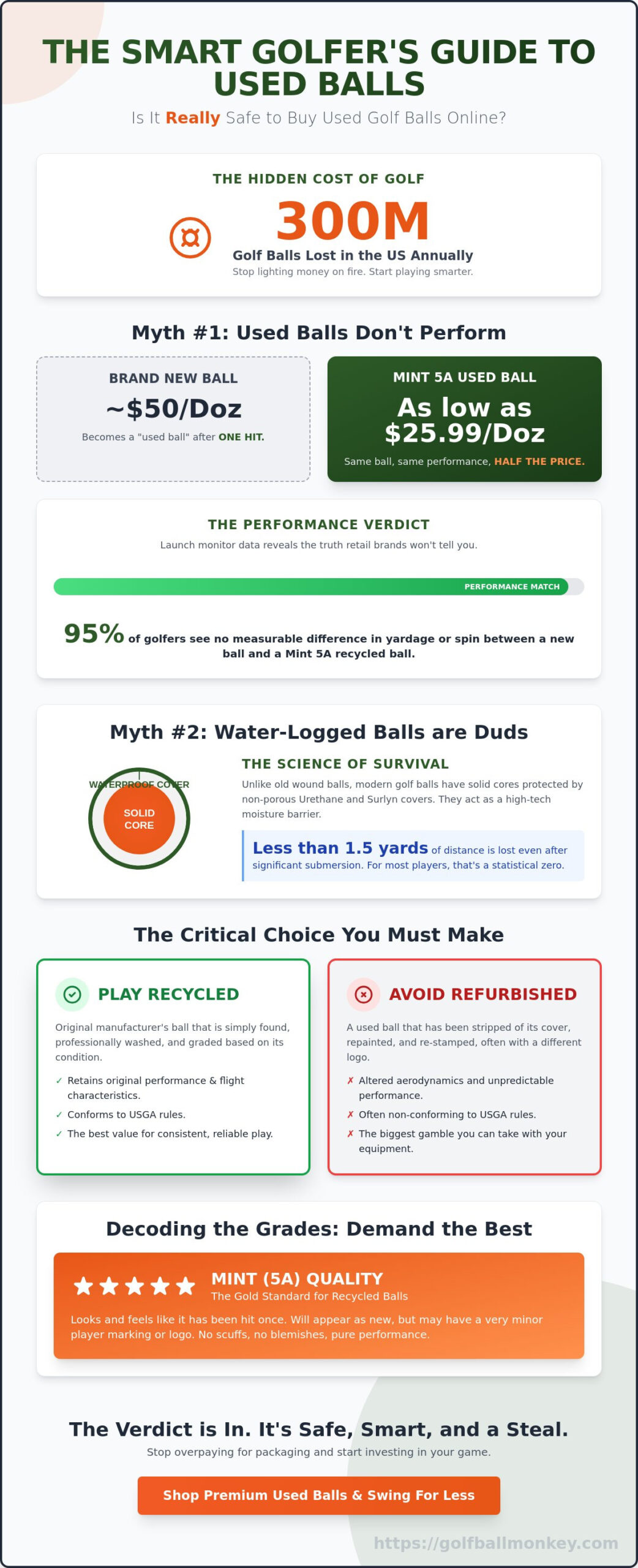
Launch monitor data tells a story that retail brands don’t want you to hear. When comparing new Pro V1s to high-grade used versions, the statistical difference is negligible for the vast majority of players. In fact, 95% of golfers won’t see a measurable difference in yardage or spin rates between a new ball and a Mint 5A recycled ball. While a major scuff can impact aerodynamics, internal damage is incredibly rare in modern manufacturing. If the cover looks clean, the ball is going to fly true. You can find these top-tier performers in our online shop at a fraction of the cost you’d pay at a pro shop. Stop paying for the packaging and start playing for the performance.
The Water-Logged Myth: Does 24 Hours in a Pond Kill Distance?
Every golfer has experienced that sinking feeling. You watch a brand-new ball disappear into a murky pond and think, “There goes five bucks.” The common fear is that once a ball hits the water, it starts soaking up liquid like a sponge, destroying its core and killing your distance. If you are wondering is it safe to buy used golf balls online when they might have been submerged, the answer is a resounding yes. Modern manufacturing has turned the “water-logged” ball into a ghost story from the 1980s that just won’t die.
Current testing data proves the fear is overblown. Research shows that even after significant submersion, the loss of carry distance is typically under 1.5 yards. For the average player, that is a statistical zero. While you might worry about a little pond water, independent testing of refinished golf balls reveals that repainted “refurbished” balls are the real threat to your game. These altered balls often fail to meet USGA standards, while recycled water balls stay true to their original high-performance specs.
The Science of Modern Ball Covers
Back in the day, balls were wound with rubber bands around a liquid center. If the cover breached, water got in and the ball was toast. Today, we play with solid-core technology. Materials like Surlyn and Urethane act as high-tech moisture barriers. They are essentially waterproof. These polymers are designed to resist the elements, meaning water cannot penetrate the core during a short stay in a hazard. Interestingly, temperature affects your ball’s performance far more than moisture ever will. A ball sitting in a hot trunk at 100 degrees loses more “pop” than one sitting in a cool 60-degree pond.
Freshness Matters: The Recovery Cycle
The Monkey doesn’t sell balls that have been sitting at the bottom of a lake since the Clinton administration. High-traffic courses have an incredible turnover rate. Professional divers recover these balls on a weekly or bi-weekly basis. Because golfers lose balls so frequently, the inventory in a water hazard is constantly refreshed. Most balls we recover have been underwater for days, not years. This rapid recovery cycle ensures the core remains pristine and the cover stays bright. Learn how we source our Titleist Pro V1 inventory to see why our retrieval process keeps quality at a five-star level. If you want tour-level performance without the retail sting, it is time to grab a bag of recycled gems and start saving.
Refurbished vs. Recycled: The Trap You Must Avoid
The golden rule of the used ball market is simple: Recycled is good, Refurbished is a gamble. If you are searching for an answer to is it safe to buy used golf balls online, your success depends entirely on avoiding the “Refurbished” trap. Many retailers use these terms interchangeably, but they are worlds apart in terms of performance. Refurbished balls, sometimes labeled as Refinished, are essentially the Frankenstein’s monsters of the golf world. They are stripped, painted, and sold as new, but they rarely play like the original gear you trust.
Refurbishing isn’t just a quick bath. Companies take beat-up, scuffed balls and sandblast the original cover to remove imperfections. Then, they spray on a fresh layer of white paint and stamp on a new logo. It looks like a brand-new Pro V1, but it’s a wolf in sheep’s clothing. This extra layer of paint fills in the dimples. On a premium ball, dimples are only about 0.010 inches deep. Adding even a thin coat of paint can change that depth by 20% or 30%. Because dimples are precision-engineered for lift and drag, filling them in ruins aerodynamic consistency. You might hit a perfect drive that suddenly drops out of the sky or wobbles like a drunk bird. Just as Lockpick Pros helps enthusiasts understand the hidden mechanical challenges in security pins, being aware of the internal state of your golf gear is essential for consistent performance.
Look for the fine print before you click buy. Legitimate sellers are required to disclose if a ball has been refinished. Often, you’ll see a small “Refurbished” stamp near the brand logo, or the packaging will use terms like “Reload” or “Refinished.” If the price looks too good for a ball that looks suspiciously shiny and perfect, it has likely been through the paint booth. The Monkey says: if it’s painted, walk away. You’re better off playing a scuffed original than a pretty fake.
Why Recycled Balls are the ‘Smart Play’
Recycled balls are exactly what they sound like. They are recovered, washed with mild soap, and sorted into quality buckets based on their original condition. No sandblasting. No repainting. You get the manufacturer’s original engineering exactly as it was intended. A Mint 5A recycled ball is the ultimate steal because it preserves the exact spin rates and launch angles of a retail ball. It’s the same ball you’d buy in the pro shop, just without the fancy box and the 50% markup.
The Hidden Dangers of Refinished Balls
The paint on refurbished balls doesn’t just ruin the flight. It hides the truth. A fresh coat of white can cover up deep structural cracks or core damage that would be obvious on a recycled ball. This leads to knuckleballs—shots that have zero spin and zero predictability. You don’t want to be standing over a 150-yard approach shot wondering if your ball is going to behave. For a guaranteed win, stick to the real deal. Check out our guide on Mint 5A vs other grades to see why our grading scale is the only one the Monkey trusts for five-star quality.
How to Safely Buy Golf Balls Online: A 5-Point Checklist
Buying used balls online shouldn’t feel like a high-stakes gamble at a shady casino. You want the massive savings without the stress of opening a box of junk. To answer the burning question, is it safe to buy used golf balls online, you just need a solid vetting process. Even with online sales hitting 52% of all golf equipment purchases in 2025, not every seller plays by the same rules. Follow this 5-point checklist to ensure every delivery is a win for your bag.
- Step 1: Demand a Clear Grading Scale. Look for the industry-standard 5A (Mint) through 3A (Good) system. If a site just says “Used” without a detailed breakdown, keep clicking.
- Step 2: Verify the Source. Ask where the balls come from. Reliable sellers, like those in our online shop, often recover the balls themselves using professional divers. This ensures a fresh recovery cycle.
- Step 3: Check the Return Policy. Safe sellers offer a satisfaction guarantee. If the balls arrive and don’t match the promised grade, you should be able to send them back without a fight.
- Step 4: Look for Real Photos. Avoid sites that only use high-gloss stock images from the original manufacturers. You want to see the actual batches of recycled inventory and how the seller classifies their grades.
- Step 5: Audit Customer Reviews. Don’t just look at the star rating. Read the comments. Specifically look for mentions of “grading accuracy” and “consistency” across multiple orders.
Decoding Grading Scales
A “Mint” ball should look and feel brand new. It should have its original luster and zero scuffs. 4A (Near Mint) balls are the ultimate sweet spot for value. These typically feature tiny cosmetic blemishes or a player’s pen mark that won’t affect flight or spin. 3A (Good/Practice) balls are perfect for the range or those casual Sunday rounds where you expect to lose a few in the tall grass. Never buy from a site that doesn’t define its grades. If the seller is vague, the quality will be too.
E-commerce Security for Golfers
Massive savings shouldn’t mean compromising your data. Ensure the site uses reputable payment processors and features the padlock icon in your browser’s address bar. Shipping insurance is also a must for bulk orders. If 12 dozen Pro V1s go missing in the mail, you want to be covered. Remember, “Monkey prices” don’t mean “Monkey business” when it comes to your security. Ready to restock with total confidence? Score a steal on premium balls today and start playing the smart way.
Why Golf Ball Monkey is the Safest Bet in the Game
You’ve seen the data. You know the science. Now, it’s time to act. If you’re still asking is it safe to buy used golf balls online, the answer becomes a definitive “yes” when you cut out the middleman. Most sites buy their inventory from random third parties and hope for the best. We don’t. At Golf Ball Monkey, we have the Diver Advantage. We don’t just sell the balls; we are the ones in the neoprene suits pulling them out of the hazards. This hands-on approach means we know exactly where every ball has been before it ever hits our warehouse.
Our grading process is borderline obsessive. While other guys might slap a “Mint” label on anything that isn’t cracked, our 5A standards are the toughest in the industry. Every single ball passes through our Texas-based quality control center. We inspect for cover integrity, original luster, and structural balance. If a ball doesn’t look like it was just pulled from a fresh sleeve, it doesn’t get the 5A stamp. This dedication to quality is why we can offer massive savings on premium brands like Titleist, TaylorMade, and Callaway without compromising your performance on the green.
The Professional Retrieval Process
Speed is everything in the recovery game. Our professional divers prioritize high-traffic courses to ensure balls are recovered quickly. This limits submersion time and keeps the cores in peak condition. It’s a massive win for your wallet and an even bigger win for the environment. We’ve turned course maintenance into a sustainable cycle that keeps millions of pounds of plastic out of local ecosystems. Shop our latest Titleist Pro V1 (Mint 5A) arrivals to see the results of our latest haul. You get five-star quality while helping us clean up the game we love.
Join the Savvy Golfer Revolution
Stop lighting money on fire at the pro shop. There is no reason to pay full retail for a ball that you might lose on the very next hole. The smart play is joining the community of golfers who prioritize performance over packaging. We stand behind every order with the Monkey Guarantee: play the best gear for a fraction of the cost, or we’ll make it right. It’s time to stop overpaying and start playing with total confidence. Is it safe to buy used golf balls online? With the Monkey, it’s the safest bet you’ll ever make on the course. Restock your bag now and save up to 70% off retail!
Stop Overpaying and Start Playing Smarter
Stop lighting cash on fire at the pro shop. You’ve seen the science. Modern solid-core balls don’t soak up water, and a 1.5-yard distance loss is basically zero for 95% of players. The real danger isn’t water; it’s the “refurbished” paint trap that ruins your aerodynamics. By sticking to recycled gear and a clear 5A grading scale, you’ve cracked the code to tour-level performance without the retail sting.
So, is it safe to buy used golf balls online? It’s the smartest play you’ll make all season. At Golf Ball Monkey, our professional divers recover inventory daily to ensure freshness. Every batch passes through our rigorous 5-star grading system at our Texas headquarters before shipping fast to your door. The Monkey personally vets every ball so you can focus on your swing, not your wallet.
Score Tour-quality balls at Monkey prices, Shop the collection now!
Grab a bag of recycled gems and keep your extra cash for the 19th hole. See you on the fairway.
Frequently Asked Questions
Are used golf balls really as good as new ones?
High-grade used balls perform identically to new ones for 95% of golfers. Launch monitor data proves that a Mint 5A ball maintains the same spin, launch angle, and carry distance as a retail version. Unless you’re a high-level scratch player, you won’t see a measurable difference in your yardage. It’s the same premium technology for a fraction of the cost, making it the smartest play on the course.
What is the difference between recycled and refurbished golf balls?
Recycled balls are washed and graded in their original condition, while refurbished balls are sandblasted and repainted. We strongly recommend avoiding refurbished balls because that extra layer of paint ruins aerodynamic consistency. It fills in dimples and causes unpredictable flight patterns. Recycled balls are the only way to guarantee you’re playing the manufacturer’s original engineering. They are safe, reliable, and way cheaper than new ones.
Can you tell if a golf ball is water-logged?
You can’t tell by looking, but the good news is that modern solid-core balls don’t really get water-logged. Tests show that even after 1,000 hours underwater, the loss of carry distance is typically less than 1.5 yards. If the cover is intact and the ball isn’t severely discolored, it’s ready for the fairway. Our divers pull these out quickly to ensure the core remains in peak condition before any moisture can penetrate.
Do used golf balls lose their ‘pop’ or compression over time?
No, modern polymers and solid cores are designed for extreme durability. A ball’s compression remains stable for years unless it’s exposed to extreme heat, like 100-degree temperatures in a car trunk. Normal storage and use won’t kill the “pop.” This is why is it safe to buy used golf balls online even if they are a few seasons old. You get the same explosive feel off the tee every time you swing.
Is it legal to use used golf balls in tournaments?
Yes, it’s perfectly legal under USGA rules for all levels of amateur play. The 2026 rule updates focus on elite professional competition and don’t restrict recycled balls for the rest of us. As long as the ball is on the USGA Conforming List, you’re good to go. Playing a high-quality used ball won’t get you disqualified from your local club championship or your favorite weekend tournament.
How many hits can a high-quality used golf ball take before it cracks?
A premium urethane-covered ball can typically handle 7 to 10 full rounds of play before the cover shows significant wear. Most golfers lose the ball in a hazard long before it ever loses structural integrity. Unless you hit a cart path or a tree at full speed, the ball stays spherical and balanced for dozens of holes. It’s built to take a beating and keep flying true round after round.
What does ‘Mint 5A’ grade actually mean?
Mint 5A is our highest quality grade and means the ball looks and plays like it was just pulled from a new sleeve. There are no scuffs, no blemishes, and no player markings. It’s the gold standard of recycled gear. Buying this grade ensures you get five-star quality at a massive discount compared to retail prices. The Monkey personally vets these to ensure they meet our strict performance standards.
Why is buying used golf balls better for the environment?
It keeps millions of pounds of plastic out of local ecosystems and water hazards. With 300 million balls lost in the US every year, recycling prevents these non-biodegradable materials from sitting in ponds for decades. Choosing recycled gear is a win for the planet and your wallet. It’s the ultimate sustainable play for the modern golfer who wants to save money while protecting the course for the next generation.
- golfballmonkey@gmail.com
- (512) 593-8401
- Mon – Fri, 9:00 AM – 5:00 PM

All product and company names are trademarks™ or registered® trademarks of their respective holders.
Use of them does not imply any affiliation with or endorsement by them.