
Callaway Supersoft Golf Balls: The Ultimate Guide to Max Distance & Soft Feel

Discover why the Callaway Supersoft is the #1 selling ball for amateur golfers and how to get that premium performance at a fraction of the retail cost.
What Makes the Callaway Supersoft the World’s Favorite Amateur Ball?
Walk into any pro shop or big-box golf store, and you’ll see a wall of golf balls. Yet, one consistently dominates the sales charts for the everyday player: the Callaway Supersoft. It’s not just about price; it’s a revolution in performance that resonates with the 90% of golfers who don’t have a tour-pro swing speed. This ball is built for you.
For years, the golf world was obsessed with hard, high-compression "distance" balls that felt like rocks off the clubface. The Supersoft changed the game by prioritizing a soft feel without sacrificing yardage. It proved that weekend warriors could have the best of both worlds.
- Key Specs: A classic 2-piece construction featuring an ultra-low compression core and a versatile hybrid cover.
- Market Dominance: It consistently outsells more complex and expensive 3-piece balls because it delivers tangible results for the players who need them most.
The 2-Piece Construction Advantage
Simplicity is the key to the Supersoft’s success. It consists of just two parts: a large inner core and a durable outer cover. This design is incredibly efficient. For golfers with moderate swing speeds, this 2-piece build maximizes the energy transfer from the clubface to the ball, converting more of your swing’s power into pure distance. It’s a durable, reliable design that holds up to the occasional off-center hit, making it a perfect match for the average player.
A History of the Supersoft Line
The Supersoft isn’t a new phenomenon. Callaway has spent the last decade perfecting this formula, listening to amateur golfers and refining the ball’s characteristics with each new version. A major breakthrough was the introduction of the PARALOID™ Impact Modifier in the cover material, which allowed for a unique blend of distance, soft feel, and short-game control. While Callaway continues to innovate, older models remain a benchmark for incredible value, delivering proven performance for pennies on the dollar.
The Science of Soft: How Callaway Engineered Max Distance
The secret to the Callaway Supersoft’s performance lies in its brilliant engineering, specifically designed to help amateur golfers launch the ball higher, straighter, and longer. It all starts with a concept that tour pros obsess over: compression.
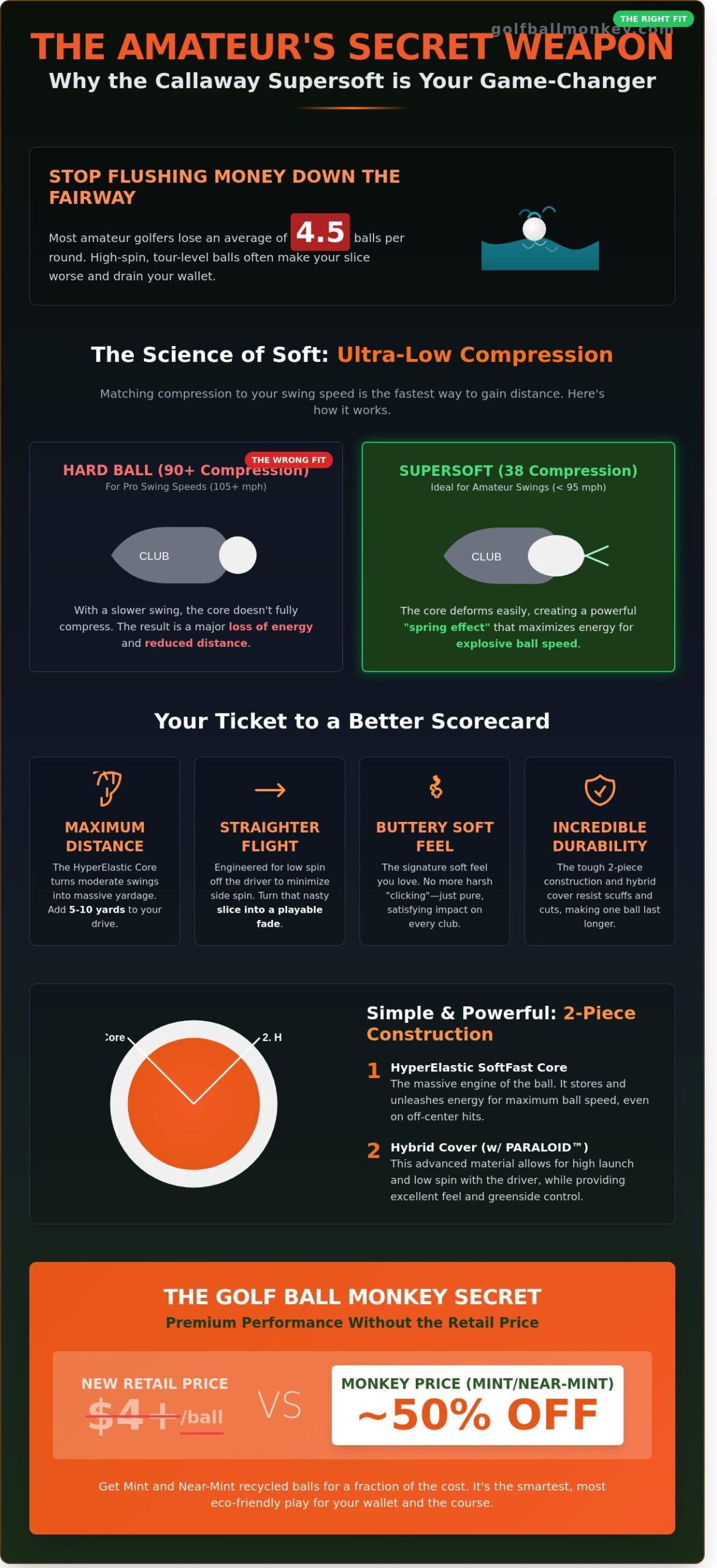
At the heart of the ball is the HyperElastic SoftFast Core. Think of it as a tightly wound spring. At impact, this ultra-low compression core squishes and stores energy, then releases it explosively for incredible ball speed. Critically, this design also reduces spin off the driver. Less backspin and less side-spin mean your drives fly on a straighter, more penetrating trajectory instead of ballooning or slicing into the trees.
What is a Low Compression Golf Ball?
In simple terms, compression is the measure of a golf ball’s "squish" under the force of impact. The Callaway Supersoft has a compression rating around 35-40, whereas a tour-level ball like a Pro V1 is rated at 90 or higher. Golfers with slower to moderate swing speeds benefit most from a low-compression ball because they can more easily "squish" it at impact, activating the core and unlocking maximum distance.
Decoding the PARALOID™ Hybrid Cover
The cover is where speed meets feel. Callaway’s innovative PARALOID™ Hybrid Cover material is a game-changer. It moves beyond the traditional, hard Surlyn covers of old distance balls. This material allows for a unique combination of benefits:
- High Launch & Low Spin: It promotes a high launch off the driver and long irons for more carry distance.
- Better Wedge Grip: It provides a noticeably better feel and more control around the greens than typical 2-piece balls.
- HEX Aerodynamics: The signature dimple pattern reduces drag, helping the ball cut through the air for a longer, more stable flight.
Real-World Performance: Distance, Spin, and Feel Tested
Lab data is one thing, but how does the Callaway Supersoft perform on the course? For its target audience, the results are undeniable.
- Driver Performance: Golfers with swing speeds in the 75-95 mph range often see a significant "distance jump." The combination of high launch and low spin is the perfect recipe for maximizing carry and roll.
- Iron Play: Shots feel wonderfully soft and muted at impact. The consistent flight provides confidence when aiming at the green, and the low spin helps reduce the severity of hooks and slices.
- Putting Feel: On the green, the soft cover provides excellent feedback. It feels responsive off the putter face, making it a favorite for players who rely on touch and feel to control their distance.
Driver Distance for Moderate Swing Speeds
If your swing speed is between 75-95 mph, you are in the Supersoft’s sweet spot. This ball is engineered for you to compress it fully, resulting in optimal energy transfer. Interestingly, players with very high swing speeds (105+ mph) might lose distance with this ball because they over-compress it, leading to less efficient energy release. For the rest of us, the "Straight Flight" factor is a massive bonus, as the low-spin characteristics help keep those off-center hits in the fairway.
Around the Green: Managing Expectations
Here’s the honest trade-off: a 2-piece, low-spin ball won’t check up on the green like a premium tour ball (like a Chrome Soft or Pro V1). You won’t get that aggressive, one-hop-and-stop action on wedge shots. However, the soft hybrid cover still provides plenty of confidence on chips and pitches. Smart golfers learn to play for a little more roll-out, utilizing the classic "bump and run" to get the ball close to the hole.
Is the Supersoft Right for Your Game? A Selection Guide
Choosing the right golf ball is one of an amateur’s most important equipment decisions. If you fit the profile below, the Callaway Supersoft could be the perfect match for your game.
- The ‘Sweet Spot’ Swing Speed: Ideal for golfers with driver swing speeds under 100 mph.
- Feel vs. Firm: If you dislike the harsh, "clicky" feel of hard distance balls, the Supersoft will be a revelation.
- Common Miss: If you fight a slice or a hook, the low-spin nature of the Supersoft can help straighten out your ball flight.
- The #1 Sign to Switch: If you currently play a premium, high-compression ball but feel like you aren’t getting the distance you deserve, it’s a clear sign you should switch to a softer model.
The Swing Speed Test
Don’t have access to a launch monitor? No problem. You can estimate your swing speed based on your average driver distance. If you typically drive the ball between 180 and 240 yards, you’re likely in the perfect zone for the Supersoft. The ultimate test is feel. If a ball feels "heavy" or "mushy" off the clubface, it might be too soft. If it feels like hitting a rock, it’s too firm. The Supersoft should feel lively and responsive. And remember the Golf Ball Monkey Rule: If you slice it, soften it.
Color and Visibility Choices
The Supersoft isn’t just about performance; it’s also about fun and practicality. It comes in a huge range of colors, including traditional white, high-visibility yellow, and a variety of matte finishes (green, red, orange). These matte colors are not just for show; they reduce glare on sunny days and are incredibly easy to spot in the rough or in overcast conditions, speeding up play and reducing lost balls.
Why Buying Used Callaway Supersoft is the Smartest Play in Golf
You’re convinced the Supersoft is the right ball. Now, here’s the secret to playing it without breaking the bank. Forget paying full retail. The single smartest play in golf is buying premium recycled Callaway Supersoft balls.
This isn’t about playing scuffed-up range balls. This is about getting pristine, high-performance balls for up to 70% off.
- The Golf Ball Monkey Price Advantage: Get that same incredible soft feel and max distance for a fraction of the cost. Why pay $25/dozen when you can get them for much less?
- Eco-Friendly: Every recycled ball you buy is one less piece of plastic sitting at the bottom of a pond. It’s a win for your wallet and a win for the course.
- Performance Retention: A high-quality used ball that has only been hit a few times before finding a water hazard loses virtually none of its original performance. The myth of "water-logged" balls has been largely debunked for modern golf balls.
The Math of the Smart Golfer
Let’s do some quick math. A new box of Callaway Supersofts costs around $25. If you’re a typical golfer who plays 50 rounds a year and loses a few balls per round, you could easily spend hundreds of dollars. By switching to Mint 5A recycled Supersofts from Golf Ball Monkey, you can cut that cost by more than half. That’s money you can spend on green fees, lessons, or a new wedge. If you want to explore the full range of Callaway golf balls and find the right model for your swing speed and budget, our complete guide breaks down every option available.
Check out our current inventory and see the savings for yourself: Shop Used Callaway Supersoft Balls at Golf Ball Monkey
Understanding Mint 5A Quality
When you see "Mint 5A" at Golf Ball Monkey, it means you’re getting the best of the best. These balls are retrieved by our professional divers, then put through a rigorous cleaning and hand-sorting process right here in Texas. A 5A ball is like new, with no player marks, scuffs, or blemishes. It’s the perfect ball for both your weekend money game and your daily practice sessions, giving you tour-level quality at a price that makes sense for every golfer.
Frequently Asked Questions
Is the Callaway Supersoft good for high handicappers?
Absolutely. It’s one of the best balls for high handicappers because its low-spin characteristics help reduce slices and hooks, leading to straighter shots. The soft feel also provides great feedback, and the affordable price point (especially when bought used) takes the sting out of losing a few during a round.
What is the compression of a Callaway Supersoft ball?
The Callaway Supersoft has an ultra-low compression rating, typically around 35-40. This makes it easy for players with moderate swing speeds to compress the ball for maximum distance.
Do Callaway Supersoft balls go further than Pro V1s?
For the right player, yes. A golfer with a slower swing speed (e.g., 85 mph) will likely get more distance from a Supersoft than a high-compression Pro V1 because they can compress the Supersoft more effectively. A high-speed player (110+ mph) will get more distance from the Pro V1.
Are the matte finish Supersoft balls different in performance?
No, the performance is identical. The matte finish is a paint and finishing process that affects the ball’s appearance and visibility but does not change its core, cover, or aerodynamic performance.
How many layers is the Callaway Supersoft?
The Callaway Supersoft is a 2-piece (or two-layer) golf ball, consisting of a large inner core and a soft outer cover.
Can I use the Supersoft if I have a fast swing speed?
You can, but it may not be optimal. Players with very fast swing speeds (over 105 mph) may "over-compress" the Supersoft, leading to a potential loss of distance and control compared to a firmer, tour-caliber ball.
What is the difference between Callaway Supersoft and Soft Feel?
Callaway Supersoft is a model made by Callaway Golf. "Soft Feel" is a competing golf ball model made by Srixon. Both target a similar audience of amateur golfers seeking a soft-feeling, low-compression ball. For a deeper look at how the full lineup of Callaway golf balls compares across models and price points, our savvy golfer’s guide covers everything you need to know.
How long do used Callaway Supersoft balls last?
A high-quality Mint 5A used Supersoft will last just as long as a new one. Modern golf balls are incredibly durable. You are far more likely to lose the ball in the woods or water before you ever wear out its cover from normal play.
- golfballmonkey@gmail.com
- (512) 593-8401
- Mon – Fri, 9:00 AM – 5:00 PM

All product and company names are trademarks™ or registered® trademarks of their respective holders.
Use of them does not imply any affiliation with or endorsement by them.