
Soft Feel or More Spin: Which Golf Ball Fits Your Game
The value ball can beat a tour ball off the tee, but that doesn’t settle the match. Kirkland Signature golf balls deserve a fresh look: in one driver test, Kirkland Performance+ totaled 267.75 yards, just ahead of Titleist Pro V1 at 266.61, while the Pro V1 produced about 100 RPM more spin on wedge shots. The V3.0’s three-piece construction makes it a serious comparison, not an automatic tour-ball replacement.
If you’ve wondered whether the newer Kirkland version is a real step forward, you’re asking the right question. Feel, spin, and distance don’t all point to the same winner. The answer depends on whether you value a softer sensation, tee performance, or control on short shots. This guide looks at who makes the balls, what their construction and testing suggest about feel and spin, and how Kirkland Performance+ compares with a Titleist Pro V1. Then you’ll get a practical decision guide to help match the ball to your game, without paying for performance you won’t use.
Key Takeaways
- Compare the V3.0’s construction and compression details to understand what the version tells you about the ball.
- Use feel as a fit factor: the core and your response to impact can shape whether a ball feels right in your hands.
- Separate driver spin from wedge spin. A ball’s performance off the tee won’t tell the whole story around the green.
- Weigh the Pro V1 comparison by shot type, so you can see where the Kirkland Performance+ holds its own and where the tour ball pulls ahead.
Who Makes Kirkland Golf Balls?
Kirkland Signature is the label golfers see, not the name of a factory. Product details identify the balls by version and specifications, rather than naming a manufacturer. That makes the version important: don’t assume every Kirkland ball has identical construction or consistency.
The Kirkland Signature Performance Plus V3.0 is a three-piece ball with a 338-dimple pattern. It’s white, has a compression rating of 93, and conforms with USGA and R&A Rules. A separate estimate describes its compression as medium-high, about 90. Treat those figures as different descriptions, not interchangeable measurements.
Consistency deserves a closer look. In one tested sample, Kirkland Performance+ showed a six-point compression difference; the Titleist Pro V1 sample showed less than a three-point difference. That’s a potential quality-control concern for golfers who want a uniform feel from ball to ball. It doesn’t establish that every package has the same variation.
Used-ball condition also affects value. Mint-grade balls show no or very little wear and retain their original color and sheen. Compare visible condition, then calculate the cost per ball for the same version and pack size. A lower total price can be misleading if the pack contains fewer balls or they show more wear.
| Option | Construction or condition | What to compare |
|---|---|---|
| Performance Plus V3.0 | Three-piece; 338 dimples | Version and compression description |
| Used, Mint grade | No or very little wear | Color, sheen, and condition |
| Other used grades | Condition varies by grade | Wear and cost per ball |
Among common complaints, variation in measured compression is the clearest quality-control concern in the comparison. When assessing Kirkland Signature golf balls, consider version and condition together rather than treating the label alone as a guarantee of consistency.
Before comparing value per ball, match the version, pack size, and used-ball condition.
Low-compression core and soft feel
The Kirkland Signature Performance Plus pairs a low-compression, highly elastic core with a feel that one reviewer rated 7 out of 10. That score suggests a fairly soft response, not a universal verdict. Feel depends on the golfer, the club, and the strike. A short putt and a full iron shot deliver different feedback, even with the same ball.
Compression describes how much a ball deforms under force. A lower-compression design generally feels softer at impact, while a firmer response feels more solid. But the number alone can’t tell you exactly how a ball will feel. Core elasticity, cover construction, and strike quality all shape the sensation. Treat compression as one useful clue, not a complete picture of feel.
The V3 compression figures deserve careful interpretation. Its listed rating and the separate medium-high estimate are different descriptions of compression, not proof that every golfer will experience the ball as firm. Ratings also don’t directly translate into a personal feel score. The practical test is simple: note the sound and impact sensation on putts, chips, and full swings, then compare those impressions across the same clubs.
- On putts: Notice whether impact feels muted or crisp.
- On chips: Compare the sound and feedback on short contact.
- On full swings: Focus on whether the strike feels comfortable and controlled.
A 7-out-of-10 review score is one person’s assessment, not a promise of a particular sensation for every player. If you’re choosing between a softer response and a firmer one, use the same club and similar strikes to make a fair comparison. That keeps the feel test focused instead of letting swing changes muddy the result.
Once you know the response you prefer, browse Kirkland Signature balls in Mint 5A condition as one option for your next round.

Spin control from long shots to wedges
Driver spin and wedge spin tell different parts of the story. In a driver test at 100 mph, the Kirkland Performance+ recorded 2,857 RPM, compared with 2,765 RPM for Titleist Pro V1. More driver spin can influence flight, so the number alone doesn’t decide which ball travels farther. In that test, Kirkland carried 239.82 yards and totaled 267.75 yards.
Closer to the green, the gap shifted. A wedge test designed to replicate a greenside shot of approximately 40 yards measured 5,566 RPM for Kirkland Performance+ and 5,675 RPM for Pro V1. The urethane cover is designed for greenside control, but the test showed Pro V1 producing more wedge spin. More spin can help a shot stop sooner, while the landing surface and strike also affect the result.
For distance, spin, feel, and durability, the results are mixed: Kirkland performed strongly in the cited driver test, while Pro V1 generated more wedge spin. A reviewer rated Kirkland’s feel 7 out of 10, and reported durability extends to several rounds, with one golfer using the same ball for four rounds.
Beginners and higher-handicap golfers can use Kirkland balls; the practical fit depends on their priorities, such as greenside control or driver performance. A 100 mph driver test describes that test setup, not every swing speed, so golfers with different speeds should judge ball flight and contact across their own clubs.
Full-shot spin also affects stopping power. On an approach, a ball that lands and releases may suit a player who prefers predictable rollout; a shot that checks quickly calls for more greenside control. Compare similar shots rather than judging a ball by a single drive. For example, test an iron approach and a short wedge separately, then note whether each finishes where you intended.
Kirkland Performance+ compared with Titleist Pro V1
The fair comparison isn’t “cheap versus tour.” It’s which shots matter most to your score. In a 7-iron test, Kirkland Performance+ carried 167.41 yards, while Titleist Pro V1 carried 173.47 yards. That gap may matter if you rely on predictable iron distances. It won’t tell you how either ball performs on every swing or course.
Launch-monitor results also showed Kirkland traveling 6 yards less through the air than Pro V1. That’s useful context, not a universal distance rule. Your strike, launch, and course conditions affect the outcome. Judge the balls with the same club and comparable swings, then focus on carry and landing position rather than one impressive total.
| Ball | 7-iron carry | Comparison point |
|---|---|---|
| Kirkland Performance+ | 167.41 yards | Shorter carry in this test |
| Titleist Pro V1 | 173.47 yards | Longer carry in this test |
Short-game performance is another separator. A review described Kirkland’s performance inside 50 yards as inferior to a premium ball. That matters if you need shots to check close to the pin. A golfer who plans for more rollout may weigh that trade-off differently. Match the ball to the shots you actually face, not just the longest drive on the card.
Consistency can factor into the choice, too. The tested Kirkland sample had a six-point compression difference, while the Pro V1 sample varied by less than three compression points. Those sample results point to a difference in measured consistency, but don’t establish what every ball will feel like. The clearest takeaway: Kirkland can compete on value and performance, while Pro V1 showed an edge in iron carry and tested consistency.
Compare golf balls for your next round by focusing on what matters to your game, especially iron carry and short-game control.
Golf Ball Monkey: Kirkland Signature (Mint 5A)
Golf Ball Monkey gives you a practical next step once you’ve weighed Kirkland’s feel and spin against a tour ball. Choose Kirkland Signature (Mint 5A) if you want to play the Kirkland option discussed here. Mint-grade balls show no or very little wear and retain their original color and sheen.
If your priority is comparing premium-ball options, Golf Ball Monkey also offers Titleist Pro V1 (Mint 5A), Titleist Pro V1x (Mint 5A), and Callaway Chrome Soft (Mint 5A). Use your own priorities from the comparison: how the ball feels, how it performs on approach shots, and what you want from your game. That keeps the decision grounded in your play, not just the label.
Contact Golf Ball Monkey if you’d like to discuss your golf ball options.
Choose Your Next Ball With a Clear Benchmark
Make your next choice deliberately. Start with the shot you most want to improve and use it as your benchmark during practice. Track whether a ball gives you the flight, control, or feel you prefer. A simple note after each session can help distinguish a genuine preference from one memorable shot. Kirkland Signature golf balls are one option; the best fit is the ball that supports the parts of your game you want to trust.
If you’d rather compare familiar alternatives, Golf Ball Monkey offers Titleist Pro V1 (Mint 5A), Titleist Pro V1x (Mint 5A), and Callaway Chrome Soft (Mint 5A). Use those choices to build a comparison around your priorities, not someone else’s idea of the perfect ball.
Contact Golf Ball Monkey for help choosing your next golf ball, then head into your next round ready to play with confidence.
Frequently Asked Questions
Kirkland Version 3.0: A new hope?
V3.0 offers a fresh option, but whether it suits you depends on your priorities. Its specifications give golfers concrete details to compare, while playing tests help show how those details translate into your shots. Treat the version as a reason to reassess the ball, not proof that it will outperform every earlier model for every golfer.
What are Kirkland Signature golf balls, and which models are discussed here?
Kirkland Signature golf balls are golf balls sold under Costco’s Kirkland Signature label. The models discussed in this guide are Performance Plus and V3.0. Names can appear together in descriptions, so use the exact version printed on the package when matching specifications or test results. That simple step helps avoid applying details from one generation to another.
How much do these golf balls cost in the United States?
In the United States, price depends on the seller, package quantity, version, and whether the balls are new or used. Compare the cost per ball, not just package totals, and account for condition when assessing used options. A lower package price may reflect a different quantity or more visible wear, so compare like with like.
What are the specifications, including construction, compression, and cover?
The V3.0 is described as a three-piece ball with 338 dimples, a urethane cover, and a compression rating of 93. A separate description estimates medium-high compression at about 90. These figures are presented differently, so don’t treat them as identical measurements. Check the version name alongside specifications because product details can vary across generations.
How do they compare with Titleist Pro V1 and other premium balls?
Kirkland Signature golf balls and Titleist Pro V1 show different strengths across the tests discussed in this guide. Pro V1 carried farther in the cited 7-iron test, while Kirkland performed strongly in driver testing. For a useful on-course comparison, hit each ball with the same club and note carry, landing, and rollout. Your short-game priorities matter, too.
What do independent tests and reviews say?
Tests and reviews offer a mixed picture, assessing driver spin, iron carry, wedge spin, feel, and compression consistency. Each result reflects its particular test setup, rather than predicting every golfer’s experience. Use the findings to identify which shot type deserves attention, then compare your own results with the same club and similar contact. This gives test data a practical role in your decision.
TaylorMade TP5 and TP5x: The Ultimate 2026 Performance Comparison
Why are you still paying nearly sixty bucks a dozen just to watch your premium gear disappear into the lake? It’s a gut-wrenching feeling that every golfer knows too well. You want the elite 5-layer performance of the tp5 and tp5x, but the retail price tag feels like a penalty stroke before you even tee off. We get it; the struggle between wanting the best equipment and protecting your wallet is real.
In this guide, we’re diving deep into the 2026 performance comparison to settle the debate once and for all. You’ll discover exactly which model matches your swing speed and spin needs. We’re stripping away the confusing technical jargon to focus on what actually matters: more distance and better greenside control. The Monkey has personally vetted our stash to ensure you can score these elite balls in Mint 5A condition for a fraction of the retail cost. We’re looking at the specific differences in feel, launch, and aerodynamics so you can make the intelligent play on every single hole.
Key Takeaways
- Decode the 5-layer tech. Get the lowdown on how the Tri-Fast Core and Dual-Spin Cover actually work to boost your game.
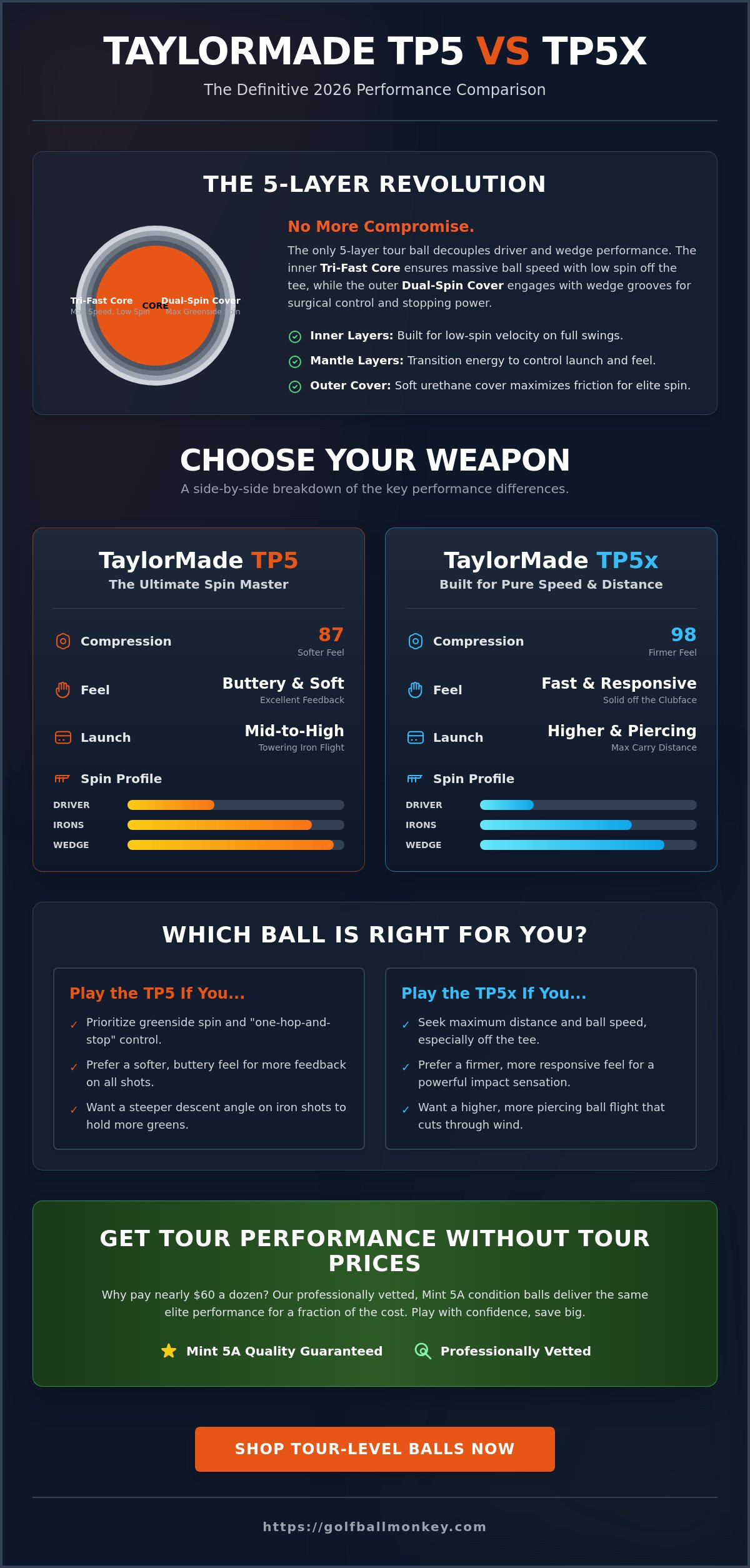
- Choose your weapon. Compare the soft 87 compression of the TP5 against the high-velocity 98 compression of the TP5x to find your perfect match.
- Stop guessing on the green. Discover how the specific spin profiles of the tp5 and tp5x help you stick more approach shots and lower your scores.
- Save big on Tour performance. Learn the secret to getting Mint 5A quality balls for a fraction of the cost of retail packs.
- Play with confidence. See why the Monkey’s vetting process ensures every ball meets the highest standards for performance and consistency.
TaylorMade TP5 and TP5x: The 5-Layer Revolution
TaylorMade didn’t just add extra layers to their flagship balls for the sake of a marketing gimmick. While most “premium” brands are content to stay in the three or four-layer lane, the tp5 and tp5x lineup stands alone as the only major 5-layer Tour ball on the market. It’s a bold engineering choice that pays dividends on your scorecard. Think of it as a precision engine where every gear has a specific job to do, from the moment of impact to the final roll on the green.
The secret to this performance lies in the combination of the Tri-Fast Core and the Dual-Spin Cover. The Tri-Fast Core consists of three inner layers designed to maximize energy transfer. When you’re swinging the big stick, these layers compress together to generate massive ball speed with low spin. Conversely, the Dual-Spin Cover features a soft urethane outer layer that interacts with your wedge grooves for surgical control. This sophisticated construction represents some of the most significant modern advancements in golf ball aerodynamics, allowing for a massive split between pure speed and greenside stopping power.
Why 5 Layers Actually Matter
Most golf balls force you into a compromise. You either get a “rock” that flies forever but feels like a marble around the green, or a “marshmallow” that spins like crazy but dies off the tee. These five layers effectively decouple those traits. The internal layers focus on reducing driver spin to keep your tee shots piercing and straight, while the outer layers react to shorter, slower swings to provide that “one-hop-and-stop” action. Simply put, 5-layer tech is the ultimate bridge between raw distance and delicate greenside feel.
- Inner Layers: Built for low spin and high velocity on full swings.
- Mantle Layers: Help transition energy and control the launch angle.
- Outer Cover: Maximizes friction with club grooves for elite spin.
The 2026 TaylorMade Lineup at a Glance
The 2026 models take everything TaylorMade learned from previous generations and dials it up. They’ve maintained the “Soft Tough” urethane cover that players love but introduced a new microcoating paint process. This ensures better consistency across the entire surface of the ball, meaning fewer “flyers” and more predictable results. Professional sticks like Rory McIlroy and Collin Morikawa are already gaming these for the 2026 season, which tells you everything you need to know about the quality. The best part? The Monkey has already vetted these 2026 gems for our online shop. You get the same Tour-level engineering without the soul-crushing retail price.
TaylorMade TP5: The Ultimate Spin Master
If you’re tired of watching your approach shots skip off the back of the green like a stone on a pond, the TP5 is your new secret weapon. In the battle between the tp5 and tp5x, the TP5 is the undisputed king of spin and feel. It features a soft 87 compression that provides a buttery sensation at impact. This isn’t just about comfort; that lower compression allows the ball to stay on the clubface longer. This increased dwell time is exactly what generates the elite spin rates needed to tuck pins and save par from tricky lies.
This ball is specifically engineered for the player who prioritizes control over raw, brute force. According to in-depth performance data, the TP5 produces a mid-to-high launch profile with irons that helps amateur golfers keep the ball in the air longer. It’s the ideal choice if you struggle with low, “screamer” shots that refuse to stop. You get a ball that works with you, providing a towering flight that holds its line even when the wind starts to kick up. You can find these high-performance gems in our TaylorMade TP5 (Mint 5A) collection for a price that won’t make your wallet cry.
Greenside Control and Wedge Performance
Around the green, the TP5 performs like a dream. On those critical 35-yard and 50-yard wedge shots, it delivers the “check and stop” behavior that pros rely on. The feel is often described as hitting a pillow; it’s incredibly soft yet remarkably responsive. You’ll feel the cover grab the grooves of your wedge, giving you the confidence to fly the ball further toward the hole knowing it will bite hard on the second hop. It’s pure surgical precision for your short game.
Iron Play and Descent Angles
The magic of the TP5 extends to your full iron shots. Because it spins more than its firmer sibling, it creates a steeper descent angle. This means the ball falls more vertically onto the green, reducing the amount of roll-out after it lands. This stability makes it much easier to predict where your ball will finish. For a deeper look at how TaylorMade refined this technology over the years, check out our TaylorMade Golf Balls guide. Whether you’re attacking a tight flag or trying to clear a front bunker, the TP5 gives you the stopping power to play aggressively.
TaylorMade TP5x: Built for Pure Speed and Distance
If the TP5 is the scalpel of the golf world, the TP5x is the sledgehammer. It’s designed for the player who wants to look their playing partners in the eye and say, “I’m hitting it past you.” While the choice between the tp5 and tp5x usually comes down to feel, the “x” model is unapologetically built for velocity. It features a 98 compression rating. That’s a significantly firmer construction than its sibling. This extra stiffness isn’t just for show; it’s the engine that drives incredible ball speeds for players with faster swing speeds.
The big differentiator here is the spin profile off the tee. The TP5x is engineered to stay low on the spin axis when you’re using the big stick. This prevents your ball from “climbing” or ballooning into the wind, which is a common distance killer. To compensate for this lower spin, TaylorMade designed the ball to launch higher. You get a piercing, towering trajectory that carries further and rolls out once it hits the short grass. It’s a high-launch, low-spin monster that turns your driver into a weapon of mass yardage. You can find these speed-focused gems in our current inventory at prices that make buying retail feel like a mistake.
Bombing It Off the Tee
High-swing-speed players often struggle with over-compressing softer balls, which leads to erratic flight. The 98 compression core in the TP5x resists this, ensuring all your swing energy converts into forward momentum. As noted in the details of the latest TP5 and TP5x models, the 2026 version maximizes this “spring” effect off the clubface. The TP5x is the speed demon of the TaylorMade family.
Iron Distance and Wind Stability
Don’t think this ball is only for the driver. The TP5x excels in the wind. Its lower spin profile means it doesn’t get pushed around by crosswinds as easily as higher-spinning models. Some pros actually prefer the firmer “click” at impact because it provides immediate auditory feedback on where the ball hit the face. The 2026 aerodynamic improvements, specifically the Tour Flight Dimple Pattern, reduce drag during the initial ascent. This keeps your iron shots on a more stable, piercing line even when conditions are less than ideal. You get more consistent yardages and fewer surprises when you’re hunting flags.
TP5 vs TP5x: The Decision Framework
Choosing between the tp5 and tp5x doesn’t have to feel like a physics exam. It’s actually quite simple. Think of the TP5 as your “Stop” ball and the TP5x as your “Go” ball. If you want maximum greenside check and a soft feel, you’re a TP5 player. If you want to squeeze every yard out of your driver and prefer a piercing flight, grab the TP5x. It’s the same logic used in our Pro V1 vs Pro V1x guide; one is built for control, the other for speed.
A common worry is that the TP5x might be “too hard.” Don’t let the 98 compression scare you. It isn’t a range rock. It’s a high-performance engine. That firmness is exactly what prevents the ball from deforming too much at high impact, keeping your energy focused on forward momentum. If you like a “clicky” sound and a ball that jumps off the face, the “x” is your friend. If you prefer a muted, “thud” sensation, stick with the standard TP5.
Swing Speed and Feel Preferences
Your swing speed is a great starting point for this decision. Generally, if your driver swing is under 95 mph, the 87 compression of the TP5 will likely feel more responsive and easier to “activate.” If you’re consistently over 105 mph, you’ll benefit from the stability of the TP5x. It won’t over-spin or balloon on you when you really step on one. Look at your typical miss. Do you struggle to hold greens? Go TP5. Do you struggle with a spinning, weak flight that gets killed by the wind? Go TP5x.
The “Monkey Test” for Your Game
The best way to decide is to take both to the chipping green. Hit ten identical 20-yard pitches with each. You’ll immediately notice the TP5 checking up shorter. Then, head to the tee and listen. That auditory feedback is a huge part of confidence. Use this quick cheat sheet to see where you land:
- TP5: 87 Compression, Mid Launch, Highest Spin, Softest Feel
- TP5x: 98 Compression, High Launch, Mid/Low Spin, Firmer Feel
Ready to stop overpaying for Tour performance? Make the intelligent play and grab a Mint 5A dozen to see which one transforms your score today.
Tour Performance for Less: The Savvy Players Move
Stop lighting your hard-earned cash on fire. We’ve spent this guide breaking down the elite tech inside the tp5 and tp5x, but there’s one massive hurdle left: the retail price. Paying top dollar for a box of balls just to donate them to the nearest water hazard is a strategy that hurts your wallet and your confidence. There’s a better way to play the best equipment in the world without the “new ball” tax. It’s time to join the community of savvy insiders who know that performance doesn’t have to come with a retail receipt.
The smart play is simple. Grab Mint 5A used TaylorMade balls. Some golfers worry that a ball that’s been out of the box loses its pop. That’s a total myth. Unless a ball has been sitting at the bottom of a pond for years, modern multi-layer construction is incredibly durable. Our vetting process ensures you’re getting balls that were likely hit once and lost, or sat in a bucket in someone’s garage. The Monkey personally inspects every batch to make sure the tp5 and tp5x inventory we ship out performs exactly like the ones on the pro tour. You get the same launch, the same spin, and the same distance for a fraction of the cost.
What is Mint 5A Grade?
Mint 5A is our gold standard. These balls look and play like they just came out of a fresh sleeve. You might find a tiny player mark or a corporate logo, but the cover and core are flawless. It’s the ultimate hack for the serious golfer. You’re getting 100 percent of the performance for about half the price of the big-box stores. For a deeper dive into how we grade our inventory, check out our Used Golf Ball Guide. It’s the blueprint for building a high-performance bag on a budget.
Build Your Bag for 2026
Consistency is the secret to lower scores. You can’t jump between different models every three holes and expect to master your distances. Because our prices are so low, you can afford to buy in bulk and play the same ball every single round. We have a massive stock of both TP5 and TP5x ready for the 2026 season. Stock up now, stop stressing about the water hazards, and start focusing on your swing. The intelligent play is just a click away. Shop TP5 and TP5x Mint 5A Balls Now and see the difference for yourself.
Take Control of Your 2026 Season
You now have the roadmap to choose between the tp5 and tp5x without the headache of technical jargon. Whether you need the surgical greenside spin of the TP5 or the high-launch velocity of the TP5x, you’re playing the most advanced 5-layer tech in the game. The choice comes down to prioritizing feel versus raw speed. You don’t have to guess anymore; you have the framework to pick the ball that fits your swing and your typical miss.
The best part is that you don’t have to pay retail prices to play like a pro. Our professional diver-harvested quality ensures you get elite gear without the sticker shock. We use a strictly vetted Mint 5A grading scale to guarantee every ball looks and performs like it’s brand new. Thousands of happy golfers have already made the switch to playing Tour balls for less. It’s the ultimate insider secret for lowering your scores and your expenses at the same time.
Stop overpaying and start playing better golf today. Grab a dozen Mint 5A TP5 or TP5x balls and save big! Your wallet and your handicap will thank you. Now get out there and hit ’em straight.
Frequently Asked Questions
Is the TaylorMade TP5 softer than the TP5x?
Yes, the TP5 is significantly softer than its sibling. It features a compression rating of 87, which provides a buttery, responsive feel at impact. In contrast, the TP5x sits at a much firmer 98 compression. This difference makes the standard TP5 the go-to choice for golfers who prioritize a muted sensation and maximum dwell time on the clubface.
Which TaylorMade ball does Rory McIlroy play?
Rory McIlroy currently games the TP5. He famously made the switch to the softer model to gain more spin and control around the greens. While many players with his massive swing speed traditionally lean toward the “x” model, Rory prefers the stopping power and flight characteristics of the standard 5-layer version to dial in his wedge play.
Does the TP5x go further than the TP5?
The TP5x generally produces more distance for players with high swing speeds. It’s engineered for higher ball speeds and lower spin off the driver, which leads to a more piercing flight and extra roll. While the gap between the tp5 and tp5x is often only a few yards, those looking for every possible inch of carry usually find it with the “x” model.
Is TP5 better for high-handicappers?
The TP5 is often better for high-handicappers who struggle to hold greens with their approach shots. The added spin helps the ball stop faster, even on off-center hits. However, if your main problem is a massive slice, the lower-spinning TP5x might actually help you stay in the fairway. It really depends on whether you need help with distance or control.
How do TaylorMade TP5 balls compare to Titleist Pro V1?
TaylorMade TP5 balls are the only 5-layer competitors to the industry-standard Pro V1. Both are elite Tour balls, but TaylorMade uses those extra layers to more aggressively decouple driver spin from wedge spin. Many players find the TP5 feels slightly softer than a Pro V1 while offering comparable, if not superior, greenside “grab” due to the Dual-Spin Cover technology.
What is the compression of the 2026 TP5x?
The 2026 TP5x features a compression rating of 98. This high-compression core is built to handle high-velocity impacts without losing energy to excessive deformation. It’s a firm, fast ball designed for golfers who want maximum feedback and a loud, satisfying “click” off the putter and irons. This stiffness is the engine behind its elite distance numbers.
Can I use a TP5x if my swing speed is slow?
You can certainly play it, but you might not reap the distance rewards. Golfers with slower swing speeds often find it difficult to fully compress a 98-compression ball. This can lead to a shorter, weaker ball flight. If you swing under 95 mph, the 87-compression TP5 is usually a much better fit for your game and provides a better feel.
Are used TP5 balls as good as new ones?
Mint 5A used balls play exactly like those fresh out of the box. Most of these are “one-hit wonders” that someone lost on their very first tee shot. Because the Monkey personally vets every ball, you can trust that the tp5 and tp5x inventory we ship hasn’t suffered any structural damage. You get Tour-level performance without the retail markup.
- golfballmonkey@gmail.com
- (512) 593-8401
- Mon – Fri, 9:00 AM – 5:00 PM

All product and company names are trademarks™ or registered® trademarks of their respective holders.
Use of them does not imply any affiliation with or endorsement by them.